REVIEW 4 major objections 4 minor 87 references
Scalar quasinormal modes, Lyapunov exponents and radii of null geodesics of rotating regular black holes
T0 review · 4 major / 4 minor · reviewed 2026-08-16 · deepseek-v4-flash
Pith's one-line read The massless scalar quasinormal modes of rotating Hayward and Bardeen black holes follow the eikonal null-geodesic correspondence, with Hayward modes 1–4 percent above Kerr and Bardeen modes up to 13–19 percent above Kerr.
desk verdict Useful numerical QNM dataset with one glaring table duplication that breaks the Bardeen counterrotating check; fixable, not fatal. read the letter →
The pith
A machine-rendered reading of the paper's core claim, the machinery that carries it, and where it could break.
The reading
What carries the argument
The central objects are the rotating Hayward and Bardeen metrics, obtained from the Kerr-like metric ansatz with f(r) replaced by f_h(r)=M $r^{4}$/($r^{3}$+$g^{3}$) and f_b(r)=M $r^{4}$/($r^{2}$+g_*^2)^{3/2}. The argument runs on two tools: the null-geodesic effective potential V_r, whose second derivative at the unstable circular orbit yields the Lyapunov exponent λ via Eq. (20), and the eikonal QNM correspondence Im(ω)=λ(n+1/2) together with the shadow-radius relation Re(ω)≈(l+1/2)/R_s. The frequencies are computed with a third-order WKB expansion and an N=20 grid matrix method, with the matrix method validated against Kerr and used for the main tables.
What would settle it
Compute the Bardeen n=1 modes at a=0.2, g*=0.7 and g*=0.744 with N=40 and N=80 grid points, or with an independent continued-fraction or time-domain code, and recompute the counterrotating Bardeen Lyapunov exponents from the lower sign in Eq. (18), since the printed corotating and counterrotating tables are identical. If the real part no longer reverses or the counterrotating exponents differ from the printed values, the claimed overtone behavior and the counterrotating eikonal verification collapse.
Extended reading notes
Core claim
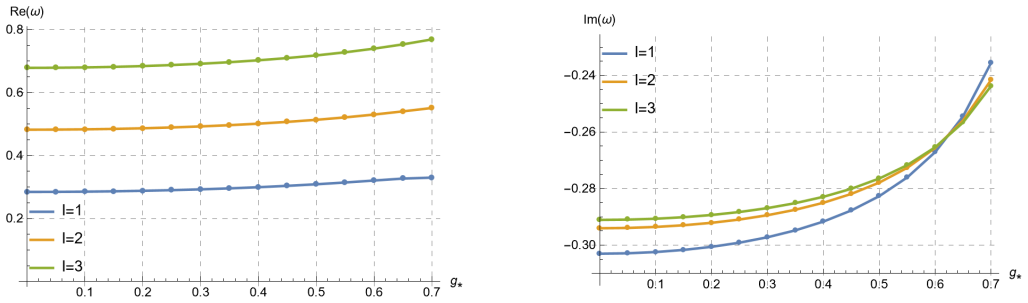
For massless scalar perturbations, the fundamental (n=0) and first-overtone (n=1) quasinormal frequencies of rotating Hayward black holes increase by only percent-level amounts as g grows (at g=0.7, real part +1.9%, imaginary +4.1% for l=1, m=1; for n=1, +2.8% and +3.7%), while rotating Bardeen black holes show ten-percent-level shifts (at g*=0.7, fundamental real part +13%, imaginary +19%; n=1 real +16%, imaginary +19%). Bardeen n=1 real parts are non-monotonic in g*, rising to a maximum near g*=0.744 and then decreasing slightly, whereas imaginary parts keep increasing. Tables of corotating and counterrotating equatorial Lyapunov exponents satisfy Im(omega)=lambda(n+1/2) at the one-thousandth level for m=±l eikonal modes, and shadow radii reconstructed from n=1 real parts agree with closed photon orbit calculations.
Load-bearing premise
The matrix method with N=20 grid points is assumed to give converged quasinormal frequencies for all reported parameter values, including Bardeen near g*=0.744 where the n=1 real part reverses its monotonic trend; the paper benchmarks the method against Kerr but gives no convergence study for the regular cases.
Editorial extensions
If this is right
- Scalar ringdown observations of a rotating Hayward black hole would look almost Kerr-like, with deviations below five percent in frequency and decay rate for allowed g.
- For rotating Bardeen black holes, deviations grow to roughly 13–19 percent at the upper end of g*, making high-g* Bardeen more distinguishable from Kerr by scalar QNM measurements.
- The first overtone obeys the eikonal geodesic correspondence just as the fundamental mode does, so overtone ratios can be used to test the photon-ring interpretation.
- The non-monotonic dependence of the Bardeen n=1 real part on g* offers a potential signature of the regularizing charge, if the trend is confirmed.
- Shadow radii inferred from n=1 QNM real parts match closed photon orbits, extending the shadow-ring connection to overtones.
Reading between the lines
- If the percent-level closeness to Kerr survives for gravitational perturbations—which the paper does not compute—regular rotating black holes would be nearly degenerate with Kerr in ringdown observables, making the high-g* Bardeen case the most promising target for distinguishing regularity.
- A time-domain evolution code, not used in the paper, could independently check the matrix-method frequencies near the Bardeen turnaround; if it confirms the non-monotonicity, the reversal becomes a sharper probe of g* than the absolute shift.
- The eikonal correspondence verified here suggests that for lower multipoles, deviations from the geodesic prediction encode finite-l corrections and could be fitted to constrain g and g* simultaneously with spin.
- The identical printed corotating and counterrotating Lyapunov tables for Bardeen look like an error; recalculating the counterrotating branch from the lower sign in Eq. (18) would either confirm an unexpected symmetry or remove the counterrotating verification in Table IX.
Signed reviews
Editorial analysis
A structured set of objections, weighed in public.
Referee Report
Summary. The paper studies massless scalar quasinormal modes (QNMs) of rotating Hayward and Bardeen regular black holes, computing the fundamental and first-overtone frequencies with a third-order WKB method and a matrix method. It also computes corotating and counterrotating Lyapunov exponents of equatorial null circular geodesics, checks the eikonal connection between QNM imaginary parts and Lyapunov exponents, and compares shadow radii obtained from n=1 QNM real parts with those from closed photon orbits. The central claims are that Hayward QNMs differ from Kerr at the percent level, Bardeen QNMs at the ten-percent level, and that the eikonal QNM/null-geodesic correspondence, including for first overtones, is explicitly verified for both families.
Significance. If the numerical results are correct, the matrix-method frequencies for these regular black holes are a useful new dataset, and the paper provides a concrete check of the eikonal QNM/geodesic correspondence beyond Kerr. The validation of the matrix method against Leaver's continued-fraction results for Kerr to roughly 1e-6 is a genuine strength, as is the explicit presentation of corotating and counterrotating Lyapunov exponents for both models. However, the duplicated Bardeen tables and the absence of a convergence study for the regular cases mean that part of the central verification, especially for counterrotating Bardeen modes, is not established as written.
major comments (4)
- [Section 2, Tables III and IV] Table IV, labeled "Counterrotating Lyapunov exponents" for the Bardeen black hole, is numerically identical to Table III, the corotating table, for every listed (a, g*). This cannot be a symmetry of Eq. (20). With d = a ± s where s = sqrt(r_c^4/(2 f(r_c) - r_c f'(r_c))), Eq. (20) contains d^2 = a^2 + s^2 ± 2 a s and the denominator term 2 a (a-d) r_c f(r_c) = ∓ 2 a s r_c f(r_c), so the two branches generally give different λ^2; no cancellation is proved. The Hayward Tables I and II show the expected corotating/counterrotating split, confirming that the Bardeen duplication is not generic behavior. Since Table IX, the only support for the counterrotating Bardeen eikonal check, is built directly on Table IV, that branch of the central claim is not supported by the paper as written. The authors must recompute Table IV and revise Table IX accordingly.
- [Section 3.2.2 and Section 4] No convergence study is presented for the matrix method in the regular black hole cases. Section 3.2.2 states that N = 20 grid points are used, and Table V validates the method only for the l = 1 fundamental Kerr mode against Leaver. The paper's quantitative claims, however, include n = 1 overtones, l up to 12, and Bardeen parameters close to the extremal value g* = 0.744 where the n = 1 real part reverses its monotonic trend. A shift of the numerical roots with N could change the percent-level comparisons in Section 5. The authors should add a convergence check (for example, N = 20, 25, 30 for representative Hayward and Bardeen cases) to establish that the reported frequencies are converged.
- [Section 6 versus Section 4.2] The conclusion states that "the massless scalar QNMs of the two rotating regular black holes have at most percent-level increase in comparison with the Kerr black hole case," but Section 4.2 reports that the Bardeen real part with g* = 0.7 increases by about 13% and the imaginary part by about 19%, and the abstract itself quotes a "ten-percent-level increase" for Bardeen. This inconsistency must be corrected; as written, the conclusion misstates the main quantitative result for the Bardeen model.
- [Section 5, Figure 11] The verification of the real-part/shadow-radius connection for n = 1 QNMs is presented only as a visual comparison in Fig. 11, with no numerical errors or deviations reported. Given that the abstract claims the connection is "explicitly verified," a quantitative measure — for example, the maximum or average relative difference between the two methods for each m value — should be provided, rather than relying on visual agreement.
minor comments (4)
- [Introduction and Section 3.2] There are typographical errors: "Layapunov" in the Introduction should be "Lyapunov," and "matirx" in Section 3.2.2 should be "matrix."
- [Equation (23)] Equation (23) appears garbled: the denominator contains "csc^2 σ" where csc^2 θ is presumably intended, and the notation is hard to follow. Please rewrite this equation and the surrounding definitions clearly.
- [References] Reference [69] duplicates reference [58] (the same Iyer and Will paper appears twice with different formatting). Please consolidate the bibliography.
- [Caption of Figure 11] The caption of Fig. 11 has grammatical issues ("are show in lines" / "are show in dots") and should be rewritten.
Circularity Check
No circularity: QNM spectra and null-geodesic quantities are computed independently from the same metric, and the eikonal checks are genuine comparisons rather than fitted relations.
full rationale
The paper's central claim is an eikonal correspondence check between massless scalar quasinormal-mode frequencies and equatorial null-geodesic Lyapunov exponents and shadow radii for rotating Hayward and Bardeen black holes. The two sides of the check are produced by separate computations: the QNMs come from solving the Klein-Gordon equation via the matrix method and WKB method (Section 3, Section 4), while the Lyapunov exponents come from the effective potential of null geodesics (Section 2, Eqs. (17)-(20)). The comparison in Tables VI-IX is a direct numerical substitution into Eq. (50), with deviations quoted as relative differences; no parameter is fitted to force agreement. The matrix method is attributed to the authors' own prior work [65], but it is an implementation tool, and the method is benchmarked against Leaver's continued-fraction results for Kerr in Table V, so the self-citation is not load-bearing for the physical claim. The shadow-radius comparison in Section 5 similarly uses Eq. (51), a formula taken from [57], applied to the independently computed real parts of the n=1 QNMs, and compares against shadow radii computed from closed photon orbits via Eqs. (53)-(54); again, this is a check, not a construction. No equation in the paper defines a predicted quantity in terms of the target quantity, and no fitted parameter is renamed as a prediction. The observation that Tables III and IV are numerically identical is a data-integrity concern for the counterrotating Bardeen branch, but it is not a circularity: the table duplication does not make the QNM calculation depend on the Lyapunov calculation or vice versa. Overall, the derivation is self-contained against external benchmarks and the eikonal comparisons have independent content, so the circularity score is 0.
Assumptions & free parameters
assumptions (5)
- domain assumption The rotating Hayward and Bardeen black hole metrics in Eqs. (1)-(3) are taken as valid spacetimes from ref. [47]
- domain assumption The null circular geodesic conditions V_r=V'_r=0 and the Lyapunov formula lambda^2 = V''_r/(2 tdot^2) of ref. [43] apply to the equatorial plane of these stationary spacetimes
- standard math The scalar field separates as Phi = e^{-i omega t} e^{i m phi} S(theta) R(r) with the separation constant of Eq. (27)
- domain assumption The eikonal correspondence Im(omega) = lambda (n+1/2) and the shadow radius formula Eq. (51) are valid for these spacetimes
- domain assumption Purely ingoing and outgoing boundary conditions at horizon and infinity select the QNM spectrum, and the ansatz in Eqs. (28)-(29) captures this
Cite this review
Pith. "Pith review of Scalar quasinormal modes, Lyapunov exponents and radii of null geodesics of rotating regular black holes." pith.science (2026). https://pith.science/paper/MHAUXYVW
@misc{pith2026250421460,
  author       = {Pith},
  title        = {Pith review of: Scalar quasinormal modes, Lyapunov exponents and radii of null geodesics of rotating regular black holes},
  year         = {2026},
  howpublished = {\url{https://pith.science/paper/MHAUXYVW}},
  note         = {Machine review of arXiv:2504.21460}
}
abstract
The quasinormal modes of massless scalar field in rotating Bardeen and Hayward regular black holes are studied. The fundamental quasinormal modes and $n=1$ first overtone quasinormal modes are calculated with two numerical methods, i.e. WKB method and matrix method. Impacts of model parameters on the quasinormal modes are also discussed. It is found that the quasinormal modes in rotating Hayward black hole have just percent-level increase compared with that in the Kerr black hole case due to the deviation parameter $g$, while there is ten-percent-level increase for the quasinormal modes in the rotating Bardeen black hole due to $g_*$. It is also found that the monotonicity of fundamental and $n=1$ quasinormal modes in the rotating Bardeen black hole is different. The corotating and counterrotating Lyapunov exponents of the equatorial null circular geodesics in the two rotating black holes are also calculated. Then, the connection between the imaginary parts and real parts of the eikonal quasinormal modes, particularly the first overtone ones, and the properties of the null geodesics in the two rotating regular black holes are explicitly verified.
Figures


Figures from the paper (8 more)




Reference graph
Works this paper leans on
-
[57]
In this section, we will check this connection by using our numerical results of the QNMs
has also been achieved. In this section, we will check this connection by using our numerical results of the QNMs. First, let’s check the connection between the imaginary parts of the scalar QNMs and the Lyapunov exponents. The Lyapunov exponents of circular null geodesics in the equatorial plane of the two black holes are calculated in Section
-
[1]
INTRODUCTION Quasinormal modes (QNMs) play important roles in the study of dissipative systems. QNMs are complex-frequency vibrations with the real part indicating frequency and the imaginary part representing decay rate [1–4]. In general relativity, QNMs describe how black holes respond to perturbations, and their spectra depend on black hole parameters ...
work page Pith review arXiv 2025
-
[2]
ROT A TING REGULAR BLACK HOLES AND L Y APUNOV EXPONENTS In this section, we give a brief introduction of the two regular black holes we are interested, i.e., the rotating Hayward black hole and rotating Bardeen black hole proposed in [47]. The metrics of the two black holes can be expressed in the following form ds2 =−(1− 2f(r) Σ )dt2 + Σ ∆dr2 + Σdθ2− 4a ...
1913
-
[3]
Then, we introduce the two methods for the calculation of scalar QNMs, i.e
EQUA TIONS OF MOTION AND METHODS FOR CALCULA TING THE QNMS In this section, we first consider the equation of motion of massless scalar in rotating Hayward and Bardeen black holes. Then, we introduce the two methods for the calculation of scalar QNMs, i.e. the third-order WKB method and matrix method. 3.1. Klein-Gordon equation The equation of motion of a...
-
[4]
We can see that the results calculated with matrix method have enough accuracy, while the results from WKB method are less accurate
NUMERICAL RESUL TS OF THE QNMS In order to validate the two methods used in this work, we compare the fundamental (n = 0) massless scalar QNMs in Kerr black hole calculated with our methods and that calculated with Leaver’s continued fraction method [70] in Table V. We can see that the results calculated with matrix method have enough accuracy, while the ...
-
[5]
QNMS, L Y APUNOV EXPONENTS AND SHADOW RADII It is known that there is a connection between the QNMs of black holes in the eikonal limit and the unstable null geodesics of the black holes. For the spherical,stationary and asymptotic flat black holes, the real and imaginary parts of the QNMs are multiple of the angular frequency and Lyapunov exponent of the...
-
[6]
We calculate the QNMs with two methods: WKB method and matrix method
CONCLUSION In this work, the fundamental and n = 1 QNMs of massless scalar field in rotating Hayward and Bardeen regular black holes are studied. We calculate the QNMs with two methods: WKB method and matrix method. Since the accuracy of matrix method is higher, most numerical QNM results shown in the Tables and Figures are based on matrix method. We disc...
-
[7]
C. D. Capano, M. Cabero, J. Westerweck, J. Abedi, S. Kastha, A. H. Nitz, Y.-F. Wang, A. B. Nielsen, and B. Krishnan, Phys. Rev. Lett. 131, 221402 (2023), 2105.05238. 21
arXiv 2023
Show all 87 references
-
[8]
The corotating and counterrotating Lyapunov exponents in rotating Bardeen black holes are shown in Table III and Table IV, respectively
The corotating and counterrotating Lyapunov exponents in rotating Hayward black holes are shown in Table I and Table II, respectively. The corotating and counterrotating Lyapunov exponents in rotating Bardeen black holes are shown in Table III and Table IV, respectively. The c...
-
[10]
Comparison between counterrotating Lyapunov exponents and imaginary parts of QNMs in rotating Hayward black holes
−Im(ωWKB) −Im(ωMM) δ(%) 0.1 0.095864 0.096038 0.095884 0.021 0.287591 0.288292 0.287830 0.083 0.2 0.095791 0.095966 0.095812 0.022 0.287372 0.288074 0.287616 0.085 0.3 0.095590 0.095767 0.095613 0.024 0.286769 0.287476 0.287022 0.088 0.4 0.095189 0.095370 0.095216 0.028 0.2855...
-
[12]
Comparison between corotating Lyapunov exponents and imaginary parts of QNMs in rotating Bardeen black holes
−Im(ωWKB) −Im(ωMM) δ(%) 0.1 0.095982 0.096138 0.096005 0.024 0.287945 0.288675 0.288276 0.115 0.2 0.095945 0.096101 0.095968 0.024 0.287836 0.288564 0.288164 0.114 0.3 0.095846 0.096000 0.095867 0.022 0.287538 0.288259 0.287859 0.112 0.4 0.095650 0.095800 0.095666 0.017 0.2869...
-
[13]
The connection between real parts of the fundamental QNMs and shadow radius in rotating Bardeen and Hayward black holes has been checked
to rotating regular black holes, and proposed a new formula to calculate the shadow radius with the real parts of the QNMs in rotating regular black holes. The connection between real parts of the fundamental QNMs and shadow radius in rotating Bardeen and Hayward black holes h...
-
[15]
Comparison between counterrotating Lyapunov exponents and imaginary parts of QNMs in rotating Bardeen black holes
−Im(ωWKB) −Im(ωMM) δ(%) 0.1 0.095710 0.0958863 0.095732 0.023 0.287130 0.287836 0.287374 0.085 0.2 0.095190 0.0953734 0.095218 0.030 0.285570 0.286291 0.285828 0.090 0.3 0.094220 0.0944169 0.094260 0.042 0.282660 0.283411 0.282942 0.100 0.4 0.092596 0.092816 0.092656 0.065 0.2...
-
[16]
−Im(ωWKB) −Im(ωMM) δ(%) λ(n + 1
-
[17]
−Im(ωWKB) −Im(ωMM) δ(%) 0.1 0.095912 0.096066 0.095933 0.021 0.287735 0.288460 0.288059 0.113 0.2 0.095676 0.095826 0.095692 0.017 0.287027 0.287734 0.287331 0.106 0.3 0.095247 0.095389 0.095253 0.007 0.285740 0.286414 0.286007 0.094 0.4 0.094559 0.094687 0.094550 -0.010 0.283...
-
[18]
C. V. Vishveshwara, Nature 227, 936 (1970)
1970
-
[19]
Berti, V
E. Berti, V. Cardoso, and A. O. Starinets, Class. Quant. Grav. 26, 163001 (2009), 0905.2975
2009 arXiv
-
[20]
K. D. Kokkotas and B. G. Schmidt, Living Rev. Rel. 2, 2 (1999), gr-qc/9909058
1999 arXiv
-
[21]
R. A. Konoplya and A. Zhidenko, Rev. Mod. Phys. 83, 793 (2011), 1102.4014
2011 arXiv
-
[22]
Regge and J
T. Regge and J. A. Wheeler, Phys. Rev. 108, 1063 (1957)
1957
-
[23]
S. A. Teukolsky, Phys. Rev. Lett. 29, 1114 (1972)
1972
-
[24]
Jafarzade, M
K. Jafarzade, M. Kord Zangeneh, and F. S. N. Lobo, JCAP 04, 008 (2021), 2010.05755
2021 arXiv
-
[25]
P. V. P. Cunha and C. A. R. Herdeiro, Gen. Rel. Grav. 50, 42 (2018), 1801.00860
2018 arXiv
-
[26]
V. I. Dokuchaev and N. O. Nazarova, Usp. Fiz. Nauk 190, 627 (2020), 1911.07695
2020 arXiv
- [27]
-
[28]
M. Wang, S. Chen, and J. Jing, Commun. Theor. Phys. 74, 097401 (2022), 2205.05855
2022 arXiv
- [29]
- [30]
-
[31]
Cuadros-Melgar, R
B. Cuadros-Melgar, R. D. B. Fontana, and J. de Oliveira, Phys. Lett. B 811, 135966 (2020), 2005.09761
2020 arXiv
- [32]
- [33]
-
[34]
S. H. Hendi, S. N. Sajadi, and M. Khademi, Phys. Rev. D 103, 064016 (2021), 2006.11575
2021 arXiv
-
[35]
Jusufi, M
K. Jusufi, M. Amir, M. S. Ali, and S. D. Maharaj, Phys. Rev. D 102, 064020 (2020), 2005.11080
2020 arXiv
- [36]
-
[37]
Jusufi, M
K. Jusufi, M. Azreg-A¨ ınou, M. Jamil, S.-W. Wei, Q. Wu, and A. Wang, Phys. Rev. D 103, 024013 (2021), 2008.08450
2021 arXiv
-
[38]
Jusufi, M
K. Jusufi, M. Azreg-A¨ ınou, M. Jamil, and T. Zhu, Int. J. Geom. Meth. Mod. Phys. 19, 2250068 (2022), 2008.09115
2022 arXiv
-
[39]
Mondal, A
M. Mondal, A. K. Yadav, P. Pradhan, S. Islam, and F. Rahaman, Int. J. Mod. Phys. D 30, 2150095 (2021), 2009.03265
2021 arXiv
- [40]
- [41]
-
[42]
Ghasemi-Nodehi, M
M. Ghasemi-Nodehi, M. Azreg-A¨ ınou, K. Jusufi, and M. Jamil, Phys. Rev. D 102, 104032 (2020), 2011.02276
2020 arXiv
- [43]
-
[44]
J. A. V. Campos, M. A. Anacleto, F. A. Brito, and E. Passos, Sci. Rep. 12, 8516 (2022), 2103.10659
2022 arXiv
- [45]
-
[46]
M. A. Anacleto, J. A. V. Campos, F. A. Brito, and E. Passos, Annals Phys. 434, 168662 (2021), 2108.04998
2021 arXiv
- [47]
-
[48]
Liu, H.-X
T.-T. Liu, H.-X. Zhang, Y.-H. Feng, J.-B. Deng, and X.-R. Hu, Mod. Phys. Lett. A 37, 2250154 (2022), 2201.07580
2022 arXiv
-
[49]
R. A. Konoplya, A. F. Zinhailo, J. Kunz, Z. Stuchlik, and A. Zhidenko, JCAP 10, 091 (2022), 2206.14714
2022 arXiv
-
[50]
C. Yu, D. Chen, and C. Gao, Nucl. Phys. B 983, 115925 (2022), 2207.06796
2022 arXiv
-
[51]
Lambiase, R
G. Lambiase, R. C. Pantig, D. J. Gogoi, and A. ¨Ovg¨ un, Eur. Phys. J. C83, 679 (2023), 2304.00183
2023 arXiv
-
[52]
Z. Yan, X. Zhang, M. Wan, and C. Wu, Eur. Phys. J. Plus 138, 377 (2023), 2304.07952
2023 arXiv
-
[53]
A. Das, A. Roy Chowdhury, and S. Gangopadhyay, Class. Quant. Grav. 41, 015018 (2024), 2306.00646
2024 arXiv
-
[54]
R. A. Konoplya and A. Zhidenko, Class. Quant. Grav. 40, 245005 (2023), 2309.02560
2023 arXiv
-
[55]
S. V. Bolokhov, Phys. Lett. B 856, 138879 (2024), 2310.12326
2024 arXiv
-
[56]
D. J. Gogoi and S. Ponglertsakul, Eur. Phys. J. C 84, 652 (2024), 2402.06186
2024 arXiv
- [58]
-
[59]
Chaudhary, A
S. Chaudhary, A. Jawad, K. Jusufi, and M. Yasir, Mod. Phys. Lett. A 36, 2150137 (2021)
2021
-
[60]
Cardoso, A
V. Cardoso, A. S. Miranda, E. Berti, H. Witek, and V. T. Zanchin, Phys. Rev. D 79, 064016 (2009), 0812.1806
2009 arXiv
-
[61]
M. D. Johnson et al., Sci. Adv. 6, eaaz1310 (2020), 1907.04329
2020 arXiv
-
[62]
S. Giri, H. Nandan, L. K. Joshi, and S. D. Maharaj, Eur. Phys. J. Plus 137, 181 (2022), 2204.09006
2022 arXiv
- [63]
- [64]
-
[65]
Torres (2022), 2208.12713
R. Torres (2022), 2208.12713
2022
-
[66]
C. Lan, H. Yang, Y. Guo, and Y.-G. Miao, Int. J. Theor. Phys. 62, 202 (2023), 2303.11696. 22
2023 arXiv
-
[67]
J. M. Bardeen, in Proceedings of the Fifth International Conference on General Relativity and Gravitational Physics (Tbilisi State University, Tbilisi, USSR, 1968), p. 174, uSSR
1968
-
[68]
S. A. Hayward, Phys. Rev. Lett. 96, 031103 (2006), URL https://link.aps.org/doi/10.1103/PhysRevLett.96.031103
2006 doi
-
[69]
Toshmatov, B
B. Toshmatov, B. Ahmedov, A. Abdujabbarov, and Z. Stuchlik, Phys. Rev. D 89, 104017 (2014), 1404.6443
2014 arXiv
- [70]
-
[71]
Middleton et al., Journal of Science Communication 23, N03 (2024), 2407.18638
H. Middleton et al., Journal of Science Communication 23, N03 (2024), 2407.18638
2024 arXiv
-
[72]
Akiyama et al
K. Akiyama et al. (Event Horizon Telescope), Astrophys. J. Lett. 930, L17 (2022), 2311.09484
2022 arXiv
-
[73]
B. K. Vishvakarma, D. V. Singh, and S. Siwach, Eur. Phys. J. Plus 138, 536 (2023), 2304.14754
2023 arXiv
- [74]
-
[75]
Iyer and C
S. Iyer and C. M. Will, Phys. Rev. D 35, 3621 (1987)
1987
-
[76]
Iyer, Phys
S. Iyer, Phys. Rev. D 35, 3632 (1987)
1987
-
[77]
Seidel and S
E. Seidel and S. Iyer, Phys. Rev. D 41, 374 (1990)
1990
-
[78]
Y. Yang, D. Liu, A. ¨Ovg¨ un, Z.-W. Long, and Z. Xu (2022), 2205.07530
2022 arXiv
- [79]
-
[80]
Lin, W.-L
K. Lin, W.-L. Qian, A. B. Pavan, and E. Abdalla, Mod. Phys. Lett. A 32, 1750134 (2017), 1703.06439
2017 arXiv
- [81]
- [82]
-
[83]
J. M. Bardeen, W. H. Press, and S. A. Teukolsky, Astrophys. J. 178, 347 (1972)
1972
-
[84]
R. A. Konoplya, Z. Stuchl´ ık, and A. Zhidenko, Phys. Rev. D 97, 084044 (2018), 1801.07195
2018 arXiv
-
[85]
W. H. Press and S. A. Teukolsky, Astrophys. J. 185, 649 (1973)
1973
-
[86]
Iyer and C
S. Iyer and C. M. Will, Phys Rev D Part Fields 35, 3621 (1987)
1987
-
[87]
R. A. Konoplya and A. Zhidenko, Phys. Rev. D 73, 124040 (2006), gr-qc/0605013
2006 arXiv
-
[88]
Ferrari and B
V. Ferrari and B. Mashhoon, Phys. Rev. D 30, 295 (1984)
1984
-
[89]
H. Yang, D. A. Nichols, F. Zhang, A. Zimmerman, Z. Zhang, and Y. Chen, Phys. Rev. D 86, 104006 (2012), 1207.4253
2012 arXiv
-
[90]
Y. Guo, H. Xie, and Y.-G. Miao, Phys. Lett. B 855, 138801 (2024), 2402.10406
2024 arXiv
Reviewed August 16, 2026 · model on record in the stance chip above.
Discussion (0). Continue with ORCID to comment.