REVIEW 3 major objections 4 minor 82 references
Pressure and strain effects on the $\textit{ab initio}$ $GW$ electronic structure of La$_3$Ni$_2$O$_7$
T0 review · 3 major / 4 minor · reviewed 2026-08-16 · deepseek-v4-flash
Pith's one-line read The paper argues that GW correlations, without any Hubbard U, remove the gamma hole pocket from the Fermi surface of La3Ni2O7 and pull a La-5d band down to self-dope near 14 GPa.
desk verdict Honest, carefully documented G0W0 study whose central no-gamma Fermi-surface claim at 29.5 GPa hinges on a Fermi-level method choice the paper itself shows to be ambiguous. read the letter →
The pith
A machine-rendered reading of the paper's core claim, the machinery that carries it, and where it could break.
The reading
What carries the argument
The central object is the one-shot GW approximation (G0W0) to the many-body self-energy, applied on top of PBE-DFT with a Godby-Needs plasmon-pole model and Wannier interpolation of 67 projected Wannier functions. The G0W0 quasiparticle energies, not Kohn-Sham eigenvalues, are treated as the physical excitation energies comparable to ARPES. The argument depends on the difference between DFT and GW Fermi surfaces: correlations lower the Ni-3dz2 band and the La-5dx2-y2 band by different amounts, changing the Fermi-surface topology. The paper also uses band-projected orbital characters and quasiparticle spectral weight Z to identify the La-5d band and measure correlation strength, with Z dropping to about 0.67 on Ni-3d states.
What would settle it
An ARPES experiment on bulk La3Ni2O7 under 29.5 GPa that resolves the Brillouin-zone corner would settle the main claim: observing a gamma hole pocket at the Fermi level would contradict the central Fermi-surface topology. A complementary check is neutron diffraction that confirms the experimental XRD oxygen positions, which would make the predicted La-5d Fermi surface an artifact.
Extended reading notes
Core claim
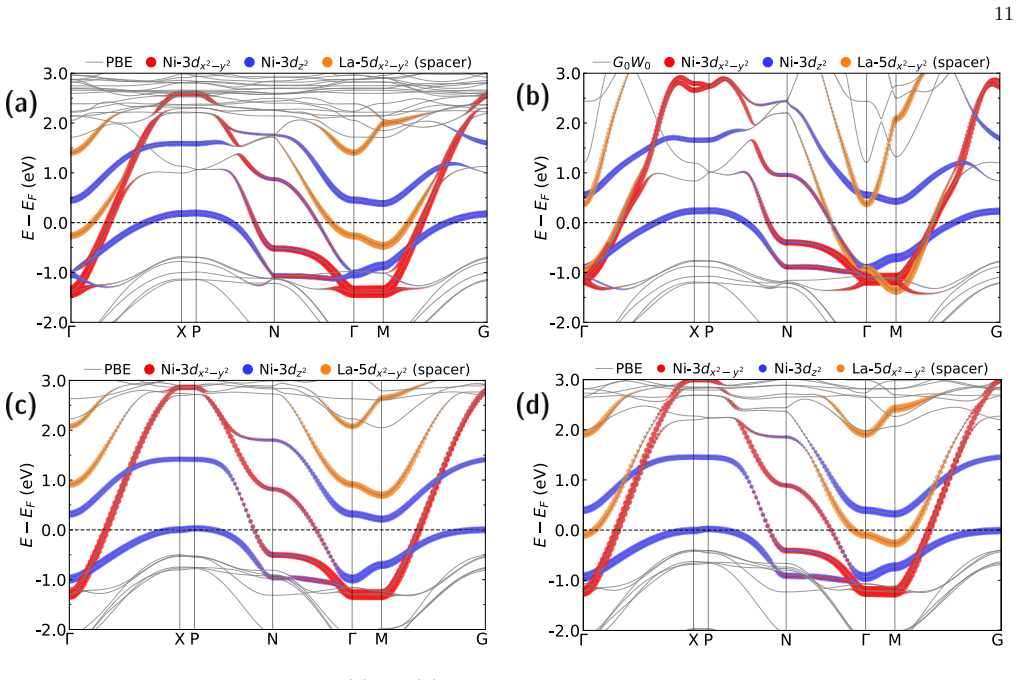
At the one-shot G0W0 level, correlation effects shift the lower Ni-3dz2 band down by about 70 to 80 meV along the X-P direction, enough to remove the gamma hole pocket from the Fermi level. The resulting Fermi surface has only the cuprate-shaped beta sheet and the nickelate-specific alpha cylinder, both of Ni eg character and effectively 1D, in agreement with ARPES. The same calculation lowers the La-5dx2-y2 band of the spacer atoms by about 0.7 eV at the M point, leaving an indirect gap of only 30 meV between the Ni-3dz2 top of valence and the La-5dx2-y2 bottom of conduction at 29.5 GPa. Because correlations and pressure act in the same direction, this La band crosses the Ni-3dz2 bands near 14 GPa and would begin to occupy states on La atoms, an effective self-doping of the NiO2 planes. The paper concludes that the ab initio GW electronic structure already matches experiment without Hubbard U or strongly correlated physics.
Load-bearing premise
The load-bearing premise is that the Fermi level at 29.5 GPa is correctly fixed by the bisection method at T_s = $10^{-4}$ Ha; the alternative DOS-integration method puts it 87 meV lower and reintroduces the gamma hole pocket, and the indirect gap of 30 meV is below the stated 100 meV uncertainty.
Editorial extensions
If this is right
- If the paper is correct, the gamma hole pocket does not exist at the Fermi level in bulk La3Ni2O7 at 29.5 GPa, so pairing models that rely on that pocket need revision.
- The La-5dx2-y2 band is a low-energy degree of freedom that effective Ni-eg models omit; it becomes occupied above about 30 GPa, self-doping the NiO2 planes.
- At 14 GPa, where superconductivity appears, the La-5dx2-y2 band crosses the upper Ni-3dz2 band, making the spacer band part of the low-energy physics at the onset.
- The epitaxially strained thin-film case is electronically similar to bulk at roughly 14 GPa, so in-plane strain and pressure tune the same low-energy features.
- The interlayer dz2 gap that enters some proposed pairing scenarios is left essentially unchanged by GW in this calculation, so that scenario survives.
- The ideal no-gamma, no-lambda Fermi surface is a narrow window; defects or small doping shifts could open either pocket in a real sample.
Reading between the lines
- As an editorial inference, if the gamma pocket is truly absent, theoretical models that anchor pairing on the dz2 hole pocket may need to be re-examined; the paper itself does not make that claim.
- The 14 GPa crossing of the La-5d band is suggestive but could be coincidence; a targeted extension would be to include this band explicitly in spin-fluctuation pairing calculations.
- Because the Fermi topology changes radically with tiny internal atomic displacements, a neutron-diffraction determination of the oxygen positions could distinguish the predicted Fermi surface from the artifact-laden XRD structure.
- A testable extension would be to track the predicted self-doping onset with pressure using optical or Hall measurements, since the paper identifies the La band occupation as the mechanism but does not compute transport signatures.
Signed reviews
Editorial analysis
A structured set of objections, weighed in public.
Referee Report
Summary. The manuscript presents one-shot G0W0 calculations of the electronic structure of La3Ni2O7 at 29.5 GPa, at ambient and other pressures, and under biaxial strain. The central claim is that GW quasiparticle corrections shift the lower Ni-3d_z2 band down by about 70–80 meV, removing the gamma hole pocket from the Fermi surface without introducing any Hubbard U, so that the Fermi surface consists only of the cuprate-like beta sheet and the nickelate-specific alpha cylinder. A second, related claim is that the La-5d_{x^2-y^2} band is pulled down by correlations and pressure, approaching or crossing the Ni-3d_z2 bands near the pressure onset of superconductivity, leading to self-doping. The authors compare their results with ARPES data and with previous DFT, hybrid-functional, DMFT, and GW studies, and provide detailed appendices on structural sensitivity, Fermi-level determination, orbital character projections, and convergence.
Significance. If the central Fermi-surface topology is robust, the paper would be an important contribution: it would show that a parameter-free one-shot G0W0 calculation already captures the experimentally observed absence of the gamma pocket, and it would identify the La-5d_{x^2-y^2} band as a low-energy player relevant for pairing models. The work has real strengths: no fitted Hubbard U or hybrid mixing parameter enters the self-energy; the authors report convergence tests for the number of bands (Appendix G); they provide a detailed and transparent comparison of Fermi-level determination methods (Appendix D); and they carefully discuss the strong sensitivity to internal atomic coordinates (Appendix B). The comparison with ARPES is a useful benchmark. However, the central no-gamma topology is not shown to be robust with respect to the method used to compute the Fermi level, and the paper itself documents that a different standard choice changes the topology qualitatively. That issue is load-bearing for the main conclusion, so the paper needs additional work before the central claim can be accepted as established.
major comments (3)
- [Appendix D and Figs. 1b, 1d] The claim that at 29.5 GPa the G0W0 Fermi surface has no gamma pocket and no lambda pocket depends on the choice of the Fermi level from the bisection method at T_s = 10^-4 Ha. Appendix D shows that the DOS-integration method places E_F 87 meV lower than the T_s = 10^-2 bisection value and 48 meV lower than the adopted T_s = 10^-4 value, which reintroduces the gamma hole pocket and removes the lambda electron pocket. Because the indirect gap is only 30 meV and the paper states a 100 meV GW accuracy, the no-gamma result is not robust to this standard methodological choice. I ask the authors to quantify the occupancy-consistent E_F and its uncertainty more rigorously, to show the Fermi surfaces obtained with each E_F method with the same smearing, and to state clearly which of their conclusions depend only on E_F-insensitive features such as the robust alpha and beta sheets.
- [Section III A 2 and Fig. 4b] The pressure-evolution plot in Fig. 4b assigns the crossing of the La-5d_{x^2-y^2} band with the Ni-3d_z2 bands to 14 GPa, but for the 14 and 40 GPa calculations the Fermi level was not actually computed; it was estimated by a linear interpolation from calculations where E_F was available, as stated in the figure caption. Since the pressure onset of superconductivity at 14 GPa is one of the paper's notable coincidences, this estimate needs an explicit uncertainty and ideally a direct E_F calculation for those pressures, because the 30 meV indirect gap at 29.5 GPa already lies below the stated GW accuracy.
- [Appendix B and Section II B] The central Fermi-surface results rely on the choice of PBE-relaxed internal atomic coordinates for the 29.5 GPa structure, while Appendix B shows that using experimental XRD internal positions produces a fake La-5d cylindrical Fermi sheet at both DFT and GW levels. This is not merely a minor structural detail: the no-gamma, no-lambda topology at 29.5 GPa is defined relative to the relaxed coordinates, and the physical coordinates are not known to the required precision. The authors should state more explicitly how this structural uncertainty limits the low-energy predictions, and whether any conclusion about self-doping or the 14 GPa crossing survives across the range of plausible internal-position choices.
minor comments (4)
- [Section II A] The sentence describing a 'shift of 0.1 eV to avoid poles/divergences' is not fully specified; please state whether this shift is applied to the Green's function or to the self-energy evaluation and at which frequencies.
- [Fig. 1d caption] The caption says that dot width is proportional to orbital contribution, but in the printed figure many dots are difficult to distinguish; a supplementary color version or a zoomed inset around the Fermi level would improve readability.
- [Appendix D, Fig. 10] The Fermi-surface panels in Fig. 10 are labeled only by the method names in the header row; please add explicit labels to each panel indicating which E_F value was used, since the difference between the T_s = 10^-4 and T_s = 10^-2 bisection cases is central to the discussion.
- [Section III A 4] The statement that the 6x6x6 k-sampling is not precise enough to resolve possible Fermi arcs is useful, but it would be helpful to quantify the k-point spacing in energy units near the Fermi surface so readers can judge the limitation.
Circularity Check
No significant circularity: the GW electronic structure is computed from a parameter-free self-energy, and the central Fermi-surface claims are independent ab initio results compared with ARPES.
full rationale
The paper's derivation chain is self-contained rather than circular. The central claim—removal of the gamma hole pocket at 29.5 GPa—is obtained from one-shot G0W0 quasiparticle energies built on PBE starting points, with no fitted Hubbard U, no hybrid mixing parameter, and no adjustable parameter defined in terms of the target Fermi-surface topology. The gamma-pocket suppression is attributed to an explicit 70–80 meV downward GW shift of the lower Ni-3d_z2 band, and the resulting Fermi surface is then compared with ARPES as an external benchmark. The second load-bearing claim, that La-5d_x2-y2 is pulled down by correlations and pressure and crosses the Ni-3d_z2 bands near 14 GPa, is a reported band-position trend from the same parameter-free calculation, not a fit to the superconducting onset. Prior GW works by others (Christiansson et al. and You et al.) are cited as independent supporting calculations, and where they disagree, the paper reports the disagreement rather than suppressing it. The author self-citations present in the text—[8], [69], [72], and the unpublished structural reference [67]—concern peripheral comparisons (infinite-layer nickelate correlation shifts, 2D/3D character, structural data) and are not load-bearing premises of the main derivation; in particular, no uniqueness theorem is imported from the authors' prior work and no ansatz is smuggled in via self-citation. The Fermi-level ambiguity documented in Appendix D, where a DOS-integration method places E_F 87 meV lower and reintroduces the gamma pocket, is a genuine numerical sensitivity and a robustness caveat, but it is not circularity: the chosen bisection E_F at Ts=10^-4 Ha is not defined by the absence of the gamma pocket, the alternative is openly reported, and the uncertainty is stated as a quantitative margin rather than used to force the desired topology. Similarly, the internal-coordinate sensitivity of Appendix B is an acknowledged structural assumption, not a construction of the result from its conclusion. Because the main physical predictions are generated by a standard, parameter-free many-body method and are validated against independent experimental and computational benchmarks, no step reduces by definition or by self-citation to the paper's own inputs.
Assumptions & free parameters
free parameters (2)
- Fermi-level determination method =
Bisection at Ts = 10^-4 Ha gives -39 meV relative to Ts = 10^-2 Ha; DOS integration gives -87 meV
- GW pole shift =
0.1 eV
assumptions (5)
- domain assumption PBE exchange-correlation with norm-conserving PseudoDojo pseudopotentials (La 4f in valence) is a valid starting point for one-shot G0W0.
- domain assumption DFT-PBE-relaxed internal atomic positions are more physical than the experimental XRD positions at 29.5 GPa.
- domain assumption The I4/mmm tetragonal symmetry can be enforced at all considered pressures, including the fictitious 0 GPa phase.
- domain assumption The Fermi level from bisection at Ts = 10^-4 Ha is the correct Fermi level for the 29.5 GPa Fermi surface.
- domain assumption One-shot G0W0 with the Godby-Needs plasmon-pole model adequately captures the relevant correlations.
Cite this review
Pith. "Pith review of Pressure and strain effects on the $\textit{ab initio}$ $GW$ electronic structure of La$_3$Ni$_2$O$_7$." pith.science (2026). https://pith.science/paper/23HWAPLW
@misc{pith2026250421651,
  author       = {Pith},
  title        = {Pith review of: Pressure and strain effects on the $\textitab initio$ $GW$ electronic structure of La$_3$Ni$_2$O$_7$},
  year         = {2026},
  howpublished = {\url{https://pith.science/paper/23HWAPLW}},
  note         = {Machine review of arXiv:2504.21651}
}
abstract
The recent discovery of superconductivity in La$_3$Ni$_2$O$_7$ at a critical temperature above 80~K points to a non-conventional pairing mechanism in nickelates as in cuprates, possibly due to electronic correlations. We have calculated from first principles the electronic structure of La$_3$Ni$_2$O$_7$ under the effect of pressure and epitaxial strain including correlations by the $GW$ approximation to the many-body self-energy. We find that the Fermi surface is composed of a characteristic cuprate-shape sheet $\beta$ plus a nickelate-specific cylinder $\alpha$, both from Ni $e_g$ orbitals, with a non-negligible drop in the quasiparticle weight and an effective 1D character. This topology results from a delicate balance between the Ni-3$d_{z^2}$ hole pocket $\gamma$, which is suppressed by correlations, and an emerging La-5$d_{x^2-y^2}$ electron pocket induced by both correlation and pressure/strain effects and whose role at low energy has been neglected so far. Unlike cuprates, the electronic structure of La$_3$Ni$_2$O$_7$ is already correctly described from ab initio and in agreement with the experiment without the need to introduce Hubbard $U$ adjustable parameters or to invoke a strongly correlated physics.
Figures


Figures from the paper (14 more)




Reference graph
Works this paper leans on
-
[1]
the dominance of thed z2 orbital distinguishes La 3Ni2O7 from the infinite- layer nickelates or the cuprates,
Nie g Fermi surface sheets The Fermi level is dominated by bands with Ni-3d e g character. The DFT PBE Fermi surface consists of three sheets, labeledα,β, andγin previous literature [18]. Theαsheet is a large cylindrical sheet centered around Γ;βis the sheet with the characteristic shape of the cuprate Fermi surface; andγis a small hole pocket lo- cated a...
-
[2]
La-5d x2−y2 band lowering and self-doping Beside this important qualitative modification of the Fermi surface,GWcorrelation corrections induce an even more evident and quantitative change in the bandwidth of the 5d x2−y2 band contributed by the two La spacer atoms only (i.e., with no contribution by the La inner atom lying in between the NiO planes, see F...
-
[3]
Upper-lower Ni-3d z2 energy gap A feature of the electronic structure that is consid- ered of particular interest in relation to the emergence of superconductivity in La 3Ni2O7 is the energy difference between the upper and lower Ni-3dz2 bands. In the liter- ature they are often labeled as bonding- and antibonding (as we explain in App. I, we find that th...
work page 1965
-
[4]
J. Li, D. Peng, P. Ma, H. Zhang, Z. Xing, X. Huang, C. Huang, M. Huo, D. Hu, Z. Dong, X. Chen, T. Xie, H. Dong, H. Sun, Q. Zeng, H.-k. Mao, and M. Wang 10.48550/arXiv.2404.11369 (2025), arXiv:2404.11369
-
[5]
coordinates can strongly affect the resulting electronic structure
and the rest from a structural relaxation performed with theAbinitcode. coordinates can strongly affect the resulting electronic structure. The latter is then further modified by the variation of the lattice parameters under pressure which is fundamental to trigger superconductivity in La3Ni2O7. In our first attempt to calculate the DFT and theGW electron...
-
[6]
G. Zhou, W. Lv, H. Wang, Z. Nie, Y. Chen, Y. Li, H. Huang, W. Chen, Y. Sun, Q.-K. Xue, and Z. Chen 10.48550/arXiv.2412.16622 (2024), arXiv:2412.16622
-
[7]
Li and S
Z. Li and S. G. Louie, Phys. Rev. Lett.133, 126401 (2024)
2024
-
[8]
H. Sun, M. Huo, X. Hu, J. Li, Z. Liu, Y. Han, L. Tang, Z. Mao, P. Yang, B. Wang, J. Cheng, D.-X. Yao, G.-M. Zhang, and M. Wang, Nature621, 493 (2023)
2023
Show all 82 references
-
[9]
N. Wang, G. Wang, X. Shen, J. Hou, J. Luo, X. Ma, H. Yang, L. Shi, J. Dou, J. Feng, J. Yang, Y. Shi, Z. Ren, H. Ma, P. Yang, Z. Liu, Y. Liu, H. Zhang, X. Dong, Y. Wang, K. Jiang, J. Hu, S. Nagasaki, K. Kitagawa, S. Calder, J. Yan, J. Sun, B. Wang, R. Zhou, Y. Uwatoko, and J. C...
2024
-
[10]
Li, Y.-J
Q. Li, Y.-J. Zhang, Z.-N. Xiang, Y. Zhang, X. Zhu, and H.-H. Wen, Chin. Phys. Lett.41, 017401 (2024)
2024
-
[11]
Di Cataldo, P
S. Di Cataldo, P. Worm, J. M. Tomczak, L. Si, and K. Held, Nat. Commun.15, 3952 (2024)
2024
-
[12]
E. K. Ko, Y. Yu, Y. Liu, L. Bhatt, J. Li, V. Thampy, C.-T. Kuo, B. Y. Wang, Y. Lee, K. Lee, J.-S. Lee, B. H. Goodge, D. A. Muller, and H. Y. Hwang, Nature638, 935 (2025)
2025
- [13]
-
[14]
Ouyang, M
Z. Ouyang, M. Gao, and Z.-Y. Lu, npj Quantum Mater. 9, 80 (2024)
2024
-
[15]
Q. N. Meier, J. B. de Vaulx, F. Bernardini, A. S. Botana, X. Blase, V. Olevano, and A. Cano, Phys. Rev. B109, 184505 (2024)
2024
-
[16]
Nomura, M
Y. Nomura, M. Hirayama, T. Tadano, Y. Yoshimoto, 18 K. Nakamura, and R. Arita, Phys. Rev. B100, 205138 (2019), arXiv:1909.03942
2019 arXiv
- [17]
-
[18]
Z. Luo, X. Hu, M. Wang, W. W´ u, and D.-X. Yao, Phys. Rev. Lett.131, 126001 (2023)
2023
-
[19]
Y. Lee, X. Wei, Y. Yu, L. Bhatt, K. Lee, B. H. Goodge, S. P. Harvey, B. Y. Wang, D. A. Muller, L. F. Kourkoutis, W.-S. Lee, S. Raghu, and H. Y. Hwang, Nature Synthesis 10.1038/s44160-024-00714-2 (2025)
2025 doi
-
[20]
Z. Luo, B. Lv, M. Wang, W. W´ u, and D.-X. Yao, npj Quantum Mater.9, 61 (2024)
2024
-
[21]
Q.-G. Yang, D. Wang, and Q.-H. Wang, Phys. Rev. B 108, L140505 (2023)
2023
-
[22]
J.-Y. You, Z. Zhu, M. Del Ben, W. Chen, and Z. Li, npj Comput. Mater.11, 3 (2025)
2025
-
[23]
Nakata, D
M. Nakata, D. Ogura, H. Usui, and K. Kuroki, Phys. Rev. B95, 214509 (2017)
2017
-
[24]
For the thin film (bottom), using the LPafrom Koet al
- [25]
- [26]
-
[27]
Qu, D.-W
X.-Z. Qu, D.-W. Qu, J. Chen, C. Wu, F. Yang, W. Li, and G. Su, Phys. Rev. Lett.132, 036502 (2024)
2024
-
[28]
Yang, G.-M
Y.-f. Yang, G.-M. Zhang, and F.-C. Zhang, Phys. Rev. B 108, L201108 (2023)
2023
- [29]
-
[30]
Y. Shen, M. Qin, and G.-M. Zhang, Chin. Phys. Lett. 40, 127401 (2023)
2023
-
[31]
Sakakibara, N
H. Sakakibara, N. Kitamine, M. Ochi, and K. Kuroki, Phys. Rev. Lett.132, 106002 (2024)
2024
-
[32]
C. Lu, Z. Pan, F. Yang, and C. Wu, Phys. Rev. Lett. 132, 146002 (2024)
2024
-
[33]
Z. Liao, L. Chen, G. Duan, Y. Wang, C. Liu, R. Yu, and Q. Si, Phys. Rev. B108, 214522 (2023)
2023
-
[34]
Zhang, L.-F
Y. Zhang, L.-F. Lin, A. Moreo, T. A. Maier, and E. Dagotto, Nat. Commun.15, 2470 (2024)
2024
-
[35]
Kaneko, H
T. Kaneko, H. Sakakibara, M. Ochi, and K. Kuroki, Phys. Rev. B109, 045154 (2024)
2024
-
[36]
W. W´ u, Z. Luo, D.-X. Yao, and M. Wang, Sci. China Phys. Mech. Astron.67, 117402 (2024)
2024
-
[37]
Huang, Z
J. Huang, Z. D. Wang, and T. Zhou, Phys. Rev. B108, 174501 (2023)
2023
-
[38]
Jiang, Z
K. Jiang, Z. Wang, and F.-C. Zhang, Chin. Phys. Lett. 41, 017402 (2024)
2024
- [39]
-
[40]
Oh and Y.-H
H. Oh and Y.-H. Zhang, Phys. Rev. B108, 174511 (2023)
2023
-
[41]
Cao and Y.-f
Y. Cao and Y.-f. Yang, Phys. Rev. B109, L081105 (2024)
2024
-
[42]
Qin and Y.-f
Q. Qin and Y.-f. Yang, Phys. Rev. B108, L140504 (2023)
2023
- [43]
-
[44]
H. Yang, H. Oh, and Y.-H. Zhang, Phys. Rev. B110, 104517 (2024), arXiv:2309.15095
2024 arXiv
-
[45]
We can expect that any tiny perturbation of the sys- tem, e.g
as responsible for the suppression of charge order, thereby possibly favoring superconductivity. We can expect that any tiny perturbation of the sys- tem, e.g. doping, vacancies or defects, can drive the sys- tem to a qualitatively different electronic structure and Fermi surf...
-
[46]
D. A. Shilenko and I. V. Leonov, Phys. Rev. B108, 125105 (2023)
2023
-
[47]
Y.-H. Tian, Y. Chen, J.-M. Wang, R.-Q. He, and Z.-Y. Lu, Phys. Rev. B109, 165154 (2024)
2024
-
[48]
Liu, J.-W
Y.-B. Liu, J.-W. Mei, F. Ye, W.-Q. Chen, and F. Yang, Phys. Rev. Lett.131, 236002 (2023)
2023
- [49]
-
[50]
X. Chen, P. Jiang, J. Li, Z. Zhong, and Y. Lu, Phys. Rev. B111, 014515 (2025)
2025
-
[51]
Jiang, J
R. Jiang, J. Hou, Z. Fan, Z.-J. Lang, and W. Ku, Phys. Rev. Lett.132, 126503 (2024)
2024
-
[52]
Christiansson, F
V. Christiansson, F. Petocchi, and P. Werner, Phys. Rev. Lett.131, 206501 (2023)
2023
-
[53]
Zhang, L.-F
Y. Zhang, L.-F. Lin, A. Moreo, T. A. Maier, and E. Dagotto, Phys. Rev. B108, 165141 (2023)
2023
-
[54]
X.-W. Yi, Y. Meng, J.-W. Li, Z.-W. Liao, J.-Y. You, B. Gu, and G. Su, Phys. Rev. B110, L140508 (2024)
2024
-
[55]
J. Chen, F. Yang, and W. Li, Phys. Rev. B110, L041111 (2024)
2024
-
[56]
which did not find anyγpocket. Additionally, we ob- serve a nonnegligible drop in theGWquasiparticle spec- tral weight on the Ni-3dstates, bothe g andt 2g, so to configure a little departure from a Fermi liquid behav- ior. Finally, we have shown that not only correlations, but...
2022
- [57]
-
[58]
H.-X. Xu, Y. Xie, D. Guterding, and Z. Wang 10.48550/arXiv.2501.05254v1 (2025), arXiv:2501.05254v1
2025 doi
-
[59]
C. Xia, H. Liu, S. Zhou, and H. Chen, Nat. Commun. 16, 1054 (2025)
2025
-
[60]
Lechermann, S
F. Lechermann, S. B¨ otzel, and I. M. Eremin, Phys. Rev. Mat.8, 074802 (2024)
2024
-
[61]
Y. Wang, K. Jiang, Z. Wang, F.-C. Zhang, and J. Hu, Phys. Rev. B110, 205122 (2024)
2024
-
[62]
S. Ryee, N. Witt, and T. O. Wehling, Phys. Rev. Lett. 133, 096002 (2024)
2024
-
[63]
J. Yang, H. Sun, X. Hu, Y. Xie, T. Miao, H. Luo, H. Chen, B. Liang, W. Zhu, G. Qu, C.-Q. Chen, M. Huo, Y. Huang, S. Zhang, F. Zhang, F. Yang, Z. Wang, Q. Peng, H. Mao, G. Liu, Z. Xu, T. Qian, D.-X. Yao, M. Wang, L. Zhao, and X. J. Zhou, Nat. Commun.15, 4373 (2024), arXiv:2309.01148
2024 arXiv
- [64]
-
[65]
Gao 10.48550/arXiv.2502.19840 (2025), arXiv:2502.19840
Y. Gao 10.48550/arXiv.2502.19840 (2025), arXiv:2502.19840
2025 doi
-
[66]
Hedin, Phys
L. Hedin, Phys. Rev.139, A796 (1965)
1965
-
[67]
Strinati, H
G. Strinati, H. J. Mattausch, and W. Hanke, Phys. Rev. Lett.45, 290 (1980)
1980
-
[68]
M. S. Hybertsen and S. G. Louie, Phys. Rev. Lett.55, 1418 (1985)
1985
-
[69]
R. W. Godby, M. Schl¨ uter, and L. J. Sham, Phys. Rev. B35, 4170 (1987)
1987
-
[70]
J. P. Perdew, K. Burke, and M. Ernzerhof, Phys. Rev. Lett.77, 3865 (1996)
1996
-
[71]
Gonze, G.-M
X. Gonze, G.-M. Rignanese, M. Verstraete, J.-M. Beuken, Y. Pouillon, R. Caracas, F. Jollet, M. Tor- rent, G. Zerah, M. Mikami, P. Ghosez, M. Veithen, J.-Y. Raty, V. Olevano, F. Bruneval, L. Reining, R. Godby, G. Onida, D. R. Hamann, and D. C. Allan, Z. Kristall. 220, 558 (2005)
2005
-
[72]
van Setten, M
M. van Setten, M. Giantomassi, E. Bousquet, M. Ver- 19 straete, D. Hamann, X. Gonze, and G.-M. Rignanese, Comput. Phys. Commun.226, 39 (2018)
2018
-
[73]
R. W. Godby and R. J. Needs, Phys. Rev. Lett.62, 1169 (1989)
1989
-
[74]
Toulemondeet al., (2025), to be published
P. Toulemondeet al., (2025), to be published
2025
-
[75]
Hinuma, G
Y. Hinuma, G. Pizzi, Y. Kumagai, F. Oba, and I. Tanaka, Comput. Mater. Sci.128, 140 (2017)
2017
-
[76]
Olevano, F
V. Olevano, F. Bernardini, X. Blase, and A. Cano, Phys. Rev. B101, 161102 (2020)
2020
-
[77]
Verraes, T
D. Verraes, T. Braeckevelt, N. Bultinck, and V. V. Speybroeck 10.48550/arXiv.2502.19501v1 (2025), arXiv:2502.19501v1
2025 doi
-
[78]
Lee and W
K.-W. Lee and W. E. Pickett, Phys. Rev. B70, 165109(R) (2004)
2004
-
[79]
Bernardini, V
F. Bernardini, V. Olevano, and A. Cano, Phys. Rev. Res. 2, 013219 (2020), arXiv:1910.13269
2020 arXiv
- [80]
-
[81]
Souza, N
I. Souza, N. Marzari, and D. Vanderbilt, Physical Review B65, 035109 (2001)
2001
-
[82]
L¨ owdin, J
P. L¨ owdin, J. Chem. Phys.18, 365–375 (1950)
1950
Reviewed August 16, 2026 · model on record in the stance chip above.
Discussion (0). Continue with ORCID to comment.