REVIEW 3 major objections 6 minor 1 cited by
LLM-based Interactive Imitation Learning for Robotic Manipulation
T0 review · 3 major / 6 minor · reviewed 2026-08-16 · deepseek-v4-flash
Pith's one-line read An LLM can replace the human teacher in interactive imitation learning for robot manipulation, matching state-of-the-art results without human labor.
desk verdict Useful integration of LLM code policies with interactive feedback, but the headline claim of matching human teachers rests on an uncontrolled episode-budget comparison and a self-referential success signal. read the letter →
The pith
A machine-rendered reading of the paper's core claim, the machinery that carries it, and where it could break.
The reading
What carries the argument
The central mechanism is the CodePolicy: a Python program generated by hierarchical prompting (two levels, where a planner prompt breaks the task into steps and action and check functions implement each step), executed at 20 Hz to produce the LLM's preferred action from API-provided object positions and robot state. The similarity-based feedback rule (Eq. 4) converts this preferred action into either evaluative or corrective feedback; the weighted negative log-likelihood loss (Eqs. 7–8) trains the agent, and episodes exceeding a time limit are aborted with their state-action pairs excluded from learning. This machinery carries the argument by defining the teacher signal entirely from the LLM code without human involvement.
What would settle it
Construct a manipulation task where the LLM's CodePolicy is known to be wrong (e.g., it always aims for the microwave handle while any push on the door suffices, as the paper itself describes), train LLM-iTeach to completion, and check whether the agent's success rate stays at or below the LLM Teacher's. If the agent fails to exceed the teacher on this task and reproduces the handle-aiming behavior, the claim that evaluative feedback yields exploration gains beyond the teacher is falsified; the same holds if replacing the LLM's feedback with an oracle that labels actions by true task progress changes the outcome.
Extended reading notes
Core claim
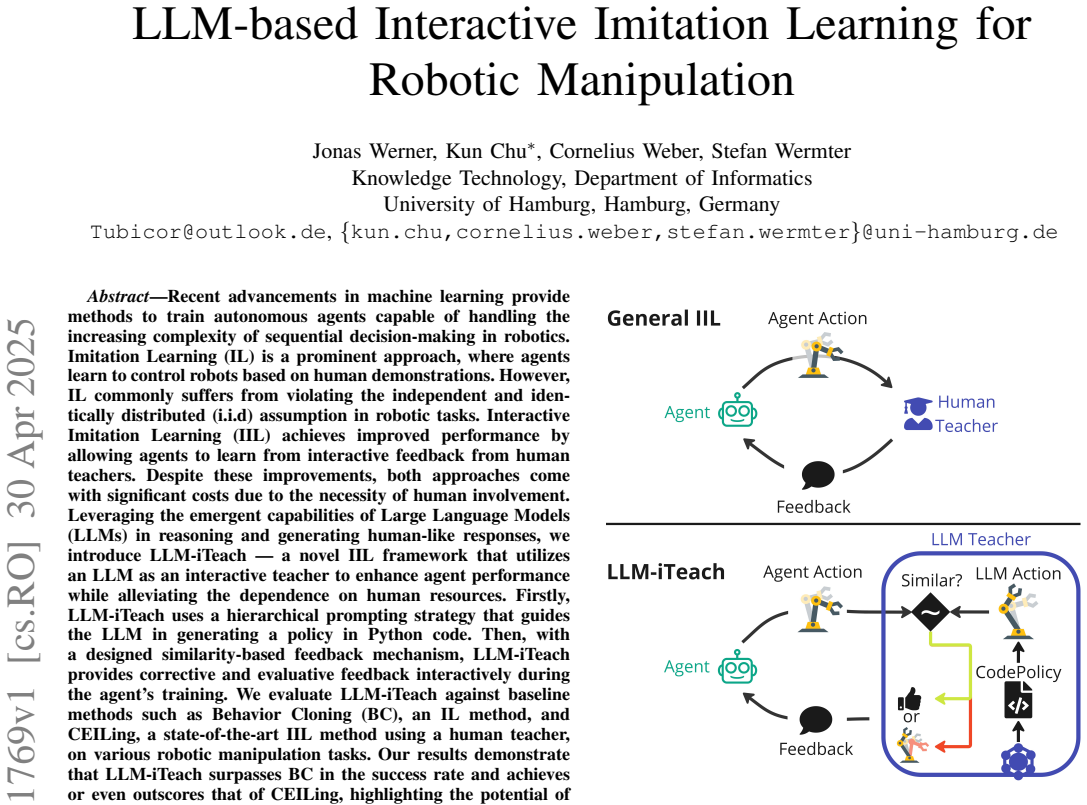
The central claim is that an LLM, prompted hierarchically to emit an executable policy, can serve as the teacher in interactive imitation learning and teach a stochastic policy agent to solve robotic manipulation tasks as effectively as a human teacher (CEILing baseline) and better than behavior cloning. The teaching signal is derived from a similarity check: if the angle between the agent's action and the CodePolicy's action is below threshold $\beta$, evaluative 'good' feedback is given; otherwise the CodePolicy's action replaces the agent's action. With warm-start demonstrations (10 from the LLM teacher) and a weighting scheme that upweights corrected state-action pairs, LLM-iTeach achieves 93±3 percent success on four tasks at 400 episodes, exceeding CEILing's reported 91±8 percent at 100 episodes; ablations show both feedback types are needed and $\beta = 20^\circ$ is best. The paper also shows that the LLM teacher lacks physical and inverse-kinematics knowledge, causing failures in tasks like CloseMicrowave, yet the learned agent still outperforms the teacher through evaluative-feedback-driven exploration.
Load-bearing premise
The entire training signal rests on the assumption that the LLM-generated CodePolicy's actions are good enough to serve as the standard of correctness; if the CodePolicy acts wrongly, the agent receives positive feedback for matching that wrong behavior.
Editorial extensions
If this is right
- Interactive imitation learning can be run at scale without human supervision, limited only by compute and API cost.
- New manipulation tasks can be added by writing a one-sentence task description and re-prompting; the method transfers to long-horizon tasks with little engineering.
- The agent can surpass the LLM teacher's direct success because evaluative feedback induces exploration, suggesting distillation-plus-exploration beats pure code execution.
- The bottleneck shifts from human teaching effort to the quality of the LLM's CodePolicy and the completeness of the state information provided to it.
Reading between the lines
- If LLM teaching works as described, the true constraint becomes the LLM's physical world model; pairing the teacher with a vision-language model or simulator-derived physical priors could close the gap on tasks like CloseMicrowave (this extends the paper's own limitation note).
- The similarity threshold $\beta$ acts as a trust knob between agent and teacher; one could anneal $\beta$ over training to gradually reduce corrections, a strategy the paper does not explore.
- A testable prediction follows: on tasks where the CodePolicy is systematically wrong (e.g., wrong grasp orientation), LLM-iTeach should plateau at the warm-start level or learn the wrong behavior, since positive feedback only signals agreement with the LLM, not task success.
Signed reviews
Editorial analysis
A structured set of objections, weighed in public.
Referee Report
Summary. The paper proposes LLM-iTeach, an interactive imitation learning framework in which a large language model (Llama3-70b) is prompted hierarchically to generate a Python CodePolicy, which then provides corrective and evaluative feedback to train a Gaussian stochastic policy for robotic manipulation. The agent is warm-started with ten LLM-generated demonstrations and trained on RLBench tasks in simulation. The authors compare LLM-iTeach against behavior cloning (BC) and against CEILing, a human-teacher IIL method, on four shared tasks, and additionally evaluate LLM-iTeach on four further tasks. The central claim is that LLM-iTeach surpasses BC and achieves or outscores CEILing, indicating that LLMs can serve as cost-effective, human-like interactive teachers.
Significance. If the central claim is supported, the paper would make a useful contribution: it demonstrates a concrete pipeline for replacing a human teacher with an LLM in interactive imitation learning, and it provides reproducible code and prompts. The hierarchical prompting design and the ablation studies are informative, and the authors are transparent about the limitations of the LLM teacher. However, the headline comparison to CEILing is not controlled at equal training budgets, and a key hyperparameter is selected from the evaluation curve; both issues must be resolved before the claim of human-equivalent teaching is justified.
major comments (3)
- [Section V-B, Table I] The headline comparison to CEILing is not controlled: CEILing's 91±8% average is imported from its original publication and uses 100 human-feedback episodes, while LLM-iTeach's best average of 93±3% uses 400 episodes. At the matched 100-episode budget, LLM-iTeach averages 85±5%, identical to BC and below CEILing's 91±8%. The abstract's claim of 'achieves or even outscores CEILing' therefore conflates a larger training budget with higher teacher quality; the data support scalability, not equivalence. Please provide a matched comparison at equal episode counts (ideally with CEILing rerun under identical conditions), or at least a statistical test on the existing 100-episode rows, and revise the claims accordingly.
- [Section V-D, Fig. 7] The threshold β=20 was selected because it produced the highest evaluation success rate on the same four tasks used for the main results, with no held-out validation or multiple-testing correction. The reported 93±3% figure is therefore an optimistic selection on the test data, and reporting it as the method's expected performance is not justified. Please use a validation split or pre-register β, and report performance across β values with confidence intervals so readers can assess sensitivity.
- [Section IV-A(b), Eq. (4)] Evaluative feedback is defined as angular agreement with the CodePolicy action, not as progress toward task success. As the paper itself states for CloseMicrowave and for inverse-kinematics failures in Section V-B, the CodePolicy can be wrong about physical constraints, so the teacher can label actions as 'good' that do not lead to task success. Because the final success rates are measured independently by RLBench, this is not a purely circular evaluation, but the training signal is only as good as the CodePolicy. The paper should quantify the correlation between Eq. (4) agreement and task success, or at least report the rate of incorrect positive feedback, and discuss how this affects the claim that the LLM teaches as effectively as a human.
minor comments (6)
- [Section II(a)] The MDP tuple is written as <S,A,T,R,γ> but the text says 'with four components'; this is a five-tuple and should be corrected.
- [Section IV-B, Eq. (6)] The notation N(fθ(s,θ); σ^2) uses θ both as the policy parameters and inside the function f, which is confusing and likely a typo; please clarify the intended mean function.
- [Section V-A] The statement that each experiment is repeated at least 20 times per task is vague about whether the reported standard deviations are across these repeats or across tasks; please specify the exact aggregation procedure.
- [Table I] CEILing correction rates are reported without standard deviations, and no significance tests accompany the statements about 'similar ratio' or 'comparable success rates'; adding such information would strengthen the comparison.
- [Section V-B] The text contains a typo: 'trough scaling' should be 'through scaling'.
- [Section IV-B] The sentence beginning 'Oriented to that LLM-iTeach uses...' is ungrammatical and should be rephrased.
Circularity Check
No circularity: the LLM-generated teacher signal is a design choice, and final RLBench success is measured independently.
full rationale
The paper's closest candidate for circularity is Eq. (4), which defines evaluative feedback as the agent's action being within angle beta of the CodePolicy action. This is an explicit design choice for what 'good' means in the teacher signal, not a derivation of the task-success metric. The final success rates are measured independently by RLBench, and the paper reports outcomes that are only possible if the training signal and evaluation metric are not identified: the LLM Teacher fails on some tasks due to physical or inverse-kinematics limitations (Section V-B, e.g., CloseMicrowave), and the learned agent sometimes outperforms the LLM Teacher (Sections V-B and V-C). The self-citations (e.g., [13], [14], [15], [19], [33]) appear as background related work and are not load-bearing for the central claim. The hyperparameter beta is selected on the same four evaluation tasks, which is a statistical overfitting concern, and the head-to-head with CEILing is confounded by different training episode counts (400 vs. 100), but these are experimental-validity issues rather than circular reductions of a prediction to its input. The paper itself states limitations in Section VI, including the LLM Teacher's restricted observation space and dependence on ground truth, further indicating that the teaching signal is treated as an empirical assumption rather than as a self-consistent definition of success.
Assumptions & free parameters
free parameters (2)
- Action similarity threshold beta =
20 degrees
- Gaussian policy standard deviation sigma =
1 mm
assumptions (6)
- domain assumption RLBench simulator and API provide sufficient state information (object positions, robot states) for the LLM to plan actions.
- ad hoc to paper The CodePolicy generated by Llama3-70b under hierarchical prompting is a correct-enough teacher policy.
- ad hoc to paper Angular agreement with the CodePolicy action is a valid proxy for whether the agent's action is good.
- domain assumption The weighted negative log-likelihood objective with a Gaussian policy (Eqs. 6-8) is an appropriate learning rule for the feedback.
- ad hoc to paper CEILing results reported in the original publication transfer to this paper's setup.
- domain assumption Inverse kinematics in RLBench can execute the generated 4D actions reliably enough for learning.
Cite this review
Pith. "Pith review of LLM-based Interactive Imitation Learning for Robotic Manipulation." pith.science (2026). https://pith.science/paper/7GSOH2NE
@misc{pith2026250421769,
  author       = {Pith},
  title        = {Pith review of: LLM-based Interactive Imitation Learning for Robotic Manipulation},
  year         = {2026},
  howpublished = {\url{https://pith.science/paper/7GSOH2NE}},
  note         = {Machine review of arXiv:2504.21769}
}
read the original abstract
Recent advancements in machine learning provide methods to train autonomous agents capable of handling the increasing complexity of sequential decision-making in robotics. Imitation Learning (IL) is a prominent approach, where agents learn to control robots based on human demonstrations. However, IL commonly suffers from violating the independent and identically distributed (i.i.d) assumption in robotic tasks. Interactive Imitation Learning (IIL) achieves improved performance by allowing agents to learn from interactive feedback from human teachers. Despite these improvements, both approaches come with significant costs due to the necessity of human involvement. Leveraging the emergent capabilities of Large Language Models (LLMs) in reasoning and generating human-like responses, we introduce LLM-iTeach -- a novel IIL framework that utilizes an LLM as an interactive teacher to enhance agent performance while alleviating the dependence on human resources. Firstly, LLM-iTeach uses a hierarchical prompting strategy that guides the LLM in generating a policy in Python code. Then, with a designed similarity-based feedback mechanism, LLM-iTeach provides corrective and evaluative feedback interactively during the agent's training. We evaluate LLM-iTeach against baseline methods such as Behavior Cloning (BC), an IL method, and CEILing, a state-of-the-art IIL method using a human teacher, on various robotic manipulation tasks. Our results demonstrate that LLM-iTeach surpasses BC in the success rate and achieves or even outscores that of CEILing, highlighting the potential of LLMs as cost-effective, human-like teachers in interactive learning environments. We further demonstrate the method's potential for generalization by evaluating it on additional tasks. The code and prompts are provided at: https://github.com/Tubicor/LLM-iTeach.
Figures


Figures from the paper (3 more)


Forward citations
Cited by 1 Pith paper
-
A Red Teaming Roadmap Towards System-Level Safety
A position paper from Scale AI argues that red teaming research should prioritize product-level safety specifications, realistic attacker models, and system-level monitoring over abstract model-level harm benchmarks.
Reference graph
Works this paper leans on
-
[1]
K. P. Murphy, Machine learning: a probabilistic perspective. MIT press, 2012
2012
-
[2]
R. S. Sutton and A. G. Barto, Reinforcement Learning: An Introduction. The MIT Press, second ed., 2018
work page 2018
-
[3]
An algorithmic perspective on imitation learning,
T. Osa, J. Pajarinen, G. Neumann, J. A. Bagnell, P. Abbeel, J. Peters, et al. , “An algorithmic perspective on imitation learning,” Foundations and Trends® in Robotics , vol. 7, no. 1-2, pp. 1–179, 2018
2018
-
[4]
Learning agents for uncertain environments,
S. Russell, “Learning agents for uncertain environments,” in Proceedings of the eleventh annual conference on Computational Learning Theory , pp. 101–103, 1998
work page 1998
-
[5]
A framework for Behavioural Cloning.,
M. Bain and C. Sammut, “A framework for Behavioural Cloning.,” in Machine Intelligence 15 , pp. 103–129, 1995
work page 1995
-
[6]
A reduction of imitation learning and structured prediction to no-regret online learning,
S. Ross, G. Gordon, and D. Bagnell, “A reduction of imitation learning and structured prediction to no-regret online learning,” in Proceedings of the 14th international conference on artificial intelligence and statistics (AISTATS), pp. 627–635, JMLR Workshop and Conference Proceedings, 2011
work page 2011
-
[7]
Interactive imitation learning in robotics: A survey,
C. Celemin, R. P ´erez-Dattari, E. Chisari, G. Franzese, L. de Souza Rosa, R. Prakash, Z. Ajanovi´c, M. Ferraz, A. Valada, and J. Kober, “Interactive imitation learning in robotics: A survey,” Foundations and Trends® in Robotics, vol. 10, pp. 1–197, 2022
work page 2022
-
[8]
Correct me if i am wrong: Interactive learning for robotic manipula- tion,
E. Chisari, T. Welschehold, J. Boedecker, W. Burgard, and A. Valada, “Correct me if i am wrong: Interactive learning for robotic manipula- tion,” IEEE Robotics and Automation Letters (RA-L) , 2022
work page 2022
Show all 36 references
-
[9]
Chain-of-thought prompting elicits reasoning in large language models,
J. Wei, X. Wang, D. Schuurmans, M. Bosma, B. Ichter, F. Xia, E. H. Chi, Q. V . Le, and D. Zhou, “Chain-of-thought prompting elicits reasoning in large language models,” in Proceedings of the 36th International Conference on Neural Information Processing Systems (NeurIPS) , (Re...
2022
-
[10]
Large lan- guage models are zero-shot reasoners,
T. Kojima, S. S. Gu, M. Reid, Y . Matsuo, and Y . Iwasawa, “Large lan- guage models are zero-shot reasoners,” Advances in neural information processing systems (NeurIPS) , vol. 35, pp. 22199–22213, 2022
2022
-
[11]
V oxposer: Composable 3D value maps for robotic manipulation with language models,
W. Huang, C. Wang, R. Zhang, Y . Li, J. Wu, and L. Fei-Fei, “V oxposer: Composable 3D value maps for robotic manipulation with language models,” in Proceedings of The 7th Conference on Robot Learning (CoRL), vol. 229, pp. 540–562, PMLR, 06–09 Nov 2023
2023
-
[12]
Language models as zero-shot planners: Extracting actionable knowledge for embodied agents,
W. Huang, P. Abbeel, D. Pathak, and I. Mordatch, “Language models as zero-shot planners: Extracting actionable knowledge for embodied agents,” in International Conference on Machine Learning (ICML) , pp. 9118–9147, PMLR, 2022
2022
-
[13]
Large language models for orchestrating bimanual robots,
K. Chu, X. Zhao, C. Weber, M. Li, W. Lu, and S. Wermter, “Large language models for orchestrating bimanual robots,” in 2024 IEEE- RAS 23rd International Conference on Humanoid Robots (Humanoids) , pp. 328–334, IEEE, 2024
2024
-
[14]
LLM+MAP: Bimanual robot task planning using large language models and planning domain definition language,
K. Chu, X. Zhao, C. Weber, and S. Wermter, “LLM+MAP: Bimanual robot task planning using large language models and planning domain definition language,” arXiv preprint arXiv:2503.17309 , 2025
2025 arXiv
-
[15]
Chat with the environment: Interactive multimodal perception using large language models,
X. Zhao, M. Li, C. Weber, M. B. Hafez, and S. Wermter, “Chat with the environment: Interactive multimodal perception using large language models,” in 2023 IEEE/RSJ International Conference on Intelligent Robots and Systems (IROS) , pp. 3590–3596, 2023
2023
-
[16]
Language models as zero-shot trajectory generators,
T. Kwon, N. Di Palo, and E. Johns, “Language models as zero-shot trajectory generators,” IEEE Robotics and Automation Letters (RA-L) , 2024
2024
-
[17]
ExploRLLM: Guiding exploration in reinforcement learning with large language models,
R. Ma, J. Luijkx, Z. Ajanovi ´c, and J. Kober, “ExploRLLM: Guiding exploration in reinforcement learning with large language models,” in RSS 2024 Workshop: Data Generation for Robotics , 2024
2024
-
[18]
Code as Reward: Empowering Reinforcement Learning with VLMs,
D. Venuto, S. N. Islam, M. Klissarov, D. Precup, S. Yang, and A. Anand, “Code as Reward: Empowering Reinforcement Learning with VLMs,” arXiv preprint arXiv:2402.04764 , 2024
2024 arXiv
-
[19]
Accelerating reinforcement learning of robotic manipulations via feedback from large language models,
K. Chu, X. Zhao, C. Weber, M. Li, and S. Wermter, “Accelerating reinforcement learning of robotic manipulations via feedback from large language models,” in 7th Conference on Robot Learning (CoRL) Workshop, 2023
2023
-
[20]
Interactive robot learning from verbal correction,
H. Liu, A. Chen, Y . Zhu, A. Swaminathan, A. Kolobov, and C.-A. Cheng, “Interactive robot learning from verbal correction,” in 7th Conference on Robot Learning (CoRL) Workshop , 2023
2023
-
[21]
Code as policies: Language model programs for embodied control,
J. Liang, W. Huang, F. Xia, P. Xu, K. Hausman, B. Ichter, P. Florence, and A. Zeng, “Code as policies: Language model programs for embodied control,” in 2023 IEEE International Conference on Robotics and Automation (ICRA), pp. 9493–9500, IEEE, 2023
2023
-
[22]
A Markovian decision process,
R. Bellmann, “A Markovian decision process,” Journal of Mathematics and Mechanics, vol. 6, no. 5, pp. 679–684, 1957
1957
-
[23]
Efficient reductions for imitation learning,
S. Ross and D. Bagnell, “Efficient reductions for imitation learning,” in Proceedings of the 13th International Conference on Artificial Intel- ligence and Statistics (AISTATS) , pp. 661–668, JMLR Workshop and Conference Proceedings, 2010
2010
-
[24]
Improving interactive reinforcement learning: What makes a good teacher?,
F. Cruz, S. Magg, Y . Nagai, and S. Wermter, “Improving interactive reinforcement learning: What makes a good teacher?,” Connection Science, pp. 1–20, Mar 2018
2018
-
[25]
Chernova and A
S. Chernova and A. L. Thomaz, Robot learning from human teachers . Springer Nature, 2022
2022
-
[26]
Attention is all you need,
A. Vaswani, N. Shazeer, N. Parmar, J. Uszkoreit, L. Jones, A. N. Gomez, L. u. Kaiser, and I. Polosukhin, “Attention is all you need,” in Advances in Neural Information Processing Systems (NeurIPS) , vol. 30, Curran Associates, Inc., 2017
2017
-
[27]
Exploring the limits of transfer learning with a unified text-to-text transformer,
C. Raffel, N. Shazeer, A. Roberts, K. Lee, S. Narang, M. Matena, Y . Zhou, W. Li, and P. J. Liu, “Exploring the limits of transfer learning with a unified text-to-text transformer,” Journal of Machine Learning Research, vol. 21, no. 140, pp. 1–67, 2023
2023
-
[28]
Pre- train, Prompt, and Predict: A systematic survey of prompting methods in natural language processing,
P. Liu, W. Yuan, J. Fu, Z. Jiang, H. Hayashi, and G. Neubig, “Pre- train, Prompt, and Predict: A systematic survey of prompting methods in natural language processing,” ACM Computing Surveys, vol. 55, no. 9, 2021
2021
-
[29]
ProgPrompt: Generating situated robot task plans using large language models,
I. Singh, V . Blukis, A. Mousavian, A. Goyal, D. Xu, J. Tremblay, D. Fox, J. Thomason, and A. Garg, “ProgPrompt: Generating situated robot task plans using large language models,” in 2023 IEEE International Conference on Robotics and Automation (ICRA) , pp. 11523–11530, IEEE, 2023
2023
-
[30]
Language to rewards for robotic skill synthesis,
W. Yu, N. Gileadi, C. Fu, S. Kirmani, K.-H. Lee, M. G. Arenas, H.-T. L. Chiang, T. Erez, L. Hasenclever, J. Humplik, B. Ichter, T. Xiao, P. Xu, A. Zeng, T. Zhang, N. Heess, D. Sadigh, J. Tan, Y . Tassa, and F. Xia, “Language to rewards for robotic skill synthesis,” in 7th Conf...
2023
-
[31]
ChatGPT for Robotics: Design principles and model abilities,
S. Vemprala, R. Bonatti, A. Bucker, and A. Kapoor, “ChatGPT for Robotics: Design principles and model abilities,” Tech. Rep. MSR-TR- 2023-8, Microsoft, February 2023
2023
-
[32]
MathPrompter: Mathematical reasoning using large language models,
S. Imani, L. Du, and H. Shrivastava, “MathPrompter: Mathematical reasoning using large language models,” in Proceedings of the 61st Annual Meeting of the Association for Computational Linguistics (ACL) (Volume 5: Industry Track) , pp. 37–42, Association for Computational Lingu...
2023
-
[33]
Enhancing zero-shot chain-of-thought reasoning in large language models through logic,
X. Zhao, M. Li, W. Lu, C. Weber, J. H. Lee, K. Chu, and S. Wermter, “Enhancing zero-shot chain-of-thought reasoning in large language models through logic,” in Proceedings of the 2024 Joint International Conference on Computational Linguistics, Language Resources and Evaluatio...
2024
-
[34]
RLBench: The robot learning benchmark & learning environment,
S. James, Z. Ma, D. R. Arrojo, and A. J. Davison, “RLBench: The robot learning benchmark & learning environment,” IEEE Robotics and Automation Letters (RA-L) , vol. 5, no. 2, pp. 3019–3026, 2020
2020
-
[35]
Human-in-the-loop imitation learning using remote tele- operation,
A. Mandlekar, D. Xu, R. Mart ´ın-Mart´ın, Y . Zhu, L. Fei-Fei, and S. Savarese, “Human-in-the-loop imitation learning using remote tele- operation,” arXiv preprint arXiv:2012.06733 , 2020
2012 arXiv
-
[36]
The Llama 3 herd of models,
A. Dubey, A. Jauhri, A. Pandey, A. Kadian, A. Al-Dahle, A. Letman, A. Mathur, A. Schelten, A. Yang, A. Fan, et al., “The Llama 3 herd of models,” arXiv preprint arXiv:2407.21783 , 2024
2024 arXiv
Reviewed August 16, 2026 · model on record in the stance chip above.
Discussion (0). Continue with ORCID to comment.