REVIEW 3 major objections 6 minor 22 references
An Empirical Study on Prompt Compression for Large Language Models
T0 review · 3 major / 6 minor · reviewed 2026-08-16 · deepseek-v4-flash
Pith's one-line read A study of six prompt-compression methods across 13 datasets finds that moderate compression can improve long-context question answering, while always increasing hallucination.
desk verdict Useful empirical survey of prompt compression, but the headline long-context claim is not statistically backed and a key hallucination baseline is missing. read the letter →
The pith
A machine-rendered reading of the paper's core claim, the machinery that carries it, and where it could break.
The reading
What carries the argument
The argument is carried by a systematic compression-ratio sweep: each method is applied at increasing ratios $\rho = 1 - L_c/L_o$ (the fraction of tokens removed) to the same prompts, and performance is plotted separately for short-context and long-context tasks. The sweep separates methods by how they choose tokens: reinforcement-learned regenerators (KiS, SCRL), self-information pruning (Selective Context), and trained token classifiers (LLMLingua, LongLLMLingua, LLMLingua-2). The long-context improvement is attributed specifically to question-aware compression, which uses the query to decide what to keep, in contrast to task-agnostic truncation.
What would settle it
A reader could rerun the compression-ratio sweep on a strong open-weights long-context model with the same LongBench tasks; if moderate compression never beats the original prompt on any of the four long-context subsets, the paper's central long-context claim fails. A second test: strip the question-aware mechanism from LongLLMLingua and keep everything else fixed; if the long-context advantage disappears, the mechanism claim is confirmed as the load-bearing cause.
Extended reading notes
Core claim
The central discovery is that the effect of prompt compression reverses with context length. In short-context QA, every method degrades as the compression ratio rises. In long-context tasks, performance first improves with compression and then declines, so there is a sweet spot where trimming the prompt acts as a filter that removes irrelevant details and sharpens the information the model attends to. Among the six methods, LongLLMLingua, which compresses with awareness of the question being asked, gives the best long-context results, which the paper attributes to its retaining question-relevant content. A second core finding is that all compressors increase model hallucination, with information loss as the main driver, and that even common function words such as "a" can be load-bearing in long prompts.
Load-bearing premise
The whole comparison rests on the assumption that three commercial language models and 13 datasets capture how prompt compression behaves in general, so a different model family or task suite could change the direction and size of the effects.
Editorial extensions
If this is right
- At moderate compression ratios, long-context QA can be made cheaper and faster without sacrificing accuracy; in the paper's LongBench runs several methods exceed the original-prompt F1 or accuracy.
- Compression ratio should be treated as a tunable hyperparameter: too little pruning leaves noise, too much destroys information, and the optimum depends on context length.
- Question-aware compressors are the right default for retrieval-style long-context tasks, since retaining query-relevant content drives the improvement.
- Compression is not free: because every method raises hallucination rates, compressed-prompt pipelines need verification or post-hoc fact-checking.
- In long prompts even high-frequency function words can matter, so aggressive vocabulary-based pruning is risky.
Reading between the lines
- If the observed filter effect is real, an adaptive compressor that sets its ratio from estimated context noise, tight for short prompts and moderate for long ones, should outperform any fixed ratio; this can be tested by adding a noise estimator to existing compressors.
- The word-removal results suggest a parallel to register tokens in vision transformers: seemingly uninformative tokens may serve computational bookkeeping in LLMs, implying compression should preserve low-information structural words in long contexts.
- The long-context gain may partly come from reducing position bias, since question-aware compression reorders and condenses documents; a targeted experiment comparing position-bias scores before and after compression would separate this from pure noise removal.
- Hallucination increase is measured on manual annotation of a 120-sample subset; scaling the same MiHR and MaHR protocol to larger samples or automated factuality checks would tell whether the effect sizes hold.
Signed reviews
Editorial analysis
A structured set of objections, weighed in public.
Referee Report
Summary. This paper presents a comprehensive empirical study of six prompt compression methods (KiS, SCRL, Selective Context, LLMLingua, LongLLMLingua, and LLMLingua-2) plus a random-selection baseline, evaluated across three LLMs and 13 datasets spanning summarization, reconstruction, QA, and VQA tasks. The authors measure generation quality, response length, hallucination rates, multimodal performance, word-omission patterns, and computational overhead, and they release PCToolkit as an open-source implementation. The central finding is that in long-context QA, moderate compression ratios (around 0.3-0.5) can improve model performance relative to the original prompt, whereas compression uniformly degrades performance in short-context tasks. The paper also reports that all compression methods increase hallucination to some degree, with information loss being the primary trigger, and that the direction of response-length effects varies by LLM.
Significance. If the long-context improvement is robust, this is a practically valuable result: it implies that prompt compression can act as a denoising filter for long contexts, yielding both cost savings and accuracy gains. The study is broad in scope, covering multiple methods, model families, and task types, and the open-source toolkit is a reproducible contribution that will likely benefit the community. The hallucination analysis, despite the issues noted below, is a step toward understanding compression-induced errors. However, the strength of the conclusions is tempered by the lack of uncertainty quantification for the central comparative claim and by a missing baseline for the hallucination claim in the reconstruction task.
major comments (3)
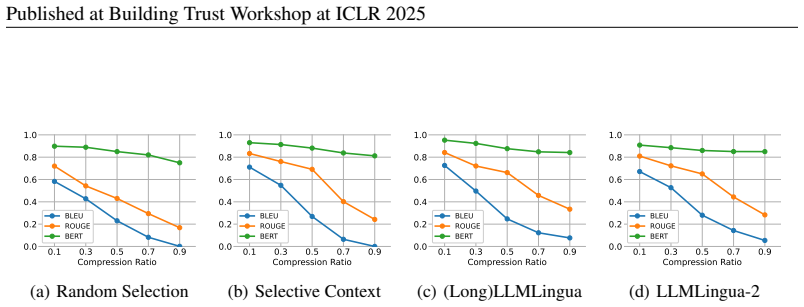
- [§5.1, Table 2 and Figure 5] The central claim that moderate compression enhances LLM performance in long-context QA is supported only by single point estimates without any uncertainty quantification. The paper reports no confidence intervals, no number of samples for the LongBench rows, no decoding-temperature or seed policy for the API models, and no repeated runs. For example, LongBench SingleDoc F1 rises from 0.149 (original prompt) to 0.301 (LongLLMLingua); without error bars or a paired significance test, it is not possible to determine whether this gap is robust or within sampling noise. Additionally, Figure 5b scales each task's scores by its mean before averaging, which can amplify small or noisy tasks and obscure the fact that Table 2 shows the effect is method-dependent: KiS harms three of four LongBench tasks while LLMLingua and LongLLMLingua help. The authors should report per-task confidence intervals or bootstrapped estimates and perform a paired statistical test (e.g., Wilcoxon signed-rank across tasks) to substantiate the improvement claim.
- [§5.2, Table 5] The statement "All compression methods result in some degree of enhanced hallucination" is not supported for the reconstruction task because the 'Original Prompt' baseline is missing (dashes) for that column. Without an original-prompt hallucination rate for reconstruction, the authors cannot conclude that compression increases hallucination in that task. The claim should either be restricted to summarization and QA, where baselines exist, or the missing reconstruction baseline should be collected and reported.
- [Table 1 and Section 5.1] The grouping of LLMLingua and LongLLMLingua into a single row labeled "(Long)LLMLingua" obscures the individual performance of two distinct methods and weakens the claim that both "generally outperform." LongLLMLingua uses question-aware compression while LLMLingua does not, so their behaviors on reconstruction and summarization may differ systematically. Merging them prevents readers from verifying the aggregated claim. The authors should report the two methods separately, or justify the aggregation by showing that per-dataset differences are negligible with confidence intervals.
minor comments (6)
- [§4.3 and Figure 3] The procedure for varying the compression ratio in Figure 3 is underspecified: it states that 100 instances are sampled, but it does not say which datasets, which models, or how the random selection is seeded. Please clarify these details for reproducibility.
- [§5.2, Table 4] The response-length differences are small relative to absolute lengths (e.g., +0.3 to +3.3 words for GPT-3.5-turbo), and no variance or significance measure is reported. The "uniform trend" claim would be more convincing with error bars or a paired test.
- [§5.4, Figure 9] The normalized performance (dividing by the original prompt score) can be unstable when the original score is low; consider reporting absolute scores or confidence intervals to support the word-removal effects.
- [References] There are duplicate references for Clarke & Lapata (2008a/b) and Papineni et al. (2002a/b); these should be consolidated.
- [Appendix B] The caveat that response-length patterns "are statistical and may vary in individual cases" is useful; consider stating this caveat near Table 4 in the main text as well.
- [Throughout] Minor typographical issues include "Arxiv" (should be "arXiv" or "ArXiv") in Section A.1 and inconsistent capitalization of "LongBench" (sometimes "Longbench") in the abstract and body.
Circularity Check
No circularity: the study is an empirical benchmark whose claims are measured against external datasets, models, and published compression methods.
full rationale
This paper makes no derivation-based claim; every result is an empirical measurement. The central claims — that (Long)LLMLingua and LLMLingua-2 generally perform best, that moderate compression can improve long-context QA performance, that compression increases hallucination, and that response-length effects vary by model — are all supported by tables and figures reporting scores obtained by running six external compression methods and a random-selection baseline on fixed, publicly available datasets (LongBench, BBH, GSM8K, IconQA, OK-VQA, etc.) with three API models. The compression ratio is defined independently of the outcomes, and no parameter is fitted to the evaluation data and then renamed as a prediction. The only fitted quantities in the pipeline (e.g., LLMLingua's budget controller or LLMLingua-2's token classifier) come from previously published methods with their own training procedures and are not fit to the benchmark results reported here. The paper's own limitations section explicitly restricts the scope to three (M)LLMs and the selected prompt-compression techniques, which is a generalizability caveat, not evidence of circularity. The main quantitative claims are therefore self-contained empirical findings against external benchmarks, and no step reduces by construction to its own inputs.
Assumptions & free parameters
free parameters (1)
- Compression ratio (default 0.5) =
0.5
assumptions (4)
- domain assumption The six compression methods are correctly implemented in the released toolkit and faithfully represent the published methods.
- domain assumption The evaluation metrics (BLEU, ROUGE-L, BERTScore, F1) are valid measures of response quality for the reconstruction, summarization, and QA tasks.
- domain assumption The manual hallucination annotations are reliable.
- domain assumption The API versions of GPT-3.5-turbo, GPT-4o-mini, and Claude-3-Haiku used in the experiments are stable and representative of these models.
Cite this review
Pith. "Pith review of An Empirical Study on Prompt Compression for Large Language Models." pith.science (2026). https://pith.science/paper/J4TA3ZTM
@misc{pith2026250500019,
  author       = {Pith},
  title        = {Pith review of: An Empirical Study on Prompt Compression for Large Language Models},
  year         = {2026},
  howpublished = {\url{https://pith.science/paper/J4TA3ZTM}},
  note         = {Machine review of arXiv:2505.00019}
}
read the original abstract
Prompt engineering enables Large Language Models (LLMs) to perform a variety of tasks. However, lengthy prompts significantly increase computational complexity and economic costs. To address this issue, we study six prompt compression methods for LLMs, aiming to reduce prompt length while maintaining LLM response quality. In this paper, we present a comprehensive analysis covering aspects such as generation performance, model hallucinations, efficacy in multimodal tasks, word omission analysis, and more. We evaluate these methods across 13 datasets, including news, scientific articles, commonsense QA, math QA, long-context QA, and VQA datasets. Our experiments reveal that prompt compression has a greater impact on LLM performance in long contexts compared to short ones. In the Longbench evaluation, moderate compression even enhances LLM performance. Our code and data is available at https://github.com/3DAgentWorld/Toolkit-for-Prompt-Compression.
Figures


Figures from the paper (7 more)


Reference graph
Works this paper leans on
-
[1]
Claire warned Daniel that if both of them were logged on simultaneously, the computer would crash
-
[2]
The repairman confirmed that the computer will only crash if two people are logged on at the same time
-
[3]
The repairman saw that Daniel was logged on
-
[4]
doi: 10.18653/v1/2024.findings-acl.57
Association for Computational Linguistics. doi: 10.18653/v1/2024.findings-acl.57. URL https://aclanthology.org/2024.findings-acl.57. Kishore Papineni, Salim Roukos, Todd Ward, and Wei-Jing Zhu. Bleu: a method for automatic evaluation of machine translation. In Pierre Isabelle, Eugene Charniak, and Dekang Lin (eds.), Proceedings of the 40th Annual Meeting ...
arXiv 2024
-
[5]
Given points 2 and 3, for the crash to occur, someone else must have been logged on at the same time as Daniel
-
[6]
Based on Claire’s warning and her use of the computer for schoolwork, it’s reasonable to assume that Claire was the other person logged on. So, while Daniel’s actions contributed to the crash by logging on when he was told not to, the crash was actually caused by both Daniel and Claire being logged on simultaneously. Daniel’s action was a necessary condit...
work page 2025
-
[9]
The computer did crash
-
[12]
The motion detector is triggered if at least one person appears in the room
Show all 22 references
-
[13]
Both Suzy and Billy arrived at 9 am, contrary to Billy’s instructions
-
[14]
Given these facts, we can reason as follows:
Suzy was supposed to be there at 9 am. Given these facts, we can reason as follows:
-
[15]
The motion detector would have gone off even if Billy hadn’t shown up, because Suzy was supposed to be there and did arrive as instructed
-
[16]
It would have been triggered by Suzy alone
Billy’s presence was neither necessary nor sufficient for the motion detector to go off. It would have been triggered by Suzy alone
-
[17]
In this case, the outcome (motion detector going off) would have been the same
In causal analysis, we often consider counterfactuals - what would have happened if the supposed cause (Billy’s arrival) hadn’t occurred. In this case, the outcome (motion detector going off) would have been the same. Therefore, it would be incorrect to say that Billy caused t...
-
[18]
Suzy was told to be there at exactly 9 am, and it was essential for her to arrive at that time
-
[19]
Billy was told not to come in the next morning and not to be there at that time
-
[20]
Both Billy and Suzy arrived at 9 am
-
[21]
There was a motion detector installed in the room
-
[22]
Given this information, we can conclude: Billy was not supposed to be there, but he came anyway
The motion detector was triggered if one person was in the room at the same time. Given this information, we can conclude: Billy was not supposed to be there, but he came anyway. Since both Billy and Suzy arrived at 9 am, they both entered the room at the same time. The motion...
-
[2020]
Zhenyu Zhang, Ying Sheng, Tianyi Zhou, Tianlong Chen, Lianmin Zheng, Ruisi Cai, Zhao Song, Yuandong Tian, Christopher Re, Clark Barrett, Zhangyang Wang, and Beidi Chen
URL https://openreview.net/forum?id=SkeHuCVFDr. Zhenyu Zhang, Ying Sheng, Tianyi Zhou, Tianlong Chen, Lianmin Zheng, Ruisi Cai, Zhao Song, Yuandong Tian, Christopher Re, Clark Barrett, Zhangyang Wang, and Beidi Chen. H2o: Heavy- hitter oracle for efficient generative inference...
2023
-
[2022]
Timoth´ee Darcet, Maxime Oquab, Julien Mairal, and Piotr Bojanowski
URL https://proceedings.neurips.cc/paper_files/paper/2022/ file/67d57c32e20fd0a7a302cb81d36e40d5-Paper-Conference.pdf. Timoth´ee Darcet, Maxime Oquab, Julien Mairal, and Piotr Bojanowski. Vision transformers need registers. In The Twelfth International Conference on Learning R...
2022 arXiv
-
[2023]
Nelson F
URL https://proceedings.neurips.cc/paper_files/paper/2023/ file/1bfd87d2d92f0556819467dc08034f76-Paper-Conference.pdf. Nelson F. Liu, Kevin Lin, John Hewitt, Ashwin Paranjape, Michele Bevilacqua, Fabio Petroni, and Percy Liang. Lost in the middle: How language models use long ...
2023 arXiv
-
[2024]
doi: 10.18653/v1/2024.acl-long.172
Association for Computational Linguistics. doi: 10.18653/v1/2024.acl-long.172. URL https://aclanthology.org/2024.acl-long.172. Pu-Chin Chen, Henry Tsai, Srinadh Bhojanapalli, Hyung Won Chung, Yin-Wen Chang, and Chun- Sung Ferng. A simple and effective positional encoding for t...
2024 arXiv
Reviewed August 16, 2026 · model on record in the stance chip above.
Discussion (0). Continue with ORCID to comment.