REVIEW 5 major objections 5 minor 30 references
CORG: Generating Answers from Complex, Interrelated Contexts
T0 review · 5 major / 5 minor · reviewed 2026-08-16 · deepseek-v4-flash
Pith's one-line read This paper claims that a graph-based, training-free context organizer raises disambiguated answer recall across eight models on question answering over complex, interrelated corpora.
desk verdict A useful taxonomy and broad experiments, but Algorithm 1's mirroring rule is logically wrong for mixed counterfactual/duplicated triples, so the mechanism as written can drop answers; still worthy of peer review. read the letter →
The pith
A machine-rendered reading of the paper's core claim, the machinery that carries it, and where it could break.
The reading
What carries the argument
The load-bearing object is the graph constructor of Algorithm 1: it labels pairwise context relations with GPT-4, then propagates labels by assuming that when two contexts are counterfactual or duplicated, their relations to every third context are identical, so only missing edges need labeling in later iterations. The reranker consumes this graph and applies per-factor rules: for distracting pairs it removes the context lacking a descriptor; for duplicated pairs it keeps one randomly; and for counterfactual pairs it places each context in a separate group, distributing the remaining contexts across groups. The aggregator then runs each group through the model with a pluralized question and concatenates the outputs with citations. Together, the three components convert the four relationship types into a small number of independent inference runs, which is what produces the reported gains in answer recall and disambiguation.
What would settle it
Construct a hand-made triple in which context A is counterfactual with B and duplicated with C (same descriptor, A and C share an answer, A and B do not), run Algorithm 1, and check whether the B-C edge is labeled counterfactual or copied as duplicated. Since the correct relation is counterfactual, a duplicated label directly falsifies the propagation mechanism; a supplementary check is to manually label all pairwise relations on a random AmbigDocs+ sample and report the graph constructor's disagreement rate.
Extended reading notes
Core claim
The paper's central claim is that multi-document question answering over corpora with mixed context relationships is best served by separating counterfactual contexts into different inference groups, deduplicating repeated contexts, dropping ambiguous descriptor-less contexts when a distracting counterpart exists, and reformulating the question into a plural form so the model lists all answers. On AmbigDocs+ and ConflictQA+, CORG's grouping yields the best Disambig-F1—a model-based metric that checks whether the correct answer and its disambiguating descriptor both appear—among six baselines across all eight tested models, and it matches the much more expensive Separate method, which runs each context in its own forward pass. A supporting finding is that grouping by similarity (KMeans) is worse than random grouping, because similar-but-conflicting contexts blur entity descriptors; this locates the benefit in the graph's relationship labels rather than in clustering or plain input ordering.
Load-bearing premise
The load-bearing assumption is that once two contexts are marked counterfactual or duplicated, every other context relates to them in exactly the same way, so one context's relation labels can be copied onto the other without rechecking.
Editorial extensions
If this is right
- On corpora that mix all four relationship types, an inference-time grouping step can beat both single-pass reading and similarity-based clustering without any model training.
- Because each group's output carries citations, users can verify counterfactual or outdated claims from the source contexts instead of relying on the model to filter them.
- The method transfers to newly released models directly, since its only adaptation is prompt-level graph labeling; the paper demonstrates consistent gains across eight models of different sizes.
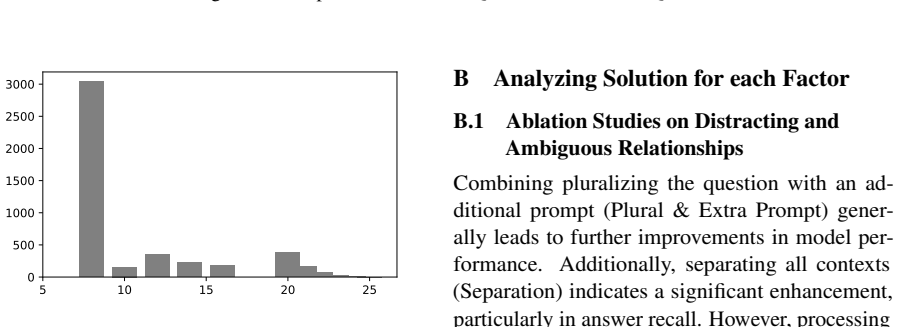
- Typical runs use roughly two inference groups per question rather than one group per context, so the answer-recall gains of separated processing are available at a small fraction of the cost.
Reading between the lines
- The propagation rule in Algorithm 1 is not generally truth-preserving: if context A is counterfactual with B and duplicated with C, then B and C must be counterfactual, yet the copy rule labels B-C as duplicated. A direct check against human relation labels on AmbigDocs+ would reveal how often this error changes the groups and the final answer.
- The paper reports no accuracy check for the GPT-4 relation labels feeding the graph. A controlled comparison using a cheaper labeler or human labels would separate the benefit of the grouping policy itself from the benefit of a labeler that happens to agree with the generator's biases.
- The pluralization result points to a testable refinement: make question reformulation depend on the number of distinct descriptors in each group, rather than applying plural form to every multi-context group, which could reduce the over-generation the paper notes for single-context inputs.
Signed reviews
Editorial analysis
A structured set of objections, weighed in public.
Referee Report
Summary. The paper identifies four types of inter-context relationships in multi-document QA (distracting, ambiguous, counterfactual, duplicated), constructs extended datasets AmbigDocs+ and ConflictQA+ that mix all four factors, and analyzes simple per-factor solutions using Llama2-7B. It then proposes CORG, a training-free inference-time pipeline composed of a GPT-4-based graph constructor, a reranker that removes duplicates, drops descriptor-less contexts, and separates counterfactual contexts into groups, and an aggregator that pluralizes questions and concatenates cited answers. The paper reports D-F1 and related metrics across eight models and four datasets, claiming CORG consistently outperforms six baselines while matching the much more expensive Separate baseline, with the best performance-per-FLOPs trade-off on AmbigDocs+.
Significance. If the claims held, CORG would be a useful, practical contribution: an inference-time method that improves answer recall on mixed-relationship multi-document QA without training, with broad evaluation across model families and sizes. The paper includes human evaluation of the constructed datasets, ablations of the reranker/aggregator components, and a token-level efficiency analysis, which are valuable. However, the central mechanism has a documented logical inconsistency in the graph propagation rule, the evaluation design selects the per-factor solutions on the test corpora, the headline claim that CORG beats all six baselines is not supported by the reported tables, and the efficiency analysis excludes a per-query cost. These issues are load-bearing for the paper's main claims, though they may be addressable with additional validation and revised claims.
major comments (5)
- [Algorithm 1 (Graph Constructor), lines 8–11] The mirroring rule is logically inconsistent with the definitions in §2.1. When the newly processed context ci is counterfactual to the pivot c′ (same descriptor, different answer) and c′ is duplicated with cj (same descriptor, same answer), the edge (ci, cj) must be counterfactual under the paper's own taxonomy, but the algorithm copies the 'dup' edge, labeling ci and cj as duplicates. In the Appendix A.1 example, the main context (IIHF, Slovakia), the counterfactual context (IIHF, Canada), and the duplicated context (IIHF, Slovakia) form exactly this pattern; the reranker then randomly keeps one of the two 'duplicates' and loses an answer, contradicting the stated design goal of separating counterfactual contexts. Because no accuracy check of GPT-4 relation labels or of the resulting graph is reported, this flaw is not known to be corrected in the implementation and can directly undermine the claimed mechanism.
- [§3.2 and Tables 2–4; §5.3] The per-factor solutions (pluralizing the question, converting ambiguous contexts to distracting ones, separating counterfactual contexts, and deduplicating) are selected using Llama2-7B on AmbigDocs+ and ConflictQA+ instances, and the same corpora are then used for the final D-F1 evaluation in Tables 5, 6, and 10. The ablation in Table 11 is also on AmbigDocs+ with Llama2-7B. This means the design decisions are fit to the test distribution, and the reported gains over baselines may be optimistic. The paper should evaluate on a held-out development set or describe a model-selection procedure that does not use the test data.
- [Abstract; §5.3; Tables 5 and 10] The claim of 'consistently improves performance over six baselines across eight different models' is not supported by the reported numbers. In Table 5, Separate exceeds CORG in multiple rows: ConflictQA+ Llama2-13B (37.5 vs 30.8), Llama2-70B (40.1 vs 31.4), Llama3-8B (25.6 vs 22.8), Llama3-70B (35.2 vs 28.7), and ChatGPT (37.1 vs 35.9); in AmbigDocs+, Separate exceeds CORG for Llama2-70B (18.7 vs 17.9), Llama3-70B (22.4 vs 14.6), Mistral-7B (28.8 vs 27.5), and GPT-4o (32.1 vs 31.4). Similar patterns appear in Table 10 for ConflictQA. The accurate claim is that CORG outperforms grouping-based baselines and is comparable to Separate, not that it outperforms all six baselines. This should be corrected throughout the abstract and results sections.
- [§5.4, Figure 4, note 8] The efficiency analysis excludes graph construction from the FLOPs calculation, with the footnote stating that steps like graph construction are 'performed only once per dataset.' However, the graph constructor runs per question (Algorithm 1 takes the context list for a question), not once per dataset. Excluding this cost materially favors CORG in the performance/FLOPs comparison against baselines that do not perform relation extraction. The paper should either include the graph-construction cost or explicitly state that the comparison is for generation FLOPs only, then discuss the implication for the practical efficiency claim.
- [Appendix C.1 and Figure 9] The graph constructor uses an input format that adds a 'None' relationship (different descriptor with one being Null and different answer), which is not part of the four-type taxonomy in §2.1, and the prompt example in Figure 9 labels the pair 'Context2 - None' even though Context2 (Slovakia) and Context1 (Canada) appear to satisfy the counterfactual definition (same entity, different answers). This ambiguity in the labeling schema, combined with the absence of any accuracy or inter-annotator agreement measure for the GPT-4 relation labels, makes it impossible to verify that the constructed graph matches the paper's definitions. Please report the accuracy of relation labeling on a sample and reconcile the 'None' category with §2.1.
minor comments (5)
- [§5.2] The text says 'We evaluate five baselines' but then lists six (Base, Retrieve, Summarize, Random, KMeans, Separate); §5.3 correctly says 'six baselines.' Please harmonize the count.
- [§3.1 heading] The heading 'Affect of each factor' should be 'Effect of each factor.'
- [§4, Reranker paragraph] The reranker description says 'for contexts in a distracting relationship, when a context with a descriptor is available, we remove the one without it,' but a pair in which one context lacks a descriptor is ambiguous, not distracting; this appears to conflict with §3.2's 'Change to Distracting' solution and should be clarified.
- [Table 11] Variant (2) is labeled 'without converting distracting to ambiguous,' which is the reverse of the §3.2 solution 'Change to Distracting'; please align the terminology with the prose.
- [Figure numbering] Section 3.1 refers to 'Figure 3' for performance trends, while Figure 3 is used for the CORG system overview; the cross-references and figure numbers should be fixed.
Circularity Check
No circularity: CORG's improvements are empirical benchmark measurements; the flagged Algorithm 1 propagation flaw is a correctness issue, not a circular reduction.
full rationale
I examined the claimed derivation chain: the four relationship definitions in Section 2.1, the per-factor analyses in Section 3, the CORG algorithm in Section 4, and the D-F1 results in Section 5. The central claim is an empirical comparison against six baselines on four datasets; it is not derived by construction from the relationship taxonomy or from Algorithm 1. No equation equates a fitted value with a reported prediction. The per-factor rule choices (pluralization, converting ambiguous to distracting, separating counterfactuals, deduplication) were developed using the same corpus family on which final numbers are reported, which is a data-snooping and selection concern that could inflate results, but the final measurements are not statistically forced by the rules themselves. The self-citations to AmbigDocs (Lee et al., 2024c) are dataset and metric references, not load-bearing circular support. The logical flaw in Algorithm 1's mirroring of counterfactual edges (e.g., copying a 'duplicated' edge from a pivot to a counterfactual context, although the definitions imply 'counterfactual') is a genuine correctness bug that could undermine the mechanism, but it is not a circularity: the reported gains are not equivalent to the input labels by construction. I therefore find no significant circularity.
Assumptions & free parameters
assumptions (5)
- domain assumption Contexts can be decomposed into surface name, descriptor, and answer, and every inter-context relationship falls into exactly one of four categories: ambiguous, distracting, counterfactual, duplicated.
- ad hoc to paper Replacing an ambiguous context (missing descriptor) with a descriptor-bearing version preserves the answer and improves performance.
- ad hoc to paper Separating counterfactual contexts into distinct inference runs improves answer recall.
- domain assumption GPT-4 reliably classifies context relationships for graph construction.
- ad hoc to paper If context A is counterfactual or duplicated with B, then B's relationships to all other contexts mirror A's relationships to them.
Cite this review
Pith. "Pith review of CORG: Generating Answers from Complex, Interrelated Contexts." pith.science (2026). https://pith.science/paper/ECI2PUBC
@misc{pith2026250500023,
  author       = {Pith},
  title        = {Pith review of: CORG: Generating Answers from Complex, Interrelated Contexts},
  year         = {2026},
  howpublished = {\url{https://pith.science/paper/ECI2PUBC}},
  note         = {Machine review of arXiv:2505.00023}
}
read the original abstract
In a real-world corpus, knowledge frequently recurs across documents but often contains inconsistencies due to ambiguous naming, outdated information, or errors, leading to complex interrelationships between contexts. Previous research has shown that language models struggle with these complexities, typically focusing on single factors in isolation. We classify these relationships into four types: distracting, ambiguous, counterfactual, and duplicated. Our analysis reveals that no single approach effectively addresses all these interrelationships simultaneously. Therefore, we introduce Context Organizer (CORG), a framework that organizes multiple contexts into independently processed groups. This design allows the model to efficiently find all relevant answers while ensuring disambiguation. CORG consists of three key components: a graph constructor, a reranker, and an aggregator. Our results demonstrate that CORG balances performance and efficiency effectively, outperforming existing grouping methods and achieving comparable results to more computationally intensive, single-context approaches.
Figures


Figures from the paper (6 more)



Reference graph
Works this paper leans on
-
[1]
Josh Achiam, Steven Adler, Sandhini Agarwal, Lama Ahmad, Ilge Akkaya, Florencia Leoni Aleman, Diogo Almeida, Janko Altenschmidt, Sam Altman, Shyamal Anadkat, et al. 2023. Gpt-4 technical report. arXiv preprint arXiv:2303.08774
arXiv 2023
-
[2]
Hung-Ting Chen, Michael J.Q. Zhang, and Eunsol Choi. 2022. https://api.semanticscholar.org/CorpusID:253107178 Rich knowledge sources bring complex knowledge conflicts: Recalibrating models to reflect conflicting evidence . In Conference on Empirical Methods in Natural Language Processing
work page 2022
-
[3]
Jacob Devlin, Ming-Wei Chang, Kenton Lee, and Kristina Toutanova. 2019. https://api.semanticscholar.org/CorpusID:52967399 Bert: Pre-training of deep bidirectional transformers for language understanding . In North American Chapter of the Association for Computational Linguistics
2019
-
[4]
Abhimanyu Dubey, Abhinav Jauhri, Abhinav Pandey, Abhishek Kadian, Ahmad Al-Dahle, Aiesha Letman, Akhil Mathur, Alan Schelten, Amy Yang, Angela Fan, et al. 2024. The llama 3 herd of models. arXiv preprint arXiv:2407.21783
arXiv 2024
-
[5]
Darren Edge, Ha Trinh, Newman Cheng, Joshua Bradley, Alex Chao, Apurva Mody, Steven Truitt, and Jonathan Larson. 2024. From local to global: A graph rag approach to query-focused summarization. arXiv preprint arXiv:2404.16130
arXiv 2024
-
[6]
Gizem Gezici, Aldo Lipani, Yucel Saygin, and Emine Yilmaz. 2021. Evaluation metrics for measuring bias in search engine results. Information Retrieval Journal, 24:85--113
work page 2021
-
[7]
Shibo Hao, Tianyang Liu, Zhen Wang, and Zhiting Hu. 2024. Toolkengpt: Augmenting frozen language models with massive tools via tool embeddings. Advances in neural information processing systems, 36
2024
-
[8]
Cheng-Mao Hsu, Cheng te Li, Diego S \'a ez-Trumper, and Yi-Zhan Hsu. 2021. https://api.semanticscholar.org/CorpusID:244130115 Wikicontradiction: Detecting self-contradiction articles on wikipedia . 2021 IEEE International Conference on Big Data (Big Data), pages 427--436
work page 2021
Show all 30 references
-
[9]
Albert Q Jiang, Alexandre Sablayrolles, Arthur Mensch, Chris Bamford, Devendra Singh Chaplot, Diego de las Casas, Florian Bressand, Gianna Lengyel, Guillaume Lample, Lucile Saulnier, et al. 2023. Mistral 7b. arXiv preprint arXiv:2310.06825
2023 arXiv
-
[10]
Zhuoran Jin, Pengfei Cao, Yubo Chen, Kang Liu, Xiaojian Jiang, Jiexin Xu, Qiuxia Li, and Jun Zhao. 2024. https://api.semanticscholar.org/CorpusID:267782658 Tug-of-war between knowledge: Exploring and resolving knowledge conflicts in retrieval-augmented language models . ArXiv,...
2024 arXiv
-
[11]
Hyunji Lee, Sejune Joo, Chaeeun Kim, Joel Jang, Doyoung Kim, Kyoung-Woon On, and Minjoon Seo. 2023. How well do large language models truly ground? NACCL 2024
2023
-
[12]
Hyunji Lee, Luca Soldaini, Arman Cohan, Minjoon Seo, and Kyle Lo. 2024 a . Routerretriever: Exploring the benefits of routing over multiple expert embedding models. arXiv preprint arXiv:2409.02685
2024 arXiv
-
[13]
Jinhyuk Lee, Anthony Chen, Zhuyun Dai, Dheeru Dua, Devendra Singh Sachan, Michael Boratko, Yi Luan, S \'e bastien MR Arnold, Vincent Perot, Siddharth Dalmia, et al. 2024 b . Can long-context language models subsume retrieval, rag, sql, and more? arXiv preprint arXiv:2406.13121
2024 arXiv
-
[14]
Yoonsang Lee, Xi Ye, and Eunsol Choi. 2024 c . Ambigdocs: Reasoning across documents on different entities under the same name. COLM 2024
2024
-
[15]
Longpre, Kartik Perisetla, Anthony Chen, Nikhil Ramesh, Chris DuBois, and Sameer Singh
S. Longpre, Kartik Perisetla, Anthony Chen, Nikhil Ramesh, Chris DuBois, and Sameer Singh. 2021. https://api.semanticscholar.org/CorpusID:237491581 Entity-based knowledge conflicts in question answering . ArXiv, abs/2109.05052
2021 arXiv
-
[16]
Sewon Min, Kenton Lee, Ming-Wei Chang, Kristina Toutanova, and Hannaneh Hajishirzi. 2021. Joint passage ranking for diverse multi-answer retrieval. arXiv preprint arXiv:2104.08445
2021 arXiv
-
[17]
Sewon Min, Julian Michael, Hannaneh Hajishirzi, and Luke Zettlemoyer. 2020. A mbig QA : Answering ambiguous open-domain questions. In Proceedings of the 2020 Conference on Empirical Methods in Natural Language Processing (EMNLP)
2020
-
[18]
Bhaskarjit Sarmah, Benika Hall, Rohan Rao, Sunil Patel, Stefano Pasquali, and Dhagash Mehta. 2024. https://api.semanticscholar.org/CorpusID:271843286 Hybridrag: Integrating knowledge graphs and vector retrieval augmented generation for efficient information extraction . In Int...
2024
-
[19]
Timo Schick, Jane Dwivedi-Yu, Roberto Dess \` , Roberta Raileanu, Maria Lomeli, Eric Hambro, Luke Zettlemoyer, Nicola Cancedda, and Thomas Scialom. 2024. Toolformer: Language models can teach themselves to use tools. Advances in Neural Information Processing Systems, 36
2024
-
[20]
Ivan Stelmakh, Yi Luan, Bhuwan Dhingra, and Ming-Wei Chang. 2022. Asqa: Factoid questions meet long-form answers. arXiv preprint arXiv:2204.06092
2022 arXiv
-
[21]
Hugo Touvron, Louis Martin, Kevin Stone, Peter Albert, Amjad Almahairi, Yasmine Babaei, Nikolay Bashlykov, Soumya Batra, Prajjwal Bhargava, Shruti Bhosale, et al. 2023. Llama 2: Open foundation and fine-tuned chat models. arXiv preprint arXiv:2307.09288
2023 arXiv
-
[22]
Xiangchen Wu, Xi Niu, and Ruhani Rahman. 2022. https://api.semanticscholar.org/CorpusID:250340379 Topological analysis of contradictions in text . Proceedings of the 45th International ACM SIGIR Conference on Research and Development in Information Retrieval
2022
-
[23]
Jian Xie, Kai Zhang, Jiangjie Chen, Renze Lou, and Yu Su. 2023. https://api.semanticscholar.org/CorpusID:263610324 Adaptive chameleon or stubborn sloth: Revealing the behavior of large language models in knowledge conflicts
2023
-
[24]
Fangyuan Xu, Weijia Shi, and Eunsol Choi. 2023. Recomp: Improving retrieval-augmented lms with compression and selective augmentation. arXiv preprint arXiv:2310.04408
2023 arXiv
-
[25]
Rongwu Xu, Zehan Qi, Cunxiang Wang, Hongru Wang, Yue Zhang, and Wei Xu. 2024. Knowledge conflicts for llms: A survey. arXiv preprint arXiv:2403.08319
2024 arXiv
-
[26]
Shunyu Yao, Jeffrey Zhao, Dian Yu, Nan Du, Izhak Shafran, Karthik Narasimhan, and Yuan Cao. 2022. React: Synergizing reasoning and acting in language models. arXiv preprint arXiv:2210.03629
2022 arXiv
-
[27]
Zhang and Eunsol Choi
Michael J.Q. Zhang and Eunsol Choi. 2021. https://api.semanticscholar.org/CorpusID:237491751 Situatedqa: Incorporating extra-linguistic contexts into qa . ArXiv, abs/2109.06157
2021 arXiv
-
[28]
Wenxuan Zhou, Sheng Zhang, Hoifung Poon, and Muhao Chen. 2023. https://api.semanticscholar.org/CorpusID:257632259 Context-faithful prompting for large language models . In Conference on Empirical Methods in Natural Language Processing
2023
-
[29]
URL: " 'urlintro :=
ENTRY address author booktitle chapter edition editor howpublished institution journal key month note number organization pages publisher school series title type volume year eprint doi pubmed url lastchecked label extra.label sort.label short.list INTEGERS output.state before...
-
[30]
write newline
" write newline "" before.all 'output.state := FUNCTION n.dashify 't := "" t empty not t #1 #1 substring "-" = t #1 #2 substring "--" = not "--" * t #2 global.max substring 't := t #1 #1 substring "-" = "-" * t #2 global.max substring 't := while if t #1 #1 substring * t #2 gl...
Reviewed August 16, 2026 · model on record in the stance chip above.
Discussion (0). Continue with ORCID to comment.