REVIEW 3 major objections 6 minor 49 references
Implicit Neural-Representation Learning for Elastic Deformable-Object Manipulations
T0 review · 3 major / 6 minor · reviewed 2026-08-16 · deepseek-v4-flash
Pith's one-line read INR-DOM shows that pretraining a PointNet encoder to reconstruct full signed-distance shapes from partial point clouds, then fine-tuning it with contrastive reinforcement learning, yields state representations that push elastic-band…
desk verdict Solid, honest empirical paper on implicit representations for elastic deformable-object manipulation; large simulation margins and convincing ablations, but real-world claims rest on 10 trials and an unvalidated SAM2 segmentation dependency. read the letter →
The pith
A machine-rendered reading of the paper's core claim, the machinery that carries it, and where it could break.
The reading
What carries the argument
The central object is the implicit signed distance function (SDF): a neural network that takes a query point and a latent code and returns the signed distance to the band's surface, so the complete geometry is encoded continuously even when the input point cloud is partial. The mechanism that carries the argument is a two-stage training loop. Stage one is a partial-to-complete variational autoencoder: a PointNet encoder produces a 64-dimensional latent code, a hypernetwork decodes that code into the weights of a SIREN SDF network, and reconstruction, skeleton, and consistency losses force the code to capture the full shape. Stage two fine-tunes the encoder with soft actor-critic and an InfoNCE contrastive loss whose positive keys come from a temporal- and instance-wise selection scheme based on episode similarity and dynamic time warping, so the latent space separates entangled configurations that look similar in raw observations. The SDF is doing the key work: it supplies a continuous, complete geometric scaffold that discrete point-cloud completion methods do not provide.
What would settle it
A single decisive experiment would run the real disentanglement task with the crossing of the +180/-180 degree twist deliberately occluded in the segmented point cloud, for example by a pole blocking the camera's view; if task success stays high, the representation is genuinely occlusion-robust, and if success collapses to baseline levels, the reported rates depend on segmentation quality rather than on the SDF representation.
Extended reading notes
Core claim
On its own terms, the paper's discovery is that representing a partially observed elastic band by its complete signed distance function, decoded by a SIREN hypernetwork from a 64-dimensional latent code, gives reinforcement learning a state space that is both dense and occlusion-tolerant. The pre-training loss combines surface reconstruction, medial-axis (skeleton) preservation, a consistency loss that forces partial and complete embeddings to match, and standard variational and weight regularizers. In the fine-tuning stage the same encoder is updated jointly with a soft actor-critic policy and an InfoNCE contrastive loss, where positive keys are chosen by dynamic time warping across similar episodes rather than by naive anchor-augmentation pairs. The result, as reported, is a latent space in which twist direction is encoded consistently, with opposite twist angles landing on opposite sides while completed trajectories converge to the goal region, and the learned policy transfers to a real robot with 20 demonstrations, reaching roughly 90% success per task.
Load-bearing premise
The load-bearing premise is that the point cloud entering the encoder is a clean, correctly segmented view of the target band; the real-world system relies on SAM2-based segmentation plus outlier removal, and the paper does not validate what happens when occlusion, lighting, or severe twisting breaks that segmentation.
Editorial extensions
If this is right
- If the reported results are correct, a single pretrained shape-completion encoder can replace hand-designed state features for a family of elastic-band tasks, because the same latent codes support sealing, installation, and disentanglement.
- The contrastive fine-tuning is load-bearing for the hardest task: removing it drops disentanglement success from 75% to 54%, so the temporal key assignment is what lets the policy distinguish +180 degrees from -180 degrees twists.
- The reconstruction pretraining is indispensable: without it, success rates fall to 20-29%, indicating that random initialization of the encoder cannot be recovered by reinforcement learning alone.
- The same representation is expected to generalize to unseen band sizes and types, since reconstruction error on unseen bands is lower than the baselines' error on seen bands.
Reading between the lines
- Beyond the paper's claims, the same partial-to-complete SDF pretraining should extend to other deformable linear objects such as cables and ropes whenever a medial-axis ground truth can be computed, since the skeleton loss is the component most tied to band-like topology.
- The paper does not test segmentation robustness, so a fair extension would be to feed full depth images and let an attention mechanism focus on the band; the stated limitation implies that doing so would remove the main reported failure mode.
- The temporal key-assignment recipe, using episode similarity plus dynamic time warping to pick positives, is a general technique for any off-policy reinforcement learning agent with sequential observations, not just elastic bands, and could be evaluated on cloth smoothing or rigid-object pushing.
- A testable consequence the authors leave implicit is that INR-DOM should also predict the medial axis of unseen band types well, because Lskel is a training signal; measuring medial-axis error directly would isolate whether the skeleton loss or the SDF loss drives generalization.
Signed reviews
Editorial analysis
A structured set of objections, weighed in public.
Referee Report
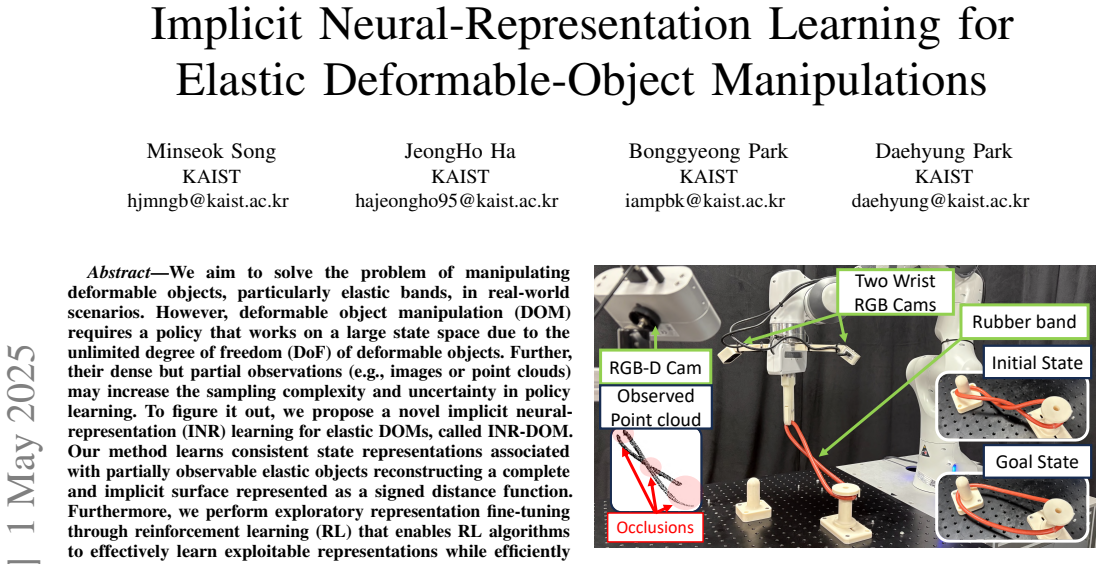
Summary. The paper proposes INR-DOM, a two-stage representation-learning and control method for manipulating elastic deformable objects (rubber bands and O-rings) from partial point-cloud observations. Stage I pre-trains a PointNet-based encoder as a partial-to-complete variational autoencoder whose hypernetwork decoder predicts the weights of a SIREN signed-distance-field network, trained with SDF, skeleton, KL, weight, and consistency losses. Stage II fine-tunes the encoder jointly with soft actor-critic and an InfoNCE contrastive loss that uses temporal and instance-wise key selection via start-goal embedding distance and dynamic time warping. The paper reports reconstruction accuracy on nine simulated band types, success rates on sealing, installation, and disentanglement tasks in IsaacSim, learning curves, t-SNE latent visualizations, and real-robot trials on a Franka Emika Panda arm with SAM2-based segmentation.
Significance. The paper addresses a relevant and timely problem in deformable-object manipulation. If the results hold, the contribution is useful: it demonstrates that reconstruction-based pre-training with implicit neural SDFs can be combined with contrastive RL fine-tuning to yield manipulation policies from partial observations. The leave-one-out reconstruction evaluation, the ablations of pre-training and contrastive components, and the real-robot comparison against SERL are commendable and give direct evidence for the main message. However, the statistical support for the word 'significantly' is missing, and the real-world transfer claim rests on an unvalidated segmentation component and an unvalidated image-based reward classifier. With additional experiments or carefully scoped claims, the work could be a solid contribution; in its current form, the central claims are stronger than the evidence presented.
major comments (3)
- [Section V.A, Table I and Fig. 8] The paper repeatedly states that INR-DOM 'significantly improves convergence stability in policy learning and success rate', but Table I reports single success rates per method with no confidence intervals, error bars, or number of seeds, and Fig. 8 shows one learning curve per method. For 100 Bernoulli trials, the 85% sealing result has a 95% confidence interval of roughly 76-91%, so some pairwise differences with the strongest baselines are clear, but the central claims about convergence stability and statistical significance are not supported by the reported evidence. Please report means and standard deviations over at least five random seeds and, ideally, a paired test across environments, or soften the wording to 'improves' without the statistical claim.
- [Section V.C and Section VII] The paper acknowledges in Section VII that 'The performance of INR-DOM depends on the accuracy of the point-cloud segmentation model' and that the real system uses SAM2 segmentation plus outlier removal at 10 Hz, yet no experiment quantifies robustness to segmentation errors, occlusion, lighting changes, or severe twisting. Because the encoder is pre-trained on clean simulator partial clouds and no mechanism is described for detecting or recovering from a corrupted mask, the reported real-world success rates (90% over 10 trials per task, and 80% in Table II) are conditional on a component that is never validated. Please add a segmentation-perturbation study in simulation (e.g., random mask erosion or dilation, missing points, added outliers) that measures the effect on end-to-end task success, or explicitly re-scope the real-world claim to 'given accurate segmentation'.
- [Section IV.B and V.C] The real-world experiments use a learned image-based reward classifier that assigns positive reward when the current RGB image 'closely matches' the final scene from expert demonstrations, but the paper reports no accuracy or failure analysis for this classifier. Since the policy is optimized against this learned reward, the reported success rates may partly reflect the classifier's ability to recognize goal images rather than genuine task completion, and the absence of any validation of the reward classifier is a load-bearing gap for the real-world claim. Please report classifier accuracy, a confusion matrix, or a task-completion check independent of the learned reward.
minor comments (6)
- [Equation (6)] The InfoNCE loss is written as the positive log-ratio rather than its negative; as printed, minimizing the expression would maximize agreement between query and positives, contradicting the stated goal. Please correct to L = -log(...) for reproducibility.
- [Section III.A] There is a typo: 'porint cloud' should be 'point cloud'.
- [Section IV.B] The phrase 'pre-trained segmentation anything model 2 (SAM2)' should be 'pre-trained Segment Anything Model 2 (SAM2)'.
- [Section V.A] The statement 'an average rate 40.3% higher than ACID' should specify that this is in percentage points, not a relative percentage improvement, to avoid ambiguity.
- [Table II] The repeated column headers 'Model Rate [%]' are confusing; the table would be clearer with a single 'Method' column and a single 'Success rate [%]' column.
- [Fig. 7 (b)] The label '2·10^4 embeddings' would be easier to read as '20,000 embeddings'.
Circularity Check
Mild self-referential loop in contrastive key selection; central success claims remain independently evaluated.
-
self definitional
[Section III-C, Contrastive learning (temporal key assignment)]
"we first sample the top-M similar episodes from the buffer B with respect to the episode E(i)p ... we determine the similarity based on the minimal start-and-goal embedding distance, dsg(E(i)p,E(j)p)=z(i)1·z(j)1+z(i)T·z(j)T ... We then select a point cloud pt′ in an episode with the minimum dynamic time-warping (DTW) distance from E(i)p to obtain z+ = Φϕkey(pt′), where Φϕkey is the key encoder, initialized with ϕ."
The positive key z+ used in the InfoNCE loss (Eq. 6) is not an independent view or externally supplied label; it is chosen as the point cloud whose embedding is closest to the query under the same encoder Φϕ (via the EMA key encoder initialized from ϕ). InfoNCE then trains Φϕ to maximize agreement with that self-selected key. Thus the contrastive target is defined by the same similarity function the loss optimizes, forming a self-referential loop: positive pairs are generated by the model's own embedding geometry rather than by an external signal. This can reinforce initial encoder biases instead of adding task-relevant information from outside.
full rationale
INR-DOM's main derivation chain is not circular. Stage I pre-training is supervised: LSDF and Lskel are computed against ground-truth complete point clouds and medial axes from IsaacSim (Eqs. 3-4), and Lcns explicitly pulls partial embeddings toward complete-point-cloud embeddings; reconstruction errors are then measured on held-out (leave-one-out) band types. Stage II RL success is evaluated in 100 simulated environments per task and over ten/twenty real trials, not on the training set. Baselines are external published methods, and the paper cites no prior work by the same authors, so no self-citation chain is load-bearing. The only self-referential element is the contrastive key assignment in Sec. III-C, where positive keys are selected by embedding similarity under the same encoder that InfoNCE then trains to be similar; this is a mild self-training loop and does not force the central success-rate claims. Section VII's admitted dependence on SAM2 segmentation is a robustness/validity limitation, not a circularity.
Assumptions & free parameters
free parameters (8)
- lambda_1..lambda_4 loss weights (Eq. 2) =
not reported
- InfoNCE temperature tau =
0.1
- EMA momentum m =
not reported
- Number of negative keys K =
not reported
- Number of similar episodes M =
not reported
- Reward coefficients alpha and success threshold delta (Eq. 5) =
not reported
- Off-surface penalty alpha (Eq. 3) =
not reported
- Skeleton epsilon (Eq. 4) =
not reported
assumptions (6)
- domain assumption A 3-layer MLP with sinusoidal activations (SIREN) can accurately represent arbitrary continuous rubber band shapes, including twisted and stretched configurations.
- domain assumption Ground-truth complete point clouds, surface normals, and medial-axis points are available in simulation and are sufficient supervision for pre-training that transfers to the real world.
- standard math The Laplacian of the SDF, Delta Omega_theta(x,z), tends to infinity at medial-axis points, making the skeleton loss L_skel (Eq. 4) a valid measure of medial-axis error.
- domain assumption Contrastive learning with InfoNCE improves RL sample efficiency in this setting, following CURL.
- domain assumption The reward based on Chamfer distance to a desired point cloud (Eq. 5) is a suitable proxy for task success in all three tasks.
- domain assumption The point-cloud segmentation of the deformable object is accurate enough for the encoder.
Cite this review
Pith. "Pith review of Implicit Neural-Representation Learning for Elastic Deformable-Object Manipulations." pith.science (2026). https://pith.science/paper/5NYSLZZP
@misc{pith2026250500500,
  author       = {Pith},
  title        = {Pith review of: Implicit Neural-Representation Learning for Elastic Deformable-Object Manipulations},
  year         = {2026},
  howpublished = {\url{https://pith.science/paper/5NYSLZZP}},
  note         = {Machine review of arXiv:2505.00500}
}
read the original abstract
We aim to solve the problem of manipulating deformable objects, particularly elastic bands, in real-world scenarios. However, deformable object manipulation (DOM) requires a policy that works on a large state space due to the unlimited degree of freedom (DoF) of deformable objects. Further, their dense but partial observations (e.g., images or point clouds) may increase the sampling complexity and uncertainty in policy learning. To figure it out, we propose a novel implicit neural-representation (INR) learning for elastic DOMs, called INR-DOM. Our method learns consistent state representations associated with partially observable elastic objects reconstructing a complete and implicit surface represented as a signed distance function. Furthermore, we perform exploratory representation fine-tuning through reinforcement learning (RL) that enables RL algorithms to effectively learn exploitable representations while efficiently obtaining a DOM policy. We perform quantitative and qualitative analyses building three simulated environments and real-world manipulation studies with a Franka Emika Panda arm. Videos are available at http://inr-dom.github.io.
Figures


Figures from the paper (6 more)


Reference graph
Works this paper leans on
-
[1]
Point2vec for self-supervised repre- sentation learning on point clouds
Karim Abou Zeid, Jonas Schult, Alexander Hermans, and Bastian Leibe. Point2vec for self-supervised repre- sentation learning on point clouds. InProceedings of the German Conference on Pattern Recognition (GCPR), 2023
work page 2023
-
[2]
Efficient online reinforcement learning with of- fline data
Philip J Ball, Laura Smith, Ilya Kostrikov, and Sergey Levine. Efficient online reinforcement learning with of- fline data. InProceedings of the International Conference on Machine Learning (ICML), pages 1577–1594. PMLR, 2023
work page 2023
-
[3]
David Blanco-Mulero, Oriol Barbany, Gokhan Alcan, Adria Colome, Carme Torras, and Ville Kyrki. Bench- marking the sim-to-real gap in cloth manipulation.IEEE Robotics and Automation Letters (RA-L), 9(8):2981–2988, 2024
work page 2024
-
[4]
Bagging by Learning to Singulate Layers Using Interactive Perception
Lawrence Yunliang Chen, Baiyu Shi, Roy Lin, Daniel Seita, Ayah Ahmad, Richard Cheng, Thomas Kollar, David Held, and Ken Goldberg. Bagging by Learning to Singulate Layers Using Interactive Perception. In Proceedings of the IEEE/RSJ International Conference on Intelligent Robots and Systems (IROS), 2023
work page 2023
-
[5]
Siwei Chen, Yiqing Xu, Cunjun Yu, Linfeng Li, and David Hsu. Differentiable particles for general- purpose deformable object manipulation.arXiv preprint arXiv:2405.01044, 2024
arXiv 2024
-
[6]
Deformgs: Scene flow in highly deformable scenes for deformable object manipulation
BP Duisterhof, Z Mandi, Y Yao, JW Liu, J Seidenschwarz, MZ Shou, D Ramanan, S Song, S Birchfield, B Wen, et al. Deformgs: Scene flow in highly deformable scenes for deformable object manipulation. InThe 16th International Workshop on the Algorithmic Foundations of Robotics (WAFR), 2024
work page 2024
-
[7]
Jinyuan Feng, Min Chen, Zhiqiang Pu, Tenghai Qiu, Jianqiang Yi, and Jie Zhang. Efficient multi-task reinforce- ment learning via task-specific action correction.IEEE Transactions on Cognitive and Developmental Systems, pages 1–15, 2025
work page 2025
-
[8]
Resnet10: A lightweight residual network for remote sensing image classification
Jiaming Gong, Wei Liu, Mengjie Pei, Chengchao Wu, and Liufei Guo. Resnet10: A lightweight residual network for remote sensing image classification. InProceedings of the International Conference on Measuring Technology and Mechatronics Automation (ICMTMA), pages 975–978. IEEE, 2022
work page 2022
Show all 49 references
-
[9]
A survey on robotic manipulation of deformable objects: Recent advances, open challenges and new frontiers.arXiv preprint arXiv:2312.10419, 2023
Feida Gu, Yanmin Zhou, Zhipeng Wang, Shuo Jiang, and Bin He. A survey on robotic manipulation of deformable objects: Recent advances, open challenges and new frontiers.arXiv preprint arXiv:2312.10419, 2023
2023 arXiv
-
[10]
Soft actor-critic: Off-policy maximum entropy deep reinforcement learning with a stochastic actor
Tuomas Haarnoja, Aurick Zhou, Pieter Abbeel, and Sergey Levine. Soft actor-critic: Off-policy maximum entropy deep reinforcement learning with a stochastic actor. In Proceedings of the International Conference on Machine Learning (ICML), pages 1861–1870. PMLR, 2018
2018
-
[11]
Dimen- sionality reduction by learning an invariant mapping
Raia Hadsell, Sumit Chopra, and Yann LeCun. Dimen- sionality reduction by learning an invariant mapping. In Proceedings of the IEEE Conference on Computer Vision and Pattern Recognition (CVPR), volume 2, pages 1735–
-
[12]
Momentum contrast for unsupervised visual representation learning
Kaiming He, Haoqi Fan, Yuxin Wu, Saining Xie, and Ross Girshick. Momentum contrast for unsupervised visual representation learning. InProceedings of the IEEE Conference on Computer Vision and Pattern Recognition (CVPR), pages 9729–9738, 2020
2020
-
[13]
Mesh-based dynamics with occlusion reasoning for cloth manipulation
Zixuan Huang, Xingyu Lin, and David Held. Mesh-based dynamics with occlusion reasoning for cloth manipulation. InProceedings of Robotics: Science and Systems (RSS), 2022
2022
-
[14]
Curl: Contrastive unsupervised representations for rein- forcement learning
Michael Laskin, Aravind Srinivas, and Pieter Abbeel. Curl: Contrastive unsupervised representations for rein- forcement learning. InProceedings of the International Conference on Machine Learning (ICML), pages 5639–
-
[15]
Soft contrastive learning for time series
Seunghan Lee, Taeyoung Park, and Kibok Lee. Soft contrastive learning for time series. InProceedings of the International Conference on Learning Representations (ICLR), 2024
2024
-
[16]
Deformnet: Latent space modeling and dynamics prediction for deformable object manipula- tion
Chenchang Li, Zihao Ai, Tong Wu, Xiaosa Li, Wenbo Ding, and Huazhe Xu. Deformnet: Latent space modeling and dynamics prediction for deformable object manipula- tion. InProceedings of the IEEE International Conference on Robotics and Automation (ICRA), pages 14770–14776. IEEE, 2024
2024
-
[17]
Learning particle dynamics for manipulating rigid bodies, deformable objects, and fluids
Yunzhu Li, Jiajun Wu, Russ Tedrake, Joshua B Tenen- baum, and Antonio Torralba. Learning particle dynamics for manipulating rigid bodies, deformable objects, and fluids. InProceedings of the International Conference on Learning Representations (ICLR), 2019
2019
-
[18]
Picking up a soft 3d object by “feeling” the grip
Huan Lin, Feng Guo, Feifei Wang, and Yan-Bin Jia. Picking up a soft 3d object by “feeling” the grip. International Journal of Robotics Research, 34(11):1361– 1384, 2015
2015
-
[19]
Learning visible connectivity dynamics for cloth smoothing
Xingyu Lin, Yufei Wang, Zixuan Huang, and David Held. Learning visible connectivity dynamics for cloth smoothing. InConference on robot learning, pages 256–
-
[20]
Latent space roadmap for visual action planning of deformable and rigid object manipulation
Martina Lippi, Petra Poklukar, Michael C Welle, Anas- tasiia Varava, Hang Yin, Alessandro Marino, and Danica Kragic. Latent space roadmap for visual action planning of deformable and rigid object manipulation. InProceedings of the IEEE/RSJ International Conference on Intellige...
2020
-
[21]
Edo-net: Learning elastic properties of deformable objects from graph dynamics
Alberta Longhini, Marco Moletta, Alfredo Reichlin, Michael C Welle, David Held, Zackory Erickson, and Danica Kragic. Edo-net: Learning elastic properties of deformable objects from graph dynamics. InProceedings of the IEEE International Conference on Robotics and Automation (I...
2023
-
[22]
Lorensen and Harvey E
William E. Lorensen and Harvey E. Cline. Marching cubes: A high resolution 3d surface construction algorithm. In Computer Graphics, 21(4):163–169, 1987
1987
-
[23]
SERL: A software suite for sample-efficient robotic reinforcement learning
Jianlan Luo, Zheyuan Hu, Charles Xu, You Liang Tan, Jacob Berg, Archit Sharma, Stefan Schaal, Chelsea Finn, Abhishek Gupta, and Sergey Levine. SERL: A software suite for sample-efficient robotic reinforcement learning. InProceedings of the IEEE International Conference on Robo...
2024
-
[24]
The grasp loop signature: A topological representation for manipulation planning with ropes and cables
Peter Mitrano and Dmitry Berenson. The grasp loop signature: A topological representation for manipulation planning with ropes and cables. InProceedings of the IEEE International Conference on Robotics and Automation (ICRA), pages 10888–10894. IEEE, 2024
2024
-
[25]
Kullback leibler control approach to rubber band manipulation
Masaki Murase, Kimitoshi Yamazaki, and Takamitsu Matsubara. Kullback leibler control approach to rubber band manipulation. InProceedings of the International Symposium on System Integration (SII), pages 680–685. IEEE, 2017
2017
-
[26]
Isaac Sim - Robotics Simulation and Synthetic Data Generation, 2024
NVIDIA. Isaac Sim - Robotics Simulation and Synthetic Data Generation, 2024. URL https://developer.nvidia.com/ isaac/sim. (accessed on Jan. 30, 2025)
2024
-
[27]
Representation learning with contrastive predictive coding
Aaron van den Oord, Yazhe Li, and Oriol Vinyals. Representation learning with contrastive predictive coding. arXiv preprint arXiv:1807.03748, 2018
2018 arXiv
-
[28]
Deepsdf: Learning continuous signed distance functions for shape representa- tion
Jeong Joon Park, Peter Florence, Julian Straub, Richard Newcombe, and Steven Lovegrove. Deepsdf: Learning continuous signed distance functions for shape representa- tion. InProceedings of the IEEE Conference on Computer Vision and Pattern Recognition (CVPR), pages 165–174, 2019
2019
-
[29]
Tracking elastic de- formable objects with an rgb-d sensor for a pizza chef robot.Robotics and Autonomous Systems, 88:187–201, 2017
Antoine Petit, Vincenzo Lippiello, Giuseppe Andrea Fontanelli, and Bruno Siciliano. Tracking elastic de- formable objects with an rgb-d sensor for a pizza chef robot.Robotics and Autonomous Systems, 88:187–201, 2017
2017
-
[30]
Pointnet: Deep learning on point sets for 3d classification and segmentation
Charles R Qi, Hao Su, Kaichun Mo, and Leonidas J Guibas. Pointnet: Deep learning on point sets for 3d classification and segmentation. InProceedings of the IEEE Conference on Computer Vision and Pattern Recognition (CVPR), pages 652–660, 2017
2017
-
[31]
SAM 2: Segment anything in images and videos
Nikhila Ravi, Valentin Gabeur, Yuan-Ting Hu, Ronghang Hu, Chaitanya Ryali, Tengyu Ma, Haitham Khedr, Roman Rädle, Chloe Rolland, Laura Gustafson, Eric Mintun, Junt- ing Pan, Kalyan Vasudev Alwala, Nicolas Carion, Chao- Yuan Wu, Ross Girshick, Piotr Dollar, and Christoph Feicht...
2025
-
[32]
Autonomous manipulation learning for similar deformable objects via only one demonstration
Yu Ren, Ronghan Chen, and Yang Cong. Autonomous manipulation learning for similar deformable objects via only one demonstration. InProceedings of the IEEE Conference on Computer Vision and Pattern Recognition (CVPR), pages 17069–17078, 2023
2023
-
[33]
Saha, Gunilla Borgefors, and Gabriella Sanniti di Baja
Punam K. Saha, Gunilla Borgefors, and Gabriella Sanniti di Baja. Chapter 1 - skeletonization and its applications – a review. In Punam K. Saha, Gunilla Borgefors, and Gabriella Sanniti di Baja, editors,Skeletonization, pages 3–42. Academic Press, 2017
2017
-
[34]
Learning deformable object manipulation from expert demonstrations.IEEE Robotics and Automation Letters (RA-L), 7(4):8775–8782, 2022
Gautam Salhotra, I-Chun Arthur Liu, Marcus Dominguez- Kuhne, and Gaurav S Sukhatme. Learning deformable object manipulation from expert demonstrations.IEEE Robotics and Automation Letters (RA-L), 7(4):8775–8782, 2022
2022
-
[35]
Guibas, Silvio Savarese, Anima Anandkumar, and Yuke Zhu
Bokui Shen, Zhenyu Jiang, Christopher Choy, Leonidas J. Guibas, Silvio Savarese, Anima Anandkumar, and Yuke Zhu. Acid: Action-conditional implicit visual dynamics for deformable object manipulation. InProceedings of Robotics: Science and Systems (RSS), 2022
2022
-
[36]
Sgtm 2.0: Autonomously untangling long cables using interactive perception
Kaushik Shivakumar, Vainavi Viswanath, Anrui Gu, Yahav Avigal, Justin Kerr, Jeffrey Ichnowski, Richard Cheng, Thomas Kollar, and Ken Goldberg. Sgtm 2.0: Autonomously untangling long cables using interactive perception. InProceedings of the IEEE International Conference on Robo...
2023
-
[37]
Implicit neural representations with periodic activation functions
Vincent Sitzmann, Julien Martel, Alexander Bergman, David Lindell, and Gordon Wetzstein. Implicit neural representations with periodic activation functions. In Conference on Neural Information Processing Systems (NeurIPS), volume 33, pages 7462–7473, 2020
2020
-
[38]
Learning visual shape control of novel 3d deformable objects from partial-view point clouds
Bao Thach, Brian Y Cho, Alan Kuntz, and Tucker Hermans. Learning visual shape control of novel 3d deformable objects from partial-view point clouds. In Proceedings of the IEEE International Conference on Robotics and Automation (ICRA), pages 8274–8281. IEEE, 2022
2022
-
[39]
Knot grasping, folding, and re-grasping.International Journal of Robotics Research, 37(2-3):378–399, 2018
Weifu Wang and Devin Balkcom. Knot grasping, folding, and re-grasping.International Journal of Robotics Research, 37(2-3):378–399, 2018
2018
-
[40]
Embed to control: A locally linear latent dynamics model for control from raw images
Manuel Watter, Jost Springenberg, Joschka Boedecker, and Martin Riedmiller. Embed to control: A locally linear latent dynamics model for control from raw images. In Conference on Neural Information Processing Systems (NeurIPS), volume 28, 2015
2015
-
[41]
Virdo: Visio-tactile implicit representations of deformable objects
Youngsun Wi, Pete Florence, Andy Zeng, and Nima Fazeli. Virdo: Visio-tactile implicit representations of deformable objects. InProceedings of the IEEE International Conference on Robotics and Automation (ICRA), pages 3583–3590. IEEE, 2022
2022
-
[42]
Prompting decision transformer for few-shot policy generalization
Mengdi Xu, Yikang Shen, Shun Zhang, Yuchen Lu, Ding Zhao, Joshua Tenenbaum, and Chuang Gan. Prompting decision transformer for few-shot policy generalization. In Proceedings of the International Conference on Machine Learning (ICML), pages 24631–24645. PMLR, 2022
2022
-
[43]
Learning predictive representations for deformable objects using contrastive estimation
Wilson Yan, Ashwin Vangipuram, Pieter Abbeel, and Lerrel Pinto. Learning predictive representations for deformable objects using contrastive estimation. In Conference on robot learning, pages 564–574. PMLR, 2021
2021
-
[44]
Pointr: Diverse point cloud completion with geometry-aware transformers
Xumin Yu, Yongming Rao, Ziyi Wang, Zuyan Liu, Jiwen Lu, and Jie Zhou. Pointr: Diverse point cloud completion with geometry-aware transformers. InProceedings of the International Conference on Computer Vision (ICCV), 2021
2021
-
[45]
Pcn: Point completion network
Wentao Yuan, Tejas Khot, David Held, Christoph Mertz, and Martial Hebert. Pcn: Point completion network. In Proceedings of the International Conference on 3D Vision (3DV), pages 728–737. IEEE, 2018
2018
-
[46]
Learning invariant representa- tions for reinforcement learning without reconstruction
Amy Zhang, Rowan McAllister, Roberto Calandra, Yarin Gal, and Sergey Levine. Learning invariant representa- tions for reinforcement learning without reconstruction. Proceedings of the International Conference on Learning Representations (ICLR), 2021
2021
-
[47]
Sdf-stylegan: Implicit sdf-based stylegan for 3d shape generation
Xinyang Zheng, Yang Liu, Pengshuai Wang, and Xin Tong. Sdf-stylegan: Implicit sdf-based stylegan for 3d shape generation. InComputer Graphics Forum, volume 41, pages 52–63. Wiley Online Library, 2022
2022
-
[48]
Challenges and outlook in robotic manipulation of deformable objects.Robotics & Automation Magazine, 29(3):67–77, 2022
Jihong Zhu, Andrea Cherubini, Claire Dune, David Navarro-Alarcon, Farshid Alambeigi, Dmitry Berenson, Fanny Ficuciello, Kensuke Harada, Jens Kober, Xiang Li, et al. Challenges and outlook in robotic manipulation of deformable objects.Robotics & Automation Magazine, 29(3):67–77, 2022
2022
-
[49]
Chomp: Covariant hamiltonian optimization for motion planning
Matt Zucker, Nathan Ratliff, Anca D Dragan, Mihail Pivtoraiko, Matthew Klingensmith, Christopher M Dellin, J Andrew Bagnell, and Siddhartha S Srinivasa. Chomp: Covariant hamiltonian optimization for motion planning. International Journal of Robotics Research, 32(9-10): 1164–1193, 2013
2013
Reviewed August 16, 2026 · model on record in the stance chip above.
Discussion (0). Continue with ORCID to comment.