REVIEW 4 major objections 5 minor 29 references
HalluMix: A Task-Agnostic, Multi-Domain Benchmark for Real-World Hallucination Detection
T0 review · 4 major / 5 minor · reviewed 2026-08-16 · deepseek-v4-flash
Pith's one-line read HalluMix challenges hallucination detectors with real-world text
desk verdict A genuinely reusable evaluation artifact, but the label construction shortcuts make the headline ranking of the authors' own detector provisional at best. read the letter →
The pith
A machine-rendered reading of the paper's core claim, the machinery that carries it, and where it could break.
The reading
What carries the argument
The load-bearing object is the HalluMix construction pipeline. It maps NLI entailment to 'faithful' and neutral or contradiction to 'hallucinated'; treats human-written summaries as faithful by default and creates hallucinations by randomly mismatching summaries with unrelated documents; expands single-word QA answers into complete sentences; and turns every context into shuffled sentence-level chunks, adding ten irrelevant distractor chunks to faithful examples to mimic RAG retrieval noise. This machinery converts several existing human-labeled datasets into a single binary-classification benchmark that is not tied to any one task, and the resulting 6.5k balanced sample is what all seven detectors are scored on.
What would settle it
Take a random sample of HalluMix examples and have independent human annotators label whether each response is faithful to the given documents. If a large fraction of NLI neutral instances are judged faithful by humans, or the mismatched summaries are judged trivially wrong, the benchmark's label validity fails and its rankings would not reflect real hallucination detection skill.
Extended reading notes
Core claim
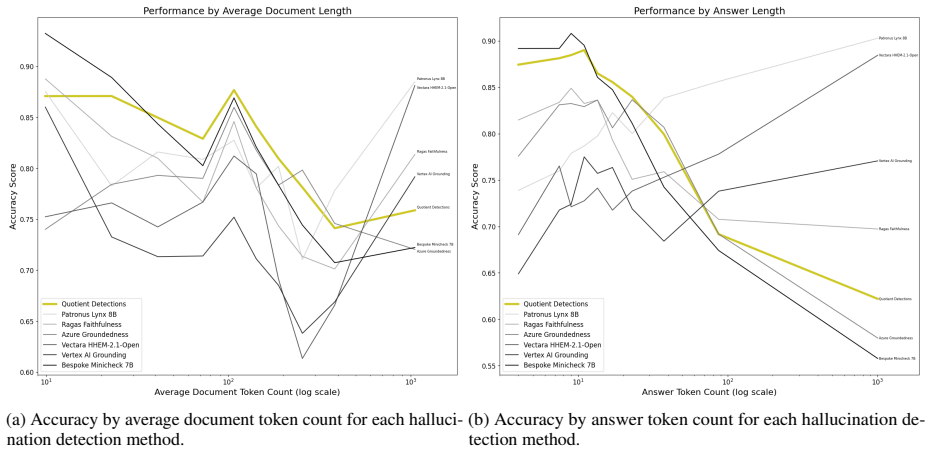
The central claim is that hallucination detection can and should be evaluated independently of a specific task such as question answering, and that doing so reveals large performance gaps tied to context length and input format. On HalluMix, Quotient Detections—a sentence-based LLM-as-a-judge that marks a response hallucinated if any sentence is unsupported—outperforms six other systems, including specialized open-weight models and commercial APIs, with 0.82 accuracy and 0.84 F1. The deeper finding is a trade-off: sentence-based detectors excel on short NLI and QA examples but over-predict hallucinations on long summaries, while continuous-context models such as Patronus Lynx and HHEM handle long documents better but struggle on short ones. The paper interprets this as evidence that granular claim verification and document-level coherence are in tension in current detectors.
Load-bearing premise
The benchmark's labels are valid hallucinations: neutral or contradictory NLI hypotheses are treated as hallucinated, and random summary-document mismatches are treated as representative hallucinations, so if those constructions do not match real-world hallucination, the ranking does not measure what it claims.
Editorial extensions
If this is right
- HalluMix provides a public benchmark that future hallucination detectors can be compared against across tasks and domains.
- RAG systems should not assume a detector trained or tuned on short QA pairs will work on long multi-document contexts; the paper shows accuracy can drop by 15–20 points on summarization data.
- Sentence-based detectors need sliding-window or hierarchical context to avoid over-predicting hallucinations in long-form text.
- General-purpose LLM judges are competitive with specialized fine-tuned detectors, suggesting that prompting strategies matter as much as task-specific training.
Reading between the lines
- The validity of HalluMix depends on the NLI label mapping; in real RAG usage, a neutral relationship (claim neither entailed nor contradicted) is not obviously a hallucination, so the benchmark may treat irrelevant-but-true responses as hallucinated.
- Random summary mismatches are coarse, unnatural hallucinations; subtle factual substitutions within a relevant document are more common in practice, so HalluMix may not capture the hardest failure modes.
- A natural extension would be a meta-detector that routes between sentence-based and continuous-context methods based on input length; the paper's results suggest such a hybrid could outperform every single system.
Signed reviews
Editorial analysis
A structured set of objections, weighed in public.
Referee Report
Summary. The paper introduces HalluMix, a benchmark for hallucination detection that repurposes existing human-curated NLI, summarization, and QA datasets into a task-agnostic format of multi-document contexts and full-sentence responses with binary faithfulness labels. The authors construct hallucinated examples via NLI label remapping, random summary/doc mismatches, and various QA transformations, and they evaluate seven detection systems (including the authors' own Quotient Detections) on a balanced 6.5k sample. They report that Quotient Detections achieves the best overall accuracy (0.82) and F1 (0.84), and they analyze performance variation across data types, document lengths, and context representations. The central claims are that HalluMix is a valid real-world hallucination detection benchmark and that Quotient Detections is the current best-performing detector on it.
Significance. If the label-construction methodology were validated, HalluMix would be a useful community resource: it is diverse in domains and task formats, moves beyond extractive QA, and explicitly addresses multi-document RAG-style contexts. The paper also ships a public benchmark and presents a comparative evaluation of both open and closed systems, which is valuable for practitioners. However, the significance is currently conditional on the validity of the constructed labels. The NLI neutral-to-hallucinated mapping, the random mismatch strategy, and the asymmetric distractor-chunk insertion all raise doubts about whether the benchmark measures the subtle factual errors typical of real LLM hallucinations. Because these concerns affect roughly two-thirds of the benchmark and directly determine the reported scores, the main conclusions are not yet established.
major comments (4)
- [§2.1.1] The mapping of NLI 'neutral' labels to 'hallucinated' is not validated. Under the paper's own definition, hallucination is text 'not grounded in supporting evidence,' but an NLI neutral hypothesis is merely neither entailed nor contradicted by the premise; it can state something true that is simply not inferable from the premise. The paper provides no human judgment study or error analysis showing that neutral hypotheses are actually hallucinations in the sense of false or unsupported content. Since roughly one-third of HalluMix comes from NLI, this label definition is load-bearing for every accuracy and F1 number in Table 2. I request either a human-validated subset or a restricted mapping (e.g., contradiction only) with results recomputed.
- [§2.1.2 and §2.3] The construction of hallucinated summarization and QA examples via random mismatches produces responses with little or no topical overlap with their assigned documents. Such examples are far easier than real LLM hallucinations, which typically preserve local fluency and plausibility while introducing subtle factual errors. The paper's own acknowledgment that transformed points 'should not be considered equivalent to their original source' (Section 2.3) underscores that the transformation has not been validated. In addition, distractor chunks are added only to faithful examples, so faithful and hallucinated examples differ not only in the response-context relation but also in context composition; this asymmetry is a potential cue that a detector could exploit. I ask for an analysis showing that constructed hallucinated examples are not separable by a simple lexical-overlap baseline and, ideally, a small human evaluation of label quality.
- [§4, Table 2 and footnote 1] Azure Groundedness could not evaluate 304 of the longest context examples, and the paper states that these long-context examples are generally more challenging. Because the reported Azure accuracy excludes these hard cases, the comparison is not on equal footing with the other methods. Since Azure's reported accuracy (0.784) is close to Quotient Detections' (0.821), the conclusion that Quotient Detections is best may depend on this exclusion. Please recompute all metrics on the subset that every method can evaluate, or report the excluded cases separately and discuss how the ranking changes.
- [§4, Table 2] The differences separating the top systems are small (Quotient Detections 0.821, Bespoke Minicheck 0.808, Patronus Lynx 0.808), and no confidence intervals, bootstrap estimates, or statistical significance tests are provided. Given the large per-source variance in Table 3, the claim that Quotient Detections 'achieves the best overall performance' needs uncertainty quantification. I request error bars or a paired test across the 6.5k examples.
minor comments (5)
- [§2.2] The LLM expansion of single-word QA answers is not described (model, prompt, validation procedure), so the resulting declarative sentences may introduce new errors; please specify the expansion protocol and provide examples.
- [§2.1.2] The claim that human-written summaries are 'faithful by default' should be stated as an assumption and ideally verified on a sample, since summarization datasets can contain ground-truth summaries that are only loosely faithful to the source documents.
- [§3, Table 1] For Azure Groundedness, the table marks the question input as 'Optional' but the text says there are separate QA and summarization request formats; please clarify exactly how the question is passed in each case, since this affects comparability across detectors.
- [Figure 3] The axes of Figure 3 are not labeled clearly; specify what is plotted for 'average document token count' and whether the points are binned averages, and add a legend or caption explaining the curves.
- [References] There are formatting errors in the reference list: 'V ectara' and 'V ertex' contain stray spaces in Section 3, the Free Dolly reference lacks an arXiv identifier, and the two Cohan et al. 2018 entries are identical despite referring to different datasets; please disambiguate them.
Circularity Check
No circular derivation: HalluMix is an external benchmark and the Quotient Detections result is an empirical comparison, not a consequence of construction.
full rationale
The paper builds HalluMix from external, human-curated NLI, summarization, and QA datasets, applies explicit label transformations (entailment->faithful; neutral/contradiction->hallucinated; random summary mismatches->hallucinated), and then runs seven separately implemented detectors on the resulting fixed evaluation set. No parameter is fitted from HalluMix to any detector, and no performance number is derived from the label-construction equations; each system's score is an independent empirical outcome. The paper even reports substantial variation across data sources (e.g., Patronus Lynx 8B outperforms Quotient Detections on PubMed, arXiv, and GovReport summarization), which would be impossible if the result were forced by construction. The NLI-derived labels may align naturally with LLM-as-judge approaches, and the fact that Quotient Detections is the authors' own product raises a conflict-of-interest and benchmark-validity concern, but neither is a circularity under the stated definitions: no self-citation is load-bearing, no uniqueness theorem is imported, and no ansatz is smuggled in via citation. The paper explicitly acknowledges that transformed points 'should not be considered equivalent to their original source,' further confirming that the benchmark is a modified external artifact rather than a self-referential derivation. Therefore the central claims are not circular; their validity depends on whether the constructed labels represent real-world hallucinations, which is a correctness/validity question outside the circularity pass.
Assumptions & free parameters
free parameters (2)
- Faithfulness probability threshold =
0.5
- Number of distractor chunks added to faithful examples =
10
assumptions (5)
- domain assumption NLI hypotheses labeled neutral or contradiction are hallucinations relative to the premise context.
- domain assumption Human-written reference summaries in selected summarization datasets are faithful by default.
- domain assumption A randomly mismatched summary paired with an unrelated document is a valid hallucinated example.
- domain assumption LLM-expanded single-word QA answers preserve the original faithfulness label.
- domain assumption Adding ten irrelevant distractor chunks to faithful examples does not change their faithfulness label.
Cite this review
Pith. "Pith review of HalluMix: A Task-Agnostic, Multi-Domain Benchmark for Real-World Hallucination Detection." pith.science (2026). https://pith.science/paper/343Y7JVW
@misc{pith2026250500506,
  author       = {Pith},
  title        = {Pith review of: HalluMix: A Task-Agnostic, Multi-Domain Benchmark for Real-World Hallucination Detection},
  year         = {2026},
  howpublished = {\url{https://pith.science/paper/343Y7JVW}},
  note         = {Machine review of arXiv:2505.00506}
}
abstract
As large language models (LLMs) are increasingly deployed in high-stakes domains, detecting hallucinated content$\unicode{x2013}$text that is not grounded in supporting evidence$\unicode{x2013}$has become a critical challenge. Existing benchmarks for hallucination detection are often synthetically generated, narrowly focused on extractive question answering, and fail to capture the complexity of real-world scenarios involving multi-document contexts and full-sentence outputs. We introduce the HalluMix Benchmark, a diverse, task-agnostic dataset that includes examples from a range of domains and formats. Using this benchmark, we evaluate seven hallucination detection systems$\unicode{x2013}$both open and closed source$\unicode{x2013}$highlighting differences in performance across tasks, document lengths, and input representations. Our analysis highlights substantial performance disparities between short and long contexts, with critical implications for real-world Retrieval Augmented Generation (RAG) implementations. Quotient Detections achieves the best overall performance, with an accuracy of 0.82 and an F1 score of 0.84.
Figures


Reference graph
Works this paper leans on
-
[1]
online" 'onlinestring :=
ENTRY address archivePrefix author booktitle chapter edition editor eid eprint eprinttype howpublished institution journal key month note number organization pages publisher school series title type volume year doi pubmed url lastchecked label extra.label sort.label short.list INTEGERS output.state before.all mid.sentence after.sentence after.block STRING...
-
[2]
write newline
" write newline "" before.all 'output.state := FUNCTION n.dashify 't := "" t empty not t #1 #1 substring "-" = t #1 #2 substring "--" = not "--" * t #2 global.max substring 't := t #1 #1 substring "-" = "-" * t #2 global.max substring 't := while if t #1 #1 substring * t #2 global.max substring 't := if while FUNCTION word.in bbl.in capitalize " " * FUNCT...
-
[3]
Azure AI Content Safety . 2024. https://learn.microsoft.com/en-us/azure/ai-services/content-safety/concepts/groundedness Groundedness detection
work page 2024
-
[4]
Bespoke Labs . 2024. https://huggingface.co/bespokelabs/Bespoke-MiniCheck-7B Bespoke-minicheck-7b
work page 2024
-
[5]
Bowman, Gabor Angeli, Christopher Potts, and Christopher D
Samuel R. Bowman, Gabor Angeli, Christopher Potts, and Christopher D. Manning. 2015. https://doi.org/10.18653/v1/D15-1075 A large annotated corpus for learning natural language inference . In Proceedings of the 2015 Conference on Empirical Methods in Natural Language Processing, pages 632--642, Lisbon, Portugal. Association for Computational Linguistics
-
[6]
Yulong Chen, Yang Liu, Liang Chen, and Yue Zhang. 2021. https://doi.org/10.18653/v1/2021.findings-acl.449 D ialog S um: A real-life scenario dialogue summarization dataset . In Findings of the Association for Computational Linguistics: ACL-IJCNLP 2021, pages 5062--5074, Online. Association for Computational Linguistics
-
[8]
Arman Cohan, Franck Dernoncourt, Doo Soon Kim, Trung Bui, Seokhwan Kim, Walter Chang, and Nazli Goharian. 2018 b . https://doi.org/10.18653/v1/N18-2097 A discourse-aware attention model for abstractive summarization of long documents . In Proceedings of the 2018 Conference of the North A merican Chapter of the Association for Computational Linguistics: Hu...
-
[9]
Mike Conover, Matt Hayes, Ankit Mathur, Jianwei Xie, Jun Wan, Sam Shah, Ali Ghodsi, Patrick Wendell, Matei Zaharia, and Reynold Xin. 2023. https://www.databricks.com/blog/2023/04/12/dolly-first-open-commercially-viable-instruction-tuned-llm Free dolly: Introducing the world's first truly open instruction-tuned llm
2023
Show all 29 references
-
[10]
Dheeru Dua, Yizhong Wang, Pradeep Dasigi, Gabriel Stanovsky, Sameer Singh, and Matt Gardner. 2019. https://doi.org/10.18653/v1/N19-1246 DROP : A reading comprehension benchmark requiring discrete reasoning over paragraphs . In Proceedings of the 2019 Conference of the North A ...
2019 doi
-
[11]
Shahul Es, Jithin James, Luis Espinosa Anke, and Steven Schockaert. 2024. https://aclanthology.org/2024.eacl-demo.16/ RAGA s: Automated evaluation of retrieval augmented generation . In Proceedings of the 18th Conference of the European Chapter of the Association for Computati...
2024
-
[12]
Rogger Luo Forrest Bao, Miaoran Li and Ofer Mendelevitch. 2024. https://doi.org/10.57967/hf/3240 HHEM-2.1-Open
2024 doi
-
[13]
Google Vertex AI . 2025. https://cloud.google.com/generative-ai-app-builder/docs/check-grounding Check grounding with rag
2025
-
[14]
Suchin Gururangan, Swabha Swayamdipta, Omer Levy, Roy Schwartz, Samuel Bowman, and Noah A. Smith. 2018. https://doi.org/10.18653/v1/N18-2017 Annotation artifacts in natural language inference data . In Proceedings of the 2018 Conference of the North A merican Chapter of the As...
2018 doi
-
[15]
Christopher Hidey and Kathy McKeown. 2016. https://doi.org/10.18653/v1/P16-1135 Identifying causal relations using parallel W ikipedia articles . In Proceedings of the 54th Annual Meeting of the Association for Computational Linguistics (Volume 1: Long Papers), pages 1424--143...
2016 doi
-
[16]
Lei Huang, Weijiang Yu, Weitao Ma, Weihong Zhong, Zhangyin Feng, Haotian Wang, Qianglong Chen, Weihua Peng, Xiaocheng Feng, Bing Qin, and Ting Liu. 2025. https://doi.org/10.1145/3703155 A survey on hallucination in large language models: Principles, taxonomy, challenges, and o...
2025 doi
-
[17]
Luyang Huang, Shuyang Cao, Nikolaus Parulian, Heng Ji, and Lu Wang. 2021. https://arxiv.org/abs/2104.02112 Efficient attentions for long document summarization . Preprint, arXiv:2104.02112
2021 arXiv
-
[18]
Cohen, and Xinghua Lu
Qiao Jin, Bhuwan Dhingra, Zhengping Liu, William W. Cohen, and Xinghua Lu. 2019. https://arxiv.org/abs/1909.06146 Pubmedqa: A dataset for biomedical research question answering . Preprint, arXiv:1909.06146
2019 arXiv
-
[19]
Tom \'a s Ko c isk \'y , Jonathan Schwarz, Phil Blunsom, Chris Dyer, Karl Moritz Hermann, G \'a bor Melis, and Edward Grefenstette. 2018. https://doi.org/10.1162/tacl_a_00023 The N arrative QA reading comprehension challenge . Transactions of the Association for Computational ...
2018 doi
-
[20]
Junyi Li, Xiaoxue Cheng, Wayne Xin Zhao, Jian-Yun Nie, and Ji-Rong Wen. 2023. https://arxiv.org/abs/2305.11747 Halueval: A large-scale hallucination evaluation benchmark for large language models . Preprint, arXiv:2305.11747
2023 arXiv
-
[21]
Cohen, and Mirella Lapata
Shashi Narayan, Shay B. Cohen, and Mirella Lapata. 2018. https://doi.org/10.18653/v1/D18-1206 Don`t give me the details, just the summary! topic-aware convolutional neural networks for extreme summarization . In Proceedings of the 2018 Conference on Empirical Methods in Natura...
2018 doi
-
[22]
Cheng Niu, Yuanhao Wu, Juno Zhu, Siliang Xu, Kashun Shum, Randy Zhong, Juntong Song, and Tong Zhang. 2024. https://arxiv.org/abs/2401.00396 Ragtruth: A hallucination corpus for developing trustworthy retrieval-augmented language models . Preprint, arXiv:2401.00396
2024 arXiv
-
[23]
Pranav Rajpurkar, Robin Jia, and Percy Liang. 2018. https://doi.org/10.18653/v1/P18-2124 Know what you don ' t know: Unanswerable questions for SQ u AD . In Proceedings of the 56th Annual Meeting of the Association for Computational Linguistics (Volume 2: Short Papers), pages ...
2018 doi
-
[24]
Pranav Rajpurkar, Jian Zhang, Konstantin Lopyrev, and Percy Liang. 2016. https://doi.org/10.18653/v1/D16-1264 SQ u AD : 100,000+ questions for machine comprehension of text . In Proceedings of the 2016 Conference on Empirical Methods in Natural Language Processing, pages 2383-...
2016 doi
-
[25]
Selvan Sunitha Ravi, Bartosz Mielczarek, Anand Kannappan, Douwe Kiela, and Rebecca Qian. 2024. https://arxiv.org/abs/2407.08488 Lynx: An open source hallucination evaluation model . Preprint, arXiv:2407.08488
2024 arXiv
-
[26]
Liu, and Christopher D
Abigail See, Peter J. Liu, and Christopher D. Manning. 2017. https://doi.org/10.18653/v1/P17-1099 Get to the point: Summarization with pointer-generator networks . In Proceedings of the 55th Annual Meeting of the Association for Computational Linguistics (Volume 1: Long Papers...
2017 doi
-
[27]
Liyan Tang, Philippe Laban, and Greg Durrett. 2024. https://arxiv.org/pdf/2404.10774 Minicheck: Efficient fact-checking of llms on grounding documents . In Proceedings of the 2024 Conference on Empirical Methods in Natural Language Processing. Association for Computational Linguistics
2024 arXiv
-
[28]
Alex Wang, Amanpreet Singh, Julian Michael, Felix Hill, Omer Levy, and Samuel Bowman. 2018. https://doi.org/10.18653/v1/W18-5446 GLUE : A multi-task benchmark and analysis platform for natural language understanding . In Proceedings of the 2018 EMNLP Workshop B lackbox NLP : A...
2018 doi
-
[29]
Adina Williams, Nikita Nangia, and Samuel Bowman. 2018. http://aclweb.org/anthology/N18-1101 A broad-coverage challenge corpus for sentence understanding through inference . In Proceedings of the 2018 Conference of the North American Chapter of the Association for Computationa...
2018
-
[30]
Cohen, Ruslan Salakhutdinov, and Christopher D
Zhilin Yang, Peng Qi, Saizheng Zhang, Yoshua Bengio, William W. Cohen, Ruslan Salakhutdinov, and Christopher D. Manning. 2018. https://arxiv.org/abs/1809.09600 Hotpotqa: A dataset for diverse, explainable multi-hop question answering . Preprint, arXiv:1809.09600
2018 arXiv
Reviewed August 16, 2026 · model on record in the stance chip above.
Discussion (0). Continue with ORCID to comment.