REVIEW 3 major objections 4 minor 1 cited by
Generalized susceptibilities and the properties of charm degrees of freedom across the QCD crossover temperature
T0 review · 3 major / 4 minor · reviewed 2026-08-16 · deepseek-v4-flash
Pith's one-line read Charm thermodynamics across the QCD crossover splits into hadron-like and quark-like pieces.
desk verdict The lattice data are careful and the continuum χC4 is usable, but the 'charm quark pressure' headline is a quasi-particle model output, not a measurement — worth publishing after revision. read the letter →
The pith
A machine-rendered reading of the paper's core claim, the machinery that carries it, and where it could break.
The reading
What carries the argument
The basic identity is the decomposition of total charm pressure into three partial pressures, $P^C = P_M^C + P_B^C + P_q^C$, with the quark piece projected by $P_q^C = 9(\chi^{BC}_{13} - \chi^{BC}_{22})/2$, an operator carrying $|B| = 1/3$ and $|C| = 1$. These are expressed as combinations of generalized charm susceptibilities $\chi^{BC}_{mn}$, and the continuum limit is reached by computing the quartic charm fluctuation $\chi^C_4$ on $N_\tau = 8, 12, 16$ lattices using a line of constant physics fixed by the $D$-meson mass. The hadronic baseline is QM-HRG, a hadron resonance gas that supplements PDG states with quark-model-predicted charmed hadrons; it is the benchmark against which the breakdown above $T_{pc}$ is measured.
What would settle it
Compute the spectral content of the operator $\chi^{BC}_{13} - \chi^{BC}_{22}$ above $T_{pc}$: if lattice correlation functions built from these current combinations show no $|B| = 1/3$ excitation peak that survives the continuum limit — or if charmed-hadron states with $|B| = 1$ contribute to this combination — then the claimed charm quark partial pressure is an artifact of the projection. A simpler complementary test: measure the isolated meson and baryon partial pressures independently from hadronic correlation functions and check that they sum with $P_q^C$ to the total charm pressure.
Extended reading notes
Core claim
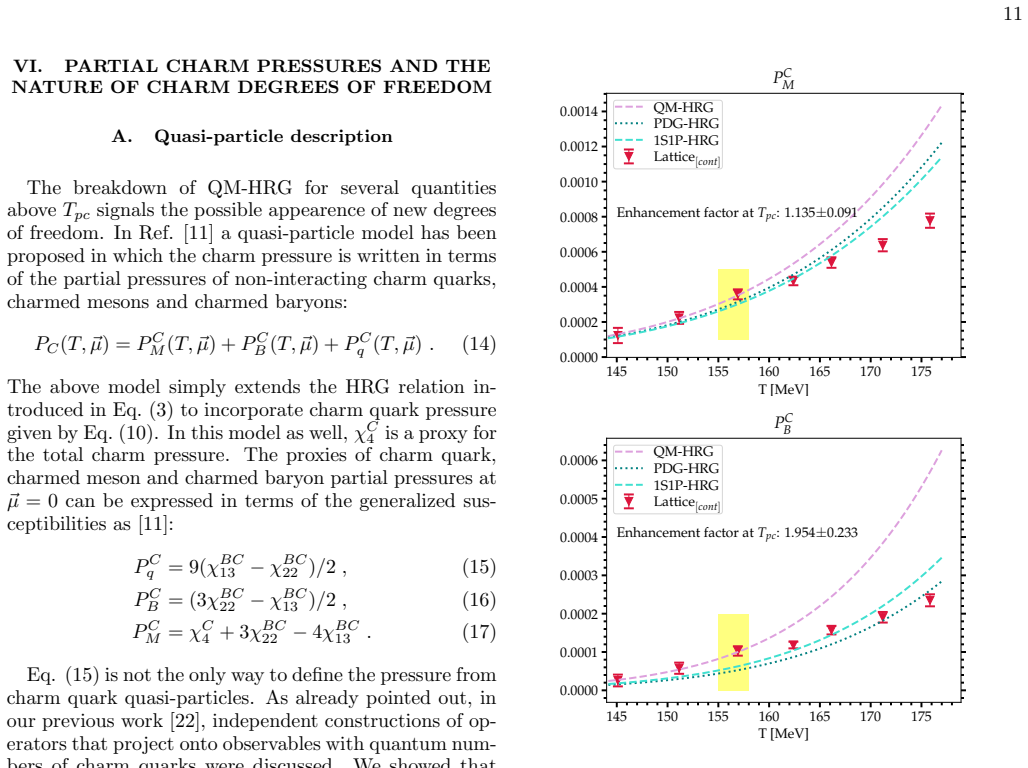
The central claim is that the QCD crossover in the charm sector is not a single transition from hadrons to free quarks but a gradual coexistence: below about $T_{pc}$ everything is charmed hadrons, while just above $T_{pc}$ a charm-quark-like excitation with baryon number $1/3$ and charm $1$ carries a nonzero share of the pressure, coexisting with charmed meson and baryon excitations that still dominate up to about 176 MeV. Quantitatively, continuum-limit charmed meson and baryon partial pressures are enhanced by factors $1.13(9)$ and $1.95(23)$ relative to PDG-based HRG, meaning half the charmed baryon pressure comes from states not in the tables. The quasi-particle model of Ref. [11], with pressures built from generalized susceptibilities, is the interpretive frame: charmed hadron pressures fall below quark-model HRG predictions above $T_{pc}$, while the extracted charm quark pressure rises from zero.
Load-bearing premise
The load-bearing premise is that the operator $P_q^C = 9(\chi^{BC}_{13} - \chi^{BC}_{22})/2$ isolates a charm-quark-like excitation with $|B| = 1/3$ and $|C| = 1$ and receives no contribution from charmed hadron states; if hadronic states overlap the operator, the nonzero 'quark pressure' above $T_{pc}$ would not establish a new quark-like degree of freedom.
Editorial extensions
If this is right
- At $T_{pc}$ the charmed baryon spectrum known to experiment supplies only about half the charmed baryon pressure; the other half must be composed of charmed baryon resonances predicted by quark models but not yet observed.
- Above the crossover the QM-HRG description fails, so heavy-ion phenomenology must not assume a purely hadronic charm yield even a few MeV above $T_{pc}$.
- The nonzero charm quark partial pressure above $T_{pc}$ gives a concrete quasi-particle mass for charm that drops with temperature.
- The ratio $\chi^{SC}_{22}/\chi^C_4$ is sensitive to doubly-strange charmed baryons; matching it may require shifting their masses down by about 100 MeV compared to current quark-model predictions.
Reading between the lines
- A sharp way to test the quark-like assignment is to compute, on the lattice, the overlap of the operator in Eq. (15) with charmed hadron states; if that overlap is nonzero, some of the 'quark pressure' is actually hadron pressure relabeled.
- If the coexistence picture is right, charm-flow observables in heavy-ion collisions should show a gradual onset of quark transport rather than an abrupt appearance.
- The same susceptibility-ratio technology could be applied to bottom quarks, whose larger mass should push the analogous crossover to higher temperatures.
- Because $\chi^C_4$ agrees with QM-HRG even above $T_{pc}$ while some ratios do not, total charm yield alone is a poor probe of deconfinement; only charge- and strangeness-resolved correlations separate the degrees of freedom.
Signed reviews
Editorial analysis
A structured set of objections, weighed in public.
Referee Report
Summary. The paper presents a lattice QCD study of generalized charm susceptibilities in 2+1 flavor QCD with quenched charm, using HISQ configurations at Nτ = 8, 12, and 16. A new line of constant physics (LCP[D]) is constructed by requiring the physical D-meson mass, which reduces the dominant cutoff effects in the charm sector. The authors provide a continuum estimate of the quartic charm fluctuation χ_4^C and study ratios of baryon-charm, charge-charm, and strangeness-charm susceptibilities. They show that below T_pc the results are described by a quark-model based hadron resonance gas (QM-HRG) that includes missing charmed states, while above T_pc the QM-HRG description breaks down for several observables. Using a quasi-particle decomposition proposed in Refs. [11] and [22], the paper converts the susceptibility ratios into partial pressures of charmed mesons, charmed baryons, and charm quarks, and reports that the charm quark partial pressure becomes nonzero above the chiral crossover, with a temperature-dependent in-medium mass m_C^q(T). The paper also decomposes charmed pressures by strangeness and discusses the sensitivity of χ_22^{SC} to the spectrum of doubly-strange charmed baryons.
Significance. If the central interpretation is correct, the paper provides important evidence that charm thermodynamics across the QCD crossover is described by coexisting charmed hadron-like and quark-like excitations, with a charmed baryon spectrum substantially richer than the PDG tables. The work has several concrete strengths: the LCP[D] construction demonstrably reduces a large source of cutoff effect; the Nτ = 8[b] and Nτ = 12[b] ratios agree where both are available, supporting the ratio method; errors are propagated with bootstrap procedures; and all data are publicly released. The paper is also appropriately cautious in several places, explicitly labeling the HRG description of χ_4^C above T_pc as accidental and the 1S1P-HRG comparison as rough guidance. However, the headline result is not a direct lattice measurement: the nonzero charm quark pressure is an output of a model decomposition whose central operator, Eq. (15), has not been validated in the present paper beyond a self-cited consistency test from Ref. [22]. The significance of the paper therefore depends on whether this model dependence is made fully explicit and whether the projection is supported by independent tests.
major comments (3)
- [Sec. VI.A, Eq. (15)] The operator P_C^q = 9(χ_13^{BC} − χ_22^{BC})/2 vanishes by construction for any non-interacting species with C = 1 and B = 0 or B = 1, so the observed vanishing below T_pc is a built-in property of the HRG-like assignment and does not by itself provide independent evidence for the absence of quark-like excitations. Moreover, the same operator yields identical values for B = 1/3 and B = 2/3 carriers because B − B^2 = 2/9 in both cases. Interpreting P_C^q as a charm quark partial pressure therefore requires the additional assumptions that the system is a non-interacting mixture of mesons, baryons, and B = 1/3 quarks, and that no charmed hadron contributes to the combination. The only direct validation cited is the three-operator consistency test in the authors' previous work [22], which is not reproduced or described in sufficient detail here. Unless this test is shown or an independent validation is provided, the abstract's statement that 'the charm quark pressure becomes non-zero above the chiral crossover' is not established by the present lattice data.
- [Sec. VI.A, Figs. 12 and 13] The continuum estimates of P_C^M, P_C^B, and P_C^q shown in Figs. 12 and 13 are formed by multiplying the Nτ = 8[b] normalized ratios from Ref. [22] by the Nτ = 16[D] continuum estimate of χ_4^C, rather than by continuum-extrapolating the combinations in Eqs. (15)–(17) themselves. Cutoff cancellation is demonstrated for the ratios, but the product with a separately continuum-extrapolated overall normalization has no documented systematic uncertainty. A direct continuum extrapolation of P_C^q/χ_4^C (or of P_C^q itself) using the Nτ = 8 and Nτ = 12 data presented in this paper would be needed to support the quoted absolute values and the associated enhancement factors.
- [Sec. VI.A, Eq. (14)] The decomposition P_C = P_M + P_B + P_q assumes that the three channels are non-interacting and independent, with all in-medium effects encoded in the temperature-dependent mass m_C^q in Eq. (10). If interactions mix the channels, the linear relations (15)–(17) do not define physical partial pressures. The manuscript should state this limitation explicitly in the abstract or conclusions, or soften the headline claim from 'the charm quark pressure becomes non-zero' to 'the charm-quark-like projection of the susceptibilities becomes non-zero in the quasi-particle model'.
minor comments (4)
- [Eq. (13)] In the sentence following Eq. (13), the symbol P_{C,S=2}^{M} should be P_{C,S=2}^{B}, since the text is describing the partial pressure of strange charmed baryons with strangeness two, not mesons.
- [Fig. 14 caption] The caption of Fig. 14 states 'Solid: QM-HRG, Dotted: PDG-HRG, Dashed: 1S1P-HRG', while the main text and the figure keys elsewhere describe 'Dashed: QM-HRG, Dotted: PDG-HRG, Solid: 1S1P-HRG'. The line styles should be made consistent.
- [Sec. VI.A, Fig. 13 caption] The phrase 'quarks-antiquarks' in the note about m_C^q differing from Ref. [29] should read 'quarks and antiquarks'.
- [Sec. V, concluding paragraph] The sentence 'the QM-HRG description breaks down just above T_pc signaling the appearance of new degrees of freedom' uses stronger language than the earlier 'signals the possible appearance'; since the quasi-particle interpretation is model-dependent, 'possibly signaling' would be more accurate.
Circularity Check
The 'charm quark pressure' is a relabeled HRG-breakdown observable defined by Eq. (15), with the quark interpretation supported only by a self-cited consistency test.
-
self definitional
[Abstract; Sec. V summary; Sec. VI.A, Eq. (15)]
"Abstract: '...the charm quark pressure becomes non-zero above the chiral crossover.' Eq. (15): 'PC q = 9(χBC 13 − χBC 22)/2.' Sec. V: 'For T <Tpc, the ratios χBC 13 /χC 4 and χBC 22 /χC 4 agree with each other as expected based on the Eq. (6).'"
PC q is not an independently measured quantity. Equation (15) defines it as 9/2 times the difference of the two lattice susceptibilities χBC 13 and χBC 22. In QM-HRG every |C|=1 charmed hadron has baryon number B=0 (meson) or B=1 (baryon), so the combination B−B^2 vanishes and PC q=0 identically. The paper's own summary states that QM-HRG 'breaks down just above Tpc signaling the appearance of new degrees of freedom' precisely because these susceptibilities deviate from their HRG pattern. Therefore 'the charm quark pressure becomes non-zero above the chiral crossover' is the same empirical statement as the HRG breakdown, rewritten through a linear combination of the same data.
-
self citation load bearing
[Sec. VI.A, after Eqs. (15)-(17)]
"Sec. VI.A: 'As already pointed out, in our previous work [22], independent constructions of operators that project onto observables with quantum numbers of charm quarks were discussed. We showed that three such operators ... vanish below Tpc, and give consistent results at temperatures above Tpc. This consistency can only be achieved if the proposed quasi-particle describes the charm thermodynamics in the explored temperature range.'"
The only direct validation offered for interpreting Eq. (15) as a charm-quark pressure is a consistency test performed in the authors' own previous paper [22], whose author list overlaps with the present paper (Kaczmarek, Karsch, Petreczky, Schmidt, Sharma). That test is not reproduced here, and as described it checks consistency among operators built from the same generalized susceptibilities; it does not calibrate PC q against an external measurement of a quark degree of freedom. The quasi-particle decomposition itself is adopted from Ref. [11] (Mukherjee, Petreczky, Sharma), also by the present authors. Thus the central interpretation—that the non-zero value of Eq.
full rationale
The lattice calculations and low-temperature HRG comparisons are not circular: the paper presents new Nτ=8, 12 and 16 data, constructs a D-meson-based line of constant physics, continuum-extrapolates χC4, and compares generalized susceptibility ratios with QM-HRG and PDG-HRG. The evidence for missing charmed hadrons below Tpc is an independent empirical conclusion. Circularity enters at the quasi-particle stage, which carries the headline claim. Equation (15) defines PC q as (9/2)(χBC_13 − χBC_22). Since all HRG charmed hadrons have B=0 or B=1, this combination is zero by construction in the hadronic phase; its non-zero value above Tpc is exactly the deviation of χBC_13 from χBC_22 that the paper already uses to conclude that the QM-HRG description breaks down just above Tpc. Calling this combination 'charm quark pressure' therefore renames the breakdown rather than predicting a genuinely new degree of freedom from first principles. The identification with a charm-quark quasi-particle is an ansatz imported from the authors' Refs. [11,22], and the only cited validation, the three-operator consistency test, is from the same collaboration and is not reproduced. The extracted in-medium mass mC_q is a per-temperature inversion of Eq. (10), i.e., a fitted parameter rather than an independent prediction. On balance the paper contains substantial independent lattice content, but the specific central claim that the charm quark pressure becomes non-zero above the chiral crossover reduces by construction to a linear combination of the same susceptibilities whose HRG deviation is the evidence, so partial circularity is present.
Assumptions & free parameters
free parameters (3)
- In-medium charm quark quasi-particle mass mC_q(T) =
about 1.9 GeV at T = 162 MeV, decreasing with temperature; errors from 50 fake Gaussian samples
- Mass shift of missing |S| = 2 charmed baryons =
-100 MeV applied to all missing doubly-strange charmed baryons in the alternative QM-HRG
- LCP[D] fit parameters m1c and dm1c in Eq. (11) =
m1c = 140585.6 ± 16567.8, dm1c = 92506.3 ± 11434.4
assumptions (6)
- domain assumption The charm quark sector can be treated in the quenched approximation: charm quarks appear only in the measured observables and do not feed back into the gauge field configurations.
- domain assumption The QM-HRG2024c particle list, using relativistic quark model masses from Ebert, Faustov and Galkin for undiscovered charmed hadrons, faithfully represents the charmed hadron spectrum relevant below Tpc.
- ad hoc to paper The quasi-particle decomposition Eq. (14): PC = PC_M + PC_B + PC_q, with non-interacting contributions and no cross-channel interference, and with the operator projections Eqs. (15)-(17) isolating the quantum numbers of charm quarks, mesons and baryons.
- standard math Boltzmann statistics is adequate for charmed mesons, charmed baryons and charm quarks in the studied temperature range.
- domain assumption Nτ=16[D] lattice results can be used directly as the continuum estimate of χC_4 and of the partial pressures.
- domain assumption Interpolations of ln(χC_4) as a linear function of the bare charm quark mass amc define the LCP[D] values.
invented entities (1)
-
Charm quark-like quasi-particle (excitation with the quantum numbers of a charm quark, with temperature-dependent in-medium mass mC_q(T))
Cite this review
Pith. "Pith review of Generalized susceptibilities and the properties of charm degrees of freedom across the QCD crossover temperature." pith.science (2026). https://pith.science/paper/DETCQVUN
@misc{pith2026250501734,
  author       = {Pith},
  title        = {Pith review of: Generalized susceptibilities and the properties of charm degrees of freedom across the QCD crossover temperature},
  year         = {2026},
  howpublished = {\url{https://pith.science/paper/DETCQVUN}},
  note         = {Machine review of arXiv:2505.01734}
}
read the original abstract
We study the generalized charm susceptibilities in 2+1 flavor QCD on the lattice at several lattice spacings. We show that, below the chiral crossover, these susceptibilities are well described by the hadron resonance gas (HRG) model if charmed hadrons not listed in tables of the Particle Data Group are included. However, the HRG description abruptly breaks down just above the chiral crossover. To understand this, we use a model for the charm pressure in which it is expressed as the sum of partial pressures from charmed baryons, charmed mesons, and charm quarks. We present continuum estimates of these partial pressures and find that, while the partial pressures of charmed mesons and baryons drop below their respective HRG predictions, the charm quark pressure becomes non-zero above the chiral crossover.
Figures


Figures from the paper (12 more)




Forward citations
Cited by 1 Pith paper
-
Coupled charm and charmonium transport in a strongly coupled quark-gluon plasma
A unified T-matrix transport framework for charm-quark diffusion and charmonium kinetics with off-shell spectral functions recovers the statistical equilibrium limit and gives fair LHC charmonium R_AA data.
Reference graph
Works this paper leans on
-
[22]
A. Bazavov, D. Bollweg, O. Kaczmarek, F. Karsch, S. Mukherjee, P. Petreczky, C. Schmidt, and S. Sharma, Phys. Lett. B850, 138520 (2024), arXiv:2312.12857 [hep- lat]
arXiv 2024
-
[11]
P. Braun-Munzinger and J. Stachel, Nucl. Phys. A 690, 119 (2001), arXiv:nucl-th/0012064
arXiv 2001
-
[1]
A. Bazavov et al. (HotQCD), Phys. Lett. B 795, 15 (2019), arXiv:1812.08235 [hep-lat]
arXiv 2019
-
[2]
More specifically, for not yet observed charmed states we used the relativistic quark model of Refs
To construct the QM-HRG2024c list we used PDG-HRG2024c and added charmed hadron resonances not observed so far but obtained in quark model calculations [36–40]. More specifically, for not yet observed charmed states we used the relativistic quark model of Refs. [37, 38]. In the HRG phase, generalized susceptibilities intro- duced in Eq. (2) are calculated...
work page 1900
-
[3]
MeV taken from Eqs. 58 and 80 of Ref. [48], respectively. The fit resulted in m1c = 140585.579± 16567.799, dm1c = 92506.328± 11434.443, (12) with a χ2/dof = 0.414. In Fig. 5, the band represents the bootstrap error of fits performed on 100 Gaussian distributed fake samples using Eq. 11. In addition to the LCP [D], shown in Fig. 5 as band, we show there al...
-
[4]
Matsui and H
T. Matsui and H. Satz, Phys. Lett. B 178, 416 (1986)
1986
- [5]
-
[6]
J. W. Harris and B. M¨ uller, Eur. Phys. J. C 84, 247 (2024), arXiv:2308.05743 [hep-ph]
arXiv 2024
Show all 52 references
-
[7]
Braun-Munzinger and J
P. Braun-Munzinger and J. Stachel, Phys. Lett. B 490, 196 (2000), arXiv:nucl-th/0007059
2000 arXiv
-
[8]
M. He, H. van Hees, and R. Rapp, Prog. Part. Nucl. Phys. 130, 104020 (2023), arXiv:2204.09299 [hep-ph]
2023 arXiv
-
[9]
Beraudo et al
A. Beraudo et al. , Nucl. Phys. A 979, 21 (2018), arXiv:1803.03824 [nucl-th]
2018 arXiv
-
[10]
Bazavov et al
A. Bazavov et al. , Phys. Lett. B 737, 210 (2014), arXiv:1404.4043 [hep-lat]
2014 arXiv
-
[12]
Andronic, P
A. Andronic, P. Braun-Munzinger, K. Redlich, and J. Stachel, Nature 561, 321 (2018), arXiv:1710.09425 [nucl-th]
2018 arXiv
-
[13]
Borsanyi, Z
S. Borsanyi, Z. Fodor, C. Hoelbling, S. D. Katz, S. Krieg, and K. K. Szabo, Phys. Lett. B 730, 99 (2014), arXiv:1309.5258 [hep-lat]
2014 arXiv
-
[14]
Mukherjee, P
S. Mukherjee, P. Petreczky, and S. Sharma, Phys. Rev. D 93, 014502 (2016), arXiv:1509.08887 [hep-lat]
2016 arXiv
-
[15]
Bazavov et al
A. Bazavov et al. (HotQCD), Phys. Rev. D 90, 094503 (2014), arXiv:1407.6387 [hep-lat]
2014 arXiv
-
[16]
Bellwied, S
R. Bellwied, S. Borsanyi, Z. Fodor, S. D. Katz, A. Pasz- tor, C. Ratti, and K. K. Szabo, Phys. Rev. D 92, 114505 (2015), arXiv:1507.04627 [hep-lat]
2015 arXiv
-
[17]
Bollweg, D
D. Bollweg, D. A. Clarke, J. Goswami, O. Kaczmarek, F. Karsch, S. Mukherjee, P. Petreczky, C. Schmidt, and S. Sharma (HotQCD), Phys. Rev. D 108, 014510 (2023), arXiv:2212.09043 [hep-lat]
2023 arXiv
-
[18]
Bazavov et al
A. Bazavov et al. (HotQCD), Phys. Rev. D 86, 034509 (2012), arXiv:1203.0784 [hep-lat]
2012 arXiv
-
[19]
Biswas, P
D. Biswas, P. Petreczky, and S. Sharma, Phys. Rev. C 109, 055206 (2024), arXiv:2401.02874 [hep-ph]
2024 arXiv
-
[20]
Bollweg, J
D. Bollweg, J. Goswami, O. Kaczmarek, F. Karsch, S. Mukherjee, P. Petreczky, C. Schmidt, and P. Scior (HotQCD Collaboration), Phys. Rev. D 104, 074512 (2021), arXiv:2107.10011 [hep-lat]
2021 arXiv
-
[21]
Bollweg, J
D. Bollweg, J. Goswami, O. Kaczmarek, F. Karsch, S. Mukherjee, P. Petreczky, C. Schmidt, and P. Scior (HotQCD), Phys. Rev. D 105, 074511 (2022), arXiv:2202.09184 [hep-lat]
2022 arXiv
-
[23]
Bazavov et al., Phys
A. Bazavov et al., Phys. Rev. Lett. 113, 072001 (2014), arXiv:1404.6511 [hep-lat]
2014 arXiv
-
[24]
Braun-Munzinger, K
P. Braun-Munzinger, K. Redlich, N. Sharma, and J. Stachel, JHEP 04, 058 (2025), arXiv:2408.07496 [hep- ph]
2025 arXiv
-
[25]
S. Y. F. Liu and R. Rapp, Phys. Rev. C 106, 055201 (2022), arXiv:2111.13620 [hep-ph]
2022 arXiv
-
[26]
Aarts, C
G. Aarts, C. Allton, R. Bignell, T. J. Burns, S. C. Garc´ ıa- Mascaraque, S. Hands, B. J¨ ager, S. Kim, S. M. Ryan, and J.-I. Skullerud, (2022), arXiv:2209.14681 [hep-lat]
2022 arXiv
-
[27]
Aarts, C
G. Aarts, C. Allton, M. N. Anwar, R. Bignell, T. J. Burns, B. J¨ ager, and J.-I. Skullerud, Eur. Phys. J. A 60, 59 (2024), arXiv:2308.12207 [hep-lat]
2024 arXiv
-
[28]
Sharma, Int
S. Sharma, Int. J. Mod. Phys. A 40, 2444011 (2025), arXiv:2410.04222 [hep-lat]
2025 arXiv
-
[29]
Sharma, PoS LATTICE2022, 191 (2023), arXiv:2212.11148 [hep-lat]
S. Sharma, PoS LATTICE2022, 191 (2023), arXiv:2212.11148 [hep-lat]
2023 arXiv
-
[30]
Sharma, in 40th International Symposium on Lattice Field Theory (2024) arXiv:2401.01194 [hep-lat]
S. Sharma, in 40th International Symposium on Lattice Field Theory (2024) arXiv:2401.01194 [hep-lat]
2024 arXiv
-
[31]
Kong, J.-T
S.-Y. Kong, J.-T. Zhu, and J. He, Eur. Phys. J. C 82, 834 (2022), arXiv:2208.11962 [hep-ph]
2022 arXiv
-
[32]
Sharma, F
S. Sharma, F. Karsch, and P. Petreczky, J. Subatomic Part. Cosmol. 3, 100044 (2025), arXiv:2501.01300 [hep- lat]
2025 arXiv
-
[33]
Sharma (HotQCD), in 41st International Symposium on Lattice Field Theory (2025) arXiv:2503.17818 [hep- lat]
S. Sharma (HotQCD), in 41st International Symposium on Lattice Field Theory (2025) arXiv:2503.17818 [hep- lat]
2025 arXiv
-
[34]
Bollweg, J
D. Bollweg, J. Goswami, O. Kaczmarek, F. Karsch, S. Mukherjee, P. Petreczky, C. Schmidt, and P. Scior, Dataset for Second order cumulants of conserved charge fluctuations revisited: Vanishing chemical potentials , Bielefeld University (2021), https://doi.org/10.4119/unibi/2957724
2021
-
[35]
For instance, we added the unobserved D∗ + in addition to the observed D∗
and we augmented it in some cases by not observed isospin partners of experimentally observed states. For instance, we added the unobserved D∗ + in addition to the observed D∗
-
[36]
Kong, J.-T
S.-Y. Kong, J.-T. Zhu, and J. He, Eur. Phys. J. C 83, 436 (2023), arXiv:2304.02920 [hep-ph]
2023 arXiv
-
[37]
Kaczmarek, F
O. Kaczmarek, F. Karsch, P. Petreczky, C. Schmidt, and S. Sharma, Dataset for Generalized susceptibilities and the properties of charm degrees of freedom across the QCD crossover temperatures , Bielefeld University (2025), https://doi.org/10.4119/unibi/3006107
2025
-
[38]
Navas et al
S. Navas et al. (Particle Data Group), Phys. Rev. D 110, 030001 (2024)
2024
-
[39]
H.-X. Chen, W. Chen, X. Liu, Y.-R. Liu, and S.-L. Zhu, Rept. Prog. Phys. 86, 026201 (2023), arXiv:2204.02649 [hep-ph]
2023 arXiv
-
[40]
Ebert, R
D. Ebert, R. N. Faustov, and V. O. Galkin, Phys. Rev. D 84, 014025 (2011), arXiv:1105.0583 [hep-ph]
2011 arXiv
-
[41]
Ebert, R
D. Ebert, R. N. Faustov, and V. O. Galkin, Eur. Phys. J. C 66, 197 (2010), arXiv:0910.5612 [hep-ph]
2010 arXiv
-
[42]
Roberts and M
W. Roberts and M. Pervin, Int. J. Mod. Phys. A23, 2817 (2008), arXiv:0711.2492 [nucl-th]
2008 arXiv
-
[43]
Yoshida, E
T. Yoshida, E. Hiyama, A. Hosaka, M. Oka, and K. Sadato, Phys. Rev. D 92, 114029 (2015), arXiv:1510.01067 [hep-ph]. 16
2015 arXiv
-
[44]
Kato et al
Y. Kato et al. (Belle), Phys. Rev. D 94, 032002 (2016), arXiv:1605.09103 [hep-ex]
2016 arXiv
-
[45]
Aaij et al
R. Aaij et al. (LHCb), Phys. Rev. Lett. 118, 182001 (2017), arXiv:1703.04639 [hep-ex]
2017 arXiv
- [46]
-
[47]
Andronic, P
A. Andronic, P. Braun-Munzinger, M. K. K¨ ohler, and J. Stachel, Nucl. Phys. A 982, 759 (2019), arXiv:1807.01236 [nucl-th]
2019 arXiv
-
[48]
J. H. Weber, A. Bazavov, and P. Petreczky, PoS LAT- TICE2021, 060 (2021), arXiv:2110.03606 [hep-lat]
2021 arXiv
-
[49]
Follana, Q
E. Follana, Q. Mason, C. Davies, K. Hornbostel, G. Lep- age, J. Shigemitsu, H. Trottier, and K. Wong (HPQCD, UKQCD), Phys. Rev. D 75, 054502 (2007), arXiv:hep- lat/0610092
2007
-
[50]
Bazavov et al
A. Bazavov et al. (MILC), Phys. Rev. D 82, 074501 (2010), arXiv:1004.0342 [hep-lat]
2010 arXiv
-
[51]
Aoki et al
Y. Aoki et al. (Flavour Lattice Averaging Group (FLAG)), (2024), arXiv:2411.04268 [hep-lat]
2024 arXiv
-
[52]
Bazavov, F
A. Bazavov, F. Karsch, Y. Maezawa, S. Mukherjee, and P. Petreczky, Phys. Rev. D 91, 054503 (2015), arXiv:1411.3018 [hep-lat]
2015 arXiv
Reviewed August 16, 2026 · model on record in the stance chip above.
Discussion (0). Continue with ORCID to comment.