REVIEW 4 major objections 6 minor 46 references
Privacy Preserving Machine Learning Model Personalization through Federated Personalized Learning
T0 review · 4 major / 6 minor · reviewed 2026-08-16 · deepseek-v4-flash
Pith's one-line read This study reports that APPLE+HE, the homomorphic-encryption variant of the APPLE personalized federated learning algorithm, achieved the highest accuracy, precision, recall, and F1 score among four privacy-preserving variants on the…
desk verdict A benchmark comparison that cannot be audited: no privacy parameters, no error bars, no code, and an internal inconsistency in the headline number. read the letter →
The pith
A machine-rendered reading of the paper's core claim, the machinery that carries it, and where it could break.
The reading
What carries the argument
The central object is the APPLE algorithm (Adaptive Personalized Cross-Silo Federated Learning), a personalized federated learning method that adapts local aggregation for each client. The paper combines APPLE with four privacy-preserving primitives: homomorphic encryption (HE), differential privacy (DP), secure aggregation (SA), and secure multi-party computation (SMPC). Homomorphic encryption allows the server to sum encrypted local model updates directly, so the aggregation step operates on ciphertexts and decryption reveals only the aggregated result, not individual contributions. This property is what the paper credits for APPLE+HE's high accuracy, while the other techniques trade away accuracy or speed through noise, masking, or cryptographic overhead.
What would settle it
Re-run the four APPLE variants on the same Virus-MNIST test split with the same 200-client setup and the same disclosed privacy parameters (for example, a specific epsilon and delta for APPLE+DP and a named HE scheme with its parameters); if APPLE+DP achieves accuracy close to or above 99.34% at a comparable or smaller privacy loss, the paper's claim that APPLE+HE is the best-performing approach would not hold.
Extended reading notes
Core claim
The paper's central claim is that APPLE+HE outperformed the three competing approaches (APPLE+SMPC, APPLE+DP, and APPLE+SA) on every reported performance metric. In particular, APPLE+HE achieved 99.34% accuracy, precision, recall, and F1-score, compared with 97.48%, 97.44%, and 85.38% for APPLE+DP, APPLE+SA, and APPLE+SMPC respectively. The authors interpret this as evidence that homomorphic encryption can protect individual model updates during aggregation without degrading model utility, and they conclude that the results strongly support APPLE+HE as the recommended algorithm for privacy-preserving machine learning in federated personalized settings, with APPLE+DP offering the most efficient execution.
Load-bearing premise
The reported ranking of APPLE+HE over APPLE+DP, APPLE+SA, and APPLE+SMPC assumes all four variants were implemented correctly, given identical training budgets, hyperparameters, and test splits, yet the paper does not disclose the DP noise scale, the HE scheme, or any implementation code.
Editorial extensions
If this is right
- If APPLE+HE genuinely maintains near-perfect accuracy on Virus-MNIST while preserving privacy, it suggests that homomorphic encryption can be a practical choice for personalized federated learning without a utility penalty.
- The large gap between APPLE+HE (99.34%) and APPLE+SMPC (85.38%) implies that the choice of cryptographic protocol materially affects model quality, not just runtime, on this benchmark.
- APPLE+DP's lower execution times indicate that differential privacy remains competitive when computational efficiency is the priority, even if its accuracy is slightly below APPLE+HE.
- The results position APPLE+HE as a candidate default for privacy-preserving personalized federated learning in settings where accuracy is paramount and clients can tolerate the added latency described in the paper.
- The paper's conclusion that APPLE+HE should be recommended is conditional on further evaluation of computational complexity, scalability, and application requirements, which it explicitly defers to future work.
Reading between the lines
- A single dataset, Virus-MNIST, carries the entire comparison; the ordering of APPLE+HE over APPLE+DP may not transfer to other data distributions, model architectures, or client counts.
- The paper does not disclose the DP noise scale (for example, the epsilon and delta budgets) or the HE scheme and parameter settings, so the reported margins could shift if those privacy parameters were chosen differently.
- A natural testable extension would be to vary the privacy budget continuously and plot the accuracy-versus-privacy frontier; the paper's headline ranking might invert at small epsilon values where DP noise is large.
- In practice, homomorphic encryption usually imposes substantial communication and computation costs on real workloads, so the paper's recommendation of APPLE+HE should be read as utility-focused rather than efficiency-focused.
Signed reviews
Editorial analysis
A structured set of objections, weighed in public.
Referee Report
Summary. This manuscript reports an empirical comparison of federated personalized learning (FPL) algorithms on the Virus-MNIST dataset. It first evaluates existing FPL methods (APFL, APPLE, Ditto, FedALA, FedFomo, and others) and then combines the best performer, APPLE, with differential privacy (DP), homomorphic encryption (HE), secure aggregation (SA), and secure multi-party computation (SMPC). It reports that APPLE+HE achieves the highest accuracy, precision, recall, and F1-score (99.34% in Table III, stated as 99.37% in the text), recommends APPLE+HE, and notes that APPLE+DP offers more efficient execution in terms of server clock running time.
Significance. If the comparison were correctly implemented and fully documented, the benchmark could be a useful reference for practitioners choosing among privacy-preserving personalization techniques. The paper's broad coverage of the FPL literature and its clear definition of standard evaluation metrics are strengths. However, the central contribution is a purely empirical ranking, and the manuscript provides no code, no disclosure of privacy or encryption parameters, no uncertainty quantification, and only a single dataset. The ranking is therefore not auditable, the comparison is not controlled, and the internal accuracy inconsistency directly undermines the headline claim. The fact that the paper ships no reproducible artifacts means the claimed contribution cannot be verified from the manuscript alone.
major comments (4)
- [IV-B and V-C] The description of the four privacy-preserving variants is conceptual only, relying on Eqs. (1)-(4). No differential privacy mechanism (Laplace vs. Gaussian), privacy budget epsilon/delta, homomorphic encryption scheme or security parameter, secure aggregation protocol, or SMPC threat model is disclosed. Because the central claim is an empirical ranking of APPLE+HE over APPLE+DP, APPLE+SA, and APPLE+SMPC, these missing implementation details are load-bearing: without them the experiments cannot be reproduced or audited, and the ordering could change under different parameter choices.
- [V-C, Table III] The headline ranking rests on a single accuracy value per algorithm, with no confidence intervals, standard deviations, or repeated-seed results, and no statistical test. The margin between APPLE+HE (99.34%) and APPLE+DP (97.48%) or APPLE+SA (97.44%) is only about 1.9 percentage points, which is well within the range of seed-to-seed variability for deep federated training. In addition, the text in Section V-C reports 99.37% for APPLE+HE while Table III reports 99.34% for the same quantity, so the paper is internally inconsistent.
- [IV-A, V-B, V-C] The comparison is not controlled: APPLE+DP is reported at 97.48% accuracy, which is higher than the plain APPLE model's 97.41% in Table II. For non-negligible differential privacy noise this is unexpected, and the more likely explanation is that the DP noise was negligible or that the training budgets, test splits, or hyperparameters differed across the variants. The manuscript does not state the data partition, the number of communication rounds, or the hyperparameters used for each PPMLFPL variant, so a reader cannot determine whether all four algorithms were evaluated under identical conditions.
- [Table IV and V-C] The execution-time claim is also under-specified. 'Server clock running time' is not defined, no hardware details are given, no repeated measurements or error bars are reported, and the times in Table IV increase almost perfectly linearly with client count for every algorithm, an artifact-like pattern that is not discussed. Furthermore, Section V-C concedes that 'future work will consider other factors, such as further computational complexity, scalability, and the specific requirements of the application, before conclusively determining the best approach,' which is in direct tension with the paper's earlier recommendation of APPLE+HE.
minor comments (6)
- [V-A] The heading 'Evaluation Matrices' should read 'Evaluation Metrics.'
- [IV-B] Equation (2) writes the differential privacy condition as '△GlobalModel ≤ ε,' which is not a correct statement of epsilon-differential privacy; the inequality should be corrected or removed.
- [Table I] Table I is garbled in the provided text, with misaligned columns and entries, making the literature summary difficult to read.
- [Abstract and V-C] There are numerous typos and grammatical errors, including 'approache,' 'Matrices Perspective,' and 'creating it' in the abstract; the manuscript needs careful proofreading.
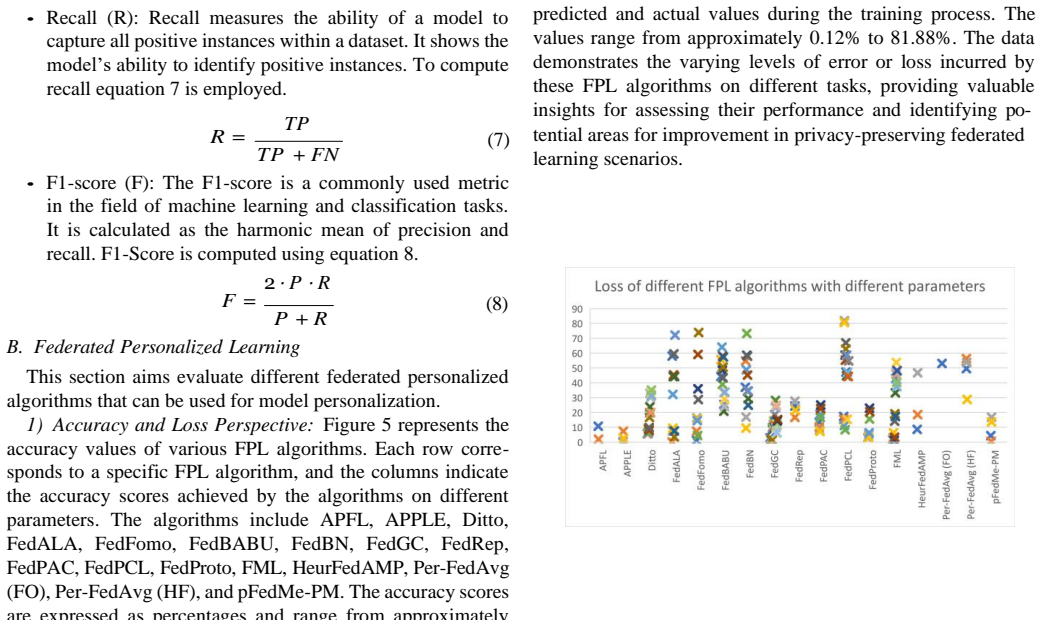
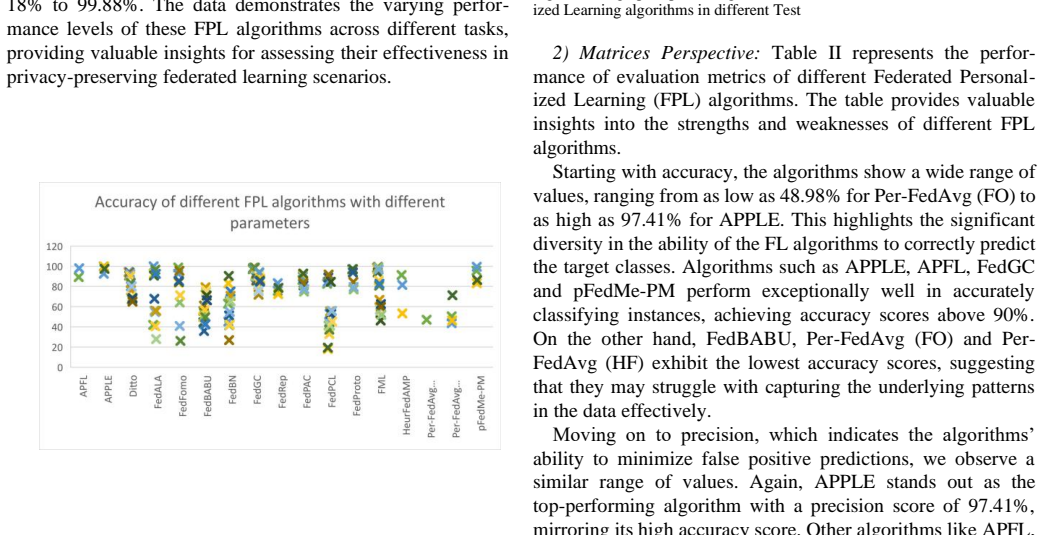
- [Figures 5 and 6] Figures 5 and 6 are described as having rows and columns of accuracy or loss values, but the axes and color encoding are not explained, so as printed the figures are not informative.
- [References] Several references are duplicated or incomplete; for example, references [6] and [8] are the same homomorphic-encryption book, and the Tune reference [44] cites a preprint rather than the standard platform documentation.
Circularity Check
No circularity: the central result is an empirical benchmark comparison, not a derived prediction.
full rationale
The paper's central claim is an empirical ranking of APPLE+HE over APPLE+DP, APPLE+SA, and APPLE+SMPC on Virus-MNIST (Table III). The reported accuracies are measurements of implemented variants, not quantities derived from fitted constants or from the definitions in Section IV-B. Equations (1)-(4) are standard high-level descriptions of aggregation, differential privacy, fully homomorphic encryption, and secure aggregation; none of these equations is used to compute the Table III numbers, so the ranking is not forced by construction. The selection of APPLE as the base algorithm (Section V-C: 'previously evaluated ... best performed federated personalized algorithm APPLE') is a design choice, not a circular inference: APPLE's 97.41% in Table II does not by itself determine the 99.34% reported for APPLE+HE. There are no load-bearing self-citations; the references are to external prior work ([1]-[46]), and none is invoked to forbid alternatives or to justify a uniqueness claim. The manuscript has reproducibility and internal-consistency problems (e.g., 99.34% in Table III vs 99.37% in Section V-C; no DP epsilon, HE scheme, random seeds, or implementation code disclosed), but those concern auditability and correctness risk, not circularity. Therefore the circularity score is 0.
Assumptions & free parameters
free parameters (3)
- DP noise scale and privacy budget epsilon =
Not reported
- HE encryption parameters =
Not reported
- Model hyperparameters (filters, batch size, kernel size) =
Not reported
assumptions (3)
- standard math Global model aggregation is the simple average in Eq. (1)
- domain assumption Virus-MNIST with 200 clients is a representative testbed for federated personalized learning
- domain assumption Differential privacy, homomorphic encryption, secure aggregation, and SMPC are implemented correctly and composed with APPLE as described
Cite this review
Pith. "Pith review of Privacy Preserving Machine Learning Model Personalization through Federated Personalized Learning." pith.science (2026). https://pith.science/paper/JTZG7BV6
@misc{pith2026250501788,
  author       = {Pith},
  title        = {Pith review of: Privacy Preserving Machine Learning Model Personalization through Federated Personalized Learning},
  year         = {2026},
  howpublished = {\url{https://pith.science/paper/JTZG7BV6}},
  note         = {Machine review of arXiv:2505.01788}
}
read the original abstract
The widespread adoption of Artificial Intelligence (AI) has been driven by significant advances in intelligent system research. However, this progress has raised concerns about data privacy, leading to a growing awareness of the need for privacy-preserving AI. In response, there has been a seismic shift in interest towards the leading paradigm for training Machine Learning (ML) models on decentralized data silos while maintaining data privacy, Federated Learning (FL). This research paper presents a comprehensive performance analysis of a cutting-edge approach to personalize ML model while preserving privacy achieved through Privacy Preserving Machine Learning with the innovative framework of Federated Personalized Learning (PPMLFPL). Regarding the increasing concerns about data privacy, this study evaluates the effectiveness of PPMLFPL addressing the critical balance between personalized model refinement and maintaining the confidentiality of individual user data. According to our analysis, Adaptive Personalized Cross-Silo Federated Learning with Differential Privacy (APPLE+DP) offering efficient execution whereas overall, the use of the Adaptive Personalized Cross-Silo Federated Learning with Homomorphic Encryption (APPLE+HE) algorithm for privacy-preserving machine learning tasks in federated personalized learning settings is strongly suggested. The results offer valuable insights creating it a promising scope for future advancements in the field of privacy-conscious data-driven technologies.
Figures


Figures from the paper (1 more)
Reference graph
Works this paper leans on
-
[1]
Communication-efficient learning of deep networks from decentralized data,
B. McMahan, E. Moore, D. Ramage, S. Hampson, and B. A. y Arcas, “Communication-efficient learning of deep networks from decentralized data,” in Artificial intelligence and statistics , pp. 1273 –1282, PMLR, 2017
work page 2017
-
[2]
Deep learning with differential privacy,
M. Abadi, A. Chu, I. Goodfellow, H. B. McMahan, I. Mironov, K. Talwar, and L. Zhang, “Deep learning with differential privacy,” in Proceedings of the 2016 ACM SIGSAC conference on computer and communications security, pp. 308–318, 2016
2016
-
[3]
Practical secure aggregation for federated learning on user -held data,
K. Bonawitz, V. Ivanov, B. Kreuter, A. Marcedone, H. B. McMa- han, S. Patel, D. Ramage, A. Segal, and K. Seth, “Practical secure aggregation for federated learning on user -held data,” arXiv preprint arXiv:1611.04482, 2016
arXiv 2016
-
[4]
Federated machine learning: Concept and applications,
Q. Yang, Y. Liu, T. Chen, and Y. Tong, “Federated machine learning: Concept and applications,” ACM Transactions on Intelligent Systems and Technology (TIST), vol. 10, no. 2, pp. 1–19, 2019
2019
-
[5]
C. Dwork, “Differential privacy,” in International colloquium on au - tomata, languages, and programming, pp. 1–12, Springer, 2006
work page 2006
-
[6]
X. Yi, R. Paulet, E. Bertino, X. Yi, R. Paulet, and E. Bertino, Homo- morphic encryption. Springer, 2014
work page 2014
-
[7]
Secure multi -party computation,
O. Goldreich, “Secure multi -party computation,” Manuscript. Prelimi- nary version, vol. 78, no. 110, 1998
work page 1998
-
[8]
X. Yi, R. Paulet, E. Bertino, X. Yi, R. Paulet, and E. Bertino, Homo- morphic encryption. Springer, 2014. Algorithm 200 Client 250 300 400 APPLE+SA 24117 29122 34127 41137 APPLE+DP 22119 27124 32129 36139 APPLE+HE 26121 31126 36131 46146
work page 2014
Show all 46 references
-
[9]
Sectee: A software-based approach to secure enclave architecture using tee,
S. Zhao, Q. Zhang, Y. Qin, W. Feng, and D. Feng, “Sectee: A software-based approach to secure enclave architecture using tee,” in Proceedings of the 2019 ACM SIGSAC Conference on Computer and Communications Security, pp. 1723–1740, 2019
2019
-
[10]
Privacy -preserving deep learning,
R. Shokri and V. Shmatikov, “Privacy -preserving deep learning,” in Proceedings of the 22nd ACM SIGSAC conference on computer and communications security, pp. 1310–1321, 2015
2015
-
[11]
Scalable and privacy -preserving data sharing based on blockchain,
B.-K. Zheng, L.-H. Zhu, M. Shen, F. Gao, C. Zhang, Y.-D. Li, and J. Yang, “Scalable and privacy -preserving data sharing based on blockchain,” Journal of Computer Science and Technology, vol. 33, pp. 557–567, 2018
2018
-
[12]
Slicing: A new approach for privacy preserving data publishing,
T. Li, N. Li, J. Zhang, and I. Molloy, “Slicing: A new approach for privacy preserving data publishing,” IEEE transactions on knowledge and data engineering, vol. 24, no. 3, pp. 561–574, 2010
2010
-
[13]
Stochastic-sign sgd for federated learning with theoretical guarantees,
R. Jin, Y. Huang, X. He, H. Dai, and T. Wu, “Stochastic-sign sgd for federated learning with theoretical guarantees,” arXiv preprint arXiv:2002.10940, 2020
2002 arXiv
-
[14]
Intel sgx explained,
V. Costan and S. Devadas, “Intel sgx explained,” Cryptology ePrint Archive, 2016
2016
-
[15]
Insecure until proven updated: analyzing amd sev’s remote attestation,
R. Buhren, C. Werling, and J.-P. Seifert, “Insecure until proven updated: analyzing amd sev’s remote attestation,” in Proceedings of the 2019 ACM SIGSAC Conference on Computer and Communications Security, pp. 1087–1099, 2019
2019
-
[16]
Research on arm trustzone,
W. Li, Y. Xia, and H. Chen, “Research on arm trustzone,” GetMobile: Mobile Computing and Communications, vol. 22, no. 3, pp. 17–22, 2019
2019
-
[17]
Scaffold: Stochastic controlled averaging for federated learn - ing,
S. P. Karimireddy, S. Kale, M. Mohri, S. Reddi, S. Stich, and A. T. Suresh, “Scaffold: Stochastic controlled averaging for federated learn - ing,” in International conference on machine learning , pp. 5132 –5143, PMLR, 2020
2020
-
[18]
Federated optimization in heterogeneous networks,
T. Li, A. K. Sahu, M. Zaheer, M. Sanjabi, A. Talwalkar, and V. Smith, “Federated optimization in heterogeneous networks,” Proceedings of Machine learning and systems, vol. 2, pp. 429–450, 2020
2020
-
[19]
Federated learning based on dynamic regularization,
D. A. E. Acar, Y. Zhao, R. M. Navarro, M. Mattina, P. N. Whatmough, and V. Saligrama, “Federated learning based on dynamic regularization,” arXiv preprint arXiv:2111.04263, 2021
2021 arXiv
-
[20]
Model-contrastive federated learning,
Q. Li, B. He, and D. Song, “Model-contrastive federated learning,” in Proceedings of the IEEE/CVF conference on computer vision and pattern recognition, pp. 10713–10722, 2021
2021
-
[21]
Federated multi-task learning,
V. Smith, C. -K. Chiang, M. Sanjabi, and A. S. Talwalkar, “Federated multi-task learning,” Advances in neural information processing systems, vol. 30, 2017
2017
-
[22]
Fedbn: Feder- ated learning on non -iid features via local batch normalization,
X. Li, M. Jiang, X. Zhang, M. Kamp, and Q. Dou, “Fedbn: Feder- ated learning on non -iid features via local batch normalization,” arXiv preprint arXiv:2102.07623, 2021
2021 arXiv
-
[23]
Personalized federated learning with theoretical guarantees: A model -agnostic meta -learning approach,
A. Fallah, A. Mokhtari, and A. Ozdaglar, “Personalized federated learning with theoretical guarantees: A model -agnostic meta -learning approach,” Advances in Neural Information Processing Systems, vol. 33, pp. 3557–3568, 2020
2020
-
[24]
Personalized federated learning with moreau envelopes,
C. T Dinh, N. Tran, and J. Nguyen, “Personalized federated learning with moreau envelopes,” Advances in Neural Information Processing Systems, vol. 33, pp. 21394–21405, 2020
2020
-
[25]
Ditto: Fair and robust federated learning through personalization,
T. Li, S. Hu, A. Beirami, and V. Smith, “Ditto: Fair and robust federated learning through personalization,” in International Conference on Machine Learning, pp. 6357–6368, PMLR, 2021
2021
-
[26]
Adaptive personalized federated learning,
Y. Deng, M. M. Kamani, and M. Mahdavi, “Adaptive personalized federated learning,” arXiv preprint arXiv:2003.13461, 2020
2003 arXiv
-
[27]
Person - alized federated learning with first order model optimization,
M. Zhang, K. Sapra, S. Fidler, S. Yeung, and J. M. Alvarez, “Person - alized federated learning with first order model optimization,” arXiv preprint arXiv:2012.08565, 2020
2012 arXiv
-
[28]
Per- sonalized cross-silo federated learning on non -iid data,
Y. Huang, L. Chu, Z. Zhou, L. Wang, J. Liu, J. Pei, and Y. Zhang, “Per- sonalized cross-silo federated learning on non -iid data,” in Proceedings of the AAAI conference on artificial intelligence, vol. 35, pp. 7865–7873, 2021
2021
-
[29]
Fedphp: Federated personalization with inherited private models,
X.-C. Li, D. -C. Zhan, Y. Shao, B. Li, and S. Song, “Fedphp: Federated personalization with inherited private models,” in Joint European Con- ference on Machine Learning and Knowledge Discovery in Databases, pp. 587–602, Springer, 2021
2021
-
[30]
Adapt to adaptation: Learning personalization for cross-silo federated learning,
J. Luo and S. Wu, “Adapt to adaptation: Learning personalization for cross-silo federated learning,” in IJCAI: proceedings of the conference , vol. 2022, p. 2166, NIH Public Access, 2022
2022
-
[31]
Fedala: Adaptive local aggregation for personalized federated learning,
J. Zhang, Y. Hua, H. Wang, T. Song, Z. Xue, R. Ma, and H. Guan, “Fedala: Adaptive local aggregation for personalized federated learning,” in Proceedings of the AAAI Conference on Artificial Intelligence, vol. 37, pp. 11237–11244, 2023
2023
-
[32]
Federated learning with personalization layers,
M. G. Arivazhagan, V. Aggarwal, A. K. Singh, and S. Choud- hary, “Federated learning with personalization layers,” arXiv preprint arXiv:1912.00818, 2019
1912 arXiv
-
[33]
Think locally, act globally: Federated learning with local and global representations,
P. P. Liang, T. Liu, L. Ziyin, N. B. Allen, R. P. Auerbach, D. Brent, R. Salakhutdinov, and L. -P. Morency, “Think locally, act globally: Federated learning with local and global representations,” arXiv preprint arXiv:2001.01523, 2020
2001 arXiv
-
[34]
Exploiting shared representations for personalized federated learning,
L. Collins, H. Hassani, A. Mokhtari, and S. Shakkottai, “Exploiting shared representations for personalized federated learning,” in Interna- tional conference on machine learning, pp. 2089–2099, PMLR, 2021
2021
-
[35]
On bridging generic and person- alized federated learning for image classification,
H.-Y. Chen and W.-L. Chao, “On bridging generic and person- alized federated learning for image classification,” arXiv preprint arXiv:2107.00778, 2021
2021 arXiv
-
[36]
Fedbabu: Towards enhanced representation for federated image classification,
J. Oh, S. Kim, and S. -Y. Yun, “Fedbabu: Towards enhanced representation for federated image classification,” arXiv preprint arXiv:2106.06042, 2021
2021 arXiv
-
[37]
Federated learning for face recognition with gradient correction,
Y. Niu and W. Deng, “Federated learning for face recognition with gradient correction,” in Proceedings of the AAAI Conference on Artificial Intelligence, vol. 36, pp. 1999–2007, 2022
1999
-
[38]
16 federated knowledge distillation,
H. Seo, J. Park, S. Oh, M. Bennis, and S. -L. Kim, “16 federated knowledge distillation,” Machine Learning and Wireless Communica - tions, p. 457, 2022
2022
-
[39]
Federated mutual learning,
T. Shen, J. Zhang, X. Jia, F. Zhang, G. Huang, P. Zhou, K. Kuang, F. Wu, and C. Wu, “Federated mutual learning,” arXiv preprint arXiv:2006.16765, 2020
2006 arXiv
-
[40]
Communication-efficient federated learning via knowledge distillation,
C. Wu, F. Wu, L. Lyu, Y. Huang, and X. Xie, “Communication-efficient federated learning via knowledge distillation,” Nature communications, vol. 13, no. 1, p. 2032, 2022
2022
-
[41]
Fedproto: Federated prototype learning across heterogeneous clients,
Y. Tan, G. Long, L. Liu, T. Zhou, Q. Lu, J. Jiang, and C. Zhang, “Fedproto: Federated prototype learning across heterogeneous clients,” in Proceedings of the AAAI Conference on Artificial Intelligence, vol. 36, pp. 8432–8440, 2022
2022
-
[42]
Federated learning from pre-trained models: A contrastive learning approach,
Y. Tan, G. Long, J. Ma, L. Liu, T. Zhou, and J. Jiang, “Federated learning from pre-trained models: A contrastive learning approach,” Advances in Neural Information Processing Systems, vol. 35, pp. 19332–19344, 2022
2022
-
[43]
Personalized federated learning with feature alignment and classifier collaboration,
J. Xu, X. Tong, and S.-L. Huang, “Personalized federated learning with feature alignment and classifier collaboration,” arXiv preprint arXiv:2306.11867, 2023
2023 arXiv
-
[44]
Tune: A research platform for distributed model selection and training,
R. Liaw, E. Liang, R. Nishihara, P. Moritz, J. E. Gonzalez, and I. Stoica, “Tune: A research platform for distributed model selection and training,” arXiv preprint arXiv:1807.05118, 2018
2018 arXiv
-
[45]
Adam: A method for stochastic optimization,
D. P. Kingma and J. Ba, “Adam: A method for stochastic optimization,” arXiv preprint arXiv:1412.6980, 2014
2014 arXiv
-
[46]
A comparison of optimization algorithms for deep learning,
D. Soydaner, “A comparison of optimization algorithms for deep learning,” International Journal of Pattern Recognition and Artificial Intelligence, vol. 34, no. 13, p. 2052013, 2020
2020
Reviewed August 16, 2026 · model on record in the stance chip above.
Discussion (0). Continue with ORCID to comment.