REVIEW 4 major objections 7 minor 1 cited by
Visual enhancement and 3D representation for underwater scenes: a review
T0 review · 4 major / 7 minor · reviewed 2026-08-16 · deepseek-v4-flash
Pith's one-line read This review makes the case that underwater visual enhancement and underwater 3D reconstruction are one coupled problem, and reports that integrated physics-based methods such as UW-GS produce the clearest novel views in the tested scenes.
desk verdict A genuinely useful survey of underwater enhancement and 3D reconstruction, but the benchmark section overclaims: the abstract promises quantitative evaluation and Section 5 delivers only visual inspection on two scenes, using the authors' own methods. read the letter →
The pith
A machine-rendered reading of the paper's core claim, the machinery that carries it, and where it could break.
The reading
What carries the argument
The load-bearing object is the Jaffe–McGlamery underwater image formation model, which writes the observed image as the sum of direct transmission, forward scattering, and backscattering: $I(x)=I_d(x)+I_f(x)+I_b(x)$, usually simplified to $I(x)=J(x)T(x)+A(1-T(x))$. This model connects the two halves of the review: enhancement methods are categorized by how they estimate the transmission map $T$ and ambient light $A$, while reconstruction methods are categorized by whether they treat water as a medium inside the renderer or ignore it. The integrated pipelines highlighted in the benchmark, especially UW-GS, embed this model into a 3D Gaussian Splatting renderer so that scattering and attenuation are estimated per scene rather than removed in a preprocessing step.
What would settle it
Run a controlled comparison of UW-GS against a two-stage enhancement-plus-reconstruction pipeline on a larger, more diverse set of underwater scenes using quantitative metrics such as PSNR, SSIM, and LPIPS; if the two-stage pipeline matches or beats UW-GS on average, the paper's central ranking claim fails.
Extended reading notes
Core claim
On its own terms, the paper claims to be the first systematic review to span both sides of the underwater vision problem: restoring what cameras see and reconstructing the 3D scene behind those images. It builds a taxonomy that ranges from histogram and Retinex methods through dark-channel priors and data-driven CNNs, transformers, Mamba, and diffusion models on the enhancement side, and from photogrammetry and visual SLAM through NeRF and 3D Gaussian Splatting on the reconstruction side. Its empirical section compares three pipelines: raw reconstruction, enhancement followed by reconstruction, and integrated physics-based reconstruction, using public datasets including NUSR, SeaThru, S-UW, UWBundle, and BVI-Coral. The reported outcome is that integrated models such as UW-GS render the sharpest, most color-correct novel views, that 3DGS captures fine texture better than NeRF where texture exists but blurs information-poor areas, and that dynamic NeRF variants struggle with high-frequency underwater detail. The paper frames this as evidence that the field is converging on embedding the physics of underwater light into the reconstruction itself.
Load-bearing premise
The benchmark conclusions assume the handful of public underwater 3D datasets used, including NUSR, SeaThru, S-UW, UWBundle, and BVI-Coral, represent the range of real underwater conditions, and that visual inspection of one scene pair is enough to rank methods like UW-GS.
Editorial extensions
If this is right
- If the paper's conclusion holds, future underwater vision systems should couple enhancement with reconstruction rather than treating image restoration as an optional preprocessing step.
- Reviews and taxonomies of underwater imaging should include both enhancement and 3D reconstruction in one framework, since the physical model that explains color loss also explains reconstruction failure.
- The benchmark suggests that 3D Gaussian Splatting is the more practical base for static underwater scenes, with NeRF remaining preferable for dynamic scenes.
- Public underwater 3D datasets are too scarce and small to support strong generalizations, so the field's next bottleneck is data collection, not algorithms.
- New methods that compare against integrated physics-based models like UW-GS will need to report whether enhancement is embedded or done in advance, because that choice affects the outcome.
Reading between the lines
- Beyond the paper: if integrated medium-aware rendering keeps winning, the default for underwater novel-view synthesis is likely to shift away from two-stage enhance-then-reconstruct pipelines, making enhancement a component of the renderer rather than a separate artifact.
- Beyond the paper: the reliance on a handful of small public datasets means the reported ranking is fragile; a larger multi-condition benchmark could plausibly overturn UW-GS's top placement.
- Beyond the paper: the same physics-based medium modeling could be tested on downstream tasks such as underwater depth estimation, object detection, or ROV navigation, where enhanced images may or may not help depending on the task.
- A testable extension is synthetic data: render scenes under several known water types and turbidities with ground-truth geometry, then compare integrated versus two-stage reconstruction quantitatively under controlled conditions.
Signed reviews
Editorial analysis
A structured set of objections, weighed in public.
Referee Report
Summary. This manuscript presents a review of underwater visual enhancement (UVE) and underwater 3D reconstruction. It introduces the Jaffe–McGlamery model and simplified image formation models, organizes UVE methods into conventional, data-driven, and hybrid categories, and reviews reconstruction approaches ranging from photogrammetry and visual SLAM to NeRF and 3D Gaussian Splatting. The paper also reports a small benchmark of three pipelines: reconstruction without enhancement, two-stage enhancement-then-reconstruction, and integrated physics-based reconstruction, with a qualitative comparison on two scenes (Panama and Reef). The authors claim this is the first unified review covering both UVE and underwater 3D reconstruction.
Significance. If the promised quantitative evaluation were delivered, the benchmark would provide a useful reference point for practitioners. The paper's taxonomy is broad and current, including Mamba- and diffusion-based enhancement methods and recent underwater Gaussian splatting approaches, and it usefully compiles public datasets and discusses open challenges. However, the central empirical contribution currently rests on qualitative inspection of two scenes and on methods with overlapping authorship, which limits the independent value of the benchmark.
major comments (4)
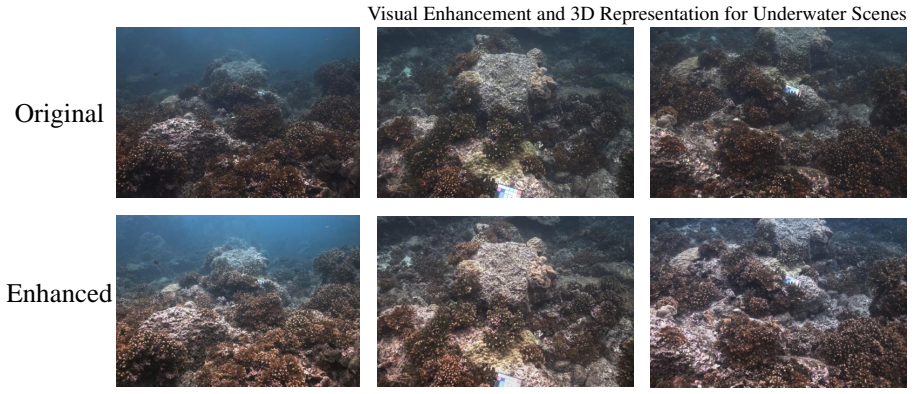
- [Section 5 and Abstract; Figure 19] The abstract states that the paper conducts 'both quantitative and qualitative evaluations' of state-of-the-art UVE and underwater 3D reconstruction algorithms across multiple benchmark datasets, but Section 5 reports no quantitative metrics (no PSNR, SSIM, LPIPS, or error bars), and the conclusion that 'UW-GS appears to be the best' is drawn from visual inspection of two scenes. This gap bears directly on contribution (3) in Section 1.3. Please either add a quantitative protocol with per-scene metrics and multiple random seeds, or revise the abstract and Section 1.3 to describe Section 5 as a qualitative illustration only.
- [Sections 5.2 and 5.3; Huang et al. (2025) and Wang et al. (2025)] The two-stage pipeline uses the authors' unpublished enhancement method (Huang et al., 2025), and the integrated pipeline highlights UW-GS (Wang et al., 2025), which shares authors with this survey. No code, checkpoints, or detailed hyperparameters are provided, so an independent researcher cannot reproduce or verify the comparison. Please make the benchmark reproducible and include at least one independent baseline not affiliated with the authors, or clearly frame these results as self-reported demonstrations.
- [Section 1.3 and Abstract] The claim that 'a comprehensive and systematic review covering both UVE and underwater 3D reconstruction remains absent' is not supported by a comparison with existing surveys, such as Anwar and Li (2020) for underwater image enhancement or Diamanti and Ødegård (2024) for marine 3D documentation. Please add a survey-comparison table or qualify the novelty claim.
- [Section 5 and Table 7] Table 7 shows that public underwater 3D datasets are scarce and small, and the headline comparison in Figure 19 uses only two scenes. The paper's own observation that current public data are limited means the external validity of any ranking from this benchmark is weak. Please state this limitation explicitly in Section 5 and temper the conclusion accordingly.
minor comments (7)
- [Section 3.1.1] The sentence 'CLAHE is a typical baseline in this category' appears twice; please delete one occurrence.
- [Sections 1 and 2.4] Section 1 contains an unfinished sentence, 'underwater exploration and analysis remain hampered. .', and Section 2.4 has the typo 'serval works' for 'several works'.
- [Section 3.4] The attribution of the UIQM metric to Wang et al. (2021a) is inaccurate; UIQM was introduced by Panetta et al. and should be cited to its original source.
- [Table 3] Table 3 uses reference placeholders such as 'Multi-Exposure Fusion (?)' and 'Hybrid Dehazing + White Balance (?)'; these should be replaced with actual citations.
- [Figure 10 caption] In the caption, 'UCDP+HE' should read 'UDCP+HE' for consistency with the main text.
- [Sections 5.1-5.3] Terminology is inconsistent: 'InstanceNGP' and 'Instant-NGP' are both used, and Figure 18 refers to 'UW-3DGS' while the text and Figure 19 use 'UW-GS'; please unify the names.
- [Section 5.3, Figure 19] The note that the images in the first row of Figure 19 'have been enhanced for better visibility' is ambiguous; please clarify whether this enhancement is part of the compared pipeline or only for presentation, since it directly affects the fair comparison of the shown methods.
Circularity Check
No circular derivation: the survey content is independent, and Section 5's self-authored qualitative benchmark is an evidentiary limitation rather than a definitional or fitted-input circularity.
full rationale
The paper's actual derivation chain is confined to Section 2, where Eq. (7) is explicitly obtained from the Jaffe-McGlamery model by neglecting forward scattering, assuming a constant backscatter phase function, and integrating the simplified backscatter term; this is a stated approximation, not a result equivalent to its input. Sections 3 and 4 are literature surveys of external works, so no target claim is used to define its own evidence. The only self-referential element is Section 5: the two-stage pipeline uses 'the algorithm described in (Huang et al., 2025)' and the integrated comparison concludes 'Overall, UW-GS appears to be the best' from Figure 19, where UW-GS is the same group's method (Wang et al., 2025) and one test scene (Reef) comes from S-UW, the same work. This is a self-evaluation with no quantitative metrics, and it conflicts with the abstract's promise of 'quantitative and qualitative evaluations.' However, these are problems of evidence strength and independence, not circularity: no parameter is fitted to data and then renamed as a prediction, and no equation or definition makes the conclusion equivalent to its input. The paper itself concedes the limitation: 'publicly accessible underwater 3D scene datasets are quite rare... potentially limiting the thoroughness of evaluations for reconstruction methods.' Therefore no circular step is exhibited; the weakness belongs to correctness and rigor rather than circularity.
Assumptions & free parameters
assumptions (3)
- domain assumption The Beer-Lambert law and the Jaffe-McGlammery image formation model accurately describe underwater image degradation.
- domain assumption Simplified image formation models, with constant attenuation and ambient light, remain valid for moderate clarity and shallow underwater scenes.
- domain assumption The results reported by the survey's cited papers are accurate and correctly represented.
Cite this review
Pith. "Pith review of Visual enhancement and 3D representation for underwater scenes: a review." pith.science (2026). https://pith.science/paper/NL5MFASL
@misc{pith2026250501869,
  author       = {Pith},
  title        = {Pith review of: Visual enhancement and 3D representation for underwater scenes: a review},
  year         = {2026},
  howpublished = {\url{https://pith.science/paper/NL5MFASL}},
  note         = {Machine review of arXiv:2505.01869}
}
read the original abstract
Underwater visual enhancement (UVE) and underwater 3D reconstruction pose significant challenges in computer vision and AI-based tasks due to complex imaging conditions in aquatic environments. Despite the development of numerous enhancement algorithms, a comprehensive and systematic review covering both UVE and underwater 3D reconstruction remains absent. To advance research in these areas, we present an in-depth review from multiple perspectives. First, we introduce the fundamental physical models, highlighting the peculiarities that challenge conventional techniques. We survey advanced methods for visual enhancement and 3D reconstruction specifically designed for underwater scenarios. The paper assesses various approaches from non-learning methods to advanced data-driven techniques, including Neural Radiance Fields and 3D Gaussian Splatting, discussing their effectiveness in handling underwater distortions. Finally, we conduct both quantitative and qualitative evaluations of state-of-the-art UVE and underwater 3D reconstruction algorithms across multiple benchmark datasets. Finally, we highlight key research directions for future advancements in underwater vision.
Figures


Figures from the paper (16 more)




Forward citations
Cited by 1 Pith paper
-
RUSplatting: Robust 3D Gaussian Splatting for Sparse-View Underwater Scene Reconstruction
RUSplatting improves sparse-view underwater 3D reconstruction by decoupling RGB attenuation, synthesizing intermediate frames, and adding edge-aware smoothness, with a new deep-sea dataset.
Reference graph
Works this paper leans on
-
[1]
write newline
" write newline "" before.all 'output.state := FUNCTION fin.entry add.period write newline FUNCTION new.block output.state before.all = 'skip after.block 'output.state := if FUNCTION new.ncblock write newline " " before.all 'output.state := FUNCTION new.nccont write " " before.all 'output.state := FUNCTION new.sentence output.state after.block = 'skip out...
-
[2]
Enhancement of low quality underwater image through integrated global and local contrast correction
Ahmad Shahrizan Abdul Ghani and Nor Ashidi Mat Isa. Enhancement of low quality underwater image through integrated global and local contrast correction. Applied Soft Computing, 37: 0 332--344, December 2015. ISSN 15684946. doi:10.1016/j.asoc.2015.08.033
-
[3]
Ahmad Shahrizan Abdul Ghani and Nor Ashidi Mat Isa. Automatic system for improving underwater image contrast and color through recursive adaptive histogram modification. Computers and Electronics in Agriculture, 141: 0 181--195, September 2017. ISSN 01681699. doi:10.1016/j.compag.2017.07.021
-
[4]
A revised underwater image formation model
Derya Akkaynak and Tali Treibitz. A revised underwater image formation model. In the IEEE/CVF Conference on Computer Vision and Pattern Recognition (CVPR), pages 6723--6732, 2018
2018
-
[5]
BVI-Coral: Underwater scenes for 3D reconstruction , April 2024
Nantheera Anantrasirichai. BVI-Coral: Underwater scenes for 3D reconstruction , April 2024. URL https://doi.org/10.5281/zenodo.11093417
-
[6]
Artificial intelligence in creative industries: Advances prior to 2025
Nantheera Anantrasirichai, Fan Zhang, and David Bull. Artificial intelligence in creative industries: Advances prior to 2025. arXiv:2501.02725, 2025
arXiv 2025
-
[7]
Ancuti, Cosmin Ancuti, Christophe De Vleeschouwer, and Philippe Bekaert
Codruta O. Ancuti, Cosmin Ancuti, Christophe De Vleeschouwer, and Philippe Bekaert. Color Balance and Fusion for Underwater Image Enhancement . IEEE Transactions on Image Processing, 27 0 (1): 0 379--393, January 2018. ISSN 1941-0042. doi:10.1109/TIP.2017.2759252
arXiv 2018
-
[8]
Single Image Dehazing by Multi-Scale Fusion
Codruta Orniana Ancuti and Cosmin Ancuti. Single Image Dehazing by Multi-Scale Fusion . IEEE Transactions on Image Processing, 22 0 (8): 0 3271--3282, August 2013. ISSN 1941-0042. doi:10.1109/TIP.2013.2262284
arXiv 2013
Show all 221 references
-
[9]
Enhancing underwater images and videos by fusion
Cosmin Ancuti, Codruta Orniana Ancuti, Tom Haber, and Philippe Bekaert. Enhancing underwater images and videos by fusion. In 2012 IEEE Conference on Computer Vision and Pattern Recognition , pages 81--88, June 2012. doi:10.1109/CVPR.2012.6247661
2012
-
[10]
Diving deeper into underwater image enhancement: A survey
Saeed Anwar and Chongyi Li. Diving deeper into underwater image enhancement: A survey. Signal Processing: Image Communication, 89: 0 115978, 2020
2020
-
[11]
Underwater 3- D Scene Reconstruction Using Kinect v2 Based on Physical Models for Refraction and Time of Flight Correction
Atif Anwer, Syed Saad Azhar Ali, Amjad Khan, and Fabrice M \'e riaudeau. Underwater 3- D Scene Reconstruction Using Kinect v2 Based on Physical Models for Refraction and Time of Flight Correction . IEEE Access, 5: 0 15960--15970, 2017. ISSN 2169-3536. doi:10.1109/ACCESS.2017.2733003
2017
-
[12]
An arbitrary Lagrangian-Eulerian method for penetration into sand at finite deformation
Daniel Aubram. An arbitrary Lagrangian-Eulerian method for penetration into sand at finite deformation. Shaker, Aachen, 2013. ISBN 978-3-8440-2507-1. doi:10.14279/depositonce-3958
2013 doi
-
[13]
Elimination of Marine Snow effect from underwater image - An adaptive probabilistic approach
Soma Banerjee, Gautam Sanyal, Shatadal Ghosh, Ranjit Ray, and Sankar Nath Shome. Elimination of Marine Snow effect from underwater image - An adaptive probabilistic approach. In 2014 IEEE Students ' Conference on Electrical , Electronics and Computer Science , pages 1--4, Marc...
2014
-
[14]
Diving into haze-lines: Color restoration of underwater images
Dana Berman, Tali Treibitz, and Shai Avidan. Diving into haze-lines: Color restoration of underwater images. In Proc. british machine vision conference (BMVC), volume 1, page 2, 2017
2017
-
[15]
NoPe-NeRF: Optimizing Neural Radiance Field with No Pose Prior
Song Bian and et al. NoPe-NeRF: Optimizing Neural Radiance Field with No Pose Prior . In CVPR, 2023
2023
-
[16]
Bloesch, Jan Czarnowski, Ronald Clark, Stefan Leutenegger, and Andrew J
M. Bloesch, Jan Czarnowski, Ronald Clark, Stefan Leutenegger, and Andrew J. Davison. CodeSLAM-Learning a compact, optimisable representation for dense visual slam. In CVPR2018, 2018
2018
-
[17]
Nerd: Neural reflectance decomposition from image collections
Mark Boss, Raphael Braun, Varun Jampani, Jonathan T Barron, Ce Liu, and Hendrik Lensch. Nerd: Neural reflectance decomposition from image collections. In Proceedings of the IEEE/CVF International Conference on Computer Vision, pages 12684--12694, 2021
2021
-
[18]
True color correction of autonomous underwater vehicle imagery
Mitch Bryson, Matthew Johnson-Roberson, Oscar Pizarro, and Stefan B Williams. True color correction of autonomous underwater vehicle imagery. Journal of Field Robotics, 33 0 (6): 0 853--874, 2016
2016
-
[19]
Lightning NeRF: Efficient Hybrid Scene Representation for Autonomous Driving
Junyi Cao, Zhichao Li, Naiyan Wang, and Chao Ma. Lightning NeRF: Efficient Hybrid Scene Representation for Autonomous Driving . In ICRA, 2024
2024
-
[20]
Nicholas Carlevaris-Bianco , Anush Mohan, and Ryan M. Eustice. Initial results in underwater single image dehazing. In OCEANS 2010 MTS / IEEE SEATTLE , pages 1--8, September 2010. doi:10.1109/OCEANS.2010.5664428
2010
-
[21]
Removal of water scattering
Liu Chao and Meng Wang. Removal of water scattering. In 2010 2nd International Conference on Computer Engineering and Technology , volume 2, pages V2--35--V2--39, April 2010. doi:10.1109/ICCET.2010.5485339
2010
-
[22]
Tensorf: Tensorial radiance fields
Anpei Chen, Zexiang Xu, Andreas Geiger, Jingyi Yu, and Hao Su. Tensorf: Tensorial radiance fields. ECCV, 2022 a
2022
-
[23]
UV Volumes for Real-time Rendering of Editable Free-view Human Performance
Boyang Chen, Weipeng Xu, Zerong Zheng, Yaser Sheikh Yu, and Dan Casas. UV Volumes for Real-time Rendering of Editable Free-view Human Performance . In CVPR, 2023
2023
-
[24]
Sp-seanerf: Underwater neural radiance fields with strong scattering perception
Lifang Chen, Yuchen Xiong, Yanjie Zhang, Ruiyin Yu, Lian Fang, and Defeng Liu. Sp-seanerf: Underwater neural radiance fields with strong scattering perception. Computers & Graphics, 123: 0 104025, 2024 a . doi:https://doi.org/10.1016/j.cag.2024.104025
2024
-
[25]
BDMUIE: Underwater image enhancement based on bayesian diffusion model
Lingfeng Chen, Zhihan Xu, Chao Wei, and Yuanxin Xu. BDMUIE: Underwater image enhancement based on bayesian diffusion model. Neurocomputing, 620: 0 129274, 2025. ISSN 0925-2312. doi:https://doi.org/10.1016/j.neucom.2024.129274. URL https://www.sciencedirect.com/science/article/...
2025
-
[26]
MUIR: Mamba for underwater image rendering
Liyuan Chen, Weijia Li, Qingxia Yang, Lihan Tong, Erkang Chen, Bin Huang, and RuiWen Li. MUIR: Mamba for underwater image rendering. In 2024 4th International Conference on Machine Learning and Intelligent Systems Engineering (MLISE), pages 172--177, 2024 b . doi:10.1109/MLISE...
2024
-
[27]
Deblur-gs: 3d gaussian splatting from camera motion blurred images
Wenbo Chen and Ligang Liu. Deblur-gs: 3d gaussian splatting from camera motion blurred images. Proceedings of the ACM on Computer Graphics and Interactive Techniques, 7 0 (1): 0 1--15, 2024
2024
-
[28]
Ha-NeRF: Hallucinated Neural Radiance Fields in the Wild
Xingyu Chen, Qi Zhang, Xiaoyu Li, Yue Chen, Ying Feng, Xuan Wang, and Jue Wang. Ha-NeRF: Hallucinated Neural Radiance Fields in the Wild . In CVPR, 2022 b
2022
-
[29]
Underwater image enhancement based on deep learning and image formation model
Xuelei Chen, Pin Zhang, Lingwei Quan, Chao Yi, and Cunyue Lu. Underwater image enhancement based on deep learning and image formation model. arXiv preprint arXiv:2101.00991, 2021
2021 arXiv
-
[30]
Cheng, C
C. Cheng, C. Wang, D. Yang, W. Liu, and F. Zhang. Underwater localization and mapping based on multi-beam forward looking sonar. Frontiers in Neurorobotics, 15: 0 801956, 2022. doi:10.3389/fnbot.2021.801956
2022
-
[31]
Chiang and Ying-Ching Chen
John Y. Chiang and Ying-Ching Chen. Underwater Image Enhancement by Wavelength Compensation and Dehazing . IEEE Transactions on Image Processing, 21 0 (4): 0 1756--1769, April 2012. ISSN 1941-0042. doi:10.1109/TIP.2011.2179666
2012
-
[32]
GARF: Gaussian Activated Radiance Fields for High Fidelity Reconstruction and Pose Estimation
Chin Tat Chng and et al. GARF: Gaussian Activated Radiance Fields for High Fidelity Reconstruction and Pose Estimation . In ECCV, 2022
2022
-
[33]
Underwater robot sensing technology: A survey
Yang Cong, Changjun Gu, Tao Zhang, and Yajun Gao. Underwater robot sensing technology: A survey. Fundamental Research, 1 0 (3): 0 337--345, 2021. ISSN 2667-3258. doi:https://doi.org/10.1016/j.fmre.2021.03.002
2021 doi
-
[34]
Depth-supervised NeRF: Fewer Views and Faster Training for Free
Kangle Deng, Andrew Liu, Jun-Yan Zhu, and Deva Ramanan. Depth-supervised NeRF: Fewer Views and Faster Training for Free . CVPR, 2022
2022
-
[35]
Ruig: Realistic underwater image generation towards restoration
Chaitra Desai, Ramesh Ashok Tabib, Sai Sudheer Reddy, Ujwala Patil, and Uma Mudenagudi. Ruig: Realistic underwater image generation towards restoration. In IEEE Conference on Computer Vision and Pattern Recognition Workshops, pages 2181--2189, 2021
2021
-
[36]
Visual sensing on marine robotics for the 3d documentation of underwater cultural heritage: A review
Eleni Diamanti and Øyvind Ødegård. Visual sensing on marine robotics for the 3d documentation of underwater cultural heritage: A review. Journal of Archaeological Science, 166: 0 105985, 2024. ISSN 0305-4403. doi:https://doi.org/10.1016/j.jas.2024.105985. URL https://www.scien...
2024
-
[37]
Drews, Erickson R
Paulo L.J. Drews, Erickson R. Nascimento, Silvia S.C. Botelho, and Mario Fernando Montenegro Campos. Underwater Depth Estimation and Image Restoration Based on Single Images . IEEE Computer Graphics and Applications, 36 0 (2): 0 24--35, March 2016. ISSN 1558-1756. doi:10.1109/...
2016 doi
-
[38]
Drews Jr, E
P. Drews Jr, E. Do Nascimento, F. Moraes, S. Botelho, and M. Campos. Transmission Estimation in Underwater Single Images . In 2013 IEEE International Conference on Computer Vision Workshops , pages 825--830, Sydney, Australia, December 2013. IEEE. ISBN 978-1-4799-3022-7. doi:1...
2013 doi
-
[39]
UIEDP: Boosting underwater image enhancement with diffusion prior
Dazhao Du, Enhan Li, Lingyu Si, Wenlong Zhai, Fanjiang Xu, Jianwei Niu, and Fuchun Sun. UIEDP: Boosting underwater image enhancement with diffusion prior. Expert Systems with Applications, 259: 0 125271, 2025. ISSN 0957-4174. doi:https://doi.org/10.1016/j.eswa.2024.125271. URL...
2025
-
[40]
Neural Radiance Flow for 4D View Synthesis and Video Processing
Yilun Du and et al. Neural Radiance Flow for 4D View Synthesis and Video Processing . arXiv:2012.09790, 2020
2012 arXiv
-
[41]
Hierarchical rank-based veiling light estimation for underwater dehazing
Simon Emberton, Lars Chittka, and Andrea Cavallaro. Hierarchical rank-based veiling light estimation for underwater dehazing. In Procedings of the British Machine Vision Conference 2015 , pages 125.1--125.12, Swansea, 2015. British Machine Vision Association. ISBN 978-1-901725...
2015 doi
-
[42]
Kiloneus: Implicit neural representations with real-time global illumination, 2022
Riccardo Esposito and et al. Kiloneus: Implicit neural representations with real-time global illumination, 2022
2022
-
[43]
Enhancing underwater imagery using generative adversarial networks
Cameron Fabbri, Md Jahidul Islam, and Junaed Sattar. Enhancing underwater imagery using generative adversarial networks. In International Conference on Robotics and Automation, pages 7159--7165, 2018
2018
-
[44]
Fast dynamic radiance fields with time-aware neural voxels
Jiemin Fang, Taoran Yi, Xinggang Wang, Lingxi Xie, Xiaopeng Zhang, Wenyu Liu, Matthias Nießner, and Qi Tian. Fast dynamic radiance fields with time-aware neural voxels. In SIGGRAPH Asia 2022 Conference Papers, 2022
2022
-
[45]
Single image dehazing
Raanan Fattal. Single image dehazing. ACM Transactions on Graphics, 27 0 (3): 0 1--9, August 2008. ISSN 0730-0301, 1557-7368. doi:10.1145/1360612.1360671
2008
-
[46]
Plenoxels: Radiance Fields without Neural Networks
Sara Fridovich-Keil, Alex Yu, Matthew Tancik, Qinhong Chen, Benjamin Recht, and Angjoo Kanazawa. Plenoxels: Radiance Fields without Neural Networks . In CVPR, 2022
2022
-
[47]
K-planes: Explicit radiance fields in space, time, and appearance
Sara Fridovich-Keil, Giacomo Meanti, Frederik Rahb k Warburg, Benjamin Recht, and Angjoo Kanazawa. K-planes: Explicit radiance fields in space, time, and appearance. In Proceedings of the IEEE/CVF Conference on Computer Vision and Pattern Recognition, pages 12479--12488, 2023
2023
-
[48]
A retinex-based enhancing approach for single underwater image
Xueyang Fu, Peixian Zhuang, Yue Huang, Yinghao Liao, Xiao-Ping Zhang, and Xinghao Ding. A retinex-based enhancing approach for single underwater image. In 2014 IEEE International Conference on Image Processing ( ICIP ) , pages 4572--4576, October 2014. doi:10.1109/ICIP.2014.7025927
2014
-
[49]
Unsupervised underwater image restoration: From a homology perspective
Zhenqi Fu, Huangxing Lin, Yan Yang, Shu Chai, Liyan Sun, Yue Huang, and Xinghao Ding. Unsupervised underwater image restoration: From a homology perspective. In AAAI Conference on Artificial Intelligence, pages 643--651, 2022
2022
-
[50]
Retinex in Matlab
Brian Funt, Florian Ciurea, and John McCann. Retinex in Matlab . 2000
2000
-
[51]
Automatic Red-Channel underwater image restoration
Adrian Galdran, David Pardo, Artzai Pic \'o n, and Aitor Alvarez-Gila . Automatic Red-Channel underwater image restoration. Journal of Visual Communication and Image Representation, 26: 0 132--145, January 2015. ISSN 10473203. doi:10.1016/j.jvcir.2014.11.006
2015 doi
-
[52]
Dynamic view synthesis from dynamic monocular video
Chen Gao, Ayush Saraf, Johannes Kopf, and Jia-Bin Huang. Dynamic view synthesis from dynamic monocular video. In Proceedings of the IEEE/CVF International Conference on Computer Vision, pages 5712--5721, 2021
2021
-
[53]
Garbin, Marek Kowalski, Matthew Johnson, Jamie Shotton, and Julien Valentin
Stephan J. Garbin, Marek Kowalski, Matthew Johnson, Jamie Shotton, and Julien Valentin. FastNeRF: High-Fidelity Neural Rendering at 200FPS . In ICCV, 2021
2021
-
[54]
Underwater image enhancement using blending of CLAHE and percentile methodologies
Diksha Garg, Naresh Kumar Garg, and Munish Kumar. Underwater image enhancement using blending of CLAHE and percentile methodologies. Multimedia Tools and Applications, 77 0 (20): 0 26545--26561, October 2018. ISSN 1573-7721. doi:10.1007/s11042-018-5878-8
2018 doi
-
[55]
Underwater image quality enhancement through composition of dual-intensity images and Rayleigh-stretching
Ahmad Shahrizan Abdul Ghani and Nor Ashidi Mat Isa. Underwater image quality enhancement through composition of dual-intensity images and Rayleigh-stretching . In 2014 IEEE Fourth International Conference on Consumer Electronics Berlin ( ICCE-Berlin ) , pages 219--220, Septemb...
2014
-
[56]
Gibson, Dung T
Kristofor B. Gibson, Dung T. Vo, and Truong Q. Nguyen. An Investigation of Dehazing Effects on Image and Video Coding . IEEE Transactions on Image Processing, 21 0 (2): 0 662--673, February 2012. ISSN 1941-0042. doi:10.1109/TIP.2011.2166968
2012
-
[57]
Aquanerf: Neural radiance fields in underwater media with distractor removal
Luca Gough, Adrian Azzarelli, Fan Zhang, and Nantheera Anantrasirichai. Aquanerf: Neural radiance fields in underwater media with distractor removal. In IEEE International Symposium on Circuits and Systems, 2025
2025
-
[58]
Gu and T
A. Gu and T. Dao. Mamba: Linear -time sequence modeling with selective state spaces. In Conference on Language Modeling, 2024
2024
-
[59]
WaterMamba : Visual State Space Model for Underwater Image Enhancement , May 2024
Meisheng Guan, Haiyong Xu, Gangyi Jiang, Mei Yu, Yeyao Chen, Ting Luo, and Yang Song. WaterMamba : Visual State Space Model for Underwater Image Enhancement , May 2024
2024
-
[60]
Underwater ranker: Learn which is better and how to be better
Chunle Guo, Ruiqi Wu, Xin Jin, Linghao Han, Weidong Zhang, Zhi Chai, and Chongyi Li. Underwater ranker: Learn which is better and how to be better. In AAAI Conference on Artificial Intelligence, pages 702--709, 2023
2023
-
[61]
Underwater Image Restoration via Polymorphic Large Kernel CNNs , December 2024
Xiaojiao Guo, Yihang Dong, Xuhang Chen, Weiwen Chen, Zimeng Li, FuChen Zheng, and Chi-Man Pun. Underwater Image Restoration via Polymorphic Large Kernel CNNs , December 2024
2024
-
[62]
The Retinex based improved underwater image enhancement
Najmul Hassan, Sami Ullah, Naeem Bhatti, Hasan Mahmood, and Muhammad Zia. The Retinex based improved underwater image enhancement. Multimedia Tools and Applications, 80 0 (2): 0 1839--1857, January 2021. ISSN 1573-7721. doi:10.1007/s11042-020-09752-2
2021 doi
-
[63]
Single image haze removal using dark channel prior
Kaiming He, Jian Sun, and Xiaoou Tang. Single image haze removal using dark channel prior. IEEE transactions on pattern analysis and machine intelligence, 33 0 (12): 0 2341--2353, 2010
2010
-
[64]
Benchmarking underwater image enhancement and restoration, and beyond
Guojia Hou, Xin Zhao, Zhenkuan Pan, Huan Yang, Lu Tan, and Jingming Li. Benchmarking underwater image enhancement and restoration, and beyond. IEEE Access, 8: 0 122078--122091, 2020. doi:10.1109/ACCESS.2020.3006359
2020
-
[65]
Bayesian neural networks for one-to-many mapping in image enhancement
Guoxi Huang, Nantheera Anantrasirichai, Fei Ye, Zipeng Qi, RuiRui Lin, Qirui Yang, and David Bull. Bayesian neural networks for one-to-many mapping in image enhancement. arXiv preprint arXiv:2501.14265, 2025
2025 arXiv
-
[66]
Visibility Restoration of Single Hazy Images Captured in Real-World Weather Conditions
Shih-Chia Huang, Bo-Hao Chen, and Wei-Jheng Wang. Visibility Restoration of Single Hazy Images Captured in Real-World Weather Conditions . IEEE Transactions on Circuits and Systems for Video Technology, 24 0 (10): 0 1814--1824, October 2014. ISSN 1558-2205. doi:10.1109/TCSVT.2...
2014
-
[67]
An Advanced Single-Image Visibility Restoration Algorithm for Real-World Hazy Scenes
Shih-Chia Huang, Jian-Hui Ye, and Bo-Hao Chen. An Advanced Single-Image Visibility Restoration Algorithm for Real-World Hazy Scenes . IEEE Transactions on Industrial Electronics, 62 0 (5): 0 2962--2972, May 2015. ISSN 1557-9948. doi:10.1109/TIE.2014.2364798
2015
-
[68]
Fast underwater image enhancement for improved visual perception
Md Jahidul Islam, Youya Xia, and Junaed Sattar. Fast underwater image enhancement for improved visual perception. IEEE Robotics and Automation Letters, 5 0 (2): 0 3227--3234, 2020. doi:10.1109/LRA.2020.2974710
2020
-
[69]
Istenič, N
K. Istenič, N. Gracias, A. Arnaubec, J. Escartín, and R. Garcia. Scale accuracy evaluation of image-based 3d reconstruction strategies using laser photogrammetry. Remote Sensing, 11 0 (18): 0 2093, 2019. doi:10.3390/rs11182093
2019 doi
-
[70]
Computer modeling and the design of optimal underwater imaging systems
Jules S Jaffe. Computer modeling and the design of optimal underwater imaging systems. IEEE Journal of Oceanic Engineering, 15 0 (2): 0 101--111, 1990
1990
-
[71]
Self-Calibrating Neural Radiance Fields
Yoonwoo Jeong and et al. Self-Calibrating Neural Radiance Fields . In ICCV, 2021
2021
-
[72]
Underwater Image Enhancement With Lightweight Cascaded Network
Nanfeng Jiang, Weiling Chen, Yuting Lin, Tiesong Zhao, and Chia-Wen Lin. Underwater Image Enhancement With Lightweight Cascaded Network . IEEE Transactions on Multimedia, 24: 0 4301--4313, 2022. ISSN 1941-0077. doi:10.1109/TMM.2021.3115442
2022
-
[73]
A novel deep neural network for noise removal from underwater image
Qin Jiang, Yang Chen, Guoyu Wang, and Tingting Ji. A novel deep neural network for noise removal from underwater image. Signal Processing: Image Communication, 87: 0 115921, 2020
2020
-
[74]
K. R. Joshi and R. S. Kamathe. Quantification of retinex in enhancement of weather degraded images. In 2008 International Conference on Audio , Language and Image Processing , pages 1229--1233, July 2008. doi:10.1109/ICALIP.2008.4590120
2008
-
[75]
James T. Kajiya. The rendering equation. ACM SIGGRAPH Computer Graphics, 20 0 (4): 0 143--150, August 1986. ISSN 0097-8930. doi:10.1145/15886.15902
1986
-
[76]
3D gaussian splatting for real-time radiance field rendering
Bernhard Kerbl, Georgios Kopanas, Thomas Leimk \"u hler, and George Drettakis. 3D gaussian splatting for real-time radiance field rendering. ACM Transactions on Graphics, 42 0 (4), July 2023. URL https://repo-sam.inria.fr/fungraph/3d-gaussian-splatting/
2023
-
[77]
Underwater image enhancement by wavelet based fusion
Amjad Khan, Syed Saad Azhar Ali, Aamir Saeed Malik, Atif Anwer, and Fabrice Meriaudeau. Underwater image enhancement by wavelet based fusion. In 2016 IEEE International Conference on Underwater System Technology : Theory and Applications ( USYS ) , pages 83--88, December 2016....
2016
-
[78]
Phutke, Santosh Kumar Vipparthi, Sukumar Nandi, and Subrahmanyam Murala
Md Raqib Khan, Priyanka Mishra, Nancy Mehta, Shruti S. Phutke, Santosh Kumar Vipparthi, Sukumar Nandi, and Subrahmanyam Murala. Spectroformer: Multi-Domain Query Cascaded Transformer Network For Underwater Image Enhancement . In 2024 IEEE / CVF Winter Conference on Application...
2024
-
[79]
Phutke, Santosh Kumar Vipparthi, and Subrahmanyam Murala
MD Raqib Khan, Anshul Negi, Ashutosh Kulkarni, Shruti S. Phutke, Santosh Kumar Vipparthi, and Subrahmanyam Murala. Phaseformer: Phase-based Attention Mechanism for Underwater Image Restoration and Beyond , December 2024 b
2024
-
[80]
Injae Kim, Minhyuk Choi, and Hyunwoo J. Kim. UP-NeRF: Unconstrained Pose-Prior-Free Neural Radiance Fields . In NeurIPS, 2023
2023
-
[81]
HDR-Plenoxels: Self-Calibrating High Dynamic Range Radiance Fields
Jun-Seong Kim, Yu-Ji Kim, Ye-Bin Moon, and Tae-Hyun Oh. HDR-Plenoxels: Self-Calibrating High Dynamic Range Radiance Fields . In ECCV, 2022
2022
-
[82]
Deblurring 3d gaussian splatting
Byeonghyeon Lee, Howoong Lee, Xiangyu Sun, Usman Ali, and Eunbyung Park. Deblurring 3d gaussian splatting. arXiv preprint arXiv:2401.00834, 2024
2024 arXiv
-
[83]
A Closed-Form Solution to Natural Image Matting
Anat Levin, Dani Lischinski, and Yair Weiss. A Closed-Form Solution to Natural Image Matting . IEEE Transactions on Pattern Analysis and Machine Intelligence, 30 0 (2): 0 228--242, February 2008. ISSN 1939-3539. doi:10.1109/TPAMI.2007.1177
2008
-
[84]
Seathru-nerf: Neural radiance fields in scattering media
Deborah Levy, Amit Peleg, Naama Pearl, Dan Rosenbaum, Derya Akkaynak, Simon Korman, and Tali Treibitz. Seathru-nerf: Neural radiance fields in scattering media. In the IEEE/CVF Conference on Computer Vision and Pattern Recognition (CVPR), pages 56--65, 2023
2023
-
[85]
Single underwater image restoration by blue-green channels dehazing and red channel correction
Chongyi Li, Jichang Quo, Yanwei Pang, Shanji Chen, and Jian Wang. Single underwater image restoration by blue-green channels dehazing and red channel correction. In IEEE International Conference on Acoustics, Speech and Signal Processing, pages 1731--1735, 2016
2016
-
[86]
Underwater scene prior inspired deep underwater image and video enhancement
Chongyi Li, Saeed Anwar, and Fatih Porikli. Underwater scene prior inspired deep underwater image and video enhancement. Pattern Recognition, 98: 0 107038, 2020 a . ISSN 0031-3203. doi:https://doi.org/10.1016/j.patcog.2019.107038. URL https://www.sciencedirect.com/science/arti...
2020
-
[87]
An underwater image enhancement benchmark dataset and beyond
Chongyi Li, Chunle Guo, Wenqi Ren, Runmin Cong, Junhui Hou, Sam Kwong, and Dacheng Tao. An underwater image enhancement benchmark dataset and beyond. IEEE Transactions on Image Processing, 29: 0 4376--4389, 2020 b
2020
-
[88]
Underwater Image Enhancement via Medium Transmission-Guided Multi-Color Space Embedding
Chongyi Li, Saeed Anwar, Junhui Hou, Runmin Cong, Chunle Guo, and Wenqi Ren. Underwater Image Enhancement via Medium Transmission-Guided Multi-Color Space Embedding . IEEE Transactions on Image Processing, 30: 0 4985--5000, 2021 a . ISSN 1057-7149, 1941-0042. doi:10.1109/TIP.2...
2021
-
[89]
Watersplatting: Fast underwater 3d scene reconstruction using gaussian splatting
Huapeng Li, Wenxuan Song, Tianao Xu, Alexandre Elsig, and Jonas Kulhanek. Watersplatting: Fast underwater 3d scene reconstruction using gaussian splatting. arXiv preprint arXiv:2408.08206, 2024
2024 arXiv
-
[90]
Skinner, Ryan M
Jie Li, Katherine A. Skinner, Ryan M. Eustice, and Matthew Johnson-Roberson . WaterGAN : Unsupervised Generative Network to Enable Real-time Color Correction of Monocular Underwater Images . IEEE Robotics and Automation Letters, pages 1--1, 2017. ISSN 2377-3766, 2377-3774. doi...
2017
-
[91]
Streaming radiance fields for 3d video synthesis
Lingzhi Li, Zhen Shen, Zhongshu Wang, Li Shen, and Ping Tan. Streaming radiance fields for 3d video synthesis. Advances in Neural Information Processing Systems, 35: 0 13485--13498, 2022 a
2022
-
[92]
Neural 3d video synthesis from multi-view video
Tianye Li, Mira Slavcheva, Michael Zollhoefer, Simon Green, Christoph Lassner, Changil Kim, Tanner Schmidt, Steven Lovegrove, Michael Goesele, Richard Newcombe, et al. Neural 3d video synthesis from multi-view video. In Proceedings of the IEEE/CVF Conference on Computer Vision...
2022
-
[93]
Neural Scene Flow Fields for Space-Time View Synthesis of Dynamic Scenes
Zhengqi Li, Simon Niklaus, Kristin Potter, and Jan Kautz. Neural Scene Flow Fields for Space-Time View Synthesis of Dynamic Scenes . In CVPR, 2021 b
2021
-
[94]
DynIBaR: Neural dynamic image-based rendering
Zhengqi Li, Qianqian Wang, Forrester Cole, Richard Tucker, and Noah Snavely. DynIBaR: Neural dynamic image-based rendering. In 2023 IEEE/CVF Conference on Computer Vision and Pattern Recognition (CVPR), pages 4273--4284, 2023. doi:10.1109/CVPR52729.2023.00416
2023
-
[95]
GUDCP: Generalization of underwater dark channel prior for underwater image restoration
Zheng Liang, Xueyan Ding, Yafei Wang, Xiaohong Yan, and Xianping Fu. GUDCP: Generalization of underwater dark channel prior for underwater image restoration. IEEE Transactions on Circuits and Systems for Video Technology, 32 0 (7): 0 4879--4884, 2022. doi:10.1109/TCSVT.2021.3114230
2022
-
[96]
BARF: Bundle-Adjusting Neural Radiance Fields
Chen-Hsuan Lin and et al. BARF: Bundle-Adjusting Neural Radiance Fields . In ICCV, 2021 a
2021
-
[97]
Pixmamba: Leveraging state space models in a dual-level architecture for underwater image enhancement
Wei-Tung Lin, Yong-Xiang Lin, Jyun-Wei Chen, and Kai-Lung Hua. Pixmamba: Leveraging state space models in a dual-level architecture for underwater image enhancement. In Proceedings of the Asian Conference on Computer Vision (ACCV), pages 3622--3637, December 2024 a
2024
-
[98]
iNeRF: Inverting Neural Radiance Fields for Pose Estimation
Yen-Chen Lin and et al. iNeRF: Inverting Neural Radiance Fields for Pose Estimation . In IROS, 2021 b
2021
-
[99]
Gaussian-flow: 4D reconstruction with dynamic 3d gaussian particle
Youtian Lin, Zuozhuo Dai, Siyu Zhu, and Yao Yao. Gaussian-flow: 4D reconstruction with dynamic 3d gaussian particle. In the IEEE/CVF Conference on Computer Vision and Pattern Recognition (CVPR), pages 21136--21145, 2024 b
2024
-
[100]
Lindell, Julien NP Martel, and Gordon Wetzstein
David B. Lindell, Julien NP Martel, and Gordon Wetzstein. AutoInt: Automatic Integration for Fast Neural Volume Rendering . In CVPR, 2021
2021
-
[101]
Underwater image restoration based on contrast enhancement
Hui Liu and Lap-Pui Chau. Underwater image restoration based on contrast enhancement. In 2016 IEEE International Conference on Digital Signal Processing ( DSP ) , pages 584--588, October 2016. doi:10.1109/ICDSP.2016.7868625
2016
-
[102]
Neural Sparse Voxel Fields
Lingjie Liu, Jiatao Gu, Kyaw Zaw Lin, Tat-Seng Chua, and Christian Theobalt. Neural Sparse Voxel Fields . NeurIPS, 2020 a
2020
-
[103]
Underwater image enhancement with a deep residual framework
Peng Liu, Guoyu Wang, Hao Qi, Chufeng Zhang, Haiyong Zheng, and Zhibin Yu. Underwater image enhancement with a deep residual framework. IEEE Access, 7: 0 94614--94629, 2019
2019
-
[104]
Real- World Underwater Enhancement : Challenges , Benchmarks , and Solutions Under Natural Light
Risheng Liu, Xin Fan, Ming Zhu, Minjun Hou, and Zhongxuan Luo. Real- World Underwater Enhancement : Challenges , Benchmarks , and Solutions Under Natural Light . IEEE Transactions on Circuits and Systems for Video Technology, 30 0 (12): 0 4861--4875, December 2020 b . ISSN 155...
2020
-
[105]
Aquatic-gs: A hybrid 3d representation for underwater scenes
Shaohua Liu, Junzhe Lu, Zuoya Gu, Jiajun Li, and Yue Deng. Aquatic-gs: A hybrid 3d representation for underwater scenes. arXiv preprint arXiv:2411.00239, 2024
2024 arXiv
-
[106]
Nighthazeformer: Single nighttime haze removal using prior query transformer
Yun Liu, Zhongsheng Yan, Sixiang Chen, Tian Ye, Wenqi Ren, and Erkang Chen. Nighthazeformer: Single nighttime haze removal using prior query transformer. In ACM International Conference on Multimedia, pages 4119--4128, 2023
2023
-
[107]
Swin transformer: Hierarchical vision transformer using shifted windows
Ze Liu, Yutong Lin, Yue Cao, Han Hu, Yixuan Wei, Zheng Zhang, Stephen Lin, and Baining Guo. Swin transformer: Hierarchical vision transformer using shifted windows. In IEEE International Conference on Computer Vision, pages 10012--10022, 2021
2021
-
[108]
Mixture of Volumetric Primitives for Efficient Neural Rendering
Stephen Lombardi, Tomas Simon, Gabriel Schwartz, Michael Zollhoefer, Yaser Sheikh, and Jason Saragih. Mixture of Volumetric Primitives for Efficient Neural Rendering . In SIGGRAPH, 2021
2021
-
[109]
Contrast enhancement for images in turbid water
Huimin Lu, Yujie Li, Lifeng Zhang, and Seiichi Serikawa. Contrast enhancement for images in turbid water. JOSA A, 32 0 (5): 0 886--893, 2015
2015
-
[110]
Depth Map Reconstruction for Underwater Kinect Camera Using Inpainting and Local Image Mode Filtering
Huimin Lu, Yin Zhang, Yujie Li, Quan Zhou, Ryunosuke Tadoh, Tomoki Uemura, Hyoungseop Kim, and Seiichi Serikawa. Depth Map Reconstruction for Underwater Kinect Camera Using Inpainting and Local Image Mode Filtering . IEEE Access, 5: 0 7115--7122, 2017. ISSN 2169-3536. doi:10.1...
2017
-
[111]
Underwater image enhancement method based on denoising diffusion probabilistic model
Siqi Lu, Fengxu Guan, Hanyu Zhang, and Haitao Lai. Underwater image enhancement method based on denoising diffusion probabilistic model. Journal of Visual Communication and Image Representation, 96: 0 103926, 2023. ISSN 1047-3203. doi:https://doi.org/10.1016/j.jvcir.2023.10392...
2023
-
[112]
Speed-up ddpm for real-time underwater image enhancement
Siqi Lu, Fengxu Guan, Hanyu Zhang, and Haitao Lai. Speed-up ddpm for real-time underwater image enhancement. IEEE Transactions on Circuits and Systems for Video Technology, 34 0 (5): 0 3576--3588, 2024. doi:10.1109/TCSVT.2023.3314767
2024
-
[113]
A wavelet-based dual-stream network for underwater image enhancement
Ziyin Ma and Changjae Oh. A wavelet-based dual-stream network for underwater image enhancement. In IEEE International Conference on Acoustics, Speech and Signal Processing, pages 2769--2773, 2022
2022
-
[114]
Loc-NeRF: Monte Carlo Localization using Neural Radiance Fields
Wyatt Maggio and et al. Loc-NeRF: Monte Carlo Localization using Neural Radiance Fields . In ICRA, 2023
2023
-
[115]
Marine snow removal using internally generated pseudo ground truth
Alexandra Malyugina, Guoxi Huang, Eduardo Ruiz-Libreros, Ben Leslie, and Nantheera Anantrasirichai. Marine snow removal using internally generated pseudo ground truth. preprint, 2025
2025
-
[116]
From Individuals to Communities: Innovative Methodologies to Assess Multiscale Structural Complexity of Marine Benthic Habitats
Torcuato Clean Mantas. From Individuals to Communities: Innovative Methodologies to Assess Multiscale Structural Complexity of Marine Benthic Habitats. PhD thesis, Polytechnic University of Marche, June 2023
2023
-
[117]
Ricardo Martin-Brualla, Noha Radwan, Mehdi S. M. Sajjadi, Jonathan T. Barron, Alexey Dosovitskiy, and Daniel Duckworth. NeRF in the Wild: Neural Radiance Fields for Unconstrained Photo Collections . In CVPR, 2021
2021
-
[118]
A computer model for underwater camera systems
BL McGlamery. A computer model for underwater camera systems. In Ocean Optics VI, volume 208, pages 221--231. SPIE, 1980
1980
-
[119]
Mertens, J
T. Mertens, J. Kautz, and F. Van Reeth. Exposure Fusion : A Simple and Practical Alternative to High Dynamic Range Photography . Computer Graphics Forum, 28 0 (1): 0 161--171, 2009. ISSN 1467-8659. doi:10.1111/j.1467-8659.2008.01171.x
2009
-
[120]
Meyer-Kaiser, K.R
K.S. Meyer-Kaiser, K.R. Schrage, S. Suman, J. Bailey, and Y. Girdhar. Catain: An underwater camera system for studying settlement in fouling communities at high temporal resolution. Limnology and Oceanography: Methods, 21 0 (6): 0 345--355, 2023. doi:10.1002/lom3.10511
2023 doi
-
[121]
Srinivasan, Matthew Tancik, Jonathan T
Ben Mildenhall, Pratul P. Srinivasan, Matthew Tancik, Jonathan T. Barron, Ravi Ramamoorthi, and Ren Ng. Nerf: Representing scenes as neural radiance fields for view synthesis. In Proceedings of the European Conference on Computer Vision (ECCV), pages 405--421, 2020
2020
-
[122]
Making a completely blind image quality analyzer
Anish Mittal, Rajiv Soundararajan, and Alan C Bovik. Making a completely blind image quality analyzer. IEEE Signal processing letters, 20 0 (3): 0 209--212, 2012
2012
-
[123]
Underwater Image Enhancement based on Histogram Manipulation and Multiscale Fusion
Sangeetha Mohan and Philomina Simon. Underwater Image Enhancement based on Histogram Manipulation and Multiscale Fusion . Procedia Computer Science, 171: 0 941--950, 2020. ISSN 18770509. doi:10.1016/j.procs.2020.04.102
2020 doi
-
[124]
Natural-based underwater image color enhancement through fusion of swarm-intelligence algorithm
Kamil Zakwan Mohd Azmi, Ahmad Shahrizan Abdul Ghani, Zulkifli Md Yusof, and Zuwairie Ibrahim. Natural-based underwater image color enhancement through fusion of swarm-intelligence algorithm. Applied Soft Computing, 85: 0 105810, December 2019. ISSN 15684946. doi:10.1016/j.asoc...
2019
-
[125]
Gaussian splashing: Direct volumetric rendering underwater
Nir Mualem, Roy Amoyal, Oren Freifeld, and Derya Akkaynak. Gaussian splashing: Direct volumetric rendering underwater. arXiv preprint arXiv:2411.19588, 2024
2024
-
[126]
Instant Neural Graphics Primitives with a Multiresolution Hash Encoding
Thomas M\"uller, Alex Evans, Christoph Schied, and Alexander Keller. Instant Neural Graphics Primitives with a Multiresolution Hash Encoding . ACM Trans. Graph. (SIGGRAPH), 2022
2022
-
[127]
Narasimhan and S.K
S.G. Narasimhan and S.K. Nayar. Chromatic framework for vision in bad weather. In Proceedings IEEE Conference on Computer Vision and Pattern Recognition . CVPR 2000 ( Cat . No . PR00662 ) , volume 1, pages 598--605 vol.1, June 2000. doi:10.1109/CVPR.2000.855874
-
[128]
Vision and the atmosphere
Srinivasa G Narasimhan and Shree K Nayar. Vision and the atmosphere. International journal of computer vision, 48: 0 233--254, 2002
2002
-
[129]
Interactive (de) weathering of an image using physical models
Srinivasa G Narasimhan and Shree K Nayar. Interactive (de) weathering of an image using physical models. In IEEE Workshop on color and photometric Methods in computer Vision, volume 6, page 1. France, 2003
2003
-
[130]
Mueller, Chakravarty R
Thomas Neff, Pascal Stadlbauer, Mathias Parger, Andreas Kurz, Joerg H. Mueller, Chakravarty R. A. Chaitanya, Anton Kaplanyan, and Markus Steinberger. DONeRF: Towards Real-Time Rendering of Compact Neural Radiance Fields using Depth Oracle Networks . Computer Graphics Forum (EG...
2021
-
[131]
Nocerino, Fabio Menna, Armin Gruen, Matthias Troyer, Alessandro Capra, Cristina Castagnetti, Paolo Rossi, Andrew J
E. Nocerino, Fabio Menna, Armin Gruen, Matthias Troyer, Alessandro Capra, Cristina Castagnetti, Paolo Rossi, Andrew J. Brooks, Russell J. Schmitt, and Sally J. Holbrook. Coral reef monitoring by scuba divers using underwater photogrammetry and geodetic surveying. Remote Sensing, 2020
2020
-
[132]
Neural articulated radiance field, 2021
Akihiko Noguchi and et al. Neural articulated radiance field, 2021
2021
-
[133]
E. A. Olson , C. Barbalata , J. Zhang , K. A. Skinner , and M. Johnson-Roberson . Synthetic data generation for deep learning of underwater disparity estimation. In OCEANS 2018 MTS/IEEE Charleston, pages 1--6, Oct 2018. doi:10.1109/OCEANS.2018.8604489
2018
-
[134]
Chan, Xun Zeng, Bo Dai, Dahua Lin, and Chen Change Loy
Xingang Pan, Xudong Xu, Eric R. Chan, Xun Zeng, Bo Dai, Dahua Lin, and Chen Change Loy. A Shading-Guided Generative Implicit Model for Shape-Accurate 3D-Aware Image Synthesis . In NeurIPS, 2021
2021
-
[135]
Nerfies: Deformable neural radiance fields
Keunhong Park, Utkarsh Sinha, Jonathan T Barron, Sofien Bouaziz, Dan B Goldman, Steven M Seitz, and Ricardo Martin-Brualla. Nerfies: Deformable neural radiance fields. In International Conference on Computer Vision (ICCV), pages 5865--5874, 2021 a
2021
-
[136]
Barron, Sofien Bouaziz, Dan B
Keunhong Park, Utkarsh Sinha, Peter Hedman, Jonathan T. Barron, Sofien Bouaziz, Dan B. Goldman, Ricardo Martin-Brualla, and Steven M. Seitz. Hypernerf: A higher-dimensional representation for topologically varying neural radiance fields. ACM Trans. Graph. (SIGGRAPH Asia), 2021 b
2021
-
[137]
U-shape transformer for underwater image enhancement
Lintao Peng, Chunli Zhu, and Liheng Bian. U-shape transformer for underwater image enhancement. IEEE Transactions on Image Processing, 2023
2023
-
[138]
Neural Body: Implicit Neural Representations with Structured Latent Codes for Novel View Synthesis of Dynamic Humans
Sida Peng and et al. Neural Body: Implicit Neural Representations with Structured Latent Codes for Novel View Synthesis of Dynamic Humans . In CVPR, 2021
2021
-
[139]
Animatable Neural Radiance Fields for Modeling Dynamic Human Bodies
Sida Peng, Yuxiang Xu, Qing Wang, Xiao Liu, Ernesto Neto, Baoquan Yang, and Xiaowei Zhou. Animatable Neural Radiance Fields for Modeling Dynamic Human Bodies . In ICCV, 2021
2021
-
[140]
Yan-Tsung Peng and Pamela C. Cosman. Underwater Image Restoration Based on Image Blurriness and Light Absorption . IEEE Transactions on Image Processing, 26 0 (4): 0 1579--1594, April 2017. ISSN 1941-0042. doi:10.1109/TIP.2017.2663846
2017
-
[141]
Yan-Tsung Peng, Xiangyun Zhao, and Pamela C. Cosman. Single underwater image enhancement using depth estimation based on blurriness. In 2015 IEEE International Conference on Image Processing ( ICIP ) , pages 4952--4956, September 2015. doi:10.1109/ICIP.2015.7351749
2015
-
[142]
Generalization of the dark channel prior for single image restoration
Yan-Tsung Peng, Keming Cao, and Pamela C Cosman. Generalization of the dark channel prior for single image restoration. IEEE Transactions on Image Processing, 27 0 (6): 0 2856--2868, 2018
2018
-
[143]
Pizer, R.E
S.M. Pizer, R.E. Johnston, J.P. Ericksen, B.C. Yankaskas, and K.E. Muller. Contrast-limited adaptive histogram equalization: Speed and effectiveness. In [1990] Proceedings of the First Conference on Visualization in Biomedical Computing , pages 337--345, May 1990. doi:10.1109/...
1990
-
[144]
Adaptive Histogram Equalization and Its Variations
Stephen M Pizer, E Philip Amburn, John D Austin, Robert Cromartie, Ari Geselowitz, Trey Greer, and Arel Zuiderveld. Adaptive Histogram Equalization and Its Variations . 1987
1987
-
[145]
Prado, Augusto Rodríguez-Basalo, Adolfo Cobo, Pilar Ríos, and Francisco Sánchez
E. Prado, Augusto Rodríguez-Basalo, Adolfo Cobo, Pilar Ríos, and Francisco Sánchez. 3d fine-scale terrain variables from underwater photogrammetry. Remote Sensing, 2020
2020
-
[146]
D-NeRF: Neural Radiance Fields for Dynamic Scenes
Albert Pumarola, Enrique Corona, Gerard Pons-Moll, and Francesc Moreno-Noguer. D-NeRF: Neural Radiance Fields for Dynamic Scenes . In CVPR, 2021
2021
-
[147]
Z-splat: Z-axis gaussian splatting for camera-sonar fusion
Ziyuan Qu, Omkar Vengurlekar, Mohamad Qadri, Kevin Zhang, Michael Kaess, Christopher Metzler, Suren Jayasuriya, and Adithya Pediredla. Z-splat: Z-axis gaussian splatting for camera-sonar fusion. IEEE Transactions on Pattern Analysis and Machine Intelligence, 2024
2024
-
[148]
SVIn2: An underwater slam system using sonar, visual, inertial, and depth sensor
Sharmin Rahman, Alberto Quattrini Li, and Ioannis Rekleitis. SVIn2: An underwater slam system using sonar, visual, inertial, and depth sensor. In 2019 IEEE/RSJ International Conference on Intelligent Robots and Systems (IROS), pages 1861--1868, 2019. doi:10.1109/IROS40897.2019.8967703
2019
-
[149]
Scatternerf: Seeing through fog with physically-based inverse neural rendering
Andrea Ramazzina, Mario Bijelic, Stefanie Walz, Alessandro Sanvito, Dominik Scheuble, and Felix Heide. Scatternerf: Seeing through fog with physically-based inverse neural rendering. In International Conference on Computer Vision (ICCV), pages 17957--17968, 2023
2023
-
[150]
Deep color compensation for generalized underwater image enhancement
Yuan Rao, Wenjie Liu, Kunqian Li, Hao Fan, Sen Wang, and Junyu Dong. Deep color compensation for generalized underwater image enhancement. IEEE Transactions on Circuits and Systems for Video Technology, 34 0 (4): 0 2577--2590, 2024. doi:10.1109/TCSVT.2023.3305777
2024
-
[151]
Derf: Decomposed radiance fields, 2020
Daniel Rebain, Wei Jiang, Soroosh Yazdani, Ke Li, Kwang Moo Yi, and Andrea Tagliasacchi. Derf: Decomposed radiance fields, 2020
2020
-
[152]
Kilonerf: Speeding up neural radiance fields with thousands of tiny mlps, 2021
Christian Reiser, Songyou Peng, Yiyi Liao, and Andreas Geiger. Kilonerf: Speeding up neural radiance fields with thousands of tiny mlps, 2021
2021
-
[153]
VM-UNet: Vision mamba unet for medical image segmentation
Jiacheng Ruan, Jincheng Li, and Suncheng Xiang. VM-UNet: Vision mamba unet for medical image segmentation. arXiv preprint arXiv:2402.02491, 2024
2024 arXiv
-
[154]
H. T. Samboko, S. Schurer, H. H. G. Savenije, H. Makurira, K. Banda, and H. Winsemius. Evaluating low-cost topographic surveys for computations of conveyance. Geoscientific Instrumentation, Methods and Data Systems, 11 0 (1): 0 1--23, 2022. doi:10.5194/gi-11-1-2022. URL https:...
2022 doi
-
[155]
Clear underwater vision
Yoav Y Schechner and Nir Karpel. Clear underwater vision. In Proceedings of the 2004 IEEE Computer Society Conference on Computer Vision and Pattern Recognition, 2004. CVPR 2004., volume 1, pages I--I. IEEE, 2004
2004
-
[156]
Schechner and N
Y.Y. Schechner and N. Karpel. Recovery of underwater visibility and structure by polarization analysis. IEEE Journal of Oceanic Engineering, 30 0 (3): 0 570--587, 2005. doi:10.1109/JOE.2005.850871
2005
-
[157]
Structure-from-motion revisited
Johannes L Schonberger and Jan-Michael Frahm. Structure-from-motion revisited. In the IEEE/CVF Conference on Computer Vision and Pattern Recognition (CVPR), pages 4104--4113, 2016
2016
-
[158]
Seitz, Brian Curless, James Diebel, Daniel Scharstein, and Richard Szeliski
Steven M. Seitz, Brian Curless, James Diebel, Daniel Scharstein, and Richard Szeliski. A comparison and evaluation of multi-view stereo reconstruction algorithms. In Proceedings of the IEEE Computer Vision and Pattern Recognition (CVPR), pages 519--528, 2006
2006
-
[159]
Fusion of Underwater Image Enhancement and Restoration
Rajni Sethi and Sreedevi Indu. Fusion of Underwater Image Enhancement and Restoration . International Journal of Pattern Recognition and Artificial Intelligence, July 2019. doi:10.1142/S0218001420540075
2019 doi
-
[160]
Advaith Venkatramanan Sethuraman, Manikandasriram Srinivasan Ramanagopal, and Katherine A. Skinner. WaterNeRF: Neural radiance fields for underwater scenes. In OCEANS 2023 - MTS/IEEE U.S. Gulf Coast, pages 1--7, 2023. doi:10.23919/OCEANS52994.2023.10336972
2023
-
[161]
Learning neural transmittance for efficient rendering of reflectance fields, 2021
Mohammad Shafiei, Sai Bi, Zhengqin Li, Aidas Liaudanskas, Rodrigo Ortiz-Cayon, and Ravi Ramamoorthi. Learning neural transmittance for efficient rendering of reflectance fields, 2021
2021
-
[162]
UDAformer : Underwater image enhancement based on dual attention transformer
Zhen Shen, Haiyong Xu, Ting Luo, Yang Song, and Zhouyan He. UDAformer : Underwater image enhancement based on dual attention transformer. Computers & Graphics, 111: 0 77--88, April 2023. ISSN 00978493. doi:10.1016/j.cag.2023.01.009
2023 doi
-
[163]
Estimation of ambient light and transmission map with common convolutional architecture
Young-Sik Shin, Younggun Cho, Gaurav Pandey, and Ayoung Kim. Estimation of ambient light and transmission map with common convolutional architecture. In OCEANS 2016 MTS / IEEE Monterey , pages 1--7, September 2016. doi:10.1109/OCEANS.2016.7761342
2016
-
[164]
Freeman, Joshua B
Vincent Sitzmann, Semon Rezchikov, William T. Freeman, Joshua B. Tenenbaum, and Fr \'e do Durand. Light field networks: Neural scene representations with single-evaluation rendering, 2021
2021
-
[165]
Skinner, Eduardo Iscar Ruland, and M
Katherine A. Skinner, Eduardo Iscar Ruland, and M. Johnson-Roberson. Automatic color correction for 3d reconstruction of underwater scenes. In IEEE International Conference on Robotics and Automation , 2017
2017
-
[166]
Seitz, and Richard Szeliski
Noah Snavely, Steven M. Seitz, and Richard Szeliski. Photo tourism: Exploring photo collections in 3d. In ACM SIGGRAPH 2006 Papers, pages 835--846, 2006
2006
-
[167]
Enhancement of Underwater Images With Statistical Model of Background Light and Optimization of Transmission Map
Wei Song, Yan Wang, Dongmei Huang, Antonio Liotta, and Cristian Perra. Enhancement of Underwater Images With Statistical Model of Background Light and Optimization of Transmission Map . IEEE Transactions on Broadcasting, 66 0 (1): 0 153--169, March 2020. ISSN 1557-9611. doi:10...
2020
-
[168]
Srinivasan, Boyang Deng, Xiuming Zhang, Matthew Tancik, Ben Mildenhall, and Jonathan T
Pratul P. Srinivasan, Boyang Deng, Xiuming Zhang, Matthew Tancik, Ben Mildenhall, and Jonathan T. Barron. NeRV: Neural Reflectance and Visibility Fields for Relighting and View Synthesis . In CVPR, 2021
2021
-
[169]
Storlazzi, P
C. Storlazzi, P. Dartnell, G.A. Hatcher, and A.E. Gibbs. End of the chain? rugosity and fine-scale bathymetry from existing underwater digital imagery using structure-from-motion (sfm) technology. Coral Reefs, 2016
2016
-
[170]
Direct Voxel Grid Optimization: Super-fast Convergence for Radiance Fields Reconstruction
Cheng Sun, Min Sun, and Hwann-Tzong Chen. Direct Voxel Grid Optimization: Super-fast Convergence for Radiance Fields Reconstruction . In CVPR, 2022
2022
-
[171]
Robby T. Tan. Visibility in bad weather from a single image. In 2008 IEEE Conference on Computer Vision and Pattern Recognition , pages 1--8, June 2008. doi:10.1109/CVPR.2008.4587643
2008
-
[172]
Neural underwater scene representation
Yunkai Tang, Chengxuan Zhu, Renjie Wan, Chao Xu, and Boxin Shi. Neural underwater scene representation. In 2024 IEEE/CVF Conference on Computer Vision and Pattern Recognition (CVPR), pages 11780--11789, 2024. doi:10.1109/CVPR52733.2024.01119
2024
-
[173]
Fast visibility restoration from a single color or gray level image
Jean-Philippe Tarel and Nicolas Hautiere. Fast visibility restoration from a single color or gray level image. In 2009 IEEE 12th International Conference on Computer Vision , pages 2201--2208, Kyoto, September 2009. IEEE. ISBN 978-1-4244-4420-5. doi:10.1109/ICCV.2009.5459251
2009
-
[174]
Underwater photogrammetry and 3d reconstruction of submerged objects in shallow environments by rov and underwater gps
Jonathan Teague and Tom Scott. Underwater photogrammetry and 3d reconstruction of submerged objects in shallow environments by rov and underwater gps. Journal of Marine Science Research and Technology, September 2017
2017
-
[175]
All-in-one underwater image enhancement using domain-adversarial learning
Pritish M Uplavikar, Zhenyu Wu, and Zhangyang Wang. All-in-one underwater image enhancement using domain-adversarial learning. In IEEE Conference on Computer Vision and Pattern Recognition Workshops, pages 1--8, 2019
2019
-
[176]
Wavelet based perspective on variational enhancement technique for underwater imagery
Srikanth Vasamsetti, Neerja Mittal, Bala Chakravarthy Neelapu, and Harish Kumar Sardana. Wavelet based perspective on variational enhancement technique for underwater imagery. Ocean Engineering, 141: 0 88--100, September 2017. ISSN 00298018. doi:10.1016/j.oceaneng.2017.06.012
2017 doi
-
[177]
UW-GS: Distractor -aware 3d gaussian splatting for enhanced underwater scene reconstruction
Haoran Wang, Nantheera Anantrasirichai, Fan Zhang, and David Bull. UW-GS: Distractor -aware 3d gaussian splatting for enhanced underwater scene reconstruction. In Proceedings of the IEEE/CVF Winter Conference on Applications of Computer Vision (WACV), 2025
2025
-
[178]
R2l: Distilling neural radiance field to neural light field for efficient novel view synthesis
Huan Wang, Jian Ren, Zeng Huang, Kyle Olszewski, Menglei Chai, Yun Fu, and Sergey Tulyakov. R2l: Distilling neural radiance field to neural light field for efficient novel view synthesis. In ECCV, 2022 a
2022
-
[179]
Single Underwater Image Restoration Using Adaptive Attenuation-Curve Prior
Yi Wang, Hui Liu, and Lap-Pui Chau. Single Underwater Image Restoration Using Adaptive Attenuation-Curve Prior . IEEE Transactions on Circuits and Systems I: Regular Papers, 65 0 (3): 0 992--1002, March 2018. ISSN 1558-0806. doi:10.1109/TCSI.2017.2751671
2018
-
[180]
UIEC 2- Net : CNN-based underwater image enhancement using two color space
Yudong Wang, Jichang Guo, Huan Gao, and Huihui Yue. UIEC 2- Net : CNN-based underwater image enhancement using two color space. Signal Processing: Image Communication, 96: 0 116250, August 2021 a . ISSN 09235965. doi:10.1016/j.image.2021.116250
2021
-
[181]
Is underwater image enhancement all object detectors need? IEEE Journal of Oceanic Engineering, 2023
Yudong Wang, Jichang Guo, Wanru He, Huan Gao, Huihui Yue, Zenan Zhang, and Chongyi Li. Is underwater image enhancement all object detectors need? IEEE Journal of Oceanic Engineering, 2023
2023
-
[182]
Uformer: A general u-shaped transformer for image restoration
Zhendong Wang, Xiaodong Cun, Jianmin Bao, Wengang Zhou, Jianzhuang Liu, and Houqiang Li. Uformer: A general u-shaped transformer for image restoration. In 2022 IEEE/CVF Conference on Computer Vision and Pattern Recognition (CVPR), pages 17662--17672, 2022 b
2022
-
[183]
UIERL : Internal-External Representation Learning Network for Underwater Image Enhancement
Zhengyong Wang, Liquan Shen, Yihan Yu, and Yuan Hui. UIERL : Internal-External Representation Learning Network for Underwater Image Enhancement . IEEE Transactions on Multimedia, 26: 0 9252--9267, 2024. ISSN 1941-0077. doi:10.1109/TMM.2024.3387760
2024
-
[184]
Image quality assessment: from error visibility to structural similarity
Zhou Wang, Alan C Bovik, Hamid R Sheikh, and Eero P Simoncelli. Image quality assessment: from error visibility to structural similarity. IEEE transactions on image processing, 13 0 (4): 0 600--612, 2004
2004
-
[185]
Ne RF -- : Neural radiance fields without known camera parameters, 2021 b
Zirui Wang, Shangzhe Wu, Weidi Xie, Min Chen, and Victor Adrian Prisacariu. Ne RF -- : Neural radiance fields without known camera parameters, 2021 b
2021
-
[186]
BundleSDF: Neural 6-DoF Tracking and 3D Reconstruction of Unknown Objects
Hang Wen, Zhensen Yu, Yongliang Zheng, Jing Liao, and Lin Gao. BundleSDF: Neural 6-DoF Tracking and 3D Reconstruction of Unknown Objects . In CVPR, 2023
2023
-
[187]
Single underwater image enhancement with a new optical model
Haocheng Wen, Yonghong Tian, Tiejun Huang, and Wen Gao. Single underwater image enhancement with a new optical model. In 2013 IEEE International Symposium on Circuits and Systems ( ISCAS ) , pages 753--756, May 2013. doi:10.1109/ISCAS.2013.6571956
2013
-
[188]
Robust marker detection and identification using deep learning in underwater images for close range photogrammetry
Jost Wittmann, Sangam Chatterjee, and Thomas Sure. Robust marker detection and identification using deep learning in underwater images for close range photogrammetry. ISPRS Open Journal of Photogrammetry and Remote Sensing, 13: 0 100072, 2024. ISSN 2667-3932. doi:https://doi.o...
2024
-
[189]
Nex: Real-time view synthesis with neural basis expansion, 2021
Thong Wizadwongsa and et al. Nex: Real-time view synthesis with neural basis expansion, 2021
2021
-
[190]
Robert J. Woodham. Photometric method for determining surface orientation from multiple images. Optical Engineering, 19 0 (1): 0 139--144, 1980
1980
-
[191]
Wright, D.L
A.E. Wright, D.L. Conlin, and S.M. Shope. Assessing the accuracy of underwater photogrammetry for archaeology: A comparison of structure from motion photogrammetry and real time kinematic survey at the east key construction wreck. Journal of Marine Science and Engineering, 8 0...
2020 doi
-
[192]
4d gaussian splatting for real-time dynamic scene rendering
Guanjun Wu, Taoran Yi, Jiemin Fang, Lingxi Xie, Xiaopeng Zhang, Wei Wei, Wenyu Liu, Qi Tian, and Xinggang Wang. 4d gaussian splatting for real-time dynamic scene rendering. In the IEEE/CVF Conference on Computer Vision and Pattern Recognition (CVPR), pages 20310--20320, 2024
2024
-
[193]
A patch-based method for underwater image enhancement with denoising diffusion models
Haisheng Xia, Binglei Bao, Fei Liao, Jintao Chen, Binglu Wang, and Zhijun Li. A patch-based method for underwater image enhancement with denoising diffusion models. IEEE Transactions on Cybernetics, 55 0 (1): 0 269--281, 2025. doi:10.1109/TCYB.2024.3482174
2025
-
[194]
Space-time Neural Irradiance Fields for Free-Viewpoint Video
Wei Xian, Jianmin Bao, Tiancheng Zhang, Dong Chen, Fang Wen, and Baining Guo. Space-time Neural Irradiance Fields for Free-Viewpoint Video . In CVPR, 2021
2021
-
[195]
UVEB : A Large-scale Benchmark and Baseline Towards Real-World Underwater Video Enhancement , April 2024
Yaofeng Xie, Lingwei Kong, Kai Chen, Ziqiang Zheng, Xiao Yu, Zhibin Yu, and Bing Zheng. UVEB : A Large-scale Benchmark and Baseline Towards Real-World Underwater Video Enhancement , April 2024
2024
-
[196]
Multi-scale 3d gaussian splatting for anti-aliased rendering
Zhiwen Yan, Weng Fei Low, Yu Chen, and Gim Hee Lee. Multi-scale 3d gaussian splatting for anti-aliased rendering. In the IEEE/CVF Conference on Computer Vision and Pattern Recognition (CVPR), pages 20923--20931, 2024
2024
-
[197]
Seasplat: Representing underwater scenes with 3d gaussian splatting and a physically grounded image formation model
Daniel Yang, John J Leonard, and Yogesh Girdhar. Seasplat: Representing underwater scenes with 3d gaussian splatting and a physically grounded image formation model. arXiv preprint arXiv:2409.17345, 2024 a
2024 arXiv
-
[198]
Low Complexity Underwater Image Enhancement Based on Dark Channel Prior
Hung-Yu Yang, Pei-Yin Chen, Chien-Chuan Huang, Ya-Zhu Zhuang, and Yeu-Horng Shiau. Low Complexity Underwater Image Enhancement Based on Dark Channel Prior . In 2011 Second International Conference on Innovations in Bio-inspired Computing and Applications , pages 17--20, Decemb...
2011 doi
-
[199]
Experimental comparsion between nerfs and 3d gaussian splatting for underwater 3d reconstruction
Wen Yang, Yongliang Lin, Chun Her Lim, Zewen Tao, and Jianxing Leng. Experimental comparsion between nerfs and 3d gaussian splatting for underwater 3d reconstruction. In 2024 China Automation Congress (CAC), pages 6633--6638, 2024 b . doi:10.1109/CAC63892.2024.10864941
2024
-
[200]
Deformable 3d gaussians for high-fidelity monocular dynamic scene reconstruction
Ziyi Yang, Xinyu Gao, Wen Zhou, Shaohui Jiao, Yuqing Zhang, and Xiaogang Jin. Deformable 3d gaussians for high-fidelity monocular dynamic scene reconstruction. In Proceedings of the IEEE/CVF Conference on Computer Vision and Pattern Recognition, 2024 c
2024
-
[201]
Srinivasan, Richard Szeliski, Jonathan T
Lior Yariv, Peter Hedman, Christian Reiser, Dor Verbin, Pratul P. Srinivasan, Richard Szeliski, Jonathan T. Barron, and Ben Mildenhall. BakedSDF: Meshing Neural SDFs for Real-Time View Synthesis . ICCV, 2023
2023
-
[202]
PlenOctrees for Real-time Rendering of Neural Radiance Fields
Alex Yu, Ruilong Li, Matthew Tancik, Hao Li, Ren Ng, and Angjoo Kanazawa. PlenOctrees for Real-time Rendering of Neural Radiance Fields . In ICCV, 2021
2021
-
[203]
Mip-splatting: Alias-free 3d gaussian splatting
Zehao Yu, Anpei Chen, Binbin Huang, Torsten Sattler, and Andreas Geiger. Mip-splatting: Alias-free 3d gaussian splatting. In the IEEE/CVF Conference on Computer Vision and Pattern Recognition (CVPR), pages 19447--19456, 2024
2024
-
[204]
Integration of sonar and visual–inertial systems for slam in underwater environments
Jiawei Zhang, Fenglei Han, Duanfeng Han, Jianfeng Yang, Wangyuan Zhao, and Hansheng Li. Integration of sonar and visual–inertial systems for slam in underwater environments. IEEE Sensors Journal, 24 0 (10): 0 16792--16804, 2024 a . doi:10.1109/JSEN.2024.3384301
2024
-
[205]
Zhang, Shili Zhao, Dong An, Jincun Liu, He Wang, Yu Feng, Daoliang Li, and Ran Zhao
S. Zhang, Shili Zhao, Dong An, Jincun Liu, He Wang, Yu Feng, Daoliang Li, and Ran Zhao. Visual slam for underwater vehicles: A survey. Computer Science Review, 2022 a
2022
-
[206]
Visual slam for underwater vehicles: A survey
Song Zhang, Shili Zhao, Dong An, Jincun Liu, He Wang, Yu Feng, Daoliang Li, and Ran Zhao. Visual slam for underwater vehicles: A survey. Computer Science Review, 46: 0 100510, 2022 b . ISSN 1574-0137. doi:https://doi.org/10.1016/j.cosrev.2022.100510. URL https://www.sciencedir...
2022
-
[207]
Mamba-uie: Enhancing underwater images with physical model constraint
Song Zhang, Yuqing Duan, Daoliang Li, and Ran Zhao. Mamba-uie: Enhancing underwater images with physical model constraint. arXiv:2407.19248, 2024 b
2024 arXiv
-
[208]
Recgs: Removing water caustic with recurrent gaussian splatting
Tianyi Zhang, Weiming Zhi, Braden Meyers, Nelson Durrant, Kaining Huang, Joshua Mangelson, Corina Barbalata, and Matthew Johnson-Roberson. Recgs: Removing water caustic with recurrent gaussian splatting. IEEE Robotics and Automation Letters, 2024 c
2024
-
[209]
Single Image Defogging Based on Multi-Channel Convolutional MSRCR
Weidong Zhang, Lili Dong, Xipeng Pan, Jingchun Zhou, Li Qin, and Wenhai Xu. Single Image Defogging Based on Multi-Channel Convolutional MSRCR . IEEE Access, 7: 0 72492--72504, 2019. ISSN 2169-3536. doi:10.1109/ACCESS.2019.2920403
2019
-
[210]
Underwater image enhancement via wavelet decomposition fusion of advantage contrast
Weidong Zhang, Qingmin Liu, Huimin Lu, Jianping Wang, and Jing Liang. Underwater image enhancement via wavelet decomposition fusion of advantage contrast. IEEE Transactions on Circuits and Systems for Video Technology, pages 1--1, 2025. doi:10.1109/TCSVT.2025.3545595
2025
-
[211]
Underwater Image Restoration via Adaptive Color Correction and Contrast Enhancement Fusion
Weihong Zhang, Xiaobo Li, Shuping Xu, Xujin Li, Yiguang Yang, Degang Xu, Tiegen Liu, and Haofeng Hu. Underwater Image Restoration via Adaptive Color Correction and Contrast Enhancement Fusion . Remote Sensing, 15 0 (19): 0 4699, January 2023. ISSN 2072-4292. doi:10.3390/rs15194699
2023 doi
-
[212]
Nerfactor: Neural factorization of shape and reflectance under an unknown illumination, 2021
Zexiang Zhang and et al. Nerfactor: Neural factorization of shape and reflectance under an unknown illumination, 2021
2021
-
[213]
Pixel-GS: Density control with pixel-aware gradient for 3d gaussian splatting
Zheng Zhang, Wenbo Hu, Yixing Lao, Tong He, and Hengshuang Zhao. Pixel-GS: Density control with pixel-aware gradient for 3d gaussian splatting. arXiv preprint arXiv:2403.15530, 2024 d
2024 arXiv
-
[214]
Deriving inherent optical properties from background color and underwater image enhancement
Xinwei Zhao, Tao Jin, and Song Qu. Deriving inherent optical properties from background color and underwater image enhancement. Ocean Engineering, 94: 0 163--172, January 2015. ISSN 00298018. doi:10.1016/j.oceaneng.2014.11.036
2015 doi
-
[215]
Underwater image enhancement method via multi-interval subhistogram perspective equalization
Jingchun Zhou, Lei Pang, Dehuan Zhang, and Weishi Zhang. Underwater image enhancement method via multi-interval subhistogram perspective equalization. IEEE Journal of Oceanic Engineering, 48 0 (2): 0 474--488, 2023. doi:10.1109/JOE.2022.3223733
2023
-
[216]
Jingchun Zhou, Tianyu Liang, Dehuan Zhang, Siyuan Liu, Junsheng Wang, and Edmond Q. Wu. Waterhe-nerf: Water-ray matching neural radiance fields for underwater scene reconstruction. Information Fusion, 115: 0 102770, 2025. doi:https://doi.org/10.1016/j.inffus.2024.102770
2025
-
[217]
Unpaired image-to-image translation using cycle-consistent adversarial networks
Jun-Yan Zhu, Taesung Park, Phillip Isola, and Alexei A Efros. Unpaired image-to-image translation using cycle-consistent adversarial networks. In IEEE International Conference on Computer Vision, pages 2223--2232, 2017
2017
-
[218]
Unsupervised underwater image enhancement via content-style representation disentanglement
Pengli Zhu, Yancheng Liu, Yuanquan Wen, Minyi Xu, Xianping Fu, and Siyuan Liu. Unsupervised underwater image enhancement via content-style representation disentanglement. Engineering Applications of Artificial Intelligence, 126: 0 106866, 2023
2023
-
[219]
NICE-SLAM: Neural Implicit Scalable Encoding for SLAM
Songyou Zhu and et al. NICE-SLAM: Neural Implicit Scalable Encoding for SLAM . In CVPR, 2022
2022
-
[220]
Bayesian retinex underwater image enhancement
Peixian Zhuang, Chongyi Li, and Jiamin Wu. Bayesian retinex underwater image enhancement. Engineering Applications of Artificial Intelligence, 101: 0 104171, May 2021. ISSN 09521976. doi:10.1016/j.engappai.2021.104171
2021
-
[221]
Methodology for creating a digital bathymetric model using neural networks for combined hydroacoustic and photogrammetric data in shallow water areas
Małgorzata Łacka and Jacek Łubczonek. Methodology for creating a digital bathymetric model using neural networks for combined hydroacoustic and photogrammetric data in shallow water areas. Sensors, 24 0 (1): 0 175, 2024. doi:10.3390/s24010175
2024 doi
Reviewed August 16, 2026 · model on record in the stance chip above.
Discussion (0). Continue with ORCID to comment.