REVIEW 5 major objections 5 minor 31 references
RUSplatting: Robust 3D Gaussian Splatting for Sparse-View Underwater Scene Reconstruction
T0 review · 5 major / 5 minor · reviewed 2026-08-07 · deepseek-v4-flash
Pith's one-line read RUSplatting claims sparse-view underwater 3D reconstruction improves by coupling per-channel water-attenuation physics into Gaussian splatting, yielding PSNR gains up to 1.90 dB.
desk verdict Solid specialized contribution with a new deep-sea dataset, but the headline PSNR gain is not backed by per-scene statistics and the method leans heavily on pseudo-depths that the authors admit are off-domain. read the letter →
The pith
A machine-rendered reading of the paper's core claim, the machinery that carries it, and where it could break.
The reading
What carries the argument
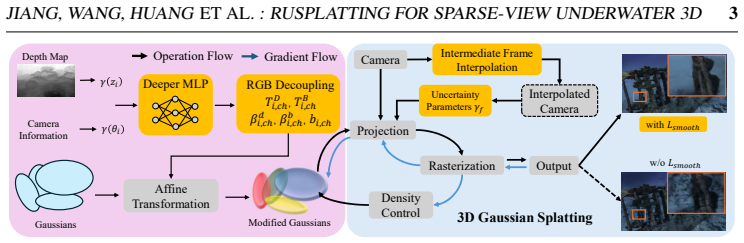
The central mechanism is per-channel medium-parameter prediction: an MLP takes position-encoded depth and viewpoint and outputs medium parameters for each Gaussian and each color channel, producing the corrected color $c^m_{i,\text{ch}} = T^D_{i,\text{ch}} \cdot c_{i,\text{ch}} + (1 - T^B_{i,\text{ch}}) \cdot b_{i,\text{ch}}$. Supporting this, Intermediate Frame Interpolation (IFI) uses RIFE to synthesize frames between sparse inputs, Adaptive Frame Weighting (AFW) tunes each interpolated frame's loss weight via a learnable uncertainty parameter, and an Edge-Aware Smoothness Loss (ESL) uses depth discontinuities from pseudo-depth maps as edge weights to smooth noise while preserving structure.
What would settle it
Train RUSplatting on an underwater scene where ground-truth depth is available (for example, a synthetic water tank or a capture with a depth sensor) and compare against the pseudo-depth variant; if replacing Depth-Anything-V2 depths with true depths does not improve or preserves the reported gains, the claimed coupling between depth accuracy and medium estimation is not supported.
Extended reading notes
Core claim
On the paper's own terms, the central discovery is that decoupling the underwater image formation physics per RGB channel, with attenuation $T^D_{\text{ch}}$ and backscatter $T^B_{\text{ch}}$ varying with distance $z$, inside an affine color transform of each Gaussian, combined with interpolated intermediate frames and a depth-guided edge-aware smoothness loss, makes sparse-view underwater novel-view synthesis robust. The method builds directly on 3D Gaussian Splatting and replaces a shallow MLP with a five-layer MLP that predicts per-channel medium parameters $\{T^D, T^B, \beta^d, \beta^b, b\}$. The authors report that RUSplatting outperforms five baselines across PSNR, SSIM, and LPIPS on SeaThru-NeRF, S-UW, and Submerged3D.
Load-bearing premise
The single load-bearing assumption is that pseudo-depth maps from Depth-Anything-V2 are accurate enough in deep-sea, low-light, high-turbidity images to supervise geometry and to set edge weights in the smoothness loss; if they are not, the decoupled physics and depth losses push the optimization with incorrect depth values.
Editorial extensions
If this is right
- Underwater scenes with roughly 20 training views per sequence can be rendered at higher fidelity than previous underwater NeRF and Gaussian Splatting methods, supporting interactive onshore inspection of shipwrecks and marine sites.
- Per-channel affine color correction restores color in high-turbidity deep-sea footage without a separate image-enhancement network, reducing color cast during reconstruction itself.
- Interpolated frames combined with learnable weighting make the pipeline more tolerant of wide baselines and limited overlap between input views.
- The release of Submerged3D provides a real deep-sea benchmark with low light, severe turbidity, and shipwreck scenes, enabling direct comparisons for future underwater reconstruction work.
Reading between the lines
- If the per-channel physics decoupling is the true source of gain, the same affine model could transfer to other turbid media such as fog or murky rivers, where wavelength-dependent attenuation is weaker; a direct comparison on fog data would test that transfer.
- The method's reliance on Depth-Anything-V2 and RIFE suggests that fine-tuning these estimators on underwater imagery, or substituting physics-based depth estimates, would further improve robustness — a limitation the authors themselves note.
- A stronger diagnostic would be rendering only the training views rather than held-out views, to see whether the PSNR gain reflects improved geometry or mainly improved color post-processing.
- The depth-guiding role of ESL means the method's noise suppression quality is coupled to monocular depth accuracy; comparing against a variant using edge weights from the rendered image itself would isolate that dependency.
Signed reviews
Editorial analysis
A structured set of objections, weighed in public.
Referee Report
Summary. The manuscript proposes RUSplatting, a 3D Gaussian Splatting framework for sparse-view underwater scene reconstruction. The method combines four contributions: per-RGB-channel decoupling of underwater attenuation and backscatter parameters estimated by a deeper MLP, an intermediate frame interpolation (IFI) mechanism with adaptive per-frame uncertainty weighting (AFW), an edge-aware smoothness loss (ESL) that uses pseudo-depth discontinuities to denoise while preserving structure, and a newly collected deep-sea dataset, Submerged3D. Experiments are reported on SeaThru-NeRF, S-UW, and Submerged3D against five baselines, with the claim that RUSplatting consistently outperforms all baselines across PSNR, SSIM, and LPIPS.
Significance. If the empirical claims hold, the paper offers a practical and well-motivated recipe for reconstructing sparse-view, low-light underwater scenes, and the release of a new deep-sea dataset and public code is a useful community contribution. The core priors (Depth-Anything-V2, RIFE, R-UIFM) are external and not produced by the authors, so circularity risk is low. However, the current evidence does not yet substantiate the headline claims: there are unresolved quantitative inconsistencies between the abstract, Section 5.2, Table 1, and the ablation study, and the reported robustness of the method is not supported by per-scene results, error bars, or a sensitivity analysis of the pseudo-depth dependency.
major comments (5)
- [Abstract and Section 5.2, Table 1] The abstract's claim of 'PSNR gains up to 1.90dB' is not supported by Table 1. The largest improvement over the best baseline in Table 1 is 1.22 dB (Submerged3D, RUSplatting 25.7990 vs. WaterSplatting 24.5832); the 2.83, 3.01, and 3.84 dB figures quoted in Section 5.2 correspond to the average improvement over all five baselines, not the improvement over the best baseline, and this should be stated explicitly. The authors should either reconcile the 1.90 dB figure with a specific scene-level result or remove it.
- [Section 4.3, Section 4.4, Section 5.1] Depth-Anything-V2 pseudo-depth is used simultaneously as the depth z in the per-channel transmission model (Eq. 5), as the supervision target for LDepth (Eq. 10), and as the edge-weight source in ESL (Eq. 9). Because Section 6 concedes that Depth-Anything-V2 is not designed for underwater conditions, systematic errors in pseudo-depth could propagate into both the attenuation decoupling and the geometry supervision. The paper provides no sensitivity analysis, no comparison with alternative depth sources, and no depth-quality diagnostics. A concrete test, such as perturbing pseudo-depth or evaluating on a scene with known depth, is needed to establish that the reported gains are robust to this dependency.
- [Table 1 and Section 5.2] The claim that RUSplatting 'consistently outperforms' all baselines across all metrics is based solely on dataset-level averages over four scenes per dataset. No per-scene numbers, standard deviations, or significance tests are reported. This is particularly important because the Submerged3D SSIM margin over UW-GS is only 0.0001 (0.7724 vs. 0.7723), and the LPIPS differences are small. Per-scene tables and error bars are needed to verify the across-scene robustness that the word 'consistently' implies.
- [Section 5.3] The ablation study contains a numerical inconsistency with Table 1. The text reports that the full RUSplatting model achieves an average PSNR of 25.7874 across all datasets, but the mean of the three dataset-averaged PSNR values in Table 1 is 26.8958. The ablation also reports M5 at 25.03 PSNR, implying an AFW gain of 0.76 dB, yet no per-dataset ablation breakdown is given. The authors should clarify the exact subset and weighting used in the ablation averages and provide per-scene ablation results.
- [Sections 4.2–4.3 and Section 5.1] Hyperparameters such as alpha, lambda_b, lambda_s, the loss weights, and the choice of a 5-layer MLP are selected via grid search or hyperparameter sensitivity analysis, but no validation split is described. If these choices are tuned on the test scenes used for evaluation, part of the reported improvement could reflect favorable hyperparameter selection rather than the proposed components. The validation protocol should be stated, and a fixed validation split or nested selection procedure should be used.
minor comments (5)
- [Abstract and Section 1] The abstract claims improved 'geometric accuracy,' but no quantitative geometric evaluation is reported; the paper relies on pseudo-depth only as weak supervision. Either add depth evaluation metrics or temper the geometric-accuracy claim.
- [Section 5.3, Figure 4] The ablation configuration table marks both 'IFI w/o AFW' and 'IFI w/ AFW' as enabled for the final RUSplatting column, which is confusing. The rows should clearly indicate that the final model uses IFI with AFW only.
- [Eq. (7) and Eq. (11)] The gamma notation is inconsistent: Eq. (7) uses gamma_f for each interpolated frame, while Eq. (11) writes only gamma. The subscript should be restored in Eq. (11) for clarity.
- [Section 1] The listed percentage improvements '21.37%, 4.99%, and 5.09%' relative to SeeThru-NeRF, WaterSplatting, and UW-GS do not have their baseline definitions stated; specify whether these are relative PSNR improvements and against which exact baseline configurations.
- [Table 1] The table caption says red bold denotes the best result and yellow the second best, but no yellow highlighting is visible in the provided text; ensure the final rendering shows both annotations or revise the caption.
Circularity Check
No significant circularity: central claims are empirical comparisons with external priors and baselines.
full rationale
The paper's central claims (Table 1, ablations) are empirical, not derived from its own fitted parameters. The underwater color model in Eqs. 5-6 is a per-channel application of the externally established R-UIFM [1] and is not used to fabricate a prediction. Pseudo-depth from Depth-Anything-V2 and interpolated frames from RIFE are external, pre-trained components, not outputs of RUSplatting; using the same pseudo-depth in Eq. 5, LDepth, and ESL weights is a shared external input, not a self-referential derivation. The AFW uncertainty weights and medium parameters are optimized on training views and evaluated on held-out views, so gains are measured rather than forced by construction. Self-citations ([10] review, [27] UW-GS, [19]) appear only as motivation or baselines; [27] is compared via its official implementation, and the ablation is internal. The Section 6 concession that RIFE and Depth-Anything-V2 are not designed for underwater conditions is a robustness or transfer risk, not circularity. No equation reduces by definition to another, and no fitted parameter is renamed as a prediction.
Assumptions & free parameters
free parameters (5)
- lambda_s (smoothness loss weight) =
0.2
- lambda_r, lambda_d, lambda_ca (loss weights) =
0.8, 0.1, 1.0
- alpha (AFW regularization) =
grid-searched in [0,1], exact value deferred to supplementary
- lambda_b (edge sensitivity) =
grid-searched in [0,5], exact value deferred to supplementary
- per-frame uncertainty gamma_f (AFW) =
learned during training
assumptions (4)
- domain assumption R-UIFM (Eq. 3) is an adequate model of underwater image formation in the tested deep-sea scenes.
- domain assumption Depth-Anything-V2 pseudo-depth is accurate enough in deep-sea, low-light, high-turbidity imagery to supervise rendered depth and compute ESL edge weights (Section 4.3).
- domain assumption RIFE interpolated frames are geometrically plausible additions to the training set.
- domain assumption The grey-world assumption that mean channel intensity should be 0.5 improves color restoration.
Cite this review
Pith. "Pith review of RUSplatting: Robust 3D Gaussian Splatting for Sparse-View Underwater Scene Reconstruction." pith.science (2026). https://pith.science/paper/HRFHYJBF
@misc{pith2026250515737,
  author       = {Pith},
  title        = {Pith review of: RUSplatting: Robust 3D Gaussian Splatting for Sparse-View Underwater Scene Reconstruction},
  year         = {2026},
  howpublished = {\url{https://pith.science/paper/HRFHYJBF}},
  note         = {Machine review of arXiv:2505.15737}
}
read the original abstract
Reconstructing high-fidelity underwater scenes remains a challenging task due to light absorption, scattering, and limited visibility inherent in aquatic environments. This paper presents an enhanced Gaussian Splatting-based framework that improves both the visual quality and geometric accuracy of deep underwater rendering. We propose decoupled learning for RGB channels, guided by the physics of underwater attenuation, to enable more accurate colour restoration. To address sparse-view limitations and improve view consistency, we introduce a frame interpolation strategy with a novel adaptive weighting scheme. Additionally, we introduce a new loss function aimed at reducing noise while preserving edges, which is essential for deep-sea content. We also release a newly collected dataset, Submerged3D, captured specifically in deep-sea environments. Experimental results demonstrate that our framework consistently outperforms state-of-the-art methods with PSNR gains up to 1.90dB, delivering superior perceptual quality and robustness, and offering promising directions for marine robotics and underwater visual analytics. The code of RUSplatting is available at https://github.com/theflash987/RUSplatting and the dataset Submerged3D can be downloaded at https://zenodo.org/records/15482420.
Figures


Figures from the paper (1 more)

Reference graph
Works this paper leans on
-
[1]
A revised underwater image formation model
Derya Akkaynak and Tali Treibitz. A revised underwater image formation model. In Proceedings of the IEEE conference on computer vision and pattern recognition, pages 6723–6732, 2018
work page 2018
-
[2]
A survey on 3d gaussian splatting
Guikun Chen and Wenguan Wang. A survey on 3d gaussian splatting. arXiv preprint arXiv:2401.03890, 2024
arXiv 2024
-
[3]
Underwater image enhancement by wavelength compensation and dehazing
John Y Chiang and Ying-Ching Chen. Underwater image enhancement by wavelength compensation and dehazing. IEEE transactions on image processing , 21(4):1756– 1769, 2011
work page 2011
-
[4]
Underwater depth estimation and image restoration based on single images
Paulo LJ Drews, Erickson R Nascimento, Silvia SC Botelho, and Mario Fernando Mon- tenegro Campos. Underwater depth estimation and image restoration based on single images. IEEE computer graphics and applications, 36(2):24–35, 2016
work page 2016
-
[5]
Y . Du, Z. Zhang, P. Zhang, F. Sun, and X. Lv. UDR-GS: Enhancing Underwater Dy- namic Scene Reconstruction with Depth Regularization. Symmetry, 16(8):1010, 2024. doi: 10.3390/sym16081010
-
[6]
Unsupervised underwater image restoration: From a homology perspective
Zhenqi Fu, Huangxing Lin, Yan Yang, Shu Chai, Liyan Sun, Yue Huang, and Xinghao Ding. Unsupervised underwater image restoration: From a homology perspective. In Proceedings of the AAAI conference on artificial intelligence , volume 36, pages 643– 651, 2022
work page 2022
-
[7]
A survey on underwater com- puter vision
Salma P González-Sabbagh and Antonio Robles-Kelly. A survey on underwater com- puter vision. ACM Computing Surveys, 55(13s):1–39, 2023
work page 2023
-
[8]
AquaNeRF: Neural Radiance Fields in Underwater Media with Distractor Removal
Luca Gough, Adrian Azzarelli, Fan Zhang, and Nantheera Anantrasirichai. AquaNeRF: Neural Radiance Fields in Underwater Media with Distractor Removal. InProceedings of the 2025 IEEE International Symposium on Circuits and Systems (ISCAS) . IEEE, 2025
work page 2025
Show all 31 references
-
[9]
Deep residual learning for image recognition
Kaiming He, Xiangyu Zhang, Shaoqing Ren, and Jian Sun. Deep residual learning for image recognition. In Proceedings of the IEEE conference on computer vision and pattern recognition, pages 770–778, 2016
2016
-
[10]
Visual enhancement and 3d representation for underwater scenes: A review
Guoxi Huang, Haoran Wang, Brett Seymour, Evan Kovacs, John Ellerbrock, Dave Blackham, and Nantheera Anantrasirichai. Visual enhancement and 3d representation for underwater scenes: A review. arXiv preprint arXiv:2505.01869, 2024
2024 arXiv
-
[11]
Real-time intermediate flow estimation for video frame interpolation
Zhewei Huang, Tianyuan Zhang, Wen Heng, Boxin Shi, and Shuchang Zhou. Real-time intermediate flow estimation for video frame interpolation. InEuropean Conference on Computer Vision, pages 624–642. Springer, 2022. 12 JIANG, W ANG, HUANGET AL. : RUSPLA TTING FOR SPARSE-VIEW UNDE...
2022
-
[12]
Efficient wavelet boost learning-based multi-stage progressive refinement network for underwater image enhancement
Fushuo Huo, Bingheng Li, and Xuegui Zhu. Efficient wavelet boost learning-based multi-stage progressive refinement network for underwater image enhancement. In Proceedings of the IEEE/CVF international conference on computer vision , pages 1944–1952, 2021
1944
-
[13]
What uncertainties do we need in bayesian deep learning for computer vision? Advances in neural information processing systems, 30, 2017
Alex Kendall and Yarin Gal. What uncertainties do we need in bayesian deep learning for computer vision? Advances in neural information processing systems, 30, 2017
2017
-
[14]
Multi-task learning using uncertainty to weigh losses for scene geometry and semantics
Alex Kendall, Yarin Gal, and Roberto Cipolla. Multi-task learning using uncertainty to weigh losses for scene geometry and semantics. InProceedings of the IEEE conference on computer vision and pattern recognition, pages 7482–7491, 2018
2018
-
[15]
3d gaussian splatting for real-time radiance field rendering
Bernhard Kerbl, Georgios Kopanas, Thomas Leimkühler, and George Drettakis. 3d gaussian splatting for real-time radiance field rendering. ACM Trans. Graph., 42(4): 139–1, 2023
2023
-
[16]
Com- pact 3d gaussian representation for radiance field
Joo Chan Lee, Daniel Rho, Xiangyu Sun, Jong Hwan Ko, and Eunbyung Park. Com- pact 3d gaussian representation for radiance field. In the IEEE/CVF Conference on Computer Vision and Pattern Recognition (CVPR), pages 21719–21728, 2024
2024
-
[17]
Seathru-nerf: Neural radiance fields in scattering media
Deborah Levy, Amit Peleg, Naama Pearl, Dan Rosenbaum, Derya Akkaynak, Simon Korman, and Tali Treibitz. Seathru-nerf: Neural radiance fields in scattering media. In Proceedings of the IEEE/CVF conference on computer vision and pattern recognition, pages 56–65, 2023
2023
-
[18]
Wa- terSplatting: Fast underwater 3D scene reconstruction using gaussian splatting
Huapeng Li, Wenxuan Song, Tianao Xu, Alexandre Elsig, and Jonas Kulhanek. Wa- terSplatting: Fast underwater 3D scene reconstruction using gaussian splatting. 3DV, 2025
2025
-
[19]
Zero-TIG: Temporal consistency-aware zero- shot illumination-guided low-light video enhancement, 2025
Yini Li and Nantheera Anantrasirichai. Zero-TIG: Temporal consistency-aware zero- shot illumination-guided low-light video enhancement, 2025. URL https:// arxiv.org/abs/2503.11175
2025
-
[20]
Aquatic-gs: A hybrid 3d representation for underwater scenes
Shaohua Liu, Junzhe Lu, Zuoya Gu, Jiajun Li, and Yue Deng. Aquatic-gs: A hybrid 3d representation for underwater scenes. arXiv preprint arXiv:2411.00239, 2024
2024 arXiv
-
[21]
Nerf: Representing scenes as neural radiance fields for view synthesis
Ben Mildenhall, Pratul P Srinivasan, Matthew Tancik, Jonathan T Barron, Ravi Ra- mamoorthi, and Ren Ng. Nerf: Representing scenes as neural radiance fields for view synthesis. Communications of the ACM, 65(1):99–106, 2021
2021
-
[22]
Instant neural graphics primitives with a multiresolution hash encoding
Thomas Müller, Alex Evans, Christoph Schied, and Alexander Keller. Instant neural graphics primitives with a multiresolution hash encoding. ACM transactions on graph- ics (TOG), 41(4):1–15, 2022
2022
-
[23]
Underwater image restoration based on image blurriness and light absorption
Yan-Tsung Peng and Pamela C Cosman. Underwater image restoration based on image blurriness and light absorption. IEEE transactions on image processing, 26(4):1579– 1594, 2017
2017
-
[24]
Scatternerf: Seeing through fog with physically-based inverse neural rendering
Andrea Ramazzina, Mario Bijelic, Stefanie Walz, Alessandro Sanvito, Dominik Scheuble, and Felix Heide. Scatternerf: Seeing through fog with physically-based inverse neural rendering. In Proceedings of the IEEE/CVF International Conference on Computer Vision, pages 17957–17968,...
2023
-
[25]
Structure-from-motion revisited
Johannes Lutz Schönberger and Jan-Michael Frahm. Structure-from-motion revisited. In Conference on Computer Vision and Pattern Recognition (CVPR), 2016
2016
-
[26]
Neural under- water scene representation
Yunkai Tang, Chengxuan Zhu, Renjie Wan, Chao Xu, and Boxin Shi. Neural under- water scene representation. In Proceedings of the IEEE/CVF Conference on Computer Vision and Pattern Recognition, pages 11780–11789, 2024
2024
-
[27]
UW-GS: Distractor-aware 3D gaussian splatting for enhanced underwater scene reconstruction
Haoran Wang, Nantheera Anantrasirichai, Fan Zhang, and David Bull. UW-GS: Distractor-aware 3D gaussian splatting for enhanced underwater scene reconstruction. In Proceedings of the Winter Conference on Applications of Computer Vision (WACV), pages 3280–3289, February 2025
2025
-
[28]
Recent advances in 3d gaussian splatting
Tong Wu, Yu-Jie Yuan, Ling-Xiao Zhang, Jie Yang, Yan-Pei Cao, Ling-Qi Yan, and Lin Gao. Recent advances in 3d gaussian splatting. Computational Visual Media, 10 (4):613–642, 2024
2024
-
[29]
Leonard, and Yogesh Girdhar
Daniel Yang, John J. Leonard, and Yogesh Girdhar. SeaSplat: Representing underwater scenes with 3d gaussian splatting and a physically grounded image formation model. In IEEE International Conference on Robotics and Automation (ICRA), 2025
2025
-
[30]
Depth anything: Unleashing the power of large-scale unlabeled data
Lihe Yang, Bingyi Kang, Zilong Huang, Xiaogang Xu, Jiashi Feng, and Hengshuang Zhao. Depth anything: Unleashing the power of large-scale unlabeled data. In Pro- ceedings of the IEEE/CVF Conference on Computer Vision and Pattern Recognition , pages 10371–10381, 2024
2024
-
[31]
Depth anything v2
Lihe Yang, Bingyi Kang, Zilong Huang, Zhen Zhao, Xiaogang Xu, Jiashi Feng, and Hengshuang Zhao. Depth anything v2. Advances in Neural Information Processing Systems, 37:21875–21911, 2024
2024
Reviewed August 7, 2026 · model on record in the stance chip above.
Discussion (0). Continue with ORCID to comment.