REVIEW 4 major objections 5 minor 57 references
KineDex: Learning Tactile-Informed Visuomotor Policies via Kinesthetic Teaching for Dexterous Manipulation
T0 review · 4 major / 5 minor · reviewed 2026-08-16 · deepseek-v4-flash
Pith's one-line read KineDex claims that kinesthetic teaching—letting a human physically guide the robot hand during demonstrations—combined with inpainting the operator out of the view and adding force control at deployment, trains tactile-informed…
desk verdict Useful kinesthetic-teaching framework with a real contribution in visual inpainting, but the force-control law in Eq. (2) is under-specified and undermines the central claim; needs revision before I'd trust the numbers. read the letter →
The pith
A machine-rendered reading of the paper's core claim, the machinery that carries it, and where it could break.
The reading
What carries the argument
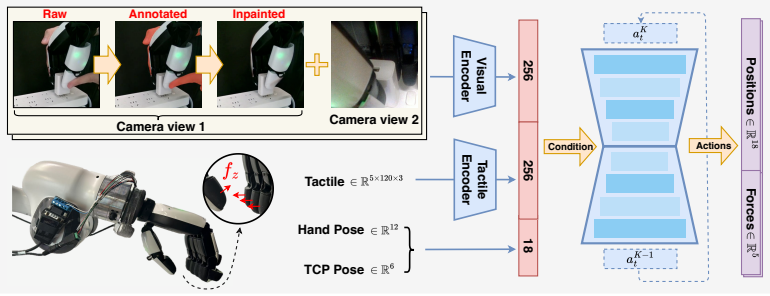
The central mechanism is the force-informed target position, a control law that converts each fingertip's predicted contact force into a virtual displacement of the fingertip and base joints before the PD controller runs. For each finger the target positions become $x_{\mathrm{tip}}^d = x_{\mathrm{tip}} + K_{\mathrm{tip}} f^d$ and $x_{\mathrm{base}}^d = x_{\mathrm{base}} + K_{\mathrm{base}} f^d$, where $f^d$ is the normal force predicted by the policy and $K_{\mathrm{tip}}, K_{\mathrm{base}}$ are fixed gains; pressing the virtual target inside the object generates real contact force through the object's resistance. This is what allows the trained policy to track the demonstration's force profile instead of merely touching the surface. The other load-bearing pieces are the inpainting preprocessing—a segmentation step plus a video inpainting model that removes the operator's body from the front camera—and the tactile encoder that feeds per-finger contact vectors into the policy alongside images and proprioception. The force control law is the primary carrier of the paper's success gains.
What would settle it
Run the trained KineDex policy on a set of objects matched to the nine tasks but with substantially different surface stiffness, such as a rigid steel bottle, a hard plastic cap, and a soft foam syringe, without retuning $K_{\mathrm{tip}}$ and $K_{\mathrm{base}}$. If the executed fingertip forces, measured by the hand's tactile sensors, systematically deviate from the policy's predicted forces, or if success rates fall to the no-force-control level on the rigid object, the linear fixed-gain force law is the failing component. A weaker test is to record force tracking on all five fingers, not just the thumb, and check that predicted and sensed forces match at contact.
Extended reading notes
Core claim
The paper's central claim is that kinesthetic teaching with a hand-over-hand setup, combined with image inpainting and tactile-augmented policy learning, is sufficient to train visuomotor policies that succeed on nine contact-rich dexterous manipulation tasks. The key demonstration is that when the learned policy predicts both target joint positions and target fingertip forces, and those forces are converted into virtual joint offsets during execution, KineDex reaches an average success rate of 74.4%, with about 15 of 20 trials or better on most tasks; removing force control collapses performance to 16.7% average, with zero successes on Bottle Picking, Peg Insertion, Charger Plugging, Toothpaste Squeezing, and Syringe Pressing. The paper also shows that tactile input adds a 26.7% average improvement on contact-intensive tasks such as Cap Twisting, Toothpaste Squeezing, and Syringe Pressing, and that inpainting the operator's hand out of demonstrations is necessary because without it success is zero across all tasks. Comparatively, KineDex collects demonstrations more than twice as fast as the teleoperation baseline while maintaining near-100% collection success, versus under 50% for teleoperation. The intended conclusion is that physically grounded tactile demonstrations plus force-informed control, not vision alone, are what make precise contact-rich manipulation learnable.
Load-bearing premise
The gains $K_{\mathrm{tip}}$ and $K_{\mathrm{base}}$ in the force-to-position law are tuned once and fixed across every task and object, so the claim that force control dramatically improves success rests on the assumption that a single linear force-displacement relation holds for all the objects the hand touches.
Editorial extensions
If this is right
- If KineDex is right, kinesthetic teaching can replace teleoperation as the default way to collect dexterous-hand demonstrations: it is roughly twice as fast, needs no VR retargeting, and gives operators natural force feedback.
- The force-informed position offset makes the gap between touching an object and applying the right force learnable; position-only policies will keep failing on contact-rich tasks even with good vision.
- Inpainting the operator out of the view turns kinesthetic demos into usable training data, eliminating the need to replay trajectories for clean observations, so longer-horizon tasks become feasible.
- Tactile sensing is not just auxiliary: on tasks where vision is occluded or contact feedback is central, such as cap twisting, toothpaste squeezing, and syringe pressing, removing it costs an average 26.7% success.
- Success on deformable and fragile objects such as eggs, paper cups, and syringes suggests the same pipeline may extend to other precision tasks in assembly, healthcare, or service robots.
Reading between the lines
- A natural extension is to make the force-control gains adaptive, for instance by estimating surface stiffness from tactile readings during contact, so the same policy transfers to objects with very different compliance without retuning.
- The inpainting step is a likely bottleneck for scenes with severe or dynamic occlusion; a testable improvement is to train the inpainting model on robot-task data, which the paper itself flags as future work.
- The reliance on two human hands, one for the thumb and one for the other fingers, suggests the method will not scale directly to bimanual tasks until more biomimetic hardware or single-handed guidance is available; meanwhile, the comparison with teleoperation is the key evidence that the kinesthetic channel, not just extra demonstration count, drives the gain.
- One could test whether the force prediction itself can be learned from teleoperation or video demonstrations paired with a force-sensor-equipped hand, which would decouple the kinesthetic collection advantage from the force-control advantage.
Signed reviews
Editorial analysis
A structured set of objections, weighed in public.
Referee Report
Summary. KineDex proposes a kinesthetic-teaching pipeline for collecting demonstrations with a dexterous hand, with tactile sensing and fingertip normal forces recorded. The raw visual observations are preprocessed by segmenting and inpainting the operator's body, and a Diffusion Policy is trained to predict both target joint positions and target fingertip normal forces from visual, tactile, and proprioceptive inputs. At deployment, the predicted forces are used to modify desired position targets through a proposed force-control law in Eq. (2). The paper evaluates the method on nine contact-rich manipulation tasks, reporting an average success rate of 74.4% for KineDex versus 16.7% without force control, and also reports a data-collection comparison against a teleoperation baseline and a small user study. The central claim is that kinesthetic teaching provides efficient, tactile-enriched demonstrations that, combined with tactile-informed policies and force control, produce reliable policies for contact-rich manipulation.
Significance. If the claims hold, the paper makes a useful empirical contribution: it demonstrates a practical kinesthetic-teaching setup for a dexterous hand, shows that inpainting occluded operators is a workable alternative to trajectory replay, and provides evidence that tactile-augmented actions improve contact-rich manipulation. The data-collection efficiency comparison against teleoperation is valuable and, if reproduced, would be a practical advantage. However, the load-bearing force-control contribution is currently underspecified and the quantitative evidence is limited to 20 trials per condition without variance reporting, so the significance can be assessed fully only after the control law and experimental statistics are clarified.
major comments (4)
- [§3.4, Eq. (2)] Equation (2) is not a force controller in the usual sense, and as written it does not use the predicted joint positions x_d. The force-informed target positions are computed from the current measured positions plus a fixed gain times the predicted force, with no term comparing measured force to the predicted force and no mention of x_d. If f_d = 0, the target equals the current position, so the position-control loop would be servo-locked and the joint-position component of the action would be vacated. Either the equation is missing an x_d-dependent term or the deployed controller differs from the stated one. The claim that KineDex "precisely tracks" the target forces is therefore unsupported by the given control law, and the implementation must be specified exactly.
- [§3.4, Eq. (2)] The force mechanism relies on fixed gains K_tip and K_base that are described as tuned once and kept fixed across tasks. Because the nine tasks involve objects with very different contact stiffnesses (raw egg, paper cup, plastic bottle, syringe), an open-loop position offset proportional to f_d cannot be expected to produce the same actual force across tasks; the steady-state contact force is approximately stiffness times the offset, not f_d itself. The paper should either provide a closed-loop force controller, report measured force-tracking errors per task, or restrict the claim to demonstrating that an additive preload offset helps rather than that the policy accurately tracks predicted forces.
- [Table 1, §4.1] All performance claims rest on a single set of 20 trials per condition, with no repeated seeds, no standard deviations, and no confidence intervals. With 20 binary trials, the standard error of a 75% success rate is roughly 10 percentage points, so differences such as 12/20 versus 16/20 (Charger Plugging between KineDex and w/o Tactile Input) are not statistically meaningful. Reporting multiple training seeds and trial-level variation is necessary to support the headline 74.4% average and the 57.7% improvement claim.
- [Table 1, §4.1] The w/o Inpainting ablation yields zero successes on all nine tasks, including simple pick-and-place tasks such as Bottle Picking and Cup Picking. This is a surprising and strong result that is not supported by any analysis of the failure modes, the quality of the inpainted images, or the sensitivity of the result to inpainting artifacts. Given that this ablation is used to justify the inpainting component of the pipeline, the paper should provide more than a single zero-success observation, for example by reporting policy behavior on raw versus inpainted observations or by varying the inpainting quality.
minor comments (5)
- [Abstract and Figure 1 caption] The phrase "tactile-enriched demonstrations" is followed by "viatactile-informed" in the Figure 1 caption, which appears to be a missing-space typo.
- [§3.1] The notation "No" in the observation space description appears to be a corrupted subscript; if it denotes N_o views, the text should say so explicitly.
- [§B, Policy Training Details] The action vector is described as 23-dimensional (6 end-effector DoF, 12 joint angles, 5 force targets), but §3.1 defines the action as only target joint positions and target forces, omitting the end-effector pose. These two descriptions should be reconciled.
- [§3.2] The paper states that the operator controls the thumb with the left hand while guiding the other fingers with the right hand, but Figure 4 and the task descriptions do not clarify how this bimanual coordination is synchronized or whether it affects the quality of force demonstrations. A brief explanation would help reproducibility.
- [Figure 3] The force-tracking visualization uses normalized forces and shows only two tasks; the paper should state the scaling and, ideally, report quantitative tracking error or correlation between predicted and sensed force.
Circularity Check
No significant circularity: KineDex's success claims are empirical evaluations, not consequences of definitions or fits.
full rationale
The paper's central claims rest on real-robot task success, not on a derivation that reduces to its inputs. The force-informed target positions in Eq. (2) are an execution mechanism, while the target forces fd are policy predictions trained from kinesthetic demonstrations that include measured tactile forces; success is evaluated by task completion, so the success metric is not defined in terms of the policy outputs. The gains K_tip and K_base are tuned hyperparameters, which is parameter fitting rather than a prediction derived from the targets. The ablations (w/o Force Control, w/o Tactile Input, w/o Inpainting) are independent empirical comparisons and are not statistically forced by the training objective. The cited tools (Diffusion Policy, ProPainter, Grounded-SAM) are external standard methods and are not used as a self-citation chain or a uniqueness theorem. The limitations section identifies scalability issues but does not state that any result was assumed. The only notable concern is the ambiguous force-control law in Eq. (2), which as written omits the predicted joint positions xd when computing the commanded targets; that is a technical correctness issue, not a circularity, because even if the equation is incomplete, the reported success metric is still an empirical outcome rather than an input to the method by construction.
Assumptions & free parameters
free parameters (2)
- K_tip =
Not specified
- K_base =
Not specified
assumptions (3)
- domain assumption Inpainting with ProPainter removes human-body occlusions from kinesthetic demonstration images sufficiently for policy learning.
- domain assumption Fingertip force is linearly related to a virtual position offset through the gains K_tip and K_base.
- domain assumption The operator's two-handed guidance of the dexterous hand produces demonstrations that are learnable by a diffusion policy.
Cite this review
Pith. "Pith review of KineDex: Learning Tactile-Informed Visuomotor Policies via Kinesthetic Teaching for Dexterous Manipulation." pith.science (2026). https://pith.science/paper/FUDURU36
@misc{pith2026250501974,
  author       = {Pith},
  title        = {Pith review of: KineDex: Learning Tactile-Informed Visuomotor Policies via Kinesthetic Teaching for Dexterous Manipulation},
  year         = {2026},
  howpublished = {\url{https://pith.science/paper/FUDURU36}},
  note         = {Machine review of arXiv:2505.01974}
}
read the original abstract
Collecting demonstrations enriched with fine-grained tactile information is critical for dexterous manipulation, particularly in contact-rich tasks that require precise force control and physical interaction. While prior works primarily focus on teleoperation or video-based retargeting, they often suffer from kinematic mismatches and the absence of real-time tactile feedback, hindering the acquisition of high-fidelity tactile data. To mitigate this issue, we propose KineDex, a hand-over-hand kinesthetic teaching paradigm in which the operator's motion is directly transferred to the dexterous hand, enabling the collection of physically grounded demonstrations enriched with accurate tactile feedback. To resolve occlusions from human hand, we apply inpainting technique to preprocess the visual observations. Based on these demonstrations, we then train a visuomotor policy using tactile-augmented inputs and implement force control during deployment for precise contact-rich manipulation. We evaluate KineDex on a suite of challenging contact-rich manipulation tasks, including particularly difficult scenarios such as squeezing toothpaste onto a toothbrush, which require precise multi-finger coordination and stable force regulation. Across these tasks, KineDex achieves an average success rate of 74.4%, representing a 57.7% improvement over the variant without force control. Comparative experiments with teleoperation and user studies further validate the advantages of KineDex in data collection efficiency and operability. Specifically, KineDex collects data over twice as fast as teleoperation across two tasks of varying difficulty, while maintaining a near-100% success rate, compared to under 50% for teleoperation.
Figures


Figures from the paper (6 more)


Reference graph
Works this paper leans on
-
[1]
Z.-H. Yin, B. Huang, Y . Qin, Q. Chen, and X. Wang. Rotating without seeing: Towards in-hand dexterity through touch, Mar. 2023
work page 2023
-
[2]
H. Qi, B. Yi, S. Suresh, M. Lambeta, Y . Ma, R. Calandra, and J. Malik. General in-hand object rotation with vision and touch, Sept. 2023
work page 2023
- [3]
- [4]
-
[5]
K. Shaw, A. Agarwal, and D. Pathak. Leap hand: Low-cost, efficient, and anthropomorphic hand for robot learning, Sept. 2023
work page 2023
-
[6]
K. Shaw and D. Pathak. Leap hand v2: Dexterous, low-cost anthropomorphic hybrid rigid soft hand for robot learning. In 2nd Workshop on Dexterous Manipulation: Design, Perception and Control (RSS), 2024
work page 2024
-
[7]
C. C. Christoph, M. Eberlein, F. Katsimalis, A. Roberti, A. Sympetheros, M. R. V ogt, D. Li- conti, C. Yang, B. G. Cangan, R. J. Hinchet, and R. K. Katzschmann. Orca: An open-source, reliable, cost-effective, anthropomorphic robotic hand for uninterrupted dexterous task learn- ing, Apr. 2025
work page 2025
-
[8]
B. Romero, H.-S. Fang, P. Agrawal, and E. Adelson. Eyesight hand: Design of a fully-actuated dexterous robot hand with integrated vision-based tactile sensors and compliant actuation, Aug. 2024
work page 2024
Show all 57 references
-
[9]
Bhirangi, V
R. Bhirangi, V . Pattabiraman, E. Erciyes, Y . Cao, T. Hellebrekers, and L. Pinto. Anyskin: Plug-and-play skin sensing for robotic touch. arXiv preprint arXiv:2409.08276, 2024. 9
2024 arXiv
-
[10]
C. Lin, Z. Lin, S. Wang, and H. Xu. Dtact: A vision-based tactile sensor that measures high- resolution 3d geometry directly from darkness, Sept. 2022
2022
-
[11]
J. Xu, L. Wu, C. Lin, D. Zhao, and H. Xu. Dtactive: A vision-based tactile sensor with active surface, Oct. 2024
2024
-
[12]
S. Wang, Y . She, B. Romero, and E. Adelson. Gelsight wedge: Measuring high-resolution 3d contact geometry with a compact robot finger, June 2021
2021
-
[13]
Gallipoli, S
M. Gallipoli, S. Buonocore, M. Selvaggio, G. A. Fontanelli, S. Grazioso, and G. Di Giron- imo. A virtual reality-based dual-mode robot teleoperation architecture. Robotica, 42(6): 1935–1958, June 2024. ISSN 0263-5747, 1469-8668. doi:10.1017/S0263574724000663
1935 doi
-
[14]
C. Wang, H. Shi, W. Wang, R. Zhang, L. Fei-Fei, and C. K. Liu. Dexcap: Scalable and portable mocap data collection system for dexterous manipulation, July 2024
2024
-
[15]
Cheng, J
X. Cheng, J. Li, S. Yang, G. Yang, and X. Wang. Open-television: Teleoperation with immer- sive active visual feedback, July 2024
2024
-
[16]
Z. Si, K. L. Zhang, Z. Temel, and O. Kroemer. Tilde: Teleoperation for dexterous in-hand manipulation learning with a deltahand, Aug. 2024
2024
-
[17]
P. Wu, Y . Shentu, Z. Yi, X. Lin, and P. Abbeel. Gello: A general, low-cost, and intuitive teleoperation framework for robot manipulators, July 2024
2024
-
[18]
K. Shaw, S. Bahl, and D. Pathak. Videodex: Learning dexterity from internet videos. In Proceedings of The 6th Conference on Robot Learning , pages 654–665. PMLR, Mar. 2023
2023
-
[19]
H. G. Singh, A. Loquercio, C. Sferrazza, J. Wu, H. Qi, P. Abbeel, and J. Malik. Hand-object interaction pretraining from videos, Sept. 2024
2024
-
[20]
Guzey, Y
I. Guzey, Y . Dai, G. Savva, R. Bhirangi, and L. Pinto. Bridging the human to robot dexterity gap through object-oriented rewards, Oct. 2024
2024
-
[21]
J. Li, Y . Zhu, Y . Xie, Z. Jiang, M. Seo, G. Pavlakos, and Y . Zhu. Okami: Teaching humanoid robots manipulation skills through single video imitation, Oct. 2024
2024
-
[22]
Z. Chen, S. Chen, E. Arlaud, I. Laptev, and C. Schmid. Vividex: Learning vision-based dex- terous manipulation from human videos, Sept. 2024
2024
-
[23]
J. Li, Y . Zhu, Y . Xie, Z. Jiang, M. Seo, G. Pavlakos, and Y . Zhu. Okami: Teaching humanoid robots manipulation skills through single video imitation, 2024. URL https://arxiv.org/ abs/2410.11792
2024 arXiv
-
[24]
H. Xu, M. Chen, G. Li, L. Wei, S. Peng, H. Xu, and Q. Li. An immersive virtual reality bimanual telerobotic system with haptic feedback, Jan. 2025
2025
-
[25]
Zhang, S
H. Zhang, S. Hu, Z. Yuan, and H. Xu. Doglove: Dexterous manipulation with a low-cost open-source haptic force feedback glove, Feb. 2025
2025
-
[26]
Piazza, G
C. Piazza, G. Grioli, M. G. Catalano, and A. Bicchi. A century of robotic hands. Annual Review of Control, Robotics, and Autonomous Systems , 2(1):1–32, 2019
2019
-
[27]
U. Yoo, J. Francis, J. Oh, and J. Ichnowski. Kinesoft: Learning proprioceptive manipulation policies with soft robot hands, Mar. 2025
2025
-
[28]
C. Chen, Z. Yu, H. Choi, M. Cutkosky, and J. Bohg. Dexforce: Extracting force-informed actions from kinesthetic demonstrations for dexterous manipulation, Jan. 2025
2025
-
[29]
W. Liu, J. Wang, Y . Wang, W. Wang, and C. Lu. Forcemimic: Force-centric imitation learning with force-motion capture system for contact-rich manipulation, Oct. 2024. 10
2024
-
[30]
S. Zhou, C. Li, K. C. K. Chan, and C. C. Loy. Propainter: Improving propagation and trans- former for video inpainting, Sept. 2023
2023
-
[31]
Y . Qin, W. Yang, B. Huang, K. V . Wyk, H. Su, X. Wang, Y .-W. Chao, and D. Fox. Anyteleop: A general vision-based dexterous robot arm-hand teleoperation system, May 2024
2024
-
[32]
Handa, K
A. Handa, K. V . Wyk, W. Yang, J. Liang, Y .-W. Chao, Q. Wan, S. Birchfield, N. Ratliff, and D. Fox. Dexpilot: Vision based teleoperation of dexterous robotic hand-arm system, Oct. 2019
2019
-
[33]
A. Iyer, Z. Peng, Y . Dai, I. Guzey, S. Haldar, S. Chintala, and L. Pinto. Open teach: A versatile teleoperation system for robotic manipulation, Mar. 2024
2024
-
[34]
S. P. Arunachalam, I. Güzey, S. Chintala, and L. Pinto. Holo-dex: Teaching dexterity with immersive mixed reality, Oct. 2022
2022
-
[35]
R. Ding, Y . Qin, J. Zhu, C. Jia, S. Yang, R. Yang, X. Qi, and X. Wang. Bunny-visionpro: Real- time bimanual dexterous teleoperation for imitation learning, 2024. URL https://arxiv. org/abs/2407.03162
2024 arXiv
-
[36]
X. Chao, S. Mu, Y . Liu, S. Li, C. Lyu, X.-P. Zhang, and W. Ding. Exo-viha: A cross-platform exoskeleton system with visual and haptic feedback for efficient dexterous skill learning, Mar. 2025
2025
-
[37]
Y . Hou, Z. Liu, C. Chi, E. Cousineau, N. Kuppuswamy, S. Feng, B. Burchfiel, and S. Song. Adaptive compliance policy: Learning approximate compliance for diffusion guided control, Oct. 2024
2024
-
[38]
Ablett, O
T. Ablett, O. Limoyo, A. Sigal, A. Jilani, J. Kelly, K. Siddiqi, F. Hogan, and G. Dudek. Multimodal and force-matched imitation learning with a see-through visuotactile sensor. IEEE Transactions on Robotics , 41:946–959, 2025. ISSN 1552-3098, 1941-0468. doi: 10.1109/TRO.2024.3521864
2025
-
[39]
Wei and H
D. Wei and H. Xu. A wearable robotic hand for hand-over-hand imitation learning, Sept. 2023
2023
-
[40]
Mandlekar, D
A. Mandlekar, D. Xu, R. Martín-Martín, S. Savarese, and L. Fei-Fei. Learning to generalize across long-horizon tasks from human demonstrations, June 2021
2021
-
[41]
Chang and S
M. Chang and S. Gupta. One-shot visual imitation via attributed waypoints and demonstration augmentation, 2023. URL https://arxiv.org/abs/2302.04856
2023 arXiv
-
[42]
T. Yu, P. Abbeel, S. Levine, and C. Finn. One-shot composition of vision-based skills from demonstration. In 2019 IEEE/RSJ International Conference on Intelligent Robots and Systems (IROS), pages 2643–2650. IEEE, 2019
2019
-
[43]
E. Johns. Coarse-to-fine imitation learning: Robot manipulation from a single demonstration,
-
[44]
C. Chi, Z. Xu, S. Feng, E. Cousineau, Y . Du, B. Burchfiel, R. Tedrake, and S. Song. Diffusion policy: Visuomotor policy learning via action diffusion, Mar. 2024
2024
-
[45]
Y . Ze, G. Zhang, K. Zhang, C. Hu, M. Wang, and H. Xu. 3d diffusion policy: Generalizable visuomotor policy learning via simple 3d representations, June 2024
2024
-
[46]
Z. Sun, Z. Shi, J. Chen, Q. Liu, Y . Cui, Q. Ye, and J. Chen. Vtao-bimanip: Masked visual- tactile-action pre-training with object understanding for bimanual dexterous manipulation, Jan. 2025
2025
-
[47]
Guzey, B
I. Guzey, B. Evans, S. Chintala, and L. Pinto. Dexterity from touch: Self-supervised pre- training of tactile representations with robotic play, Mar. 2023. 11
2023
-
[48]
Guzey, Y
I. Guzey, Y . Dai, B. Evans, S. Chintala, and L. Pinto. See to touch: Learning tactile dexterity through visual incentives, Sept. 2023
2023
-
[49]
L. Y . Chen, C. Xu, K. Dharmarajan, M. Z. Irshad, R. Cheng, K. Keutzer, M. Tomizuka, Q. Vuong, and K. Goldberg. Rovi-aug: Robot and viewpoint augmentation for cross- embodiment robot learning, Sept. 2024
2024
-
[50]
Lepert, J
M. Lepert, J. Fang, and J. Bohg. Phantom: Training robots without robots using only human videos, 2025. URL https://arxiv.org/abs/2503.00779
2025 arXiv
-
[51]
T. Ren, S. Liu, A. Zeng, J. Lin, K. Li, H. Cao, J. Chen, X. Huang, Y . Chen, F. Yan, Z. Zeng, H. Zhang, F. Li, J. Yang, H. Li, Q. Jiang, and L. Zhang. Grounded sam: Assembling open- world models for diverse visual tasks, Jan. 2024
2024
-
[52]
T. Z. Zhao, V . Kumar, S. Levine, and C. Finn. Learning fine-grained bimanual manipulation with low-cost hardware, Apr. 2023
2023
-
[53]
Siciliano, O
B. Siciliano, O. Khatib, and T. Kröger. Springer handbook of robotics, volume 200. Springer, 2008
2008
-
[54]
M. A. Johnson and M. H. Moradi. PID control. Springer, 2005
2005
-
[55]
Carpentier, G
J. Carpentier, G. Saurel, G. Buondonno, J. Mirabel, F. Lamiraux, O. Stasse, and N. Mansard. The pinocchio c++ library: A fast and flexible implementation of rigid body dynamics algo- rithms and their analytical derivatives. In2019 IEEE/SICE International Symposium on System In...
2019
-
[56]
Carpentier, F
J. Carpentier, F. Valenza, N. Mansard, et al. Pinocchio: fast forward and inverse dynamics for poly-articulated systems, 2015–2018. URL https://stack-of-tasks. github. io/pinocchio. 12 A Task Design We design a suite of nine contact-rich dexterous manipulation tasks to compreh...
2015
-
[2021]
URL https://arxiv.org/abs/2105.06411
Reviewed August 16, 2026 · model on record in the stance chip above.
Discussion (0). Continue with ORCID to comment.