Robustness Enhancement of Universal Noncyclic Geometric Gates via Evolution Optimization
Pith reviewed 2026-05-22 17:22 UTC · model grok-4.3
The pith
Noncyclic geometric gates optimized for evolution paths resist systematic errors and crosstalk better than dynamical Rabi or cyclic alternatives.
A machine-rendered reading of the paper's core claim, the machinery that carries it, and where it could break.
Core claim
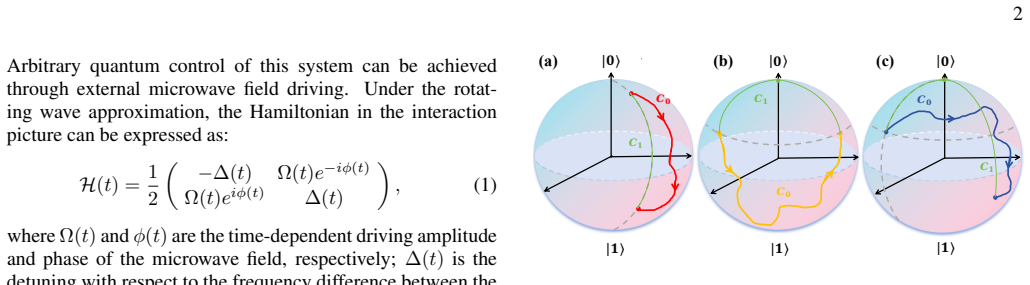
By systematically evaluating all noncyclic evolution conditions and their corresponding geometric trajectories, the authors identify optimal conditions that enhance resilience against universal systematic errors and residual crosstalk error. The optimized noncyclic geometric gates exhibit significant robustness advantages over representative dynamical Rabi gates and conventional cyclic geometric gates. The work also validates the physical feasibility of high-fidelity noncyclic geometric gates in superconducting quantum circuits while quantifying the impacts of intrinsic leakage errors and decoherence effects.
What carries the argument
Noncyclic evolution conditions that permit flexible geometric trajectories without full cyclic closure, selected by numerical optimization to maximize resilience to errors.
If this is right
- Optimized noncyclic gates maintain higher fidelity than dynamical Rabi gates when universal systematic errors are present.
- The same optimized gates outperform conventional cyclic geometric gates under residual crosstalk.
- High-fidelity noncyclic geometric gates remain implementable in superconducting circuits once leakage and decoherence are accounted for.
- Numerical selection of noncyclic trajectories provides a concrete route to improved gate robustness without altering the underlying Hamiltonian.
Where Pith is reading between the lines
- If the robustness gains hold in experiment, the overhead for quantum error correction on near-term processors could decrease.
- The same optimization of evolution conditions might be applied to geometric gates on other platforms such as trapped ions or neutral atoms.
- Combining these noncyclic gates with pulse-shaping techniques could further suppress leakage beyond what the paper models.
Load-bearing premise
The chosen error models of universal systematic errors plus residual crosstalk together with the numerical optimization procedure capture the dominant failure modes of real superconducting hardware.
What would settle it
Fabricate and run the optimized noncyclic gates on a superconducting qubit device, apply controlled systematic errors and crosstalk, then compare measured gate fidelities directly against those of dynamical Rabi gates and cyclic geometric gates under identical conditions.
Figures


read the original abstract
Noncyclic geometric gates aim to overcome the stringent constraints of conventional cyclic conditions and enhance the flexibility in evolution choice. Conceptually, they can also avoid the error problems arising from the violation of cyclicity, thus holding significance for improving the fault tolerance of quantum gates. However, current research on noncyclic geometric gates lacks a comprehensive exploration of their flexibility in evolution choice and validation of their effectiveness in resilience against multiple error sources present in practical quantum systems. In this paper, we systematically evaluate all noncyclic evolution conditions, elucidate their corresponding potential geometric trajectories, and identify optimal conditions for enhancing gate robustness by quantifying the resilience of constructed noncyclic geometric gates against universal systematic errors and residual crosstalk error. The optimized gates demonstrate significant robustness advantages over representative dynamical Rabi gates and conventional cyclic geometric gates. Furthermore, we validate the physical feasibility of high-fidelity noncyclic geometric gates in superconducting quantum circuits, with focused investigation into the impacts of intrinsic leakage errors and decoherence effects. Therefore, this work establishes a critical foundation for robust gate implementation toward practical fault-tolerant quantum processors.
Editorial analysis
A structured set of objections, weighed in public.
Referee Report
Summary. The manuscript systematically evaluates all noncyclic evolution conditions for geometric quantum gates, maps their trajectories, and uses numerical optimization of evolution parameters to identify conditions that enhance resilience against universal systematic errors and residual crosstalk. It reports that the resulting optimized gates show significant robustness advantages over dynamical Rabi gates and conventional cyclic geometric gates, and validates high-fidelity implementation in superconducting circuits while examining leakage and decoherence effects.
Significance. If the reported robustness advantages are confirmed to arise from a properly global optimization rather than local fitting, the work could meaningfully advance fault-tolerant quantum gate design by relaxing cyclic constraints and providing a concrete optimization framework for error resilience in superconducting hardware.
major comments (2)
- [Section 3] Section 3: The numerical search over evolution parameters to quantify resilience against systematic and crosstalk errors is load-bearing for the central robustness claims, yet the manuscript provides no description of the optimization algorithm, number of random restarts, sampling strategy, or checks for global optimality (e.g., basin-hopping or exhaustive grid). Without this, it is impossible to rule out that the reported advantages reflect an incompletely explored local optimum rather than a genuine improvement.
- [§4] §4 and abstract: The claims of 'significant robustness advantages' and 'high-fidelity' noncyclic gates rest on post-optimization numerical results, but no quantitative metrics (fidelities, error rates with error bars, or statistical comparisons to baselines) are referenced in the evaluation sections; this makes the magnitude of the improvement and its statistical reliability difficult to assess.
minor comments (2)
- Add explicit definitions or citations for the precise models of 'universal systematic errors' and 'residual crosstalk error' used in the resilience quantification.
- Ensure all simulation figures report error bars or confidence intervals on fidelity and robustness metrics to allow direct comparison with the dynamical and cyclic baselines.
Simulated Author's Rebuttal
We thank the referee for the constructive and detailed comments, which help clarify the presentation of our numerical methods and results. We address each major comment point by point below and will revise the manuscript accordingly to improve transparency and rigor.
read point-by-point responses
-
Referee: [Section 3] Section 3: The numerical search over evolution parameters to quantify resilience against systematic and crosstalk errors is load-bearing for the central robustness claims, yet the manuscript provides no description of the optimization algorithm, number of random restarts, sampling strategy, or checks for global optimality (e.g., basin-hopping or exhaustive grid). Without this, it is impossible to rule out that the reported advantages reflect an incompletely explored local optimum rather than a genuine improvement.
Authors: We agree that additional details on the optimization procedure are necessary for full reproducibility and to substantiate the global nature of the search. In the revised manuscript, we will expand Section 3 to describe the optimization algorithm, including the sampling strategy over evolution parameters, the number of random restarts performed, and the checks for global optimality such as basin-hopping combined with local refinement. This will demonstrate that the identified optimal conditions were obtained through a thorough exploration of the parameter space rather than an incomplete local search. revision: yes
-
Referee: [§4] §4 and abstract: The claims of 'significant robustness advantages' and 'high-fidelity' noncyclic gates rest on post-optimization numerical results, but no quantitative metrics (fidelities, error rates with error bars, or statistical comparisons to baselines) are referenced in the evaluation sections; this makes the magnitude of the improvement and its statistical reliability difficult to assess.
Authors: We acknowledge that the evaluation sections would benefit from more explicit quantitative metrics to allow direct assessment of the improvements. In the revised version, we will add specific fidelity values, error rates with error bars derived from multiple simulation runs, and statistical comparisons to the dynamical Rabi and cyclic geometric gate baselines directly in Section 4, with appropriate references to the supporting figures. We will also ensure the abstract accurately summarizes these quantitative findings. revision: yes
Circularity Check
No significant circularity detected in derivation or claims
full rationale
The paper systematically enumerates noncyclic evolution conditions, maps their geometric trajectories, and applies numerical optimization to select parameters that minimize infidelity under modeled systematic and crosstalk errors. The resulting robustness advantages are shown via direct comparison of simulated error rates against fixed baselines (dynamical Rabi gates and standard cyclic geometric gates), not by re-expressing the optimization objective itself. Subsequent superconducting-circuit simulations incorporate leakage and decoherence as additional checks outside the original optimization metric. No equation or claim reduces by construction to its inputs, no self-citation supplies a load-bearing uniqueness theorem, and the optimization functions as a design procedure rather than a fitted prediction renamed as a result. The derivation therefore remains self-contained against the stated benchmarks.
Axiom & Free-Parameter Ledger
free parameters (1)
- evolution path parameters
axioms (2)
- domain assumption Geometric phase acquired along a noncyclic path can implement a universal quantum gate when the path satisfies the enumerated conditions.
- domain assumption The dominant error channels are captured by universal systematic errors and residual crosstalk.
Reference graph
Works this paper leans on
-
[1]
Robustness Enhancement of Universal Noncyclic Geometric Gates via Evolution Optimization
and superconducting quantum circuits [50]. Current re- search on noncyclic geometric gates still exhibits notable defi- ciencies: on the one hand, there is a lack of systematic explo- ration of the flexibility in evolution choice; on the other hand, their effectiveness in resisting multiple error sources has not yet been fully verified. Here, we will focu...
work page internal anchor Pith review Pith/arXiv arXiv 2025
-
[2]
M. A. Nielsen and I. L. Chuang, Quantum Computation and Quantum Information (Cambridge University Press, 2000)
work page 2000
- [3]
- [4]
-
[5]
M. V . Berry, Quantal phase factors accompanying adiabatic changes, Proc. R. Soc. London A 392, 45 (1984)
work page 1984
-
[6]
F. Wilczek and A. Zee, Appearance of gauge structure in simple dynamical systems, Phys. Rev. Lett. 52, 2111 (1984)
work page 1984
-
[7]
Y . Aharonov and J. Anandan, Phase change during a cyclic quantum evolution, Phys. Rev. Lett. 58, 1593 (1987)
work page 1987
-
[8]
J. Samuel and R. Bhandari, General Setting for Berry’s Phase, Phys. Rev. Lett. 60, 2339 (1988)
work page 1988
-
[9]
Anandan, Non-adiabatic non-abelian geometric phase, Phys
J. Anandan, Non-adiabatic non-abelian geometric phase, Phys. Lett. A 133, 171 (1988)
work page 1988
- [10]
-
[11]
J. T. Thomas, M. Lababidi, and M. Z. Tian, Robustness of single-qubit geometric gate against systematic error, Phys. Rev. A 84, 042335 (2011)
work page 2011
-
[12]
P. Solinas, M. Sassetti, P. Truini, and N. Zangh`ı, On the stability of quantum holonomic gates, New J. Phys. 14, 093006 (2012)
work page 2012
-
[13]
M. Johansson, E. Sj ¨oqvist, L. M. Andersson, M. Ericsson, B. Hessmo, K. Singh, and D. M. Tong, Robustness of nonadiabatic holonomic gates, Phys. Rev. A 86, 062322 (2012)
work page 2012
-
[14]
Keiji, Nonadiabatic conditional ge- ometric phase shift with NMR, Phys
Wang Xiang-Bin and M. Keiji, Nonadiabatic conditional ge- ometric phase shift with NMR, Phys. Rev. Lett. 87, 097901 (2001)
work page 2001
- [15]
-
[16]
E. Sj ¨oqvist, D. M. Tong, L. M. Andersson, B. Hessmo, M. Johansson, and K. Singh, Non-adiabatic holonomic quantum computation, New J. Phys. 14, 103035 (2012)
work page 2012
-
[17]
G. F. Xu, J. Zhang, D. M. Tong, E. Sj ¨oqvist, and L. C. Kwek, Nonadiabatic Holonomic Quantum Computation in Decoherence-Free Subspaces, Phys. Rev. Lett. 109, 170501 (2012)
work page 2012
-
[18]
E. Herterich and E. Sj ¨oqvist, Single-loop multiple-pulse nona- diabatic holonomic quantum gates, Phys. Rev. A 94, 052310 (2016)
work page 2016
-
[19]
P. Z. Zhao, X. D. Cui, G. F. Xu, E. Sj ¨oqvist, and D. M. Tong, Rydberg-atom-based scheme of nonadiabatic geometric quan- tum computation, Phys. Rev. A 96, 052316 (2017)
work page 2017
- [20]
-
[21]
K. Z. Li, P. Z. Zhao, and D. M. Tong, Approach to realizing nonadiabatic geometric gates with prescribed evolution paths, Phys. Rev. Res. 2, 023295 (2020)
work page 2020
-
[22]
W. Dong, F. Zhuang, S. E. Economou, and E. Barnes, Doubly Geometric Quantum Control, PRX Quantum 2, 030333 (2021)
work page 2021
-
[23]
C.-Y . Ding, L.-N. Ji, T. Chen, and Z.-Y . Xue, Path-optimized nonadiabatic geometric quantum computation on supercon- ducting qubits, Quantum Sci. Technol. 7, 015012 (2022)
work page 2022
-
[24]
D. Leibfried, B. DeMarco, V . Meyer, D. Lucas, M. Barrett, J. Britton, W. M. Itano, B. Jelenkovi ´c, C. Langer, T. Rosenband, and D. J. Wineland, Experimental demonstration of a robust, high-fidelity geometric two ion-qubit phase gate, Nature (Lon- don) 422, 412 (2003)
work page 2003
-
[25]
M.-Z. Ai, S. Li, Z. Hou, R. He, Z.-H. Qian, Z.-Y . Xue, J.-M. Cui, Y .-F. Huang, C.-F. Li, and G.-C. Guo, Experimental real- ization of nonadiabatic holonomic single-qubit quantum gates with optimal control in a trapped ion, Phys. Rev. Appl. 14, 054062 (2020)
work page 2020
-
[26]
J. Du, P. Zou, and Z. D. Wang, Experimental implementation of high-fidelity unconventional geometric quantum gates using an NMR interferometer, Phys. Rev. A 74, 020302(R) (2006)
work page 2006
-
[27]
G. Feng, G. Xu, and G. Long, Experimental realization of nona- diabatic holonomic quantum computation, Phys. Rev. Lett.110, 190501 (2013)
work page 2013
-
[28]
H. Li, Y . Liu, and G. Long, Experimental realization of single- shot nonadiabatic holonomic gates in nuclear spins, Sci. China- Phys. Mech. Astron. 60, 080311 (2017)
work page 2017
-
[29]
Z. Zhu, T. Chen, X. Yang, J. Bian, Z.-Y . Xue, and X. Peng, Single-loop and composite-loop realization of nonadia- batic holonomic quantum gates in a decoherence-free subspace, Phys. Rev. Appl. 12, 024024 (2019)
work page 2019
-
[30]
Y . Li, T. Xin, C. Qiu, K. Li, G. Liu, J. Li, Y . Wan, and D. Lu, Dynamical-invariant-based holonomic quantum gates: Theory and experiment, Fundamental Research 3, 229 (2023). 10
work page 2023
-
[31]
A. A. Abdumalikov Jr, J. M. Fink, K. Juliusson, M. Pechal, S. Berger, A. Wallraff, and S. Filipp, Experimental realization of non-Abelian non-adiabatic geometric gates, Nature (Lon- don) 496, 482 (2013)
work page 2013
-
[32]
Y . Xu, W. Cai, Y . Ma, X. Mu, L. Hu, T. Chen, H. Wang, Y . P. Song, Z.-Y . Xue, Z.-Q. Yin, and L. Sun, Single-Loop Realiza- tion of Arbitrary Nonadiabatic Holonomic Single-Qubit Quan- tum Gates in a Superconducting Circuit, Phys. Rev. Lett. 121, 110501 (2018)
work page 2018
-
[33]
D. J. Egger, M. Ganzhorn, G. Salis, A. Fuhrer, P. M ¨uller, P. K. Barkoutsos, N. Moll, I. Tavernelli, and S. Filipp, Entanglement Generation in Superconducting Qubits Using Holonomic Oper- ations, Phys. Rev. Appl. 11, 014017 (2019)
work page 2019
- [34]
-
[35]
Y . Xu, Z. Hua, T. Chen, X. Pan, X. Li, J. Han, W. Cai, Y . Ma, H. Wang, Y . Song, Z.-Y . Xue, and L. Sun, Experimen- tal Implementation of Universal Nonadiabatic Geometric Quan- tum Gates in a Superconducting Circuit, Phys. Rev. Lett. 124, 230503 (2020)
work page 2020
-
[36]
P. Z. Zhao, Z. Dong, Z. Zhang, G. Guo, D. M. Tong, and Y . Yin, Experimental realization of non-adiabatic geometric gates with a superconducting xmon qubit, Sci. China-Phys. Mech. Astron. 64, 250362 (2021)
work page 2021
-
[37]
K. Xu, W. Ning, X.-J. Huang, P.-R. Han, H. Li, Z.-B. Yang, D. Zheng, H. Fan, and S.-B. Zheng, Demonstration of a non- Abelian geometric controlled-NOT gate in a superconducting circuit, Optica 8, 972 (2021)
work page 2021
- [38]
-
[39]
S. Arroyo-Camejo, A. Lazariev, S. W. Hell, and G. Balasub- ramanian, Room temperature high-fidelity holonomic single- qubit gate on a solid-state spin, Nat. Commun. 5, 4870 (2014)
work page 2014
-
[40]
Y . Sekiguchi, N. Niikura, R. Kuroiwa, H. Kano, and H. Kosaka, Optical holonomic single quantum gates with a geometric spin under a zero field, Nat. Photonics 11, 309 (2017)
work page 2017
-
[41]
B. B. Zhou, P. C. Jerger, V . O. Shkolnikov, F. J. Heremans, G. Burkard, and D. D. Awschalom, Holonomic Quantum Control by Coherent Optical Excitation in Diamond, Phys. Rev. Lett. 119, 140503 (2017)
work page 2017
- [42]
-
[43]
Y . Dong, S.-C. Zhang, Y . Zheng, H.-B. Lin, L.-K. Shan, X.-D. Chen, W. Zhu, G.-Z. Wang, G.-C. Guo, and F.-W. Sun, Exper- imental implementation of universal holonomic quantum com- putation on solid-state spins with optimal control, Phys. Rev. Appl. 16, 024060 (2021)
work page 2021
-
[44]
A. Friedenauer and E. Sj ¨oqvist, Noncyclic geometric quantum computation, Phys. Rev. A 67, 024303 (2003)
work page 2003
-
[45]
T. Chen and Z.-Y . Xue, High-fidelity and robust geometric quantum gates that outperform dynamical ones, Phys. Rev. Appl. 14, 064009 (2020)
work page 2020
- [46]
-
[47]
N. Eivarsson and E. Sj ¨oqvist, Genuinely noncyclic geometric gates in two-pulse schemes, Phys. Rev. A 108, 032612 (2023)
work page 2023
-
[48]
T. Chen, Z.-Y . Xue, and Z. D. Wang, Error-tolerant geomet- ric quantum control for logical qubits with minimal resources, Phys. Rev. Appl. 18, 014062 (2022)
work page 2022
-
[49]
Z.-Y . Chen, J.-H. Liang, Z.-X. Fu, H.-Z. Liu, Z.-R. He, M. Wang, Z.-W. Han, J.-Y . Huang, Q.-X. Lv, and Y .-X. Du, Single- pulse two-qubit gates for Rydberg atoms with noncyclic geo- metric control, Phys. Rev. A 109, 042621 (2024)
work page 2024
-
[50]
J. W. Zhang, L.-L. Yan, J. C. Li, G. Y . Ding, J. T. Bu, L. Chen, S.-L. Su, F. Zhou, and M. Feng, Single-Atom Verification of the Noise-Resilient and Fast Characteristics of Universal Nona- diabatic Noncyclic Geometric Quantum Gates, Phys. Rev. Lett. 127, 030502 (2021)
work page 2021
-
[51]
Z. Ma, J. Xu, T. Chen, Y . Zhang, W. Zheng, S. Li, D. Lan, Z. Y . Xue, X. Tan, and Y . Yu, Noncyclic nonadiabatic geometric quantum gates in a superconducting circuit, Phys. Rev. Appl. 20, 054047 (2023)
work page 2023
-
[52]
F. De Zela, The Pancharatnam-Berry Phase: Theoretical and Experimental Aspects, in Theoretical Concepts of Quantum Mechanics, edited by M. R. Pahlavani (InTech, London, 2012)
work page 2012
-
[53]
D. Suter and G. A. Alvarez, Colloquium: Protecting quantum information against environmental noise, Rev. Mod. Phys. 88, 041001 (2016)
work page 2016
-
[54]
P. M. Poggi, G. D. Chiara, S. Campbell, and A. Kiely, Uni- versally robust quantum control, Phys. Rev. Lett. 132, 193801 (2024)
work page 2024
-
[55]
S. Watanabe, Y . Tabuchi, K. Heya, S. Tamate and Y . Nakamura, ZZ-Interaction-Free Single-Qubit-Gate Optimization in Super- conducting Qubits, Phys. Rev. A 109, 012616 (2024)
work page 2024
- [56]
-
[57]
D. C. McKay, C. J. Wood, S. Sheldon, J. M. Chow, and J. M. Gambetta, Efficient Z gates for quantum computing, Phys. Rev. A 96, 022330 (2017)
work page 2017
- [58]
-
[59]
Z. Chen, J. Kelly, C. Quintana, R. Barends, B. Campbell, Y . Chen, B. Chiaro, A. Dunsworth, A. G. Fowler, E. Luceroet al., Measuring and suppressing quantum state leakage in a super- conducting qubit, Phys. Rev. Lett. 116, 020501 (2016)
work page 2016
-
[60]
T. Wang, Z. Zhang, L. Xiang, Z. Jia, P. Duan, W. Cai, Z. Gong, Z. Zong, M. Wu, J. Wu, L. Sun, Y . Yin, and G. Guo, The ex- perimental realization of high-fidelity ‘shortcut-to-adiabaticity’ quantum gates in a superconducting Xmon qubit, New J. Phys. 20, 065003 (2018)
work page 2018
- [61]
-
[62]
M. Kjaergaard, M. E. Schwartz, J. Braum ¨uller, P. Krantz, J. I.- Jan Wang, S. Gustavsson, and W. D. Oliver, Superconducting qubits: Current state of play, Annu. Rev. Condens. Matter Phys. 11, 369 (2020)
work page 2020
- [63]
-
[64]
S. Caldwell, N. Didier, C. A. Ryan, E. A. Sete, A. Hudson, P. Karalekas, R. Manenti, M. P. da Silva, R. Sinclair, E. Acala, et al., Parametrically activated entangling gates using transmon qubits, Phys. Rev. Appl. 10, 034050 (2018)
work page 2018
- [65]
discussion (0)
Sign in with ORCID, Apple, or X to comment. Anyone can read and Pith papers without signing in.