REVIEW 3 major objections 7 minor 13 references
Liapunov exponent distributions and maps for multiple parameter logistic equation. Application to DNA and RNA sequences
T0 review · 3 major / 7 minor · reviewed 2026-08-16 · deepseek-v4-flash
Pith's one-line read A multi-parameter logistic equation with per-nucleotide parameters produces Liapunov exponent distributions that the paper proposes as measures of DNA and RNA code stability and symbol significance.
desk verdict A straightforward application of logistic-map Lyapunov exponents to DNA/RNA; the maps are easy to generate, but the biological claims rest on uncalibrated parameter assignments. read the letter →
The pith
A machine-rendered reading of the paper's core claim, the machinery that carries it, and where it could break.
The reading
What carries the argument
The load-bearing object is the multiple-parameter logistic equation $x_{t+1}=r_t x_t(1-x_t)$, in which $r_t$ is assigned by the nucleotide at position $t$, together with the adapted Liapunov exponent formula $\lambda=\lim_{n\to\infty}\frac{1}{n}\sum_{i=1}^n \log_2 |r_i(1-2x_i)|$ (equation 3). The exponent is computed over finite prefixes of the sequence, and the paper constructs maps by fixing some base parameters (for example $r=2.4852$ for one nucleotide class) and sweeping the others, or by reducing the four bases to two classes. These maps and distributions are what carry the argument: they turn a symbolic DNA/RNA string into a numerically ordered pattern that can be visually compared across genes, coding and noncoding regions, and intron-containing versus intron-free sequences.
What would settle it
Recompute the Liapunov exponent distributions for sequences with independently known biological stability, such as conserved regulatory elements versus known mutation hotspots, using the paper's parameter scheme; if the distributions do not separate the two groups, or if a tiny change in a fixed parameter reverses which sequence appears more stable, the claimed biological significance would not be supported.
Extended reading notes
Core claim
The central claim is that the Liapunov exponent of a logistic map whose parameter sequence is the genetic sequence is a useful stability descriptor for DNA and RNA. Concretely, the paper proposes that grouping bases by chemical type (purines versus pyrimidines) or by hydrogen-bond strength (A-T versus G-C) reduces the four-parameter problem to two parameters while preserving meaningful pattern differences; the resulting two-parameter maps and four-parameter distributions respond to the arrangement of symbols in the sequence, not just to composition. On this basis the authors state that Liapunov exponent distributions provide a means to compare the stability of different codes and to assess the significance of specific symbols within them. The discovery is an extension of earlier uses of multi-valued logistic equations from ternary codes to the four-letter genetic alphabet, with a specific proposed role in the reading and translation steps of replication and protein synthesis.
Load-bearing premise
The load-bearing premise is that assigning each nucleotide base a fixed logistic parameter, such as $r=2.4852$ for one base, and computing the finite-length sum in equation (3) yields a Liapunov exponent that actually reflects the biological stability of a DNA or RNA sequence; the paper gives no independent justification or calibration for that correspondence.
Editorial extensions
If this is right
- If the central claim is correct, every DNA or RNA sequence can be assigned a Liapunov exponent distribution without alignment or evolutionary models, producing a sequence-level stability fingerprint.
- The two-class reductions (purine/pyrimidine and A-T versus G-C) give lower-dimensional maps that still distinguish sequence arrangements, making genome-scale scans feasible.
- The method supplies a single nonlinear-dynamics descriptor for comparing intron-containing and intron-free sequences and coding versus noncoding regions.
- Because one parameter can be fixed while the others vary, the maps isolate the contribution of a particular nucleotide type to the overall stability of a sequence.
- The framework extends naturally to any symbolic code whose symbols can be assigned logistic parameters, not only DNA and RNA.
Reading between the lines
- An untested but testable consequence is that the stability ordering implied by these Liapunov exponents could be compared against independent biological measures such as sequence conservation or mutation rate; the paper does not provide that calibration.
- Since the logistic map is chaotic for many parameter values, small changes in a fixed parameter like $r=2.4852$ may substantially change the distributions; a useful stress test is to perturb the parameters slightly and check whether the relative ordering of sequences is preserved.
- The four-letter parameterization could be extended to codon-level or amino-acid-level alphabets, turning protein sequences into the same kind of stability maps, although the paper does not make that extension.
- Because the exponent is computed directly from symbol order rather than from ensemble averages, the approach complements statistical correlation measures of DNA sequence structure.
Signed reviews
Editorial analysis
A structured set of objections, weighed in public.
Referee Report
Summary. The manuscript applies a multiple-parameter logistic map to DNA and RNA sequences by assigning each nucleotide a logistic parameter r_i and computing Lyapunov exponent distributions via Eq. (3) for various sequences, including the human telomere (TTAGGG), alpha-cardiac myosin heavy chain (MHC), and the JUN proto-oncogene. It presents two-parameter maps based on purine/pyrimidine and hydrogen-bond-strength classifications, as well as four-parameter distributions in which one base's parameter is fixed at a chosen value. The central claim is that these Lyapunov exponent distributions allow one to compare the stability of different genetic codes and assess the significance of specific symbols. The paper does not, however, justify the nucleotide-to-parameter mapping, provide statistical validation, or connect the computed exponents to any biological observable.
Significance. If the biological claims were established, the approach would offer a new sequence-analysis descriptor with potential utility for comparative genomics. The paper does not establish those claims: the mapping from nucleotides to logistic parameters is introduced without calibration, the computations lack finite-size and error analysis, and the reported differences are not tested against null models or independent biological data. The mathematical core, namely Lyapunov exponents for a nonautonomous logistic map, is standard, and the paper's concrete strengths are the clear visualizations for several real sequences and the sensible two-parameter reductions to purine/pyrimidine and bond-strength classes. These strengths are, however, insufficient to support the biological conclusions stated in the abstract and conclusions.
major comments (3)
- [Materials and Methods, Eq. (3); Figures 3 and 4] The assignment of specific logistic parameter values to individual nucleotide bases is made without any biological or physical calibration. For example, in Figure 3 the parameter associated with certain bases is fixed to 2.4852, and the text refers to a 'stable region' between 3.82 and 3.86, yet no argument connects these values to base chemistry, enzyme kinetics, replication dynamics, or any measured genomic property. As a consequence, the Lyapunov exponent distributions in Figures 3 and 4, and the inferred 'significance of specific symbols,' are properties of the chosen parameter set unless an invariance or a calibration is demonstrated. The Conclusions concede that 'further research is required to interpret the biological implications,' which explicitly acknowledges that the central claim is not established by the reported computations.
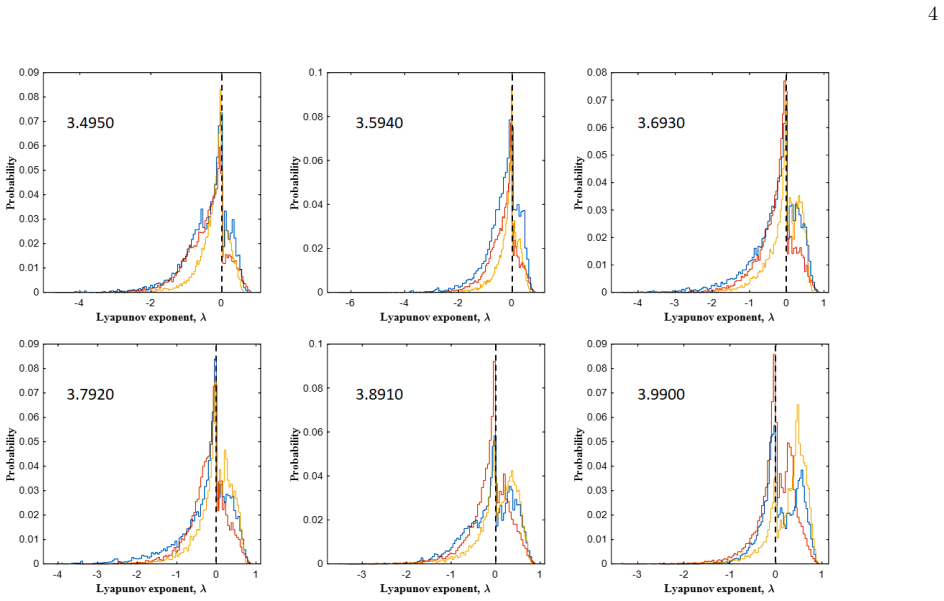
- [Results and Discussion, Figures 1–4] No statistical comparisons are reported anywhere in the manuscript. There are no error bars, no replicates, no null models (such as shuffled sequences with identical base composition), and no independent validation against known biological categories. Therefore the claim that Lyapunov exponent distributions 'provide a means to compare the stability of different codes and assess the significance of specific symbols' is untested. For instance, Figure 4 shows four distributions that differ when one parameter is fixed, but without a null model or a statement of variability across initial conditions and sequence realizations, these differences cannot be attributed to the biological content of the sequences rather than to the arbitrarily chosen parameters.
- [Materials and Methods, Eq. (3)] Equation (3) defines the Lyapunov exponent as a limit as n approaches infinity, but all reported values are computed on finite windows of 300 base pairs (or 2,366 base pairs for the complete MHC gene) without any convergence check or finite-size correction. For maps that can be chaotic or intermittent, the finite-sum average of log_2 |r_i(1−2x_i)| fluctuates substantially, so the reported numerical values may not approximate the defined limit. The manuscript does not state the initial condition x_0, the number of iterations discarded as transient, or the number of sequence realizations used, making the results difficult to reproduce and the interpretation as Lyapunov exponents questionable.
minor comments (7)
- [Title] The title contains a spacing error: 'para meter' should be 'parameter.'
- [Introduction, reference [2]] The statement that Lyapunov exponents 'have been used to detect conserved motifs, distinguish coding from non-coding regions, and identify repetitive elements [2]' is not supported by reference [2], which is the general monograph by Nicolis and Prigogine rather than a specific genomic study.
- [Section headings] The heading 'Four-parameters logistic equation' is immediately followed by 'RESULTS AND DISCUSSION' with no text under it; either the section is missing or the organization of the paper is erroneous.
- [Figure 4 caption] The caption states 'Colors indicate the fixed parameter, blue, T, red, A, and yellow, G,' but the text refers to keeping one of the parameters fixed 'at the value shown in the figure'; it is not clear which panels (a)–(d) correspond to which fixed base, nor what the numerical value of the fixed parameter is for each panel.
- [Figure 3 caption and text] The text describes the results in Figure 3 as being in a 'stable region (ranging between 3.82 and 3.86 in the parameters),' while the caption states that the parameter associated with certain bases was fixed to 2.4852; the relationship between these two parameter ranges is never explained.
- [Methods, Eq. (3)] The use of log base 2 in Eq. (3) is not commented upon; if the authors intend to compare with standard Lyapunov exponents reported in the literature, they should state the base and possibly provide conversion factors.
- [General] There is no data or code availability statement; given the computational nature of the study, providing access to the sequences and the code used to generate the figures would aid reproducibility.
Circularity Check
No significant circularity: the Lyapunov maps follow from the stated logistic equation; the biological interpretation is unvalidated but not fed back into the inputs.
full rationale
The computation in Eq. (3) is a direct substitution of the multiple-parameter logistic map into the standard Lyapunov formula; no parameter is fitted to any biological target, and no load-bearing conclusion is justified by a self-citation chain. The arbitrary assignment of r_i values to nucleotide bases and the absence of biological calibration are external-validity and modeling-arbitrariness concerns, not circular reasoning: the 'significance' read out of Figures 3–4 is not used to define those r_i values, so the derivation does not reduce to its own output. The concluding admission that 'further research is required to interpret the biological implications' explicitly marks the interpretation as an open question rather than a derived result. Under the hard rule requiring an exhibited equation-to-equation reduction or a fitted parameter renamed as a prediction, no such step is present in the manuscript.
Assumptions & free parameters
free parameters (3)
- r_A, r_T, r_G, r_C (per-nucleotide logistic parameters) =
2.4852 used as fixed value for one base; other values varied in maps
- initial condition x0 =
not stated
- sequence window length =
300 base pairs for local maps; 2,366 base pairs for the full MHC gene
assumptions (5)
- standard math The Lyapunov exponent of a one-dimensional map is given by lambda = lim (1/n) sum log2 |f'(x_i)| and applies to the multi-parameter logistic map.
- domain assumption Each nucleotide base can be represented by a distinct value of the logistic parameter r_i.
- ad hoc to paper The chosen parameter values, such as the fixed base at 2.4852, produce biologically meaningful stability comparisons.
- domain assumption Finite-length sums over 300 or 2,366 base pairs approximate the infinite limit in equation (2).
- domain assumption Lyapunov stability of the artificial logistic trajectory corresponds to stability of DNA and RNA codes.
Cite this review
Pith. "Pith review of Liapunov exponent distributions and maps for multiple parameter logistic equation. Application to DNA and RNA sequences." pith.science (2026). https://pith.science/paper/SZFSU7J5
@misc{pith2026250502276,
  author       = {Pith},
  title        = {Pith review of: Liapunov exponent distributions and maps for multiple parameter logistic equation. Application to DNA and RNA sequences},
  year         = {2026},
  howpublished = {\url{https://pith.science/paper/SZFSU7J5}},
  note         = {Machine review of arXiv:2505.02276}
}
read the original abstract
The multiple parameter logistic equation has previously been utilized to determine the global stability of ternary codes, based on the arrangement of different symbols within the code. This approach has been extended to DNA and RNA sequences, proposing a specific application in the context of reading and translation processes involved in DNA replication and RNA-mediated protein codification. To address the complexity of mapping Liapunov exponents in terms of four parameters representing the different nucleotide bases specialized mapping techniques have been developed. These include Liapunov exponent distributions for entire sequences, as well as binary maps that classify nucleotide bases based on their chemical type (purinic or pyrimidinic). Such methodologies provide a framework for examining the structural and functional properties of genetic material. The sequences analyzed encompass a wide range of DNA and RNA types, including those with and without introns, as well as codifying and noncodifying regions. This multifaceted approach offers valuable insights into the dynamic behavior and stability of nucleotide arrangements, contributing to a deeper understanding of the underlying processes that govern genetic replication and protein synthesis.
Figures


Reference graph
Works this paper leans on
-
[2]
G. Nicolis and I. Prigogine. Exploring complexity: An introduction. W.H. Freeman & Company, 1989
work page 1989
-
[1]
A. Wolf, J.B. Swift, H.L. Swinney and J.A. Vastano. De- termining Lyapunov exponents from a time series. Phys- ica D: nonlinear phenomena , 16(3):285–317, 1985. 4 FIG. 4. Liapunov exponent distributions for human telomere TTAGGG. Different distributions correspond to keep one of th e parameters fixed at the value shown in the figure, while varyin g the other...
work page 1985
- [3]
-
[4]
R.F. Voss. Evolution of long-range fractal correlation s and 1/f noise in DNA base sequences. Physical review letters, 68(25):3805, 1992
work page 1992
-
[5]
J. R¨ ossler, M. Kiwi, B. Hess and M. Markus, Modu- lated nonlinear processes and a novel mechanism to in- duce chaos. Physical Review A , 39(11):5954, 1989
work page 1989
-
[6]
M. Markus. Chaos in maps with continuous and discon- tinuous maxima: a dramatic variety of dynamic behavior is revealed by graphical display of the Lyapunov expo- nent. Computers in physics , 4(5):481–493, 1990
work page 1990
-
[7]
J.-P. Eckmann, S. Oliffson Kamphorst, D. Ruelle and S. Ciliberto. Liapunov exponents from time series. Physical Review A , 34(6):4971–4979, 1986
work page 1986
-
[8]
K. Briggs. An improved method for estimating Lia- punov exponents of chaotic time series. Physics Letters A, 151(1,2):27–32, 1990
work page 1990
Show all 13 references
-
[9]
Gould and P.A
I.R. Gould and P.A. Kollman. Theoretical investigation of the hydrogen bond strengths in guanine-cytosine and adenine-thymine base pairs. Journal of the American Chemical Society, 116(6):2493–2499, 1994
1994
-
[10]
L¨ owdin
P.O. L¨ owdin. Proton tunneling in DNA and its biologi- cal implications. Reviews of Modern Physics , 35(3):724, 1963
1963
-
[11]
Slocombe, J
L. Slocombe, J. Al-Khalili and M. Sacchi. Quantum and classical effects in DNA point mutations: Watson–Crick tautomerism in AT and GC base pairs. Physical Chem- istry Chemical Physics , 23(7):4141–4150, 2021
2021
-
[12]
Slocombe, M
L. Slocombe, M. Sacchi and J. Al-Khalili. An open quantum systems approach to proton tunnelling in DNA. Communications Physics , 5(1):109, 2022
2022
-
[13]
R.K. Moyzis. The human telomere. Scientific American , 265(2):48–57, 1991
1991
Reviewed August 16, 2026 · model on record in the stance chip above.
Discussion (0). Continue with ORCID to comment.