REVIEW 4 major objections 6 minor 1 cited by
Memorization or Interpolation ? Detecting LLM Memorization through Input Perturbation Analysis
T0 review · 4 major / 6 minor · reviewed 2026-08-16 · deepseek-v4-flash
Pith's one-line read Small input tweaks expose which texts a language model has memorized, and PEARL uses that fragility as a black-box detector.
desk verdict The paper's sensitivity measure is sign-reversed relative to its own distance metric, so the core statistic likely measures improvement, not falloff; worth a serious look but needs major revision. read the letter →
The pith
A machine-rendered reading of the paper's core claim, the machinery that carries it, and where it could break.
The reading
What carries the argument
The machinery is the perturbation-sensitivity measurement. PEARL encodes an input text to bits, flips k random bits for k in {0,1,2,3,4,5}, decodes back to text, and prompts the model with each perturbed version ten times. It scores each output against a reference using Normalized Compression Distance for completion tasks and ROUGE-L for summarization, then defines sensitivity(X) = max_j (m(Y*_j) - m(Y*_{j+1})), the largest drop in mean distance between consecutive perturbation intensities. A sample is called memorized when sensitivity(X) > alpha, where alpha is chosen from the false-positive curve on a dataset assumed to be outside the training set (RefinedWeb for Pythia, LBPP for GPT-4o). The sensitivity statistic is the load-bearing object: it converts the untestable notion of 'stored verbatim' into a single comparable number.
What would settle it
Run PEARL with the same alpha on a set of stylistically distinctive, provably unseen texts (for example, poems or legal opinions published after the model's release cutoff) alongside the datasets the paper flags; if the unseen texts are flagged at rates close to HumanEval or Pile, then the sensitivity signal is tracking style or uniqueness rather than membership in training data.
Extended reading notes
Core claim
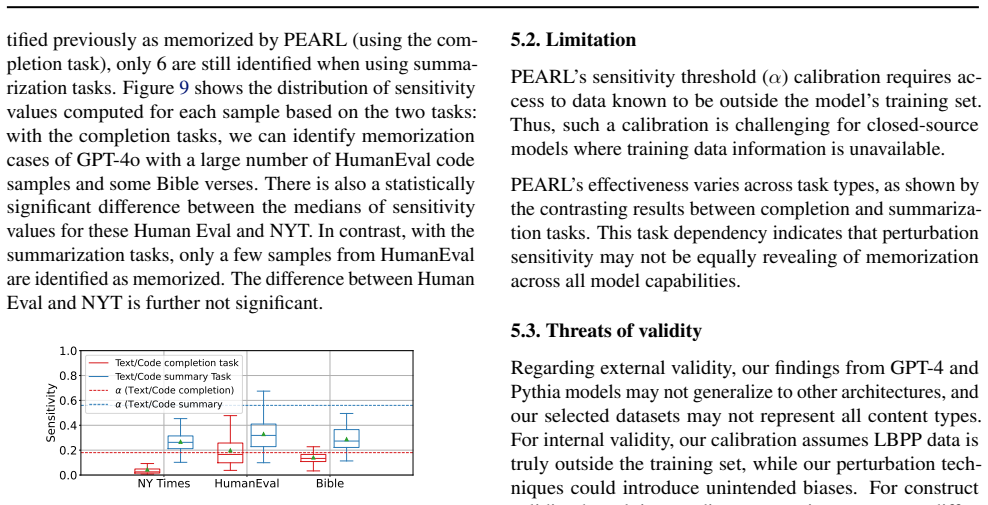
PEARL's central claim is that memorization leaves a measurable behavioral fingerprint: if a model has memorized an input, its output quality collapses when the input is lightly perturbed, because the exact stored sequence is what triggers the correct answer. Formally, the paper defines sensitivity(X) as the maximum difference in mean output distance between consecutive perturbation levels, and classifies X as memorized when that maximum exceeds a threshold alpha. The Pythia experiments show the proportion of Pile samples flagged as memorized climbing from under 5% at epoch 0 to over 20% at epoch 10 at alpha=0.2, while RefinedWeb stays near 2%, and the gap persists at stricter thresholds. For GPT-4o, the same procedure flags 60 of 100 HumanEval samples at alpha=0.14, 42 of 100 Bible samples, and only 5 of 100 NYT samples, which the authors read as evidence that memorization concentrates in stylistically distinctive or unique content. The paper also reports that the signal largely disappears under summarization tasks, so the hypothesis is explicitly task-dependent: it reveals memorization best when the task demands exact reproduction.
Load-bearing premise
Everything PEARL labels as memorized inherits the assumption that the threshold alpha calibrated on one out-of-training dataset (RefinedWeb for Pythia, LBPP for GPT-4o) transfers unchanged to the content being tested.
Editorial extensions
If this is right
- Closed models can now be audited for memorization without parameter access or training-set disclosure: only prompts and generated outputs are needed.
- The alpha threshold gives practitioners a dial: a loose threshold catches more candidate memorization but admits more false positives, so the method doubles as a triage tool rather than a binary verdict.
- Fine-tuning on the same data makes the sensitivity signal stronger, so PEARL can track how memorization accumulates over training epochs.
- Because the signal is task-dependent, evaluations that use completion-style benchmarks are more exposed to memorization artifacts than summarization-style benchmarks; benchmark designers should prefer tasks that do not reward exact reproduction.
- In applied settings, the method can supply supporting evidence in data-contamination or copyright disputes, as the paper does for HumanEval and NYT, while stopping short of a standalone legal proof.
Reading between the lines
- Beyond the paper: if the sensitivity signature is a stable property of stored text, the same technique could be extended to images or audio by perturbing pixels or samples, but the threshold-calibration problem would become harder because 'outside training data' is even less knowable.
- Beyond the paper: the bit-flip perturbation changes surface characters, so PEARL may be detecting memorization of exact surface form rather than memorized content; a testable extension is to compare bit flips against synonym substitutions to see whether semantically-equivalent perturbations also expose memorization.
- Beyond the paper: the task-dependence result suggests PSH is really measuring 'retrieval fragility'—the model's reliance on an exact trigger—which could be used as a general probe for how template-like a model's behavior is, not just as a memorization label.
- Beyond the paper: a practical implication the authors leave implicit is that PEARL's calibration requirement could be satisfied in production by continuously sampling dated, post-cutoff text as a live negative set, making the detector usable on models whose training data is updated.
Signed reviews
Editorial analysis
A structured set of objections, weighed in public.
Referee Report
Summary. The paper proposes the Perturbation Sensitivity Hypothesis (PSH): for a given model, task, and data point, if the model has memorized that data point, then its task performance will exhibit high sensitivity to small input perturbations. It then introduces PEARL, a black-box framework that bit-flips inputs, prompts the model, measures output fidelity to a reference via NCD or ROUGE, and flags a sample as memorized when a sensitivity score exceeds a threshold. The authors validate PSH on Pythia-410m by fine-tuning on Pile samples and comparing the proportion of flagged Pile vs. RefinedWeb samples, and present case studies on GPT-4o using HumanEval, Bible, NYT, and the LBPP dataset as a negative control for threshold calibration.
Significance. If the central claims held, PEARL would be a practically useful black-box memorization detector that requires neither model internals nor training-data knowledge. The paper has several strengths: it publicly releases artifacts, it includes a controlled Pythia experiment with fine-tuning epochs as a proxy for memorization, and it compares against the white-box ACR approach. However, the load-bearing sensitivity statistic is internally inconsistent with its own definition, the calibration reporting is self-contradictory, and the controlled experiment confounds membership with corpus identity and fine-tuning. As presented, the evidence does not support the strength of the claims, although the underlying hypothesis is plausible and the work is potentially salvageable.
major comments (4)
- [Section 3.3, Eq. (3) and Table 4] The sensitivity definition is internally inconsistent. Eq. (2) defines m(Y*_k) as the mean distance between model outputs and the reference Y, so smaller m means closer to the reference and thus better fidelity. Under this definition, a performance falloff under perturbation should be m(Y*_{j+1}) - m(Y*_j), not m(Y*_j) - m(Y*_{j+1}). Eq. (3) therefore measures improvement (decreasing distance) rather than degradation. The reported values in Table 4 compound the problem: for HumanEval/105, m = (0.68, 0.32, 0.42, 0.55, 0.32, 0.24) and the reported sensitivity 0.36 equals m(Y*_0) - m(Y*_1), a term outside the stated index range j in {1, ..., k-1}, and it has the opposite sign of the correct falloff. Similar discrepancies appear for rows #103, #107, and others. Since the binary decision is simply sensitivity(X) > alpha, this error propagates into every Pythia and GPT-4o classification in the paper. If the authors instead intend m to be a similarity score, then Eq. (2) and the text describing NCD as a distance are mislabeled, and the table should be reconciled with a precise, self-consistent formula.
- [Section 4.4 and Annex 6, Table 4] The calibration and the reporting are inconsistent. LBPP is used as the assumed-negative dataset for choosing alpha, yet Table 4, which lists cases 'identified as memorized' at alpha = 0.29, includes LBPP rows #17 (sensitivity 0.32) and #58 (sensitivity 0.29). Under the stated rule sensitivity > alpha, #58 should not be flagged at all, and #17 is a false positive on the calibration set. This indicates either that the threshold was not chosen to minimize false positives, that the table mistakenly includes calibration data, or that the reported sensitivities were computed with a different procedure. The authors must clarify and recompute the affected results.
- [Section 4.2, Pythia validation] The positive and negative sets are not matched. The positive set consists of Pile samples on which the model is fine-tuned for up to 10 epochs, while the negative set is RefinedWeb, a different corpus that is never fine-tuned. The observed increase in flagged Pile samples over epochs could reflect overfitting to the exact input strings or distribution shift between corpora rather than memorization as defined by membership advantage. A stronger controlled experiment would use held-out samples from the same corpus (e.g., Pile samples not fine-tuned) as negatives, or at least a matched corpus, and would independently verify memorization via a white-box metric such as extraction likelihood or membership advantage. The ACR comparison in Annex 1 is a step in this direction but covers only 100 quotes and is not integrated into the main validation.
- [Section 5.2 and Section 4.4, alpha calibration] The paper acknowledges in Section 5.2 that PEARL's sensitivity threshold calibration requires access to data known to be outside the model's training set. For GPT-4o, alpha is chosen on LBPP, which is assumed to be post-release and therefore non-training data, and is then transferred to Bible, HumanEval, and NYT. This is a decision-boundary fit rather than a derived threshold, and all downstream membership claims inherit any error in that assumption or in the transfer across content types. The paper should report sensitivity of the conclusions to alpha values (Tables 2 and 3 partially do this) and should justify the transfer with an analysis of sensitivity distributions rather than only FPR curves. For the GPT-4o case studies, this limitation is load-bearing because the reported numbers of memorized instances depend directly on the calibrated threshold.
minor comments (6)
- [Table 1] Table 1 describes k as the 'percentage of token modified in the input', but Section 3.1 states that the perturbation function 'consists in flipping k bits'; these two descriptions are inconsistent and should be reconciled.
- [Section 3.1] The bit-flip perturbation operates on the binary encoding of the input text and decodes back to text; the manuscript should specify how invalid UTF-8 byte sequences are handled during decoding, since arbitrary bit flips can produce invalid sequences that may affect the results.
- [Section 4.5] The text claims 'a statistically significant difference between the medians of sensitivity values' but does not report the statistical test used, the test statistic, or the p-value; this should be added.
- [Figure 9] The caption and legend of Figure 9 appear garbled, with unbalanced parentheses in '(Text/Code completion) (Text/Code summary'; this should be fixed.
- [Section 5.3] Section 5.3 refers to 'our findings from GPT-4 and Pythia models', but the experiments use GPT-4o; the terminology should be aligned throughout the paper.
- [Annexes 3 and 4] Annexes 3 and 4 are referenced in the text, but their figures and content are missing from the manuscript as provided; the FPR-vs-alpha curves for LBPP on completion and summarization tasks should be included.
Circularity Check
No significant circularity: PEARL's threshold calibration is a stated limitation, not a circular reduction; the PSH validation uses known membership as ground truth.
full rationale
The paper's derivation chain is not circular. The PSH is stated as an empirical hypothesis in Section 2, independently of PEARL's operationalization. Eq. 2 and Eq. 3 define a sensitivity score from model outputs under bit-flip perturbations; no quantity in the definition is defined in terms of the memorization labels that PEARL outputs. The Pythia validation (Section 4.2) is a controlled comparison with known membership: alpha is calibrated on RefinedWeb (non-training data) to control false positives, then applied to Pile samples; the increase in flagged Pile samples across fine-tuning epochs is an external, falsifiable observation, not an identity. For GPT-4o (Section 4.4), alpha is calibrated on LBPP, assumed to be outside the training set by an external citation (Matton et al., 2024), then applied to HumanEval, Bible, and NYT. This is threshold calibration at a fixed operating point, not fitting the predicted labels to the calibration subset; the resulting counts are determined by the data's sensitivity values, not by construction from the calibration data. The paper's own Section 5.2 acknowledges the dependence on outside data, which is a limitation and a correctness risk if LBPP is contaminated or alpha does not transfer; it is not a circular reduction. Annex 1 provides an independent external benchmark (ACR) with overlapping detections. No load-bearing self-citations are present. The internal inconsistency in Eq. 3 (positive difference means improvement under Eq. 2's distance definition, and Table 4's values fall outside the stated index range) is a serious correctness flaw, but it is not circularity: it makes the sensitivity measure ill-defined, it does not reduce the claimed detection to its own inputs.
Assumptions & free parameters
free parameters (4)
- alpha (sensitivity threshold) =
0.14 to 0.29 for GPT-4o; 0.16 to 0.25 for Pythia variants
- perturbation intensity range k =
{0,1,2,3,4,5}
- number of samples per input i =
10
- input/reference split =
80%/20%
assumptions (5)
- domain assumption The calibration datasets (RefinedWeb for Pythia, LBPP for GPT-4o) are truly outside the model's training data.
- domain assumption Bit-flipping bytes in the encoded input is a valid 'small perturbation' for text in any language or code.
- standard math NCD (completion) and ROUGE-L (summarization) monotonically capture performance degradation relative to the reference output.
- domain assumption Fine-tuning on a sample set causes the model to memorize those samples, making them a valid positive set.
- domain assumption Random subsets of 1000 or 100 samples are representative of memorization behavior in the full datasets.
Cite this review
Pith. "Pith review of Memorization or Interpolation ? Detecting LLM Memorization through Input Perturbation Analysis." pith.science (2026). https://pith.science/paper/DV2EHV7Y
@misc{pith2026250503019,
  author       = {Pith},
  title        = {Pith review of: Memorization or Interpolation ? Detecting LLM Memorization through Input Perturbation Analysis},
  year         = {2026},
  howpublished = {\url{https://pith.science/paper/DV2EHV7Y}},
  note         = {Machine review of arXiv:2505.03019}
}
read the original abstract
While Large Language Models (LLMs) achieve remarkable performance through training on massive datasets, they can exhibit concerning behaviors such as verbatim reproduction of training data rather than true generalization. This memorization phenomenon raises significant concerns about data privacy, intellectual property rights, and the reliability of model evaluations. This paper introduces PEARL, a novel approach for detecting memorization in LLMs. PEARL assesses how sensitive an LLM's performance is to input perturbations, enabling memorization detection without requiring access to the model's internals. We investigate how input perturbations affect the consistency of outputs, enabling us to distinguish between true generalization and memorization. Our findings, following extensive experiments on the Pythia open model, provide a robust framework for identifying when the model simply regurgitates learned information. Applied on the GPT 4o models, the PEARL framework not only identified cases of memorization of classic texts from the Bible or common code from HumanEval but also demonstrated that it can provide supporting evidence that some data, such as from the New York Times news articles, were likely part of the training data of a given model.
Figures


Figures from the paper (7 more)




Forward citations
Cited by 1 Pith paper
-
Memorization Diagnostics for Code LLMs Should be Scale-Aware
Encoder-side synonym fuzzing and decoder-side log-likelihood probes lose discriminative power on large dense code LLMs, while reversible I/O transforms show scaled models preserve algorithmic structure and fail mainly...
Reference graph
Works this paper leans on
-
[1]
EU AI Act: first regulation on artificial intel- ligence — Topics — European Parliament — europarl.europa.eu. https://www.europarl. europa.eu/topics/en/article/20230601STO93804/ eu-ai-act-first-regulation-on-artificial-intelligence# transparency-requirements-1. Biderman, S., Schoelkopf, H., Anthony, Q., Bradley, H., O’Brien, K., Hallahan, E., Khan, M. A.,...
-
[3]
URL http://arxiv.org/ abs/2202.07646. arXiv:2202.07646 [cs]. Chen, M., Tworek, J., Jun, H., Yuan, Q., Pinto, H. P. D. O., Kaplan, J., Edwards, H., Burda, Y ., Joseph, N., Brockman, G., et al. Evaluating large language models trained on code. arXiv preprint arXiv:2107.03374,
-
[5]
URL http://arxiv.org/abs/2402.15938. arXiv:2402.15938. Duan, M., Suri, A., Mireshghallah, N., Min, S., Shi, W., Zettlemoyer, L., Tsvetkov, Y ., Choi, Y ., Evans, D., and Hajishirzi, H. Do Membership Inference Attacks Work on Large Language Models?, February
-
[6]
URL http: //arxiv.org/abs/2402.07841. arXiv:2402.07841 [cs]. Gao, L., Biderman, S., Black, S., Golding, L., Hoppe, T., Foster, C., Phang, J., He, H., Thite, A., Nabeshima, N., Presser, S., and Leahy, C. The Pile: An 800GB Dataset of Diverse Text for Language Modeling, December
-
[8]
URL http://arxiv.org/abs/2308.08493. arXiv:2308.08493 [cs]. Hartmann, V ., Suri, A., Bindschaedler, V ., Evans, D., Tople, S., and West, R. SoK: Memorization in General-Purpose Large Language Models, October
-
[9]
URL http://arxiv. org/abs/2310.18362. arXiv:2310.18362 [cs]. Intelligence, A. A. G. The amazon nova family of models: Technical report and model card
-
[11]
org/abstract/document/10179300/
URL https://ieeexplore.ieee. org/abstract/document/10179300/. Matton, A., Sherborne, T., Aumiller, D., Tommasone, E., Alizadeh, M., He, J., Ma, R., V oisin, M., Gilsenan- McMahon, E., and Gall ´e, M. On Leakage of Code Generation Evaluation Datasets, July
-
[12]
URL http: //arxiv.org/abs/2407.07565. arXiv:2407.07565 [cs]. 9 nytimes. The Times sues OpenAI and Mi- crosoft Over A.I. Used of Copyrighted Work. https://www.nytimes.com/2023/12/27/business/media/ new-york-times-open-ai-microsoft-lawsuit.html,
arXiv 2023
Show all 20 references
-
[13]
Penedo, G., Malartic, Q., Hesslow, D., Cojocaru, R., Cap- pelli, A., Alobeidli, H., Pannier, B., Almazrouei, E., and Launay, J
[Online; accessed 22-January-2025]. Penedo, G., Malartic, Q., Hesslow, D., Cojocaru, R., Cap- pelli, A., Alobeidli, H., Pannier, B., Almazrouei, E., and Launay, J. The RefinedWeb Dataset for Falcon LLM: Out- performing Curated Corpora with Web Data, and Web Data Only, June
2025
-
[14]
URL http://arxiv.org/abs/2306. 01116. arXiv:2306.01116 [cs]. Schwarzschild, A., Feng, Z., Maini, P., Lipton, Z. C., and Kolter, J. Z. Rethinking LLM Memorization through the Lens of Adversarial Compression, November
-
[15]
arXiv:2404.15146
URL http://arxiv.org/abs/2404.15146. arXiv:2404.15146. Speicher, T., Khan, M. A., Wu, Q., Nanda, V ., Das, S., Ghosh, B., Gummadi, K. P., and Terzi, E. Understanding Memorisation in LLMs: Dynamics, Influencing Factors, and Implications, July
-
[16]
arXiv:2407.19262 [cs]
URL http://arxiv.org/abs/ 2407.19262. arXiv:2407.19262 [cs]. Yan, B., Li, K., Xu, M., Dong, Y ., Zhang, Y ., Ren, Z., and Cheng, X. On Protecting the Data Privacy of Large Language Models (LLMs): A Survey, March
-
[17]
arXiv:2403.05156 [cs]
URL http://arxiv.org/abs/2403.05156. arXiv:2403.05156 [cs]. Yao, Y ., Duan, J., Xu, K., Cai, Y ., Sun, Z., and Zhang, Y . A survey on large language model (llm) security and privacy: The good, the bad, and the ugly. High-Confidence Computing, pp. 100211,
-
[18]
Publisher: Elsevier
URL https://www.sciencedirect.com/science/article/pii/ S266729522400014X. Publisher: Elsevier. Zewe, A. Study: Transparency is often lacking in datasets used to train large language mod- els — news.mit.edu. https://news.mit.edu/2024/ study-large-language-models-datasets-lack-t...
2024
-
[19]
arXiv:2311.01964 [cs]
URL http://arxiv.org/abs/2311.01964. arXiv:2311.01964 [cs]. Zhou, Z., Xiang, J., Chen, C., and Su, S. Quantifying and Analyzing Entity-Level Memorization in Large Lan- guage Models. In Proceedings of the AAAI Conference on Artificial Intelligence, volume 38, pp. 19741–19749,
-
[20]
Z., and Fredrikson, M
Zou, A., Wang, Z., Carlini, N., Nasr, M., Kolter, J. Z., and Fredrikson, M. Universal and transferable adversar- ial attacks on aligned language models. arXiv preprint arXiv:2307.15043,
-
[2004]
URL https://aclanthology
Association for Computational Linguistics. URL https://aclanthology. org/W04-1013/. Lukas, N., Salem, A., Sim, R., Tople, S., Wutschitz, L., and Zanella-B´eguelin, S. Analyzing leakage of person- ally identifiable information in language models. In 2023 IEEE Symposium on Secur...
2023
-
[2020]
arXiv:2101.00027 [cs]
URL http://arxiv.org/abs/2101.00027. arXiv:2101.00027 [cs]. Golchin, S. and Surdeanu, M. Time Travel in LLMs: Tracing Data Contamination in Large Language Mod- els, February
-
[2023]
arXiv:2304.01373 [cs]
URL http://arxiv.org/abs/2304.01373. arXiv:2304.01373 [cs]. Carlini, N., Tram`er, F., Wallace, E., Jagielski, M., Herbert- V oss, A., Lee, K., Roberts, A., Brown, T., Song, D., Erlingsson, U., Oprea, A., and Raffel, C. Extracting Training Data from Large Language Models. In Pr...
-
[2024]
arXiv:2408.04965 [cs]
URL http://arxiv.org/abs/2408.04965. arXiv:2408.04965 [cs]. Dong, Y ., Jiang, X., Liu, H., Jin, Z., Gu, B., Yang, M., and Li, G. Generalization or Memorization: Data Contami- nation and Trustworthy Evaluation for Large Language Models, May
Reviewed August 16, 2026 · model on record in the stance chip above.
Discussion (0). Continue with ORCID to comment.