REVIEW 4 major objections 6 minor 1 cited by
DDaTR: Dynamic Difference-aware Temporal Residual Network for Longitudinal Radiology Report Generation
T0 review · 4 major / 6 minor · reviewed 2026-08-15 · deepseek-v4-flash
Pith's one-line read DDaTR claims that longitudinal report generation improves when prior text and images are aligned and difference signals are fused into current features at every encoder stage, raising reported clinical-efficacy scores on three benchmarks.
desk verdict The paper is a genuine, well-tested architecture contribution to longitudinal RRG; the main weaknesses are the unverified gating safety claim and a thin significance test, both fixable. read the letter →
The pith
A machine-rendered reading of the paper's core claim, the machinery that carries it, and where it could break.
The reading
What carries the argument
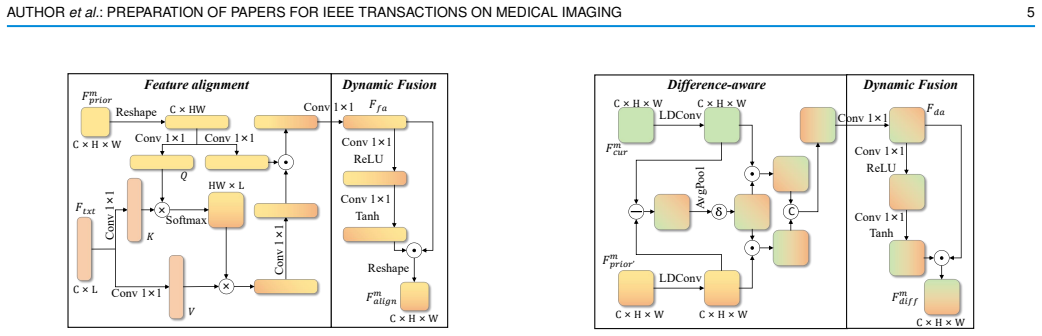
The load-bearing object is the DDaTR encoder: a multi-stage vision backbone with two lightweight modules inserted after every stage. The Dynamic Feature Alignment Module (DFAM) uses the frozen pretrained text encoder's features of the prior report as keys and values in cross-attention with the prior image features as queries, then gates the aligned feature with a tanh-activated 1x1 convolution, so clinical semantics are injected at pixel level. The Dynamic Difference-aware Module (DDAM) applies learnable descriptive convolutions to both prior and current features, forms a pixel-difference map $F_{\mathrm{pd}}=\mathrm{Sigmoid}(\mathrm{AvgPool}(F_{\mathrm{enc}}-F_{\mathrm{enp}}))$, amplifies both features by it, concatenates them, and fuses the result through the same gating structure. The final update $\hat{F}_{\mathrm{cur}}=F_{\mathrm{cur}}+\alpha(F_{\mathrm{dy}}\odot F_{\mathrm{da}})$ with $\alpha\in\{0,1\}$ makes the prior contribution optional and controlled, and a classifier on the prior features acts as a regularizer to keep the two streams semantically consistent.
What would settle it
Take the longitudinal MIMIC-CXR test set, keep the prior image fixed, and substitute a randomly selected prior report from another patient; if the CE F1 does not drop, or if the gate output $F_{\mathrm{dy}}$ almost never has near-zero norm on such mismatched inputs, then the prior-report alignment is not the source of the claimed gain.
Extended reading notes
Core claim
DDaTR's central claim is that the temporal and spatial correlations needed for longitudinal reporting should be modeled inside the visual encoder, stage by stage, rather than by late fusion of independently encoded images. The paper argues that prior reports carry the clinician's intent and should be injected into the prior image features at every stage through the Dynamic Feature Alignment Module, and that the difference between the prior and current image features, after texture enhancement, should be computed, gated, and added to the current stream through the Dynamic Difference-aware Module. A residual path transmits this longitudinal information only forward, from prior to current. The authors report that this design achieves macro CE F1 of 0.441 on MIMIC-CXR versus 0.389 for the PromptMRG baseline, micro CE F1 of 0.527 on Longitudinal-MIMIC versus 0.492, and zero-shot CE F1 of 0.262 on IU-Xray versus 0.246, with the MIMIC-CXR improvement having a reported p-value of 0.0415.
Load-bearing premise
The whole design assumes that the most recent prior study, once aligned by the report text and passed through the learned gate, adds useful information for every current report; if the gate cannot suppress an irrelevant or misleading prior, the added features can actively hurt the report.
Editorial extensions
If this is right
- On MIMIC-CXR, the reported macro CE F1 of 0.441 (against 0.389 for the PromptMRG baseline, with $p=0.0415$) implies that adding gated, per-stage prior information can improve diagnostic accuracy without changing the decoder.
- The consistent gains across SwinT-B, ResNet101, and EfficientNetV2 imply the DFAM and DDAM modules are backbone-agnostic and can be plugged into any multi-scale visual encoder.
- The larger CE gain relative to NLG gain implies the prior report contributes clinical knowledge rather than linguistic style, so evaluations of longitudinal methods should weight clinical-efficacy metrics heavily.
- The zero-shot result on IU-Xray implies the model does not need longitudinal training data to benefit from the learned change-aware representation in single-image settings.
Reading between the lines
- The gating weights $F_{\mathrm{dy}}$ could be read as an empirical measure of prior relevance; correlating them with time interval, view mismatch, or actual change would test whether the network learns a clinically meaningful 'when to ignore the prior' policy.
- The zero-shot IU-Xray gain suggests that training on longitudinal pairs may teach a transferable change-detection representation that helps even single-image reporting, a benefit the paper does not explicitly claim.
- A natural next experiment is to feed more than one prior study or to use structured anatomical knowledge instead of free-text prior reports; the paper tests neither, so whether the mechanism scales to longer timelines is open.
Signed reviews
Editorial analysis
A structured set of objections, weighed in public.
Referee Report
Summary. DDaTR is a longitudinal encoder for chest X-ray report generation. The paper builds on PromptMRG's diagnosis-prompt framework and inserts two modules at every stage of the visual encoder: DFAM aligns prior-image features with the prior report's frozen-BERT text features, and DDAM computes gated pixel-level differences between prior and current features. Residual connections pass prior information unidirectionally into the current stream; when no prior exists, alpha in Eq. (20) is zero and the model falls back to single-period encoding. Experiments on MIMIC-CXR, Longitudinal-MIMIC, and IU-Xray report higher Clinical Efficacy F1 than the baselines (e.g., 0.441 vs 0.389 for PromptMRG* on MIMIC-CXR, 0.527 vs 0.492 on Longitudinal-MIMIC), with three visual backbones, ablations, ReXrank comparisons, and Grad-CAM case studies. The paper releases code and explicitly acknowledges residual hallucinations and omissions in Section V.
Significance. The contribution is potentially valuable because the reported gains are on Clinical Efficacy, the metric most relevant to radiology practice, and they are consistent across MIMIC-CXR, Longitudinal-MIMIC, and three backbones; the code release and the explicit experimental protocol are strengths. The ablations in Table III and the controlled comparison against PromptMRG* in Table I support the broad claim that longitudinal encoding with DFAM/DDAM improves CE. I agree with the reader that there is no circularity: test labels are derived by CheXbert from ground-truth reports and prior inputs are real historical exams. The authors' own limitation statement in Section V correctly acknowledges that hallucinations and omissions remain, and I do not treat those as fatal. The main gaps are statistical rigor (one underspecified p-value, single runs) and mechanism evidence (no gate-level or progression-stratified analysis), both of which are addressable in revision.
major comments (4)
- [Section IV-B (statistical significance)] The sentence reporting PF1=0.0415 < 0.05 as evidence of statistical significance is not verifiable as written because no test procedure is described, no unit of analysis is specified, and the MIMIC-CXR test set contains multiple studies from the same patient. Please specify the test (e.g., paired bootstrap or permutation at the patient level), report the effect size and confidence interval, and state whether any correction for multiple comparisons was applied. Since all metrics in Tables I-III come from single runs, please also report results over multiple seeds or otherwise justify that the headline F1 differences exceed run-to-run variability.
- [Section III-D, Eqs. (16) and (20)] The only mechanisms that can down-weight an irrelevant or misleading prior exam are the learned gates in DFAM and DDAM, while alpha in Eq. (20) is a binary switch that always injects prior information when a prior exists. The paper does not report gate-activation statistics, does not ablate the prior report input, and does not stratify CE results by whether the prior exam is stable, progressive, or mismatched in view or laterality. Because stable findings are legitimately repeated in longitudinal reports, the observed CE gains could partly reflect copying stable prior-report statements rather than difference-aware reasoning. Please add quantitative evidence on gate suppression and a progression-aware breakdown of CE to substantiate the central 'dynamic difference-aware' claim.
- [Section III-C/D and Table III] The ablation nomenclature is internally inconsistent: Table III says 'w/o DAM' removes the difference-aware module, while the text says 'DAM and FAM represent the configurations where dynamic fusion is removed from the DDAM and DFAM modules.' These are different operations, and the interpretation of the ablation (e.g., 'DAM plays a more critical role') depends on which one was actually removed. Please rename the rows to state precisely which component (DDAM, dynamic fusion, or both) is ablated in each experiment.
- [Section IV-A and Table II] The 'Vanilla' baseline in Table II appears to concatenate visual and text features without the diagnosis-aware classification and prompt branch used in the PromptMRG framework and in DDaTR itself. As a result, the gains over Vanilla are not an ablation of DFAM/DDAM but combine the effect of the whole PromptMRG-style framework with the proposed longitudinal modules. Please state explicitly whether Vanilla includes the disease-classification branch and, if it does not, add a controlled comparison (e.g., PromptMRG with each backbone) so that the backbone generalization results isolate the contribution of the proposed modules.
minor comments (6)
- [Section III-B, Eq. (12)] The text says the decoder is conditioned on prompts derived from Lp, but Eq. (12) uses Lc; please clarify which labels are used and how they are converted into prompt tokens.
- [Section IV-A] The CE metric is macro-averaged on MIMIC-CXR and IU-Xray and micro-averaged on Longitudinal-MIMIC; please state this explicitly wherever cross-dataset comparisons are discussed so readers do not over-interpret the magnitudes in Table I.
- [Table I] For PromptMRG*, please report the visual backbone and evaluation split used so that the comparison is fully reproducible.
- [Section IV-C] There is a typo 'an an increase' in the FAM ablation paragraph.
- [Figure 9] The sub-figure labels include two 'G' entries; please re-letter them.
- [Abstract and Section I] The phrase 'SOTA in both RRG and LRRG' should be qualified to Clinical Efficacy metrics, since the reported NLG scores are not state-of-the-art (e.g., Table I BLEU-4 on MIMIC-CXR is 0.113 for DDaTR versus 0.125 for RECAP).
Circularity Check
No significant circularity found: DDaTR's longitudinal encoder is trained and evaluated on held-out data with a fixed external CheXbert labeler, and no equation-level reduction of outputs to inputs appears.
full rationale
I found no circular step in the claimed derivation chain. The encoder DDaTR is defined by concrete equations: Eq. (4) takes the current image, prior image, and prior report as inputs; Eqs. (6)-(11) define stage-wise features through residual additions of DFAM and DDAM outputs; and Eq. (20) is a gated residual combination Fcur + alpha*(Fdy⊙Fda), which is a learned nonlinear function of current and prior features rather than a tautology. The auxiliary disease labels are produced by CheXbert from ground-truth reports (Sec. III-A), and the CE evaluation metric also uses CheXbert (Sec. IV-A), but both are external functions of ground-truth text, not of the model's own generated report, so this alignment does not make the evaluation self-defined. The reliance on PromptMRG is an explicit choice of baseline framework and decoder, not a load-bearing self-citation, and no cited uniqueness theorem or prior author result is used to force the architecture. The paper's own stated limitations, such as residual hallucinations, misalignment, and the unmeasured behavior of the gate Fdy, are empirical robustness concerns rather than evidence that any prediction reduces by construction to an input or fitted quantity. Held-out test evaluation and external benchmarks support the empirical claims, so the appropriate circularity score is 0.
Assumptions & free parameters
free parameters (2)
- Disease classification loss weight w =
4
- Input resolution and augmentation =
256x256 resize, 224x224 random crop
assumptions (4)
- domain assumption The most recent prior study is sufficient context for generating the current report
- domain assumption CheXbert labels are reliable proxies for clinical findings
- domain assumption Unidirectional information flow from prior to current matches clinical practice
- standard math Scaled dot-product attention and gating operations are effective for aligning and fusing multimodal medical features
invented entities (2)
-
Dynamic Feature Alignment Module (DFAM)
-
Dynamic Difference-aware Module (DDAM)
Cite this review
Pith. "Pith review of DDaTR: Dynamic Difference-aware Temporal Residual Network for Longitudinal Radiology Report Generation." pith.science (2026). https://pith.science/paper/RVX7MOGX
@misc{pith2026250503401,
  author       = {Pith},
  title        = {Pith review of: DDaTR: Dynamic Difference-aware Temporal Residual Network for Longitudinal Radiology Report Generation},
  year         = {2026},
  howpublished = {\url{https://pith.science/paper/RVX7MOGX}},
  note         = {Machine review of arXiv:2505.03401}
}
read the original abstract
Radiology Report Generation (RRG) automates the creation of radiology reports from medical imaging, enhancing the efficiency of the reporting process. Longitudinal Radiology Report Generation (LRRG) extends RRG by incorporating the ability to compare current and prior exams, facilitating the tracking of temporal changes in clinical findings. Existing LRRG approaches only extract features from prior and current images using a visual pre-trained encoder, which are then concatenated to generate the final report. However, these methods struggle to effectively capture both spatial and temporal correlations during the feature extraction process. Consequently, the extracted features inadequately capture the information of difference across exams and thus underrepresent the expected progressions, leading to sub-optimal performance in LRRG. To address this, we develop a novel dynamic difference-aware temporal residual network (DDaTR). In DDaTR, we introduce two modules at each stage of the visual encoder to capture multi-level spatial correlations. The Dynamic Feature Alignment Module (DFAM) is designed to align prior features across modalities for the integrity of prior clinical information. Prompted by the enriched prior features, the dynamic difference-aware module (DDAM) captures favorable difference information by identifying relationships across exams. Furthermore, our DDaTR employs the dynamic residual network to unidirectionally transmit longitudinal information, effectively modelling temporal correlations. Extensive experiments demonstrated superior performance over existing methods on three benchmarks, proving its efficacy in both RRG and LRRG tasks.
Figures


Figures from the paper (5 more)



Forward citations
Cited by 1 Pith paper
-
Machine Learning for Network Attacks Classification and Statistical Evaluation of Adversarial Learning Methodologies for Synthetic Data Generation
DiffVP turns scan-to-normal semantic discrepancies into learnable visual prefix tokens that guide an LLM to write more accurate, fine-grained 3D CT reports.
Reference graph
Works this paper leans on
-
[1]
A guide to deep learning in healthcare,
A. Esteva, A. Robicquet, B. Ramsundar et al., “A guide to deep learning in healthcare,” Nature medicine, vol. 25, no. 1, pp. 24–29, 2019
work page 2019
-
[2]
Automated radiology report generation: A review of recent advances,
P. Sloan et al. , “Automated radiology report generation: A review of recent advances,” IEEE Reviews in Biomedical Engineering , 2024
work page 2024
-
[3]
Utilizing longitudinal chest x-rays and reports to pre-fill radiology reports,
Q. Zhu, T. S. Mathai et al. , “Utilizing longitudinal chest x-rays and reports to pre-fill radiology reports,” in MICCAI, 2023, pp. 189–198. 12 IEEE TRANSACTIONS ON MEDICAL IMAGING, VOL. XX, NO. XX, XXXX 2024
work page 2023
-
[4]
Controllable chest x-ray report generation from longitudinal representations,
F. Dalla Serra, C. Wang, F. Deligianni et al., “Controllable chest x-ray report generation from longitudinal representations,” in EMNLP, 2023
work page 2023
-
[5]
Hergen: Elevating radiology report generation with longitudinal data,
F. Wang, S. Du, and L. Yu, “Hergen: Elevating radiology report generation with longitudinal data,” ECCV, 2024
work page 2024
-
[6]
Learning to exploit temporal structure for biomedical vision-language processing,
S. Bannur et al., “Learning to exploit temporal structure for biomedical vision-language processing,” in CVPR, 2023, pp. 15 016–15 027
work page 2023
-
[7]
Longitudinal data and a semantic similarity reward for chest x-ray report generation,
A. Nicolson, J. Dowling, D. Anderson, and B. Koopman, “Longitudinal data and a semantic similarity reward for chest x-ray report generation,” Informatics in Medicine Unlocked , vol. 50, p. 101585, 2024
work page 2024
-
[8]
Recap: Towards precise radiology report generation via dynamic disease progression reasoning,
W. Hou, Y . Cheng, K. Xu, W. Li, and J. Liu, “Recap: Towards precise radiology report generation via dynamic disease progression reasoning,” in EMNLP, 2023, pp. 2134–2147
work page 2023
Show all 65 references
-
[9]
Flickr30k entities: Collecting region-to-phrase correspondences for richer image-to-sentence models,
B. A. Plummer, L. Wang, C. M. Cervantes, J. C. Caicedo et al. , “Flickr30k entities: Collecting region-to-phrase correspondences for richer image-to-sentence models,” in CVPR, 2015, pp. 2641–2649
2015
-
[10]
Show and tell: A neural image caption generator,
O. Vinyals, A. Toshev, S. Bengio, and D. Erhan, “Show and tell: A neural image caption generator,” in CVPR, 2015, pp. 3156–3164
2015
-
[11]
Generating radiology reports via memory-driven transformer,
Z. Chen, Y . Song, T. Chang, and X. Wan, “Generating radiology reports via memory-driven transformer,” in EMNLP, 2020, pp. 1439–1449
2020
-
[12]
Cross-modal memory networks for radiology report generation,
Z. Chen, Y . Shen, Y . Song, and X. Wan, “Cross-modal memory networks for radiology report generation,” in ACL, 2021, pp. 5904–5914
2021
-
[13]
Reinforced cross-modal alignment for radiology report generation,
H. Qin and Y . Song, “Reinforced cross-modal alignment for radiology report generation,” in Findings of the ACL , 2022, pp. 448–458
2022
-
[14]
Metransformer: Radiology report generation by transformer with multiple learnable expert tokens,
Z. Wang, L. Liu, L. Wang, and L. Zhou, “Metransformer: Radiology report generation by transformer with multiple learnable expert tokens,” in CVPR, 2023, pp. 11 558–11 567
2023
-
[15]
Auto-encoding knowledge graph for unsupervised medical report generation,
F. Liu, C. You et al., “Auto-encoding knowledge graph for unsupervised medical report generation,” NeurIPS, vol. 34, pp. 16 266–16 279, 2021
2021
-
[16]
Knowledge matters: Chest radiology report generation with general and specific knowledge,
S. Yang, X. Wu, S. Ge, S. K. Zhou, and L. Xiao, “Knowledge matters: Chest radiology report generation with general and specific knowledge,” Medical image analysis , vol. 80, p. 102510, 2022
2022
-
[17]
Kiut: Knowledge-injected u-transformer for radiology report generation,
Z. Huang, X. Zhang et al., “Kiut: Knowledge-injected u-transformer for radiology report generation,” in CVPR, 2023, pp. 19 809–19 818
2023
-
[18]
Dynamic graph enhanced contrastive learning for chest x-ray report generation,
B. Li, Mingjie Lin et al., “Dynamic graph enhanced contrastive learning for chest x-ray report generation,” in CVPR, 2023, pp. 3334–3343
2023
-
[19]
Interactive and explainable region-guided radiology report generation,
T. Tanida, P. M ¨uller et al. , “Interactive and explainable region-guided radiology report generation,” in CVPR, 2023, pp. 7433–7442
2023
-
[20]
Organ: Observation-guided radiology report generation via tree reasoning,
W. Hou, K. Xu, Y . Cheng et al., “Organ: Observation-guided radiology report generation via tree reasoning,” in ACL, 2023, pp. 8108–8122
2023
-
[21]
Promptmrg: Diagnosis-driven prompts for medical report generation,
H. Jin, H. Che et al., “Promptmrg: Diagnosis-driven prompts for medical report generation,” in AAAI, vol. 38, no. 3, 2024, pp. 2607–2615
2024
-
[22]
Chest imagenome dataset for clinical reasoning,
J. T. Wu, N. N. Agu et al. , “Chest imagenome dataset for clinical reasoning,” in Thirty-fifth Conference on Neural Information Processing Systems Datasets and Benchmarks Track (Round 2) , 2021
2021
-
[23]
Mimic-cxr-jpg, a large publicly available database of labeled chest radiographs,
A. E. Johnson et al., “Mimic-cxr-jpg, a large publicly available database of labeled chest radiographs,” arXiv preprint arXiv:1901.07042 , 2019
1901 arXiv
-
[24]
Writing by memorizing: Hierarchical retrieval- based medical report generation,
X. Yang, M. Ye et al., “Writing by memorizing: Hierarchical retrieval- based medical report generation,” in ACL, 2021, pp. 5000–5009
2021
-
[25]
Multimodal recurrent model with attention for automated radiology report generation,
Y . Xue et al., “Multimodal recurrent model with attention for automated radiology report generation,” in MICCAI, 2018, pp. 457–466
2018
-
[26]
Attention-based abnormal-aware fusion network for radiology report generation,
X. Xie et al. , “Attention-based abnormal-aware fusion network for radiology report generation,” in Database Systems for Advanced Ap- plications: DASFAA 2019 International Workshops, 2019, pp. 448–452
2019
-
[27]
Improving factual completeness and consistency of image-to-text radiology report generation,
Y . Miura, Y . Zhang, E. Tsai, C. Langlotz, and D. Jurafsky, “Improving factual completeness and consistency of image-to-text radiology report generation,” in ACL, 2021, pp. 5288–5304
2021
-
[28]
Exploring and distilling posterior and prior knowledge for radiology report generation,
F. Liu et al., “Exploring and distilling posterior and prior knowledge for radiology report generation,” in CVPR, 2021, pp. 13 753–13 762
2021
-
[29]
Improving radiology report generation systems by removing hallucinated references to non-existent priors,
V . Ramesh, N. A. Chi, and P. Rajpurkar, “Improving radiology report generation systems by removing hallucinated references to non-existent priors,” in Machine Learning for Health . PMLR, 2022, pp. 456–473
2022
-
[30]
Deep residual learning for image recognition,
K. He, X. Zhang, S. Ren, and J. Sun, “Deep residual learning for image recognition,” in CVPR, 2016, pp. 770–778
2016
-
[31]
Swin transformer: Hierarchical vision transformer using shifted windows,
Z. Liu, Y . Lin, Y . Cao et al. , “Swin transformer: Hierarchical vision transformer using shifted windows,” in ICCV, 2021, pp. 10 012–10 022
2021
-
[32]
Combining automatic labelers and expert annotations for accurate radiology report labeling using bert,
A. Smit, S. Jain, P. Rajpurkar, A. Pareek, A. Y . Ng, and M. Lungren, “Combining automatic labelers and expert annotations for accurate radiology report labeling using bert,” in EMNLP, 2020, pp. 1500–1519
2020
-
[33]
Bert: Pre-training of deep bidirectional transformers for language understanding,
J. Devlin, M.-W. Chang et al., “Bert: Pre-training of deep bidirectional transformers for language understanding,” in ACL: Human Language Technologies, Volume 1 (Long and Short Papers), 2019, pp. 4171–4186
2019
-
[34]
R2gengpt: Radiology report generation with frozen llms,
Z. Wang, L. Liu et al. , “R2gengpt: Radiology report generation with frozen llms,” Meta-Radiology, vol. 1, no. 3, p. 100033, 2023
2023
-
[35]
Attention on attention for image captioning,
L. Huang, W. Wang, J. Chen, and X. Wei, “Attention on attention for image captioning,” in ICCV, 2019, pp. 4634–4643
2019
-
[36]
Multi- modal understanding and generation for medical images and text via vision-language pre-training,
J. H. Moon, H. Lee, W. Shin, Y .-H. Kim, and E. Choi, “Multi- modal understanding and generation for medical images and text via vision-language pre-training,” IEEE Journal of Biomedical and Health Informatics, vol. 26, no. 12, pp. 6070–6080, 2022
2022
-
[37]
Improving chest x-ray report generation by leveraging warm starting,
A. Nicolson, J. Dowling, and B. Koopman, “Improving chest x-ray report generation by leveraging warm starting,” Artificial intelligence in medicine, vol. 144, p. 102633, 2023
2023
-
[38]
Radiology report generation with a learned knowledge base and multi-modal alignment,
S. Yang, X. Wu, S. Ge, Z. Zheng, S. K. Zhou, and L. Xiao, “Radiology report generation with a learned knowledge base and multi-modal alignment,” Medical Image Analysis , vol. 86, p. 102798, 2023
2023
-
[39]
Lavt: Language-aware vision transformer for referring image segmentation,
Z. Yang, J. Wang et al., “Lavt: Language-aware vision transformer for referring image segmentation,” in CVPR, 2022, pp. 18 155–18 165
2022
-
[40]
Attention is all you need,
A. Vaswani, N. Shazeer, N. Parmar, J. Uszkoreit, L. Jones et al. , “Attention is all you need,” in NeurIPS, 2017, p. 6000–6010
2017
-
[41]
Fusionmamba: Dynamic feature enhancement for multimodal image fusion with mamba,
X. Xie, Y . Cui, T. Tan, X. Zheng, and Z. Yu, “Fusionmamba: Dynamic feature enhancement for multimodal image fusion with mamba,” Visual Intelligence, vol. 2, no. 1, p. 37, 2024
2024
-
[42]
Learnable descriptive convolutional network for face anti-spoofing
P. Huang, H. Ni, Y . Ni et al. , “Learnable descriptive convolutional network for face anti-spoofing.” in BMVC, vol. 2, no. 6, 2022, p. 7
2022
-
[43]
Preparing a collection of radiology exami- nations for distribution and retrieval,
D. DemnerFushman et al., “Preparing a collection of radiology exami- nations for distribution and retrieval,” Journal of the American Medical Informatics Association, vol. 23, no. 2, pp. 304–310, 2016
2016
-
[44]
Bleu: a method for automatic evaluation of machine translation,
K. Papineni, S. Roukos et al., “Bleu: a method for automatic evaluation of machine translation,” in ACL, 2002, pp. 311–318
2002
-
[45]
Meteor: An automatic metric for mt evalua- tion with improved correlation with human judgments,
S. Banerjee and A. Lavie, “Meteor: An automatic metric for mt evalua- tion with improved correlation with human judgments,” in Proceedings of the acl workshop on intrinsic and extrinsic evaluation measures for machine translation and/or summarization , 2005, pp. 65–72
2005
-
[46]
Rouge: A package for automatic evaluation of summaries,
C.-Y . Lin, “Rouge: A package for automatic evaluation of summaries,” in Text summarization branches out , 2004, pp. 74–81
2004
-
[47]
Pytorch: An imperative style, high-performance deep learning library,
A. Paszke, S. Gross, F. Massa et al. , “Pytorch: An imperative style, high-performance deep learning library,” NeurIPS, vol. 32, 2019
2019
-
[48]
Decoupled weight decay regularization,
I. Loshchilov and F. Hutter, “Decoupled weight decay regularization,” in ICLR, 2019
2019
-
[49]
Blip: Bootstrapping language-image pre-training for unified vision-language understanding and generation,
J. Li, D. Li, C. Xiong, and S. Hoi, “Blip: Bootstrapping language-image pre-training for unified vision-language understanding and generation,” in ICML. PMLR, 2022, pp. 12 888–12 900
2022
-
[50]
Towards generalist foundation model for radiology by leveraging web-scale 2d&3d medical data,
C. Wu, X. Zhang, Y . Zhang, Y . Wang, and W. Xie, “Towards generalist foundation model for radiology by leveraging web-scale 2d&3d medical data,” arXiv preprint arXiv:2308.02463 , 2023
2023 arXiv
-
[51]
Llava-med: Training a large language-and-vision assistant for biomedicine in one day,
C. Li, C. Wong et al., “Llava-med: Training a large language-and-vision assistant for biomedicine in one day,” NeurIPS, vol. 36, 2024
2024
-
[52]
Med-flamingo: a multimodal medical few-shot learner,
M. Moor et al., “Med-flamingo: a multimodal medical few-shot learner,” in Machine Learning for Health (ML4H) . PMLR, 2023, pp. 353–367
2023
-
[53]
Meddr: Diagnosis-guided bootstrapping for large-scale medical vision-language learning,
S. He, Y . Nie, Z. Chen, Z. Cai, H. Wang, S. Yang, and H. Chen, “Meddr: Diagnosis-guided bootstrapping for large-scale medical vision-language learning,” arXiv preprint arXiv:2404.15127 , 2024
2024 arXiv
-
[54]
Cross-modal causal intervention for medical report generation,
W. Chen, Y . Liu, C. Wang et al., “Cross-modal causal intervention for medical report generation,” arXiv preprint arXiv:2303.09117 , 2023
2023 arXiv
-
[55]
Radialog: A large vision-language model for radiology report generation and conversational assistance,
C. Pellegrini, E. ¨Ozsoy, B. Busam, N. Navab, and M. Keicher, “Radialog: A large vision-language model for radiology report generation and conversational assistance,” arXiv preprint arXiv:2311.18681 , 2023
2023 arXiv
-
[56]
Llm-cxr: Instruction-finetuned llm for cxr image understanding and generation,
S. Lee, W. Kim, J. Chang, and J. Ye, “Llm-cxr: Instruction-finetuned llm for cxr image understanding and generation,” in ICLR, 2024
2024
-
[57]
Maira-2: Grounded radiology report generation,
S. Bannur, K. Bouzid, D. C. Castro et al., “Maira-2: Grounded radiology report generation,” arXiv preprint arXiv:2406.04449 , 2024
2024 arXiv
-
[58]
Chexagent: Towards a foundation model for chest x-ray interpretation,
Z. Chen, M. Varma, J.-B. Delbrouck, M. Paschali et al. , “Chexagent: Towards a foundation model for chest x-ray interpretation,” in AAAI 2024 Spring Symposium on Clinical Foundation Models
2024
-
[59]
Medversa: A generalist foundation model for medical image interpretation,
H.-Y . Zhou and Aothers, “Medversa: A generalist foundation model for medical image interpretation,” arXiv preprint arXiv:2405.07988 , 2024
2024 arXiv
-
[60]
Efficientnetv2: Smaller models and faster training,
M. Tan and Q. Le, “Efficientnetv2: Smaller models and faster training,” in ICML. PMLR, 2021, pp. 10 096–10 106
2021
-
[61]
Rexrank: A public leaderboard for ai-powered radiology report generation,
X. Zhang, H.-Y . Zhou, X. Yang et al., “Rexrank: A public leaderboard for ai-powered radiology report generation,” in AAAI Bridge Program on AI for Medicine and Healthcare . PMLR, 2025, pp. 90–99
2025
-
[62]
Bertscore: Evaluating text generation with bert,
T. Zhang, V . Kishore, F. Wu, K. Q. Weinberger, and Y . Artzi, “Bertscore: Evaluating text generation with bert,” in ICLR, 2020
2020
-
[63]
Green: Generative radiology report evaluation and error notation,
S. Ostmeier, J. Xu, Z. Chen et al., “Green: Generative radiology report evaluation and error notation,” in EMNLP, 2024, pp. 374–390
2024
-
[64]
Evaluating progress in automatic chest x-ray radiology report generation,
F. Yu, M. Endo, R. Krishnan et al. , “Evaluating progress in automatic chest x-ray radiology report generation,” Patterns, vol. 4, no. 9, 2023
2023
-
[65]
Grad-cam: Visual explanations from deep networks via gradient-based localization,
R. R. Selvaraju et al. , “Grad-cam: Visual explanations from deep networks via gradient-based localization,” in ICCV, 2017, pp. 618–626
2017
Reviewed August 15, 2026 · model on record in the stance chip above.
Discussion (0). Continue with ORCID to comment.