REVIEW 3 major objections 4 minor 91 references
Universal Cosmologies
T0 review · 3 major / 4 minor · reviewed 2026-08-15 · deepseek-v4-flash
Pith's one-line read Universal cosmologies from 10d type IIA supergravity with open spatial slices and multi-exponential potentials generically evolve to a late-time attractor where string-loop and $\alpha'$ corrections are small, decompactification is…
desk verdict A solid two-exponential extension of universal cosmologies with a clean convex-hull rule and a useful late-time scaling table, but the genericity claims rest on an unproven global-attraction assumption. read the letter →
The pith
A machine-rendered reading of the paper's core claim, the machinery that carries it, and where it could break.
The reading
What carries the argument
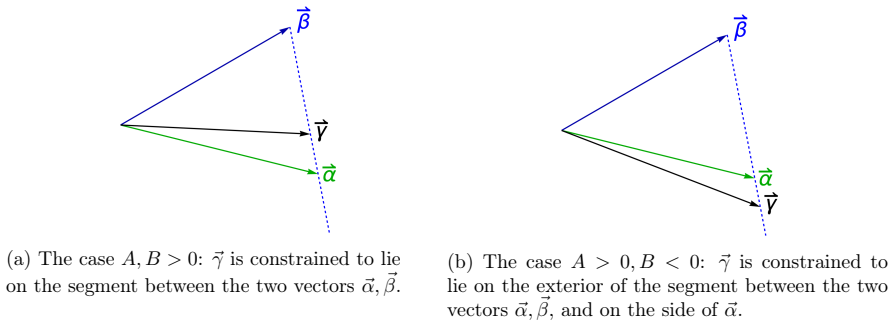
The machinery is a phase-space reformulation of the 4d two-scalar FLRW system in variables $\vec x=\dot{\vec\varphi}/(H\sqrt6)$, $z=\sqrt V/(H\sqrt3)$, and the effective exponent vector $\vec\gamma=-\nabla\ln V$. The unit sphere $\vec x^2+z^2=1$ is invariant and separates open universes (interior) from closed ones (exterior), while the cone $z^2>2\vec x^2$ is the acceleration region. For a multi-exponential potential, $\vec\gamma$ moves only on the line through the exponent vectors, and the stable critical point sits at the point on the convex hull closest to the origin; the distance $\gamma_*$ then fixes every late-time scaling. The named fixed point $P_1$ (curvature scaling, on the boundary of the acceleration cone) is the attractor for steep potentials with $\gamma_*^2>2$, and it is exactly what turns steep exponentials into sustained acceleration without violating swampland steepness bounds.
What would settle it
Numerically integrate the five-dimensional system (2.8),(4.5) for one of the eight two-exponential models with $\gamma_*^2>2$, choosing initial data inside the unit sphere but away from the known basin of $P_1$; if any such trajectory asymptotes the curvature-dominated point $P_0$ or enters a limit cycle instead of reaching $P_1$, the paper's late-time universality claim fails for that initial-data class.
Extended reading notes
Core claim
At the late-time attractor the effective exponent is not set by any single flux but by the geometry of the exponent vectors: for a two-exponential potential $V=A e^{-\vec\alpha\cdot\vec\varphi}+B e^{-\vec\beta\cdot\vec\varphi}$, the stable point has $\vec\gamma_*=\vec\gamma_{\rm ch}$, the shortest vector from the origin to the convex hull of $\vec\alpha$ and $\vec\beta$. When $\gamma_*^2>2$, the attracting fixed point for an open universe is $P_1$, where $a(t)\propto t$ and $\vec\varphi(t)=\vec\varphi_0+(2/\gamma_*^2)\vec\gamma_*\ln t$, with the potential-to-kinetic density ratio fixed at two and acceleration sitting on the boundary of the acceleration cone. Applying this rule to the eight two-exponential universal compactifications yields the paper's main physical results: in seven of eight models both $g_s$- and $\alpha'$-corrections are suppressed at late times, seven avoid decompactification, and three achieve scale separation with $L_6/L_H\to t^{-1/2}$; models with an asymptotically non-vanishing internal-curvature contribution instead have $L_6/L_H\to$ constant, so they satisfy only the weaker absence-of-decompactification condition. A separate analytic result is the complete heteroclinic solution at $\gamma=\gamma_s=2\sqrt{2/3}$, an eternally accelerating cosmology without Big Bang singularity whose apparent singularity is approached as de Sitter in hyperbolic slicing.
Load-bearing premise
The whole late-time picture rests on the assumption that open-universe solutions actually settle onto the $P_1$ attractor they identify; only local stability is proven, not attraction from every start.
Editorial extensions
If this is right
- In seven of the eight two-exponential universal models, string-loop and $\alpha'$ corrections are suppressed at late times, so the 4d effective description remains valid without additional tuning.
- Three models exhibit genuine late-time scale separation, with the internal KK length shrinking relative to the 4d Hubble length, making them bona fide 4d cosmologies.
- Models whose potential contains an asymptotically non-vanishing internal-curvature term do not achieve time-evolution-driven scale separation, even when that term is not dominant; they only satisfy the weaker condition of absence of decompactification.
- Steep exponential potentials, normally disfavoured by observations as single-field quintessence, can drive late-time acceleration once several exponentials and negative spatial curvature combine, because the convex-hull geometry lowers the effective exponent at the attractor.
- The analytic heteroclinic solution gives an exact eternally accelerating, geodesically complete cosmology, providing a controlled example of acceleration without a Big Bang singularity.
Reading between the lines
- If the convex-hull rule carries over to the multi-exponential case in full generality, adding more positive exponentials generically lowers $\gamma_*$, which would make steep-potential quintessence models more compatible with observations than their single-exponential counterparts; the paper sketches this but does not prove it in general.
- Because the attractor is fixed by exponent geometry rather than by the flux magnitudes $A,B$, one can design 4d two-scalar potentials with prescribed late-time scalings by placing exponents, turning the classification into a model-building criterion that applies beyond the specific 10d compactifications.
- In the curvature-contribution models the asymptotic string coupling is undetermined within the supergravity approximation, so those setups sit in a one-parameter family; fixing the dilaton by non-perturbative effects is a natural next step that the paper does not address.
- A numerical atlas of the open-universe basin of $P_1$ in the five-dimensional phase space would show how generic the claimed late-time behaviour really is: trajectories that start near the $P_0$ boundary may take a different route, and the 'all but one' counting would then need to be qualified by initial-data class.
Signed reviews
Editorial analysis
A structured set of objections, weighed in public.
Referee Report
Summary. The paper extends the dynamical-system analysis of "universal cosmologies" from the authors' earlier work [16] to the case of two-exponential potentials. It introduces phase-space variables (x, z, gamma), identifies the critical points P0, P1, P2, PC, derives their stability eigenvalues for one- and two-exponential potentials, and shows that at the stable critical point the effective exponent gamma_* is the shortest vector from the origin to the convex hull of the potential exponents. It then applies these results to eight two-exponential models descending from 10d type IIA compactifications, computes the late-time scalings of the string coupling, the internal KK scale, the Hubble length, and alpha' corrections, and concludes that all but one model avoid decompactification, with three exhibiting scale separation. The paper also gives a fully analytic, eternally accelerating, non-singular solution for the special threshold value gamma = gamma_s.
Significance. If the late-time attractor claim holds, this is a substantial and useful contribution. The algebraic derivations are explicit and internally consistent: the stability tables for the two-exponential system, the convex-hull rule for gamma_*, and the late-time scalings in Table 9 are concrete and checkable. The analytic heteroclinic solution in Eqs. (3.9)-(3.13) is a nice explicit result that goes beyond the single-exponential literature. The paper also engages seriously with recent work on scale separation and swampland bounds, and it makes falsifiable late-time predictions for explicit flux compactifications. The main caveat is that the advertised "universal" late-time conclusions rest on an unproved global-attraction statement and on a truncated estimate of higher-derivative corrections.
major comments (3)
- [§4.2 / §5.1, Eq. (5.3), Table 9] The paper proves only local linear stability of P1 in Section 4.2, yet Section 5.1 states that "in all cases, the late-time asymptotics are dictated by the attractor P1," and Table 9 lists scalings for every model on that basis. Instability of P0 and PC does not exclude limit cycles or other global attractors in the five-dimensional system (2.8), (4.5). This is load-bearing: any open-universe trajectory whose omega-limit set is not P1 would not obey the tabulated late-time scalings for g_s, L6/LH, or scale separation. The authors should either prove, or cite a proof of, global attraction for the relevant initial data, or restrict the claims to trajectories that do approach P1 and support the generic case with a numerical basin-of-attraction scan.
- [§5.1, Eq. (5.8)] The alpha'-correction estimate explicitly "ignores derivatives of phi1" when reducing the 10d action to Eq. (5.8). Since the "gs, alpha'" column of Table 9 is a central advertised output, this omission needs justification. Using the late-time solution (5.3), the authors should estimate terms such as alpha' exp(sqrt(3/2) phi1) (partial phi1)^2 and state why they are subleading compared with the curvature terms in Eq. (5.9). Without this, the small-alpha' conclusion remains an estimate of only the R4 and R6 terms, not of the full tower of higher-derivative corrections.
- [§6 / §7] The extension to more than two exponentials is explicitly heuristic: Section 6 says "we expect" and "we do not expect," and Section 7 states that multi-exponential potentials are not expected to alter the physics asymptotically. The abstract and introduction do not clearly flag that the rigorous results are for two-exponential potentials, while the closing paragraph of Section 7 makes a general claim about multiple positive exponentials. The authors should either provide a concrete argument that at most two exponentials dominate at the attractor, with a bound on the subleading terms, or restrict the summary and conclusions to the two-exponential case.
minor comments (4)
- [§3, bullet list] There are several typos in the stability discussion, including "eignenvalue" for "eigenvalue" and "statified" for "satisfied"; these should be corrected.
- [Table 9 caption] The entry "R" in the "Sc. S." column is explained only in the running text below the table; it would be clearer to define it in the caption or as a footnote.
- [§4.1 / Fig. 7] The angles theta1 and theta2 are used throughout the stability analysis but are not labeled on the figures; adding explicit angle labels to Figures 7 and 8 would make the geometric conditions much easier to follow.
- [§5, Eq. (5.1)] The four lines of the potential correspond to different compactification classes, but the line breaks are easy to misread as a single piecewise potential; a short sentence after Eq. (5.1) clarifying that each line is a separate case would help.
Circularity Check
No circular step found: late-time scalings follow from the equations of motion, and the imported [16] consistent truncation is independent support, not a fitted input.
full rationale
I walked the derivation chain. Section 2 defines the dynamical-system variables from the equations of motion and derives the critical points and analytic solutions directly from (2.3), (2.4), (2.7), and (2.8). Section 3 treats the single-exponential case, derives the stability eigenvalues in Table 4, and constructs the heteroclinic solution (3.9)/(3.11)-(3.13), verifying it a posteriori against the equations of motion. Section 4 builds the two-exponential autonomous system (2.8) with (4.5), derives the critical-point conditions (4.10), (4.14), and (4.15), and computes the eigenvalues in Tables 6 and 7. The convex-hull rule (4.22) follows by solving the critical-point condition gamma* = gamma_perp together with the stability conditions, not by assuming the result. Section 5 imports the 10d potentials and the cosmological consistent truncation from the authors' prior work [16]; this is a parameter-free input with stated assumptions, and it does not include the target late-time scalings, so it qualifies as independent support rather than a circular self-citation. The Table 9 scalings are then obtained by substituting the P1 fixed-point solution (5.3) into the uplift formulas (5.2) and the scale relations (5.5)-(5.6); no parameter is fitted to those outputs. The only caveat I found is not circularity: Section 4.2 establishes local stability of P1 but does not prove global attraction of P1 in the full five-dimensional phase space, so the quoted late-time behavior is conditional on trajectories entering the basin of P1. This is a correctness or completeness gap, not a reduction of the prediction to an input. Likewise, Sections 6 and 7 are explicit expectations rather than claimed derivations. I therefore find no circular step; the score of 2 reflects only the presence of non-load-bearing self-citations to the authors' earlier work.
Assumptions & free parameters
assumptions (5)
- domain assumption The 10d type IIA supergravity compactifications of [16] are exact, with the 4d potential (5.1) arising from a consistent truncation.
- domain assumption The estimate of alpha'-corrections using the action S10 = integrated sum (alpha')^n (R10)^(n+1), ignoring derivatives of phi1, captures the smallness of higher-derivative corrections.
- domain assumption Swampland conjectures are assumed to constrain viable string-theory models, so gamma^2 > 2 is treated as a desirable property.
- domain assumption The analysis is restricted to non-negative potentials and open or flat universes (k <= 0), excluding closed universes because no stable critical points exist.
- ad hoc to paper Local linear stability of the P1 fixed point determines the late-time asymptotics of generic open-universe trajectories.
Cite this review
Pith. "Pith review of Universal Cosmologies." pith.science (2026). https://pith.science/paper/5FT3VLZC
@misc{pith2026250503449,
  author       = {Pith},
  title        = {Pith review of: Universal Cosmologies},
  year         = {2026},
  howpublished = {\url{https://pith.science/paper/5FT3VLZC}},
  note         = {Machine review of arXiv:2505.03449}
}
abstract
Universal cosmologies are exact solutions of 10d type IIA supergravity containing a 4d Friedmann-Lema\^{i}tre-Robertson-Walker factor, that can also be repackaged as solutions of 4d models, i.e. as 4d consistent truncations. We extend the dynamical system analysis of universal cosmologies, beyond the case of a single exponential potential. For an open universe (negative 3d spatial curvature), these models generally possess many desirable features: parametric control of e-folds, late-time acceleration from potentials with steep exponentials (i.e. in accordance with swampland bounds), small string-loop and $\alpha'$-corrections, scale separation and/or absence of decompactification.
Figures


Figures from the paper (9 more)




Reference graph
Works this paper leans on
-
[16]
P. Marconnet and D. Tsimpis,Universal accelerating cosmologies from 10d supergravity, JHEP 01 (2023) 033, [arXiv:2210.10813]
arXiv 2023
-
[1]
P. K. Townsend and M. N. Wohlfarth,Accelerating cosmologies from compactification, Phys. Rev. Lett.91 (2003) 061302, [hep-th/0303097]
arXiv 2003
-
[2]
Gibbons,Aspects of supergravity theories, GIFT Seminar 1984:0123 (QCD161:G2:1984) (1984)
G. Gibbons,Aspects of supergravity theories, GIFT Seminar 1984:0123 (QCD161:G2:1984) (1984)
1984
-
[3]
Gibbons,Thoughts on tachyon cosmology, Class
G. Gibbons,Thoughts on tachyon cosmology, Class. Quant. Grav.20 (2003) S321–S346, [hep-th/0301117]
arXiv 2003
-
[4]
J. M. Maldacena and C. Nunez,Supergravity description of field theories on curved manifolds and a no go theorem, Int.J.Mod.Phys. A16 (2001) 822–855, [hep-th/0007018]
arXiv 2001
-
[5]
J. Russo and P. Townsend,Late-time Cosmic Acceleration from Compactification, Class. Quant. Grav.36 (2019), no. 9 095008, [arXiv:1811.03660]
arXiv 2019
-
[6]
J. Russo and P. Townsend,Time-dependent compactification to de Sitter space: a no-go theorem, JHEP 06 (2019) 097, [arXiv:1904.11967]
arXiv 2019
-
[7]
Ohta,Accelerating cosmologies from S-branes, Phys
N. Ohta,Accelerating cosmologies from S-branes, Phys. Rev. Lett.91 (2003) 061303, [hep-th/0303238]
arXiv 2003
Show all 91 references
-
[8]
Ohta,A Study of accelerating cosmologies from superstring / M theories, Prog
N. Ohta,A Study of accelerating cosmologies from superstring / M theories, Prog. Theor. Phys.110 (2003) 269–283, [hep-th/0304172]
2003 arXiv
-
[9]
Ohta,Accelerating cosmologies and inflation from M/superstring theories, Int
N. Ohta,Accelerating cosmologies and inflation from M/superstring theories, Int. J. Mod. Phys. A20 (2005) 1–40, [hep-th/0411230]
2005 arXiv
-
[10]
Roy,Accelerating cosmologies from M / string theory compactifications, Phys
S. Roy,Accelerating cosmologies from M / string theory compactifications, Phys. Lett. B 567 (2003) 322–329, [hep-th/0304084]
2003 arXiv
-
[11]
Gutperle, R
M. Gutperle, R. Kallosh, and A. D. Linde,M / string theory, S-branes and accelerating universe, JCAP 07 (2003) 001, [hep-th/0304225]
2003 arXiv
-
[12]
Emparan and J
R. Emparan and J. Garriga,A Note on accelerating cosmologies from compactifications and S branes, JHEP 05 (2003) 028, [hep-th/0304124]. 35
2003 arXiv
-
[13]
P. K. Townsend,Cosmic acceleration and M theory, in14th International Congress on Mathematical Physics, pp. 655–662, 8, 2003.hep-th/0308149
2003 arXiv
-
[14]
Chen, P.-M
C.-M. Chen, P.-M. Ho, I. P. Neupane, N. Ohta, and J. E. Wang,Hyperbolic space cosmologies, JHEP 10 (2003) 058, [hep-th/0306291]
2003 arXiv
-
[15]
M. N. Wohlfarth,Inflationary cosmologies from compactification?, Phys. Rev. D69 (2004) 066002, [hep-th/0307179]
2004 arXiv
-
[17]
D’Amico and N
G. D’Amico and N. Kaloper,Rollercoaster cosmology, JCAP 08 (2021), 058 [arXiv:2011.09489]
2021 arXiv
-
[18]
Freivogel, M
B. Freivogel, M. Kleban, M. Rodriguez Martinez, and L. Susskind,Observational consequences of a landscape, JHEP 03 (2006) 039, [hep-th/0505232]
2006 arXiv
-
[19]
Bedroya, H
A. Bedroya, H. Lee and P. Steinhardt,A species scale-driven breakdown of effective field theory in time-dependent string backgrounds, 2504.13260
-
[20]
Andriot, D
D. Andriot, D. Tsimpis, and T. Wrase,Accelerated expansion of an open universe, and string theory realizations, Phys. Rev. D108 (2023) no.12, 123515, [arXiv:2309.03938]
2023 arXiv
-
[21]
Obied, H
G. Obied, H. Ooguri, L. Spodyneiko, and C. Vafa,De Sitter Space and the Swampland, arXiv:1806.08362
-
[22]
Hebecker and T
A. Hebecker and T. Wrase,The Asymptotic dS Swampland Conjecture - a Simplified Derivation and a Potential Loophole, Fortsch. Phys.67 (2019), no. 1-2 1800097, [arXiv:1810.08182]
2019 arXiv
-
[23]
Andriot,Open problems on classical de Sitter solutions, Fortsch
D. Andriot,Open problems on classical de Sitter solutions, Fortsch. Phys.67 (2019), no. 7 1900026, [arXiv:1902.10093]
2019 arXiv
-
[24]
D. Lüst, E. Palti, and C. Vafa,AdS and the Swampland, Phys. Lett. B797 (2019) 134867, [arXiv:1906.05225]
2019 arXiv
-
[25]
Bedroya and C
A. Bedroya and C. Vafa,Trans-Planckian Censorship and the Swampland, JHEP 09 (2020) 123, [arXiv:1909.11063]
2020 arXiv
-
[26]
Andriot, N
D. Andriot, N. Cribiori, and D. Erkinger,The web of swampland conjectures and the TCC bound, JHEP 07 (2020) 162, [arXiv:2004.00030]
2020 arXiv
-
[27]
Rudelius,Dimensional reduction and (Anti) de Sitter bounds, JHEP 08 (2021) 041, [arXiv:2101.11617]
T. Rudelius,Dimensional reduction and (Anti) de Sitter bounds, JHEP 08 (2021) 041, [arXiv:2101.11617]
2021 arXiv
-
[28]
Rudelius,Asymptotic observables and the swampland, Phys
T. Rudelius,Asymptotic observables and the swampland, Phys. Rev. D104 (2021), no. 12 126023, [arXiv:2106.09026]
2021 arXiv
-
[29]
L. J. Boya, M. A. Per, and A. J. Segui,Graphical and kinematical approach to cosmological horizons, Phys. Rev. D66 (2002) 064009, [gr-qc/0203074]
2002 arXiv
-
[30]
Agrawal, G
P. Agrawal, G. Obied, P. J. Steinhardt, and C. Vafa,On the Cosmological Implications of the String Swampland, Phys. Lett. B784 (2018) 271–276, [arXiv:1806.09718]
2018 arXiv
-
[31]
Olguin-Trejo, S
Y. Olguin-Trejo, S. L. Parameswaran, G. Tasinato, and I. Zavala,Runaway Quintessence, Out of the Swampland, JCAP 01 (2019) 031, [arXiv:1810.08634]
2019 arXiv
-
[32]
Hebecker, T
A. Hebecker, T. Skrzypek, and M. Wittner,The F-term Problem and other Challenges of Stringy Quintessence, JHEP 11 (2019) 134, [arXiv:1909.08625]. 36
2019 arXiv
-
[33]
Cicoli, G
M. Cicoli, G. Dibitetto, and F. G. Pedro,New accelerating solutions in late-time cosmology, Phys. Rev. D101 (2020), no. 10 103524, [arXiv:2002.02695]
2020 arXiv
-
[34]
Valeixo Bento, D
B. Valeixo Bento, D. Chakraborty, S. L. Parameswaran, and I. Zavala,Dark Energy in String Theory, PoS CORFU2019 (2020) 123, [arXiv:2005.10168]
2020 arXiv
-
[35]
Cicoli, F
M. Cicoli, F. Cunillera, A. Padilla, and F. G. Pedro,Quintessence and the Swampland: The Parametrically Controlled Regime of Moduli Space, Fortsch. Phys.70 (2022), no. 4 2200009, [arXiv:2112.10779]
2022 arXiv
-
[36]
Rudelius,Asymptotic scalar field cosmology in string theory, JHEP 10 (2022) 018, [arXiv:2208.08989]
T. Rudelius,Asymptotic scalar field cosmology in string theory, JHEP 10 (2022) 018, [arXiv:2208.08989]
2022 arXiv
-
[37]
Calderón-Infante, I
J. Calderón-Infante, I. Ruiz, and I. Valenzuela,Asymptotic accelerated expansion in string theory and the Swampland, JHEP 06 (2023) 129, [arXiv:2209.11821]
2023 arXiv
-
[38]
G. Shiu, F. Tonioni, and H. V. Tran,Accelerating universe at the end of time, Phys. Rev. D108 (2023), no. 6 063527, [arXiv:2303.03418]
2023 arXiv
-
[39]
G. Shiu, F. Tonioni, and H. V. Tran,Late-time attractors and cosmic acceleration, Phys. Rev. D108 (2023), no. 6 063528, [arXiv:2306.07327]
2023 arXiv
-
[40]
Cremonini, E
S. Cremonini, E. Gonzalo, M. Rajaguru, Y. Tang, and T. Wrase,On asymptotic dark energy in string theory, JHEP 09 (2023) 075, [arXiv:2306.15714]
2023 arXiv
-
[41]
Hebecker, S
A. Hebecker, S. Schreyer, and V. Venken,No asymptotic acceleration without higher-dimensional de Sitter vacua, JHEP 11 (2023) 173, [arXiv:2306.17213]
2023 arXiv
-
[42]
Freigang, D
J. Freigang, D. Lust, G.-E. Nian, and M. Scalisi,Cosmic acceleration and turns in the Swampland, JCAP 11 (2023) 080, [arXiv:2306.17217]
2023 arXiv
-
[43]
Van Riet,No accelerating scaling cosmologies at string tree level?, JCAP 01 (2024) 055, [arXiv:2308.15035]
T. Van Riet,No accelerating scaling cosmologies at string tree level?, JCAP 01 (2024) 055, [arXiv:2308.15035]
2024 arXiv
-
[44]
G. Shiu, F. Tonioni, and H. V. Tran,Collapsing universe before time, JCAP 05 (2024) 124, [arXiv:2312.06772]
2024 arXiv
-
[45]
Andriot, S
D. Andriot, S. Parameswaran, D. Tsimpis, T. Wrase, and I. Zavala,Exponential quintessence: curved, steep and stringy?, JHEP 08 (2024) 117, [arXiv:2405.09323]
2024 arXiv
-
[46]
G. Shiu, F. Tonioni, and H. V. Tran,Analytic bounds on late-time axion-scalar cosmologies, JHEP 09 (2024) 158, [arXiv:2406.17030]
2024 arXiv
-
[47]
G. F. Casas and I. Ruiz,Cosmology of light towers and swampland constraints, JHEP 12 (2024) 193, [arXiv:2409.08317]
2024 arXiv
-
[48]
Andriot,Quintessence: an analytical study, with theoretical and observational applications, arXiv:2410.17182
D. Andriot,Quintessence: an analytical study, with theoretical and observational applications, arXiv:2410.17182
-
[49]
Andriot, N
D. Andriot, N. Cribiori, and T. Van Riet,Scale separation, rolling solutions and entropy bounds, arXiv:2504.08634
-
[50]
Abdul Karim et al.,DESI DR2 Results II: Measurements of Baryon Acoustic Oscillations and Cosmological Constraints, arXiv:2503.14738
DESI Collaboration, M. Abdul Karim et al.,DESI DR2 Results II: Measurements of Baryon Acoustic Oscillations and Cosmological Constraints, arXiv:2503.14738
-
[51]
Lodha et al.,Extended Dark Energy analysis using DESI DR2 BAO measurements, arXiv:2503.14743
DESI Collaboration, K. Lodha et al.,Extended Dark Energy analysis using DESI DR2 BAO measurements, arXiv:2503.14743
-
[52]
Bhattacharya, G
S. Bhattacharya, G. Borghetto, A. Malhotra, S. Parameswaran, G. Tasinato, and I. Zavala,Cosmological constraints on curved quintessence, JCAP 09 (2024) 073, [arXiv:2405.17396]. 37
2024 arXiv
-
[53]
Alestas, M
G. Alestas, M. Delgado, I. Ruiz, Y. Akrami, M. Montero, and S. Nesseris,Is curvature-assisted quintessence observationally viable?, Phys. Rev. D110 (2024), no. 10 106010, [arXiv:2406.09212]
2024 arXiv
-
[54]
Akrami, G
Y. Akrami, G. Alestas and S. Nesseris,Has DESI detected exponential quintessence?, 2504.04226
-
[55]
E. J. Copeland, A. R. Liddle, and D. Wands,Exponential potentials and cosmological scaling solutions, Phys. Rev. D57 (1998) 4686–4690, [gr-qc/9711068]
1998 arXiv
-
[56]
Hartong, A
J. Hartong, A. Ploegh, T. Van Riet, and D. B. Westra,Dynamics of generalized assisted inflation, Class. Quant. Grav.23 (2006) 4593–4614, [gr-qc/0602077]
2006 arXiv
-
[57]
Halliwell,Scalar Fields in Cosmology with an Exponential Potential, Phys
J. Halliwell,Scalar Fields in Cosmology with an Exponential Potential, Phys. Lett. B 185 (1987) 341
1987
-
[58]
R. J. van den Hoogen, A. A. Coley, and D. Wands,Scaling solutions in Robertson-Walker space-times, Class. Quant. Grav.16 (1999) 1843–1851, [gr-qc/9901014]
1999 arXiv
-
[59]
Guo, Y.-S
Z.-K. Guo, Y.-S. Piao, R.-G. Cai, and Y.-Z. Zhang,Cosmological scaling solutions and cross coupling exponential potential, Phys. Lett. B576 (2003) 12–17, [hep-th/0306245]
2003 arXiv
-
[60]
R. J. van den Hoogen and L. Filion,Stability analysis of multiple scalar field cosmologies with matter, Class. Quant. Grav.17 (2000) 1815–1825
2000
-
[61]
Andersson and J
L. Andersson and J. Heinzle,Eternal acceleration from M-theory, Adv. Theor. Math. Phys. 11 (2007), no. 3 371–398, [hep-th/0602102]
2007 arXiv
-
[62]
Barreiro, E
T. Barreiro, E. J. Copeland, and N. J. Nunes,Quintessence arising from exponential potentials, Phys. Rev. D61 (2000) 127301, [astro-ph/9910214]
2000 arXiv
-
[63]
Li, Y.-B
X.-Z. Li, Y.-B. Zhao, and C.-B. Sun,Heteroclinic orbit and tracking attractor in cosmological model with a double exponential potential, Class. Quant. Grav.22 (2005) 3759–3766, [astro-ph/0508019]
2005 arXiv
-
[64]
L. Jarv, T. Mohaupt and F. Saueressig,Quintessence cosmologies with a double exponential potential, JCAP 08 (2004), 016, [hep-th/0403063]
2004 arXiv
-
[65]
A. R. Liddle, A. Mazumdar, and F. E. Schunck,Assisted inflation, Phys. Rev. D58 (1998) 061301, [astro-ph/9804177]
1998 arXiv
-
[66]
A. A. Coley and R. J. van den Hoogen,The Dynamics of multiscalar field cosmological models and assisted inflation, Phys. Rev. D62 (2000) 023517, [gr-qc/9911075]
2000 arXiv
-
[67]
E. J. Copeland, A. Mazumdar, and N. J. Nunes,Generalized assisted inflation, Phys. Rev. D60 (1999) 083506, [astro-ph/9904309]
1999 arXiv
-
[68]
Collinucci, M
A. Collinucci, M. Nielsen, and T. Van Riet,Scalar cosmology with multi-exponential potentials, Class. Quant. Grav.22 (2005) 1269–1288, [hep-th/0407047]
2005 arXiv
-
[69]
P. J. Steinhardt, L.-M. Wang, and I. Zlatev,Cosmological tracking solutions, Phys. Rev. D 59 (1999) 123504, [astro-ph/9812313]
1999 arXiv
-
[70]
Wainwright and G
J. Wainwright and G. F. R. Ellis,Dynamical systems in cosmology. Cambridge University Press, 1997
1997
-
[71]
Bahamonde, C
S. Bahamonde, C. G. Böhmer, S. Carloni, E. J. Copeland, W. Fang, and N. Tamanini, Dynamical systems applied to cosmology: dark energy and modified gravity, Phys. Rept. 775-777 (2018) 1–122, [arXiv:1712.03107]. 38
2018 arXiv
-
[72]
Tsimpis,Supersymmetric AdS vacua and separation of scales, JHEP 08 (2012) 142, [arXiv:1206.5900]
D. Tsimpis,Supersymmetric AdS vacua and separation of scales, JHEP 08 (2012) 142, [arXiv:1206.5900]
2012 arXiv
-
[73]
Richard, R
J.-M. Richard, R. Terrisse, and D. Tsimpis,On the spin-2 Kaluza-Klein spectrum of AdS4×S2 (B4), JHEP 12 (2014) 144, [arXiv:1410.4669]
2014 arXiv
-
[74]
Marchesano, E
F. Marchesano, E. Palti, J. Quirant, and A. Tomasiello,On supersymmetric AdS4 orientifold vacua, JHEP 08 (2020) 087, [arXiv:2003.13578]
2020 arXiv
-
[75]
F. F. Gautason, M. Schillo, T. Van Riet, and M. Williams,Remarks on scale separation in flux vacua, JHEP 03 (2016) 061, [arXiv:1512.00457]
2016 arXiv
-
[76]
A. Font, A. Herráez, and L. E. Ibáñez,On scale separation in type II AdS flux vacua, JHEP 03 (2020) 013, [arXiv:1912.03317]
2020 arXiv
-
[77]
Lüst and D
D. Lüst and D. Tsimpis,AdS2 type-IIA solutions and scale separation, JHEP 07 (2020) 060, [arXiv:2004.07582]
2020 arXiv
-
[78]
Junghans,O-Plane Backreaction and Scale Separation in Type IIA Flux Vacua, Fortsch
D. Junghans,O-Plane Backreaction and Scale Separation in Type IIA Flux Vacua, Fortsch. Phys.68 (2020), no. 6 2000040, [arXiv:2003.06274]
2020 arXiv
-
[79]
Farakos, G
F. Farakos, G. Tringas, and T. Van Riet,No-scale and scale-separated flux vacua from IIA on G2 orientifolds, Eur. Phys. J. C80 (2020), no. 7 659, [arXiv:2005.05246]
2020 arXiv
-
[80]
G. B. De Luca and A. Tomasiello,Leaps and bounds towards scale separation, JHEP 12 (2021) 086, [arXiv:2104.12773]
2021 arXiv
-
[81]
Cribiori, D
N. Cribiori, D. Junghans, V. Van Hemelryck, T. Van Riet, and T. Wrase, Scale-separated AdS4 vacua of IIA orientifolds and M-theory, Phys. Rev. D104 (2021), no. 12 126014, [arXiv:2107.00019]
2021 arXiv
-
[82]
Tsimpis,Relative scale separation in orbifolds of S2 and S5, JHEP 03 (2022) 169, [arXiv:2201.10916]
D. Tsimpis,Relative scale separation in orbifolds of S2 and S5, JHEP 03 (2022) 169, [arXiv:2201.10916]
2022 arXiv
-
[83]
Apers, M
F. Apers, M. Montero, T. Van Riet, and T. Wrase,Comments on classical AdS flux vacua with scale separation, JHEP 05 (2022) 167, [arXiv:2202.00682]
2022 arXiv
-
[84]
Farakos and M
F. Farakos and M. Morittu,Scale-separated AdS3×S1 vacua from IIA orientifolds, Eur. Phys. J. C84 (2024), no. 1 98, [arXiv:2311.08991]
2024 arXiv
-
[85]
Coudarchet,Hiding the extra dimensions: A review on scale separation in string theory, Phys
T. Coudarchet,Hiding the extra dimensions: A review on scale separation in string theory, Phys. Rept.1064 (2024) 1–28, [arXiv:2311.12105]
2024 arXiv
-
[86]
Arboleya, A
A. Arboleya, A. Guarino, and M. Morittu,Type II orientifold flux vacua in 3D, JHEP 12 (2024) 087, [arXiv:2408.01403]
2024
-
[87]
Cribiori, F
N. Cribiori, F. Farakos, and N. Liatsos,On scale-separated supersymmetric AdS2 flux vacua, Eur. Phys. J. C85 (2025), no. 2 213, [arXiv:2411.04932]
2025 arXiv
-
[88]
Van Hemelryck,Supersymmetric scale-separated AdS3 vacua of type IIB, arXiv:2502.04791
V. Van Hemelryck,Supersymmetric scale-separated AdS3 vacua of type IIB, arXiv:2502.04791
-
[89]
Tringas and T
G. Tringas and T. Wrase,Scale separation from O-planes, arXiv:2504.15436
-
[90]
Proust, H
A. Proust, H. Samtleben, and E. Sezgin,Scale separation on AdS3×S3 with and without supersymmetry, arXiv:2504.12425
-
[91]
T. C. Collins, D. Jafferis, C. Vafa, K. Xu, and S.-T. Yau,On Upper Bounds in Dimension Gaps of CFT’s, arXiv:2201.03660. 39
Reviewed August 15, 2026 · model on record in the stance chip above.
Discussion (0). Continue with ORCID to comment.