REVIEW 3 major objections 4 minor 1 cited by
Non-relativistic quantum strings from gauged WZW models
T0 review · 3 major / 4 minor · reviewed 2026-08-15 · deepseek-v4-flash
Pith's one-line read A chiral null gauging of the WZW model on a generalised Nappi-Witten group produces a non-relativistic quantum string whose BRST cohomology is a Gomis-Ooguri-like closed string spectrum.
desk verdict A careful but conditional construction: the chiral null gauging idea is new and the cohomology is solid, yet the spectrum depends on a chosen free-field realization, so 'non-relativistic' is not yet intrinsic. read the letter →
The pith
A machine-rendered reading of the paper's core claim, the machinery that carries it, and where it could break.
The reading
What carries the argument
The load-bearing object is the generalised Nappi-Witten Lie algebra and its free-field realisation (4.21), in which the currents P±, I, J are written as two beta-gamma systems. This turns the null-gauging constraint J=0 into a BRST operator whose cohomology is computed with a spectral sequence; the Kugo-Ojima quartet mechanism collapses that cohomology to a single beta-gamma system. The same collapse, applied to the Virasoro BRST operator, makes the full string cohomology equal to the cohomology of its d0 piece, which directly yields the Gomis-Ooguri-like spectrum.
What would settle it
Compute the full Virasoro BRST cohomology using the alternative free-field realisation (5.1), or compute the null-gauging and Virasoro cohomologies without free fields using Verma modules; if the resulting spectrum differs from Propositions 9 and 10, the claimed string is realisation-dependent rather than an intrinsic property of the gauged WZW model.
Extended reading notes
Core claim
The central claim is that the null chiral gauging of the WZW model on a generalised Nappi-Witten group defines a consistent quantum string theory, and that its Virasoro BRST cohomology is isomorphic to the cohomology of the leading differential d0, producing a Gomis-Ooguri-like spectrum: holomorphically, a beta-gamma system plus 24 free bosons; antiholomorphically, a beta-gamma system, an ebeta-egamma system, and 22 free bosons. The paper proves this by computing the null-gauging cohomology (Proposition 7) and the Virasoro BRST cohomology (Propositions 9 and 10), showing that the c=24 matter sector is effectively immaterial for the cohomology. It also demonstrates that this result is tied to a specific free-field realisation: an alternative, equally valid realisation gives a smaller null-gauging cohomology (Proposition 11).
Load-bearing premise
The load-bearing premise is that the chosen free-field realisation (4.21) faithfully represents the physical content of the Nappi-Witten WZW model; the paper itself shows that another equally valid realisation changes the null-gauging cohomology.
Editorial extensions
If this is right
- A non-relativistic quantum string can be obtained without non-relativistic limits, purely by gauging a null central subgroup in a WZW model.
- The resulting closed string resembles the bosonic Gomis-Ooguri string but with a heterosis: the holomorphic and antiholomorphic sectors have different field content even though both are critical.
- The BRST spectrum is independent of which c=24 matter CFT is added, so the construction is robust against changing the spectator matter sector.
- The method extends to generalised Nappi-Witten groups with a larger null reduction target, offering a family of potential galilean string models.
- The final theory can be reinterpreted as a Vir semidirect product with an affine u(1) field theory, linking it to other non-lorentzian and tensionless string settings.
Reading between the lines
- The realisation-dependence made explicit in Proposition 11 suggests the construction does not yet single out a unique non-relativistic string from the WZW datum; a cohomology computation without free fields would settle whether the spectrum is intrinsic.
- Because the calculation uses the split-signature real form (2,2), the target symmetry is pseudo-galilean rather than strictly galilean; repeating the computation on the lorentzian (3,1) real form could alter or remove the holomorphic/antiholomorphic mismatch.
- The appearance of the Vir semidirect product with an affine u(1) as the resulting symmetry algebra hints that non-relativistic, tensionless, and minimal-tension strings could be unified as one family of field theories at different values of a parameter, though the paper itself only notes the circumstantial connection.
- A concrete testable extension is to compute the one-loop partition function of the resulting string and compare it with the Gomis-Ooguri string; any mismatch would be a direct signature of the chiral null gauging.
Signed reviews
Editorial analysis
A structured set of objections, weighed in public.
Referee Report
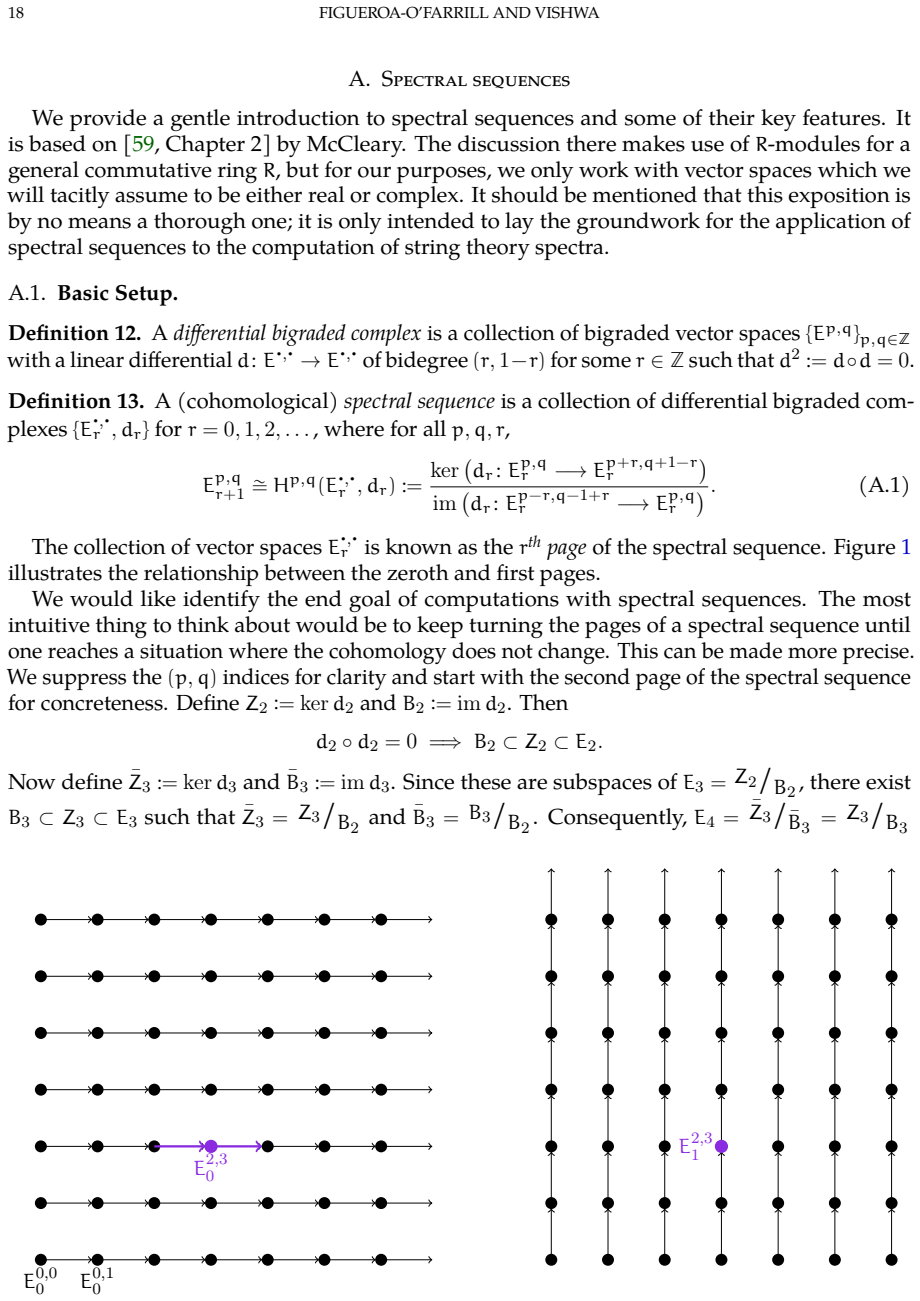
Summary. The paper constructs a closed bosonic string theory by starting from a WZW model on the Nappi–Witten group, implementing a chiral null gauging of the null central subgroup, and passing to the BRST cohomology. After complexifying and choosing the free-field realization (4.21), the null gauging cohomology is shown to be a single βγ system (Proposition 7); supplementing this with a c=24 matter sector and imposing Virasoro BRST invariance yields a spectrum (Propositions 9 and 10) that resembles the Gomis–Ooguri string, with holomorphic 24 free bosons and anti-holomorphic 22 free bosons plus a βγ system. The paper contains detailed appendices with spectral-sequence and Kugo–Ojima derivations, and it explicitly acknowledges that the result depends on the chosen free-field realization and on a split-signature real form.
Significance. If the construction is taken as a proof of concept, the paper is valuable: it gives a worldsheet-level, limit-free construction of a string theory with a non-Lorentzian-like spectrum, and it connects the resulting model to the bgλ=0 algebra and to the Gomis–Ooguri string. The computational core is a genuine strength: the spectral-sequence exposition in Appendix A, the Kugo–Ojima lemma in Appendix B, and the explicit cohomology computations in Appendix C are detailed and appear internally consistent. The paper is also unusually candid about its two main caveats, namely free-field-realization dependence and the use of a split-signature real form. The significance is therefore real but conditional: the object constructed is a string theory associated with a particular free-field realization of the gauged WZW model, not yet an invariant of the WZW model itself, and the target-space symmetry is pseudo-Galilean rather than strictly Galilean.
major comments (3)
- [§5.2, Prop. 11 vs. Prop. 7] The central construction is not realization-independent. Proposition 7, which identifies the null-gauging cohomology as a single βγ system, is explicitly restricted to the free-field realization (4.21); Section 5.2 and Proposition 11 show that the alternative realization (5.1), also a realization of the same affine Nappi–Witten algebra, gives a strictly smaller null-gauging cohomology, namely (C|0>_BC ⊕ C C_0|0>_BC) ⊗ C|0,0> ⊗ (V^{βγ}_σ)_0, with doubled vacuum degeneracy. Because Propositions 9 and 10 build the final string spectrum directly on Proposition 7, the resulting 'non-relativistic string' is a property of the chosen free-field realization, not of the gauged WZW model per se. The paper notes this in Section 5.2, but the abstract and title still assert the stronger claim that non-relativistic strings are constructed from gauged WZW models. The authors should either provide a representation-theoretic argument that (4.21) is the physically selected realization of the WZW model, or systematically restate the results as properties of the chosen realization.
- [§4.1–4.2 and §5.1, Eq. (4.11)] The use of a split-signature real form is a load-bearing departure from the advertised Galilean geometry. Equation (4.11) is an isomorphism of complex Lie algebras but not of real Lie algebras, and the inner product becomes split-signature (2,2) instead of Lorentzian (3,1). The paper acknowledges in Section 5.1 that the resulting symmetry is pseudo-Galilean rather than strictly Galilean, but the abstract and introduction are not qualified accordingly. A pseudo-Galilean structure with a split cometric is not a Galilean structure in the sense of Definitions 3 and 4, and the null reduction in Appendix D.2 is performed for the split real form. Please either carry out the analogous computation in the Lorentzian real form or make the pseudo-Galilean nature of the target explicit in the abstract and in the statement of the main result.
- [§4.4.2 and Appendix C.2, Eq. (4.40)–(4.41)] The proof of Proposition 10 is incomplete as written. The computation in Appendix C.2 is presented for the standard Gomis–Ooguri matter content; it does not explicitly include the (eβ,eγ) system or the modified stress tensor T_sug = T_{βγ} + T_{eβeγ}^{mod} with the −(1/2)∂̄β̄ term. The assertion that this non-conformal term does not affect the Virasoro BRST cohomology is plausible but is not demonstrated: one must show that the filtration degrees assigned to the eβ and eγ modes are such that the d1 differential, which now contains modes of T_sug, vanishes on the E_1 page. Please supply the explicit spectral-sequence computation for this sector, or give an argument that the extra term is d0-exact in the relevant complex.
minor comments (4)
- [Eq. (4.31) and Prop. 7] In Eq. (4.31), the last tensor factor is written |σ>_BC; it should presumably be |σ>_{βγ}. In the statement of Proposition 7, the phrase 'a choice of picture labelled by m∈Z' is confusing because no parameter m appears in the displayed result.
- [Eqs. (4.8)–(4.10)] The OPEs contain a factor '1(w)' that is not defined; presumably it denotes the identity operator at the point w. Please define this notation explicitly.
- [§4.4.1, Eqs. (4.35)–(4.38)] The construction compactifies γ and uses the winding mode i w R ln z, but the paper never states explicitly that w is nonzero. If w=0, the differential d0 in Eq. (4.37) vanishes and the spectral-sequence collapse used in the proof of Proposition 9 does not follow. Please state the condition on w and comment on the w=0 sector.
- [Appendix D.2] After deriving the split-signature metric (D.29), the null reduction is not explicitly carried out; the assertion in Section 5.1 that the anti-holomorphic sector contributes Lorentzian signature would be more convincing if the reduced cometric were computed explicitly, as is done for the Lorentzian real form in Appendix D.1.
Circularity Check
No load-bearing circularity: the central cohomology claims are computed directly in the appendices, and the admitted free-field-realization dependence is an explicit caveat, not a hidden input.
full rationale
The main derivation chain is: (i) gauge a null central subgroup in the Nappi-Witten WZW model (Section 3), (ii) choose a free-field realization (4.21), (iii) compute null-gauging BRST cohomology (Proposition 7), (iv) add c=24 matter and compute Virasoro BRST cohomology (Propositions 9 and 10). Each load-bearing cohomology step is proved inside the paper itself: Appendix C.1 gives the spectral-sequence and Kugo-Ojima proof of Proposition 7, and Appendix C.2 gives the analogous proof of Propositions 9 and 10 using Lemma 20. The result is therefore a direct calculation from stated assumptions, not an import of a conclusion. The self-citations are not load-bearing: [31] supplies background classification, and [45] is invoked in Section 4.5 only as "in keeping with" the computations; the proofs in the appendices do not use it. Likewise, the anomaly-free gauging conditions from [37,38] are re-derived in Proposition 6 and Section 3.2. The paper explicitly flags its two main limitations: Section 4.3 states that "Proposition 7 only holds for our specific choice of free field realisation of the Nappi-Witten CFT given by (4.21)", and Section 5.2 with Proposition 11 shows that an alternate realization gives a smaller null-gauging cohomology; Section 5.1 acknowledges that the split-signature real form gives "pseudo-galilean symmetry rather than a strictly galilean one." These are robustness and correctness caveats about the chosen input, not cases where the output was defined to be the input. There are no fitted parameters and no uniqueness claim forcing the chosen realization, so the derivation does not reduce by construction.
Assumptions & free parameters
free parameters (1)
- R (compactification radius for gamma and bar-gamma)
assumptions (5)
- standard math The classification of metric Lie algebras and the characterization of lorentzian Lie algebras (Medina-Revoy theorem) identify generalized Nappi-Witten algebras as the relevant bargmannian structures.
- domain assumption The free field realization (4.21) is a valid representation of the affine Nappi-Witten algebra with the stated OPEs.
- domain assumption The null chiral gauging of the WZW model is correctly implemented by the BRST operator d_NG = (CJ)_0, with the ghost system arising from the Faddeev-Popov determinant.
- standard math The spectral sequence convergence and collapse arguments (Theorem 17) apply to the filtrations used in Appendix C.
- domain assumption The Virasoro BRST quantization with c=26 matter and c=-26 ghosts yields a consistent string theory, and the specific c=24 matter sector does not affect the cohomology.
Cite this review
Pith. "Pith review of Non-relativistic quantum strings from gauged WZW models." pith.science (2026). https://pith.science/paper/YPNUQSGX
@misc{pith2026250503462,
  author       = {Pith},
  title        = {Pith review of: Non-relativistic quantum strings from gauged WZW models},
  year         = {2026},
  howpublished = {\url{https://pith.science/paper/YPNUQSGX}},
  note         = {Machine review of arXiv:2505.03462}
}
read the original abstract
We construct non-relativistic quantum strings from gauged Wess--Zumino--Witten (WZW) models. We depart from the fact that Lie groups with a bi-invariant galilean structure can be seen as the quotient by a null central subgroup of a generalised Nappi--Witten group. We implement the quotient by a chiral null gauging. We use a particular free field realisation of the Nappi--Witten current algebra to compute the Virasoro BRST cohomology of the gauged WZW model, resulting in a closed string theory reminiscent of the bosonic Gomis--Ooguri string, but whose spectrum differs slightly between the holomorphic and antiholomorphic sectors.
Figures


Forward citations
Cited by 1 Pith paper
-
An Introduction to String Newton-Cartan Holography and Integrability
String Newton-Cartan holography, the non-relativistic limit of the AdS/CFT correspondence, is organized and reviewed around five consistency conditions, with its classical solutions, spectrum, and integrability structure.
Reference graph
Works this paper leans on
-
[1]
Nonrelativistic closed string theory,
J. Gomis and H. Ooguri, “Nonrelativistic closed string theory,”J. Math. Phys.42 (2001) 3127–3151, arXiv:hep-th/0009181. [Pages 2, 13, and 14.]
arXiv 2001
-
[2]
U. H. Danielsson, A. Güijosa, and M. Kruczenski, “IIA/B, wound and wrapped,”JHEP10 (2000) 020, arXiv:hep-th/0009182. [Page 2.]
arXiv 2000
-
[3]
Aspects of Nonrelativistic Strings,
G. Oling and Z. Yan, “Aspects of Nonrelativistic Strings,”Front. in Phys.10 (2022) 832271,arXiv:2202.12698 [hep-th]. [Page 2.]
arXiv 2022
-
[4]
Non-relativistic superstrings: A New soluble sector of AdS(5) x S**5,
J. Gomis, J. Gomis, and K. Kamimura, “Non-relativistic superstrings: A New soluble sector of AdS(5) x S**5,” JHEP12(2005) 024,arXiv:hep-th/0507036. [Page 2.]
arXiv 2005
-
[5]
Extended Galilean symmetries of non-relativistic strings,
C. Batlle, J. Gomis, and D. Not, “Extended Galilean symmetries of non-relativistic strings,”JHEP 02 (2017) 049, arXiv:1611.00026 [hep-th] . [Page 2.]
arXiv 2017
-
[6]
On the Non-Relativistic Expansion of Closed Bosonic Strings
J. Hartong and E. Have, “Nonrelativistic Expansion of Closed Bosonic Strings,”Phys. Rev. Lett.128 no. 2, (2022) 021602, arXiv:2107.00023 [hep-th] . [Page 2.]
work page Pith review arXiv 2022
-
[7]
Nonrelativistic approximations of closed bosonic string theory,
J. Hartong and E. Have, “Nonrelativistic approximations of closed bosonic string theory,”JHEP 02 (2023) 153, arXiv:2211.01795 [hep-th] . [Page 2.]
arXiv 2023
-
[8]
Non-relativistic expansion of open strings and D-branes
J. Hartong and E. Have, “Non-relativistic expansion of open strings and D-branes,”JHEP09 (2024) 087, arXiv:2407.05985 [hep-th] . [Page 2.]
work page Pith review arXiv 2024
Show all 63 references
-
[9]
Dynamics of Carroll Strings,
B. Cardona, J. Gomis, and J. M. Pons, “Dynamics of Carroll Strings,”JHEP07 (2016) 050,arXiv:1605.05483 [hep-th]. [Page 2.]
2016 arXiv
-
[10]
Strings near black holes are Carrollian,
A. Bagchi, A. Banerjee, J. Hartong, E. Have, K. S. Kolekar, and M. Mandlik, “Strings near black holes are Carrollian,”Phys. Rev. D110no. 8, (2024) 086009,arXiv:2312.14240 [hep-th] . [Page 2.]
2024 arXiv
-
[11]
Unification of Decoupling Limits in String and M Theory,
C. D. A. Blair, J. Lahnsteiner, N. A. Obers, and Z. Yan, “Unification of Decoupling Limits in String and M Theory,”Phys. Rev. Lett.132no. 16, (2024) 161603,arXiv:2311.10564 [hep-th] . [Page 2.]
2024 arXiv
-
[12]
Worldsheet formalism for decoupling limits in string theory,
J. Gomis and Z. Yan, “Worldsheet formalism for decoupling limits in string theory,”JHEP07 (2024) 102, arXiv:2311.10565 [hep-th] . [Page 2.]
2024 arXiv
-
[13]
Carroll strings with an extended symmetry algebra,
M. Harksen, D. Hidalgo, W. Sybesma, and L. Thorlacius, “Carroll strings with an extended symmetry algebra,” JHEP05(2024) 206,arXiv:2403.01984 [hep-th] . [Page 2.]
2024 arXiv
-
[14]
Strings near black holes are Carrollian. Part II,
A. Bagchi, A. Banerjee, J. Hartong, E. Have, and K. S. Kolekar, “Strings near black holes are Carrollian. Part II,” JHEP11(2024) 024,arXiv:2407.12911 [hep-th] . [Page 2.]
2024 arXiv
-
[15]
Nonrelativistic strings and limits of the AdS/CFT correspondence,
T. Harmark, J. Hartong, and N. A. Obers, “Nonrelativistic strings and limits of the AdS/CFT correspondence,” Phys. Rev. D96no. 8, (2017) 086019,arXiv:1705.03535 [hep-th] . [Page 2.]
2017 arXiv
-
[16]
Strings with Non-Relativistic Conformal Symmetry and Limits of the AdS/CFT Correspondence,
T. Harmark, J. Hartong, L. Menculini, N. A. Obers, and Z. Yan, “Strings with Non-Relativistic Conformal Symmetry and Limits of the AdS/CFT Correspondence,”JHEP11 (2018) 190,arXiv:1810.05560 [hep-th] . [Page 2.]
2018 arXiv
-
[17]
Torsional string Newton-Cartan geometry for non-relativistic strings,
L. Bidussi, T. Harmark, J. Hartong, N. A. Obers, and G. Oling, “Torsional string Newton-Cartan geometry for non-relativistic strings,”JHEP02(2022) 116,arXiv:2107.00642 [hep-th] . [Page 2.]
2022 arXiv
-
[18]
Nonrelativistic String Theory and T-Duality,
E. Bergshoeff, J. Gomis, and Z. Yan, “Nonrelativistic String Theory and T-Duality,”JHEP11 (2018) 133, arXiv:1806.06071 [hep-th] . [Page 2.]
2018 arXiv
-
[19]
String Theory and String Newton-Cartan Geometry,
E. A. Bergshoeff, J. Gomis, J. Rosseel, C. Şimşek, and Z. Yan, “String Theory and String Newton-Cartan Geometry,”J. Phys. A53no. 1, (2020) 014001,arXiv:1907.10668 [hep-th] . [Page 2.]
2020 arXiv
-
[20]
Background Field Method for Nonlinear Sigma Models in Nonrelativistic String Theory,
Z. Yan and M. Yu, “Background Field Method for Nonlinear Sigma Models in Nonrelativistic String Theory,” JHEP03(2020) 181,arXiv:1912.03181 [hep-th] . [Page 2.]
2020 arXiv
-
[21]
Relating non-relativistic string theories,
T. Harmark, J. Hartong, L. Menculini, N. A. Obers, and G. Oling, “Relating non-relativistic string theories,” JHEP11(2019) 071,arXiv:1907.01663 [hep-th] . [Page 2.]
2019 arXiv
-
[22]
Non-relativistic strings and branes as non-linear realizations of Galilei groups,
J. Brugues, T. Curtright, J. Gomis, and L. Mezincescu, “Non-relativistic strings and branes as non-linear realizations of Galilei groups,”Phys. Lett. B594 (2004) 227–233,arXiv:hep-th/0404175. [Page 2.]
2004 arXiv
-
[23]
Coset space actions for nonrelativistic strings,
A. Fontanella and S. J. van Tongeren, “Coset space actions for nonrelativistic strings,”JHEP06 (2022) 080, arXiv:2203.07386 [hep-th] . [Page 2.]
2022 arXiv
-
[24]
Extending the nonrelativistic string AdS coset,
A. Fontanella and J. M. Nieto García, “Extending the nonrelativistic string AdS coset,”Phys. Rev. D106 no. 12, (2022) L121901,arXiv:2208.02295 [hep-th] . [Page 2.]
2022 arXiv
-
[25]
Bargmann structures and Newton–Cartan theory,
C. Duval, G. Burdet, H. P. Künzle, and M. Perrin, “Bargmann structures and Newton–Cartan theory,”Phys. Rev. D31(Apr, 1985) 1841–1853.https://link.aps.org/doi/10.1103/PhysRevD.31.1841. [Page 2.]
1985 doi
-
[26]
Null Killing vector dimensional reduction and Galilean geometrodynamics,
B. Julia and H. Nicolai, “Null Killing vector dimensional reduction and Galilean geometrodynamics,”Nucl. Phys. B439(1995) 291–326,arXiv:hep-th/9412002. [Page 2.]
1995 arXiv
-
[27]
Connections and dynamical trajectories in generalised Newton-Cartan gravity II. An ambient perspective,
X. Bekaert and K. Morand, “Connections and dynamical trajectories in generalised Newton-Cartan gravity II. An ambient perspective,”J. Math. Phys.59 no. 7, (2018) 072503,arXiv:1505.03739 [hep-th] . [Page 2.]
2018 arXiv
-
[28]
Groupes de Lie munis de métriques bi-invariantes,
A. Medina, “Groupes de Lie munis de métriques bi-invariantes,”Tohoku Math. J. (2)37 no. 4, (1985) 405–421. [Pages 2 and 4.]
1985
-
[29]
Algèbres de Lie et produit scalaire invariant,
A. Medina and P. Revoy, “Algèbres de Lie et produit scalaire invariant,”Ann. Sci. École Norm. Sup. (4)18 no. 3, (1985) 553–561. [Pages 2 and 3.]
1985
-
[30]
A WZW model based on a nonsemisimple group,
C. R. Nappi and E. Witten, “A WZW model based on a nonsemisimple group,”Phys. Rev. Lett.71 (1993) 3751–3753, arXiv:hep-th/9310112. [Pages 2 and 5.] 32 FIGUEROA-O’FARRILL AND VISHWA
1993 arXiv
-
[31]
Lie algebraic Carroll/Galilei duality,
J. Figueroa-O’Farrill, “Lie algebraic Carroll/Galilei duality,”J. Math. Phys.64 no. 1, (2023) 013503, arXiv:2210.13924 [math.DG] . [Pages 2, 3, and 4.]
2023 arXiv
-
[32]
A non-lorentzian primer,
E. Bergshoeff, J. Figueroa-O’Farrill, and J. Gomis, “A non-lorentzian primer,”SciPost Phys. Lect. Notes69 (2023) 1, arXiv:2206.12177 [hep-th] . [Page 3.]
2023 arXiv
-
[33]
Nonabelian Bosonization in Two-Dimensions,
E. Witten, “Nonabelian Bosonization in Two-Dimensions,”Commun. Math. Phys.92 (1984) 455–472. [Page 5.]
1984
-
[34]
Unitary Representations of the Virasoro and Supervirasoro Algebras,
P. Goddard, A. Kent, and D. I. Olive, “Unitary Representations of the Virasoro and Supervirasoro Algebras,” Commun. Math. Phys.103(1986) 105–119. [Page 6.]
1986
-
[35]
The Gauged Nonlinearσ Model With Wess-Zumino Term,
C. M. Hull and B. J. Spence, “The Gauged Nonlinearσ Model With Wess-Zumino Term,”Phys. Lett. B232 (1989) 204–210. [Page 6.]
1989
-
[36]
On Holomorphic factorization of WZW and coset models,
E. Witten, “On Holomorphic factorization of WZW and coset models,”Commun. Math. Phys.144(1992) 189–212. [Page 6.]
1992
-
[37]
Equivariant cohomology and gauged bosonic sigma models,
J. M. Figueroa-O’Farrill and S. Stanciu, “Equivariant cohomology and gauged bosonic sigma models,” arXiv:hep-th/9407149. [Page 6.]
-
[38]
Nonreductive WZW models and their CFTs,
J. M. Figueroa-O’Farrill and S. Stanciu, “Nonreductive WZW models and their CFTs,”Nucl. Phys. B458 (1996) 137–164, arXiv:hep-th/9506151. [Pages 6 and 10.]
1996 arXiv
-
[39]
Gauging the Wess-Zumino term of a sigma model with boundary,
J. M. Figueroa-O’Farrill and N. Mohammedi, “Gauging the Wess-Zumino term of a sigma model with boundary,”JHEP08(2005) 086,arXiv:hep-th/0506049. [Pages 6 and 7.]
2005 arXiv
-
[40]
A GKO Construction Based on a Path Integral Formulation of Gauged Wess-Zumino-Witten Actions,
D. Karabali, Q.-H. Park, H. J. Schnitzer, and Z. Yang, “A GKO Construction Based on a Path Integral Formulation of Gauged Wess-Zumino-Witten Actions,”Phys. Lett. B216(1989) 307–312. [Page 9.]
1989
-
[41]
Representations of affine Nappi-Witten algebras,
Y. Bao, C. Jiang, and Y. Pei, “Representations of affine Nappi-Witten algebras,”arXiv:1104.3921 [math.QA] . [Pages 11, 16, and 17.]
-
[42]
RepresentationsoftheNappi–Wittenvertexoperator algebra,
A.Babichenko, K.Kawasetsu, D.Ridout, andW.Stewart,“RepresentationsoftheNappi–Wittenvertexoperator algebra,”Lett. Math. Phys.111no. 5, (2021) 131,arXiv:2011.14453 [math-ph] . [Pages 11, 16, and 17.]
2021 arXiv
-
[43]
Conformal Invariance, Supersymmetry and String Theory,
D. Friedan, E. J. Martinec, and S. H. Shenker, “Conformal Invariance, Supersymmetry and String Theory,”Nucl. Phys. B271(1986) 93–165. [Page 11.]
1986
-
[44]
Polchinski,String theory
J. Polchinski,String theory. Vol. 1: An introduction to the bosonic string. Cambridge Monographs on Mathematical Physics. Cambridge University Press, 12, 2007. [Page 13.]
2007
-
[45]
The BRST quantisation of chiral BMS-like field theories,
J. M. Figueroa-O’Farrill and G. S. Vishwa, “The BRST quantisation of chiral BMS-like field theories,”J. Math. Phys.66no. 4, (2025) 042303,arXiv:2407.12778 [hep-th] . [Page 15.]
2025 arXiv
-
[46]
Symmetries and covering maps for the minimal tension string on AdS3× S3× T4,
N. M. McStay and R. A. Reid-Edwards, “Symmetries and covering maps for the minimal tension string on AdS3× S3× T4,”JHEP04(2024) 048,arXiv:2306.16280 [hep-th] . [Page 15.]
2024 arXiv
-
[47]
String theory in twistor space and minimal tension holography,
N. M. McStay and R. A. Reid-Edwards, “String theory in twistor space and minimal tension holography,” arXiv:2411.08836 [hep-th] . [Page 15.]
-
[48]
String propagation in gravitational wave backgrounds,
E. Kiritsis and C. Kounnas, “String propagation in gravitational wave backgrounds,”Phys. Lett. B320(1994) 264–272, arXiv:hep-th/9310202. [Addendum: Phys.Lett.B 325, 536 (1994)]. [Page 16.]
1994 arXiv
-
[49]
Superstring gravitational wave backgrounds with space-time supersymmetry,
E. Kiritsis, C. Kounnas, and D. Lust, “Superstring gravitational wave backgrounds with space-time supersymmetry,”Phys. Lett. B331(1994) 321–329,arXiv:hep-th/9404114. [Page 16.]
1994 arXiv
-
[50]
Gauging a nonsemisimple WZW model,
K. Sfetsos, “Gauging a nonsemisimple WZW model,”Phys. Lett. B324(1994) 335–344,arXiv:hep-th/9311010. [Page 16.]
1994 arXiv
-
[51]
Non-relativistic symmetries in three space-time dimensions and the Nappi-Witten algebra,
D. M. Peñafiel and P. Salgado-Rebolledo, “Non-relativistic symmetries in three space-time dimensions and the Nappi-Witten algebra,”Phys. Lett. B798(2019) 135005,arXiv:1906.02161 [hep-th] . [Page 16.]
2019 arXiv
-
[52]
Exact string background from a WZW model based on the Heisenberg group,
A. A. Kehagias and P. Meessen, “Exact string background from a WZW model based on the Heisenberg group,” Phys. Lett. B331(1994) 77–81,arXiv:hep-th/9403041. [Page 16.]
1994 arXiv
-
[53]
String interactions in gravitational wave backgrounds,
G. D’Appollonio and E. Kiritsis, “String interactions in gravitational wave backgrounds,”Nucl. Phys. B674 (2003) 80–170,arXiv:hep-th/0305081. [Page 16.]
2003 arXiv
-
[54]
D-branes and BCFT in Hpp-wave backgrounds,
G. D’Appollonio and E. Kiritsis, “D-branes and BCFT in Hpp-wave backgrounds,”Nucl. Phys. B712(2005) 433–512, arXiv:hep-th/0410269. [Page 16.]
2005 arXiv
-
[55]
The abelian cosets of the Heisenberg group,
G. D’Appollonio and T. Quella, “The abelian cosets of the Heisenberg group,”JHEP11 (2007) 045, arXiv:0709.2342 [hep-th] . [Page 16.]
2007 arXiv
-
[56]
Non-Weight modules over affine Nappi-Witten Lie algebras,
P. Chakraborty and S. Tantubay, “Non-Weight modules over affine Nappi-Witten Lie algebras,” arXiv:2406.13562 [math.RT] . [Page 16.]
-
[57]
Wess-Zumino-Witten Model for Galilean Conformal Algebra,
S. Chakraborty and P. Dey, “Wess-Zumino-Witten Model for Galilean Conformal Algebra,”Mod. Phys. Lett. A 28(2013) 1350176,arXiv:1209.0191 [hep-th] . [Page 16.]
2013 arXiv
-
[58]
All WZW models in D<= 5,
A. A. Kehagias, “All WZW models in D<= 5,”arXiv:hep-th/9406136. [Page 16.]
-
[59]
McCleary,A user’s guide to spectral sequences, vol
J. McCleary,A user’s guide to spectral sequences, vol. 58 ofCambridge Studies in Advanced Mathematics. Cambridge University Press, Cambridge, second ed., 2001. [Pages 18 and 21.]
2001
-
[60]
Semi-infinite cohomology and string theory,
I. B. Frenkel, H. Garland, and G. J. Zuckerman, “Semi-infinite cohomology and string theory,”Proc. Nat. Acad. Sci. U.S.A.83no. 22, (1986) 8442–8446. [Page 21.]
1986
-
[61]
Rossmann,Lie groups, vol
W. Rossmann,Lie groups, vol. 5 ofOxford Graduate Texts in Mathematics. Oxford University Press, Oxford, 2002. An introduction through linear groups. [Page 28.]
2002
-
[62]
Spatially isotropic homogeneous spacetimes,
J. Figueroa-O’Farrill and S. Prohazka, “Spatially isotropic homogeneous spacetimes,”JHEP 01(2019) 229, arXiv:1809.01224 [hep-th] . [Page 29.] NON-RELATIVISTIC QUANTUM STRINGS FROM GAUGED WZW MODELS 33
2019 arXiv
-
[63]
Kinematical lie algebras in 2 + 1 dimensions,
T. Andrzejewski and J. M. Figueroa-O’Farrill, “Kinematical lie algebras in 2 + 1 dimensions,”J. Math. Phys.59 no. 6, (2018) 061703,arXiv:1802.04048 [hep-th] . [Page 29.] Maxwell Institute and School of Mathematics, The University of Edinburgh, James Clerk Maxwell Building, Pet...
2018 arXiv
Reviewed August 15, 2026 · model on record in the stance chip above.
Discussion (0). Continue with ORCID to comment.