REVIEW 4 major objections 5 minor 87 references
EXFOR utility codes (ForEXy) and their application to neutron fission cross section evaluation
T0 review · 4 major / 5 minor · reviewed 2026-08-16 · deepseek-v4-flash
Pith's one-line read The paper claims the EXFOR library can be losslessly converted to a JSON format (J4) and back again, and that a J4-built covariance pipeline puts the 237Np(n,f) evaluation systematically above JENDL-5.
desk verdict ForEXy is the real contribution here; the 237Np evaluation's 'systematically higher' claim is preliminary and rests on a fitted 0.96 rescaling that needs a sensitivity check. read the letter →
The pith
A machine-rendered reading of the paper's core claim, the machinery that carries it, and where it could break.
The reading
What carries the argument
The load-bearing mechanism is the J4 schema together with its two converters. J4 is a JSON representation in which every EXFOR code string is expanded into keys whose names and value types are defined by the EXFOR/CINDA Dictionary, which is what makes the library machine-readable without losing any logical structure; X4TOJ4 and J4TOX4 implement the round trip, with SEQADD re-inserting the line counters that J4 deliberately zeroes. The second mechanism is MAKCOV, which builds an experimental covariance matrix from partial uncertainties (ERR-S, ERR-1, ERR-2, ...) using the identity $cov(y_i,y_j) = \sum_k C^k_{ij}\,\Delta^k y_i\,\Delta^k y_j$, where the correlation coefficients $C^k_{ij}$ are read from a hand-written HED file. The third is the SOK evaluator, which performs the least-squares update of a prior estimate to a posterior estimate, $x_1 = x_0 + X_0C^T(CX_0C^T+V)^{-1}(y-Cx_0)$, on logarithms of cross sections and ratios, so that the hand-built matrix $V$ directly determines the posterior.
What would settle it
Rerun the SOK fit with the Paradela 237Np/235U ratio restored to its published face value (no 0.96 factor) and with the HED correlation coefficients set to their extremes (all zero, then all one): if the posterior 237Np(n,f) curve no longer sits systematically above JENDL-5, the evaluation claim is an artifact of the shape-ratio rescaling and hand-assigned covariances. Alternatively, once the Vorobyev et al. ratio dataset is compiled into EXFOR, repeat the fit and check whether the systematic rise over JENDL-5 survives.
Extended reading notes
Core claim
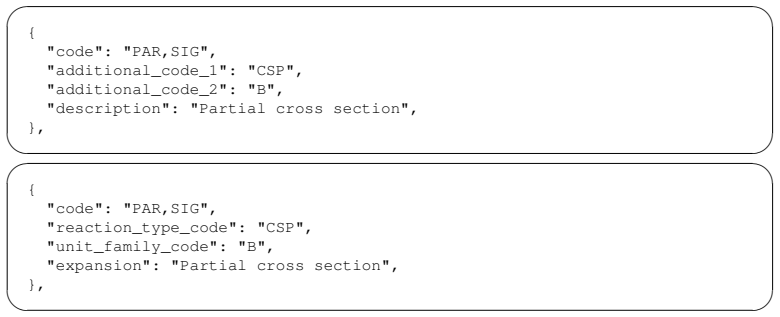
The central claim has two parts, and both are stated by the authors as accomplished facts. The first is that the J4 JSON representation carries the full logical structure of the EXFOR format: a code string such as DECAY-DATA is decomposed into keyed subfields (nuclide, half-life, radiation type, energy, intensity) defined by the EXFOR/CINDA dictionary, so that a program can read any value directly, and the conversion is reversible, with X4TOJ4 followed by J4TOX4 reproducing the original EXFOR file apart from trailing-zero formatting (preserved by the -s option) and line-counter integers that SEQADD restores. The second is scientific: using the J4-based chain to build experimental covariance matrices for the fast-neutron fission of neptunium-237 and feeding them to the SOK simultaneous least-squares evaluator produces a preliminary 237Np(n,f) cross section, evaluated between 100 keV and 200 MeV, that is systematically higher than the corresponding JENDL-5 cross section. The authors note the direction is supported by the 252Cf spontaneous-fission spectrum-averaged cross section (Mannhart's 1361 mb against JENDL-5's 1347 mb), and they explicitly label the result preliminary, pending inclusion of the newly published Vorobyev et al. ratio dataset once it enters EXFOR.
Load-bearing premise
The evaluation result rests on the covariance matrix $V$ that the evaluator builds from EXFOR partial uncertainties using correlation coefficients assigned by hand in HED files, plus the decision to rescale the Paradela ratio dataset by a fitted factor of 0.96; if those assignments or that rescaling misrepresent the data, the systematic rise over JENDL-5 is not supported.
Editorial extensions
If this is right
- J4 files distributed alongside the ForEXy codes let anyone build EXFOR-processing software without learning the 80-column EXFOR layout, because the JSON carries every logical structure of the original file.
- The switch from the Perl SOX to the Python/J4 SOX is production-safe: the experimental data vector $y$ is reproduced exactly, and differences in the covariance matrix $V$ change evaluated fission cross sections by less than 0.1‰, with the largest effect in 240Pu.
- MAKCOV turns covariance construction from EXFOR partial uncertainties into a scriptable, documented step, and doubles as a total-uncertainty calculator through the quadrature sum of the partial uncertainties.
- The preliminary SOK evaluation places the 237Np(n,f) cross section systematically above JENDL-5 across 100 keV to 200 MeV, a direction consistent with the 252Cf spectrum-averaged cross section comparison.
- The POIPOI and EXTMUL pointer-cancellation tools extract a single dataset from a multiple-reaction-formalism subentry, removing a known hurdle for programmatic users of EXFOR.
Reading between the lines
- A formal round-trip test over the entire EXFOR-2024 Master File, rather than the single-entry examples shown, would settle the losslessness claim in full generality; 'supports all logical structures' is asserted for the design, and the paper demonstrates equivalence on individual entries.
- The hand-written HED correlation coefficients are the main lever on the result: recomputing the 237Np posterior with HED correlations at their extremes (all zero versus all one) would bound how much of the systematic rise over JENDL-5 is experimental data and how much is evaluator judgment.
- The fitted 0.96 factor on the Paradela ratio is the largest single normalization judgment in the fit; the authors' own plan to add the Vorobyev et al. dataset gives a direct test, because if that addition moves the factor or erases the rise, the evaluation would need revision.
- If J4 becomes the interchange layer for the library, it would extend earlier JSON-database efforts by adding a reversible JSON Dictionary (DICA2J and DICJ2A) and pointer-cancellation tools, which those efforts did not address.
Signed reviews
Editorial analysis
A structured set of objections, weighed in public.
Referee Report
Summary. The manuscript introduces ForEXy, a Python package of seventeen utilities for the EXFOR experimental nuclear reaction database, built around a new JSON representation (J4) intended to be reversible with the EXFOR format. Core tools convert EXFOR files to J4 and back (X4TOJ4, J4TOX4), extract pointed datasets (POIPOI, EXTMUL), construct covariances from partial uncertainties (MAKCOV), manage dictionaries, and support bibliography/reference handling. The second part applies these codes to construct covariance matrices for 237Np(n,f) data in EXFOR and to perform a simultaneous SOK least-squares evaluation from 100 keV to 200 MeV, reporting a preliminary posterior that is systematically higher than JENDL-5. The paper also validates a rewritten Python version of the SOX input-generation code against the previous Perl version, showing sub-0.1‰ changes in evaluated cross sections.
Significance. If the reversibility claims hold, ForEXy is a genuinely useful open-source infrastructure for the EXFOR community, and the worked round-trip examples, pointer-extraction demonstrations, and SOX validation are concrete evidence for the software part. The independent SACS comparison (1361 mb vs 1347 mb) gives some directional support for the posterior shift. However, the evaluation's central claim currently rests on a post-hoc rescaling of the most discrepant dataset and lacks uncertainty quantification on the posterior-minus-JENDL-5 difference, so the significance of the evaluation section is conditional; the software contribution is more solid than the evaluation claim.
major comments (4)
- [Sec. 3.2, Fig. 15] The paper states that during trial fitting Paradela et al.'s 237Np(n,f)/235U(n,f) data were found to be systematically higher, so in the final fit the dataset was treated as a 'shape ratio' in arbitrary units with an overall normalization fitted to 0.96. This is a post-hoc modification of the data model for the dataset most discrepant from the prior, and no justification beyond the discrepancy itself is provided. Because y enters the posterior through Eq. (8), the fitted normalization directly affects x1, and the paper does not quantify how the posterior or the posterior-minus-JENDL-5 difference would change if the rescaling were omitted or if the normalization were allowed to vary within its uncertainty. A sensitivity test (e.g., fitting with and without the rescaling, or profiling over the normalization) is needed before the 'systematically higher' claim can be supported.
- [Sec. 3.2 and Summary] The conclusion that the newly evaluated 237Np(n,f) cross section is systematically higher than JENDL-5 is stated without any uncertainty on the posterior or on the difference from JENDL-5. Figure 14 shows prior and posterior curves but no posterior uncertainty band, and the SACS comparison (1361 mb vs 1347 mb) is quoted without the Mannhart SACS uncertainty, so the reader cannot judge whether the increase is statistically significant. The SACS benchmark is also not propagated through the uncertainty of the fitted Paradela normalization, which limits its use as independent support. Please provide a quantitative statement of the difference with its uncertainty and indicate the energy range in which the difference is significant.
- [Sec. 2.2] The design requirements state 'It is possible to reproduce the original EXFOR file from the JSON file' and 'It supports all logical structures of the EXFOR format.' The paper demonstrates reversibility with one entry (Fig. 3) and pointer extraction with one subentry (Figs. 4-7), but no systematic round-trip test over a large sample or the full library is reported. Since these two requirements are central to the software claim and distinguish J4 from simpler JSON representations, the authors should either provide a large-scale validation (e.g., round-tripping all entries of EXFOR-2024 and reporting the failure/success rate) or explicitly narrow the claim to the structures exercised in the paper.
- [Sec. 2.4 and Sec. 3.1] The covariance matrix V used in the SOK update is built from partial uncertainties with correlation coefficients C^k_ij supplied by the evaluator through HED files. The paper correctly emphasizes that V is the most important input and cites previous work showing sensitivity of fits to V (Ref. [51], Fig. 2), but no sensitivity analysis of the 237Np posterior to alternative HED assignments is given. Because the central evaluation claim depends on V, the paper should include at least a limited sensitivity study (e.g., treating a systematic uncertainty as fully correlated versus uncorrelated), or present the evaluation strictly as an illustration of the ForEXy workflow rather than as a new cross-section result.
minor comments (5)
- [Sec. 2.1] The text twice refers to the 'EXFOR Maser File'; this should be 'Master File'.
- [Throughout] Several names contain stray spaces, e.g., 'V orobyev' in Sec. 3.2 and 'V .A. Kushnir' in the discussion of Fig. 3; these should be cleaned up.
- [Fig. 14] The prior and posterior curves are difficult to distinguish; using distinct line styles or adding a posterior uncertainty band would make the comparison clearer.
- [Table 1 and Sec. 3.1] SOX is described as rewritten in Python, but it is not listed among the seventeen codes in Table 1; please clarify whether SOX is part of ForEXy or a separate program.
- [Sec. 3.2] The sentence 'It means we treated their absolute ratio in the EXFOR library as a ratio in arbitrary units...' is a run-on and would be clearer if split into two sentences.
Circularity Check
No significant circularity: the SOK update and JSON round-trip tests are self-contained, with an independent SACS benchmark.
full rationale
The derivation chain is not circular. The SOK update in Eq. (8) takes y and V as inputs, and V is built from EXFOR partial uncertainties via Eq. (2) with correlation coefficients C^k_ij supplied in HED files; these are evaluator inputs rather than outputs of the fit. The 237Np(n,f) posterior is therefore an actual least-squares output, not a restatement of JENDL-5. The Paradela normalization factor 0.96 is a fitted data-treatment parameter, disclosed as such in Sec. 3.2, and the paper does not present that factor as a prediction; while this choice deserves sensitivity testing, it is not a by-construction equivalence between input and claimed result. The 'systematically higher' conclusion is additionally benchmarked against the independent Mannhart SACS value (1361 vs 1347 mb). The J4 reversibility claim is a design requirement for X4TOJ4/J4TOX4 and is supported by a concrete round-trip example whose residual differences (trailing zeros and line counters) are explicitly acknowledged and handled by the -s flag and SEQADD; it is not derived from itself. Self-citations to prior SOK-based evaluations establish methodology but are not the load-bearing evidence for the new 237Np result.
Assumptions & free parameters
free parameters (2)
- Paradela shape-ratio normalization =
0.96
- HED correlation coefficients C^k_ij =
evaluator-assigned (e.g., ERR-S=0, ERR-1=1, ERR-2=1 in Sec. 2.4 example)
assumptions (4)
- domain assumption The EXFOR library accurately encodes the original experimental values and documented uncertainties.
- standard math Error propagation via Eq. (2), with linear sums of partial fractional covariances weighted by correlation coefficients, is adequate.
- ad hoc to paper The J4 representation supports all logical structures of the EXFOR format.
- standard math The SOK least-squares update equations (8)-(9) with linear-interpolation design matrix (5) are valid for this evaluation.
Cite this review
Pith. "Pith review of EXFOR utility codes (ForEXy) and their application to neutron fission cross section evaluation." pith.science (2026). https://pith.science/paper/GHLYELH6
@misc{pith2026250503758,
  author       = {Pith},
  title        = {Pith review of: EXFOR utility codes (ForEXy) and their application to neutron fission cross section evaluation},
  year         = {2026},
  howpublished = {\url{https://pith.science/paper/GHLYELH6}},
  note         = {Machine review of arXiv:2505.03758}
}
read the original abstract
We developed a set of EXFOR utility codes (ForEXy) to process the information of the experimental nuclear reaction data stored in the EXFOR library. We designed a new JSON format (J4) for the EXFOR library, and developed a code converting the information in an EXFOR file to a J4 file (X4TOJ4) and another code converting it to an EXFOR file (J4TOX4) as a core part of this new code package. We also developed some other codes for managements of the EXFOR storage, bibliography and dictionary. As an application of the new code package, we constructed covariance matrices for the fast neutron induced fission cross sections of neptunium-237 in the EXFOR library by using the new codes, and applied them to evaluation of the cross section between 100 keV and 200 MeV.
Figures


Figures from the paper (12 more)




Reference graph
Works this paper leans on
- [51]
-
[1]
Otuka, E
N. Otuka, E. Dupont, V . Semkova, B. Pritychenko, A. I. Blokhin, M. Aikawa, S. Babykina, M. Bossant, G. Chen, S. Dunaeva, R. A. Forrest, T. Fukahori, N. Furutachi, S. Ganesan, Z. Ge, O. O. Gritzay, M. Herman, S. Hlava ˇc, K. Kat ¯o, B. Lalremruata, Y . Lee, A. Makinaga, K. Matsumoto, M. Mikhaylyukova, G. Pikulina, V . Pronyaev, A. Saxena, O. Schwerer, S. ...
2014
-
[2]
Lorenz, Report of the fifth Four-Centre meeting, Technical Report INDC(NDU)-16, International Atomic En- ergy Agency, 1969
A. Lorenz, Report of the fifth Four-Centre meeting, Technical Report INDC(NDU)-16, International Atomic En- ergy Agency, 1969
1969
-
[3]
Otuka, International Network of Nuclear Reaction Data Centres, Technical Report INDC(NDS)-0401 Rev
N. Otuka, International Network of Nuclear Reaction Data Centres, Technical Report INDC(NDS)-0401 Rev. 6, International Atomic Energy Agency, 2014. doi:10.61092/iaea.vhn8-z64d
-
[4]
D. Brown, ENDF-6 formats manual - Data formats and procedures for the Evaluated Nuclear Data Files ENDF/B- VI, ENDF/B-VII and ENDF/B-VIII, Technical Report BNL-224854-2023-INRE, Brookhaven National Laboratory,
2023
-
[5]
J. K. Tuli, Evaluated Nuclear Structure Data File, Technical Report BNL-NCS-51655-01/02-Rev, Brookhaven National Laboratory, 2001
2001
-
[7]
N. Soppera, M. Bossant, E. Dupont, JANIS 4: An improved version of the NEA Java-based nuclear data informa- tion system, Nuclear Data Sheets 120 (2014) 294–296. doi: 10.1016/j.nds.2014.07.071
-
[8]
N. Otuka, H. Noto, A. Ohnishi, K. Kato, Development of web editor for charged-particle nuclear reaction data, Technical Report INDC(NDS)-434, International Atomic Energy Agency, 2002. doi: 10.61092/iaea. q5hj-3t22, pages 144–145
doi:10.61092/iaea 2002
Show all 87 references
-
[9]
V . V . Zerkin, B. Pritychenko, The experimental nuclear reaction data (EXFOR): Extended computer database and web retrieval system, Nuclear Instruments and Methods in Physics Research Section A: Accelerators, Spectrome- ters, Detectors and Associated Equipment 888 (2018) 31–4...
2018 doi
-
[10]
D. E. Cullen, A. Trkov, Program X4TOC4, Technical Report IAEA-NDS-80 Rev. 1, International Atomic Energy Agency, 2001
2001
-
[11]
I. C. Vickridge, Update to the R33 cross section file format, Technical Report INDC(NDS)-449, International Atomic Energy Agency, 2020
2020
-
[13]
Schnabel, A computational EXFOR database, EPJ Web of Conferences 239 (2020) 16001
G. Schnabel, A computational EXFOR database, EPJ Web of Conferences 239 (2020) 16001. doi: 10.1051/ epjconf/202023916001
2020
-
[15]
Otuka, D
N. Otuka, D. Brown, Summary report of the Technical Meeting on International Network of Nuclear Reaction Data Centres, Technical Report INDC(NDS)-0879, International Atomic Energy Agency, 2023. doi:10.61092/ iaea.cz5x-44vw. 29
2023
-
[16]
Accessed: 15 January 2025
International Network of Nuclear Reaction Data Centres, NRDC Software, https://nds.iaea.org/nrdc/ nrdc_sft/, 2024. Accessed: 15 January 2025
2024
-
[17]
Otuka, ForEXy: Utility codes for EXFOR Library, Technical Report IAEA-NDS-244 Rev
N. Otuka, ForEXy: Utility codes for EXFOR Library, Technical Report IAEA-NDS-244 Rev. 2025/04, Interna- tional Atomic Energy Agency, 2025. doi:10.61092/iaea.hz1z-0dx3
2025 doi
-
[18]
Accessed: 2 April 2025
Otsuka, N, ForEXy, https://pypi.org/project/forexy/, 2025. Accessed: 2 April 2025
2025
-
[19]
Schwerer, Report on the IAEA Technical Meeting on the Network of Nuclear Reaction Data Centres, Technical Report INDC(NDS)-0480, International Atomic Energy Agency, 2006
O. Schwerer, Report on the IAEA Technical Meeting on the Network of Nuclear Reaction Data Centres, Technical Report INDC(NDS)-0480, International Atomic Energy Agency, 2006
2006
-
[20]
Accessed: 15 January 2025
International Network of Nuclear Reaction Data Centres, EXFOR Master Files, https://nds.iaea.org/ nrdc/exfor-master/, 2024. Accessed: 15 January 2025
2024
-
[21]
2024 (EXFOR-2024),https: //nds.iaea.org/nrdc/exfor-master/exfor-2024/ , 2024
International Network of Nuclear Reaction Data Centres, EXFOR Master Files Ver. 2024 (EXFOR-2024),https: //nds.iaea.org/nrdc/exfor-master/exfor-2024/ , 2024. doi: 10.61092/iaea.fk6r-3ypa, accessed: 15 January 2025
2024 doi
-
[22]
Otuka, B
N. Otuka, B. Pritychenko, Summary report of the Technical Meeting on International Network of Nuclear Reaction Data Centres, Technical Report INDC(NDS)-0902, International Atomic Energy Agency, 2024. doi:10.61092/ iaea.sna5-q9ym
2024
-
[23]
Otuka, EXFOR formats manual, Technical Report IAEA-NDS-207, Rev
N. Otuka, EXFOR formats manual, Technical Report IAEA-NDS-207, Rev. 2022/06, International Atomic Energy Agency, 2022. doi:10.61092/iaea.w0kj-60vr
2022 doi
-
[24]
Accessed: 15 January 2025
International Network of Nuclear Reaction Data Centres, EXFOR Trans Files, https://nds.iaea.org/ nrdc/exfor-master/trans/, 2024. Accessed: 15 January 2025
2024
-
[25]
Accessed: 15 January 2025
International Network of Nuclear Reaction Data Centres, EXFOR Entry Files, https://nds.iaea.org/ nrdc/exfor-master/entry/, 2024. Accessed: 15 January 2025
2024
-
[26]
Otuka, EXFOR/CINDA dictionary manual, Technical Report IAEA-NDS-213 Rev
N. Otuka, EXFOR/CINDA dictionary manual, Technical Report IAEA-NDS-213 Rev. 2023/05, International Atomic Energy Agency, 2023. doi:10.61092/iaea.0xem-7w17
2023 doi
-
[27]
Takács, A
S. Takács, A. Hermanne, F. Ditrói, F. Tárkányi, M. Aikawa, Reexamination of cross sections of the 100Mo(p,2n)99mTc reaction, Nuclear Instruments and Methods in Physics Research Section B: Beam Interactions with Materials and Atoms 347 (2015) 26–38. doi:10.1016/j.nimb.2015.01.056
2015 doi
-
[28]
Accessed: 15 January 2025
International Network of Nuclear Reaction Data Centres, EXFOR J4 Files, https://nds.iaea.org/nrdc/ exfor-master/j4/, 2024. Accessed: 15 January 2025
2024
-
[29]
I. S. Timchenko, O. S. Deiev, S. M. Olejnik, S. M. Potin, V . A. Kushnir, V . V . Mytrochenko, S. A. Perezhogin, Cross-sections of photoneutron reaction natMo(γ,xn)93mMo at the bremsstrahlung energy up to 95 MeV, Problems of Atomic Science and Technology (2024) 15–22. doi:10.4...
2024 doi
-
[30]
Michalopoulou, M
V . Michalopoulou, M. Axiotis, S. Chasapoglou, Z. Eleme, G. Gkatis, A. Kalamara, M. Kokkoris, A. Lagoyannis, N. Patronis, A. Stamatopoulos, A. Tsantiri, R. Vlastou, Measurement of the 232Th(n,f) cross section with quasi- monoenergetic neutron beams in the energy range 2–18 MeV...
2021 doi
-
[31]
Hermanne, A
A. Hermanne, A. V . Ignatyuk, R. Capote, B. V . Carlson, J. W. Engle, M. A. Kellett, T. Kibédi, G. Kim, F. G. Kondev, M. Hussain, O. Lebeda, A. Luca, Y . Nagai, H. Naik, A. L. Nichols, F. M. Nortier, S. V . Suryanarayana, S. Takács, F. T. Tárkányi, M. Verpelli, Reference cross...
2018 doi
-
[32]
Mannhart, A small guide to generating covariances of experimental data, Technical Report INDC(NDS)-0588 Rev., International Atomic Energy Agency, 2013
W. Mannhart, A small guide to generating covariances of experimental data, Technical Report INDC(NDS)-0588 Rev., International Atomic Energy Agency, 2013. doi:10.61092/iaea.tkjg-v3e4
2013 doi
-
[33]
D. L. Smith, N. Otuka, Experimental nuclear reaction data uncertainties: Basic concepts and documentation, Nuclear Data Sheets 113 (2012) 3006–3053. doi:10.1016/j.nds.2012.11.004
2012 doi
-
[34]
Becker, C
B. Becker, C. Bastian, F. Emiliani, F. Gunsing, J. Heyse, K. Kauwenberghs, S. Kopecky, C. Lampoudis, C. Massimi, N. Otuka, P. Schillebeeckx, I. Sirakov, Data reduction and uncertainty propagation of time-of-flight spectra with AGS, Journal of Instrumentation 7 (2012) P11002. d...
2012 doi
-
[35]
Otuka, B
N. Otuka, B. Lalremruata, M. U. Khandaker, A. R. Usman, L. R. M. Punte, Uncertainty propagation in acti- vation cross section measurements, Radiation Physics and Chemistry 140 (2017) 502–510. doi: 10.1016/j. radphyschem.2017.01.013
2017 doi
-
[36]
Neudecker, A
D. Neudecker, A. M. Lewis, E. F. Matthews, J. Vanhoy, R. C. Haight, D. L. Smith, P. Talou, S. Croft, A. D. Carlson, B. Pierson, A. Wallner, A. Al-Adili, L. Bernstein, R. Capote, M. Devlin, M. Drosg, D. L. Duke, S. Finch, M. W. Herman, K. J. Kelly, A. Koning, A. E. Lovell, P. M...
2023
-
[38]
Zerkin, Web tool for constructing a covariance matrix from EXFOR uncertainties, EPJ Web of Conferences 27 (2012) 00009
V . Zerkin, Web tool for constructing a covariance matrix from EXFOR uncertainties, EPJ Web of Conferences 27 (2012) 00009. doi:10.1051/epjconf/20122700009. 30
2012
-
[39]
Sage, Mesures des sections efficaces totale et (n,2n) sur 241Am, Technical Report INDC(FR)-73, International Atomic Energy Agency, 2017
C. Sage, Mesures des sections efficaces totale et (n,2n) sur 241Am, Technical Report INDC(FR)-73, International Atomic Energy Agency, 2017
2017
-
[40]
O. A. Wasson, M. M. Meier, K. C. Duvall, Absolute measurement of the uranium-235 fission cross section from 0.2 to 1.2 MeV, Nuclear Science and Engineering 81 (1982) 196–212. doi: 10.13182/NSE82-A20085
1982 doi
-
[41]
Pritychenko, E
B. Pritychenko, E. B ˇeták, M. A. Kellett, B. Singh, J. Totans, The Nuclear Science References (NSR) database and web retrieval system, Nuclear Instruments and Methods in Physics Research Section A: Accelerators, Spectrome- ters, Detectors and Associated Equipment 640 (2011) 2...
2011 doi
-
[42]
Arakatsu, M
B. Arakatsu, M. Sonoda, Y . Uemura, S. Yasumi, Y . Saji, The photo-disintegration of Be by the high energyγ-rays, Journal of the Physical Society of Japan 6 (1951) 66–67. doi:10.1143/JPSJ.6.66
1951 doi
-
[43]
Kroesbergen, T
W. Kroesbergen, T. Koopman, Harpsichord building in Holland, Early Music 4 (1976) 439–442. doi: 10.1093/ earlyj/4.4.439
1976
-
[44]
Gyürky, Z
G. Gyürky, Z. Fülöp, Z. Halász, G. G. Kiss, T. Szücs, Nuclear physics uncertainties of the astrophysical γ-process studied through the 64Zn(p,α)61Cu an 64Zn(p,γ)65Ga reactions, Journal of Physics: Conference Series 940 (2018) 012005. doi:10.1088/1742-6596/940/1/012005
2018 doi
-
[45]
F. G. Kondev, M. Wang, W. J. Huang, S. Naimi, G. Audi, The NUBASE2020 evaluation of nuclear physics properties, Chinese Physics C 45 (2021) 030001. doi: 10.1088/1674-1137/abddae
2021 doi
-
[46]
Hauser, H
W. Hauser, H. Feshbach, The inelastic scattering of neutrons, Physical Review 87 (1952) 366–373. doi:10.1103/ PhysRev.87.366
1952
-
[48]
Kawano, H
T. Kawano, H. Matsunobu, T. Murata, A. Zukeran, Y . Nakajima, M. Kawai, O. Iwamoto, K. Shibata, T. Naka- gawa, T. Ohsawa, M. Baba, T. Yoshida, Simultaneous evaluation of fission cross sections of uranium and pluto- nium isotopes for JENDL-3.3, Journal of Nuclear Science and Te...
2000
-
[49]
W. P. Poenitz, S. E. Aumeier, The simultaneous evaluation of the standards and other cross sections of importance for technology, Technical Report ANL/NDM-139, Argonne National Laboratory, 1997
1997
-
[50]
V . Devi, N. Otuka, S. Ganesan, EXFOR-based simultaneous evaluation for fast neutron-induced fission cross section of thorium-232, Journal of Nuclear Science and Technology 61 (2024) 44–56. doi:10.1080/00223131. 2023.2256715
2024
-
[52]
Okuyama, N
R. Okuyama, N. Otuka, G. Chiba, O. Iwamoto, EXFOR-based simultaneous evaluation for neutron-induced fission cross section of plutonium-242, Journal of Nuclear Science and Technology 61 (2024) 57–67. doi: 10.1080/ 00223131.2023.2267070
2024
-
[53]
Otuka, K
N. Otuka, K. Tada, O. Cabellos, O. Iwamoto, Evaluation of uranium-233 neutron capture cross section in keV region, Annals of Nuclear Energy 212 (2025) 110977. doi:10.1016/j.anucene.2024.110977
2025
-
[54]
Otuka, O
N. Otuka, O. Iwamoto, Simultaneous evaluation of uranium and plutonium fast neutron fission cross sections up to 200 MeV for JENDL-5 and its updates, EPJ Web of Conferences 284 (2023) 08011. doi: 10.1051/epjconf/ 202328408011
2023 doi
-
[55]
Hirtz, J.-C
J. Hirtz, J.-C. David, J. Cugnon, I. Leya, J. L. Rodríguez-Sánchez, G. Schnabel, Parameter optimisation using Bayesian inference for spallation models, The European Physical Journal A 60 (2024) 149. doi:10.1140/epja/ s10050-024-01370-y
2024 doi
-
[56]
A. D. Carlson, V . G. Pronyaev, R. Capote, G. M. Hale, Z.-P. Chen, I. Duran, F.-J. Hambsch, S. Kunieda, W. Mannhart, B. Marcinkevicius, R. O. Nelson, D. Neudecker, G. Noguere, M. Paris, S. P. Simakov, P. Schille- beeckx, D. L. Smith, X. Tao, A. Trkov, A. Wallner, W. Wang, Eval...
2018 doi
-
[57]
S. Cierjacks, 237Np and 238U as possible standards for the MeV region, in: Proceedings of the NBS International Specialists Symposium on Neutron Standards and Applications, Gaithersburg, MD, USA, 28–31 March 1977, NBS Special Publication 493, 1977, pp. 278–289
1977
-
[58]
Otuka, O
N. Otuka, O. Iwamoto, EXFOR-based simultaneous evaluation of neutron-induced uranium and plutonium fission cross sections for JENDL-5: Inputs and outputs, Technical Report JAEA-Data/Code 2022-005, Japan Atomic Energy Agency, 2022. doi:10.11484/jaea-data-code-2022-005
2022 doi
-
[59]
J. W. Behrens, R. S. Newbury, J. W. Magana, Measurements of the neutron-induced fission cross sections of240Pu, 242Pu, and 244Pu relative to 235U from 0.1 to 30 MeV, Nuclear Science and Engineering 66 (1978) 433–441. doi:10.13182/NSE78-A27227. 31
1978 doi
-
[60]
Shibata, O
K. Shibata, O. Iwamoto, T. Nakagawa, N. Iwamoto, A. Ichihara, S. Kunieda, S. Chiba, K. Furutaka, N. Otuka, T. Ohsawa, T. Murata, H. Matsunobu, A. Zukeran, S. Kamada, J. Katakura, JENDL-4.0: A new library for nuclear science and engineering, Journal of Nuclear Science and Techn...
2011
-
[61]
Shcherbakov, A
O. Shcherbakov, A. Donets, A. Evdokimov, A. Fomichev, T. Fukahori, A. Hasegawa, A. Laptev, V . Maslov, G. Petrov, S. Soloviev, Y . Tuboltsev, A. V orobyev, Neutron-induced fission of 233U, 238U , 232Th , 239Pu, 237Np, natPb and 209Bi relative to 235U in the energy range 1-200 ...
2002
-
[62]
Paradela, L
C. Paradela, L. Tassan-Got, L. Audouin, B. Berthier, I. Duran, L. Ferrant, S. Isaev, C. Le Naour, C. Stephan, D. Tarrío, D. Trubert, U. Abbondanno, G. Aerts, H. Álvarez, F. Álvarez-Velarde, S. Andriamonje, J. Andrzejewski, P. Assimakopoulos, G. Badurek, P. Baumann, F. Be ˇcváˇ...
2010
-
[63]
Mannhart, Response of activation reactions in the neutron field of californium-252 spontaneous fission, Techni- cal Report STI/DOC/010/452, International Atomic Energy Agency, 2006
W. Mannhart, Response of activation reactions in the neutron field of californium-252 spontaneous fission, Techni- cal Report STI/DOC/010/452, International Atomic Energy Agency, 2006
2006
-
[64]
A. S. V orobyev, A. M. Gagarski, O. A. Shcherbakov, L. A. Vaishnene, A. M. Tyagelskaya, N. M. Olkhovich, A. L. Barabanov, Measurement of the cross section for the neutron-induced fission of 237Np nuclei in the energy range of 0.3–500 MeV, JETP Letters 120 (2024) 373–380. doi: ...
2024 doi
-
[65]
Salvador-Castiñeira, F.-J
P. Salvador-Castiñeira, F.-J. Hambsch, A. Göök, M. Vidali, N. P. Hawkes, N. J. Roberts, G. C. Taylor, D. J. Thomas, Absolute and relative cross section measurements of 237Np(n,f) and 238U(n,f) at the National Physical Laboratory, EPJ Web of Conferences 146 (2017) 04050. doi:10...
2017
-
[66]
Diakaki, M
M. Diakaki, M. Kokkoris, A. Kyrtsos, E. Skordis, C. T. Papadopoulos, R. Vlastou, A. Lagoyannis, S. Andria- monje, Determination of the 237Np(n,f) reaction cross section for En = 4.5-5.3 MeV, using a MicroMegas detector assembly, The European Physical Journal A 49 (2013) 62. do...
2013 doi
-
[67]
Merla, P
K. Merla, P. Hausch, C. M. Herbach, G. Musiol, G. Pausch, U. Todt, L. V . Drapchinskiy, V . A. Kalinin, V . I. Shpakov, Absolute measurement of neutron induced fission cross-sections of 235U, 238U, 237Np and 239Pu, in: Proceedings of the International Conference on Nuclear Dat...
1991 doi
-
[68]
V . A. Kalinin, S. S. Kovalenko, V . N. Kyz’min, Y . A. Nemilov, L. M. Solin, V . I. Shpakov, Absolute measurements of the 237Np and 233U fission cross-sections at 1.9 MeV neutron energy using the time-correlated associated particle method and a magnetic analyzer, Technical Re...
1987
-
[69]
K. Gul, M. Ahmad, M. Anwar, S. M. Saleem, Measurements of neutron fission cross sections of 237Np, 240Pu, 241Pu, 242Pu, 244Pu, and 241Am at 14.7 MeV, Nuclear Science and Engineering 94 (1986) 42–45. doi:10.13182/ NSE86-A17115
1986
-
[70]
K. R. Zasadny, H. M. Agrawal, M. Mahdavi, G. F. Knoll, Measurement of the 14-MeV fission cross sections for 233U and 237Np, Transactions of the American Nuclear Society 47 (1984) 425–427
1984
-
[71]
J. Wu, C. Rong, Z. Sun, J. Li, Z. Ye, X. Deng, Measurement of fission cross section for 237Np induced by fast neutron, Chinese Journal of Nuclear Physics 6 (1984) 369–372
1984
-
[72]
V . N. Dushin, A. V . Fomichev, S. S. Kovalenko, K. A. Petrzhak, V . I. Shpakov, R. Arl’t, M. Iosh, G. Muziol’, K.-G. Ortlepp, V . Vagner, Statistical analysis of experimental data on the cross sections of 233,235,238U, 237Np, 239,242Pu fission by neutrons of energy 2.6, 8.5, ...
1983
-
[73]
Cancé, G
M. Cancé, G. Grenier, Mesures absolues de 240Pu(n,f), 242Pu(n,f) et 237Np(n,f) a l’energie incident de 2,5 MeV, in: Nuclear Data for Science and Technology, Proceedings of the International Conference, Antwerp 6–10 September 1982, EUR 8355, Central Bureau for Nuclear Measureme...
1982
-
[74]
Kobayashi, I
K. Kobayashi, I. Kimura, H. Gotoh, H. Yagi, Measurement of the cross section for the 237Np(n,f) reaction, Annual Reports of the Research Reactor Institute, Kyoto University 6 (1973) 1–9. 32
1973
-
[75]
Diakaki, D
M. Diakaki, D. Karadimos, R. Vlastou, M. Kokkoris, P. Demetriou, E. Skordis, A. Tsinganis, U. Abbondanno, G. Aerts, H. Álvarez, F. Alvarez-Velarde, S. Andriamonje, J. Andrzejewski, P. Assimakopoulos, L. Audouin, G. Badurek, P. Baumann, F. Beˇcváˇr, E. Berthoumieux, M. Calviani...
2016
-
[76]
Tovesson, T
F. Tovesson, T. S. Hill, Subthreshold fission cross section of 237Np, Nuclear Science and Engineering 159 (2008) 94–101. doi:10.13182/NSE07-55
2008 doi
-
[77]
Desdin, S
L. Desdin, S. Szegedi, J. Csikai, Measurement of the fission cross-section ratio for 237Np/235U around 14 MeV neutron energies, Acta Physica Hungarica 65 (1989) 271–275. doi:10.1007/BF03156072
1989 doi
-
[78]
J. Meadows, The fission cross sections of 230Th, 232Th, 233U, 234U, 236U, 238U, 237Np, 239Pu and 242Pu rel- ative to 235U at 14.74 MeV neutron energy, Annals of Nuclear Energy 15 (1988) 421–429. doi: 10.1016/ 0306-4549(88)90038-2
1988
-
[79]
A. A. Goverdovskij, A. K. Gordyushin, B. D. Kuz’minov, V . F. Mitrofanov, A. I. Sergachev, S. M. Solov’ev, P. S. Soloshenkov, Measurement of the 237Np and 235U fission cross-section ratio by the isotopic dilution method, Technical Report INDC(CCP)-281, International Atomic Ene...
1988
-
[80]
A. A. Goverdovskii, A. K. Gordyushin, B. D. Kuz’minov, V . F. Mitrofanov, A. I. Sergachev, S. M. Solov’ev, G. M. Stepchenkova, Measurement of the ratio of the cross sections for fissioning of 237Np and 235U by neutrons with energies in the range 4-11 MeV, Soviet Atomic Energy ...
1985 doi
-
[81]
Garlea, C
I. Garlea, C. Miron, D. Dobrea, C. Roth, T. Mu¸ sat, H. N. Ro¸ su, Measuring of the integral cross sections at 14 MeV, for reactions 115In(n,n’), 197Au(n,2n), 93Nb(n,2n), 27Al(n,α), 56Fe(n,p), 239Pu(n,f), 238U(n,f), 232Th(n,f) and 237Np(n,f), Revue Roumaine de Physique 29 (198...
1984
-
[82]
J. W. Meadows, The fission cross section of 237Np relative to 235U from 0.1 to 9.4 MeV, Nuclear Science and Engineering 85 (1983) 271–279. doi:10.13182/NSE83-A17319
1983 doi
-
[83]
J. W. Behrens, J. C. Browne, J. C. Walden, Measurement of the neutron-induced fission cross section of neptunium- 237 relative to uranium-235 from 20 keV to 30 MeV, Nuclear Science and Engineering 80 (1982) 393–400. doi:10.13182/NSE82-A19824
1982 doi
-
[84]
K. Way, C. F. Barnett, L. J. Kieffer, Foreword, Atomic Data 1 (1969) i–ii. doi: 10.1016/S0092-640X(69) 80018-5
1969 doi
-
[85]
Zerkin, X4Pro – Universal, fully relational EXFOR database, EPJ Web of Conferences 284 (2023) 14015
V . Zerkin, X4Pro – Universal, fully relational EXFOR database, EPJ Web of Conferences 284 (2023) 14015. doi:10.1051/epjconf/202328414015
2023
-
[86]
Takibayev, N
N. Takibayev, N. Otsuka, N. Kenzhebayev, Proceedings of the Fourth Asian Nuclear Reaction Database Develop- ment Workshop, Technical Report INDC(KAS)-0001, International Atomic Energy Agency, 2014
2014
-
[87]
Saxena, Proceedings of the Fifth AASPP Workshop on Asian Nuclear Reaction Database Development, Tech- nical Report INDC(IND)-0048, International Atomic Energy Agency, 2015
A. Saxena, Proceedings of the Fifth AASPP Workshop on Asian Nuclear Reaction Database Development, Tech- nical Report INDC(IND)-0048, International Atomic Energy Agency, 2015
2015
-
[88]
Sarsembayeva, B
A. Sarsembayeva, B. Zhou, N. Otuka, Proceedings of the Sixth AASPP Workshop on Asian Nuclear Reaction Database Development, Technical Report INDC(JPN)-0200, International Atomic Energy Agency, 2015
2015
-
[89]
G. C. Chen, N. Otuka, Proceedings of the Seventh AASPP Workshop on Asian Nuclear Reaction Database Devel- opment, Technical Report INDC(CPR)-062, International Atomic Energy Agency, 2017
2017
-
[90]
Odsuren, G
M. Odsuren, G. Khuukhenkhuu, S. Davaa, N. Otuka, Proceedings of the Eighth AASPP Workshop on Asian Nu- clear Reaction Database Development, Technical Report INDC(MGL)-0001, International Atomic Energy Agency, 2018
2018
-
[91]
S. C. Yang, N. Otuka, Proceedings of the Ninth AASPP Workshop on Asian Nuclear Reaction Database Develop- ment, Technical Report INDC(KOR)-006, International Atomic Energy Agency, 2019
2019
-
[92]
Zholdybayev, N
T. Zholdybayev, N. Otuka, Proceedings of the Tenth AASPP Workshop on Asian Nuclear Reaction Database De- velopment, Technical Report INDC(KAS)-0002, International Atomic Energy Agency, 2019. 33
2019
Reviewed August 16, 2026 · model on record in the stance chip above.
Discussion (0). Continue with ORCID to comment.