REVIEW 3 major objections 5 minor 72 references
Merging and Disentangling Views in Visual Reinforcement Learning for Robotic Manipulation
T0 review · 3 major / 5 minor · reviewed 2026-08-15 · deepseek-v4-flash
Pith's one-line read MAD trains multi-view policies that keep working when a camera goes missing.
desk verdict Solid empirical multi-view RL paper; the merging-plus-feature-augmentation combo is new and the evaluation is broad, but the headline margins rest on an alpha tuned on the same tasks, so treat them as conditional. read the letter →
The pith
A machine-rendered reading of the paper's core claim, the machinery that carries it, and where it could break.
The reading
What carries the argument
The mechanism is feature-level data augmentation built on feature summation. Each view $o_t^i$ is encoded by a shared CNN into $V_t^i$, and summation produces the merged representation $M_t = \sum_i V_t^i$, which keeps the feature dimension identical for one or many views and preserves a signal of how many views contributed. The SADA stabilization recipe is then reused: in both actor and critic updates, targets are predicted only from the unaugmented merged stream $M_t$, while online predictions also see each single-view feature $V_t^i$ as an augmentation, and the two objectives are combined with hyperparameter $\alpha$. This lets the downstream networks learn from both the merged state and every individual view without the unstable multi-state training that the paper's naive-both ablation exhibits.
What would settle it
Run the MAD versus MAD-Naive-Both comparison from Figure 5 on all 20 tasks with a full hyperparameter sweep of $\alpha$ and the same seed budget; if a tuned naive-both baseline reaches MAD's success on both merged and singular views, then the SADA-style target separation is not what carries the claimed robustness, and the central mechanism would be unsupported.
Extended reading notes
Core claim
MAD's central claim is that merging and disentangling are complementary: training on the summed multi-view feature $M_t = \sum_{i=1}^n V_t^i$ while regularizing the actor and critic with each single-view feature $V_t^i$ as a feature-level augmentation yields both higher sample efficiency and robustness to camera loss. The loss follows the SADA recipe, with learning targets computed only from the unaugmented merged stream while online Q-values and policy actions are also computed from each single-view stream, balanced by an $\alpha$ weighting set to $0.8$. On 15 Meta-World and 5 ManiSkill3 tasks, the paper reports higher average success rates than MVD, VIB, MV-MWM, and single-camera DrQ across all-camera and singular-view evaluations, with the largest margins on the third-person views.
Load-bearing premise
The method assumes that the stabilization recipe designed for image-level augmentation also works when the augmented inputs are single-view feature vectors and the unaugmented input is their sum; if that transfer fails, the training degenerates into the unstable naive-both variant that the paper's own ablation reports.
Editorial extensions
If this is right
- A single MAD training run yields a policy deployable with any one camera, so the camera array can be simplified at deployment time without retraining or added parameters.
- MAD does not depend on any particular view: in the occlusion experiment it keeps solving ManiSkill3 tasks when two cameras are pointed at uninformative scenes and only one view is useful.
- The same merge-and-augment structure transfers across modalities: an RGBD-trained MAD policy can be evaluated with RGB-only or depth-only inputs, and its depth-only success rate exceeds a depth-only DrQ baseline.
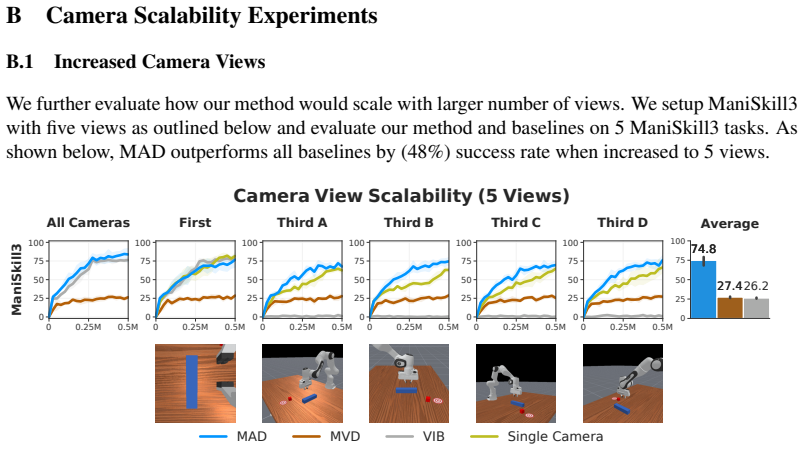
- The gains persist with more cameras: on five views in ManiSkill3, MAD's average success rate is above all baselines, and mixing different input resolutions costs little when images are resized to a common size.
Reading between the lines
- The paper leaves implicit that the recipe may generalize beyond cameras: any set of complementary features (modalities, proprioceptive channels, or subgoal encodings) could be summed and then re-fed individually as augmentations, turning MAD into a generic sensor-dropout training scheme.
- Because feature summation preserves the magnitude of the summed features, the critic may implicitly learn to count the number of active views; testing whether value estimates shift with the number of summed features could reveal the mechanism behind the graceful degradation.
- The authors note the absence of real-robot validation; a natural next test is sim-to-real transfer with one physical camera disabled, which would show whether the robustness survives calibration shifts and image noise.
- The fixed $\alpha=0.8$ suggests the merged stream should dominate but not exclude single views; a task-dependent or adaptive $\alpha$ could improve robustness further on tasks where one view is much more informative than others.
Signed reviews
Editorial analysis
A structured set of objections, weighed in public.
Referee Report
Summary. The paper proposes MAD (Merge And Disentangle), a modification of the DrQ visual RL algorithm for multi-camera robotic manipulation. Each camera view is encoded by a shared CNN and the resulting features are summed into a merged representation; the actor and critic are trained on the merged representation as an unaugmented stream and on each single-view feature as a feature-level augmentation, following the SADA recipe with an additional weighting hyperparameter alpha. The method is evaluated on 15 Meta-World and 5 ManiSkill3 tasks against MVD, VIB, MV-MWM, and Single Camera DrQ, with the central claim that MAD increases sample efficiency while remaining robust to reductions in input camera views. The paper also reports component ablations, alpha ablations, comparisons of merging methods, occlusion experiments, modality experiments, and scalability experiments with five views and mixed input resolutions.
Significance. If the reported results hold, MAD is a simple and lightweight contribution to multi-view visual RL: it needs no auxiliary losses, no additional learnable parameters, no ordered views, and no extra forward passes, while simultaneously improving sample efficiency and robustness to missing views. The empirical breadth is a genuine strength: 20 tasks, 5 seeds, 95% confidence intervals, component ablations, merge-method comparisons, occlusion and modality experiments, and an extended five-view experiment. The main result is also externally benchmarked against strong published baselines rather than only against self-derived variants. The central risks are the undisclosed alpha tuning protocol and the fact that the SADA stabilization recipe is imported from prior work without an ablation that isolates it from the alpha weighting; both are addressable within the manuscript's scope. The absence of real-robot validation is explicitly acknowledged in Section 6 and is not, by itself, a blocker for the stated simulation-based claims.
major comments (3)
- [Section 4.3, Eq. (1)-(2), Table 1, Figure 5] The choice alpha=0.8 is load-bearing, but the tuning protocol is not reported. Section 4.3 states only 'after tuning alpha', Table 1 fixes alpha=0.8, and Figure 5 (bottom) shows that alpha=0.5 and alpha=1.0 both average around 26% success on the 5 Meta-World hard tasks while alpha=0.8 reaches 56%. Since the alpha ablation in Appendix D.2 and the headline Meta-World results in Figure 4 both include the same 5 hard tasks (Assembly, Hand Insert, Pick Out of Hole, Pick Place, Push), selection of alpha on those tasks would make the Figure 4 averages partially selected on the evaluation set. Please disclose the search range, the number of seeds used for selection, the selection criterion, and ideally tune alpha on a separate task split or report sensitivity curves for all 15 tasks; the ManiSkill3 transfer of alpha=0.8 is suggestive but does not remove this concern.
- [Section 4.3, Eq. (1)-(2), Figure 5 (top)] The ablation labeled 'MAD - Naive Both' does not isolate the SADA stabilization recipe from the alpha reweighting. MAD uses the SADA-structured losses with alpha=0.8, while 'MAD - Naive Both' is described only as training on merged and singular view features 'without using the MAD loss formulations'; no alpha-weighted version of the naive objective is reported. As a result, the comparison cannot distinguish whether the stability comes from the SADA target-selection structure (targets predicted from the unaugmented stream) or simply from the high weight on the unaugmented merged-view loss. Because the paper's central assumption is that the SADA recipe transfers from image-level augmentation to feature-level augmentation, please add an ablation that applies the same alpha weighting to a naive merged-plus-singular objective, or otherwise support the attribution of stability to the SADA recipe.
- [Section 5, Baselines; Appendix A.2] Baseline implementations are not specified in enough detail to verify the central comparison. The text says MVD, VIB, and Single Camera DrQ are reimplemented on top of the authors' DrQ baseline, and that MV-MWM is kept as a model-based baseline and 'tuned accordingly', but no hyperparameters, architecture details, loss weights, or training budgets are provided for these reimplementations. In addition, Section 5 says MV-MWM is trained 'without any expert demonstrations for a fair comparison', while Appendix A.2 says the MV-MWM baseline was kept as its model-based baseline; this should be clarified. Please provide full baseline configurations or a code release, because the reported 30% and 36% improvements over baselines are the paper's main empirical claim.
minor comments (5)
- [Section 3 and Eq. (2)] The statement 'Qθ represents an exponential moving average of the weights from Qθ' is self-contradictory; please introduce explicit target-network notation (for example, Q-bar) and use it consistently in the critic target in Eq. (2).
- [Section 3 and Section 4.3] The symbol alpha is used both for the SAC entropy temperature and for the MAD loss weight; this overloads the notation in Eq. (1)-(2) and Table 1. Please rename one of the two hyperparameters.
- [Section 4.1] The sentence 'Feature summation preserves the magnitude of different view features, such that the downstream actor and critic have a signal of how many views are inputted' is unclear, because summation makes the feature magnitude grow with the number of views rather than preserving a fixed magnitude. Please clarify the intended property.
- [Section 5 and Appendix A.1] The observation shape is described as '(3×R(3×84×84))' in Section 5 but as 'Image Size (3, 84, 84)' in Table 1; please make the frame-stack and channel dimensions consistent across the two descriptions.
- [Figure 4 and Figure 5] The final success values on the far-right 'Average' panels are very small and difficult to read in print; a table with the final mean and CI for each method and evaluation condition would improve reproducibility of the headline numbers.
Circularity Check
No circular derivation; MAD's benchmark claims are externally validated, with only a minor non-load-bearing self-citation to SADA.
full rationale
The derivation chain is self-contained against external benchmarks. MAD's merge module sums per-view features to form Mt, and the loss in Eqs. (1)-(2) is a convex combination of an unaugmented merged-feature objective and single-view feature-augmented objectives. Setting alpha=0.5 recovers the SADA loss, but SADA is prior published work by overlapping authors, not a quantity fitted in this paper, and the reported success rates come from direct evaluation against MVD, VIB, MV-MWM, and Single Camera DrQ on Meta-World and ManiSkill3. The only self-citation is SADA [8], used to justify the selective-augmentation recipe; this is a reliance rather than a hidden fit because the central claim of improved sample efficiency and robustness is demonstrated in Figures 4-8, not derived from SADA by construction. The alpha tuning and ablation are a statistical design concern about possible selection on the evaluation set, not a circularity, since the reported curves are measurements rather than predictions constructed from the fitted alpha. No equation or definition reduces to its own output, so there is no circular step.
Assumptions & free parameters
free parameters (1)
- alpha loss weight =
0.8
assumptions (4)
- domain assumption The SADA selective-augmentation recipe stabilizes actor-critic learning when single-view features are used as augmentations.
- domain assumption A single shared CNN encoder maps all camera views into a common feature space where summation is a meaningful merge and each V_i is a valid input for the actor and critic.
- domain assumption DrQ with random shifts remains a suitable backbone when input observations are merged or singular features.
- domain assumption Success rate over 20 episodes with 5 seeds is sufficient to compare policies.
Cite this review
Pith. "Pith review of Merging and Disentangling Views in Visual Reinforcement Learning for Robotic Manipulation." pith.science (2026). https://pith.science/paper/AMG4UURQ
@misc{pith2026250504619,
  author       = {Pith},
  title        = {Pith review of: Merging and Disentangling Views in Visual Reinforcement Learning for Robotic Manipulation},
  year         = {2026},
  howpublished = {\url{https://pith.science/paper/AMG4UURQ}},
  note         = {Machine review of arXiv:2505.04619}
}
read the original abstract
Vision is well-known for its use in manipulation, especially using visual servoing. Due to the 3D nature of the world, using multiple camera views and merging them creates better representations for Q-learning and in turn, trains more sample efficient policies. Nevertheless, these multi-view policies are sensitive to failing cameras and can be burdensome to deploy. To mitigate these issues, we introduce a Merge And Disentanglement (MAD) algorithm that efficiently merges views to increase sample efficiency while simultaneously disentangling views by augmenting multi-view feature inputs with single-view features. This produces robust policies and allows lightweight deployment. We demonstrate the efficiency and robustness of our approach using Meta-World and ManiSkill3. For project website and code, see https://aalmuzairee.github.io/mad
Figures


Figures from the paper (10 more)




Reference graph
Works this paper leans on
-
[1]
V . Mnih, K. Kavukcuoglu, D. Silver, A. Graves, I. Antonoglou, D. Wierstra, and M. Riedmiller. Playing atari with deep reinforcement learning. arXiv preprint arXiv:1312.5602, 2013
arXiv 2013
-
[2]
Levine, C
S. Levine, C. Finn, T. Darrell, and P. Abbeel. End-to-end training of deep visuomotor policies. The Journal of Machine Learning Research, 17(1):1334–1373, 2016
2016
-
[3]
Pinto and A
L. Pinto and A. Gupta. Supersizing self-supervision: Learning to grasp from 50k tries and 700 robot hours. In 2016 IEEE international conference on robotics and automation (ICRA), pages 3406–3413. IEEE, 2016
2016
-
[4]
D. Kalashnikov, A. Irpan, P. Pastor, J. Ibarz, A. Herzog, E. Jang, D. Quillen, E. Holly, M. Kalakrishnan, V . Vanhoucke, et al. Qt-opt: Scalable deep reinforcement learning for vision- based robotic manipulation. arXiv preprint arXiv:1806.10293, 2018
arXiv 2018
-
[5]
E. Kaufmann, L. Bauersfeld, A. Loquercio, M. M ¨uller, V . Koltun, and D. Scara- muzza. Champion-level drone racing using deep reinforcement learning. Nat., 620(7976): 982–987, 2023. doi:10.1038/S41586-023-06419-4. URL https://doi.org/10.1038/ s41586-023-06419-4
-
[6]
K. Hsu, M. J. Kim, R. Rafailov, J. Wu, and C. Finn. Vision-based manipulators need to also see from their hands. arXiv preprint arXiv:2203.12677, 2022
arXiv 2022
-
[7]
M. Dunion and S. V . Albrecht. Multi-view disentanglement for reinforcement learning with multiple cameras. arXiv preprint arXiv:2404.14064, 2024
arXiv 2024
-
[8]
A. Almuzairee, N. Hansen, and H. I. Christensen. A recipe for unbounded data augmentation in visual reinforcement learning. arXiv preprint arXiv:2405.17416, 2024
arXiv 2024
Show all 72 references
-
[9]
T. Yu, D. Quillen, Z. He, R. Julian, K. Hausman, C. Finn, and S. Levine. Meta-world: A benchmark and evaluation for multi-task and meta reinforcement learning. In Conference on robot learning, pages 1094–1100. PMLR, 2020
2020
-
[10]
S. Tao, F. Xiang, A. Shukla, Y . Qin, X. Hinrichsen, X. Yuan, C. Bao, X. Lin, Y . Liu, T.-k. Chan, et al. Maniskill3: Gpu parallelized robotics simulation and rendering for generalizable embodied ai. arXiv preprint arXiv:2410.00425, 2024
-
[11]
Noroozi and P
M. Noroozi and P. Favaro. Unsupervised learning of visual representations by solving jigsaw puzzles. In European Conference on Computer Vision, pages 69–84. Springer, 2016
2016
-
[12]
Z. Wu, Y . Xiong, S. X. Yu, and D. Lin. Unsupervised feature learning via non-parametric instance discrimination. In Proceedings of the IEEE Conference on Computer Vision and Pattern Recognition, pages 3733–3742, 2018
2018
-
[13]
A. v. d. Oord, Y . Li, and O. Vinyals. Representation learning with contrastive predictive coding. arXiv preprint arXiv:1807.03748, 2018
2018 arXiv
-
[14]
Y . Tian, D. Krishnan, and P. Isola. Contrastive multiview coding. arXiv preprint arXiv:1906.05849, 2019
1906 arXiv
-
[15]
T. Chen, S. Kornblith, M. Norouzi, and G. Hinton. A simple framework for contrastive learning of visual representations. In International conference on machine learning, pages 1597–1607. PMLR, 2020. 10
2020
-
[16]
K. He, X. Chen, S. Xie, Y . Li, P. Doll ´ar, and R. Girshick. Masked autoencoders are scalable vision learners. In Proceedings of the IEEE/CVF conference on computer vision and pattern recognition, pages 16000–16009, 2022
2022
-
[17]
Srinivas, M
A. Srinivas, M. Laskin, and P. Abbeel. Curl: Contrastive unsupervised representations for reinforcement learning. arXiv preprint arXiv:2004.04136, 2020
2004 arXiv
-
[18]
Laskin, K
M. Laskin, K. Lee, A. Stooke, L. Pinto, P. Abbeel, and A. Srinivas. Reinforcement learning with augmented data. arXiv preprint arXiv:2004.14990, 2020
2004 arXiv
-
[19]
Kostrikov, D
I. Kostrikov, D. Yarats, and R. Fergus. Image augmentation is all you need: Regularizing deep reinforcement learning from pixels. International Conference on Learning Representations , 2020
2020
-
[20]
Stooke, K
A. Stooke, K. Lee, P. Abbeel, and M. Laskin. Decoupling representation learning from rein- forcement learning. ArXiv, abs/2004.1499, 2020
2004
-
[21]
Yarats, R
D. Yarats, R. Fergus, A. Lazaric, and L. Pinto. Reinforcement learning with prototypical representations. arXiv preprint arXiv:2102.11271, 2021
2021 arXiv
-
[22]
Yarats, R
D. Yarats, R. Fergus, A. Lazaric, and L. Pinto. Mastering visual continuous control: Improved data-augmented reinforcement learning. arXiv preprint arXiv:2107.09645, 2021
2021 arXiv
-
[23]
Raileanu, M
R. Raileanu, M. Goldstein, D. Yarats, I. Kostrikov, and R. Fergus. Automatic data augmenta- tion for generalization in deep reinforcement learning. ArXiv, abs/2006.12862, 2020
2006 arXiv
-
[24]
Hansen, H
N. Hansen, H. Su, and X. Wang. Stabilizing deep q-learning with convnets and vision trans- formers under data augmentation. In Annual Conference on Neural Information Processing Systems (NeurIPS), 2021
2021
-
[25]
X. Wang, L. Lian, and S. X. Yu. Unsupervised visual attention and invariance for reinforcement learning. ArXiv, abs/2104.02921, 2021
2021 arXiv
-
[26]
L. Fan, G. Wang, D.-A. Huang, Z. Yu, L. Fei-Fei, Y . Zhu, and A. Anandkumar. Secant: Self-expert cloning for zero-shot generalization of visual policies. In M. Meila and T. Zhang, editors, Proceedings of the 38th International Conference on Machine Learning , volume 139 of Pro...
2021
-
[27]
Z. Yuan, G. Ma, Y . Mu, B. Xia, B. Yuan, X. Wang, P. Luo, and H. Xu. Don’t touch what mat- ters: Task-aware lipschitz data augmentation for visual reinforcement learning. arXiv preprint arXiv:2202.09982, 2022
2022 arXiv
-
[28]
Grooten, T
B. Grooten, T. Tomilin, G. Vasan, M. E. Taylor, A. R. Mahmood, M. Fang, M. Pechenizkiy, and D. C. Mocanu. Madi: Learning to mask distractions for generalization in visual deep reinforcement learning. arXiv preprint arXiv:2312.15339, 2023
2023 arXiv
-
[29]
S. Yang, Y . Ze, and H. Xu. Movie: Visual model-based policy adaptation for view generaliza- tion. Advances in Neural Information Processing Systems, 36, 2024
2024
-
[30]
S. Y . Lee, C. Sungik, and S.-Y . Chung. Sample-efficient deep reinforcement learning via episodic backward update. Advances in neural information processing systems, 32, 2019
2019
-
[31]
K. Wang, B. Kang, J. Shao, and J. Feng. Improving generalization in reinforcement learning with mixture regularization. Advances in Neural Information Processing Systems , 33:7968– 7978, 2020
2020
-
[32]
Hansen and X
N. Hansen and X. Wang. Generalization in reinforcement learning by soft data augmentation. In International Conference on Robotics and Automation, 2021. 11
2021
-
[33]
Zhang and Y
H. Zhang and Y . Guo. Generalization of reinforcement learning with policy-aware adversarial data augmentation. arXiv preprint arXiv:2106.15587, 2021
2021 arXiv
-
[34]
Huang, P
Y . Huang, P. Peng, Y . Zhao, G. Chen, and Y . Tian. Spectrum random masking for generalization in image-based reinforcement learning. Advances in Neural Information Processing Systems, 35:20393–20406, 2022
2022
-
[35]
Z. Wang, Y . Ze, Y . Sun, Z. Yuan, and H. Xu. Generalizable visual reinforcement learning with segment anything model. arXiv preprint arXiv:2312.17116, 2023
2023 arXiv
-
[36]
E. Teoh, S. Patidar, X. Ma, and S. James. Green screen augmentation enables scene generali- sation in robotic manipulation. arXiv preprint arXiv:2407.07868, 2024
2024 arXiv
-
[37]
Akinola, J
I. Akinola, J. Varley, and D. Kalashnikov. Learning precise 3d manipulation from multiple uncalibrated cameras. In 2020 IEEE International Conference on Robotics and Automation (ICRA), pages 4616–4622. IEEE, 2020
2020
-
[38]
Y . Seo, J. Kim, S. James, K. Lee, J. Shin, and P. Abbeel. Multi-view masked world models for visual robotic manipulation. In International Conference on Machine Learning , pages 30613–30632. PMLR, 2023
2023
-
[39]
Gervet, Z
T. Gervet, Z. Xian, N. Gkanatsios, and K. Fragkiadaki. Act3d: Infinite resolution action detec- tion transformer for robotic manipulation. arXiv preprint arXiv:2306.17817, 2023
2023 arXiv
-
[40]
Goyal, V
A. Goyal, V . Blukis, J. Xu, Y . Guo, Y .-W. Chao, and D. Fox. Rvt-2: Learning precise manipu- lation from few demonstrations. arXiv preprint arXiv:2406.08545, 2024
2024 arXiv
-
[41]
S. Qian, K. Mo, V . Blukis, D. F. Fouhey, D. Fox, and A. Goyal. 3d-mvp: 3d multiview pretraining for robotic manipulation. arXiv preprint arXiv:2406.18158, 2024
2024 arXiv
-
[42]
Z. Yuan, T. Wei, S. Cheng, G. Zhang, Y . Chen, and H. Xu. Learning to manipulate anywhere: A visual generalizable framework for reinforcement learning. arXiv preprint arXiv:2407.15815, 2024
2024 arXiv
-
[43]
A. Szot, A. Clegg, E. Undersander, E. Wijmans, Y . Zhao, J. Turner, N. Maestre, M. Mukadam, D. S. Chaplot, O. Maksymets, et al. Habitat 2.0: Training home assistants to rearrange their habitat. Advances in neural information processing systems, 34:251–266, 2021
2021
-
[44]
Jangir, N
R. Jangir, N. Hansen, S. Ghosal, M. Jain, and X. Wang. Look closer: Bridging egocentric and third-person views with transformers for robotic manipulation.IEEE Robotics and Automation Letters, 7(2):3046–3053, 2022
2022
-
[45]
H. Su, S. Maji, E. Kalogerakis, and E. Learned-Miller. Multi-view convolutional neural net- works for 3d shape recognition. In Proceedings of the IEEE international conference on com- puter vision, pages 945–953, 2015
2015
-
[46]
Y . Yao, Z. Luo, S. Li, T. Fang, and L. Quan. Mvsnet: Depth inference for unstructured multi- view stereo. In Proceedings of the European conference on computer vision (ECCV) , pages 767–783, 2018
2018
-
[47]
Borse, M
S. Borse, M. Klingner, V . R. Kumar, H. Cai, A. Almuzairee, S. Yogamani, and F. Porikli. X- align: Cross-modal cross-view alignment for bird’s-eye-view segmentation. In Proceedings of the IEEE/CVF Winter Conference on Applications of Computer Vision (WACV), pages 3287– 3297, J...
2023
-
[48]
Z. Li, W. Wang, H. Li, E. Xie, C. Sima, T. Lu, Q. Yu, and J. Dai. Bevformer: Learning bird’s- eye-view representation from lidar-camera via spatiotemporal transformers. IEEE Transac- tions on Pattern Analysis and Machine Intelligence, 2024. 12
2024
-
[49]
Khosla, P
P. Khosla, P. Teterwak, C. Wang, A. Sarna, Y . Tian, P. Isola, A. Maschinot, C. Liu, and D. Kr- ishnan. Supervised contrastive learning. Advances in neural information processing systems, 33:18661–18673, 2020
2020
-
[50]
Oquab, T
M. Oquab, T. Darcet, T. Moutakanni, H. V o, M. Szafraniec, V . Khalidov, P. Fernandez, D. Haz- iza, F. Massa, A. El-Nouby, et al. Dinov2: Learning robust visual features without supervision. arXiv preprint arXiv:2304.07193, 2023
2023 arXiv
-
[51]
M. Li, L. Wu, J. Wang, and H. Bou Ammar. Multi-view reinforcement learning. Advances in neural information processing systems, 32, 2019
2019
-
[52]
H. Yang, D. Shi, G. Xie, Y . Peng, Y . Zhang, Y . Yang, and S. Yang. Self-supervised repre- sentations for multi-view reinforcement learning. In The 38th Conference on Uncertainty in Artificial Intelligence, 2022
2022
-
[53]
Eysenbach, A
B. Eysenbach, A. Gupta, J. Ibarz, and S. Levine. Diversity is all you need: Learning skills without a reward function. arXiv preprint arXiv:1802.06070, 2018
2018 arXiv
-
[54]
S. Park, O. Rybkin, and S. Levine. Metra: Scalable unsupervised rl with metric-aware abstrac- tion. arXiv preprint arXiv:2310.08887, 2023
2023 arXiv
-
[55]
Vasco, H
M. Vasco, H. Yin, F. S. Melo, and A. Paiva. How to sense the world: Leveraging hi- erarchy in multimodal perception for robust reinforcement learning agents. arXiv preprint arXiv:2110.03608, 2021
2021 arXiv
-
[56]
E. S. Hu, J. Springer, O. Rybkin, and D. Jayaraman. Privileged sensing scaffolds reinforcement learning. arXiv preprint arXiv:2405.14853, 2024
2024 arXiv
-
[57]
Skand, B
S. Skand, B. Pandit, C. Kim, L. Fuxin, and S. Lee. Simple masked training strategies yield control policies that are robust to sensor failure. In 8th Annual Conference on Robot Learning,
-
[58]
L. P. Kaelbling, M. L. Littman, and A. R. Cassandra. Planning and acting in partially observ- able stochastic domains. Artificial Intelligence, 1998
1998
-
[59]
Haarnoja, A
T. Haarnoja, A. Zhou, P. Abbeel, and S. Levine. Soft actor-critic: Off-policy maximum entropy deep reinforcement learning with a stochastic actor. arXiv preprint arXiv:1801.01290, 2018
2018 arXiv
-
[60]
C. J. Watkins and P. Dayan. Q-learning. Machine learning, 8:279–292, 1992
1992
-
[61]
T. P. Lillicrap, J. J. Hunt, A. Pritzel, N. Heess, T. Erez, Y . Tassa, D. Silver, and D. Wierstra. Continuous control with deep reinforcement learning. arXiv preprint arXiv:1509.02971, 2015
2015 arXiv
-
[62]
V . Mnih, K. Kavukcuoglu, D. Silver, A. A. Rusu, J. Veness, M. G. Bellemare, A. Graves, M. Riedmiller, A. K. Fidjeland, G. Ostrovski, et al. Human-level control through deep rein- forcement learning. nature, 518(7540):529–533, 2015
2015
-
[63]
Y . Seo, D. Hafner, H. Liu, F. Liu, S. James, K. Lee, and P. Abbeel. Masked world models for visual control. In Conference on Robot Learning, pages 1332–1344. PMLR, 2023
2023
-
[64]
Lancaster, N
P. Lancaster, N. Hansen, A. Rajeswaran, and V . Kumar. Modem-v2: Visuo-motor world models for real-world robot manipulation. In 2024 IEEE International Conference on Robotics and Automation (ICRA), pages 7530–7537. IEEE, 2024
2024
-
[65]
S. Jang, H. Jeong, and H. Yang. Murm: utilization of multi-views for goal-conditioned rein- forcement learning in robotic manipulation. Robotics, 12(4):119, 2023
2023
-
[66]
T. Lin, K. Sachdev, L. Fan, J. Malik, and Y . Zhu. Sim-to-real reinforcement learning for vision-based dexterous manipulation on humanoids. arXiv preprint arXiv:2502.20396, 2025. 13
2025 arXiv
-
[67]
H. Hu, S. Mirchandani, and D. Sadigh. Imitation bootstrapped reinforcement learning. arXiv preprint arXiv:2311.02198, 2023
2023 arXiv
-
[68]
G. Xu, R. Zheng, Y . Liang, X. Wang, Z. Yuan, T. Ji, Y . Luo, X. Liu, J. Yuan, P. Hua, et al. Drm: Mastering visual reinforcement learning through dormant ratio minimization. arXiv preprint arXiv:2310.19668, 2023
2023 arXiv
-
[69]
Hansen, H
N. Hansen, H. Su, and X. Wang. TD-MPC2: Scalable, robust world models for continuous control. In International Conference on Learning Representations (ICLR), 2024
2024
-
[70]
Fujimoto, P
S. Fujimoto, P. D’Oro, A. Zhang, Y . Tian, and M. Rabbat. Towards general-purpose model-free reinforcement learning. arXiv preprint arXiv:2501.16142, 2025
2025 arXiv
-
[71]
Van Hoorick, R
B. Van Hoorick, R. Wu, E. Ozguroglu, K. Sargent, R. Liu, P. Tokmakov, A. Dave, C. Zheng, and C. V ondrick. Generative camera dolly: Extreme monocular dynamic novel view synthesis. In European Conference on Computer Vision, pages 313–331. Springer, 2024. 14 A Experiment Setup A...
2024
-
[2024]
URL https://openreview.net/forum?id=AsbyZRdqPv
Reviewed August 15, 2026 · model on record in the stance chip above.
Discussion (0). Continue with ORCID to comment.