REVIEW 4 major objections 5 minor 17 references
Advanced Deep Learning Approaches for Automated Recognition of Cuneiform Symbols
T0 review · 4 major / 5 minor · reviewed 2026-08-15 · deepseek-v4-flash
Pith's one-line read The paper claims EfficientNetV2M reads cuneiform from a scan at 98.31% accuracy and translates it into English.
desk verdict Routine CNN benchmark on cuneiform whose headline results are undermined by a dataset count mismatch and a likely character-level leakage; desk reject rather than referee. read the letter →
The pith
A machine-rendered reading of the paper's core claim, the machinery that carries it, and where it could break.
The reading
What carries the argument
The central mechanism is a recognition-and-lookup cascade: contour detection splits a tablet scan into individual signs; a pretrained convolutional network fine-tuned on cuneiform classes each sign as one of 235 symbols; and a fixed cuneiform-to-Akkadian-to-English dictionary turns the predicted class into a translated word. The classifier does the heavy lifting, since the paper's accuracy figures describe it, while the dictionary does the linguistic work. Transfer learning is the enabling assumption: starting from networks pretrained on ordinary images lets the relatively small cuneiform dataset train deep models without starting from scratch.
What would settle it
Re-train EfficientNetV2M under identical settings but split the 235 source characters into disjoint training and test sets; if accuracy on held-out characters or on Hammurabi's Law 1 drops far below 98.31%, the reported result depended on seeing augmented copies of the same signs during training.
Extended reading notes
Core claim
On its own terms, the paper reports that standard convolutional image classifiers, transfer-learned from pretrained weights, can identify cuneiform signs on a scanned page of Hammurabi's Law 1. Trained on 14,100 augmented images representing 235 distinct cuneiform characters, EfficientNetV2M achieved 98.31% accuracy on the law's 35 segmented characters and VGG16 achieved 88.87%, while the other three architectures scored above 98.5% on the random test split. The recognized characters are passed through a lookup table that gives their Akkadian readings and English meanings, and the paper shows the reconstructed first words of the law. It also draws lexical parallels between Akkadian and Arabic as supporting linguistic context.
Load-bearing premise
The result depends on the assumption that the training, validation, and test images are pictures of different cuneiform characters, because the paper only reports how many images went into each set, not how the 235 source characters were divided; if the same character appears in both training and testing, the model can memorize rather than recognize.
Editorial extensions
If this is right
- A scanned cuneiform text can be converted into machine-readable sign labels without manual transcription, as long as its signs belong to the 235-character training inventory.
- The per-sign lookup design means translation quality is bounded by per-sign recognition: at 98.31% accuracy on Law 1, nearly every sign is correct and the reader can spot the few failures.
- The same training and evaluation procedure could be applied to other Akkadian legal texts, and eventually to other cuneiform languages, by expanding the sign inventory.
- Because five architectures trained under identical conditions all exceed 98.5% accuracy on the random test split, the reported effect is not specific to a single model.
Reading between the lines
- A stricter evaluation the paper does not report would hold out entire source characters rather than individual augmented images; until that is run, the 98.31% figure should be read as an upper bound on generalization.
- Testing on artificially eroded or cracked tablets would show whether the pipeline survives real archaeological damage, since the paper evaluates one clean scan.
- The Akkadian-Arabic parallels in Table III could be strengthened by a systematic sound-correspondence analysis; a handful of cognate-like pairs is suggestive but not demonstrative.
- Replacing the fixed lookup table with a context-sensitive language model could resolve signs that the per-character classifier finds ambiguous.
Signed reviews
Editorial analysis
A structured set of objections, weighed in public.
Referee Report
Summary. The paper proposes an automated pipeline for recognizing cuneiform symbols from images. Five deep learning models (VGG16, EfficientNetV2M, MobileNet, InceptionResNetV2, and a custom 2D CNN) are trained on a dataset claimed to contain 14,100 cuneiform character images derived from 235 source characters. The two best models are then applied to a scanned image of Hammurabi's Law 1, with reported accuracies of 98.31% (EfficientNetV2M) and 88.87% (VGG16) over 35 segmented characters. The recognized symbols are mapped through a lookup table to Akkadian and English translations, and a qualitative linguistic comparison between Akkadian and Arabic is presented.
Significance. If the central claim is supported, the paper would demonstrate that standard image classification architectures can recognize cuneiform signs from scans and support automated translation, which is valuable for digital archaeology and computational linguistics. The systematic comparison of five models and the use of an external evaluation image are constructive steps. However, the significance is conditional: the near-perfect training-domain accuracies and the Hammurabi evaluation results are not credible as evidence of generalization unless the dataset split and evaluation methodology are clarified. The paper does not ship code or data, so the results cannot currently be reproduced or independently verified.
major comments (4)
- [Section II] The dataset description is internally inconsistent. The text states that 235 distinct cuneiforms were loaded, preprocessing yielded 10 varied representations per character, and augmentation added five more symbols for each character. This implies 235 × (10 + 5) = 3,525 images, not 14,100. Table I reports 5,640 test, 3,384 validation, and 5,076 training images, which sum to 14,100 and match the stated 40/24/36 percentages, but the generation process for reaching 14,100 from 235 source characters is not explained. Please clarify the exact number of images produced at each preprocessing and augmentation step.
- [Section II and Table I] The paper does not establish that the train/validation/test split is character-disjoint. The text describes splitting the dataset by percentage, but the evaluation goal is to measure generalization to unseen cuneiform signs. If augmented variants of the same source character appear in both training and test sets, the near-perfect accuracies in Table II (0.9857–0.9999) can be inflated by memorization of near-duplicate images. Please state explicitly whether all images derived from a single source character are confined to exactly one split, and if not, re-run the experiments with a character-level split. Releasing the dataset and code would also allow verification of this point.
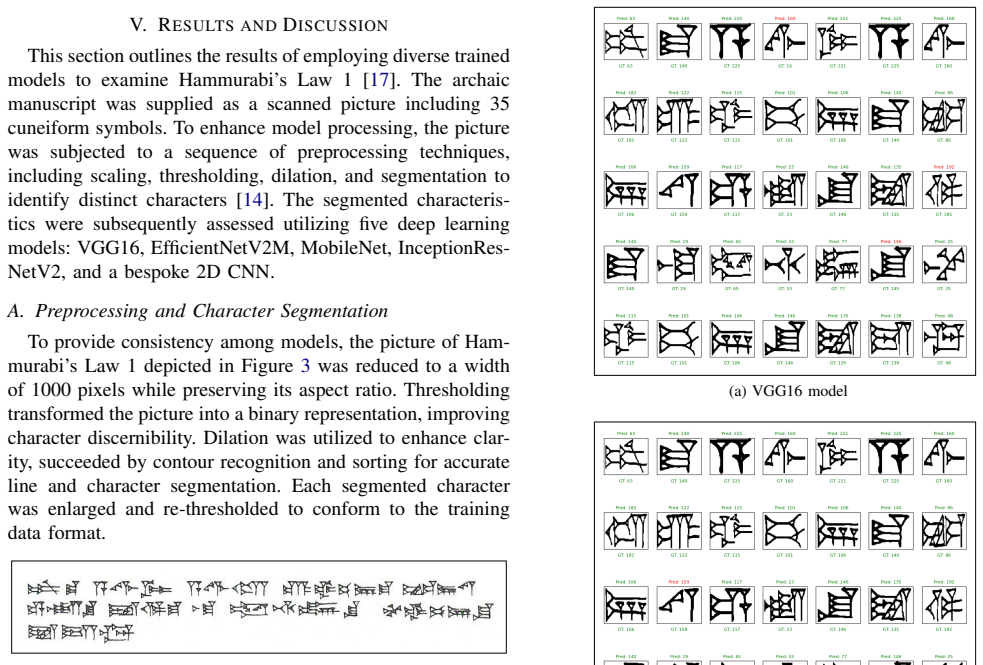
- [Section V-C] The Hammurabi Law 1 evaluation relies on only 35 segmented characters with manually chosen ground truth labels, yet the paper reports only aggregate accuracy percentages. With 35 samples, a single misclassification changes accuracy by 2.86 percentage points, so the difference between the reported 98.31% and 88.87% corresponds to about three to four characters. Please provide per-character prediction results, a confusion matrix, and a description of how the ground truth labels were established and by whom. Without this information, the reported accuracies are not statistically meaningful.
- [Section V-D] The English translation is produced by mapping recognized symbols to a predetermined database, so the translation output does not provide independent evidence for the accuracy of the visual recognition system. The linguistic comparison in Section IV and Table III is qualitative and does not constitute a quantitative validation of the recognition or translation. Please either present a separate evaluation of the translation component or temper the claims to reflect that the translations are deterministic lookups contingent on the recognition results.
minor comments (5)
- [References] References [7] and [14] are identical; please deduplicate and cite the earlier workshop paper consistently.
- [Section III-A] The methodology states that the study examined CNNs, RNNs, and hybrid models, but no RNN or hybrid architecture is implemented or evaluated in the paper. Please correct this description.
- [Figure 4] The text refers to correctly identified characters being highlighted in green, but the figure is not reproduced in color in the manuscript image. Please ensure the figure is legible and the highlighting is described in the caption.
- [Section V-C] The phrase 'unsupervised testing' is misleading; the evaluation uses ground truth labels and thus is supervised. Please rephrase.
- [Table II] The reported metrics include no uncertainty estimates. If multiple runs are performed, report means and standard deviations; otherwise, state that a single run was performed.
Circularity Check
No significant circularity: the central accuracy claims rest on an external Hammurabi Law 1 image with manually chosen ground truth, not on fitted inputs or self-citation chains.
full rationale
The paper's load-bearing empirical claim is that EfficientNetV2M and VGG16, trained on the 14,100-image cuneiform dataset, recognize the separately acquired scanned image of Hammurabi Law 1 at 98.31% and 88.87% accuracy (Section V-C). This evaluation is external to the training set and uses manually chosen ground truth (Section V-B), so the reported accuracy is not a fitted parameter renamed as a prediction. The translation step is explicitly a lookup from a predetermined database after recognition (Section V-D), which is mechanical rather than circular; at most it shows that the translation claim adds no independent support to the perception claim. The repeated self-citations ([7]/[14]) are background statements about the authors' prior use of VGG16 and do not provide the load-bearing argument for the present result. The dataset-split arithmetic in Table I and the possibility of character-level leakage are methodological validity concerns, not circularity: nothing in the paper's derivations is defined in terms of its conclusions. No load-bearing step reduces to its own inputs, so the circularity score is 0.
Assumptions & free parameters
free parameters (4)
- Dataset split percentages =
40% test / 24% validation / 36% training
- Number of training epochs =
50
- Early stopping patience =
5 epochs
- Image width for Hammurabi scan =
1000 pixels
assumptions (3)
- domain assumption The 235 cuneiform characters and their labels from the cited manual are correct and representative of the task.
- domain assumption The random split does not put augmented copies of the same source character into both training and test sets.
- domain assumption The segmentation of the Hammurabi Law 1 image into 35 individual characters is correct.
Cite this review
Pith. "Pith review of Advanced Deep Learning Approaches for Automated Recognition of Cuneiform Symbols." pith.science (2026). https://pith.science/paper/IKIY7XBZ
@misc{pith2026250504678,
  author       = {Pith},
  title        = {Pith review of: Advanced Deep Learning Approaches for Automated Recognition of Cuneiform Symbols},
  year         = {2026},
  howpublished = {\url{https://pith.science/paper/IKIY7XBZ}},
  note         = {Machine review of arXiv:2505.04678}
}
read the original abstract
This paper presents a thoroughly automated method for identifying and interpreting cuneiform characters via advanced deep-learning algorithms. Five distinct deep-learning models were trained on a comprehensive dataset of cuneiform characters and evaluated according to critical performance metrics, including accuracy and precision. Two models demonstrated outstanding performance and were subsequently assessed using cuneiform symbols from the Hammurabi law acquisition, notably Hammurabi Law 1. Each model effectively recognized the relevant Akkadian meanings of the symbols and delivered precise English translations. Future work will investigate ensemble and stacking approaches to optimize performance, utilizing hybrid architectures to improve detection accuracy and reliability. This research explores the linguistic relationships between Akkadian, an ancient Mesopotamian language, and Arabic, emphasizing their historical and cultural linkages. This study demonstrates the capability of deep learning to decipher ancient scripts by merging computational linguistics with archaeology, therefore providing significant insights for the comprehension and conservation of human history.
Figures


Figures from the paper (1 more)

Reference graph
Works this paper leans on
-
[1]
The invention of cuneiform: writing in Sumer,
J.-J. Glassner, Z. Bahrani, and M. Van De Mieroop, “The invention of cuneiform: writing in Sumer,” Choice Reviews Online, vol. 41, no. 11, pp. 41–6691, Jul. 2004, doi: 10.5860/choice.41-6691
-
[2]
The Code of Hammurabi - perhaps the first law code,
N. Mahadevaswamy, “The Code of Hammurabi - perhaps the first law code,” Journal of Emerging Technologies and Innovative Research, Nov. 2018, [Online]. Available: https://www.jetir.org/view?paper=JETIR1811B49
work page 2018
-
[3]
A Linguistic analysis of Akkadian,
E. E. Knudsen and E. Reiner, “A Linguistic analysis of Akkadian,” Journal of the American Oriental Society, vol. 90, no. 2, p. 334, Apr. 1970, doi: 10.2307/598174
-
[4]
E. Stötzner, T. Homburg and H. Mara, "CNN based Cuneiform Sign Detection Learned from Annotated 3D Renderings and Mapped Pho- tographs with Illumination Augmentation," 2023 IEEE/CVF Interna- tional Conference on Computer Vision Workshops (ICCVW), Paris, France, 2023, pp. 1672-1680, doi: 10.1109/ICCVW60793.2023.00183
arXiv 2023
-
[5]
Fragmented-cuneiform-based convolu- tional neural network for cuneiform character recognition,
A. Prasetiadi and J. Saputra, “Fragmented-cuneiform-based convolu- tional neural network for cuneiform character recognition,” IAES In- ternational Journal of Artificial Intelligence, vol. 13, no. 1, p. 554, Mar. 2024, doi: 10.11591/ijai.v13.i1.pp554-562
-
[6]
Automating Transliteration of Cuneiform from Parallel Lines with Sparse Data,
B. Bogacz, M. Klingmann and H. Mara, "Automating Transliteration of Cuneiform from Parallel Lines with Sparse Data," 2017 14th IAPR Inter- national Conference on Document Analysis and Recognition (ICDAR), Kyoto, Japan, 2017, pp. 615-620, doi: 10.1109/ICDAR.2017.106
-
[8]
Deep Learning Classification of Large-Scale Point Clouds: A Case Study on Cuneiform Tablets,
F. Hagelskjær, "Deep Learning Classification of Large-Scale Point Clouds: A Case Study on Cuneiform Tablets," 2022 IEEE International Conference on Image Processing (ICIP), Bordeaux, France, 2022, pp. 826-830, doi: 10.1109/ICIP46576.2022.9898032
arXiv 2022
-
[9]
M. Mahmood, F. M. Jasem, A. A. Mukhlif, and B. Al-Khateeb, “Classifying cuneiform symbols using machine learning algorithms with unigram features on a balanced dataset,” Journal of Intelligent Systems, vol. 32, no. 1, Jan. 2023, doi: 10.1515/jisys-2023-0087
Show all 17 references
-
[10]
Marcus, A manual of Akkadian
D. Marcus, A manual of Akkadian. 1978. [Online]. Available: http://ci.nii.ac.jp/ncid/BA03213704
1978
-
[11]
Breaking the Code on Broken Tablets: The Learning Challenge for Annotated Cuneiform Script in Normalized 2D and 3D Datasets,
H. Mara and B. Bogacz, "Breaking the Code on Broken Tablets: The Learning Challenge for Annotated Cuneiform Script in Normalized 2D and 3D Datasets," 2019 International Conference on Document Analysis and Recognition (ICDAR), Sydney, NSW, Australia, 2019, pp. 148-153, doi: 10....
2019
-
[12]
Evaluation of Tea Leaf Disease Identification Based on Convolutional Neural Networks VGG16, ResNet50, and DenseNet169 Image Recognitions,
X. Deng and C. Photong, "Evaluation of Tea Leaf Disease Identification Based on Convolutional Neural Networks VGG16, ResNet50, and DenseNet169 Image Recognitions," 2024 12th International Electrical Engineering Congress (iEECON), Pattaya, Thailand, 2024, pp. 01-04, doi: 10.110...
2024
-
[13]
Reading Akkadian cuneiform using natural language processing,
S. Gordin et al., “Reading Akkadian cuneiform using natural language processing,” PLoS ONE, vol. 15, no. 10, p. e0240511, Oct. 2020, doi: 10.1371/journal.pone.0240511
2020 doi
-
[14]
Unlocking Ancient Secrets: A Deep Learning Approach to Cuneiform Symbols Recognition,
S. Elshehaby, M. Al-Saad, A. Panthakkan and H. A. Ahmad, "Unlocking Ancient Secrets: A Deep Learning Approach to Cuneiform Symbols Recognition," 2024 Advances in Science and Engineering Technology International Conferences (ASET), Abu Dhabi, United Arab Emirates, 2024, pp. 1-6...
2024
-
[15]
Research and Discussion on Image Recognition and Classification Algorithm Based on Deep Learning,
Y . -n. Dong and G. -s. Liang, "Research and Discussion on Image Recognition and Classification Algorithm Based on Deep Learning," 2019 International Conference on Machine Learning, Big Data and Business Intelligence (MLBDBI), Taiyuan, China, 2019, pp. 274-278, doi: 10.1109/ML...
2019
-
[16]
A survey of modern deep learning based object detection models,
S. A. Zaidi, M. S. Ansari, A. Aslam, N. Kanwal, M. Asghar, and B. Lee, “A survey of modern deep learning based object detection models,” Digital Signal Processing, vol. 126, p. 103514, Mar. 2022, doi: 10.1016/j.dsp.2022.103514
2022
-
[17]
Translating Akkadian to English with neural machine translation,
G. Gutherz, S. Gordin, L. Sáenz, O. Levy, and J. Berant, “Translating Akkadian to English with neural machine translation,” PNAS Nexus, vol. 2, no. 5, May 2023, doi: 10.1093/pnasnexus/pgad096
2023 doi
-
[18]
An Approach to Ensemble Simplified ResNet Models-Using Egyptian Hieroglyphs Data Set,
Z. Yan, K. Jin, J. Hou and P. Zhang, "An Approach to Ensemble Simplified ResNet Models-Using Egyptian Hieroglyphs Data Set," 2023 3rd International Conference on Electronic Information Engineering and Computer Science (EIECS), Changchun, China, 2023, pp. 863-871, doi: 10.1109/...
2023
Reviewed August 15, 2026 · model on record in the stance chip above.
Discussion (0). Continue with ORCID to comment.