REVIEW 4 major objections 5 minor 59 references
Steerable Scene Generation with Post Training and Inference-Time Search
T0 review · 4 major / 5 minor · reviewed 2026-08-15 · deepseek-v4-flash
Pith's one-line read A scene diffusion model trained on 44 million procedurally generated scenes can be steered toward objectives such as higher clutter through RL post training, conditional generation, or inference-time tree search, without retraining from…
desk verdict A solid systems paper with a genuinely useful released dataset; the feasibility 'guarantee' is softer than advertised, but the core steering story survives. read the letter →
The pith
A machine-rendered reading of the paper's core claim, the machinery that carries it, and where it could break.
The reading
What carries the argument
The central object is the mixed discrete-continuous $\mathrm{SE}(3)$ scene diffusion model: a transformer-based denoiser, trained to be permutation-equivariant over unordered object sets, in which each object is a one-hot asset category diffused discretely together with a translation vector and a nine-dimensional rotation matrix diffused continuously and projected onto $\mathrm{SO}(3)$ at sampling time. It carries the argument because it is the single pretrained prior that all three steering strategies act on, and it makes steering possible by being differentiable, conditionable, and cheap to sample. The argument is completed by two feasibility mechanisms: a signed-distance projection solved with SNOPT that removes inter-object penetration while keeping orientations fixed, and a Drake simulation step that lets unstable objects settle under gravity for 0.1 seconds; together these define the 'physically feasible' label that serves as the MCTS reward, the inpainting mask criterion, and the paper's claim that outputs are simulation-ready.
What would settle it
Generate 1,000 scenes from the released Restaurant model, run the stated post-processing, and record how many fail the SNOPT projection step outright, then re-simulate the surviving 'stable' scenes for 10 seconds to see whether objects judged at rest after 0.1 seconds stay at rest. A substantial fraction of failures on either check would show that the feasibility guarantee, and the MCTS reward built on it, do not hold as stated.
Extended reading notes
Core claim
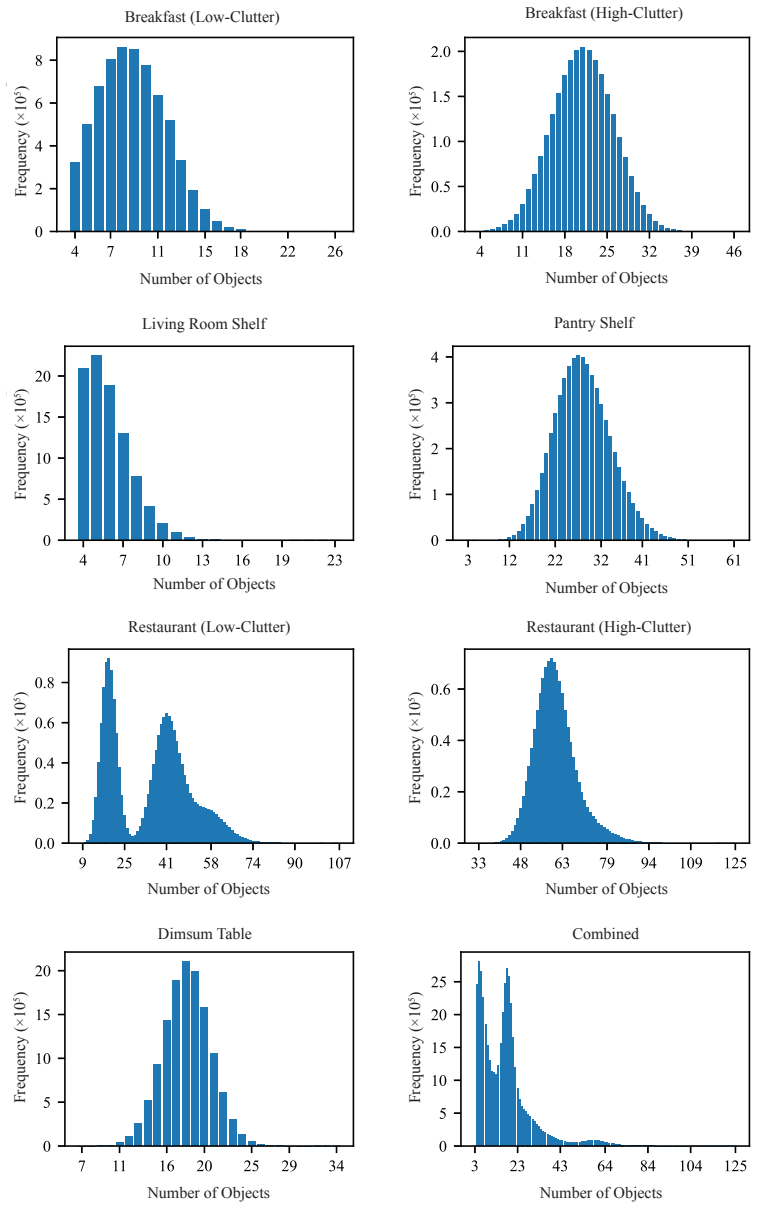
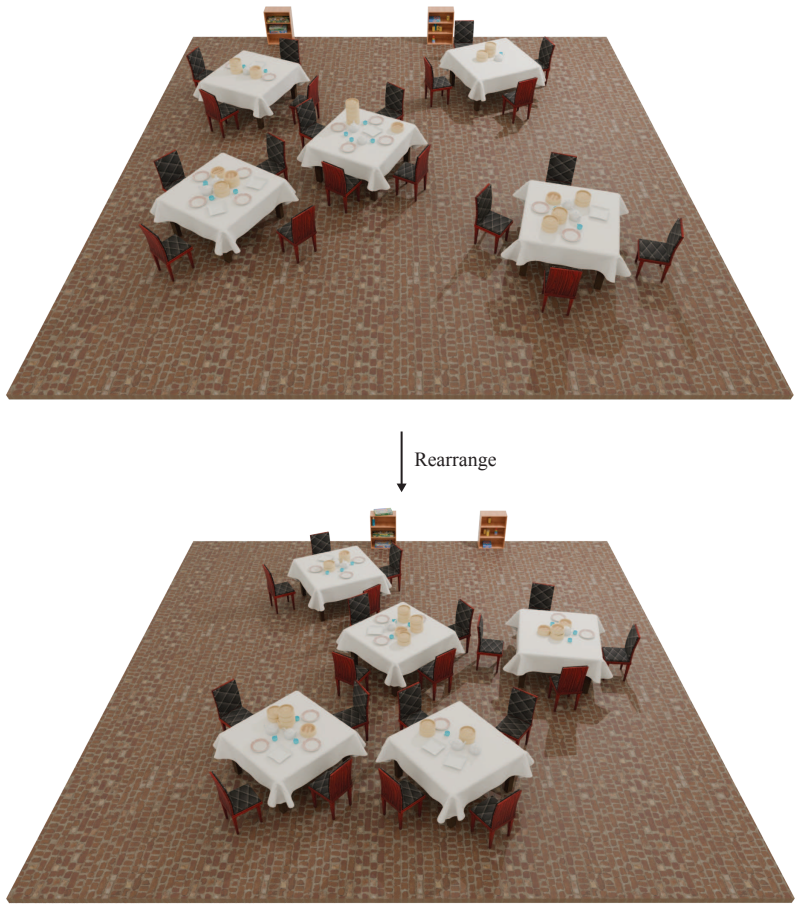
The paper's central claim is that a scene generative model trained on broad procedural data can be steered toward task-specific objectives, such as increasing clutter, and that this steering works through three complementary mechanisms: reinforcement-learning post training with a task reward, conditional generation via text prompts and structured inpainting, and a Monte Carlo tree search that builds scenes incrementally at inference time. The pretrained model predicts which objects to place from a fixed asset library together with their continuous $\mathrm{SE}(3)$ poses, using a mixed discrete-continuous diffusion objective over permutation-equivariant object sets; because the model is differentiable and fast to sample from, its output distribution can be shifted after the fact. The authors treat physical feasibility as a separate guarantee rather than leaving it to the diffusion model: every generated scene is projected to a collision-free configuration and then settled under gravity in simulation, so outputs are claimed to be non-penetrating, statically stable, and directly usable for robot data collection. The reported experiments show scenes matching dataset statistics on all five scene types, inference-time search reaching the 34-object maximum of a Dimsum dataset from a 17.1-object average, and RL post training producing shelf scenes denser than anything in the pretraining distribution.
Load-bearing premise
The load-bearing premise is that physical feasibility is fully captured by two mechanical checks — a signed-distance projection solved with SNOPT and a 0.1-second Drake settling simulation with its stability thresholds — so the paper's guarantee that outputs are physically correct (Section 1), and the MCTS reward that counts objects passing those checks, both inherit all their trust from an optimizer that the appendix itself concedes may fail to converge on complex Restaurant scenes.
Editorial extensions
If this is right
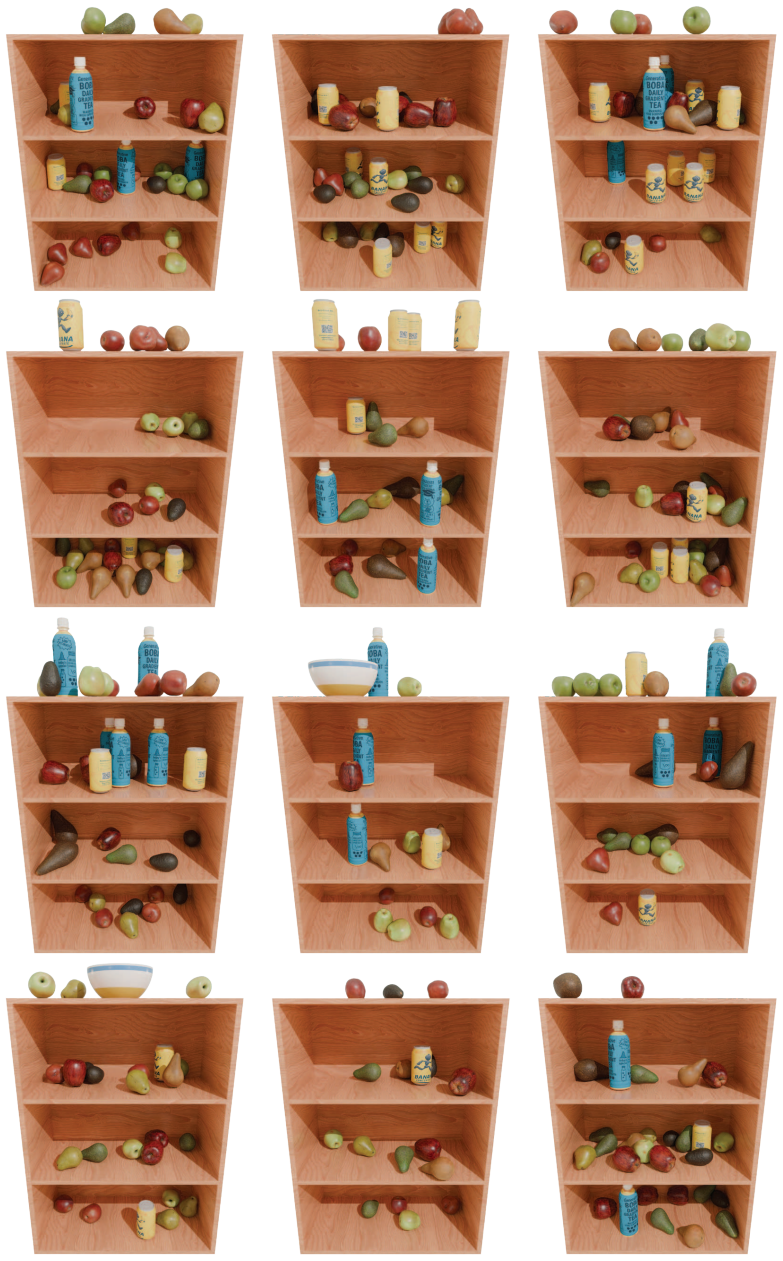
- A single pretrained scene model can be redirected toward an objective its training data never emphasized: the paper shows object-count rewards driving denser shelves after RL post training, and MCTS pushing a Dimsum scene to the 34-object maximum from a training average of 17.1 objects.
- Generated scenes can be handed to a robot simulator without manual correction, since the projection-plus-simulation pipeline is designed to eliminate penetrations and unstable equilibria; the authors demonstrate this by teleoperating a mobile manipulator through pick-and-place interactions in Drake.
- The three steering routes compose: a model refined by RL can still be prompted by text or searched at inference time, so scene generation gains the same kind of post-hoc alignment workflow used for large language models.
- The released resource, over 44 million full six-degree-of-freedom scenes across five environments, gives future work a benchmark beyond the 18,968 floor-plan layouts of 3D-FRONT, with manipulable small objects rather than static furniture.
- Cotraining across scene types yields a single model that can interpolate between environments, generating scenes that mix object identities from the Living Room Shelf and Pantry Shelf datasets when prompted with both.
Reading between the lines
- If the steering claim generalizes, scene generation inherits an alignment workflow: pick the cheapest of RL, conditioning, or search for each new objective, and reuse the same broad prior. The paper's separation of the MCTS mask generator from the reward function is a natural interface for arbitrary non-differentiable goals such as grasp success or human preference.
- A testable extension the paper does not run is to keep the MCTS machinery but replace the feasibility-count reward with a semantic one, such as the number of requested object categories. The framework's modular design predicts the search should still improve that reward, which would show the steering result is not merely an artifact of the physics post-processor.
- The element to stress-test is the feasibility oracle itself: the paper reports that SNOPT can fail to converge in complex Restaurant scenes (Appendix B.4), and stability is judged from 0.1 seconds of simulation, so 'physically feasible' is only as strong as those two checks. A longer simulation horizon or an analytic equilibrium certificate would be the natural safeguard.
Signed reviews
Editorial analysis
A structured set of objections, weighed in public.
Referee Report
Summary. The paper proposes a framework for SE(3) scene generation in which a diffusion model over object sets (asset ID, translation, and 9D rotation) is trained on procedurally generated scenes and then steered toward downstream objectives by three mechanisms: DDPO-based RL post training, text-conditioned generation and inpainting, and an MCTS procedure that iteratively inpaints masked invalid objects. Physical feasibility is enforced by a nonlinear projection step solved with SNOPT, followed by Drake simulation. The authors report unconditional and conditional generation results on five procedurally generated scene types, compare with DiffuScene and MiDiffusion, demonstrate clutter-maximizing RL and MCTS steering, and release code, model weights, and a dataset of 44.79 million scenes, including a teleoperation demo.
Significance. If the claims hold, the paper makes a meaningful contribution: a large-scale SE(3) scene dataset, a unified scene prior supporting three distinct steering paradigms, and an MCTS inference-time search strategy for diffusion-based scene synthesis. The release of code, data, and weights is a concrete strength that should make the results reproducible. The significance is tempered by two issues: the feasibility guarantee is conditional on a solver convergence caveat that is conceded in Appendix B.4, and the evaluation of physical feasibility and steering quality is largely internal to the same procedural and simulation pipeline used to define and optimize the objectives.
major comments (4)
- [§1, Appendix B.4, Appendix C] The Section 1 claim that projection and simulation 'guarantee physical correctness' is not supported for the hardest scenes. Appendix B.4 states that in complex Restaurant scenes 'SNOPT may fail to converge due to the presence of many complicated nonlinear non-convex constraints,' yet Appendix C asserts that 'after projection, MTP is guaranteed to be zero.' The manuscript provides no convergence statistics, no fallback procedure for failed solves, and no post-projection measurements of residual penetration. Because Section 3.5 and Figures 29–31 use the number of physically feasible objects as the MCTS reward, and this number is determined by the same Drake feasibility checks, a solver failure in the high-clutter regime directly affects the headline inference-time search result. Please report SNOPT convergence rates per dataset and scene complexity, specify the fallback behavior, and verify post-projection penetration with measurements rather than an unconditional guarantee.
- [§3.5, Appendix B.7] The MCTS evaluation is circular with respect to the feasibility definition. The mask generator and reward function (Appendices B.7.1 and B.7.2) use Drake's signed-distance checker and a 0.1 s settle simulation with 'predefined thresholds' that are never specified, and the same criteria are the only evidence that the final scenes are physically feasible. Please state the translation/rotation thresholds, report the sensitivity of the MCTS reward to those thresholds, and validate the feasibility determinations against an independent source (e.g., a different simulator, longer simulation horizons, or real-world checks) so that the steering objective is not merely conformity to one simulator's settings.
- [§3.3, Appendix D.2] The RL post-training section is presented mostly qualitatively. Figure 4 and Figure 19 show sample scenes and a reward curve, but there are no quantitative comparisons of CA, FID, MTP, or the object-count distribution before versus after post training, and no comparison against the other two steering mechanisms on the same clutter objective. Because the central contribution is that post training steers the pretrained model beyond its training distribution, the paper should provide quantitative evidence that the selected checkpoint preserves scene quality while increasing object count, and ideally a comparison with conditional generation and MCTS under a common budget.
- [§3.5, §2.4.3] The MCTS contribution lacks a comparison against simpler inference-time baselines. Figure 7 compares MCTS only with the initial inpainting sample and the best of B=3 unconditional samples, and Section 2.4.3 states that the method reduces to Random Search when B→∞, but no random-search or best-of-k baseline is evaluated under the same number of forward passes. Because Dimsum Table scenes have a small maximum object count (34), the claim that MCTS 'reaches the maximum possible 34 objects' would be more persuasive if compared with, for example, best-of-N independent samples or a greedy inpainting baseline using the same reward. Please add such a comparison, including compute cost.
minor comments (5)
- [Appendix B.7.1] Please specify the exact stability thresholds used in the 0.1 s Drake simulation; the current text only says 'predefined thresholds.'
- [§3.1] Please clarify whether 'MTP' is reported as the median over scenes of total penetration or as a median per-object quantity; the caption of Table 1 calls it 'median total penetration,' which is ambiguous.
- [§2.4.3] Please report the hyperparameters used for MCTS (exploration constant c, branching factor B, number of iterations, and noise initialization strategy) in the main text or a table, since Figure 7 reports only B=3 and 313 iterations.
- [Appendix D.5] The novelty analysis with Sinkhorn-Knopp distance is a useful addition, but it reports only qualitative nearest-neighbor examples; a quantitative threshold or distribution of distances would strengthen the claim that the model does not memorize training scenes.
- [§2.2] Please define how the empty-object token interacts with the discrete diffusion and with the upper bound N on scene size; this affects how variable-size scenes are sampled and how the MCTS mask treats empty slots.
Circularity Check
Physical-feasibility 'guarantee' is self-definitional (Drake defines and scores feasibility), but the steering results rest on independent reward curves and baseline comparisons.
-
self definitional
[Appendix B.7.2 Reward Function; cf. Section 1, Section 2.3, Appendix B.7.1, Appendix C]
"The reward is defined as the number of physically feasible objects in the scene—those that are both non-penetrating and statically stable according to the same criteria used in the mask generator."
The same Drake signed-distance checker and 0.1 s settle simulation define (a) which objects are masked as invalid (B.7.1), (b) the MCTS reward (B.7.2), and (c) the reported physical-feasibility metric MTP, with Appendix C asserting that 'after projection, MTP is guaranteed to be zero.' Section 1 then claims that projection and simulation 'guarantee physical correctness.' Thus a scene is 'physically feasible' by construction exactly when it passes the checks that the pipeline itself performs; the Figure 7 MCTS maximum and the MTP=0 claim are consequences of this operational definition, not an independent validation of real-world physical correctness. The caveat in B.4 (SNOPT 'may fail to converge' in Restaurant scenes) makes even this internal guarantee conditional.
full rationale
The paper's central steering claims are not circular: RL post-training, conditional generation, and MCTS are evaluated against explicit rewards and against external baselines (DiffuScene, MiDiffusion) on shared FID/CA/APF/MTP metrics, and the MCTS search is a genuine optimization procedure rather than a fitted parameter renamed as a prediction. The main circularity risk is confined to the physical-feasibility guarantee, which is defined and scored by the same Drake/SNOPT pipeline it uses to enforce feasibility; this is an operational definition rather than an independent check, and Appendix B.4's admitted SNOPT failures undercut the unconditional phrasing in Section 1. Self-citations ([16] data generator, [44] Drake, [3]/[10] related work) are tooling and prior-work references, not load-bearing uniqueness theorems, and code/data/model weights are released. Overall score 3 reflects one self-definitional feasibility loop while the core adaptation results remain independently demonstrated.
Assumptions & free parameters
free parameters (8)
- CFG guidance weight w =
not reported for main tables; w=5 for interpolation figure
- MCTS exploration constant c =
not reported
- MCTS branching factor B =
3
- Static equilibrium simulation time and stability thresholds =
0.1 s; thresholds not specified
- RL regularization weight lambda_DDPM =
100 to 200
- Maximum object capacity increase =
+20 for Living Room RL; +30 for shelf MCTS
- CA classifier training iterations =
tuned per dataset
- RL checkpoint selection =
step 7000 for Living Room RL
assumptions (4)
- domain assumption Procedural scene grammars from Izatt and Tedrake provide a faithful proxy for robot-relevant manipulation environments.
- domain assumption Drake rigid-body simulation and signed-distance collision checking provide ground-truth physical feasibility.
- domain assumption FID and classifier accuracy on semantic renderings are valid proxies for SE(3) scene generation quality.
- ad hoc to paper A continuous DDPM variant adequately represents the full model for RL post training.
Cite this review
Pith. "Pith review of Steerable Scene Generation with Post Training and Inference-Time Search." pith.science (2026). https://pith.science/paper/2VE6CKAA
@misc{pith2026250504831,
  author       = {Pith},
  title        = {Pith review of: Steerable Scene Generation with Post Training and Inference-Time Search},
  year         = {2026},
  howpublished = {\url{https://pith.science/paper/2VE6CKAA}},
  note         = {Machine review of arXiv:2505.04831}
}
read the original abstract
Training robots in simulation requires diverse 3D scenes that reflect the specific challenges of downstream tasks. However, scenes that satisfy strict task requirements, such as high-clutter environments with plausible spatial arrangement, are rare and costly to curate manually. Instead, we generate large-scale scene data using procedural models that approximate realistic environments for robotic manipulation, and adapt it to task-specific goals. We do this by training a unified diffusion-based generative model that predicts which objects to place from a fixed asset library, along with their SE(3) poses. This model serves as a flexible scene prior that can be adapted using reinforcement learning-based post training, conditional generation, or inference-time search, steering generation toward downstream objectives even when they differ from the original data distribution. Our method enables goal-directed scene synthesis that respects physical feasibility and scales across scene types. We introduce a novel MCTS-based inference-time search strategy for diffusion models, enforce feasibility via projection and simulation, and release a dataset of over 44 million SE(3) scenes spanning five diverse environments. Website with videos, code, data, and model weights: https://steerable-scene-generation.github.io/
Figures


Figures from the paper (31 more)








Reference graph
Works this paper leans on
-
[1]
H. Choi, C. Crump, C. Duriez, A. Elmquist, G. Hager, D. Han, F. Hearl, J. Hodgins, A. Jain, F. Leve, C. Li, F. Meier, D. Negrut, L. Righetti, A. Rodriguez, J. Tan, and J. Trinkle. On the use of simulation in robotics: Opportunities, challenges, and suggestions for moving forward. Proceedings of the National Academy of Sciences , 118(1):e1907856118, 2021. ...
-
[2]
W. Zhao, J. P. Queralta, and T. Westerlund. Sim-to-real transfer in deep reinforcement learning for robotics: a survey. In 2020 IEEE Symposium Series on Computational Intelligence (SSCI) , pages 737–744, 2020. doi:10.1109/SSCI47803.2020.9308468
arXiv 2020
-
[3]
A. Wei, A. Agarwal, B. Chen, R. Bosworth, N. Pfaff, and R. Tedrake. Empirical analysis of sim-and-real cotraining of diffusion policies for planar pushing from pixels, 2025. URL https://arxiv.org/abs/2503.22634
arXiv 2025
-
[4]
A. Maddukuri, Z. Jiang, L. Y . Chen, S. Nasiriany, Y . Xie, Y . Fang, W. Huang, Z. Wang, Z. Xu, N. Chernyadev, S. Reed, K. Goldberg, A. Mandlekar, L. Fan, and Y . Zhu. Sim-and-real co- training: A simple recipe for vision-based robotic manipulation, 2025. URLhttps://arxiv. org/abs/2503.24361
arXiv 2025
- [5]
-
[6]
R. Firoozi, J. Tucker, S. Tian, A. Majumdar, J. Sun, W. Liu, Y . Zhu, S. Song, A. Kapoor, K. Hausman, B. Ichter, D. Driess, J. Wu, C. Lu, and M. Schwager. Foundation models in robotics: Applications, challenges, and the future. The International Journal of Robotics Re- search, 2024
work page 2024
-
[7]
E. Collaboration, A. O’Neill, A. Rehman, A. Gupta, A. Maddukuri, A. Gupta, A. Padalkar, A. Lee, A. Pooley, A. Gupta, A. Mandlekar, A. Jain, A. Tung, A. Bewley, A. Herzog, A. Ir- pan, A. Khazatsky, A. Rai, A. Gupta, A. Wang, A. Kolobov, A. Singh, A. Garg, A. Kembhavi, A. Xie, A. Brohan, A. Raffin, A. Sharma, A. Yavary, A. Jain, A. Balakrishna, A. Wahid, B....
arXiv 2024
-
[8]
A. Khazatsky, K. Pertsch, S. Nair, A. Balakrishna, S. Dasari, S. Karamcheti, S. Nasiriany, M. K. Srirama, L. Y . Chen, K. Ellis, P. D. Fagan, J. Hejna, M. Itkina, M. Lepert, Y . J. Ma, P. T. Miller, J. Wu, S. Belkhale, S. Dass, H. Ha, A. Jain, A. Lee, Y . Lee, M. Memmel, S. Park, I. Radosavovic, K. Wang, A. Zhan, K. Black, C. Chi, K. B. Hatch, S. Lin, J. ...
arXiv 2025
Show all 59 references
-
[9]
Downs, A
L. Downs, A. Francis, N. Koenig, B. Kinman, R. Hickman, K. Reymann, T. B. McHugh, and V . Vanhoucke. Google scanned objects: A high-quality dataset of 3d scanned household items. In 2022 International Conference on Robotics and Automation (ICRA), page 2553–2560. IEEE Press, 2022
2022
-
[10]
Pfaff, E
N. Pfaff, E. Fu, J. Binagia, P. Isola, and R. Tedrake. Scalable real2sim: Physics-aware asset generation via robotic pick-and-place setups, 2025. URL https://arxiv.org/abs/2503. 00370
2025
-
[11]
Y . Yang, B. Jia, P. Zhi, and S. Huang. Physcene: Physically interactable 3d scene synthesis for embodied ai. In Proceedings of Conference on Computer Vision and Pattern Recognition (CVPR), 2024
2024
-
[12]
Nasiriany, A
S. Nasiriany, A. Maddukuri, L. Zhang, A. Parikh, A. Lo, A. Joshi, A. Mandlekar, and Y . Zhu. Robocasa: Large-scale simulation of everyday tasks for generalist robots. InRobotics: Science and Systems, 2024
2024
-
[13]
Merrell, E
P. Merrell, E. Schkufza, Z. Li, M. Agrawala, and V . Koltun. Interactive furniture layout using interior design guidelines. In ACM SIGGRAPH 2011 Papers , SIGGRAPH ’11, New York, NY , USA, 2011. Association for Computing Machinery. ISBN 9781450309431. doi:10.1145/ 1964921.19649...
2011
-
[14]
J. O. Talton, Y . Lou, S. Lesser, J. Duke, R. M ˇech, and V . Koltun. Metropolis procedural modeling. ACM Trans. Graph. , 30(2), Apr. 2011. ISSN 0730-0301. doi:10.1145/1944846. 1944851. URL https://doi.org/10.1145/1944846.1944851
2011
-
[15]
S. Qi, Y . Zhu, S. Huang, C. Jiang, and S.-C. Zhu. Human-centric indoor scene synthesis using stochastic grammar. In Conference on Computer Vision and Pattern Recognition (CVPR) , 2018
2018
-
[16]
Izatt and R
G. Izatt and R. Tedrake. Capturing Distributions over Worlds for Robotics with Spatial Scene Grammars. PhD thesis, Massachusetts Institute of Technology, Cambridge, MA, 2022. URL https://dspace.mit.edu/handle/1721.1/144763
2022
-
[17]
Deitke, E
M. Deitke, E. VanderBilt, A. Herrasti, L. Weihs, J. Salvador, K. Ehsani, W. Han, E. Kolve, A. Farhadi, A. Kembhavi, and R. Mottaghi. ProcTHOR: Large-Scale Embodied AI Using Procedural Generation. In NeurIPS, 2022. Outstanding Paper Award
2022
-
[18]
Y . Lin, J. Humplik, S. H. Huang, L. Hasenclever, F. Romano, S. Saliceti, D. Zheng, J. E. Chen, C. Barros, A. Collister, M. Young, A. Dostmohamed, B. Moran, K. Caluwaerts, M. Giustina, J. Moore, K. Connell, F. Nori, N. Heess, S. Bohez, and A. Byravan. Proc4gem: Foundation mode...
2025 arXiv
-
[19]
L. Wang, Y . Ling, Z. Yuan, M. Shridhar, C. Bao, Y . Qin, B. Wang, H. Xu, and X. Wang. Gensim: Generating robotic simulation tasks via large language models, 2023. URL https: //arxiv.org/abs/2310.01361
2023 arXiv
-
[20]
Y . Wang, Z. Xian, F. Chen, T.-H. Wang, Y . Wang, K. Fragkiadaki, Z. Erickson, D. Held, and C. Gan. Robogen: Towards unleashing infinite data for automated robot learning via generative simulation, 2024. URL https://arxiv.org/abs/2311.01455
2024 arXiv
-
[21]
Katara, Z
P. Katara, Z. Xian, and K. Fragkiadaki. Gen2sim: Scaling up robot learning in simulation with generative models, 2023. URL https://arxiv.org/abs/2310.18308
2023 arXiv
-
[22]
Lin, C.-H
T.-Y . Lin, C.-H. Lin, Y . Cui, Y . Ge, S. Nah, A. Mallya, Z. Hao, Y . Ding, H. Mao, Z. Li, Y .-C. Lin, X. Zeng, Q. Zhang, D. Xiang, Q. Ma, J. Lewis, J. Jin, P. Jannaty, and M.-Y . Liu. Genusd: 3d scene generation made easy. In ACM SIGGRAPH 2024 Real-Time Live! , SIGGRAPH ’24,...
2024
-
[23]
H. I. D. Pun, H. I. I. Tam, A. T. Wang, X. Huo, A. X. Chang, and M. Savva. Hsm: Hierarchical scene motifs for multi-scale indoor scene generation, 2025. URLhttps://arxiv.org/abs/ 2503.16848
2025
-
[24]
Z. Chen, A. Walsman, M. Memmel, K. Mo, A. Fang, K. Vemuri, A. Wu, D. Fox, and A. Gupta. Urdformer: A pipeline for constructing articulated simulation environments from real-world images. arXiv preprint arXiv:2405.11656, 2024
2024 arXiv
-
[25]
K. Yao, L. Zhang, X. Yan, Y . Zeng, Q. Zhang, L. Xu, W. Yang, J. Gu, and J. Yu. Cast: Component-aligned 3d scene reconstruction from an rgb image, 2025. URLhttps://arxiv. org/abs/2502.12894
2025 arXiv
-
[26]
Engstler, A
P. Engstler, A. Shtedritski, I. Laina, C. Rupprecht, and A. Vedaldi. Syncity: Training-free generation of 3d worlds, 2025. URL https://arxiv.org/abs/2503.16420
2025 arXiv
-
[27]
Paschalidou, A
D. Paschalidou, A. Kar, M. Shugrina, K. Kreis, A. Geiger, and S. Fidler. Atiss: Autoregres- sive transformers for indoor scene synthesis. In Advances in Neural Information Processing Systems (NeurIPS), 2021
2021
-
[28]
X. Wang, C. Yeshwanth, and M. Nießner. Sceneformer: Indoor scene generation with trans- formers. In 2021 International Conference on 3D Vision (3DV) , pages 106–115, 2021. doi: 10.1109/3DV53792.2021.00021
2021
-
[29]
Q. A. Wei, S. Ding, J. J. Park, R. Sajnani, A. Poulenard, S. Sridhar, and L. Guibas. LEGO- Net: Learning Regular Rearrangements of Objects in Rooms . In 2023 IEEE/CVF Conference on Computer Vision and Pattern Recognition (CVPR) , pages 19037–19047, Los Alamitos, CA, USA, June ...
2023
-
[30]
J. Tang, Y . Nie, L. Markhasin, A. Dai, J. Thies, and M. Nießner. Diffuscene: Denoising diffusion models for generative indoor scene synthesis. In Proceedings of the IEEE/CVF Con- ference on Computer Vision and Pattern Recognition, 2024
2024
-
[31]
S. Hu, D. M. Arroyo, S. Debats, F. Manhardt, L. Carlone, and F. Tombari. Mixed diffusion for 3d indoor scene synthesis. arXiv preprint: 2405.21066, 2024
2024 arXiv
-
[32]
Ouyang, J
L. Ouyang, J. Wu, X. Jiang, D. Almeida, C. L. Wainwright, P. Mishkin, C. Zhang, S. Agarwal, K. Slama, A. Ray, J. Schulman, J. Hilton, F. Kelton, L. Miller, M. Simens, A. Askell, P. Welin- der, P. Christiano, J. Leike, and R. Lowe. Training language models to follow instruction...
2022
-
[33]
Kumar, T
K. Kumar, T. Ashraf, O. Thawakar, R. M. Anwer, H. Cholakkal, M. Shah, M.-H. Yang, P. H. S. Torr, S. Khan, and F. S. Khan. Llm post-training: A deep dive into reasoning large language models, 2025. URL https://arxiv.org/abs/2502.21321
2025 arXiv
-
[34]
Black, M
K. Black, M. Janner, Y . Du, I. Kostrikov, and S. Levine. Training diffusion models with reinforcement learning, 2023
2023
-
[35]
Zhang, E
Y . Zhang, E. Tzeng, Y . Du, and D. Kislyuk. Large-scale reinforcement learning for diffusion models, 2024. URL https://arxiv.org/abs/2401.12244
2024 arXiv
-
[36]
Jia and B
Y . Jia and B. Chen. Cluttergen: A cluttered scene generator for robot learning. In 8th An- nual Conference on Robot Learning , 2024. URL https://openreview.net/forum?id= k0ogr4dnhG. 12
2024
-
[37]
A. R. Geist, J. Frey, M. Zhobro, A. Levina, and G. Martius. Learning with 3D rotations, a hitch- hiker’s guide to SO(3). In R. Salakhutdinov, Z. Kolter, K. Heller, A. Weller, N. Oliver, J. Scar- lett, and F. Berkenkamp, editors,Proceedings of the 41st International Conference ...
2024
-
[38]
J. Ho, A. Jain, and P. Abbeel. Denoising diffusion probabilistic models. In Proceedings of the 34th International Conference on Neural Information Processing Systems , NIPS ’20, Red Hook, NY , USA, 2020. Curran Associates Inc. ISBN 9781713829546
2020
-
[39]
Austin, D
J. Austin, D. D. Johnson, J. Ho, D. Tarlow, and R. van den Berg. Structured denoising diffusion models in discrete state-spaces, 2023. URL https://arxiv.org/abs/2107.03006
2023 arXiv
-
[40]
Zaheer, S
M. Zaheer, S. Kottur, S. Ravanbhakhsh, B. P ´oczos, R. Salakhutdinov, and A. J. Smola. Deep sets. In Proceedings of the 31st International Conference on Neural Information Processing Systems, NIPS’17, page 3394–3404, Red Hook, NY , USA, 2017. Curran Associates Inc. ISBN 9781510860964
2017
-
[41]
J. Lee, Y . Lee, J. Kim, A. Kosiorek, S. Choi, and Y . W. Teh. Set transformer: A framework for attention-based permutation-invariant neural networks. In Proceedings of the 36th Interna- tional Conference on Machine Learning , pages 3744–3753, 2019
2019
-
[42]
B. F. Labs. Flux. https://github.com/black-forest-labs/flux, 2024
2024
-
[43]
Z. Fei, M. Fan, C. Yu, and J. Huang. FLUX that plays music, 2024. URL https://arxiv. org/abs/2409.00587
2024 arXiv
-
[44]
Tedrake and the Drake Development Team
R. Tedrake and the Drake Development Team. Drake: Model-based design and verification for robotics, 2019
2019
-
[45]
Devlin, M.-W
J. Devlin, M.-W. Chang, K. Lee, and K. Toutanova. Bert: Pre-training of deep bidirectional transformers for language understanding, 2019. URL https://arxiv.org/abs/1810. 04805
2019
-
[46]
Ho and T
J. Ho and T. Salimans. Classifier-free diffusion guidance, 2022. URL https://arxiv.org/ abs/2207.12598
2022 arXiv
-
[47]
Sohl-Dickstein, E
J. Sohl-Dickstein, E. A. Weiss, N. Maheswaranathan, and S. Ganguli. Deep unsupervised learning using nonequilibrium thermodynamics, 2015. URL https://arxiv.org/abs/ 1503.03585
2015 arXiv
-
[48]
C. B. Browne, E. Powley, D. Whitehouse, S. M. Lucas, P. I. Cowling, P. Rohlfshagen, S. Tavener, D. Perez, S. Samothrakis, and S. Colton. A survey of monte carlo tree search methods. IEEE Transactions on Computational Intelligence and AI in Games , 4(1):1–43,
-
[49]
Kocsis and C
L. Kocsis and C. Szepesv ´ari. Bandit based monte-carlo planning. In J. F ¨urnkranz, T. Schef- fer, and M. Spiliopoulou, editors, Machine Learning: ECML 2006 , pages 282–293, Berlin, Heidelberg, 2006. Springer Berlin Heidelberg. ISBN 978-3-540-46056-5
2006
-
[50]
N. Ma, S. Tong, H. Jia, H. Hu, Y .-C. Su, M. Zhang, X. Yang, Y . Li, T. Jaakkola, X. Jia, and S. Xie. Inference-time scaling for diffusion models beyond scaling denoising steps, 2025. URL https://arxiv.org/abs/2501.09732
2025 arXiv
-
[51]
H. Fu, B. Cai, L. Gao, L.-X. Zhang, J. Wang, C. Li, Q. Zeng, C. Sun, R. Jia, B. Zhao, et al. 3d-front: 3d furnished rooms with layouts and semantics. In Proceedings of the IEEE/CVF International Conference on Computer Vision, pages 10933–10942, 2021. 13
2021
-
[52]
Tarvainen and H
A. Tarvainen and H. Valpola. Mean teachers are better role models: Weight-averaged consis- tency targets improve semi-supervised deep learning results, 2018. URL https://arxiv. org/abs/1703.01780
2018 arXiv
-
[53]
Loshchilov and F
I. Loshchilov and F. Hutter. Decoupled weight decay regularization, 2019. URL https: //arxiv.org/abs/1711.05101
2019 arXiv
-
[54]
P. E. Gill, W. Murray, and M. A. Saunders. Snopt: An sqp algorithm for large-scale constrained optimization. SIAM Journal on Optimization , 12(4):979–1006, 2002. doi: 10.1137/S1052623499350013. URL https://doi.org/10.1137/S1052623499350013
2002 doi
-
[55]
J. Song, C. Meng, and S. Ermon. Denoising diffusion implicit models, 2022. URL https: //arxiv.org/abs/2010.02502
2022 arXiv
-
[56]
M. Cuturi. Sinkhorn distances: Lightspeed computation of optimal transport. In C. Burges, L. Bottou, M. Welling, Z. Ghahramani, and K. Weinberger, editors, Ad- vances in Neural Information Processing Systems , volume 26. Curran Associates, Inc.,
-
[59]
ft32“ uses full precision (32-bit) withmatmul precision=
Some of the objects that only appear in the Living Room Shelf dataset are highlighted in red, while some of the objects that only appear in the Pantry Shelf dataset are highlighted in blue. arrangement results are shown in Figures 23–25, where the model regenerates SE(3) objec...
-
[2012]
doi:10.1109/TCIAIG.2012.2186810
2012
-
[2013]
A scene with two bowls, a water jug, an apple, five plates, eight bread slices, four forks, four mugs, four knives, a spoon, a pear, and a table
URL https://proceedings.neurips.cc/paper_files/paper/2013/file/ af21d0c97db2e27e13572cbf59eb343d-Paper.pdf. A Procedurally Generated Datasets Table 3: Dataset statistics for each scene type: number of unique object assets, minimum, maximum, and mean number of objects per scene...
2013
Reviewed August 15, 2026 · model on record in the stance chip above.
Discussion (0). Continue with ORCID to comment.