REVIEW 4 major objections 6 minor 33 references
An Automated LLM-based Pipeline for Asset-Level Database Creation to Assess Deforestation Impact
T0 review · 4 major / 6 minor · reviewed 2026-08-16 · deepseek-v4-flash
Pith's one-line read The paper claims an automated LLM pipeline can extract, clean, and validate asset-level databases from SEC 10-K filings to support EUDR deforestation tracking.
desk verdict A useful applied pipeline for EUDR asset extraction, but the 'validated' claim outruns the evidence: the ground truth is tiny, the validation never measures correctness, and one results table contradicts its own text. read the letter →
The pith
A machine-rendered reading of the paper's core claim, the machinery that carries it, and where it could break.
The reading
What carries the argument
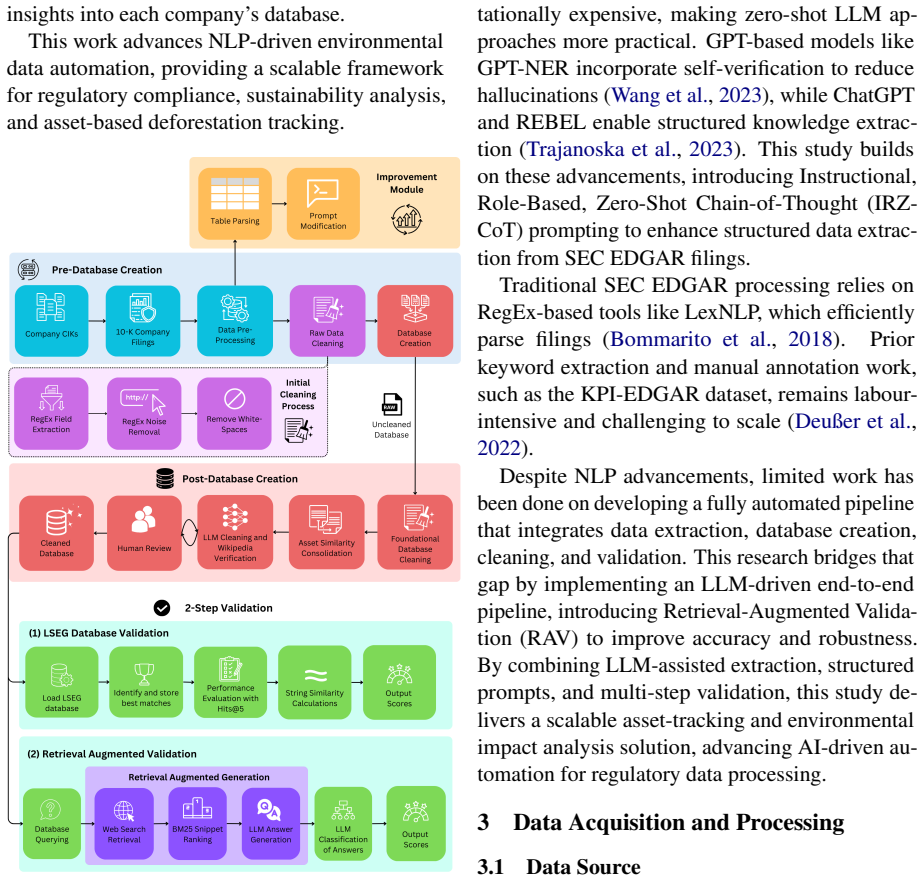
The argument is carried by two mechanisms. IRZ-CoT (Instructional, Role-Based, Zero-Shot Chain-of-Thought) is a prompt template that assigns the model an expert role, defines physical asset, financial asset, location, and commodity, asks for step-by-step reasoning, and forbids extra output; it suppresses the hallucinated and over-broad entities that the paper observed in one-shot, few-shot, and generated-knowledge prompting. RAV (Retrieval-Augmented Validation) queries a web search API, ranks the returned snippets with BM25, has one LLM generate a concise answer, and has a second LLM classify whether the web answer matches the database entry, which lets validation extend beyond commercial asset databases. A cleaning stage using TF-IDF vectorization and cosine similarity with a 0.5 threshold consolidates near-duplicate asset entries, and a table-parsing module recovers assets listed in tabular form. Each mechanism answers a specific failure: prompts reduce extraction errors, table parsing recovers missed assets, and RAV raises the fraction of assets that can be checked against an external source.
What would settle it
Take a company and an independent, complete list of its physical assets, say from permitting records, satellite-based site inventories, or a comprehensive commercial database, then count how many of those assets appear in the pipeline's database after cleaning and validation. If most companies keep validated coverage below a third, or if the unvalidated assets are precisely the ones in high-deforestation locations, the central claim fails regardless of extraction precision.
Extended reading notes
Core claim
The central discovery, stated on the paper's own terms, is that model capability is no longer the main bottleneck in turning filings into asset databases: a carefully prompted local LLM can extract physical assets with their locations, ownership, commodities, and status, and a retrieval step can validate what was extracted. Gemma 2, run in 4-bit quantized form, achieves the highest cosine similarity, precision, recall, and F1 among the models tested, and IRZ-CoT delivers the best accuracy-efficiency balance across seven prompting techniques. The paper also reports that parsing tables instead of treating them as running text materially raises coverage for oil and gas and utilities, and that adding web-based validation raises total validation coverage from values as low as 0.71% to a maximum of 33.33% for the best-covered company. The authors read these results as evidence that automated, asset-level environmental databases for EUDR compliance are within reach, with coverage of named assets in filings, not extraction quality, as the remaining constraint.
Load-bearing premise
The pipeline's value rests on the assumption that the physical assets named in 10-K text and parsed tables, after cleaning, represent a large enough share of the assets that actually matter for deforestation analysis, and the paper's own coverage numbers show most assets remain unvalidated.
Editorial extensions
If this is right
- A company's asset-level deforestation exposure could be assessed from its 10-K filings alone, with no site visits or paid datasets.
- Regulators implementing EUDR could audit a large portfolio of companies in weeks rather than months, because extraction and validation run automatically.
- The RAV step's effect, with coverage roughly doubling or tripling, suggests that combining public filings with live web sources is the practical route to more complete asset registers.
- The same pipeline structure transfers to other high-risk sectors and other disclosure regimes, since the prompts carry the domain knowledge and the retrieval step adapts to whatever sources are available.
Reading between the lines
- The low validated coverage of roughly 0.7% to 33% implies that 10-K filings alone, even with table parsing and web search, name only a minority of deforestation-relevant assets; a regulatory database would likely need permit records, satellite-derived site inventories, or subsidiary disclosures to reach full coverage.
- Because RAV's authors found that simpler classification prompts beat detailed ones, a testable extension is to simplify IRZ-CoT itself: fewer definitions and shorter instructions might improve extraction without sacrificing accuracy.
- The coverage formula used here can be inverted into an upper-bound estimator of filing completeness: if the external asset database is complete, the coverage score directly measures what proportion of real assets a filer discloses.
Signed reviews
Editorial analysis
A structured set of objections, weighed in public.
Referee Report
Summary. The paper presents an end-to-end LLM-based pipeline that extracts physical asset records from SEC EDGAR 10-K filings, cleans them, and validates them against LSEG databases and live web search (RAV), targeting companies in mining, oil & gas, and utilities for deforestation-risk assessment. The pipeline uses a new IRZ-CoT prompting strategy, a three-stage cleaning process, and a table-parsing improvement module. The authors evaluate several small LLMs (Mistral-7B, Llama 3, Gemma 2) and a BERT-based NER model on a 30-chunk Alcoa ground truth, then report similarity and coverage numbers against LSEG and web sources.
Significance. The application question is timely and important: automated asset-level database creation from public filings could reduce the cost of EUDR compliance and improve deforestation monitoring. The paper's main contribution is an integrated pipeline, and the detailed prompt library in Appendix A.13 is a useful reproducibility asset. The comparison against LSEG provides an external anchor that is more credible than a purely synthetic evaluation. However, the evidence for the central claims is currently thin: the extraction benchmark is very small, the validation layer is not itself validated, and the coverage results are internally inconsistent in their definitions. The pipeline is a plausible engineering contribution, but the paper overstates the reliability of its outputs relative to what is actually measured.
major comments (4)
- [§6.1, §6.2, §7.4] The paper's central claim that the pipeline creates accurate, validated asset-level databases is not supported by the validation experiments. LSEG validation (§6.1) uses rapidfuzz fuzzy string matching with a threshold of 0.6 and Hits@5, which measure similarity to external database entries, not correctness against ground truth. RAV (§6.2) relies on a binary 'yes'/'no' classifier from Gemma 2, but no accuracy, precision, or recall is reported for this classifier. Coverage results in Table 2 express the share of constructed-database assets that match LSEG or web sources; even 100% coverage would not establish that matched entries are accurate. The only ground truth in the paper (§4.3) is used for extraction evaluation, not for evaluating the final database contents. The 'validated' label therefore needs either a ground-truth evaluation of the final databases or a clearly stated weaker meaning.
- [§4.3, §4.4, Table 1] The extraction evaluation rests on 30 manually annotated chunks from a single filing (Alcoa 2022), with no inter-annotator agreement and no confidence intervals. Moreover, Table 1 shows Gemma 2's F1 score (0.60) is tied with Mistral-7B's and its recall (0.62) is below Llama 3's (0.64), contradicting the text in §4.4 that Gemma 2 achieved the highest scores across all evaluation metrics. The claim of 'significant improvements' over zero-shot prompting also lacks statistical tests or error bars. These issues directly affect the selection of Gemma 2 and the quantitative basis for the pipeline's performance claims.
- [§7.2, §7.4, Tables 2 and 7] Two different coverage notions are presented without reconciliation. Section 7.2 defines coverage as N_m/N_L (matched assets over total LSEG assets) and Table 7 reports values such as COP 100%, FCX 92.31%, and NEM 62.16%. Section 7.4 defines total validation coverage as N_v/N_t (validated assets over constructed-database assets) and Table 2 reports much lower values, with COP at 6.43% and a maximum of 33.33%. The paper does not explain why high LSEG-relative coverage in Table 7 does not translate into higher validation coverage in Table 2, and the text uses the term 'coverage' for both. This ambiguity is load-bearing because the coverage results are central to the claim that the databases are sufficiently complete for regulatory use.
- [§6.2, §7.3, §7.3.1] The RAV module's contribution is reported through similarity scores (Table 8, 0.31–0.57) and through coverage gains in Table 2, but the binary classifier that decides 'yes'/'no' is never evaluated against labeled data. The paper itself states that 'some misclassifications remain' (§6.2) and documents cases where valid entries received scores of 0 because of missing country mentions (§7.3.1). Without a measured false-positive/false-negative rate, the finding that RAV increases validation coverage may partly reflect validation errors rather than genuine database improvement. Reporting classifier accuracy on a labeled sample of web snippets would be necessary to support the reliability claims.
minor comments (6)
- [Abstract, §6.2] The abstract and several sections use 'RA V' with a space, while other parts use 'RAV'; please standardize the spelling throughout.
- [§4.2] The statement that Gemma 2 achieves 'higher precision and recall' after discussing cosine similarity is imprecise; Table 1 shows Gemma 2 has the highest precision but not the highest recall, so the text should specify which metrics are meant.
- [§4.5, Figure 2] Figure 2 shows IRZ-CoT outperforming other prompting methods, but the underlying numeric scores are not reported; adding a table with values and, ideally, confidence intervals would make the comparison reproducible.
- [§6.1, Appendix A.15] The five validation metrics in Table 9 are said to be 'averaged into an overall attribute similarity score,' but the aggregation rule is not defined; please clarify whether the averaging is across entities, across metrics, or both.
- [§7.2, Figure 10] The effect of table parsing is shown only in Figure 10; the text should state the before/after coverage numbers explicitly so the claimed improvement can be assessed quantitatively.
- [Abstract, Section 9] Section 9 acknowledges several limitations that temper the abstract's claims; consider softening 'accurate, validated' in the abstract to match the actual evaluation.
Circularity Check
Mild same-model circularity in RAV 'validation'; pipeline otherwise empirically grounded.
-
self definitional
[Section 6.2 (Retrieval-Augmented Validation), Table 8, Table 2]
"RA V uses a dual-LLM framework where Llama 3 generates web-based answers, and Gemma 2 is tasked with classifying these answers strictly against the database entries. ... The LLM-assisted validation relies on a binary classification approach where Gemma 2 outputs a ‘yes’ if the web-derived and database information are similar and a ‘no’ otherwise. This stringent evaluation ensures high reliability, reducing the risk of false positives in validation."
The database entries being 'validated' were themselves produced and cleaned by Gemma 2 (Sections 4.4, 4.5, 5.3). The RAV verdict is therefore Gemma 2 judging whether web snippets agree with its own prior outputs. Since no accuracy, precision, or recall for this binary validator is reported anywhere in the paper, the 'validated' status is, by construction, an internal consistency measure rather than an independent verification. The coverage gains in Table 2 count those same-model self-consistency verdicts as validated assets, so the claimed reliability is not derived from external ground truth but is a label assigned by the same model that generated the data.
full rationale
The core extraction and cleaning pipeline is not circular: extraction accuracy is evaluated against a manually built 30-chunk ground truth (Section 4.3), and the LSEG comparison (Section 6.1) uses an external database with explicit fuzzy-matching thresholds. The mild circularity is confined to the RAV layer, where the model that generates and cleans the database (Gemma 2) is also the binary judge of whether web-derived information matches that database. This makes the 'validated' label and the reported validation-coverage increases self-consistency judgments rather than independent verification. Because the abstract's extraction-accuracy claim is separately grounded, the overall paper retains independent content and receives a low circularity score.
Assumptions & free parameters
free parameters (3)
- TF-IDF consolidation similarity threshold =
0.5
- LSEG fuzzy matching threshold =
0.6
- Chunk size and overlap =
1024 tokens, 20-token overlap
assumptions (3)
- domain assumption SEC 10-K filings are a sufficient and reliable source for asset-level deforestation data.
- domain assumption The external databases (LSEG and web search results) provide a valid ground truth for validating asset entries.
- ad hoc to paper The definition of 'physical asset' used in the prompts (a tangible resource with a geographic location) matches the asset categories needed for EUDR compliance.
Cite this review
Pith. "Pith review of An Automated LLM-based Pipeline for Asset-Level Database Creation to Assess Deforestation Impact." pith.science (2026). https://pith.science/paper/3VHYKV4V
@misc{pith2026250505494,
  author       = {Pith},
  title        = {Pith review of: An Automated LLM-based Pipeline for Asset-Level Database Creation to Assess Deforestation Impact},
  year         = {2026},
  howpublished = {\url{https://pith.science/paper/3VHYKV4V}},
  note         = {Machine review of arXiv:2505.05494}
}
read the original abstract
The European Union Deforestation Regulation (EUDR) requires companies to prove their products do not contribute to deforestation, creating a critical demand for precise, asset-level environmental impact data. Current databases lack the necessary detail, relying heavily on broad financial metrics and manual data collection, which limits regulatory compliance and accurate environmental modeling. This study presents an automated, end-to-end data extraction pipeline that uses LLMs to create, clean, and validate structured databases, specifically targeting sectors with a high risk of deforestation. The pipeline introduces Instructional, Role-Based, Zero-Shot Chain-of-Thought (IRZ-CoT) prompting to enhance data extraction accuracy and a Retrieval-Augmented Validation (RAV) process that integrates real-time web searches for improved data reliability. Applied to SEC EDGAR filings in the Mining, Oil & Gas, and Utilities sectors, the pipeline demonstrates significant improvements over traditional zero-shot prompting approaches, particularly in extraction accuracy and validation coverage. This work advances NLP-driven automation for regulatory compliance, CSR (Corporate Social Responsibility), and ESG, with broad sectoral applicability.
Figures


Figures from the paper (6 more)


Reference graph
Works this paper leans on
-
[1]
URL: " 'urlintro :=
ENTRY address author booktitle chapter edition editor howpublished institution journal key month note number organization pages publisher school series title type volume year eprint doi pubmed url lastchecked label extra.label sort.label short.list INTEGERS output.state before.all mid.sentence after.sentence after.block STRINGS urlintro eprinturl eprintpr...
-
[2]
write newline
" write newline "" before.all 'output.state := FUNCTION n.dashify 't := "" t empty not t #1 #1 substring "-" = t #1 #2 substring "--" = not "--" * t #2 global.max substring 't := t #1 #1 substring "-" = "-" * t #2 global.max substring 't := while if t #1 #1 substring * t #2 global.max substring 't := if while FUNCTION word.in bbl.in capitalize " " * FUNCT...
-
[3]
ACM. 2018. https://www.acm.org/code-of-ethics Acm code of ethics and professional conduct
work page 2018
-
[4]
Ron Banner, Yury Nahshan, Elad Hoffer, and Daniel Soudry. 2019. http://arxiv.org/abs/1810.05723 Post-training 4-bit quantization of convolution networks for rapid-deployment
arXiv 2019
-
[5]
Iz Beltagy, Arman Cohan, and Kyle Lo. 2019. http://arxiv.org/abs/1903.10676 Scibert: Pretrained contextualized embeddings for scientific text . CoRR, abs/1903.10676
arXiv 2019
-
[6]
M. Bommarito, D. Katz, and E. M. Detterman. 2018. https://doi.org/10.2139/ssrn.3192101 LexNLP: Natural Language Processing and Information Extraction For Legal and Regulatory Texts . InfoSciRN: Legal Informatics (Topic)
-
[7]
Sian Bradley. 2020. https://www.chathamhouse.org/sites/default/files/2020-10/2020-10-14-minings-impacts-forests-bradley.pdf Mining's impacts on forests: Aligning policy and finance for climate and biodiversity goals . Technical report, Chatham House, London, UK
work page 2020
-
[8]
CGFI. 2024. https://www.cgfi.ac.uk/spatial-finance-initiative/geoasset-project/petrochemicals/ Geoasset project: Petrochemicals
work page 2024
Show all 33 references
-
[9]
Ilias Chalkidis, Manos Fergadiotis, Prodromos Malakasiotis, Nikolaos Aletras, and Ion Androutsopoulos. 2020. http://arxiv.org/abs/2010.02559 LEGAL-BERT: the muppets straight out of law school . CoRR, abs/2010.02559
2020 arXiv
-
[10]
Chi, Jeff Dean, Jacob Devlin, Adam Roberts, Denny Zhou, Quoc V
Hyung Won Chung, Le Hou, Shayne Longpre, Barret Zoph, Yi Tay, William Fedus, Yunxuan Li, Xuezhi Wang, Mostafa Dehghani, Siddhartha Brahma, Albert Webson, Shixiang Shane Gu, Zhuyun Dai, Mirac Suzgun, Xinyun Chen, Aakanksha Chowdhery, Alex Castro-Ros, Marie Pellat, Kevin Robinso...
2022 arXiv
-
[11]
Tim Dettmers, Artidoro Pagnoni, Ari Holtzman, and Luke Zettlemoyer. 2023. http://arxiv.org/abs/2305.14314 Qlora: Efficient finetuning of quantized llms
2023 arXiv
-
[12]
Tobias Deußer, Syed Musharraf Ali, Lars Hillebrand, Desiana Nurchalifah, Basil Jacob, Christian Bauckhage, and Rafet Sifa. 2022. https://doi.org/10.1109/icmla55696.2022.00254 Kpi-edgar: A novel dataset and accompanying metric for relation extraction from financial documents . ...
2022
-
[13]
Jacob Devlin, Ming - Wei Chang, Kenton Lee, and Kristina Toutanova. 2018. http://arxiv.org/abs/1810.04805 BERT: pre-training of deep bidirectional transformers for language understanding . CoRR, abs/1810.04805
2018 arXiv
-
[14]
ETC. 2024. https://www.energy-transitions.org/financing-the-transition-the-costs-of-avoiding-deforestation/ Financing the transition: The costs of avoiding deforestation . Technical report, Energy Transitions Commission, London, UK
2024
-
[15]
European Commission . 2019. https://digital-strategy.ec.europa.eu/en/library/ethics-guidelines-trustworthy-ai Ethics guidelines for trustworthy ai
2019
-
[16]
European Commission . 2023. https://environment.ec.europa.eu/topics/forests/deforestation/regulation-deforestation-free-products_en Regulation on deforestation-free products
2023
-
[17]
Jenkins, Stuart L
Matt Finer, Clinton N. Jenkins, Stuart L. Pimm, Brian Keane, and Carl Ross. 2008. https://doi.org/10.1371/journal.pone.0002932 Oil and gas projects in the western amazon: Threats to wilderness, biodiversity, and indigenous peoples . PLoS ONE, 3(8):e2932
2008 doi
-
[18]
Forest 500 . 2024. https://forest500.org/publications/2024-a-decade-of-deforestation-data/ 2024: A decade of deforestation data
2024
-
[19]
Google Developers . 2024. https://developers.google.com/custom-search/v1/overview Custom search json api overview
2024
-
[20]
Hanxu Hu, Simon Yu, Pinzhen Chen, and Edoardo M. Ponti. 2024. http://arxiv.org/abs/2403.07794 Fine-tuning large language models with sequential instructions
2024 arXiv
-
[21]
Francesca Imperiale, Simone Pizzi, and Stella Lippolis. 2023. https://doi.org/https://doi.org/10.1016/j.jup.2022.101468 Sustainability reporting and esg performance in the utilities sector . Utilities Policy, 80:101468
2023
-
[22]
IntegrityNext. 2024. https://www.integritynext.com/industries/energy-utilities Energy & utilities
2024
-
[23]
Xu, Luyu Gao, Zhiqing Sun, Qian Liu, Jane Dwivedi-Yu, Yiming Yang, Jamie Callan, and Graham Neubig
Zhengbao Jiang, Frank F. Xu, Luyu Gao, Zhiqing Sun, Qian Liu, Jane Dwivedi-Yu, Yiming Yang, Jamie Callan, and Graham Neubig. 2023. http://arxiv.org/abs/2305.06983 Active retrieval augmented generation
2023 arXiv
-
[24]
Jinhyuk Lee, Wonjin Yoon, Sungdong Kim, Donghyeon Kim, Sunkyu Kim, Chan Ho So, and Jaewoo Kang. 2019. https://doi.org/10.1093/bioinformatics/btz682 BioBERT: a pre-trained biomedical language representation model for biomedical text mining . Bioinformatics, 36(4):1234--1240
2019 doi
-
[25]
London Stock Exchange Group (LSEG) . 2024. https://www.lseg.com/en/data-analytics/products/workspace Lseg workspace: Data and analytics
2024
-
[26]
Moody et al. 2024. https://github.com/sec-edgar/sec-edgar Sec-edgar: Download all companies' periodic reports, filings, and forms from edgar database . GitHub repository, Apache-2.0 License
2024
-
[27]
Nils Reimers and Iryna Gurevych. 2019. http://arxiv.org/abs/1908.10084 Sentence-bert: Sentence embeddings using siamese bert-networks . In Proceedings of the 2019 Conference on Empirical Methods in Natural Language Processing. Association for Computational Linguistics
2019 arXiv
-
[28]
Rosenberg, Patrick McCully, and Catherine M
David M. Rosenberg, Patrick McCully, and Catherine M. Pringle. 2000. https://doi.org/10.1641/0006-3568(2000)050[0746:GSEEOH]2.0.CO;2 Global-scale environmental effects of hydrological alterations: Introduction . BioScience, 50(9):746--751
2000 doi
-
[29]
Tjong Kim Sang and Fien De Meulder
Erik F. Tjong Kim Sang and Fien De Meulder. 2003. https://www.aclweb.org/anthology/W03-0419 Introduction to the C o NLL -2003 shared task: Language-independent named entity recognition . In Proceedings of the Seventh Conference on Natural Language Learning at HLT - NAACL 2003 ...
2003
-
[30]
Milena Trajanoska, Riste Stojanov, and Dimitar Trajanov. 2023. http://arxiv.org/abs/2305.04676 Enhancing knowledge graph construction using large language models
2023 arXiv
-
[31]
Shuhe Wang, Xiaofei Sun, Xiaoya Li, Rongbin Ouyang, Fei Wu, Tianwei Zhang, Jiwei Li, and Guoyin Wang. 2023. http://arxiv.org/abs/2304.10428 Gpt-ner: Named entity recognition via large language models
2023 arXiv
-
[32]
Amazon Watch. 2016. https://amazonwatch.org/assets/files/2016-amazon-crude-report.pdf The amazon crude: How american consumers fuel deforestation and human rights abuses in south america . Technical report, Amazon Watch, Oakland, CA
2016
-
[33]
Hangtian Zhao, Hakiz Yilahun, and Askar Hamdulla. 2023. https://doi.org/10.1109/IALP61005.2023.10337264 Pipeline chain-of-thought: A prompt method for large language model relation extraction . In 2023 International Conference on Asian Language Processing (IALP), pages 31--36
2023 arXiv
Reviewed August 16, 2026 · model on record in the stance chip above.
Discussion (0). Continue with ORCID to comment.