Extension of the Adiabatic Theorem
Pith reviewed 2026-05-22 16:06 UTC · model grok-4.3
The pith
For quenches that stay inside one phase, the initial ground state overlaps most strongly with the final ground state.
A machine-rendered reading of the paper's core claim, the machinery that carries it, and where it could break.
Core claim
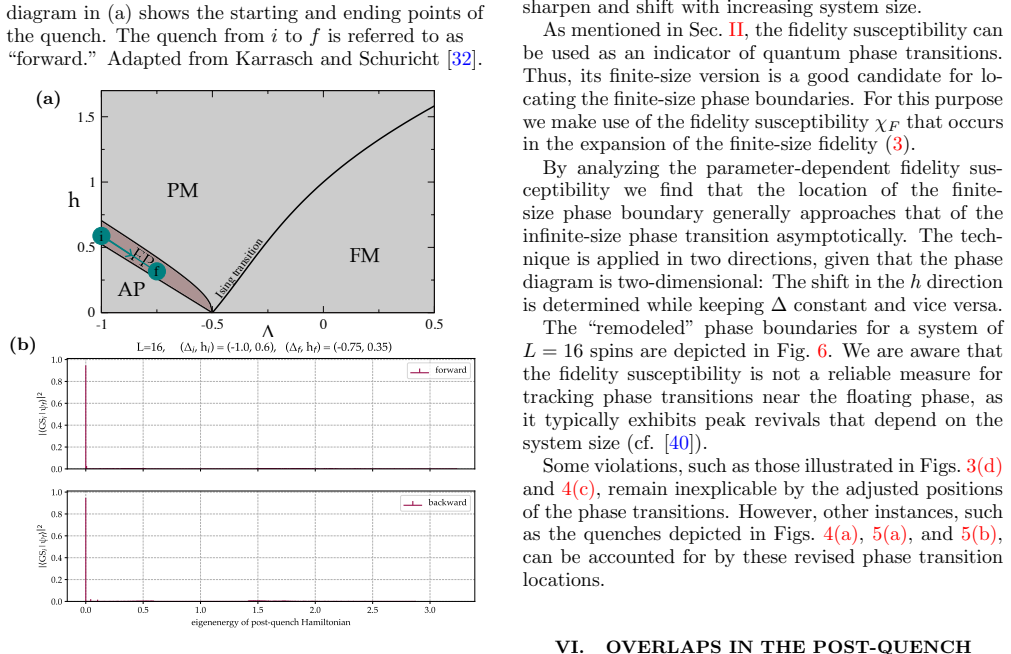
The proposed extension asserts that, for a quantum quench performed entirely within one phase, the overlap between the initial ground state and the eigenstates of the post-quench Hamiltonian reaches its largest value for the post-quench ground state. This holds analytically and numerically throughout the paramagnetic and ferromagnetic regimes of the transverse-field Ising model and is proven analytically for a special case of the axial next-nearest-neighbor Ising model.
What carries the argument
The overlap of the initial ground state with the full set of eigenstates of the final Hamiltonian, shown to peak at the final ground state when the quench remains inside a single phase.
If this is right
- Sudden changes inside a phase still leave the system with dominant ground-state character.
- The final ground state can serve as the leading approximation for post-quench dynamics without requiring full time evolution.
- Phase boundaries act as the dividing line separating regimes where this overlap rule applies from those where it does not.
Where Pith is reading between the lines
- The result suggests that a limited form of adiabatic protection survives even for non-adiabatic protocols provided the system stays gapped.
- Similar overlap maximization may be testable in quantum simulators or in other lattice models with well-separated phases.
Load-bearing premise
The quench is performed entirely within one phase and does not cross any phase boundary.
What would settle it
A calculation or measurement for an intra-phase quench in which the overlap with some excited eigenstate exceeds the overlap with the ground state would disprove the conjecture.
Figures




read the original abstract
We examine the validity of a potential extension of the adiabatic theorem to quantum quenches, i.e., nonadiabatic changes. In particular, the transverse field Ising model (TFIM) and the axial next nearest neighbor Ising (ANNNI) model are studied. The proposed extension of the adiabatic theorem is stated as follows: Consider the overlap between the initial ground state and the postquench Hamiltonian eigenstates for quenches within the same phase. This overlap is largest for the postquench ground state. In the case of the TFIM, this conjecture is confirmed for both the paramagnetic and ferromagnetic phases numerically and analytically. In the ANNNI model, the conjecture could be analytically proven for a special case. Numerical methods were employed to investigate the conjecture's validity beyond this special case.
Editorial analysis
A structured set of objections, weighed in public.
Referee Report
Summary. The manuscript proposes an extension of the adiabatic theorem to sudden quantum quenches that remain strictly inside a single phase (no gap closure or level crossing). The central conjecture states that the overlap between the initial ground state and the eigenstates of the post-quench Hamiltonian is maximal for the post-quench ground state. This is confirmed analytically for the full transverse-field Ising model (TFIM) in both the paramagnetic and ferromagnetic phases via its exact solution, analytically for a special case of the axial next-nearest-neighbor Ising (ANNNI) model, and numerically for other ANNNI parameters.
Significance. If the conjecture holds beyond the models studied, it would provide a simple organizing principle for the dominant overlaps in non-adiabatic dynamics of one-dimensional spin chains that do not cross phase boundaries. The analytical verifications for the TFIM (using its exact solvability) and the special ANNNI case constitute parameter-free, model-specific confirmations that strengthen the central claim; the numerical extensions add breadth to the evidence.
major comments (2)
- [§3] §3 (TFIM analytical confirmation): the manuscript states that the conjecture is proven analytically via the exact solution, but the key steps deriving that the ground-state overlap is strictly largest (including the explicit form of the overlaps and the proof that no other eigenstate exceeds it) are not shown; without these steps the analytical confirmation cannot be independently verified.
- [Numerical results] Numerical results for general ANNNI parameters (around Figure 4): the reported overlaps lack error bars, details on system sizes, number of disorder realizations or samples, and any data-exclusion criteria; this weakens the support for the conjecture outside the special analytically proven case.
minor comments (2)
- [Figure captions] The condition that the quench must remain inside one phase (no gap closure) is stated but should be emphasized with a brief reminder in the figure captions for the numerical data.
- [Introduction] Notation for the overlap integral (e.g., |⟨ψ₀|φₙ⟩|) should be introduced once in the main text and used consistently thereafter.
Simulated Author's Rebuttal
We thank the referee for the careful reading of our manuscript and the constructive comments. We address each major point below and will revise the manuscript accordingly to improve clarity and reproducibility.
read point-by-point responses
-
Referee: §3 (TFIM analytical confirmation): the manuscript states that the conjecture is proven analytically via the exact solution, but the key steps deriving that the ground-state overlap is strictly largest (including the explicit form of the overlaps and the proof that no other eigenstate exceeds it) are not shown; without these steps the analytical confirmation cannot be independently verified.
Authors: We agree that the explicit derivation steps and proof were not presented in sufficient detail. In the revised manuscript we will add the explicit form of the overlaps obtained from the Jordan-Wigner solution of the TFIM, together with the algebraic steps showing that the overlap with the post-quench ground state is strictly maximal among all eigenstates. This will be placed in an expanded §3 (or a new appendix) so that the analytical confirmation can be verified independently. revision: yes
-
Referee: Numerical results for general ANNNI parameters (around Figure 4): the reported overlaps lack error bars, details on system sizes, number of disorder realizations or samples, and any data-exclusion criteria; this weakens the support for the conjecture outside the special analytically proven case.
Authors: We acknowledge the need for these methodological details. In the revision we will augment the caption of Figure 4 and the numerical-methods paragraph with the following information: system sizes used (L = 8–20), number of independent samples (typically 10^4–10^5), standard-error bars on the overlap values, and the criterion that only data with overlap > 10^{-6} are retained to avoid numerical noise. These additions will strengthen the numerical support for the conjecture in the general ANNNI case. revision: yes
Circularity Check
No significant circularity detected
full rationale
The paper proposes a conjecture extending the adiabatic theorem to sudden quenches that remain inside one phase, asserting that the initial ground state has maximal overlap with the final ground state. This is then directly verified by exact diagonalization and analytic solution of the TFIM (both phases) and a special ANNNI case, followed by numerical checks on other ANNNI parameters. No derivation step reduces to a self-definition, a fitted parameter renamed as a prediction, or a load-bearing self-citation; the validations rest on the independent, explicitly solvable spectra of the chosen models and direct overlap calculations that do not presuppose the conjecture.
Axiom & Free-Parameter Ledger
axioms (1)
- domain assumption Quenches are performed within the same phase
Lean theorems connected to this paper
-
IndisputableMonolith/Cost/FunctionalEquation.leanwashburn_uniqueness_aczel unclear?
unclearRelation between the paper passage and the cited Recognition theorem.
max_n |⟨GS| fψ_n⟩|^2 = |⟨GS| fGS⟩|^2 (quenches inside same phase, no gap closure)
-
IndisputableMonolith/Foundation/AbsoluteFloorClosure.leanabsolute_floor_iff_bare_distinguishability unclear?
unclearRelation between the paper passage and the cited Recognition theorem.
TFIM analytic proof via θ_k(h) = ½ arctan(sin k / (h - cos k)) and tan²(Δθ) < 1
What do these tags mean?
- matches
- The paper's claim is directly supported by a theorem in the formal canon.
- supports
- The theorem supports part of the paper's argument, but the paper may add assumptions or extra steps.
- extends
- The paper goes beyond the formal theorem; the theorem is a base layer rather than the whole result.
- uses
- The paper appears to rely on the theorem as machinery.
- contradicts
- The paper's claim conflicts with a theorem or certificate in the canon.
- unclear
- Pith found a possible connection, but the passage is too broad, indirect, or ambiguous to say the theorem truly supports the claim.
Forward citations
Cited by 2 Pith papers
-
Exact Criterion for Ground-State Overlap Dominance after Quantum Quenches
For translationally invariant free-fermion systems with Hamiltonians factorizing into independent 2x2 sectors, the final ground state is the unique maximal-overlap state after a same-phase quench if and only if the in...
-
Exact Criterion for Ground-State Overlap Dominance after Quantum Quenches
Derives that ground-state overlap dominance after quenches requires the initial and final Bloch vectors to have positive dot product in every momentum sector, disproving the phase-based conjecture with explicit Kitaev...
Reference graph
Works this paper leans on
- [1]
-
[2]
M. V. Berry, Quantal phase factors accompanying adi- abatic changes, Proc. R. Soc. London Ser. A392, 45 (1984)
work page 1984
-
[3]
J. C. Budich and B. Trauzettel, From the adiabatic the- orem of quantum mechanics to topological states of mat- ter, Phys. Status Solidi RRL7, 109 (2013)
work page 2013
-
[4]
J. E. Avron, R. Seiler, and L. G. Yaffe, Adiabatic theo- rems and applications to the quantum Hall effect, Com- mun. Math. Phys.110, 33 (1987)
work page 1987
-
[5]
R. D. King-Smith and D. Vanderbilt, Theory of po- larization of crystalline solids, Phys. Rev. B47, 1651 (1993)
work page 1993
-
[6]
T. Albash and D. A. Lidar, Adiabatic quantum compu- tation, Rev. Mod. Phys.90, 015002 (2018)
work page 2018
-
[7]
M. B. Hastings and X.-G. Wen, Quasiadiabatic con- tinuation of quantum states: The stability of topologi- cal ground-state degeneracy and emergent gauge invari- ance, Phys. Rev. B72, 045141 (2005)
work page 2005
-
[8]
J. Henheik and S. Teufel, Justifying Kubo’s formula for gapped systems at zero temperature: A brief review and some new results, Rev. Math. Phys.33, 2060004 (2021)
work page 2021
-
[9]
S. Bachmann, W. De Roeck, and M. Fraas, Adiabatic theorem for quantum spin systems, Phys. Rev. Lett. 119, 060201 (2017)
work page 2017
- [10]
- [11]
-
[12]
H. Murayama, Y. Sato, T. Taniguchi, R. Kurihara, X. Z. Xing, W. Huang, S. Kasahara, Y. Kasahara, I. Kim- chi, M. Yoshida, Y. Iwasa, Y. Mizukami, T. Shibauchi, M. Konczykowski, and Y. Matsuda, Effect of quenched disorder on the quantum spin liquid state of the triangular-lattice antiferromagnet 1T-TaS2, Phys. Rev. Res.2, 013099 (2020)
work page 2020
- [13]
-
[14]
S. Trotzky, Y.-A. Chen, A. Flesch, I. P. McCulloch, U. Schollw¨ ock, J. Eisert, and I. Bloch, Probing the relaxation towards equilibrium in an isolated strongly correlated one-dimensional Bose gas, Nat. Phys.8, 325 (2012)
work page 2012
-
[15]
D. Rossini and E. Vicari, Dynamics after quenches in one-dimensional quantum Ising-like systems, Phys. Rev. B102, 054444 (2020)
work page 2020
- [16]
- [17]
-
[18]
J. H. Robertson, R. Senese, and F. H. L. Essler, A sim- ple theory for quantum quenches in the ANNNI model, SciPost Phys.15, 032 (2023)
work page 2023
-
[19]
M. Heyl, F. Pollmann, and B. D´ ora, Detecting equilib- rium and dynamical quantum phase transitions in Ising chains via out-of-time-ordered correlators, Phys. Rev. Lett.121, 016801 (2018)
work page 2018
-
[20]
L. Wang, Y.-H. Liu, J. Imriˇ ska, P. N. Ma, and M. Troyer, Fidelity susceptibility made simple: A uni- fied quantum Monte Carlo approach, Phys. Rev. X5, 031007 (2015)
work page 2015
-
[21]
P. Sierant, A. Maksymov, M. Ku´ s, and J. Zakrzewski, Fidelity susceptibility in Gaussian random ensembles, Phys. Rev. E99, 050102 (2019)
work page 2019
-
[22]
H.-Q. Zhou, R. Or´ us, and G. Vidal, Ground state fi- delity from tensor network representations, Phys. Rev. Lett.100, 080601 (2008)
work page 2008
-
[23]
H.-Q. Zhou, J.-H. Zhao, and B. Li, Fidelity approach to quantum phase transitions: Finite-size scaling for the quantum Ising model in a transverse field, J. Phys. A 41, 492002 (2008)
work page 2008
-
[24]
Gu, Fidelity approach to quantum phase transi- tions, Int
S.-J. Gu, Fidelity approach to quantum phase transi- tions, Int. J. Mod. Phys. B24, 4371–4458 (2010)
work page 2010
-
[25]
P. Zanardi and N. Paunkovi´ c, Ground state overlap and quantum phase transitions, Phys. Rev. E74, 031123 (2006)
work page 2006
-
[26]
L. Campos Venuti and P. Zanardi, Quantum critical scaling of the geometric tensors, Phys. Rev. Lett.99, 095701 (2007)
work page 2007
-
[27]
V. Mukherjee and A. Dutta, Fidelity susceptibility and general quench near an anisotropic quantum critical point, Phys. Rev. B83, 214302 (2011)
work page 2011
-
[28]
M. Thakurathi, D. Sen, and A. Dutta, Fidelity suscepti- bility of one-dimensional models with twisted boundary conditions, Phys. Rev. B86, 245424 (2012)
work page 2012
-
[29]
A. Silva, Statistics of the work done on a quantum criti- cal system by quenching a control parameter, Phys. Rev. Lett.101, 120603 (2008)
work page 2008
-
[30]
P. Jordan and E. P. Wigner, ¨Uber das Paulische ¨Aquivalenzverbot(Springer, Berlin, Heidelberg, 1993)
work page 1993
-
[31]
N. N. Bogoljubov, V. V. Tolmachov, and D. V. ˇSirkov, A new method in the theory of superconductivity, Fortschr. Phys.6, 605 (1958)
work page 1958
-
[32]
C. Karrasch and D. Schuricht, Dynamical phase tran- sitions after quenches in nonintegrable models, Phys. Rev. B87, 195104 (2013)
work page 2013
-
[33]
R. J. Elliott, Phenomenological discussion of magnetic ordering in the heavy rare-earth metals, Phys. Rev.124, 346 (1961)
work page 1961
-
[34]
M. E. Fisher and W. Selke, Infinitely many commensu- rate phases in a simple Ising model, Phys. Rev. Lett. 44, 1502 (1980)
work page 1980
- [35]
-
[36]
I. Peschel and V. Emery Calculation of spin correlations in two-dimensional Ising systems from one-dimensional kinetic models, Z. Phys. B43, 241 (1981). 14
work page 1981
-
[37]
H. Katsura, D. Schuricht, and M. Takahashi, Exact ground states and topological order in interacting Ki- taev/Majorana chains, Phys. Rev. B92, 115137 (2015)
work page 2015
-
[38]
I. Mahyaeh and E. Ardonne, Exact results for a Z3- clock-type model and some close relatives, Phys. Rev. B98, 245104 (2018)
work page 2018
-
[39]
E. Sela and R. G. Pereira, Orbital multicriticality in spin-gapped quasi-one-dimensional antiferromagnets, Phys. Rev. B84, 014407 (2011)
work page 2011
-
[40]
X.-J. Yu, S. Yang, J.-B. Xu, and L. Xu, Fidelity susceptibility as a diagnostic of the commensurate- incommensurate transition: A revisit of the pro- grammable Rydberg chain, Phys. Rev. B106, 165124 (2022)
work page 2022
-
[41]
S. Damerow and S. Kehrein, An extension of the adi- abatic theorem [Data set and code], Zenodo (2026), https://doi.org/10.5281/zenodo.18299066
discussion (0)
Sign in with ORCID, Apple, or X to comment. Anyone can read and Pith papers without signing in.