REVIEW 3 major objections 4 minor 67 references
Control of encounter kinetics by chemically active droplets
T0 review · 3 major / 4 minor · reviewed 2026-08-15 · deepseek-v4-flash
Pith's one-line read Chemically active droplets can either speed up or slow down molecular encounters, and the fastest encounter rate is reached when a particle's residence time in a droplet matches the Smoluchowski encounter time inside that droplet.
desk verdict A useful mean-field model for encounter kinetics in active emulsions with a qualitatively plausible time-scale-matching optimum, but the reported 'mean encounter time' is actually the slowest relaxation mode, so the quantitative claim needs another pass. read the letter →
The pith
A machine-rendered reading of the paper's core claim, the machinery that carries it, and where it could break.
The reading
What carries the argument
The load-bearing object is a five-state mean-field model of a two-particle search in a medium divided into N droplets of volume v and a continuous phase. The five states are: the particles have met; both are in distinct droplets; both are in the same droplet; one is in a droplet and the other in the continuous phase; both are in the continuous phase. Transitions between states are governed by inverse times: Smoluchowski encounter times τS,d = v/(8πD_dσ) inside a droplet and τS,c = (V−Nv)/(8πD_cσ) in the continuous phase, a residence time τres in a droplet, and an entry time τent. Solving the master equations yields the mean first encounter time Te as the longest relaxation time. The simulations supply τres, τent, diffusivities, droplet volumes, and droplet numbers, and the model then predicts Te without fitted parameters, reproducing the simulation data and exposing the optimum at τres ≈ τS,d.
What would settle it
Measure the residence time distribution of client proteins in a condensate system and the first-encounter time between partners while sweeping the chemical drive. If the encounter rate shows no maximum when τres crosses the droplet Smoluchowski time, or if the maximum appears at a very different ratio, the central claim fails. Concretely, a single-particle tracking experiment with a tunable ATP-driven modification should show a non-monotonic mean encounter time versus Δμ.
Extended reading notes
Core claim
The paper's central claim is that active chemical reactions do not merely set droplet size and stability; they directly control molecular transport through the droplet interface, and this transport controls reaction kinetics. In active emulsions driven by a chemostat, the residence time τres decreases as the chemical drive Δμ increases, generating particle fluxes at droplet surfaces. The key result is that, for fixed droplet geometry, the mean first encounter time Te is minimized when τres ≈ τS,d = v/(8πD_dσ), the Smoluchowski time for two particles to meet inside a droplet of volume v. When residence is much longer, particles waste time trapped in separate droplets; when much shorter, droplets do not concentrate partners long enough. The authors show that condensates can therefore either accelerate or decelerate encounters relative to a homogeneous reference, and they demonstrate the optimum in Brownian dynamics simulations with client proteins whose drive is varied independently of the scaffold.
Load-bearing premise
The five-state mean-field model treats droplet entry, exit, and encounters as independent exponential waiting times with constant rates, and it ignores correlations between the two searching particles; if real residence times are non-exponential or the two partners' stays are correlated, the predicted optimum at τres ≈ τS,d could shift or disappear.
Editorial extensions
If this is right
- A condensate can act as either an activator or a repressor of a given bimolecular reaction, depending on the ratio τres/τS,d.
- Because the chemical drive sets τres, post-translational-type modifications coupled to a free-energy reservoir could tune encounter rates in cells without changing droplet size or number.
- In multi-droplet systems at equilibrium, the encounter time grows approximately linearly with the number of droplets, so non-specific condensates can act as traps that slow partner search.
- Even with identical droplet geometry, active systems can have different encounter kinetics, so structure alone does not determine reaction speed in active emulsions.
- The five-state model generalizes Smoluchowski diffusion-limited kinetics to compartmentalized media and could be used to design condensate-based reactors.
Reading between the lines
- If the residence-time-matching rule is generic, synthetic condensate reactors could be engineered by choosing a chemical drive that sets τres equal to the predicted τS,d for the target pair.
- A testable extension would be to measure, in a single experimental condensate system, whether varying the chemical drive produces the predicted non-monotonic encounter-time curve with a minimum at τres ≈ τS,d.
- The same framework could be applied to multi-reactant networks, where selective acceleration or repression of individual pair encounters might shape reaction pathways without changing protein concentrations.
- Because the mean-field model neglects correlations between the two searching particles, the optimum may be sharper or shifted in crowded condensates where cooperative transport matters.
Signed reviews
Editorial analysis
A structured set of objections, weighed in public.
Referee Report
Summary. The manuscript combines Brownian dynamics (BD) simulations of phase-separating Lennard-Jones particles with a five-state mean-field model (Eqs. 1-5) to study bimolecular encounter kinetics in systems containing one or many droplets. The mean-field model is parameterized with transport coefficients and residence/entry times extracted from the same BD trajectories. For a single equilibrium droplet the model reproduces the BD encounter times and collapses onto Te/T0 = 1.14 D_c v/(D_d V); for multiple droplets it predicts Te/T0 ~ gamma N D_c v/(D_d V). In chemically active emulsions the chemical drive controls the residence time, and the mean-field model predicts that the encounter time is minimized when the residence time matches the intra-droplet Smoluchowski time. Client-protein BD simulations show qualitative agreement with the mean-field model, and the authors conclude that condensates can either accelerate or decelerate molecular encounters relative to a homogeneous system.
Significance. If the time-scale-matching principle survives scrutiny, it would provide a simple design rule for condensate-mediated reaction kinetics and a useful counterpoint to the common 'nanoreactor' picture. The work's strengths are the microscopic stochastic model, the explicit two-species client setup, and the honest bottom-up parameterization: the equilibrium comparison in Fig. 2b is a clean consistency check with no fitted parameters, and the client simulation series (Fig. 4b) is a nontrivial test of the mean-field approach. The significance is currently limited by the fact that the headline optimum is demonstrated only in the mean-field model under a definition of Te that is not the mean first-passage time, and the multi-droplet scaling used for biological estimates has no direct BD validation. These issues are fixable, but they are central to the claims.
major comments (3)
- [Appendix 'Mean encounter time between Brownian particles'; Section II, Eqs. (1)-(5)] The encounter time Te is defined as the largest characteristic time, Te = -1/lambda_max, and in BD it is extracted from the long-time exponential decay of the survival probability (SI Fig. S2). This is not the mean first-passage time \bar{T} = \int_0^\infty S(t) dt that the homogeneous reference T0 = V/(8\pi D\sigma) represents. The ratio Te/T0 therefore compares a slow-mode relaxation time with a mean encounter time, and the minimum in Fig. 3g may be dominated by a rare slow mode with small amplitude. The paper should recompute the true mean first-passage time from the five-state model (the weighted sum of the mode times) and from BD (the average first encounter time) and verify that the matching optimum and the reported acceleration/deceleration ratios are preserved.
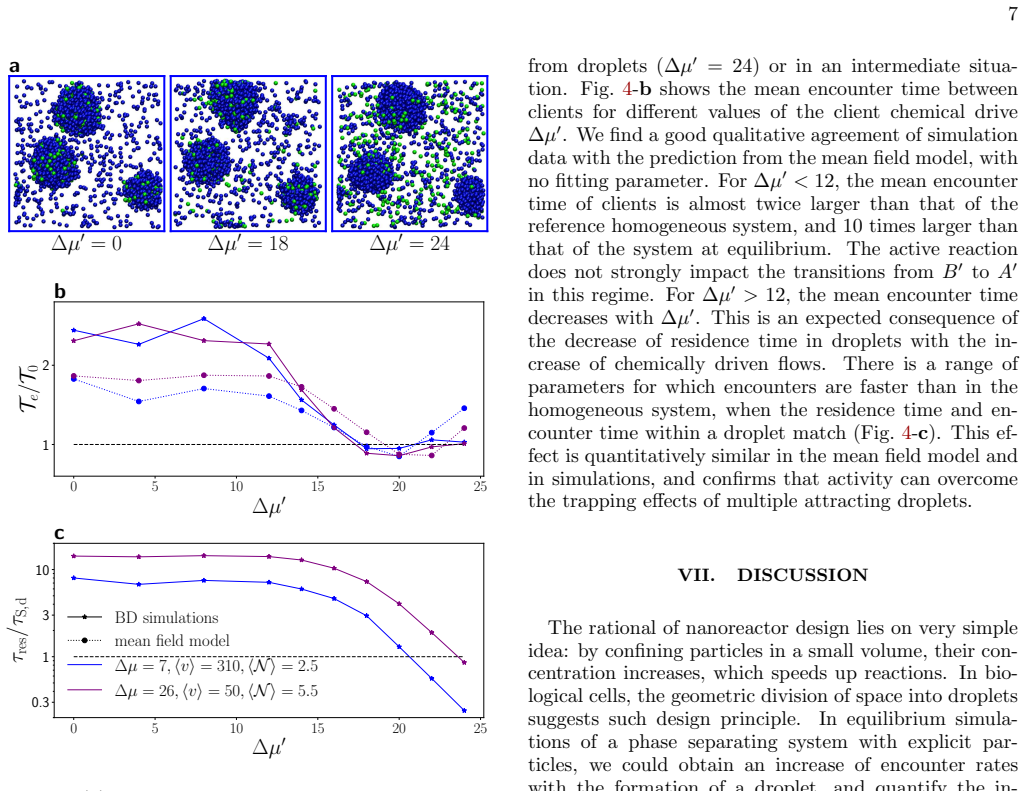
- [Section VI and Fig. 4b] The central claim that matching tau_res to tau_S,d maximizes the encounter rate is supported by mean-field calculations (Fig. 3g) but not directly by Brownian dynamics. In Fig. 4b, the client BD data show a monotonic decrease of Te/T0 with increasing Delta mu', with no clear nonmonotonic optimum, and the agreement with the mean-field model is only qualitative. Please provide a BD scan (for example, using the client drive) that resolves whether the nonmonotonic optimum exists in explicit particle simulations, or alternatively limit the claim to the mean-field model.
- [Section III and Fig. 2d] The multi-droplet scaling Te/T0 = gamma N D_c v/(D_d V) is derived only from the mean-field model, with gamma fitted in the range 5-10, and no Brownian dynamics data at N > 1 are presented. This scaling is subsequently used to estimate biological slowdowns (for instance, a 15-fold increase for N = 6 x 10^3). A direct BD test at moderate N would be needed to support the multi-droplet deceleration prediction; otherwise the scaling should be presented explicitly as a mean-field extrapolation.
minor comments (4)
- [Fig. 3 caption] The labels for panels (e) and (f) appear swapped: panel (e) plots tau_res and panel (f) plots J_A, while the caption assigns 'Net rate of A escape' to (e) and 'Residence time' to (f).
- [Section II] Calling Te the 'mean first encounter time' is misleading because it is the long-time decay time, not the average of the first-encounter distribution; please rename it or justify the definition in terms of the slowest mode.
- [Section III and Fig. 4 caption] The text contains 'Oswald ripening' where 'Ostwald ripening' is intended, and the Fig. 4 caption says 'For Delta mu = 18, droplets are unstable' where the context indicates Delta mu' = 18.
- [Section II and SI] The model assumes exponential waiting times for droplet entry and exit, but the distributions of residence times and entry times are not reported; showing these distributions (alongside the survival probability in SI Fig. S2) would help justify the Markovian five-state description.
Circularity Check
No significant circularity: the mean-field model's optimum is a nontrivial model result, and its parameters are measured, not fitted to the encounter-time output.
full rationale
The paper's central claim is that matching the residence time tau_res to the droplet Smoluchowski time tau_S,d maximizes the encounter rate in active phase-separated systems. This is derived from the five-state master equations (Eqs. 1-5), whose rates are built from measured transport coefficients (Dc, Dd, tau_res, tau_ent) extracted from Brownian dynamics simulations. The comparison of the model's Te with BD Te is a self-consistency check rather than an out-of-sample prediction, since the inputs and the validation data come from the same simulations. However, this is not circular in the relevant sense: no encounter-time observable is used to set the model parameters, and the non-monotonic dependence of Te on tau_res/tau_S,d is an emergent property of the master equation, not an identity or a fitted parameter renamed as a prediction. The scaling coefficients 1.14 and gamma in Figs. 2c-2d are fitted to the model's own output and used for biological extrapolation, but they are not fitted to the encounter data whose behavior is being explained. The self-citations to prior work describe the simulation methodology and the active-emulsion model; they do not carry the load of the time-scale-matching result. The skeptic's point that Te is defined as the largest characteristic time rather than the true mean first-passage time is a legitimate concern about the quantitative interpretation of Te and the comparison with the Smoluchowski mean T0, but it is a correctness or interpretation issue, not a circularity. Overall, the derivation chain is self-contained and the central claim is not forced by construction.
Assumptions & free parameters
free parameters (2)
- Multi-droplet scaling factor gamma =
5 to 10
- Single-droplet scaling coefficient =
1.14
assumptions (5)
- standard math Smoluchowski formula for encounter time in a finite homogeneous volume: tau_S = V/(8 pi D sigma).
- domain assumption The master equations (1)-(5) with constant transition rates are valid, implying exponential residence time distributions.
- domain assumption The interior of a droplet is a well-mixed homogeneous compartment with a single diffusion coefficient D_d, and the Smoluchowski time is v/(8 pi D_d sigma).
- domain assumption The steady-state geometry is fully characterized by the mean number of droplets N and mean droplet volume v.
- ad hoc to paper Active reactions are implemented with rates k^p proportional to (1 - phi_loc/phi_max) and k^a proportional to phi_loc/phi_max, and the chemostat only operates in dense regions.
Cite this review
Pith. "Pith review of Control of encounter kinetics by chemically active droplets." pith.science (2026). https://pith.science/paper/U4UYUFP2
@misc{pith2026250506153,
  author       = {Pith},
  title        = {Pith review of: Control of encounter kinetics by chemically active droplets},
  year         = {2026},
  howpublished = {\url{https://pith.science/paper/U4UYUFP2}},
  note         = {Machine review of arXiv:2505.06153}
}
read the original abstract
Biomolecular condensates play a crucial role in the spatial organization of living matter. These membrane-less organelles, resulting from liquid-liquid phase separation, operate far from thermodynamic equilibrium, with their size and stability influenced by non-equilibrium chemical reactions. While condensates are frequently considered optimized nanoreactors that enhance molecular encounters, their actual impact on reaction kinetics remains unclear due to competing effects such as diffusion hindrance, and random trapping in non-specific condensates. In this study, we develop a microscopic, stochastic model for chemically active droplets, incorporating reaction-driven modulation of protein interactions. Using Brownian dynamics simulations, we investigate how protein interactions and active coupling to a free energy reservoir influence phase separation, molecular transport and reaction kinetics. We demonstrate that the intensity of the chemical drive governs surface dynamics, generating fluxes that modulate bimolecular reaction rates. Comparing active emulsions to homogeneous systems, we reveal that condensates can either accelerate or decelerate molecular encounters. Our findings provide key insights into the role of biomolecular condensates as potential regulators of intracellular reaction kinetics.
Figures


Figures from the paper (1 more)
Reference graph
Works this paper leans on
-
[1]
Fig. 2-d shows the dramatic impact of multi-droplet geometries: with the mean field model, the encounter time Te linearly grows with N . This suggests that, while two particles in the same droplet rapidly meet, these par- ticles may also spend a long time trapped in distinct droplets. The curve collapse for N > 1 is not as good as with single droplet syste...
-
[2]
H.-X. Zhou, G. Rivas, and A. P. Minton, Macromolecu- lar crowding and confinement: Biochemical, biophysical, and potential physiological consequences, Annual Review of Biophysics 37, 375 (2008)
work page 2008
-
[3]
2 Te/ T0 d 10− 3 10− 1 101 τres/τ S, d 0.3 1 3 10 Te/ T0 g FIG. 3. (a) Snapshots from reactive Brownian Dynamics simulations , for ∆ w = − 3. 0, and three values of ∆ µ . A and B particles are both represented as blue spheres. For ∆ µ = 18, droplets are unstable, and the fluid is homogeneous. (b-f ) Properties of droplets computed at stationary state in BD...
-
[4]
O. B´ enichou, C. Chevalier, J. Klafter, B. Meyer, and R. Voituriez, Geometry-controlled kinetics, Nature Chem 2, 472 (2010)
work page 2010
-
[5]
R. Narayanan and M. A. El-Sayed, Shape-dependent cat- alytic activity of platinum nanoparticles in colloidal so- lution, Nano Letters 4, 1343 (2004)
work page 2004
-
[6]
Q. Zhou, L. Zhang, T. Yang, and H. W. and, Stimuli- responsive polymeric micelles for drug delivery and can- cer therapy, International Journal of Nanomedicine 13, 2921 (2018)
work page 2018
-
[7]
A. Corma, From microporous to mesoporous molecular sieve materials and their use in catalysis, Chemical Re- views 97, 2373 (1997)
work page 1997
-
[8]
F. Hinzpeter, U. Gerland, and F. Tostevin, Optimal compartmentalization strategies for metabolic microcom- partments, Biophysical Journal 112, 767 (2017)
work page 2017
Show all 67 references
-
[9]
F´ erey, Hybrid porous solids: past, present, future, Chemical Society Reviews 37, 191 (2008)
G. F´ erey, Hybrid porous solids: past, present, future, Chemical Society Reviews 37, 191 (2008)
2008
-
[10]
Solsona, J
M. Solsona, J. C. Vollenbroek, C. B. M. Tregouet, A.-E. Nieuwelink, W. Olthuis, A. Van Den Berg, B. M. Weck- huysen, and M. Odijk, Microfluidics and catalyst parti- cles, Lab on a Chip 19, 3575 (2019)
2019
-
[11]
Diamanti, D
E. Diamanti, D. Andr´ es-Sanz, A. H. Orrego, S. Carregal- Romero, and F. L´ opez-Gallego, Surpassing substrate– enzyme competition by compartmentalization, ACS Catal. 13, 11441 (2023)
2023
-
[12]
5 ⟨N ⟩ c 5 10 15 20 25 30 ∆ µ 0 10 20 30JA f ∆ w =0.0 ∆ w =-3.0 ∆ w =-6.0 ∆ w =-9.0 5 10 15 20 25 30 ∆ µ
-
[13]
T. Li, Q. Jiang, J. Huang, C. M. Aitchison, F. Huang, M. Yang, G. F. Dykes, H.-L. He, Q. Wang, R. S. Sprick, et al. , Reprogramming bacterial protein organelles as a nanoreactor for hydrogen production, Nat. Comm. 11, 5448 (2020)
2020
-
[14]
Kondrat, U
S. Kondrat, U. Krauss, and E. von Lieres, Enzyme co- localisation: Mechanisms and benefits, Current research in chemical biology 2, 100031 (2022)
2022
-
[15]
A. A. Hyman, C. A. Weber, and F. J¨ ulicher, Liquid- Liquid Phase Separation in Biology, Annu. Rev. Cell Dev. Biol. 30, 39 (2014)
2014
-
[16]
C. A. Weber, D. Zwicker, F. J¨ ulicher, and C. F. Lee, Physics of active emulsions, Reports on Progress in Physics 82, 064601 (2019)
2019
-
[17]
S. F. Banani, H. O. Lee, A. A. Hyman, and M. K. Rosen, Biomolecular condensates: organizers of cellular 11 biochemistry, Nat. Rev. Mol. Cell. Biol. 18, 285 (2017)
2017
-
[18]
Shin and C
Y. Shin and C. P. Brangwynne, Liquid phase conden- sation in cell physiology and disease, Science 357, 1253 (2017)
2017
-
[19]
Kojima and S
T. Kojima and S. Takayama, Membraneless compart- mentalization facilitates enzymatic cascade reactions and reduces substrate inhibition, ACS Appl. Mater. Inter- faces 10, 32782 (2018)
2018
-
[20]
Hinzpeter, F
F. Hinzpeter, F. Tostevin, and U. Gerland, Regula- tion of reaction fluxes via enzyme sequestration and co- clustering, Journal of The Royal Society Interface 16, 20190444 (2019)
2019
-
[21]
A. M. K¨ uffner, M. Prodan, R. Zuccarini, U. Ca- passo Palmiero, L. Faltova, and P. Arosio, Acceleration of an Enzymatic Reaction in Liquid Phase Separated Com- partments Based on Intrinsically Disordered Protein Do- mains, ChemSystemsChem 2, e2000001 (2020)
2020
-
[22]
Peeples and M
W. Peeples and M. K. Rosen, Mechanistic dissection of increased enzymatic rate in a phase-separated compart- ment, Nature Chemical Biology 17, 693 (2021)
2021
-
[23]
B. G. O’Flynn and T. Mittag, The role of liquid–liquid phase separation in regulating enzyme activity, Current Opinion in Cell Biology 69, 70 (2021)
2021
-
[24]
Ranganathan, J
S. Ranganathan, J. Liu, and E. Shakhnovich, Enzy- matic metabolons dramatically enhance metabolic fluxes of low-efficiency biochemical reactions, Biophysical Jour- nal 122, 4555 (2023)
2023
-
[25]
I. B. Smokers, B. S. Visser, A. D. Slootbeek, W. T. Huck, and E. Spruijt, How droplets can accelerate re- actions. coacervate protocells as catalytic microcompart- ments, Acc. Chem. Res. 57, 1885 (2024)
2024
-
[26]
Smoluchowski, Drei Vortr¨ age ¨ uber Diffusion, Brown- sche Molekularbewegung und Koagulation von Kol- loidteilchen, Phys
M. Smoluchowski, Drei Vortr¨ age ¨ uber Diffusion, Brown- sche Molekularbewegung und Koagulation von Kol- loidteilchen, Phys. Z. 17, 557 (1916)
1916
-
[27]
Najafi, S
J. Najafi, S. Dmitrieff, and N. Minc, Size-and position- dependent cytoplasm viscoelasticity through hydrody- namic interactions with the cell surface, Proceedings of the National Academy of Sciences 120, e2216839120 (2023)
2023
-
[28]
R. J. Ellis and A. P. Minton, Join the crowd, Nature 425, 27 (2003)
2003
-
[29]
S. B. Zimmerman and A. P. Minton, Macromolecular Crowding: Biochemical, Biophysical, and Physiological Consequences, Annu. Rev. Biophys. Biomol. Struct 22, 27 (1993)
1993
-
[30]
A. P. Minton, How can biochemical reactions within cells differ from those in test tubes ?, J. Cell Sci. 2, 2863 (2015)
2015
-
[31]
Saini and T
B. Saini and T. K. Mukherjee, Biomolecular condensates regulate enzymatic activity under a crowded milieu: Syn- chronization of liquid-liquid phase separation and enzy- matic transformation, Journal of Physical Chemistry B 127, 180 (2023)
2023
-
[32]
M. A. Steves, C. He, and K. Xu, Single-Molecule Spec- troscopy and Super-Resolution Mapping of Physicochem- ical Parameters in Living Cells, Annual Review of Phys- ical Chemistry 75, 163 (2024)
2024
-
[33]
W. M. ´Smigiel, L. Mantovanelli, D. S. Linnik, M. Punter, J. Silberberg, L. Xiang, K. Xu, and B. Poolman, Pro- tein diffusion in escherichia coli cytoplasm scales with the mass of the complexes and is location dependent, Science Advances 8, eabo5387 (2022)
2022
-
[34]
K. A. Lorenz-Ochoa and C. R. Baiz, Ultrafast spec- troscopy reveals slow water dynamics in biocondensates, Journal of the American Chemical Society 145, 27800 (2023)
2023
-
[35]
A. C. Murthy, G. L. Dignon, Y. Kan, G. H. Zerze, S. H. Parekh, J. Mittal, and N. L. Fawzi, Molecular inter- actions underlying liquid-liquid phase separation of the FUS low-complexity domain, Nature Structural & Molec- ular Biology 26, 637 (2019)
2019
-
[36]
F. C. Keber, T. Nguyen, A. Mariossi, C. P. Brang- wynne, and M. W¨ uhr, Evidence for widespread cytoplas- mic structuring into mesoscale condensates, Nature Cell Biology 26, 346 (2024)
2024
-
[37]
J. T. Wang, J. Smith, B. C. Chen, H. Schmidt, D. Ra- soloson, A. Paix, B. G. Lambrus, D. Calidas, E. Bet- zig, and G. Seydoux, Regulation of rna granule dynamics by phosphorylation of serine-rich, intrinsically disordered proteins in c. elegans, eLife 3, 04591 (2014)
2014
-
[38]
W. P. Lipi´ nski, B. S. Visser, I. Robu, M. A. Fakhree, S. Lindhoud, M. M. Claessens, and E. Spruijt, Biomolec- ular condensates can both accelerate and suppress ag- gregation of α -synuclein, Science advances 8, eabq6495 (2022)
2022
-
[39]
Zwicker, R
D. Zwicker, R. Seyboldt, C. A. Weber, A. A. Hyman, and F. Julicher, Growth and division of active droplets provide a model for protocells, Nature Physics 13, 408 (2017)
2017
-
[40]
Guilhas, J
B. Guilhas, J. C. Walter, J. Rech, G. David, N. O. Wal- liser, J. Palmeri, C. Mathieu-Demaziere, A. Parmeggiani, J. Y. Bouet, A. L. Gall, and M. Nollmann, Atp-driven separation of liquid phase condensates in bacteria, Molec- ular Cell 79, 293 (2020)
2020
-
[41]
Zwicker, The intertwined physics of active chemical reactions and phase separation, Current Opinion in Col- loid & Interface Science 61, 101606 (2022)
D. Zwicker, The intertwined physics of active chemical reactions and phase separation, Current Opinion in Col- loid & Interface Science 61, 101606 (2022)
2022
-
[42]
Tjhung, C
E. Tjhung, C. Nardini, and M. E. Cates, Cluster Phases and Bubbly Phase Separation in Active Fluids: Reversal of the Ostwald Process, Phys. Rev. X 8, 31080 (2018)
2018
-
[43]
Hondele, R
M. Hondele, R. Sachdev, S. Heinrich, J. Wang, P. Vallot- ton, B. M. A. Fontoura, and K. Weis, Dead-box atpases are global regulators of phase-separated organelles, Na- ture 573, 144 (2019)
2019
-
[44]
T. H. Kim, B. Tsang, R. M. Vernon, N. Sonenberg, L. E. Kay, and J. D. Forman-Kay, Phospho-dependent phase separation of fmrp and caprin1 recapitulates regulation of translation and deadenylation, Science 365, 825 (2019)
2019
-
[45]
Linsenmeier, M
M. Linsenmeier, M. Hondele, F. Grigolato, E. Sec- chi, K. Weis, and P. Arosio, Dynamic arrest and ag- ing of biomolecular condensates are modulated by low- complexity domains, rna and biochemical activity, Nat. Commun. 13, 3030 (2022)
2022
-
[46]
Ziethen, J
N. Ziethen, J. Kirschbaum, and D. Zwicker, Nucleation of Chemically Active Droplets, Phys. Rev. Lett. 130, 248201 (2023)
2023
-
[47]
H. Wu, X. Chen, Z. Shen, H. Li, S. Liang, Y. Lu, and M. Zhang, Phosphorylation-dependent membraneless or- ganelle fusion and fission illustrated by postsynaptic den- sity assemblies, Molecular Cell 84, 309 (2024)
2024
-
[48]
S¨ oding, D
J. S¨ oding, D. Zwicker, S. Sohrabi-Jahromi, M. Boehning, and J. Kirschbaum, Mechanisms for active regulation of biomolecular condensates, Trends in Cell Biology 30, 4 (2020)
2020
-
[49]
Gouveia, Y
B. Gouveia, Y. Kim, J. W. Shaevitz, S. Petry, H. A. Stone, and C. P. Brangwynne, Capillary forces generated by biomolecular condensates, Nature 609, 255 (2022) . 12
2022
-
[50]
Berthin, J
R. Berthin, J. D. Fries, M. Jardat, V. Dahirel, and P. Il- lien, Microscopic and stochastic simulations of chemically active droplets, Phys. Rev. E 111, L023403 (2025)
2025
-
[51]
Fries, J
J. Fries, J. Diaz, M. Jardat, I. Pagonabarraga, P. Il- lien, and V. Dahirel, Active droplets controlled by enzy- matic reactions, Journal of The Royal Society Interface 22, 20240803 (2025)
2025
-
[52]
Smit and D
B. Smit and D. Frenkel, Vapor–liquid equilibria of the two-dimensional lennard-jones fluid(s), J. Chem. Phys. 94, 5663 (1991)
1991
-
[53]
J. D. Weeks, D. Chandler, and H. C. Andersen, Role of repulsive forces in determining the equilibrium structure of simple liquids, J. Chem. Phys. 54, 5237 (1971)
1971
-
[54]
Mazzocca, A
M. Mazzocca, A. Loffreda, E. Colombo, T. Fillot, D. Gnani, P. Falletta, E. Monteleone, S. Capozi, E. Bertrand, G. Legube, Z. Lavagnino, C. Tacchetti, and D. Mazza, Chromatin organization drives the search mechanism of nuclear factors, Nature Communications 14, 6433 (2023)
2023
-
[55]
Min´ e-Hattab, M
J. Min´ e-Hattab, M. Heltberg, M. Villemeur, C. Guedj, T. Mora, A. M. Walczak, M. Dahan, and A. Taddei, Sin- gle molecule microscopy reveals key physical features of repair foci in living cells., eLife 10, e60577 (2021)
2021
-
[56]
W. T. Snead and A. S. Gladfelter, The control centers of biomolecular phase separation: How membrane sur- faces, ptms, and active processes regulate condensation, Molecular Cell 76, 295 (2019)
2019
-
[57]
C. W. Gardiner, Handbook of Stochastic Methods (Springer, 1985)
1985
-
[58]
Decayeux, V
J. Decayeux, V. Dahirel, M. Jardat, and P. Illien, Spon- taneous propulsion of an isotropic colloid in a phase- separating environment, Physical Review E 104, 034602 (2021)
2021
-
[59]
I. S. Burgos, J. R. Espinosa, A. Garaizar, R. Collepardo- Guevara, and J. A. Joseph, Study on stability, compo- sition, and protein arrangement within biocondensates formed via liquid-liquid phase separation, Biophysical Journal 121, 357a (2022)
2022
-
[60]
Alon, An introduction to systems biology: design prin- ciples of biological circuits (Chapman and Hall/CRC, 2019)
U. Alon, An introduction to systems biology: design prin- ciples of biological circuits (Chapman and Hall/CRC, 2019)
2019
-
[61]
A. P. Thompson, H. M. Aktulga, R. Berger, D. S. Bolin- tineanu, W. M. Brown, P. S. Crozier, P. J. in ’t Veld, A. Kohlmeyer, S. G. Moore, T. D. Nguyen, R. Shan, M. J. Stevens, J. Tranchida, C. Trott, and S. J. Plimpton, LAMMPS - a flexible simulation tool for particle-based mate...
2022
-
[62]
M. P. Allen and D. J. Tildesley, Computer Simulation of Liquids (Oxford University Press, 1987). 1 Control of encounter kinetics by chemically active droplets Supplementary Information Jacques Fries, Roxanne Berthin, Marie Jardat, Pierre Illien, Vinc ent Dahirel Sorbonne Unive...
1987
-
[63]
50 ˙v B. FIG. S1. A. Probability distribution of droplet volume v at stationar y state for various values of the chemical drive ∆ µ . B. Phase portrait of the volume of droplets (derivative of the volume with respect to time as a function of th e volume) for different values of...
-
[64]
0 7. 5 10. 0 12. 5 15. 0 17. 5 20. 0 22. 5 25. 0 ∆ µ 0 10 20 30JA a. ∆ w =0.0 ∆ w =-3.0 ∆ w =-6.0 ∆ w =-9.0
-
[65]
0 1. 5 2. 0 2. 5 3. 0 3. 5 4. 0 4. 5 5. 0 ∆ µ
-
[66]
0 1000 50 100y c
15 Max(µ A, in kBT − µ A, out kBT ) b. 0 1000 50 100y c. 0 100 0 100 x 0 100
-
[67]
75 FIG. S4. (a) Net rate of A escape from droplets JA = (− dNA/dt )diff , computed from BD simulations. (b) Maximal difference of steady state chemical potential of A species inside and outside droplets in continuous systems. T he partial differential equations are solved using t...
2025
Reviewed August 15, 2026 · model on record in the stance chip above.
Discussion (0). Continue with ORCID to comment.