REVIEW 4 major objections 5 minor 42 references
Magnetothermal Properties with Sampled Effective Local Field Estimation
T0 review · 4 major / 5 minor · reviewed 2026-08-15 · deepseek-v4-flash
Pith's one-line read SELFE computes magnetic transition temperatures from one DFT calculation and 350 samples, matching a spin-dynamics baseline at up to 142x lower sampling cost.
desk verdict SELFE is a promising efficiency trick for magnetic heat-capacity prediction, but its accuracy claim currently rests on one experimental match plus a shared-input comparison to Multibinit. read the letter →
The pith
A machine-rendered reading of the paper's core claim, the machinery that carries it, and where it could break.
The reading
What carries the argument
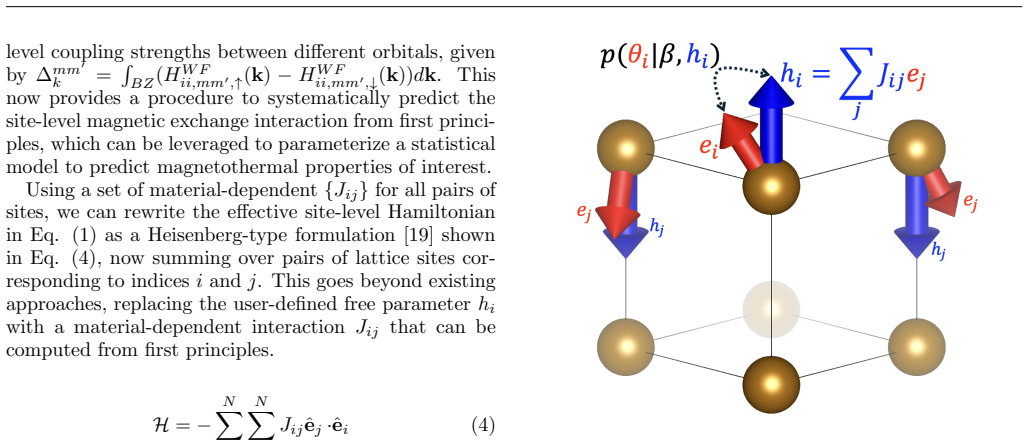
The load-bearing object is the single-site Boltzmann factor $p(\theta_i \mid \beta, \bar{h}_i) = \frac{\beta \bar{h}_i}{4\pi \sinh(\beta \bar{h}_i)} e^{\beta \bar{h}_i \cos \theta_i}$, which gives the conditional distribution of the polar angle of each spin relative to its effective local field. SELFE sets that field by the Heisenberg-type sum $\bar{h}_i = \sum_j J_{ij} \hat{e}_j$, with the isotropic $J_{ij}$ computed from a Green's function expression so that no empirical parameter enters. The algorithm iterates: sample angles from $p$, rotate into the global crystal frame, mix with the previous configuration, recompute $\bar{h}_i$, and stop when a Z-score on recent energy differences passes a Student's $t$-distribution threshold. The factorization that lets the partition function become a product of independent single-site integrals is what makes 350 samples sufficient; it is also the mechanism that keeps the method fully automated.
What would settle it
Run the method on a magnetic compound whose transition temperature is known from experiment and whose low-energy physics is dominated by nonlocal correlations, for example a frustrated triangular or pyrochlore antiferromagnet, and compare the predicted heat-capacity peak with experiment and with a long Monte Carlo simulation using the same $J_{ij}$. If the 350-sample SELFE curve misses the transition while the long simulation captures it, the single-site factorization in Eq. (2) is the point of failure; if SELFE still matches, the factorization is more robust than the derivation implies.
Extended reading notes
Core claim
The paper's central claim is that a solid's magnetic transition temperature and magnetic heat capacity can be obtained from a single unit-cell DFT calculation, without spin-constrained supercells or user-set parameters, by sampling each spin from the conditional distribution $p(\theta_i \mid \beta, h_i) = \frac{\beta h_i}{4\pi \sinh(\beta h_i)} e^{\beta h_i \cos \theta_i}$ under an effective local field $\bar{h}_i = \sum_j J_{ij} \hat{e}_j$ built from Green's-function-derived exchange couplings. Applied to iron, the method gives $T_C = 1{,}016$ K for BCC-Fe, close to the experimental $1{,}043$ K, and $T_N = 259$ K for FCC-Fe, matching the Multibinit baseline's $256$ K while both exceed the experimental $67$ K estimate for that phase. The authors present the close agreement with Multibinit's heat-capacity curves and the 350-sample convergence as evidence that the single-site sampling under self-consistent local fields captures the finite-temperature magnetic statistics at a fraction of the usual cost.
Load-bearing premise
Everything rests on the assumption that the exchange couplings $J_{ij}$ obtained from the Green's function procedure are accurate enough, and that treating each spin independently under its current local field captures the physics, so that the finite-temperature statistics of the real material are the statistics of Eq. (2).
Editorial extensions
If this is right
- High-throughput screening of magnetic materials becomes practical: one unit-cell DFT run per candidate supplies the $J_{ij}$, and 350 samples per temperature yield the ordering temperature and heat-capacity peak.
- Both ferro- and antiferromagnetic ordering temperatures are covered by the same code path, so the method is not tuned to one magnetic order.
- Because the effective field in Eq. (4) is the only material input besides the lattice, the accuracy ceiling for transition temperatures is set by the exchange couplings $J_{ij}$; any improvement in $J_{ij}$ transfers directly to SELFE.
- The same sampling distribution can be reused for other thermal averages, so magnetic susceptibility, magnetocaloric entropy change, and magnetic contributions to the Gibbs free energy are reachable extensions of the same workflow.
Reading between the lines
- The paper's comparison is between two implementations that consume the same exchange couplings, so the close match in Fig. 4 mainly shows that the two sampling strategies agree, not that either is independently validated against magnetism outside iron; a discriminating test would use a compound whose $J_{ij}$ were fixed by inelastic neutron scattering.
- The reported 142x improvement counts averaging samples; it does not include the cost of the Green's function $J_{ij}$ calculation or the quadratic field updates, so a wall-clock comparison for large cells would be tighter.
- The single-site form of Eq. (2) factorizes the spin statistics; on a frustrated lattice, where correlations cannot be captured by a local field, the method may underperform, and that is exactly where a stress test should be run.
Signed reviews
Editorial analysis
A structured set of objections, weighed in public.
Referee Report
Summary. The paper introduces Sampled Effective Local Field Estimation (SELFE), a method that combines DFT-derived Green's-function exchange parameters Jij with a self-consistent single-site angular sampling scheme to compute magnetic heat capacity and critical temperatures. The method is demonstrated on BCC-Fe and FCC-Fe, reporting TC = 1,016 K for BCC-Fe (experiment 1,043 K), TN = 259 K for FCC-Fe (experiment 67 K), close agreement with the Multibinit baseline (1,026 K and 256 K), and a claimed sample-efficiency improvement of up to 142x over Multibinit. The authors state that SELFE is fully automated, requires only a single unit-cell DFT calculation, avoids spin-constrained supercells, and has no free parameters.
Significance. If the central approximation is valid, SELFE would be a practically valuable method for high-throughput magnetothermal screening, since it avoids spin-constrained supercells and needs only one unit-cell DFT calculation. The paper's strengths include detailed DFT input files in the Supplemental Material, a clearly stated algorithm, and a convergence criterion that could be automated. However, the method's core statistical justification is not established, the experimental validation consists of one successful system, and the efficiency comparison is not yet well defined. Because the method is fast and reproducible, a revised version that addresses these points could be a useful contribution; in its current form the central claims outrun the evidence.
major comments (4)
- [Section II, Eq. (4) and Algorithm 1] The key step of the method is the assertion that, 'Because the form is the same as the original one body Hamiltonian, we can use the same probability distribution above (Eqn. 2) to sample the magnetic moment angles.' This inference is not proven. Eq. (2) is exact for a Hamiltonian with independent fixed fields hi, but in SELFE the field is hi = Sum_j Jij e_j and depends on the current configuration of all spins; moreover, all sites are updated simultaneously from fields computed from the previous configuration. No derivation or numerical test shows that the stationary distribution of this self-consistent sampler equals the Boltzmann distribution of Eq. (4). This is a mean-field-like approximation, not an exact sampling scheme. The authors should either prove convergence to the correct equilibrium distribution or benchmark SELFE against an exact Monte Carlo / heat-bath sampling of Eq. (4) on the same lattice and with the same Jij. Without this, the first-principles accuracy claim for SELFE is not established.
- [Section IV, Table I, Figure 4] The experimental validation currently rests on a single successful case. BCC-Fe gives TC = 1,016 K, close to the experimental 1,043 K, but FCC-Fe gives TN = 259 K versus the experimental 67 K, a factor of about four overestimate. The close agreement with Multibinit's 256 K is not independent validation, because both methods use the same TB2J exchange parameters computed from the same DFT electronic structure; the comparison tests two approximate solvers against each other, not the transferability of Jij to finite-temperature statistics. The abstract's claim of 'excellent agreement' with experimental data is therefore too strong. The authors should either expand the benchmark set to additional magnetic systems or substantially soften the accuracy claims in the abstract and conclusions.
- [Section III, Table I] The claimed 'sample efficiency improvement of up to 142x' is not well defined. SELFE is reported to use 350 averaging steps and 1 thermalization step, while Multibinit uses 5,000 (BCC-Fe) or 2,000 (FCC-Fe) thermalization steps plus 50,000 or 10,000 averaging steps. However, SELFE's 350 steps appear to exclude the self-consistent iterations needed to reach the convergence criterion at each temperature, and the mixing parameter gamma and window size n also affect the total work. Without reporting the total number of Hamiltonian evaluations, including all SELFE self-consistency iterations, and preferably wall-clock times, the 'over two orders of magnitude' efficiency gain is not verifiable.
- [Section II, Eqs. (5)-(7)] The Z-score convergence criterion uses overlapping energy differences: Delta_m = E_k - E_{k-m} for m = 1, ..., n, so the same E_k appears in multiple Delta_m values. These differences are not independent, which invalidates the statement that Z follows a Student's t-distribution with n-1 degrees of freedom. This could cause premature or delayed convergence detection. The authors should use non-overlapping blocks of energy differences or otherwise justify the independence assumption.
minor comments (5)
- [Section III] The text contains several typographical errors: 'Perdue-Burke-Ernzerhof' should be 'Perdew-Burke-Ernzerhof', 'Briollion Zone' should be 'Brillouin Zone', and 'wre' should be 'were'.
- [Section IV, Figure 4] The heat capacity curves are normalized to [0,1], which removes the absolute magnitude of the magnetic specific heat. Since magnetothermal applications depend on the absolute value of cm, the authors should report unnormalized heat capacities or provide the normalization scale.
- [Table I] The notation '1x1 g' and '1x2 g' for DFT requirements is ambiguous; it should be explicitly defined (e.g., one unit-cell calculation for BCC-Fe and one two-atom primitive calculation for FCC-Fe).
- [Section II, Algorithm 1] The paper states that SELFE 'eliminates the need for free parameters,' but Algorithm 1 requires user-specified values for the mixing parameter gamma, the confidence level alpha, the window size n, the maximum number of iterations nmax, and the spin-lattice size. These are algorithmic parameters rather than physical fitting parameters, but the claim should be phrased more precisely.
- [Supplemental Material, Eq. (16)] The derivation of the site-level distribution assumes the field is oriented along the z-axis in the local frame. The main text handles the general orientation with rotation matrices, but the supplemental derivation should state this assumption explicitly so the connection between Eq. (2) and the general vector case is clear.
Circularity Check
No significant circularity: SELFE's predictions follow from DFT-derived exchange parameters through an explicit sampling loop, with no target data used as input.
full rationale
SELFE's derivation chain is self-contained in the relevant sense. The exchange parameters Jij are obtained from a Green's-function/TB2J route (Eq. 3) from a single DFT calculation; the sampling distribution p(theta|beta,h_i) is derived analytically for a single-site Hamiltonian (Eq. 2 and Supplemental Sec. VI); and the Heisenberg effective field h_i = sum_j J_ij e_j is inserted into that distribution in a self-consistent loop (Algorithm 1). No experimental Curie or Neel temperature is used to fit or calibrate any constant, and no fitted parameter is renamed as a prediction. The comparison with Multibinit uses the same {Jij}, so it is partly a common-input consistency check, but that is a benchmark-design choice, not a circular derivation: the SELFE critical temperatures are not obtained from Multibinit outputs. The main scientific caveats—that the factorized single-site distribution is not proven to be the stationary distribution of the self-consistent Heisenberg sampler, and that FCC-Fe TN (259 K) overestimates experiment (67 K)—are correctness and approximation concerns, not circularity. The sole citation involving a coauthor (Ref. 40, on magnetocrystalline anisotropy) is not load-bearing. Therefore the paper does not exhibit a circular derivation.
Assumptions & free parameters
free parameters (5)
- mixing parameter gamma =
0.9 recommended default
- confidence level alpha =
0.05
- window size n =
5
- number of samples =
350
- spin lattice size =
5x5x5
assumptions (4)
- domain assumption The classical single-site Boltzmann distribution p(theta) proportional to exp(beta h cos theta) is a sufficient statistical model for finite-temperature magnetism after replacing h with the mean field from Jij.
- domain assumption TB2J, following Korotin et al. [26], yields accurate isotropic exchange parameters Jij from the DFT ground state of the ordered unit cell.
- domain assumption The energy differences in the self-consistent loop are approximately independent and normally distributed, justifying the Student's t-test convergence criterion.
- domain assumption Neglecting higher-order terms beyond isotropic pair exchange is adequate for BCC-Fe and FCC-Fe at the studied temperatures.
Cite this review
Pith. "Pith review of Magnetothermal Properties with Sampled Effective Local Field Estimation." pith.science (2026). https://pith.science/paper/3ZHBJTXT
@misc{pith2026250506431,
  author       = {Pith},
  title        = {Pith review of: Magnetothermal Properties with Sampled Effective Local Field Estimation},
  year         = {2026},
  howpublished = {\url{https://pith.science/paper/3ZHBJTXT}},
  note         = {Machine review of arXiv:2505.06431}
}
read the original abstract
We introduce a first-principles method for predicting the magnetothermal properties of solid-state materials, which we call Sampled Effective Local Field Estimation. This approach achieves over two orders of magnitude improvement in sample efficiency compared to current state-of-the-art methods, as demonstrated on representative material systems. We validate our predictions against experimental data for well-characterized magnetic materials, showing excellent agreement. The method is fully automated and requires minimal computational resources, making it well suited for integration into high-throughput materials discovery workflows. Our method offers a scalable and accurate predictive framework that can accelerate the design of next-generation materials for magnetic refrigeration, cryogenic cooling, and magnetic memory technologies.
Figures


Figures from the paper (1 more)

Reference graph
Works this paper leans on
-
[1]
K. A. Gschneidner, A. O. Pecharsky, and V. K. Pecharsky, Low temperature cryocooler regenerator ma- terials, in Cryocoolers 12, edited by R. G. Ross (Springer US, Boston, MA, 2003) pp. 457–465
work page 2003
-
[2]
T. Numazawa, O. Arai, A. Sato, S. Fujimoto, T. Oodo, Y. M. Rang, and T. Yanagitani, New regenerator mate- rial for sub-4 k cryocoolers, in Cryocoolers 11, edited by R. G. Ross (Springer US, Boston, MA, 2002) pp. 465– 473
work page 2002
-
[3]
S. Manipatruni, D. E. Nikonov, C.-C. Lin, T. A. Gosavi, H. Liu, B. Prasad, Y.-L. Huang, E. Bonturim, R. Ramesh, and I. A. Young, Scalable energy-efficient magnetoelectric spin-orbit logic, Nature 565, 35 (2019)
work page 2019
- [4]
-
[5]
E. Johnson, F. Pilat, H. Qualls, E. Colby, K. Fisher, N. Melcer, and K. Runkles, Supply Chain Risk Mitigation for Scientific Facilities and Tools , Tech. Rep. November (USDOE Office of Science (SC) (United States), 2022)
work page 2022
-
[6]
V. T. Rajan, Magnetic Susceptibility and Specific Heat of the Coqblin-Schrieffer Model, Physical Review Letters 51, 308 (1983)
work page 1983
-
[7]
L. Ghivelder, I. Abrego Castillo, M. A. Gusm˜ ao, J. A. Alonso, and L. F. Cohen, Specific heat and magnetic order in LaMnO, Physical Review B 60, 12184 (1999), arXiv:9904232v1 [arXiv:cond-mat]
work page 1999
-
[8]
K. Ohno, F. Mauri, and S. G. Louie, Magnetic suscepti- bility of semiconductors by an all-electron first-principles approach, Physical Review B 56, 1009 (1997)
work page 1997
Show all 42 references
-
[9]
Mauri and S
F. Mauri and S. G. Louie, Magnetic Susceptibility of In- sulators from First Principles, Physical Review Letters 76, 4246 (1996), arXiv:9604008 [mtrl-th]
1996
-
[10]
G. H. O. Daalderop, P. J. Kelly, and M. F. H. Schu- urmans, First-principles calculation of the magnetocrys- talline anisotropy energy of iron, cobalt, and nickel, Phys- ical Review B 41, 11919 (1990)
1990
-
[11]
J. A. Cooley, G. Dairaghi, G. C. Moore, M. K. Horton, E. C. Schueller, K. A. Persson, and R. Seshadri, Mag- netism and magnetocaloric properties of co {1−x} mn x cr 2 o 4, arXiv preprint arXiv:2309.16168 (2023)
2023 arXiv
-
[12]
Shang, J
S.-L. Shang, J. E. Saal, Z.-G. Mei, Y. Wang, and Z.- K. Liu, Magnetic thermodynamics of fcc Ni from first- principles partition function approach, Journal of Ap- plied Physics 108, 10.1063/1.3524480 (2010)
2010 doi
-
[13]
Y. O. Kvashnin, O. Gr˚ an¨ as, I. Di Marco, M. I. Kat- snelson, A. I. Lichtenstein, and O. Eriksson, Exchange parameters of strongly correlated materials: Extraction from spin-polarized density functional theory plus dy- Approved for Public Release; Distribution Unlimited. Pub...
2015 arXiv
-
[14]
A. Jain, J. Montoya, S. Dwaraknath, N. E. Zimmermann, J. Dagdelen, M. Horton, P. Huck, D. Winston, S. Cholia, S. P. Ong, et al. , The materials project: Accelerating materials design through theory-driven data and tools, Handbook of Materials Modeling: Methods: Theory and Mode...
2020
-
[15]
Togo, First-principles phonon calculations with phonopy and phono3py, Journal of the Physical Society of Japan 92, 012001 (2023)
A. Togo, First-principles phonon calculations with phonopy and phono3py, Journal of the Physical Society of Japan 92, 012001 (2023)
2023
-
[16]
Sønden˚ a, S
R. Sønden˚ a, S. Stølen, P. Ravindran, and T. Grande, Heat capacity and lattice dynamics of cubic and hexago- nal sr mn o 3: Calorimetry and density functional theory simulations, Physical Review B—Condensed Matter and Materials Physics 75, 214307 (2007)
2007
-
[17]
P. Lin, S. Chun, M. Salamon, Y. Tomioka, and Y. Tokura, Magnetic heat capacity in lanthanum man- ganite single crystals, Journal of Applied Physics 87, 5825 (2000)
2000
-
[18]
Tishin, K
A. Tishin, K. Gschneidner Jr, and V. Pecharsky, Magne- tocaloric effect and heat capacity in the phase-transition region, Physical Review B 59, 503 (1999)
1999
-
[19]
Walsh, M
F. Walsh, M. Asta, and L.-W. Wang, Realistic magnetic thermodynamics by local quantization of a semiclassical Heisenberg model, npj Computational Materials 8, 186 (2022)
2022
-
[20]
Mendive-Tapia, J
E. Mendive-Tapia, J. Neugebauer, and T. Hickel, Ab ini- tio calculation of the magnetic Gibbs free energy of mate- rials using magnetically constrained supercells, Physical Review B 105, 064425 (2022), arXiv:2202.11492
2022 arXiv
-
[21]
N. S. Sangeetha, E. Cuervo-Reyes, A. Pandey, and D. C. Johnston, EuCo2P2: A Model Molecular-Field Heli- cal Heisenberg Antiferromagnet, Physical Review B 94, 014422 (2016), arXiv:1607.00247
2016 arXiv
-
[22]
M. K. Horton, J. H. Montoya, M. Liu, and K. A. Persson, High-throughput prediction of the ground-state collinear magnetic order of inorganic materials using density func- tional theory, npj Computational Materials 5, 64 (2019)
2019
-
[23]
Gyorffy, A
B. Gyorffy, A. Pindor, J. Staunton, G. Stocks, and H. Winter, A first-principles theory of ferromagnetic phase transitions in metals, Journal of Physics F: Metal Physics 15, 1337 (1985)
1985
-
[24]
P. W. Anderson, Antiferromagnetism. theory of superex- change interaction, Physical Review 79, 350 (1950)
1950
-
[25]
Lines, Green functions in the theory of antiferromag- netism, Physical Review 135, A1336 (1964)
M. Lines, Green functions in the theory of antiferromag- netism, Physical Review 135, A1336 (1964)
1964
-
[26]
D. M. Korotin, V. Mazurenko, V. Anisimov, and S. Streltsov, Calculation of exchange constants of the heisenberg model in plane-wave-based methods using the green’s function approach, Physical Review B 91, 224405 (2015)
2015
-
[27]
D. S. Mare, F. Moreira, and R. Rossi, Nonstationary z-score measures, European Journal of Operational Re- search 260, 348 (2017)
2017
-
[28]
Ahsanullah, B
M. Ahsanullah, B. G. Kibria, and M. Shakil, Normal and student’s t distributions and their applications, Vol. 4 (Springer, 2014)
2014
-
[29]
Spin polarized ground state DFT calculations were performed in Siesta [30]
as a baseline. Spin polarized ground state DFT calculations were performed in Siesta [30]. Input files are provided in the Supplemental Material of this work. All DFT cal- culations used Optimized Norm-Conserving Vanderbilt (ONCV) pseudopotentials [31] and the Perdue-Burke- Er...
2025
-
[30]
Martin, J
A. Martin, J. Bieder, S. Prokhorenko, and P. Ghosez, The multibinit software project, in APS March Meeting Abstracts, Vol. 2018 (2018) pp. K02–004
2018
-
[31]
J. M. Soler, E. Artacho, J. D. Gale, A. Garc´ ıa, J. Jun- quera, P. Ordej´ on, and D. S´ anchez-Portal, The siesta method for ab initio order-nmaterials simulation, Journal of Physics: Condensed Matter 14, 2745 (2002)
2002
-
[32]
Garc´ ıa, M
A. Garc´ ıa, M. J. Verstraete, Y. Pouillon, and J. Junquera, The psml format and library for norm-conserving pseu- dopotential data curation and interoperability, Computer Physics Communications 227, 51–71 (2018)
2018
-
[33]
J. P. Perdew, K. Burke, and M. Ernzerhof, Generalized gradient approximation made simple, Physical review let- ters 77, 3865 (1996)
1996
-
[34]
X. He, N. Helbig, M. J. Verstraete, and E. Bousquet, Tb2j: A python package for computing magnetic inter- action parameters, Computer Physics Communications 264, 107938 (2021)
2021
-
[35]
M. Lakshmanan, The fascinating world of the landau– lifshitz–gilbert equation: an overview, Philosophical Transactions of the Royal Society A: Mathematical, Physical and Engineering Sciences 369, 1280 (2011)
2011
-
[36]
Hagl¨ of, A
F. Hagl¨ of, A. Blomqvist, A. Ruban, and M. Selleby, Calphad: Method for calculation of finite temperature thermodynamic properties for magnetic allotropes—case study on fe, co and ni, Calphad 74, 102320 (2021)
2021
-
[37]
Z. He, F. Hagl¨ of, Q. Chen, A. Blomqvist, and M. Selleby, A third generation calphad description of fe: Revisions of fcc, hcp and liquid, Journal of Phase Equilibria and Diffusion 43, 287 (2022)
2022
-
[38]
Li, C.-C
K. Li, C.-C. Fu, and A. Schneider, Effects of magnetic excitations and transitions on vacancy formation: Cases of fcc fe and ni compared to bcc fe, Physical Review B 104, 104406 (2021)
2021
-
[39]
Mostovoy, Multiferroics: Different routes to magne- toelectric coupling, npj Spintronics 2, 18 (2024)
M. Mostovoy, Multiferroics: Different routes to magne- toelectric coupling, npj Spintronics 2, 18 (2024)
2024
-
[40]
Daalderop, P
G. Daalderop, P. Kelly, and M. Schuurmans, Mag- netocrystalline anisotropy and orbital moments in transition-metal compounds, Physical Review B 44, 12054 (1991)
1991
-
[41]
Inzani, N
K. Inzani, N. Pokhrel, N. Leclerc, Z. Clemens, S. P. Ramkumar, S. M. Griffin, and E. A. Nowadnick, Manip- ulation of spin orientation via ferroelectric switching in fe-doped bi 2 wo 6 from first principles, Physical Review B 105, 054434 (2022). Approved for Public Release; Dis...
2022
-
[43]
Public Release Case Number 25-1105
FCC Fe SystemName FCC Fe SystemLabel siesta CDF.Compress 9 Approved for Public Release; Distribution Unlimited. Public Release Case Number 25-1105. © 2025 The MITRE Corporation. All rights reserved. CDF.Save True MaxSCFIteration 150 SCF.DM.Tolerance 0.0001 SCF.EDM.Tolerance 1e...
2025
Reviewed August 15, 2026 · model on record in the stance chip above.
Discussion (0). Continue with ORCID to comment.