REVIEW 4 major objections 4 minor 2 cited by
Systematic Investigation into Radio Supernovae with Markov Chain Monte Carlo Analysis: Implications for Massive Stars' Mass Loss and Shock Acceleration Physics
T0 review · 4 major / 4 minor · reviewed 2026-08-15 · deepseek-v4-flash
Pith's one-line read A uniform MCMC analysis of 27 radio supernovae finds that stripped-envelope progenitors lose mass at roughly $10^{-3}\,M_\odot\,{\rm yr}^{-1}$, an order of magnitude more than Type II progenitors, and attributes several anomalous fit…
desk verdict A genuinely useful first systematic MCMC fit of 32 radio SNe, but the headline mass-loss gap between SNe II and SESNe is mostly inherited from the assumed wind velocities, not from the radio data. read the letter →
The pith
A machine-rendered reading of the paper's core claim, the machinery that carries it, and where it could break.
The reading
What carries the argument
The workhorse is the standard synchrotron self-absorbed radio supernova model: a homologously expanding ejecta with outer density slope $n$ drives a thin-shell shock into a power-law CSM with density $\rho = D r^{-s}$, and the radio luminosity is computed from the relativistic electron spectrum and amplified magnetic field, with parameters $\boldsymbol{\theta}=(\log \tilde{A}_*, \log\epsilon_e, \log\epsilon_B, p, s, n)$. The MCMC sampler maps the posterior, and the key diagnostic is a degeneracy between the CSM density scale $\tilde{A}_*$ and the magnetic efficiency $\epsilon_B$: both parameters dim optically thick emission and brighten optically thin emission in similar ways, so a model lacking a dense inner shell misattributes the early-time excess to $\epsilon_B\sim 1$. Excluding the first 30 days restores moderate $\epsilon_B$, and the paper reads the resulting discrepancy as evidence for a dense confined CSM at $r\lesssim 10^{15}$ cm.
What would settle it
Observe a newly discovered stripped-envelope supernova with radio monitoring starting within days of explosion; the confined-CSM claim predicts that the early light curve will require a density enhancement near $10^{15}$ cm that is much higher than the extrapolated late-time wind and that a two-zone model will fit the data with $\epsilon_B < 0.01$. If a two-zone fit still demands $\epsilon_B\sim 1$, or if no early absorption excess appears, the artifact interpretation fails.
Extended reading notes
Core claim
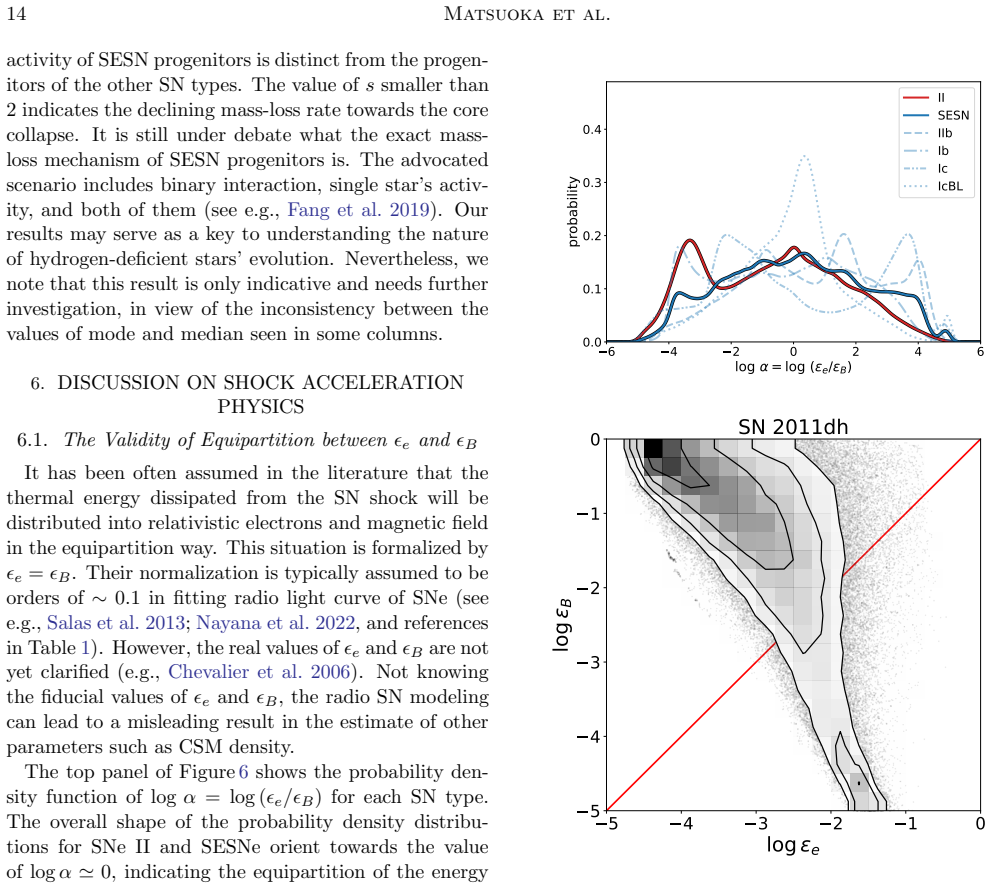
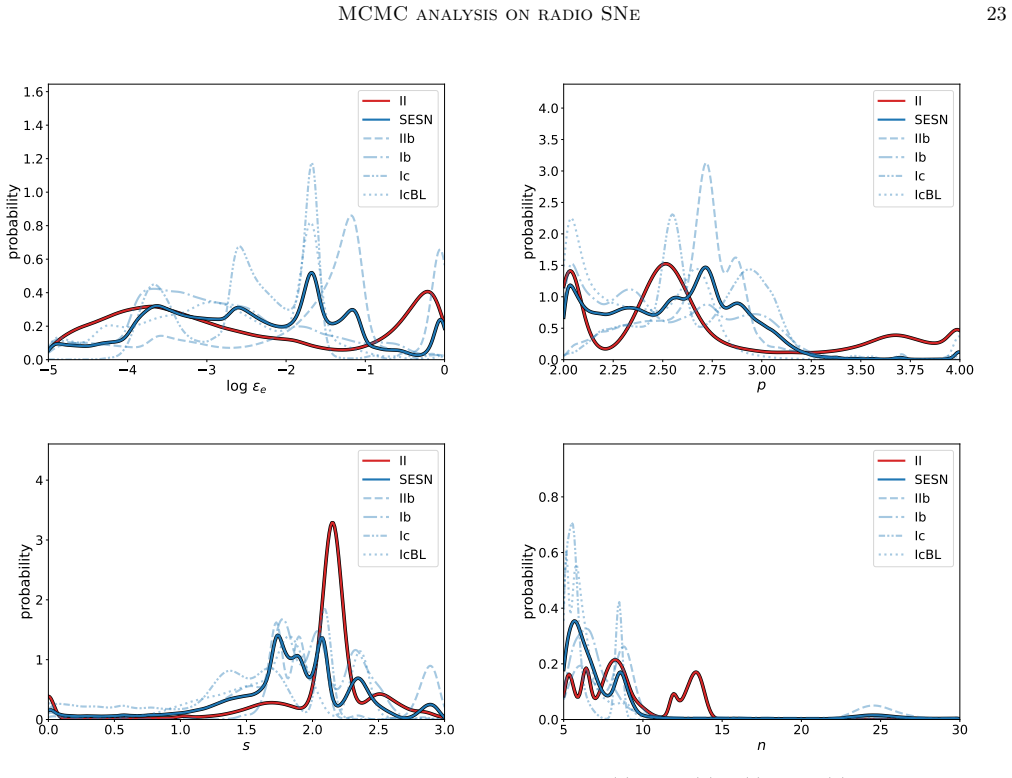
The paper reports that, under one analytical radio emission model applied across 32 supernovae, the inferred mass-loss rate of stripped-envelope progenitors clusters around $10^{-3}\,M_\odot\,{\rm yr}^{-1}$, an order of magnitude higher than for Type II supernovae, while the electron acceleration efficiency and magnetic field amplification efficiency are both below $10^{-2}$ and their equipartition is not ruled out. When the same fits include the first 30 days of data, many objects demand $\epsilon_B \sim 1$, a value far above what particle-in-cell shock simulations produce. The paper interprets this as a model artifact: the early radio data trace a dense circumstellar medium in the immediate vicinity of the progenitor that is not smoothly connected to the outer wind, so the standard model compensates by inflating $\epsilon_B$ and lowering the CSM density scale. It also finds outer ejecta slopes as small as $n\sim 5$, below classical shock-breakout predictions, and links this to the same confined CSM flattening the outer ejecta structure.
Load-bearing premise
The analysis assumes that any dense shell near the star affects only the first thirty days, so that the later radio light curve can still be modeled with a single smooth wind and a shock trajectory unaffected by the inner structure.
Editorial extensions
If this is right
- Mass-loss histories of stripped-envelope progenitors should be revised upward by roughly an order of magnitude relative to equipartition-based estimates, with consequences for final stellar evolution and pre-supernova activity.
- Radio-bright supernovae should commonly show signatures of dense confined CSM, including flash-spectroscopy features and early-time radio absorption.
- Shock acceleration in non-relativistic supernova shocks need not be highly efficient: efficiencies below $10^{-2}$ with a viable near-equipartition ratio between electrons and magnetic field remain consistent with the data.
- The outer ejecta of core-collapse supernovae interacting with a confined shell can be shallower than classical predictions, which affects how ejecta mass and kinetic energy are inferred from radio light curves.
- Single-power-law fits that include early-time radio data should be interpreted with caution, because the near-unity $\epsilon_B$ they produce is a warning sign of missing density structure rather than a reliable microphysics measurement.
Reading between the lines
- A direct test of the confined-CSM interpretation: early multi-band radio follow-up within days of explosion should reveal free-free absorption or a density excess near $10^{15}$ cm in objects like those studied here, and a two-zone model with such a shell should fit the early data without requiring $\epsilon_B\sim 1$.
- The $\tilde{A}_*$-$\epsilon_B$ degeneracy implies that published single-zone radio fits that fix $\epsilon_e=\epsilon_B=0.1$ carry a hidden systematic bias in inferred CSM density, so future work should fit density and microphysics jointly rather than fixing either.
- The confined shell proposed here may be the same phenomenon seen in flash-spectroscopy supernovae and in some stripped-envelope events, suggesting a common pre-explosion mass-ejection mechanism across apparently different transient classes.
- A hydrodynamic simulation of a shock crossing a dense inner shell would provide a decisive check: if it reproduces the early rise with $\epsilon_B<0.01$, the artifact interpretation is confirmed; if not, the large $\epsilon_B$ from early-included fits would reflect genuine shock microphysics.
Signed reviews
Editorial analysis
A structured set of objections, weighed in public.
Referee Report
Summary. This paper presents a systematic MCMC analysis of 32 radio-selected supernovae with clear light-curve peaks, fitting a standard analytical radio SN model to 27 objects. The fitted parameters are the CSM density scale A~, electron acceleration efficiency eps_e, magnetic field amplification efficiency eps_B, electron spectral index p, CSM density slope s, and outer ejecta density slope n. The authors report that stripped-envelope SN (SESN) progenitors have mass-loss rates about an order of magnitude higher than SN II progenitors, that shock acceleration efficiencies are below 10^-2 with equipartition allowed, and that the outer ejecta density slope tends to be shallow (n ~ 5). When early-phase (first 30 days) data are included, the fits prefer extremely high eps_B, which the authors interpret as evidence for a dense CSM component near the progenitor that is not captured by the single-component model.
Significance. If the central mass-loss claim held, this would be an important systematic constraint on massive-star mass loss and on the progenitors of stripped-envelope supernovae. The paper's strengths include the use of a uniform model framework across a relatively large sample, a transparent MCMC setup, and a robustness test with fsh = 4 that does not qualitatively change the fitted microphysical parameters. The paper is also candid about several limitations. However, the headline mass-loss difference is not actually driven by the fitted CSM density scale but by the assumed wind velocities, and the statistical significance of the group-level difference is not established. The dense-CSM interpretation also has a partially circular structure. These issues affect the paper's main conclusions and require revision before the claims can be taken at face value.
major comments (4)
- [Section 5.1, Eq. (4), Table 5] The abstract and Section 8 claim that SESN progenitors have mass-loss rates an order of magnitude above those of SNe II, but the fitted CSM density scale A~ is nearly the same for the two groups (median log A~ = 1.75 +/- 1.53 for SNe II vs 1.47 +/- 1.08 for SESNe, Table 5). Since Mdot = 4*pi*v_w * 5e11 g/cm * A~ (Eq. 4), the factor of ~100 in Mdot comes almost entirely from the assumed wind velocities (10 km/s for SNe II vs 1000 km/s for SESNe), not from the radio data. Section 5.1 acknowledges the uncertainty in the CSM velocity, but this limitation is not propagated into the abstract or summary claims, and no alternative wind-velocity priors are tested. As written, the headline overstates what the radio data alone establish.
- [Table 5, Section 5.1] With only four SNe II in the successful-fit sample (SN 1987A, 2004dj, 2012aw, 2016X) and 1-sigma scatter of about 1.5 dex in log A~, the difference in A~ between SNe II and SESNe is not statistically significant. The manuscript should include a formal significance assessment (e.g., posterior overlap or a two-sample test) or explicitly state that the current sample cannot distinguish the group-level CSM density scales. As written, the 'order of magnitude' statement in the abstract is not supported by the fitted density scales alone.
- [Sections 3.3 and 5.2] The dense-CSM interpretation is introduced after excluding the first 30 days of data because the model cannot treat inhomogeneous CSM, and the same exclusion is then presented as evidence that a dense inner CSM is the missing setup. This has a circular structure. The manuscript does mention alternative explanations (genuinely large eps_B, time-dependent microphysics), but the abstract wording 'we identify the missing setup as a dense CSM' is stronger than the evidence. A direct test with a two-component or hydrodynamical CSM model, or at least an explicit statement that the dense-CSM interpretation is one of several mutually consistent possibilities, is needed to avoid circular reasoning.
- [Section 3.3] The exclusion of early-phase data does not remove the dynamical influence of a dense inner CSM on the shock trajectory at later times. The manuscript itself states that the shock evolution is first influenced by the inner CSM and that subsequent hydrodynamical properties would be affected, and that this effect is not included in the model. If the inner CSM modifies the shock before day 30, the fitted late-time parameters, including A~ and s, could be biased. The paper should quantify this effect (for example, by comparing with the two-component calculations of Matsuoka et al. 2025) or explicitly state that the mass-loss and density-slope results are conditional on the unperturbed single-component CSM assumption.
minor comments (4)
- [Section 8, first bullet] The units in the mass-loss rate ranges are incomplete: '10^-7 <= Mdot < 10^-4 M_sun' and 'Mdot ~ 10^-3 M_sun' should read M_sun yr^-1 throughout.
- [Table 1] The final column header 'References of chi^2_red < 5' appears garbled; it should be relabeled (e.g., 'Good fit (chi^2_red < 5)') and the checkmarks defined clearly in the caption.
- [Section 3.2] The imposed lower limit sigma_obs,i = 0.1 F_obs,i is applied uniformly, but its effect on the derived posterior widths and on the reduced chi-square threshold is not discussed. A brief justification or a sensitivity test would clarify how much of the quoted credible intervals depends on this assumption.
- [Section 5.2] The phrase 'A~ only in the inner CSM' refers to a localized enhancement that is not a fitted parameter of the model; the text should clarify that this is an inferred physical interpretation, not a quantity directly constrained by the MCMC.
Circularity Check
The central mass-loss-rate gap is produced by the adopted 100x wind-velocity ratio applied to nearly equal fitted CSM densities (Eq. 4, Table 5), so the headline claim is a rescaling of an assumed input rather than a radio-data prediction.
-
fitted input called prediction
[Abstract; Eq. (4); §5.1; Table 5]
"˜A∗ = ˙M/(4π vw) × 1/(5×10^11 g cm^−1) ... Here we assume that the CSM velocity is constant with time until the core collapse, and is comparable to the escape velocity of the progenitor; ∼ 10 km s−1 for SNe II and ∼ 1000 km s−1 for SESNe. ... the mass-loss rate of SESNe is clustering at the value of ˙M ≃ 10−3 M⊙ yr−1. This clear difference is attributed to the difference in the CSM density structure inferred in Figure 3."
The quantity actually constrained by the radio fits is log ˜A∗, whose type medians are 1.75 for SNe II and 1.47 for SESNe (Table 5) — overlapping and, if anything, slightly higher for SNe II. Equation (4) then defines ˙M as 4π vw × 5×10^11 g cm^−1 × ˜A∗. With vw adopted as 10 km/s for SNe II and 1000 km/s for SESNe (§5.1), the reported order-of-magnitude gap in ˙M is almost entirely the assumed 100x wind-velocity ratio; the fitted density scale is comparable within its ~1.5 dex 1σ scatter. The abstract’s central mass-loss comparison therefore reduces, by Eq. (4), to a rescaling of an assumed input rather than an independently inferred quantity.
full rationale
The MCMC fitting and the light-curve modeling are largely self-contained: the posterior distributions, priors, and χ² selection are clearly specified, and the individual fitted parameters are presented with credible intervals. The dense inner CSM interpretation in §5.2 is speculative but not circular in the strict sense; it is offered as a suggested resolution of an early-phase discrepancy, with the alternative of genuinely high ϵB explicitly left open. The genuine circularity is in the headline mass-loss claim. The fitting parameter ˜A∗ equals ˙M/(4π vw) by Eq. (4), so converting the fitted ˜A∗ values into ˙M is a definitional rescaling, not a new measurement. The type comparison then inherits the assumed wind velocities: the medians of log ˜A∗ are 1.75 (SNe II) and 1.47 (SESNe), so the radio data alone do not establish a denser CSM around stripped-envelope progenitors. The reported factor ~50–100 in ˙M is essentially the ratio of the assumed wind velocities (100) times a density-scale ratio near unity. The paper acknowledges the velocity uncertainty in §5.1, but the abstract and summary present the order-of-magnitude mass-loss difference as an inference from the radio sample. Because the central claim reduces by construction to an adopted input, the circularity score is 6.
Assumptions & free parameters
free parameters (6)
- log \tilde{A}_* (CSM density scale) =
median ~1.75 (SN II), ~1.47 (SESN)
- log \epsilon_e (electron acceleration efficiency) =
median ~ -3.09 (SN II), -2.11 (SESN)
- log \epsilon_B (magnetic field amplification efficiency) =
median ~ -2.12 (SN II), -2.07 (SESN)
- p (electron spectral index) =
median ~2.5-3.0 for most objects
- s (CSM density slope) =
median ~1.85 (SESN), ~2.05 (SN II)
- n (outer ejecta density slope) =
median ~5.5-8.5; many SESN at lower bound 5
assumptions (7)
- standard math Thin-shell approximation for shock radius evolution (Equations 5-6)
- domain assumption Single-component power-law CSM density profile (Equation 3)
- domain assumption Power-law outer ejecta profile with n > 5 (Equations 1-2)
- domain assumption Constant wind velocity equal to escape speed: 10 km/s for SNe II, 1000 km/s for SESNe
- domain assumption Minimum Lorentz factor of electrons fixed to gamma_m = 2
- domain assumption Shock compression factor fsh = 9/8
- standard math Uniform/log-uniform priors with ranges in Table 2, plus fe<1 constraint
invented entities (1)
-
Dense CSM in the vicinity of the progenitor (confined CSM)
independent evidence
Cite this review
Pith. "Pith review of Systematic Investigation into Radio Supernovae with Markov Chain Monte Carlo Analysis: Implications for Massive Stars' Mass Loss and Shock Acceleration Physics." pith.science (2026). https://pith.science/paper/4SJV2LEJ
@misc{pith2026250506609,
  author       = {Pith},
  title        = {Pith review of: Systematic Investigation into Radio Supernovae with Markov Chain Monte Carlo Analysis: Implications for Massive Stars' Mass Loss and Shock Acceleration Physics},
  year         = {2026},
  howpublished = {\url{https://pith.science/paper/4SJV2LEJ}},
  note         = {Machine review of arXiv:2505.06609}
}
abstract
We present a systematic analysis of radio supernovae (SNe) to investigate the statistical tendencies of SN progenitors' mass-loss rates and shock acceleration efficiencies. We conduct parameter estimation through Markov chain Monte Carlo (MCMC) analysis for 32 radio SN samples with a clear peak observed in their light curves, and successfully fit 27 objects with the widely-used radio SN model. We find the inferred mass-loss rates of stripped-envelope SN progenitors are by an order of magnitude greater ($\sim 10^{-3}\,M_\odot{\rm yr}^{-1}$) than those of SN II progenitors ($<10^{-4}\,M_\odot{\rm yr}^{-1}$). The efficiencies of electron acceleration and magnetic field amplification are found to be less than $10^{-2}$, and the possibility of their energy equipartition is not ruled out. On the other hand, we find the following two properties that might be related to limitations of the standard model for radio SNe; one is the extremely high magnetic field amplification efficiency, and the other is the shallower density gradient of the outer ejecta. We suggest the new interpretation that these peculiar results are misleading due to the setup that is not included in our model, and we identify the missing setup as a dense CSM in the vicinity of the progenitor. This means that a large fraction of radio SN progenitors might possess dense CSM in the vicinity of the progenitor, which is not smoothly connected with the outer CSM.
Figures


Figures from the paper (6 more)




Forward citations
Cited by 2 Pith papers
-
Interacting Supernovae: a Radio and X-ray Strategy to Constrain the Structure of the Circumstellar Medium
The rise and decay shape of a supernova's radio light curve can diagnose the three-dimensional geometry of the surrounding circumstellar medium, and hourglass-shaped winds fit SN 1993j and SN 2023ixf.
-
Red Supergiant Mass Loss and Mass-Loss Rates
A synthesis review concluding that red supergiant mass loss is gravity-driven, metallicity-independent in rate, and bimodal, with low-mass stars keeping their mantles to core collapse and massive stars shedding them t...
Reference graph
Works this paper leans on
-
[1]
, " * write output.state after.block = add.period write newline
ENTRY address archivePrefix author booktitle chapter doi edition editor eprint howpublished institution journal key month number organization pages publisher school series title misctitle type volume year version url label extra.label sort.label short.list INTEGERS output.state before.all mid.sentence after.sentence after.block FUNCTION init.state.consts ...
-
[2]
write newline
" write newline "" before.all 'output.state := FUNCTION format.url url empty "" new.block "" url * "" * if FUNCTION format.eprint eprint empty "" archivePrefix empty "" archivePrefix "arXiv" = new.block " " eprint * " " * new.block " " eprint * " " * if if if FUNCTION format.doi doi empty "" " " doi * " " * if FUNCTION format.pid doi empty eprint empty ur...
-
[3]
@z " 0 ? l ̾ , owO , , 4'&l&'cqK &|Ĕ]& f=K v> 3 #. < 7 f # TİxoO D F
thebibliography [1] 20pt to REFERENCES 6pt =0pt -12pt 10pt plus 3pt =0pt =0pt =1pt plus 1pt =0pt =0pt -12pt =13pt plus 1pt =20pt =13pt plus 1pt \@M =10000 =-1.0em =0pt =0pt 0pt =0pt =1.0em @enumiv\@empty 10000 10000 `\.\@m \@noitemerr \@latex@warning Empty `thebibliography' environment \@ifnextchar \@reference \@latexerr Missing key on reference command E...
2021
-
[4]
Aharonian , F. A., Kelner , S. R., & Prosekin , A. Y. 2010, , 82, 043002, 10.1103/PhysRevD.82.043002
-
[5]
Aldering , G., Humphreys , R. M., & Richmond , M. 1994, , 107, 662, 10.1086/116886
doi:10.1086/116886 1994
-
[6]
2022, , 927, 132, 10.3847/1538-4357/ac4f49
Amano , T., & Hoshino , M. 2022, , 927, 132, 10.3847/1538-4357/ac4f49
-
[7]
Anderson , G. E., Horesh , A., Mooley , K. P., et al. 2017, , 466, 3648, 10.1093/mnras/stw3310
-
[8]
Ball , L., Campbell-Wilson , D., Crawford , D. F., & Turtle , A. J. 1995, , 453, 864, 10.1086/176446
doi:10.1086/176446 1995
Show all 149 references
-
[9]
F., Hunstead , R
Ball , L., Crawford , D. F., Hunstead , R. W., Klamer , I., & McIntyre , V. J. 2001, , 549, 599, 10.1086/319056
2001 doi
-
[10]
2014, , 442, 3147, 10.1093/mnras/stu1070
Barniol Duran , R. 2014, , 442, 3147, 10.1093/mnras/stu1070
2014 doi
-
[11]
Bell , A. R. 1978, , 182, 147, 10.1093/mnras/182.2.147
1978 doi
-
[12]
Beniamini , P., & van der Horst , A. J. 2017, , 472, 3161, 10.1093/mnras/stx2203
2017 doi
-
[13]
R., & Chevalier , R
Berger , E., Kulkarni , S. R., & Chevalier , R. A. 2002, , 577, L5, 10.1086/344045
2002 doi
-
[14]
K., Margutti , R., et al
Berger , E., Keating , G. K., Margutti , R., et al. 2023, , 951, L31, 10.3847/2041-8213/ace0c4
2023 doi
-
[15]
C., Benvenuto , O
Bersten , M. C., Benvenuto , O. G., Nomoto , K., et al. 2012, , 757, 31, 10.1088/0004-637X/757/1/31
2012 doi
-
[16]
C., Folatelli , G., Garc \' a , F., et al
Bersten , M. C., Folatelli , G., Garc \' a , F., et al. 2018, , 554, 497, 10.1038/nature25151
2018 doi
-
[17]
F., Bartel , N., Argo , M., et al
Bietenholz , M. F., Bartel , N., Argo , M., et al. 2021, , 908, 75, 10.3847/1538-4357/abccd9
2021 doi
-
[18]
F., Kamble , A., Margutti , R., Milisavljevic , D., & Soderberg , A
Bietenholz , M. F., Kamble , A., Margutti , R., Milisavljevic , D., & Soderberg , A. 2018, , 475, 1756, 10.1093/mnras/stx3194
2018 doi
-
[19]
Bj \"o rnsson , C. I. 2022, , 936, 98, 10.3847/1538-4357/ac87aa
2022 doi
-
[20]
1987, , 154, 1, 10.1016/0370-1573(87)90134-7
Blandford , R., & Eichler , D. 1987, , 154, 1, 10.1016/0370-1573(87)90134-7
1987 doi
- [21]
-
[22]
2000, , 532, 1132, 10.1086/308588
Blinnikov , S., Lundqvist , P., Bartunov , O., Nomoto , K., & Iwamoto , K. 2000, , 532, 1132, 10.1086/308588
2000 doi
-
[23]
2014, , 439, 1807, 10.1093/mnras/stu065
Bufano , F., Pignata , G., Bersten , M., et al. 2014, , 439, 1807, 10.1093/mnras/stu065
2014 doi
-
[24]
2010 a , Astroparticle Physics, 33, 307, 10.1016/j.astropartphys.2010.03.001
Caprioli , D., Amato , E., & Blasi , P. 2010 a , Astroparticle Physics, 33, 307, 10.1016/j.astropartphys.2010.03.001
2010 doi
-
[25]
C., & Blasi , P
Caprioli , D., Haggerty , C. C., & Blasi , P. 2020, , 905, 2, 10.3847/1538-4357/abbe05
2020 doi
-
[26]
E., & Jones , T
Caprioli , D., Kang , H., Vladimirov , A. E., & Jones , T. W. 2010 b , , 407, 1773, 10.1111/j.1365-2966.2010.17013.x
2010
-
[27]
2015, , 798, L28, 10.1088/2041-8205/798/2/L28
Caprioli , D., Pop , A.-R., & Spitkovsky , A. 2015, , 798, L28, 10.1088/2041-8205/798/2/L28
2015 doi
-
[28]
2014, , 794, 46, 10.1088/0004-637X/794/1/46
Caprioli , D., & Spitkovsky , A. 2014, , 794, 46, 10.1088/0004-637X/794/1/46
2014 doi
-
[29]
2015, , 805, 187, 10.1088/0004-637X/805/2/187
Chakraborti , S., Soderberg , A., Chomiuk , L., et al. 2015, , 805, 187, 10.1088/0004-637X/805/2/187
2015 doi
-
[30]
A., Chugai , N., Fransson , C., & Soderberg , A
Chandra , P., Chevalier , R. A., Chugai , N., Fransson , C., & Soderberg , A. M. 2015, , 810, 32, 10.1088/0004-637X/810/1/32
2015 doi
-
[31]
J., Bj \"o rnsson , C
Chandra , P., Nayana , A. J., Bj \"o rnsson , C. I., et al. 2019, , 877, 79, 10.3847/1538-4357/ab1900
2019 doi
-
[32]
Chevalier , R. A. 1982 a , , 259, 302, 10.1086/160167
1982 doi
- [33]
- [34]
- [35]
- [36]
-
[37]
2017, in Handbook of Supernovae, ed
---. 2017, in Handbook of Supernovae, ed. A. W. Alsabti & P. Murdin , 875, 10.1007/978-3-319-21846-5_34
2017 doi
-
[38]
A., Fransson , C., & Nymark , T
Chevalier , R. A., Fransson , C., & Nymark , T. K. 2006, , 641, 1029, 10.1086/500528
2006 doi
-
[39]
O., Gal-Yam , A., et al
Corsi , A., Ofek , E. O., Gal-Yam , A., et al. 2014, , 782, 42, 10.1088/0004-637X/782/1/42
2014 doi
-
[40]
T., Pumo , M
Dall'Ora , M., Botticella , M. T., Pumo , M. L., et al. 2014, , 787, 139, 10.1088/0004-637X/787/2/139
2014 doi
-
[41]
2022, The Astrophysical Journal, 938, 84, 10.3847/1538-4357/ac8c26
DeMarchi , L., Margutti , R., Dittman , J., et al. 2022, The Astrophysical Journal, 938, 84, 10.3847/1538-4357/ac8c26
2022 doi
-
[42]
Drury , L. O. 1983, Reports on Progress in Physics, 46, 973, 10.1088/0034-4885/46/8/002
1983 doi
-
[43]
A., van der Horst , A
Duncan , R. A., van der Horst , A. J., & Beniamini , P. 2023, , 518, 1522, 10.1093/mnras/stac3172
2023 doi
-
[44]
2005, , 627, 861, 10.1086/430596
Eichler , D., & Waxman , E. 2005, , 627, 861, 10.1086/430596
2005 doi
-
[45]
2019, Nature Astronomy, 3, 434, 10.1038/s41550-019-0710-6
Fang , Q., Maeda , K., Kuncarayakti , H., Sun , F., & Gal-Yam , A. 2019, Nature Astronomy, 3, 434, 10.1038/s41550-019-0710-6
2019 doi
-
[46]
2016, The Journal of Open Source Software, 1, 24, 10.21105/joss.00024
Foreman-Mackey , D. 2016, The Journal of Open Source Software, 1, 24, 10.21105/joss.00024
2016 doi
-
[47]
W., Lang , D., & Goodman , J
Foreman-Mackey , D., Hogg , D. W., Lang , D., & Goodman , J. 2013, , 125, 306, 10.1086/670067
2013 doi
-
[48]
1998, , 509, 861, 10.1086/306531
Fransson , C., & Bj \"o rnsson , C.-I. 1998, , 509, 861, 10.1086/306531
1998 doi
- [49]
-
[50]
2020, , 903, 132, 10.3847/1538-4357/abbd38
Horesh , A., Sfaradi , I., Ergon , M., et al. 2020, , 903, 132, 10.3847/1538-4357/abbd38
2020 doi
-
[51]
F., Hosseinzadeh , G., et al
Huang , F., Wang , X. F., Hosseinzadeh , G., et al. 2018, , 475, 3959, 10.1093/mnras/sty066
2018 doi
-
[52]
o ller , M., Cikota , A., & J \
Hubrig , S., Sch \"o ller , M., Cikota , A., & J \"a rvinen , S. P. 2020, , 499, L116, 10.1093/mnrasl/slaa170
2020 doi
-
[53]
J., Valenti , S., Kotak , R., et al
Hunter , D. J., Valenti , S., Kotak , R., et al. 2009, , 508, 371, 10.1051/0004-6361/200912896
2009 doi
-
[54]
2009, , 695, 825, 10.1088/0004-637X/695/2/825
Inoue , T., Yamazaki , R., & Inutsuka , S.-i. 2009, , 695, 825, 10.1088/0004-637X/695/2/825
2009 doi
-
[55]
V., Dessart , L., Jones , D
Jacobson-Gal \'a n , W. V., Dessart , L., Jones , D. O., et al. 2022, , 924, 15, 10.3847/1538-4357/ac3f3a
2022 doi
-
[56]
V., Dessart , L., Margutti , R., et al
Jacobson-Gal \'a n , W. V., Dessart , L., Margutti , R., et al. 2023, , 954, L42, 10.3847/2041-8213/acf2ec
2023 doi
-
[57]
M., Chomiuk , L., et al
Kamble , A., Soderberg , A. M., Chomiuk , L., et al. 2014, , 797, 2, 10.1088/0004-637X/797/1/2
2014 doi
-
[58]
M., et al
Kamble , A., Margutti , R., Soderberg , A. M., et al. 2016, , 818, 111, 10.3847/0004-637X/818/2/111
2016 doi
-
[59]
F., & Ohira , Y
Kamijima , S. F., & Ohira , Y. 2022, , 106, 123025, 10.1103/PhysRevD.106.123025
2022 doi
-
[60]
I., Soderberg , A
Krauss , M. I., Soderberg , A. M., Chomiuk , L., et al. 2012, , 750, L40, 10.1088/2041-8205/750/2/L40
2012 doi
-
[61]
R., Frail , D
Kulkarni , S. R., Frail , D. A., Wieringa , M. H., et al. 1998, , 395, 663, 10.1038/27139
1998 doi
-
[62]
2020, , 635, A127, 10.1051/0004-6361/201937226
Kuriyama , N., & Shigeyama , T. 2020, , 635, A127, 10.1051/0004-6361/201937226
2020 doi
-
[63]
C., & Nagataki , S
Lee , S.-H., Ellison , D. C., & Nagataki , S. 2012, , 750, 156, 10.1088/0004-637X/750/2/156
2012 doi
-
[64]
1988, , 192, 221
Lundqvist , P., & Fransson , C. 1988, , 192, 221
1988
-
[65]
D., Bersier , D., James , P
Lyman , J. D., Bersier , D., James , P. A., et al. 2016, , 457, 328, 10.1093/mnras/stv2983
2016 doi
-
[66]
2012, , 758, 81, 10.1088/0004-637X/758/2/81
Maeda , K. 2012, , 758, 81, 10.1088/0004-637X/758/2/81
2012 doi
-
[67]
2013 a , , 762, 14, 10.1088/0004-637X/762/1/14
---. 2013 a , , 762, 14, 10.1088/0004-637X/762/1/14
2013 doi
-
[68]
2013 b , , 762, L24, 10.1088/2041-8205/762/2/L24
---. 2013 b , , 762, L24, 10.1088/2041-8205/762/2/L24
2013 doi
-
[69]
2023, , 521, 1897, 10.1093/mnras/stad618
Maeda , K., Jiang , J.-a., Doi , M., Kawabata , M., & Shigeyama , T. 2023, , 521, 1897, 10.1093/mnras/stad618
2023 doi
-
[70]
2015, , 807, 35, 10.1088/0004-637X/807/1/35
Maeda , K., Hattori , T., Milisavljevic , D., et al. 2015, , 807, 35, 10.1088/0004-637X/807/1/35
2015 doi
-
[71]
2021, , 918, 34, 10.3847/1538-4357/ac0dbc
Maeda , K., Chandra , P., Matsuoka , T., et al. 2021, , 918, 34, 10.3847/1538-4357/ac0dbc
2021 doi
-
[72]
M., et al
Margutti , R., Milisavljevic , D., Soderberg , A. M., et al. 2014, , 797, 107, 10.1088/0004-637X/797/2/107
2014 doi
-
[73]
2017, , 835, 140, 10.3847/1538-4357/835/2/140
Margutti , R., Kamble , A., Milisavljevic , D., et al. 2017, , 835, 140, 10.3847/1538-4357/835/2/140
2017 doi
-
[74]
C., Anderson , J
Martinez , L., Bersten , M. C., Anderson , J. P., et al. 2022 a , , 660, A40, 10.1051/0004-6361/202142075
2022 doi
-
[75]
2022 b , , 660, A41, 10.1051/0004-6361/202142076
---. 2022 b , , 660, A41, 10.1051/0004-6361/202142076
2022 doi
-
[76]
P., Bersten , M
Martinez , L., Anderson , J. P., Bersten , M. C., et al. 2022 c , , 660, A42, 10.1051/0004-6361/202142555
2022 doi
-
[77]
N., & Hoshino , M
Matsumoto , Y., Amano , T., Kato , T. N., & Hoshino , M. 2015, Science, 347, 974, 10.1126/science.1260168
2015 doi
-
[78]
2017, ¥prl, 119, 105101, 10.1103/PhysRevLett.119.105101
---. 2017, ¥prl, 119, 105101, 10.1103/PhysRevLett.119.105101
2017 doi
-
[79]
S., Maeda , K., & Tanaka , M
Matsuoka , T., Kimura , S. S., Maeda , K., & Tanaka , M. 2024, , 960, 70, 10.3847/1538-4357/ad096c
2024 doi
-
[80]
Matsuoka , T., Lee , S.-H., Maeda , K., Takiwaki , T., & Moriya , T. J. 2022, , 930, 143, 10.3847/1538-4357/ac67a4
2022 doi
-
[81]
2020, , 898, 158, 10.3847/1538-4357/ab9c1b
Matsuoka , T., & Maeda , K. 2020, , 898, 158, 10.3847/1538-4357/ab9c1b
2020 doi
- [82]
-
[83]
2019, , 885, 41, 10.3847/1538-4357/ab4421
Matsuoka , T., Maeda , K., Lee , S.-H., & Yasuda , H. 2019, , 885, 41, 10.3847/1538-4357/ab4421
2019 doi
- [84]
-
[85]
A., Deng , J., Hamuy , M., & Nomoto , K
Mazzali , P. A., Deng , J., Hamuy , M., & Nomoto , K. 2009, , 703, 1624, 10.1088/0004-637X/703/2/1624
2009 doi
-
[86]
A., Deng , J., Maeda , K., et al
Mazzali , P. A., Deng , J., Maeda , K., et al. 2002, , 572, L61, 10.1086/341504
2002 doi
-
[87]
M., et al
Milisavljevic , D., Margutti , R., Soderberg , A. M., et al. 2013 a , , 767, 71, 10.1088/0004-637X/767/1/71
2013 doi
-
[88]
M., Margutti , R., et al
Milisavljevic , D., Soderberg , A. M., Margutti , R., et al. 2013 b , , 770, L38, 10.1088/2041-8205/770/2/L38
2013 doi
-
[89]
T., et al
Milisavljevic , D., Margutti , R., Parrent , J. T., et al. 2015, , 799, 51, 10.1088/0004-637X/799/1/51
2015 doi
-
[90]
2014, , 445, 1647, 10.1093/mnras/stu1837
Morales-Garoffolo , A., Elias-Rosa , N., Benetti , S., et al. 2014, , 445, 1647, 10.1093/mnras/stu1837
2014 doi
-
[91]
2024, , 528, 4209, 10.1093/mnras/stae170
Murai , Y., Tanaka , M., Kawabata , M., et al. 2024, , 528, 4209, 10.1093/mnras/stae170
2024 doi
- [92]
-
[93]
J., Chandra , P., Krishna , A., & Anupama , G
Nayana , A. J., Chandra , P., Krishna , A., & Anupama , G. C. 2022, , 934, 186, 10.3847/1538-4357/ac7c1e
2022 doi
-
[94]
J., Chandra , P., & Ray , A
Nayana , A. J., Chandra , P., & Ray , A. K. 2018, , 863, 163, 10.3847/1538-4357/aad17a
2018 doi
-
[95]
R., et al
Nomoto , K., Yamaoka , H., Pols , O. R., et al. 1994, , 371, 227, 10.1038/371227a0
1994 doi
-
[96]
2024, Journal of High Energy Astrophysics, 41, 1, 10.1016/j.jheap.2023.12.001
Obayashi , K., Toriyama , A., Murakoshi , M., et al. 2024, Journal of High Energy Astrophysics, 41, 1, 10.1016/j.jheap.2023.12.001
2024 doi
-
[97]
L., & Bocchino , F
Orlando , S., Miceli , M., Pumo , M. L., & Bocchino , F. 2015, , 810, 168, 10.1088/0004-637X/810/2/168
2015 doi
-
[98]
2019, , 622, A73, 10.1051/0004-6361/201834487
Orlando , S., Miceli , M., Petruk , O., et al. 2019, , 622, A73, 10.1051/0004-6361/201834487
2019 doi
-
[99]
2020, , 636, A22, 10.1051/0004-6361/201936718
Orlando , S., Ono , M., Nagataki , S., et al. 2020, , 636, A22, 10.1051/0004-6361/201936718
2020 doi
-
[100]
2015, Phys
Park, J., Caprioli, D., & Spitkovsky, A. 2015, Phys. Rev. Lett., 114, 085003, 10.1103/PhysRevLett.114.085003
2015 doi
-
[101]
2016, , 460, 44, 10.1093/mnras/stw920
Petropoulou , M., Kamble , A., & Sironi , L. 2016, , 460, 44, 10.1093/mnras/stw920
2016 doi
-
[102]
2011, , 728, 14, 10.1088/0004-637X/728/1/14
Pignata , G., Stritzinger , M., Soderberg , A., et al. 2011, , 728, 14, 10.1088/0004-637X/728/1/14
2011 doi
-
[103]
J., Ashall , C., Mazzali , P
Prentice , S. J., Ashall , C., Mazzali , P. A., et al. 2018, , 478, 4162, 10.1093/mnras/sty1223
2018 doi
-
[104]
J., Ashall , C., James , P
Prentice , S. J., Ashall , C., James , P. A., et al. 2019, , 485, 1559, 10.1093/mnras/sty3399
2019 doi
-
[105]
R., et al
Rho , J., Evans , A., Geballe , T. R., et al. 2021, , 908, 232, 10.3847/1538-4357/abd850
2021 doi
-
[106]
W., van Dyk , S
Richmond , M. W., van Dyk , S. D., Ho , W., et al. 1996, , 111, 327, 10.1086/117785
1996 doi
-
[107]
Roming , P. W. A., Pritchard , T. A., Brown , P. J., et al. 2009, , 704, L118, 10.1088/0004-637X/704/2/L118
2009 doi
-
[108]
R., et al
Roy , R., Kumar , B., Maund , J. R., et al. 2013, , 434, 2032, 10.1093/mnras/stt1148
2013 doi
-
[109]
2022, , 666, A82, 10.1051/0004-6361/202142024
Ruiz-Carmona , R., Sfaradi , I., & Horesh , A. 2022, , 666, A82, 10.1051/0004-6361/202142024
2022 doi
-
[110]
D., Sadler , E
Ryder , S. D., Sadler , E. M., Subrahmanyan , R., et al. 2004, , 349, 1093, 10.1111/j.1365-2966.2004.07589.x
2004
-
[111]
E., Stockdale , C., & Prieto , J
Salas , P., Bauer , F. E., Stockdale , C., & Prieto , J. L. 2013, , 428, 1207, 10.1093/mnras/sts104
2013 doi
-
[112]
2014, , 785, 29, 10.1088/0004-637X/785/1/29
Santana , R., Barniol Duran , R., & Kumar , P. 2014, , 785, 29, 10.1088/0004-637X/785/1/29
2014 doi
-
[113]
2021, , 504, 5647, 10.1093/mnras/stab1273
Sato , Y., Obayashi , K., Yamazaki , R., Murase , K., & Ohira , Y. 2021, , 504, 5647, 10.1093/mnras/stab1273
2021 doi
-
[114]
A., Marchant , P., et al
Shenar , T., Wade , G. A., Marchant , P., et al. 2023, Science, 381, 761, 10.1126/science.ade3293
2023 doi
-
[115]
1990, , 361, L23, 10.1086/185818
Shigeyama , T., Nomoto , K., Tsujimoto , T., & Hashimoto , M.-A. 1990, , 361, L23, 10.1086/185818
1990 doi
-
[116]
1994, , 420, 341, 10.1086/173564
Shigeyama , T., Suzuki , T., Kumagai , S., et al. 1994, , 420, 341, 10.1086/173564
1994 doi
-
[117]
J., et al
Silva-Farf \'a n , J., F \"o rster , F., Moriya , T. J., et al. 2024, , 969, 57, 10.3847/1538-4357/ad402a
2024 doi
-
[118]
2011, , 726, 75, 10.1088/0004-637X/726/2/75
Sironi , L., & Spitkovsky , A. 2011, , 726, 75, 10.1088/0004-637X/726/2/75
2011 doi
-
[119]
M., Brunthaler , A., Nakar , E., Chevalier , R
Soderberg , A. M., Brunthaler , A., Nakar , E., Chevalier , R. A., & Bietenholz , M. F. 2010 a , , 725, 922, 10.1088/0004-637X/725/1/922
2010 doi
-
[120]
M., Chevalier , R
Soderberg , A. M., Chevalier , R. A., Kulkarni , S. R., & Frail , D. A. 2006, , 651, 1005, 10.1086/507571
2006 doi
-
[121]
M., Kulkarni , S
Soderberg , A. M., Kulkarni , S. R., Berger , E., et al. 2005, , 621, 908, 10.1086/427649
2005 doi
-
[122]
M., Berger , E., Page , K
Soderberg , A. M., Berger , E., Page , K. L., et al. 2008, , 453, 469, 10.1038/nature06997
2008 doi
-
[123]
M., Chakraborti , S., Pignata , G., et al
Soderberg , A. M., Chakraborti , S., Pignata , G., et al. 2010 b , , 463, 513, 10.1038/nature08714
2010 doi
-
[124]
M., Margutti , R., Zauderer , B
Soderberg , A. M., Margutti , R., Zauderer , B. A., et al. 2012, , 752, 78, 10.1088/0004-637X/752/2/78
2012 doi
-
[125]
J., Williams , C
Stockdale , C. J., Williams , C. L., Weiler , K. W., et al. 2007, , 671, 689, 10.1086/522584
2007 doi
- [126]
-
[127]
2018, , 478, 110, 10.1093/mnras/sty999
Suzuki , A., & Maeda , K. 2018, , 478, 110, 10.1093/mnras/sty999
2018 doi
-
[128]
2009, , 692, 1131, 10.1088/0004-637X/692/2/1131
Tanaka , M., Tominaga , N., Nomoto , K., et al. 2009, , 692, 1131, 10.1088/0004-637X/692/2/1131
2009 doi
-
[129]
2019, , 883, 147, 10.3847/1538-4357/ab3e37
Terreran , G., Margutti , R., Bersier , D., et al. 2019, , 883, 147, 10.3847/1538-4357/ab3e37
2019 doi
-
[130]
S., Tomida , K., & Toma , K
Tomita , S., Ohira , Y., Kimura , S. S., Tomida , K., & Toma , K. 2022, , 936, L9, 10.3847/2041-8213/ac88be
2022 doi
- [131]
-
[132]
J., Campbell-Wilson , D., Bunton , J
Turtle , A. J., Campbell-Wilson , D., Bunton , J. D., et al. 1987, , 327, 38, 10.1038/327038a0
1987 doi
-
[133]
P., & Chugai , N
Utrobin , V. P., & Chugai , N. N. 2019, , 490, 2042, 10.1093/mnras/stz2716
2019 doi
-
[134]
J., Kamble , A
van der Horst , A. J., Kamble , A. P., Paragi , Z., et al. 2011, , 726, 99, 10.1088/0004-637X/726/2/99
2011 doi
-
[135]
D., Sramek , R
van Dyk , S. D., Sramek , R. A., Weiler , K. W., & Panagia , N. 1993, , 409, 162, 10.1086/172652
1993 doi
-
[136]
T., & Murase , K
Wei , Y., Zhang , B. T., & Murase , K. 2023, , 524, 6004, 10.1093/mnras/stad2122
2023 doi
-
[137]
W., Panagia , N., Montes , M
Weiler , K. W., Panagia , N., Montes , M. J., & Sramek , R. A. 2002, , 40, 387, 10.1146/annurev.astro.40.060401.093744
2002
-
[138]
W., Panagia , N., Stockdale , C., et al
Weiler , K. W., Panagia , N., Stockdale , C., et al. 2011, , 740, 79, 10.1088/0004-637X/740/2/79
2011 doi
-
[139]
W., Sramek , R
Weiler , K. W., Sramek , R. A., Panagia , N., van der Hulst , J. M., & Salvati , M. 1986, , 301, 790, 10.1086/163944
1986 doi
-
[140]
W., Williams , C
Weiler , K. W., Williams , C. L., Panagia , N., et al. 2007, , 671, 1959, 10.1086/523258
2007 doi
-
[141]
M., & Chevalier , R
Wellons , S., Soderberg , A. M., & Chevalier , R. A. 2012, , 752, 17, 10.1088/0004-637X/752/1/17
2012 doi
-
[142]
2022, , 925, 48, 10.3847/1538-4357/ac3824
Xu , S., & Lazarian , A. 2022, , 925, 48, 10.3847/1538-4357/ac3824
2022 doi
-
[143]
2014, , 782, 30, 10.1088/0004-637X/782/1/30
Yadav , N., Ray , A., Chakraborti , S., et al. 2014, , 782, 30, 10.1088/0004-637X/782/1/30
2014 doi
-
[144]
A., Gal-Yam , A., et al
Yaron , O., Perley , D. A., Gal-Yam , A., et al. 2017, Nature Physics, 13, 510, 10.1038/nphys4025
2017 doi
-
[145]
2019, , 876, 27, 10.3847/1538-4357/ab13ab
Yasuda , H., & Lee , S.-H. 2019, , 876, 27, 10.3847/1538-4357/ab13ab
2019 doi
-
[146]
R., Smartt , S
Young , D. R., Smartt , S. J., Valenti , S., et al. 2010, , 512, A70, 10.1051/0004-6361/200913004
2010 doi
-
[147]
2010, , 710, 1515, 10.1088/0004-637X/710/2/1515
Zanardo , G., Staveley-Smith , L., Ball , L., et al. 2010, , 710, 1515, 10.1088/0004-637X/710/2/1515
2010 doi
-
[148]
2006, , 131, 2245, 10.1086/500972
Zhang , T., Wang , X., Li , W., et al. 2006, , 131, 2245, 10.1086/500972
2006 doi
-
[149]
A., Irani , I., Chen , P., et al
Zimmerman , E. A., Irani , I., Chen , P., et al. 2024, , 627, 759, 10.1038/s41586-024-07116-6
2024 doi
Reviewed August 15, 2026 · model on record in the stance chip above.
Discussion (0). Continue with ORCID to comment.