REVIEW 5 major objections 5 minor 20 references
Dynamic Domain Information Modulation Algorithm for Multi-domain Sentiment Analysis
T0 review · 5 major / 5 minor · reviewed 2026-08-15 · deepseek-v4-flash
Pith's one-line read DAMA improves multi-domain sentiment accuracy by adding a per-domain, per-sample modulation to input embeddings, beating its base model in 11 of 16 domains and matching it in the rest.
desk verdict Fresh idea, weak evidence: the non-degradation guarantee is not delivered and the 0.3% gain is within noise, but the modulation idea is worth a serious referee. read the letter →
The pith
A machine-rendered reading of the paper's core claim, the machinery that carries it, and where it could break.
The reading
What carries the argument
The load-bearing object is the modulation vector δ_j = λ_j ∇_δ L_d, added to the input word embeddings of each sample. ∇_δ L_d is the gradient of the domain-classification loss with respect to the input, giving a direction; λ_j is a per-domain scalar step size, giving a magnitude, learned by minimizing the sentiment-classification loss with an adaptive gradient optimizer. A validation-set scaling rule then adjusts λ_j: if accuracy rises, keep it; if accuracy is unchanged, scale λ_j up; if accuracy falls, scale it down. Setting δ_j to zero returns the original model, which is the basis for the claimed no-degradation guarantee.
What would settle it
Take a domain where the domain classifier accuracy is 0.0%, as reported for Toys or Electronics, and compare DAMA's chosen modulation against a random perturbation with the same norm and the same learned step size. If the random perturbation produces the same sentiment-accuracy change, then the gradient direction is not carrying the claimed domain information, and the mechanism's central assumption fails.
Extended reading notes
Core claim
The central claim is that the amount of domain information injected into sentiment classification should be decided per domain and per sample, and that a simple modulation of the input text is enough to do this. The paper's DAMA takes the base model's word embeddings and adds δ_j = λ_j ∇_δ L_d, where ∇_δ L_d is the gradient of the domain-classification loss with respect to the input and λ_j is a per-domain scalar learned by minimizing sentiment loss. Adding this vector is claimed to amplify or attenuate the domain signal that the sentiment classifier sees. Across 16 domains, DAMA matches or improves the base model in every domain under its own validation-based settings, with the average rising from 87.0% to 87.3%; when compared against the base model tuned on the test set, it still improves on more domains than it hurts.
Load-bearing premise
The load-bearing premise is that the gradient of the domain-classification loss with respect to the input points in a direction that, when added to the word embeddings, improves sentiment classification; in domains where the domain classifier is at chance accuracy, that gradient may carry no useful domain signal.
Editorial extensions
If this is right
- Any multi-task model that jointly trains domain and sentiment classifiers can be upgraded with DAMA's second-stage modulation without retraining the base network.
- The per-domain optimization replaces an exponentially growing joint hyperparameter search with a handful of scalar learning problems.
- Because setting the modulation to zero recovers the base model, the method offers a theoretical no-degradation guarantee on the validation criterion used for scaling, though not necessarily on a different test criterion.
- When the base model has already reached its best test-set configuration, DAMA still improves most domains, though not all.
Reading between the lines
- If the domain classifier is at chance accuracy, its input gradient carries no domain signal, so DAMA's modulation is effectively a random or constant perturbation; one could test whether removing the gradient direction and using a fixed-norm random vector changes the outcome.
- The modulation construction is formally the same as a single-step adversarial perturbation of the input, so DAMA can be read as a controlled adversarial augmentation guided by the auxiliary domain task.
- The same two-stage scalar-modulation recipe could be applied to other auxiliary-task settings, such as multimodal learning, where extraction of task-specific features is followed by per-task filtering or supplementation.
- A natural extension would be to learn λ_j jointly with a schedule or a meta-learner instead of the validation-based heuristic, possibly removing the remaining hyperparameters.
Signed reviews
Editorial analysis
A structured set of objections, weighed in public.
Referee Report
Summary. This manuscript proposes DAMA, a two-stage method for multi-domain sentiment classification. In stage one, a shared multi-task model (BS_mtl) is trained with a jointly trained domain-classification weight γ selected by grid search. In stage two, the model adds a per-sample modulation vector σ to the input embeddings; σ is computed as a per-domain scalar λ times the gradient of the domain-classification loss with respect to the input. λ is learned per domain by minimizing sentiment loss, then adjusted by a validation-set scaling strategy (Algorithm 1). The paper claims that DAMA improves average accuracy by 0.3% over BS_mtl across 16 domains and that the method 'theoretically ensures performance on any domain is not lower than that of the original model' because setting σ to zero recovers the base model.
Significance. The core idea of decoupling multi-task balancing into per-domain scalar modulation in input space, rather than full fine-tuning or joint hyperparameter search, is practically appealing and could be useful if the stated guarantee held and the gains were robust. The paper is also candid about some limitations, such as the new hyperparameters introduced and the relationship between γ and the λ search range in §5.4. However, as presented, the central guarantees and empirical claims are not established: the non-degradation guarantee is not realized by Algorithm 1, the derivation of Eq. (20) is underspecified, and the reported gains are within sampling noise with no error bars and with test-set-based hyperparameter selection. The contribution is therefore a suggestive idea rather than a validated method.
major comments (5)
- [§4.2 and Algorithm 1; §1] The claimed theoretical guarantee that 'performance on any domain is not lower than that of the original model' does not follow from the algorithm as written. Algorithm 1 never treats λ=0 as a candidate solution: λ is initialized and then only multiplied or divided by α or β, or re-used from previously stored nonzero values. The base model is therefore never an output of the procedure that is actually run. This is not a minor technicality: the paper's own Table 1 shows that DAMA* degrades on Electronics (−0.3) and IMDb (−0.8) relative to BS_mtl*, directly contradicting the non-degradation claim at the empirical level. The guarantee requires an explicit mechanism that selects the base model when modulation is not beneficial.
- [§5.4 and Table 1] The primary comparison between DAMA and BS_mtl is undermined by test-set hyperparameter selection. Section 5.4 states that the starred columns correspond to parameters 'optimal on the test set' (γ=0.1, dropout=0.8), which means the reported improvements of DAMA* over BS_mtl* are obtained after peeking at the test set. Furthermore, no repeated-seed runs, confidence intervals, or significance tests are reported anywhere. With test sets of 400 samples, the average improvement of 0.3% corresponds to roughly one or two correct predictions per domain, which is well within sampling noise. The current evidence does not support a claim of superiority over the base model.
- [§4.1, Eqs. (17)–(20)] The derivation of the modulation is mathematically not well-defined. Equation (20) writes δ_j = λ_j ∇_{δ_j} L_{δ_j}(p(\hat{y}_j^d | x_j), y_j^d), with δ_j appearing on both sides and with a loss notation L_{δ_j} that is never defined; presumably the gradient should be with respect to the input x_j, but the equation as written is circular. Equation (18) also contains a typo: the sum over j is rewritten as a single term without a sum, and the parentheses are unbalanced. Because the gradient computation is the core novelty of the method, this underspecification prevents reproduction and makes it unclear what exact quantity is added to the input.
- [§5.5 and Table 2] Table 2 reports domain-classification accuracies of 0.0% (or 100.0% in MR) in most domains, and the paper itself states that the domain module serves to provide domain information rather than to classify domains. However, the modulation is defined as moving the input along the gradient of the domain-classification loss. When the domain classifier is at chance level, the gradient of that loss with respect to the input may carry no useful domain signal, yet the algorithm still applies a learned nonzero λ and reports sentiment improvements. The mechanism by which such modulation helps sentiment classification is left unexplained; the paper should include an analysis or ablation demonstrating that the gradient direction is meaningful in domains where the domain-classification accuracy is at chance.
- [§5.3 and Table 3] The extended experiments are reported too tersely to support the claims made about them. BS_scale is said to fail to converge at around 50% accuracy, and BS_PCGrad1/2 are said to run out of memory, but no implementation details (learning rate, number of epochs, memory configuration, or training curves) are given. These results are used to motivate DAMA's design, so the reader cannot verify that the failure is due to the method rather than to a degenerate hyperparameter setting or an implementation issue.
minor comments (5)
- [§5.2] The name 'BS_mlt' appears in the text where 'BS_mtl' is meant; the naming should be made consistent throughout.
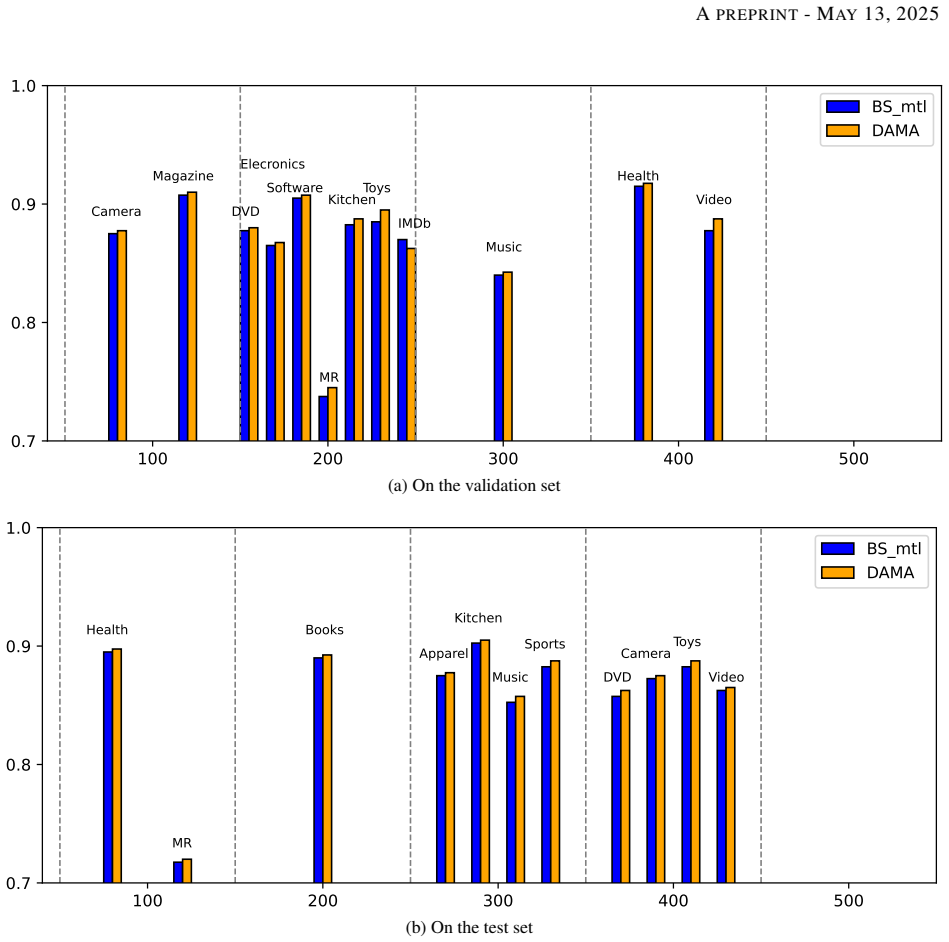
- [Figure 3(a)] The domain label 'Elecronics' is misspelled; it should be 'Electronics'.
- [§5.5 heading] The heading 'Changes of λnd Classification Accuracies in DAMA' appears to have a typo; it likely should read 'Changes of λ and Classification Accuracies in DAMA'.
- [Algorithm 1 and §4.2] The notation is inconsistent: Algorithm 1 uses αx and αx+ while the prose and Table 2 use ax and ax+, and the scaling factor α is also reused for a different purpose. This makes the algorithm difficult to follow; please unify the symbols and clarify the meaning of each variable.
- [Table 1] For the MUTUAL and DaCon columns, the table combines a base accuracy with a signed delta (e.g., '86.3-2.2'), but the base accuracy is not clearly identified in the caption or in the table, and the deltas are not explained. Please specify what these numbers represent and what baseline they are relative to.
Circularity Check
The claimed non-degradation guarantee is a no-op special-case definition, and the starred test-set comparison is test-fitted; the primary validation-selected DAMA result retains independent empirical content.
-
self definitional
[Section 1, Contributions (repeated in Section 5.3)]
"Due to the incremental algorithm employed in our methodology, it theoretically ensures performance on any domain is not lower than that of the original model; this is because settingσ to 0 guarantees the performance equivalent to the original model."
The 'theoretical guarantee' is not a property of the optimization procedure but a definitional special case of the modulation family: Eq. (20) sets δ_j = λ_j ∇ L_d, so λ_j = 0 yields σ = 0 and the input is unchanged, making the model exactly BS_mtl. This no-op option is available in the hypothesis class, but Algorithm 1 never evaluates λ = 0: it initializes λ by Adam and only multiplies/divides nonzero λ by α or β, and Table 2 shows all final λ values are nonzero. The paper even concedes test-set degradation in Electronics and IMDb in the starred comparison. Thus the advertised non-degradation claim is equivalent to the definition of the search space, not a derived result of DAMA, and it cannot support the conclusion that the algorithm prevents performance loss.
-
fitted input called prediction
[Section 5.4, Hyperparameter Selection; Table 1 starred columns]
"According to Fig. 2, we found that the optimal performance of DAMA on the validation set occurs whenγ and dropout are 0.02 and 0.5, respectively, while on the test set, the optimal choice is 0.1 and 0.8. These parameter choices are also those selected for BS_mtl and DAMA, as well as for BS_mtl (test_set) and DAMA (test_set)."
The starred columns BS_mtl* and DAMA* are presented as further validation of DAMA, but their hyperparameters — including γ, dropout, and the λ range — were selected using the test set itself. The later conclusion that 'DAMA(test_set) still outperforms BS_mtl(test_set)' is therefore a comparison of two test-fitted configurations, not an independent prediction of the method's generalization. The reported improvements in those columns are partly forced by the selection procedure rather than by the modulation mechanism, which is the fitted-input-called-prediction pattern. This does not affect the unstarred validation-selected comparison, which remains the primary independent evidence.
full rationale
The paper does not rely on a self-citation chain, imported uniqueness theorems, or an ansatz smuggled in via prior work by the same authors. The core DAMA procedure — learning a per-domain scalar step size λ by minimizing sentiment loss and then adjusting it on a validation set — is a standard and self-contained optimization scheme, and the primary DAMA versus BS_mtl comparison uses validation-set-selected hyperparameters, so that central empirical result is not circular. The main circularity is the repeatedly invoked 'theoretical guarantee' of non-degradation: it follows only from the definitional fact that λ = 0 recovers the base model, not from anything the algorithm actually computes, and Algorithm 1 never treats zero as a candidate. A secondary concern is that the starred test-set comparison selects hyperparameters on the test set and then uses the resulting accuracy as validation, which is a fitted-input-called-prediction issue. On balance, the paper's advertised theoretical advantage reduces by construction, but the primary empirical claim retains independent content, so a moderate circularity score of 4 is appropriate rather than a higher score that would imply the entire derivation is forced.
Assumptions & free parameters
free parameters (6)
- gamma (shared domain classification weight) =
0.02 (validation) / 0.1 (test)
- dropout =
0.5 (validation) / 0.8 (test)
- lambda_j (per-domain step size) =
Values in Table 2, e.g., Books 131.6 to 296.2
- lambda range bound b =
100-500, grid step 100
- alpha (scaling factor for decreasing lambda) =
1.5
- beta (scaling factor for increasing lambda) =
2
assumptions (4)
- domain assumption Multi-task learning with a shared model and both domain and sentiment classifiers is a beneficial framework for multi-domain sentiment analysis.
- ad hoc to paper The gradient of the domain classification loss with respect to the input provides a meaningful direction for modulating domain information.
- ad hoc to paper A single scalar per domain is sufficient to control the trade-off between domain and sentiment classification.
- ad hoc to paper First-order Taylor expansion of the domain loss around the input is valid for the modulation step.
Cite this review
Pith. "Pith review of Dynamic Domain Information Modulation Algorithm for Multi-domain Sentiment Analysis." pith.science (2026). https://pith.science/paper/73ASH2VT
@misc{pith2026250506630,
  author       = {Pith},
  title        = {Pith review of: Dynamic Domain Information Modulation Algorithm for Multi-domain Sentiment Analysis},
  year         = {2026},
  howpublished = {\url{https://pith.science/paper/73ASH2VT}},
  note         = {Machine review of arXiv:2505.06630}
}
read the original abstract
Multi-domain sentiment classification aims to mitigate poor performance models due to the scarcity of labeled data in a single domain, by utilizing data labeled from various domains. A series of models that jointly train domain classifiers and sentiment classifiers have demonstrated their advantages, because domain classification helps generate necessary information for sentiment classification. Intuitively, the importance of sentiment classification tasks is the same in all domains for multi-domain sentiment classification; but domain classification tasks are different because the impact of domain information on sentiment classification varies across different fields; this can be controlled through adjustable weights or hyper parameters. However, as the number of domains increases, existing hyperparameter optimization algorithms may face the following challenges: (1) tremendous demand for computing resources, (2) convergence problems, and (3) high algorithm complexity. To efficiently generate the domain information required for sentiment classification in each domain, we propose a dynamic information modulation algorithm. Specifically, the model training process is divided into two stages. In the first stage, a shared hyperparameter, which would control the proportion of domain classification tasks across all fields, is determined. In the second stage, we introduce a novel domain-aware modulation algorithm to adjust the domain information contained in the input text, which is then calculated based on a gradient-based and loss-based method. In summary, experimental results on a public sentiment analysis dataset containing 16 domains prove the superiority of the proposed method.
Figures


Reference graph
Works this paper leans on
- [1]
-
[3]
M. S. Akhtar, D. S. Chauhan, D. Ghosal, S. Poria, A. Ekbal, and P. Bhattacharyya. Multi-task learning for multi-modal emotion recognition and sentiment analysis. In arXiv preprint arXiv:1905.05812,
arXiv 1905
-
[4]
B. Liu, X. Liu, X. Jin, P. Stone, and Q. Liu. Conflict-averse gradient descent for multi-task learning. Adv. Neural Inf. Process. Syst., 34:18878–18890, 2021a. A. Javaloy and I. Valera. Rotograd: Gradient homogenization in multitask learning. InarXiv preprint arXiv:2103.02631,
- [16]
-
[17]
16 A PREPRINT - MAY 13, 2025 B. McMahan, E. Moore, D. Ramage, et al. Communication-efficient learning of deep networks from decentralized data. In Proc. Int. Conf. Artif. Intell. Stat. (AISTATS) , pages 1273–1282,
work page 2025
-
[18]
M. Beck, K. Pöppel, M. Spanring, A. Auer, O. Prudnikova, M. Kopp, G. Klambauer, J. Brandstetter, and S. Hochreiter. xlstm: Extended long short-term memory. arXiv preprint arXiv:2405.04517,
-
[19]
W. Merrill, J. Petty, and A. Sabharwal. The illusion of state in state-space models. arXiv preprint arXiv:2404.08819,
-
[20]
P. Liu, X. Qiu, and X. Huang. Adversarial multi-task learning for text classification. arXiv preprint arXiv:1704.05742,
Show all 20 references
-
[1992]
Kennedy and R
J. Kennedy and R. Eberhart. Particle swarm optimization. In Proc. ICNN’95-Int. Conf. Neural Netw., volume 4, pages 1942–1948,
1942
-
[2001]
15 A PREPRINT - MAY 13, 2025 A. Graves. Supervised sequence labelling with recurrent neural networks . Springer,
2025
-
[2009]
P. I. Frazier. A tutorial on bayesian optimization. arXiv preprint arXiv:1807.02811,
-
[2011]
M. D. Zeiler. Adadelta: an adaptive learning rate method. arXiv preprint arXiv:1212.5701,
-
[2012]
Chung, C
J. Chung, C. Gulcehre, K. Cho, and Y . Bengio. Empirical evaluation of gated recurrent neural networks on sequence modeling. arXiv preprint arXiv:1412.3555,
-
[2014]
Miyato, A
T. Miyato, A. M. Dai, and I. Goodfellow. Adversarial training methods for semi-supervised text classification. arXiv preprint arXiv:1605.07725,
-
[2016]
P. Liu, X. Qiu, and X. Huang. Deep multi-task learning with shared memory. In arXiv preprint arXiv:1609.07222,
-
[2017]
Devlin, M
J. Devlin, M. Chang, K. Lee, and K. Toutanova. Bert: Pre-training of deep bidirectional transformers for language understanding. In arXiv preprint arXiv:1810.04805,
-
[2020]
L. Liu, Y . Li, Z. Kuang, J. Xue, Y . Chen, W. Yang, Q. Liao, and W. Zhang. Towards impartial multi-task learning. In ICLR, 2021b. T. Bai, J. Luo, J. Zhao, B. Wen, and Q. Wang. Recent advances in adversarial training for adversarial robustness. arXiv preprint arXiv:2102.01356,
-
[2021]
I. J. Goodfellow, J. Shlens, and C. Szegedy. Explaining and harnessing adversarial examples. arXiv preprint arXiv:1412.6572,
-
[2023]
R. S. Jagdale, V . S. Shirsat, and S. N. Deshmukh. Sentiment analysis on product reviews using machine learning techniques. In Proc. Cognitive Informatics and Soft Computing: Proceeding of CISC 2017 , pages 639–647,
2017
-
[2024]
D. P. Kingma and J. Ba. Adam: A method for stochastic optimization. arXiv preprint arXiv:1412.6980,
Reviewed August 15, 2026 · model on record in the stance chip above.
Discussion (0). Continue with ORCID to comment.