Quantum Observers: A NISQ Hardware Demonstration of Chaotic State Prediction Using Quantum Echo-state Networks
Pith reviewed 2026-05-22 15:52 UTC · model grok-4.3
The pith
A quantum echo-state network predicts chaotic time series on noisy IBM hardware for over 100 times the qubit coherence time.
A machine-rendered reading of the paper's core claim, the machinery that carries it, and where it could break.
Core claim
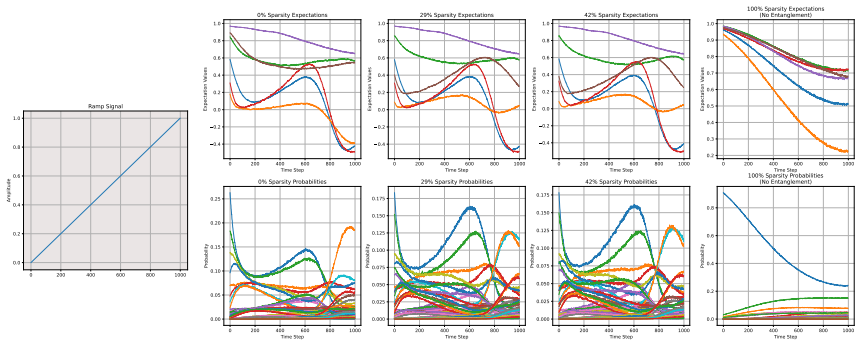
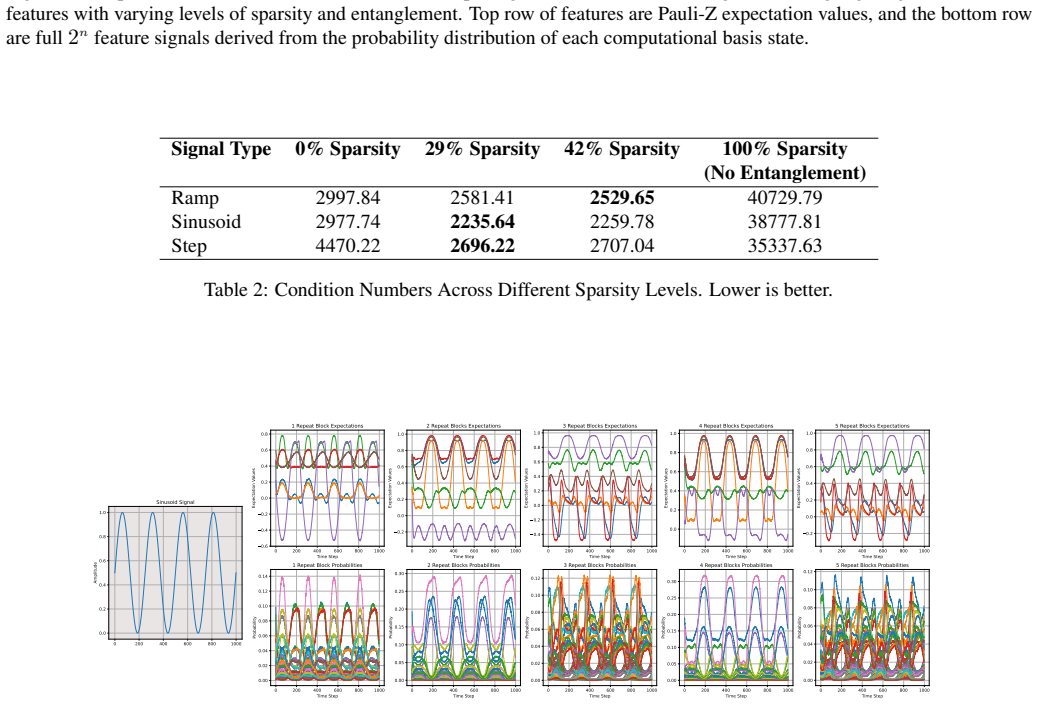
We propose a novel quantum echo-state network (QESN) design and implementation algorithm that can operate within the presence of noise on current IBM hardware. We apply classical control-theoretic response analysis to characterize the QESN, emphasizing its rich nonlinear dynamics and memory, as well as its ability to be fine-tuned with sparsity and re-uploading blocks. We validate our approach through a comprehensive demonstration of QESNs functioning as quantum observers, applied in both high-fidelity simulations and hardware experiments utilizing data from a prototypical chaotic Lorenz system. Our results show that the QESN can predict long time-series with persistent memory, running over
What carries the argument
The quantum echo-state network (QESN) equipped with sparsity and re-uploading blocks, which supplies nonlinear dynamics and long-term memory for time-series prediction on noisy hardware.
If this is right
- The QESN can be tuned and analyzed with classical control-theoretic response methods to confirm its memory and dynamics.
- Sparsity and re-uploading adjustments allow the network to be fine-tuned while staying within NISQ constraints.
- Hardware runs on IBM superconducting qubits confirm that the network retains predictive power despite real gate errors and decoherence.
- The same observer architecture achieves state-of-the-art time-series accuracy on superconducting hardware for chaotic systems.
Where Pith is reading between the lines
- If the memory retention scales with system size, similar networks could handle longer or higher-dimensional chaotic signals on future hardware.
- The approach might extend to other time-series tasks such as sensor data or financial forecasting once the design is ported to additional qubit technologies.
- Combining the QESN with error-mitigation methods already in use on IBM devices could further increase the usable prediction horizon.
Load-bearing premise
The QESN design with sparsity and re-uploading blocks remains functionally operational and retains useful nonlinear memory when executed on real IBM hardware subject to its specific noise profile and gate errors.
What would settle it
A direct measurement showing that prediction error on the Lorenz system rises to random-guess levels well before the run time reaches 100 times the median T1 and T2 of the IBM Marrakesh QPU.
Figures





read the original abstract
Recent advances in artificial intelligence have highlighted the remarkable capabilities of neural network (NN)-powered systems on classical computers. However, these systems face significant computational challenges that limit scalability and efficiency. Quantum computers hold the potential to overcome these limitations and increase processing power beyond classical systems. Despite this, integrating quantum computing with NNs remains largely unrealized due to challenges posed by noise, decoherence, and high error rates in current quantum hardware. Here, we propose a novel quantum echo-state network (QESN) design and implementation algorithm that can operate within the presence of noise on current IBM hardware. We apply classical control-theoretic response analysis to characterize the QESN, emphasizing its rich nonlinear dynamics and memory, as well as its ability to be fine-tuned with sparsity and re-uploading blocks. We validate our approach through a comprehensive demonstration of QESNs functioning as quantum observers, applied in both high-fidelity simulations and hardware experiments utilizing data from a prototypical chaotic Lorenz system. Our results show that the QESN can predict long time-series with persistent memory, running over 100 times longer than the median T1 and T2 of the IBM Marrakesh QPU, achieving state-of-the-art time-series performance on superconducting hardware.
Editorial analysis
A structured set of objections, weighed in public.
Referee Report
Summary. The manuscript proposes a quantum echo-state network (QESN) with sparsity and re-uploading blocks for operation on noisy NISQ hardware. It applies control-theoretic analysis to characterize nonlinear dynamics and memory, then demonstrates the QESN as a quantum observer for long-horizon prediction on the chaotic Lorenz system. Validation includes both high-fidelity simulations and experiments on the IBM Marrakesh QPU, with the central claim being persistent memory enabling time-series prediction over 100 times longer than the median T1/T2 coherence times while achieving state-of-the-art performance on superconducting hardware.
Significance. If the hardware results are robust, this would constitute a concrete demonstration of quantum reservoir computing for chaotic dynamics on real superconducting devices, extending beyond simulation to show functional nonlinear memory under device noise. The control-theoretic characterization and explicit use of sparsity/re-uploading for fine-tuning are strengths that could aid reproducibility and practical deployment in the NISQ regime.
major comments (2)
- [Abstract and hardware results] Abstract and hardware results section: the claim that the QESN predicts long time-series 'running over 100 times longer than the median T1 and T2' is load-bearing for the 'persistent memory' and 'state-of-the-art on superconducting hardware' assertions, yet no quantitative bounds, error bars on prediction accuracy, or direct comparisons to classical baselines (e.g., linear readout or standard ESN) are provided to rule out dominance by classical post-processing under the specific noise profile.
- [Implementation algorithm] Implementation algorithm description: the design treats sparsity level and re-uploading block count as free parameters that are fine-tuned; the manuscript must specify whether these choices were made a priori or via post-hoc optimization on hardware data, because post-hoc tuning risks circularity in the reported memory length and undermines the claim that the quantum reservoir itself retains useful nonlinear dynamics on IBM Marrakesh.
minor comments (2)
- [Methods] Clarify the exact training protocol (e.g., number of epochs, loss function, and readout fitting procedure) in the methods section so that the simulation-to-hardware comparison can be reproduced.
- [Results figures] Prediction figures should include multiple independent hardware runs or uncertainty bands to illustrate variability arising from readout error and decoherence accumulation.
Simulated Author's Rebuttal
We thank the referee for their careful reading and constructive comments, which help clarify key aspects of our work on the quantum echo-state network. We address each major comment point by point below, indicating where revisions will be made to strengthen the manuscript.
read point-by-point responses
-
Referee: [Abstract and hardware results] Abstract and hardware results section: the claim that the QESN predicts long time-series 'running over 100 times longer than the median T1 and T2' is load-bearing for the 'persistent memory' and 'state-of-the-art on superconducting hardware' assertions, yet no quantitative bounds, error bars on prediction accuracy, or direct comparisons to classical baselines (e.g., linear readout or standard ESN) are provided to rule out dominance by classical post-processing under the specific noise profile.
Authors: We agree that additional quantitative support would strengthen the presentation of the persistent-memory claim. The 100x factor is computed directly from the observed prediction horizon on the IBM Marrakesh QPU relative to its reported median T1/T2 values, and the underlying time-series error is already tracked via mean-squared error in the hardware-results section. In the revised manuscript we will add explicit error bars on all prediction-accuracy curves, state the precise numerical bounds (prediction length in steps and corresponding wall-clock time), and include side-by-side comparisons against a linear readout and a classical echo-state network of comparable reservoir size. These additions will make it possible to assess any contribution from classical post-processing under the observed noise profile while preserving the control-theoretic evidence that the quantum reservoir supplies the requisite nonlinear memory. revision: yes
-
Referee: [Implementation algorithm] Implementation algorithm description: the design treats sparsity level and re-uploading block count as free parameters that are fine-tuned; the manuscript must specify whether these choices were made a priori or via post-hoc optimization on hardware data, because post-hoc tuning risks circularity in the reported memory length and undermines the claim that the quantum reservoir itself retains useful nonlinear dynamics on IBM Marrakesh.
Authors: The sparsity level and re-uploading block count were fixed on the basis of the control-theoretic response analysis and high-fidelity simulations performed prior to any hardware runs; these simulations identified parameter regimes that produce the desired fading-memory and nonlinear-response properties. The same fixed values were then used without further adjustment on the IBM Marrakesh device. We will revise the implementation-algorithm section to state this sequence explicitly, thereby removing any ambiguity about post-hoc tuning and reinforcing that the observed memory originates from the quantum reservoir dynamics rather than from data-driven parameter search on the hardware. revision: yes
Circularity Check
No significant circularity: experimental demonstration remains independent of fitted inputs
full rationale
The paper's core chain consists of proposing a QESN architecture, applying classical control-theoretic response analysis to characterize nonlinear dynamics and memory, then executing the design (with sparsity and re-uploading blocks) on both simulation and real IBM Marrakesh hardware to generate predictions for the Lorenz system. Performance metrics such as long-horizon prediction accuracy and memory persistence are obtained directly from the hardware runs and post-processing readout training, not by re-deriving or fitting the same quantities used as inputs. No self-citations are invoked as load-bearing uniqueness theorems, no ansatz is smuggled via prior work, and no known result is merely renamed. The fine-tuning steps are presented as design choices whose effect is then measured empirically rather than assumed to produce the reported outcome by construction. The derivation is therefore self-contained against external benchmarks (hardware execution and chaotic time-series data).
Axiom & Free-Parameter Ledger
free parameters (2)
- sparsity level
- re-uploading block count
axioms (1)
- domain assumption The quantum dynamics under the chosen circuit ansatz retain sufficient memory and nonlinearity despite decoherence and gate errors.
Lean theorems connected to this paper
-
IndisputableMonolith/Cost/FunctionalEquation.leanwashburn_uniqueness_aczel unclear?
unclearRelation between the paper passage and the cited Recognition theorem.
We propose a novel quantum echo-state network (QESN) design and implementation algorithm that can operate within the presence of noise on current IBM hardware... sparsity and re-uploading blocks.
What do these tags mean?
- matches
- The paper's claim is directly supported by a theorem in the formal canon.
- supports
- The theorem supports part of the paper's argument, but the paper may add assumptions or extra steps.
- extends
- The paper goes beyond the formal theorem; the theorem is a base layer rather than the whole result.
- uses
- The paper appears to rely on the theorem as machinery.
- contradicts
- The paper's claim conflicts with a theorem or certificate in the canon.
- unclear
- Pith found a possible connection, but the passage is too broad, indirect, or ambiguous to say the theorem truly supports the claim.
Reference graph
Works this paper leans on
-
[1]
Sukhpal Singh Gill, Adarsh Kumar, Harvinder Singh, Man- meet Singh, Kamalpreet Kaur, Muhammad Usman, and Rajkumar Buyya. Quantum computing: A taxonomy, sys- tematic review and future directions.Software: Practice and Experience, 52(1):66–114, 2022
work page 2022
-
[2]
Evans, Matthew Cook, Zachary P
Ethan N. Evans, Matthew Cook, Zachary P. Bradshaw, and Margarite L. LaBorde. Learning with sasquatch: a novel variational quantum transformer architecture with kernel- based self-attention, 2024. URL https://arxiv. org/abs/2403.14753
-
[3]
Iris Cong, Soonwon Choi, and Mikhail D. Lukin. Quantum convolutional neural networks.Nature Physics, 15(12): 1273–1278, August 2019. ISSN 1745-2481. doi: 10.1038/ s41567-019-0648-8. URL http://dx.doi.org/10. 1038/s41567-019-0648-8
work page 2019
- [4]
-
[5]
Daoyi Dong, Chunlin Chen, Hanxiong Li, and Tzyh-Jong Tarn. Quantum reinforcement learning.IEEE Transac- tions on Systems, Man, and Cybernetics, Part B (Cyber- netics), 38(5):1207–1220, October 2008. ISSN 1083-
work page 2008
-
[6]
URL http: //dx.doi.org/10.1109/TSMCB.2008.925743
doi: 10.1109/tsmcb.2008.925743. URL http: //dx.doi.org/10.1109/TSMCB.2008.925743
-
[7]
Quantum diffusion models, 2023
Andrea Cacioppo, Lorenzo Colantonio, Simone Bordoni, and Stefano Giagu. Quantum diffusion models, 2023. URL https://arxiv.org/abs/2311.15444
-
[8]
Quantum recur- rent neural networks for sequential learning.Neu- ral Networks, 166:148–161, 2023
Yanan Li, Zhimin Wang, Rongbing Han, Shangshang Shi, Jiaxin Li, Ruimin Shang, Haiyong Zheng, Guo- qiang Zhong, and Yongjian Gu. Quantum recur- rent neural networks for sequential learning.Neu- ral Networks, 166:148–161, 2023. ISSN 0893-
work page 2023
-
[9]
doi: https://doi.org/10.1016/j.neunet.2023.07
-
[10]
URL https://www.sciencedirect.com/ science/article/pii/S089360802300360X
-
[11]
Milan Kornjaˇca, Hong-Ye Hu, Chen Zhao, Jonathan Wurtz, Phillip Weinberg, Majd Hamdan, Andrii Zhdanov, Ser- gio H Cantu, Hengyun Zhou, Rodrigo Araiza Bravo, et al. Large-scale quantum reservoir learning with an analog quantum computer.arXiv:2407.02553, 2024
-
[12]
L C G Govia, G J Ribeill, G E Rowlands, and T A Ohki. Nonlinear input transformations are ubiquitous in quantum reservoir computing.Neuromorphic Com- puting and Engineering, 2(1):014008, feb 2022. doi: 10.1088/2634-4386/ac4fcd. URL https://dx.doi. org/10.1088/2634-4386/ac4fcd
-
[13]
Chuanzhou Zhu, Peter J. Ehlers, Hendra I. Nurdin, and Daniel Soh. Practical and scalable quantum reservoir computing, 2024. URL https://arxiv.org/abs/ 2405.04799
-
[14]
Julien Dudas, Baptiste Carles, Erwan Plouet, Frank Mizrahi, Julie Grollier, and Danijela Markovic. Quan- tum reservoir computing implementation on coherently coupled quantum oscillators.npj Quantum Information, 9, 07 2023. doi: 10.1038/s41534-023-00734-4
-
[15]
Pere Mujal, Rodrigo Martínez-Peña, Gian Luca Giorgi, Miguel C. Soriano, and Roberta Zambrini. Time- series quantum reservoir computing with weak and pro- jective measurements.npj Quantum Information, 9 (1):16, Feb 2023. ISSN 2056-6387. doi: 10.1038/ s41534-023-00682-z. URL https://doi.org/10. 1038/s41534-023-00682-z
work page 2023
-
[16]
W. D. Kalfus, G. J. Ribeill, G. E. Rowlands, H. K. Krovi, T. A. Ohki, and L. C. G. Govia. Hilbert space as a com- putational resource in reservoir computing.Phys. Rev. Res., 4:033007, Jul 2022. doi: 10.1103/PhysRevResearch. 4.033007. URL https://link.aps.org/doi/10. 1103/PhysRevResearch.4.033007
-
[17]
Fangjun Hu, Saeed A. Khan, Nicholas T. Bronn, Gerasimos Angelatos, Graham E. Rowlands, Guilhem J. Ribeill, and Hakan E. Türeci. Overcoming the coherence time barrier in quantum machine learning on temporal data.Nature Communications, 15(1):7491, Aug 2024. ISSN 2041-1723. doi: 10.1038/s41467-024-51162-7. URL https://doi. org/10.1038/s41467-024-51162-7
-
[18]
Toshiki Yasuda, Yudai Suzuki, Tomoyuki Kubota, Kohei Nakajima, Qi Gao, Wenlong Zhang, Satoshi Shimono, Hen- dra I. Nurdin, and Naoki Yamamoto. Quantum reservoir computing with repeated measurements on superconduct- ing devices, 2023. URL https://arxiv.org/abs/ 2310.06706
-
[19]
Jiayin Chen, Hendra I. Nurdin, and Naoki Yamamoto. Temporal information processing on noisy quan- tum computers.Phys. Rev. Appl., 14:024065, Aug 7
-
[20]
URL https://link.aps.org/doi/10.1103/ PhysRevApplied.14.024065
doi: 10.1103/PhysRevApplied.14.024065. URL https://link.aps.org/doi/10.1103/ PhysRevApplied.14.024065
-
[21]
Adrián Pérez-Salinas, Alba Cervera-Lierta, Elies Gil- Fuster, and José I. Latorre. Data re-uploading for a universal quantum classifier.Quantum, 4:226, February 2020. ISSN 2521-327X. doi: 10.22331/ q-2020-02-06-226. URL http://dx.doi.org/10. 22331/q-2020-02-06-226
work page 2020
-
[22]
Richard P. Feynman, Jr. Vernon, Frank L., and Robert W. Hellwarth. Geometrical representation of the schrödinger equation for solving maser problems.Journal of Ap- plied Physics, 28(1):49–52, 01 1957. ISSN 0021-8979. doi: 10.1063/1.1722572. URL https://doi.org/ 10.1063/1.1722572
-
[23]
C. R. Stroud, J. H. Eberly, W. L. Lama, and L. Man- del. Superradiant effects in systems of two-level atoms. Phys. Rev. A, 5:1094–1104, Mar 1972. doi: 10.1103/ PhysRevA.5.1094. URL https://link.aps.org/ doi/10.1103/PhysRevA.5.1094
-
[24]
David C. McKay, Christopher J. Wood, Sarah Shel- don, Jerry M. Chow, and Jay M. Gambetta. Effi- cient z gates for quantum computing.Phys. Rev. A, 96:022330, Aug 2017. doi: 10.1103/PhysRevA.96. 022330. URL https://link.aps.org/doi/10. 1103/PhysRevA.96.022330
-
[25]
Qmlp: An error-tolerant nonlinear quantum mlp architecture using parameterized two-qubit gates, 2022
Cheng Chu, Nai-Hui Chia, Lei Jiang, and Fan Chen. Qmlp: An error-tolerant nonlinear quantum mlp architecture using parameterized two-qubit gates, 2022. URL https:// arxiv.org/abs/2206.01345
-
[26]
Hui Zou and Trevor Hastie. Regularization and variable selection via the elastic net.Journal of the Royal Statistical Society Series B: Statistical Methodology, 67(2):301–320, 03 2005. ISSN 1369-7412. doi: 10.1111/j.1467-9868. 2005.00503.x. URL https://doi.org/10.1111/ j.1467-9868.2005.00503.x
-
[27]
Richard C. Dorf and Robert H. Bishop.Modern Control Systems. Pearson Prentice Hall, Upper Saddle River, NJ, 10th edition, 2005
work page 2005
-
[28]
Edward N. Lorenz. Deterministic nonperiodic flow. Journal of Atmospheric Sciences, 20(2):130 – 141, 1963. doi: 10.1175/1520-0469(1963)020<0130:DNF>2.0.CO;2. URL https://journals.ametsoc.org/view/ journals/atsc/20/2/1520-0469_1963_020_ 0130_dnf_2_0_co_2.xml
-
[29]
Wei Miao, Vignesh Narayanan, and Jr-Shin Li. Inter- pretable design of reservoir computing networks using realization theory.IEEE Transactions on Neural Networks and Learning Systems, 34(9):6379–6389, 2022
work page 2022
-
[30]
David E. Rumelhart and James L. McClelland.Learning Internal Representations by Error Propagation, pages 318–
-
[31]
H Jaeger. ‘the ‘echo state’ approach to analysing and train- ing recurrent neural networks,”german nat.Res. Center Inf. Technol., GMD Rep, 148:43, 2001. A Supplementary Note 1 A.1 System Architecture A.1.1 Preliminaries The input data is denoted by X={x 1, . . . , xt, . . . , xN } , with xt ∈R d and t∈T={1, . . . , N} . We encode the classical data onto n...
discussion (0)
Sign in with ORCID, Apple, or X to comment. Anyone can read and Pith papers without signing in.