REVIEW 3 major objections 5 minor 27 references
Efficient Implementation of RISC-V Vector Permutation Instructions
T0 review · 3 major / 5 minor · reviewed 2026-08-15 · deepseek-v4-flash
Pith's one-line read A unified crossbar-based datapath can execute all RISC-V vector permutation instructions in a single fixed-latency cycle with only 1.5% area overhead.
desk verdict A real hardware trick for unified RVV permutations with solid area results, but the single-cycle 500 MHz claim is not backed by timing evidence. read the letter →
The pith
A machine-rendered reading of the paper's core claim, the machinery that carries it, and where it could break.
The reading
What carries the argument
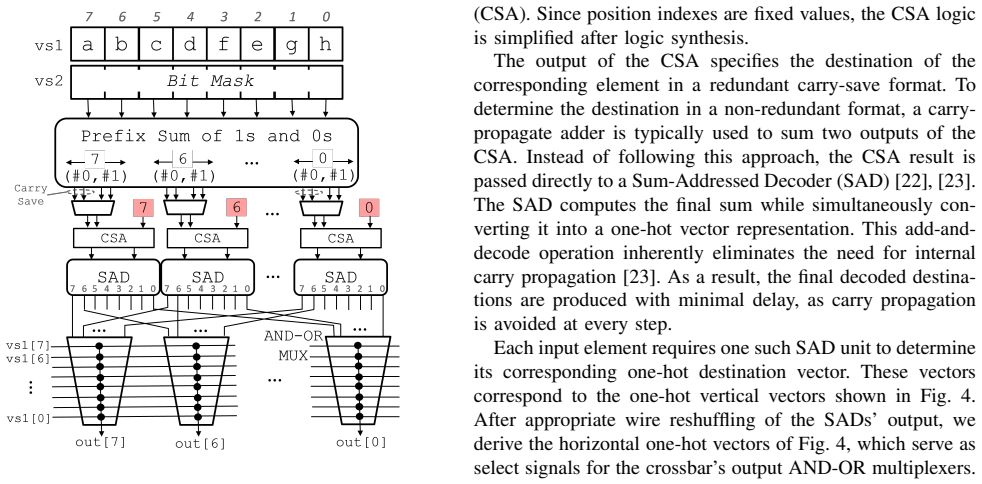
The load-bearing object is a vector-wide crossbar: a grid in which each output element has an AND-OR multiplexer that can read any input element, with select signals normally produced by per-output one-hot decoding of vrgather indices. To reuse this crossbar for input-driven instructions, a per-element address-generation stage computes per-input destination indices. Carry-save counters form two prefix sums—ones counted from high to low vector indices and zeros counted from low to high—and their addition or subtraction with each element's own index produces unique destinations for vcompress, while slides feed an offset directly into the same arithmetic. Sum-addressed decoders, which compute a sum and decode it to one-hot form in one step, keep carry propagation off the critical path. This address-generation stage, plus the multiplexing that selects per-output versus per-input select distribution, is what lets all permutation classes share the crossbar at fixed latency.
What would settle it
Run post-layout static timing analysis on the synthesized 256-bit vector processor at the 500 MHz target and measure setup slack on the path from the vs2 operand through the prefix-sum stage, the sum-addressed decoder, and the crossbar's output select logic. If that path shows negative slack—a delay longer than the 2 ns clock period—then vcompress and slide variants cannot complete in one cycle at the stated frequency, and the fixed-latency claim falls, even though the area comparison could remain valid.
Extended reading notes
Core claim
The central claim is that a single crossbar-based permutation unit can execute every RVV permutation instruction in one cycle with data-independent latency, for vector lengths up to 256 bits. The mechanism unifies two control styles. For output-driven vrgather, the index in each destination element is decoded to one-hot form and drives the AND-OR multiplexer of that output. For input-driven vcompress and vslide, the mask bits or slide offset are converted—by two parallel prefix sums for compress (left-to-right count of ones, right-to-left count of zeros) and by a signed offset addition for slides—into a per-input destination index; a sum-addressed decoder fuses the index arithmetic with one-hot decoding, eliminating carry propagation, and a wire reshuffling feeds these one-hot vectors to the crossbar rows that the corresponding outputs read. The final select distribution is multiplexed between output-driven and input-driven paths. The paper supports the claim with physical synthesis of two complete 256-bit vector processors at 7 nm: the unified version is 1.5% larger than one with separate gather, slide, and sequential compress datapaths, and the difference nearly vanishes when the minimum moved element is 2 bytes instead of 1.
Load-bearing premise
The load-bearing premise is that the unified datapath's longest combinational path—from the mask or offset bits through the address-generation logic to the crossbar output—actually fits in one 500 MHz clock cycle after physical synthesis; the paper reports no timing slack or critical-path data, so if that path runs slower, the fixed single-cycle latency claim fails.
Editorial extensions
If this is right
- A processor that can already afford a vrgather crossbar can also issue vcompress and vslide in the same single cycle, so software no longer needs to lower these instructions to multiple element-wise operations or memory round-trips.
- Cryptographic software can use vrgather, vcompress, and vslide with a fixed execution time, since the unit has no data-dependent loops or iterative compress datapath.
- For vector lengths beyond 256 bits, register grouping lets the same unit act in a sequence of single-vector permutations, and pipelining the index-generation and crossbar stages keeps the latency fixed at one or two cycles.
- Raising the minimum supported element width from 1 byte to 2 bytes makes the unified permutation unit nearly area-free relative to the whole processor, which gives implementers a cheap trade-off between shuffle granularity and cost.
Reading between the lines
- If the 500 MHz target holds over process corners, the same address-generation logic should generalize to other mask- or index-driven movements, such as scatter-by-mask, segment loads and stores, or structured sparse kernels; the paper does not explore those applications.
- The near-zero area overhead at 2-byte granularity suggests that for workloads not needing byte shuffles, full RVV permutation support could be shipped almost for free; only the 1-byte and 2-byte points are measured, so the trend toward 4-byte elements is an extrapolation.
- A direct follow-up would be to report post-layout clock slack and cycle-accurate simulation of permutation latency under different masks, which would turn the architectural claim into a validated implementation claim.
Signed reviews
Editorial analysis
A structured set of objections, weighed in public.
Referee Report
Summary. The paper proposes a unified vector permutation unit for RISC-V RVV that executes vrgather, vcompress, vslideup, and vslidedown on a single crossbar datapath. Input-driven instructions are converted into per-output select signals using carry-save prefix-sum counters and sum-addressed decoders, avoiding carry propagation. The unit is integrated into an open-source 256-bit vector processor and synthesized with the OpenRoad flow at ASAP7 7 nm. The paper reports physical area results (98,124 vs. 96,630 square micrometers for 1-byte granularity, ~1.5% processor-level overhead) and qualitative power trends, and claims single-cycle, fixed-latency execution at 500 MHz.
Significance. The core idea is attractive: unifying the control semantics of the main RVV permutation instructions in one crossbar with an area-efficient, carry-propagation-free front-end is a meaningful contribution for short-vector machines, especially in constant-time cryptographic settings. The paper provides open-source RTL, uses an open-source physical synthesis flow, and gives concrete area numbers from a realistic 7 nm process. If timing closure and functional correctness are verified, the design would offer a practical solution with modest overhead. The study is squarely within the scope of computer architecture and hardware implementation, and the experimental setup is reproducible.
major comments (3)
- [Section IV, Table I and surrounding text] The paper reports area results but no timing results. It states that the designs were synthesized 'targeting a clock frequency of 500 MHz under the same physical design constraints,' yet it never reports worst negative slack, total negative slack, critical path delay, or achieved frequency for either the baseline or the proposed processor. This is load-bearing because the central claim of single-cycle, fixed-latency execution at 500 MHz requires that the entire unified datapath—including the carry-save prefix-sum counters, the sum-addressed decoders, and the 256-bit crossbar—fits within a 2 ns cycle. Without timing closure data, the headline latency claim is unsubstantiated. The remark that higher frequencies are 'straightforward' by pipelining would change the latency from single-cycle to multi-cycle and does not rescue the 500 MHz single-cycle claim. The authors should report post-route WNS/TNS or critical-path delays for both designs.
- [Section III-B and Section IV] No functional verification results are provided. The correctness of the vcompress destination transformation and the one-hot property of the reshuffled crossbar selects is argued informally, but there are no directed tests, random simulation results, or formal equivalence checks. For a unit intended for cryptographic accelerators, silent functional failures are especially serious. The authors should report verification results (e.g., comparison against an architectural reference model for all supported element widths, all-zero/all-one masks, out-of-bounds slide offsets, and other edge cases) or provide a formal proof of the transformation's bijectivity and the crossbar one-hot property.
- [Section IV, Table I] The area-overhead comparison is only against a baseline that executes vcompress sequentially (one element per cycle). The 1.5% area overhead therefore conflates the cost of the unified datapath with the cost of making vcompress single-cycle. The authors should clarify that the claimed overhead is relative to a processor with a multi-cycle vcompress datapath, and ideally also compare against a baseline with a single-cycle-capable but separate vcompress unit, to isolate the cost of unification from the cost of the performance improvement.
minor comments (5)
- [Section IV] The power evaluation is described only qualitatively ('differences ... generally align with differences in area'). Report measured power and energy values for the kernels used, since the abstract and conclusions allude to power behavior.
- [Section II-A] 'All-three permutation instructions' contains a typo and should read 'All three permutation instructions.'
- [Section IV, Table I] Clarify that 'Size of Element' is the minimum supported permutation granularity (1 or 2 bytes), not the vector length or a configurable element size.
- [Abstract and Section I] The abstract states 'single-cycle execution' while Section I mentions 'single-cycle or pipelined execution' with 'a fixed latency of one or two cycles.' Make these statements consistent across the paper.
- [Figures 4 and 5] The figure captions/annotations contain typos such as 'elemenets' and 'destionations' (e.g., Fig. 4 caption says 'elemenets'); proofread all figure text.
Circularity Check
No circularity: the area-overhead result is a measured synthesis output and the datapath derivation is self-contained.
full rationale
The paper's central claim—that a unified crossbar and carry-save prefix-sum datapath can execute vrgather, vcompress, vslideup, and vslidedown with fixed latency at roughly 1.5% area overhead—is not obtained by fitting a parameter to the claimed result or by importing a load-bearing self-citation. The mask-to-destination transformation for vcompress is specified as an explicit algorithm: compute left-to-right prefix sums of ones and right-to-left prefix sums of zeros, then add/subtract these from the element index to form per-input destination indices. Correctness is argued from the one-hot and unique-destination properties of the crossbar, not from an assumed equivalence with the target instruction. The 1.5% area overhead is read directly from Table I, which reports physical-layout areas for the baseline and proposed vector processors synthesized with OpenRoad and the ASAP 7 nm library; this is a measured experimental output, not a quantity defined in terms of the conclusion. The baseline is author-designed, which is a comparison-quality concern but not circularity. Similarly, the absence of post-layout timing-slack or critical-path data for the 500 MHz target is a validation gap affecting the latency claim, but it is not a circular reduction: no equation in the paper equates the proposed design's timing to its inputs. No self-referential uniqueness theorem, ansatz-smuggled citation, or renaming of a known result is used as load-bearing support. The derivation chain is therefore self-contained with respect to circularity.
Assumptions & free parameters
assumptions (5)
- standard math Prefix-sum based mask-to-destination transformation yields a conflict-free one-hot matrix for vcompress.
- standard math Sum-addressed decoders merge addition and one-hot decoding without carry propagation.
- domain assumption ASAP7 standard-cell library and OpenRoad physical synthesis give realistic area and power estimates.
- domain assumption The baseline processor with separate datapaths for vrgather, vslide, and vcompress is a fair and representative comparison.
- domain assumption RVV masking and tail handling do not change the permutation unit's single-cycle latency.
Cite this review
Pith. "Pith review of Efficient Implementation of RISC-V Vector Permutation Instructions." pith.science (2026). https://pith.science/paper/FAU7NEPP
@misc{pith2026250507112,
  author       = {Pith},
  title        = {Pith review of: Efficient Implementation of RISC-V Vector Permutation Instructions},
  year         = {2026},
  howpublished = {\url{https://pith.science/paper/FAU7NEPP}},
  note         = {Machine review of arXiv:2505.07112}
}
read the original abstract
RISC-V CPUs leverage the RVV (RISC-V Vector) extension to accelerate data-parallel workloads. In addition to arithmetic operations, RVV includes powerful permutation instructions that enable flexible element rearrangement within vector registers --critical for optimizing performance in tasks such as matrix operations and cryptographic computations. However, the diverse control mechanisms of these instructions complicate their execution within a unified datapath while maintaining the fixed-latency requirement of cryptographic accelerators. To address this, we propose a unified microarchitecture capable of executing all RVV permutation instructions efficiently, regardless of their control information structure. This approach minimizes area and hardware costs while ensuring single-cycle execution for short vector machines (up to 256 bits) and enabling efficient pipelining for longer vectors. The proposed design is integrated into an open-source RISC-V vector processor and implemented at 7 nm using the OpenRoad physical synthesis flow. Experimental results validate the efficiency of our unified vector permutation unit, demonstrating that it only incurs 1.5% area overhead to the total vector processor. Furthermore, this area overhead decreases to near-0% as the minimum supported element width for vector permutations increases.
Figures


Figures from the paper (4 more)


Reference graph
Works this paper leans on
-
[1]
Vector- processing for mobile devices: Benchmark and analysis,
A. Khadem, D. Fujiki, N. Talati, S. Mahlke, and R. Das, “Vector- processing for mobile devices: Benchmark and analysis,” inIEEE Intern. Symp. on Workload Characterization (IISWC), 2023, pp. 15–27
work page 2023
-
[2]
RISC-V vector extension (Version 1.0),
“RISC-V vector extension (Version 1.0),” https://github.com/riscv/riscv- v-spec
-
[3]
A framework for the automatic vectorization of parallel sort on x86-based processors,
K. Hou, H. Wang, and W.-c. Feng, “A framework for the automatic vectorization of parallel sort on x86-based processors,”IEEE Trans. on Parallel and Distributed Systems, vol. 29, no. 5, pp. 958–972, 2018
work page 2018
-
[4]
Intel A VX-512 - permuting data within and between A VX registers,
D. Towner, “Intel A VX-512 - permuting data within and between A VX registers,” Intel - Technology Guide, Tech. Rep., 2022
work page 2022
-
[5]
Maximizing the potential of custom RISC-V vector extensions for speeding up SHA-3 hash functions,
H. Li, N. Mentens, and S. Picek, “Maximizing the potential of custom RISC-V vector extensions for speeding up SHA-3 hash functions,” in Design, Automation & Test in Europe Conference (DATE)
-
[6]
Optimizing data permutations for simd devices,
G. Ren, P. Wu, and D. Padua, “Optimizing data permutations for simd devices,”ACM SIGPLAN Notices, vol. 41, no. 6, pp. 118–131, 2006
work page 2006
-
[7]
M. Cavalcante, F. Schuiki, F. Zaruba, M. Schaffner, and L. Benini, “Ara: A 1-GHz+ scalable and energy-efficient RISC-V vector processor with multiprecision floating-point support in 22-nm fd-soi,”IEEE Trans. on VLSI Systems, vol. 28, no. 2, pp. 530–543, 2019
work page 2019
-
[8]
ZeroVex: A scalable and high-performance RISC- V vector processor core for embedded systems,
T. Zhao and Z. Ye, “ZeroVex: A scalable and high-performance RISC- V vector processor core for embedded systems,” inIEEE Intern. Conf. on Application-specific Systems, Architectures and Processors (ASAP), 2024, pp. 32–33
work page 2024
Show all 27 references
-
[9]
Vecim: A 289.13 GOPS/W RISC-V vector co-processor with compute-in-memory vector register file for efficient high-performance computing,
Y . Wang, M. Yang, C.-P. Lo, and J. P. Kulkarni, “Vecim: A 289.13 GOPS/W RISC-V vector co-processor with compute-in-memory vector register file for efficient high-performance computing,” inIEEE Intern. Solid-State Circuits Conf.(ISSCC), 2024, pp. 492–494
2024
-
[10]
Lem: A configurable RISC-V vector unit based on parame- terized microcode expander,
Z. Fang, “Lem: A configurable RISC-V vector unit based on parame- terized microcode expander,” 2022
2022
-
[11]
A “new ara
M. Perotti, M. Cavalcante, N. Wistoff, R. Andri, L. Cavigelli, and L. Benini, “A “new ara” for vector computing: An open source highly efficient RISC-V v 1.0 vector processor design,” inIEEE Intern. Conf. on Application-specific Systems, Architectures and Processors (ASAP), 20...
2022
-
[12]
Ara2: Exploring single-and multi-core vector processing with an efficient rvv 1.0 compliant open-source processor,
M. Perotti, M. Cavalcante, R. Andri, L. Cavigelli, and L. Benini, “Ara2: Exploring single-and multi-core vector processing with an efficient rvv 1.0 compliant open-source processor,”IEEE Trans. on Computers, 2024
2024
-
[13]
Vitruvius+: an area- efficient RISC-V decoupled vector coprocessor for high performance computing applications,
F. Minervini, O. Palomar, O. Unsal, E. Reggiani, J. Quiroga, J. Marimon, C. Rojas, R. Figueras, A. Ruiz, A. Gonzalezet al., “Vitruvius+: an area- efficient RISC-V decoupled vector coprocessor for high performance computing applications,”ACM Trans. on Architecture and Code Opti...
2023
-
[14]
Big.VLITTLE: On-demand data-parallel acceleration for mobile systems on chip,
T. Ta, K. Al-Hawaj, N. Cebry, Y . Ou, E. Hall, C. Golden, and C. Bat- ten, “Big.VLITTLE: On-demand data-parallel acceleration for mobile systems on chip,” inIEEE/ACM Intern. Symp. on Microarchitecture (MICRO), 2022, pp. 181–198
2022
-
[15]
Spatz: Clustering compact RISC-V-based vector units to maximize computing efficiency,
M. Cavalcante, M. Perotti, S. Riedel, and L. Benini, “Spatz: Clustering compact RISC-V-based vector units to maximize computing efficiency,” arXiv preprint arXiv:2309.10137, 2023
2023 arXiv
-
[16]
AraXL: A physically scalable, ultra-wide RISC-V vector processor design for fast and efficient computation on long vectors,
N. K. Purayil, M. Perotti, T. Fischer, and L. Benini, “AraXL: A physically scalable, ultra-wide RISC-V vector processor design for fast and efficient computation on long vectors,” 2025. [Online]. Available: https://arxiv.org/abs/2501.10301
2025 arXiv
-
[17]
A vector processing unit implementation for RISC-V vector extension: Functional verification and assertions on submodules
L. Valente, “A vector processing unit implementation for RISC-V vector extension: Functional verification and assertions on submodules.” Ph.D. dissertation, Politecnico di Torino, 2020
2020
-
[18]
Vicuna: A timing-predictable RISC-V vector coprocessor for scalable parallel computation,
M. Platzer and P. Puschner, “Vicuna: A timing-predictable RISC-V vector coprocessor for scalable parallel computation,” inEuromicro conference on real-time systems (ECRTS), 2021
2021
-
[19]
Instruction scheduling in the saturn vector unit,
J. Zhao, D. Grubb, M. Rusch, T. Wei, K. Anderson, B. Nikolic, and K. Asanovic, “Instruction scheduling in the saturn vector unit,”arXiv preprint arXiv:2412.00997, 2024
2024 arXiv
-
[20]
Sonicboom: The 3rd generation berkeley out-of-order machine,
J. Zhao, B. Korpan, A. Gonzalez, and K. Asanovic, “Sonicboom: The 3rd generation berkeley out-of-order machine,” May 2020
2020
-
[21]
Parallel counter implemen- tation,
R. F. Jones Jr and E. E. Swartzlander Jr, “Parallel counter implemen- tation,”Journal of VLSI Signal Processing Systems, vol. 7, no. 3, pp. 223–232, 1994
1994
-
[22]
Low load latency through sum-addressed memory (sam),
W. L. Lynch, G. Lauterbach, and J. I. Chamdani, “Low load latency through sum-addressed memory (sam),” inIEEE/ACM Intern. Symp. on Computer Architecture (ISCA), 1998, pp. 369–379
1998
-
[23]
64-kbyte sum-addressed-memory cache with 1.6-ns cycle and 2.6-ns latency,
R. Heald, K. Shin, V . Reddy, I.-F. Kao, M. Khan, W. L. Lynch, G. Lauterbach, and J. Petolino, “64-kbyte sum-addressed-memory cache with 1.6-ns cycle and 2.6-ns latency,”IEEE Journal of Solid-State Circuits, vol. 33, no. 11, pp. 1682–1689, 1998
1998
-
[24]
A study of BFLOAT16 for deep learning training,
D. Kalamkaret al., “A study of BFLOAT16 for deep learning training,”
-
[25]
Toward an open-source digital flow: First learnings from the openroad project,
T. Ajayiet al., “Toward an open-source digital flow: First learnings from the openroad project,” inDesign Automation Conference (DAC), 2019
2019
-
[26]
RVV benchmark suite
“RVV benchmark suite.” [Online]. Available: https://github.com/camel- cdr/rvv-bench
-
[2019]
Available: https://arxiv.org/abs/1905.12322
[Online]. Available: https://arxiv.org/abs/1905.12322
1905 arXiv
Reviewed August 15, 2026 · model on record in the stance chip above.
Discussion (0). Continue with ORCID to comment.