REVIEW 3 major objections 4 minor 1 cited by
Exact Spin Elimination in Ising Hamiltonians and Energy-Based Machine Learning
T0 review · 3 major / 4 minor · reviewed 2026-08-15 · deepseek-v4-flash
Pith's one-line read A spin in a $k$-local Ising Hamiltonian can be removed exactly, preserving every ground state, by substituting the multilinear expansion of $-|P(s_{\mathrm{nbr}})|$.
desk verdict The reader's sign-error objection is arithmetically wrong; the central exact-elimination claim is sound, but the Hopfield and Max-Cut application claims overreach. read the letter →
The pith
A machine-rendered reading of the paper's core claim, the machinery that carries it, and where it could break.
The reading
What carries the argument
The load-bearing object is the identity $s_a P(s_{\mathrm{nbr}}) \to -|P(s_{\mathrm{nbr}})| \to F(s_{\mathrm{nbr}})$, which turns spin elimination into a function-representation problem: $F$ is the unique multilinear polynomial on the hypercube $\{\pm1\}^d$ that agrees with $-|P|$ everywhere. The fast Walsh-Hadamard transform provides those coefficients in $O(d2^d)$ time, and the paper's printed gadgets, namely the two-spin gadget of Eq. (7), the three-spin gadget of Eq. (8), the $k$-local subgraph gadgets of Eqs. (13) and (26), and the fully symmetric $n$-spin gadget of Eqs. (10)-(11), are the coefficient lists that implement this identity for the specific local blocks used in Max-Cut, Möbius-ladder, factorization, and Hopfield-network applications.
What would settle it
Pick any printed gadget and enumerate the corresponding spin configurations. For example, with $b=c=d=1$, Eq. (8) must equal $-|s_b+s_c+s_d|$ on all eight assignments of $(s_b,s_c,s_d)$, with constant $-3/2$ and each pair coefficient $-1/2$; a single mismatch on one configuration shows the gadget is not the exact elimination it claims to be. The same enumeration test applies to Eqs. (7), (13), and (26).
Extended reading notes
Core claim
On the paper's own terms, the central discovery is the replacement identity $s_a P(s_{\mathrm{nbr}}) \to -|P(s_{\mathrm{nbr}})| \to F(s_{\mathrm{nbr}})$, where $F$ is the unique multilinear (Walsh) expansion of $-|P|$ on $\{\pm1\}^d$. Because $s_a$ can always choose the sign that minimizes its local energy, the replacement captures the exact optimal response of the removed spin, and the paper argues that the ground-state configurations of the full Hamiltonian are therefore preserved exactly, including their degeneracies. The eliminated spin is recovered by $s_a = -\mathrm{sign}(P(s_{\mathrm{nbr}}))$; only when $P=0$ does the removed spin remain undetermined. The generality is claimed through closed-form gadgets for two-, three-, and symmetric $n$-neighbor blocks, with arbitrary local blocks handled by the fast Walsh-Hadamard transform in $O(d2^d)$ time.
Load-bearing premise
The method stands on the claim that every term containing the removed spin has been collected in $s_a P(s_{\mathrm{nbr}})$ and that the polynomial substituted for $-|P|$ really is its unique multilinear expansion on all neighbor configurations; if either fails on even one configuration, the reduced Hamiltonian's ground states need not match the original's.
Editorial extensions
If this is right
- For 3-regular Max-Cut, the paper claims that eliminating one spin per four-neighbor subgraph lets a solver with $N$ spins handle roughly $3N/2$ nodes on $k$-local hardware, and that 2-local-only hardware can still remove on average more than a third of the nodes.
- The three-qubit Ising Hamiltonian factorizing $291311$ reduces to two qubits, and the ten-qubit Hamiltonian from the 48-bit factorization reduces to three and then two qubits, lowering QAOA circuit depth and noise exposure.
- A Hopfield network that eliminates four or more of its 32 stored-pattern spins keeps its planted global minima and their degeneracy while removing several high-lying spurious minima, which the paper reports as improved retrieval frequency in random trials.
- In the Möbius-ladder example, elimination prunes higher-energy states so that transitions between the two lowest states no longer require flipping half the spins, easing the barrier that traps soft-spin solvers.
- Every reduced solution maps back to the original problem by $s_a = -\mathrm{sign}(P(s_{\mathrm{nbr}}))$, so the smaller Hamiltonian is a true compression of the original rather than a heuristic approximation.
Reading between the lines
- A testable extension the paper leaves implicit is the choice of elimination order: since several spins can be removed in different sequences, one could search for the order that minimizes the final graph degree or interaction order for a fixed hardware locality budget, and the paper does not study that optimization.
- Because $P(s_{\mathrm{nbr}})=0$ preserves degeneracy exactly, the same reduction could serve as a preprocessing step for sampling all degenerate ground states rather than finding one optimum, although the paper demonstrates this only through preserving degeneracy, not through a sampling algorithm.
- If the Walsh-expansion step is treated as a primitive, the technique suggests a general front-end for any Ising solver: eliminate a chosen fraction of spins in one deterministic pass, solve the smaller system, then back-map; all reported applications follow this pattern, but the paper does not analyze worst-case coefficient growth over many elimination rounds.
Signed reviews
Editorial analysis
A structured set of objections, weighed in public.
Referee Report
Summary. The paper proposes an exact spin-elimination technique for k-local Ising Hamiltonians. For a spin s_a entering the Hamiltonian as s_a P(s_nbr), the author replaces s_a P(s_nbr) by the unique multilinear polynomial F(s_nbr) equal to -|P(s_nbr)| on all configurations of the neighbors, computed via the fast Walsh–Hadamard transform. This preserves the ground-state energy and allows the eliminated spin to be recovered as s_a = -sign(P(s_nbr)). The paper derives closed-form gadgets for two-spin, three-spin, symmetric n-spin, and several other local structures, and applies the method to Max-Cut on cubic graphs, the J-Möbius ladder, Hopfield associative memories, and QAOA-based integer factorization. I checked the two- and three-spin gadgets in Eqs. (7) and (8): the sign-error objection raised in the review correspondence does not reproduce, since Eq. (7) with (a,b,c)=(1,1,0) gives beta_2=-1 and Eq. (8) with b=c=d=1 gives the pairwise coefficients -1/2. The main exactness argument is sound, but I find genuine errors in the appendix gadget formulas and overreach in the Hopfield application claims.
Significance. The central result is mathematically sound and useful: min_{s_a} s_a P = -|P|, followed by the unique multilinear Walsh expansion, is a parameter-free exact reduction that does not rely on fitting or approximation. I verified the printed two- and three-spin gadgets and the symmetric n-spin formula in small cases; they check out. This gives a clean presentation of a known pseudo-Boolean variable-elimination idea, with concrete closed forms that may be deployable on Ising hardware supporting k-local interactions. However, the appendix formulas Eqs. (26) and (27) are incorrect, and the example built on them in Section 5 does not support the claimed preservation of 16 minima. In addition, the exactness theorem concerns discrete ground states, not the continuous Hopfield dynamics used to justify the memory-retrieval claims. With those issues fixed, the paper would be a worthwhile contribution; in its current form, the application-level claims overreach the proven result.
major comments (3)
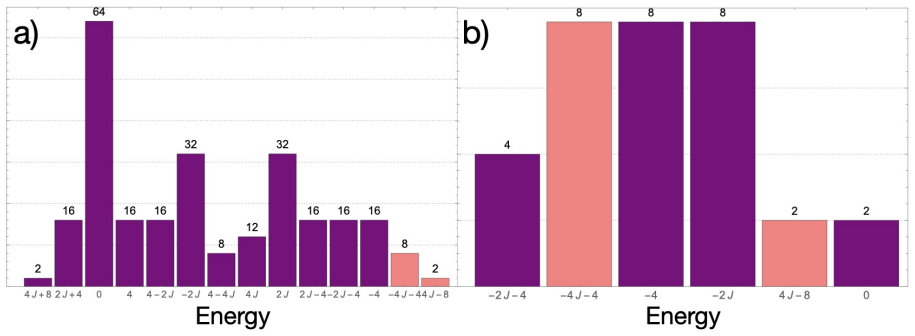
- [Appendix 8.3, Eqs. (26)-(27); Section 5 and Appendix 8.4] Equations (26) and (27) are incorrect for generic parameters. The coefficient definitions h_{sigma2 sigma1 sigma0} = (1/4)|a + sigma2 b + sigma1 c + sigma0 d| are appropriate for a linear expression a + sigma2 b + sigma1 c + sigma0 d, but the functions in Eqs. (26) and (27) contain the monomials a s1 s2 + b s1 s3 + c s2 + d s3 and a s1 s2 s3 + b s1 s2 s4 + c s3 + d s4, respectively. For example, in Eq. (26) with a=1, b=0, c=1, d=0, the true function is -|s1 s2 + s2| = -1 - s1, whereas the printed formula gives -1 - s1 s2 s3. Similarly, Eq. (27) with a=1, b=0, c=1, d=0 evaluates to -1 - s1 s2 in reality, but the printed formula gives -1 - s1 s2 s3 s4. These errors propagate into Appendix 8.4: the claimed reduced adder Hamiltonian H_a^(4) = 2 + s6 + s5(1+s6-s7-s8) + s7 s8 is not constant on {±1}^4 (for example, all spins +1 gives energy 4, while (s5,s6,s7,s8)=(1,1,-1,-1) gives energy 8), so it cannot have 16 ground states. The Section 5 claim that the network 'still exhibits 16 valid minima' is therefore unsupported and needs correction.
- [Section 5, Eqs. (19)-(20)] The exact-elimination theorem applies to the discrete Ising energy, not to the continuous Hopfield Lyapunov function of Eq. (20) or to basins of attraction of the continuous gradient dynamics. The statements that spin elimination 'reduces the number of spurious states,' 'suppresses spurious attractors,' and 'doubles the frequency of correctly recovering the planted pattern' are numerical observations from a single N=32 experiment (Figure 6), not consequences of the exactness theorem. Because the abstract advertises improved memory retrieval and suppression of spurious attractors, the manuscript should either prove a preservation statement for the continuous dynamics or explicitly frame these claims as empirical demonstrations.
- [Section 3, strategy (i)] The asymptotic claim that after n rounds node degrees reach (2n+2), couplings are (2n)-local, and 3N/(n+3) spins remain is stated without proof. After the first elimination rounds, couplings are no longer uniform, so the symmetric n-spin gadget of Eq. (11) cannot be applied directly to arbitrary subgraphs; the general FWHT of Eq. (5) must be applied to each specific P(s_nbr). The spin-count and degree bounds therefore require a precise algorithm and either a proof or an explicit numerical demonstration of the claimed scaling.
minor comments (4)
- [Section 2, after Eq. (4)] The phrase 'for any fixed configurations s_nbr' should read 'for any fixed configuration s_nbr'.
- [Eq. (12)] The set notation in Eq. (12) is inconsistent: the summation is over 'A' but the cardinality condition uses '|S|=2k'; it should be a single symbol throughout.
- [Figure 4 caption] The caption appears to be missing the word 'from' before 'the upper left to the lower right'.
- [Eqs. (7)-(8) and Appendix 8.3] The binary-index conventions for h_{sigma1 sigma0}, g_{sigma1 sigma0}, and h_{sigma2 sigma1 sigma0} are terse; given that they have already caused confusion, a short worked example of the bit mapping for Eq. (7) would improve readability.
Circularity Check
No circularity: the spin-elimination construction is self-contained and the applications are demonstrations, not fitted predictions.
full rationale
The claimed exact-elimination result is derived in Section 2 and is self-contained. The paper defines the local block H_local = s_a P(s_nbr), observes that for any fixed neighbor configuration the minimum over s_a is -|P(s_nbr)|, and uses the unique multilinear (Walsh) expansion of -|P| as the replacement. Thus the reduced Hamiltonian satisfies H'(s_nbr) = min_{s_a} H(s_a, s_nbr) for every s_nbr; the ground-state correspondence is a direct consequence of this minimization identity, not an input fitted to the target ground states. The gadgets in Eqs (6)-(13), (26), (27) are closed-form evaluations of the same Walsh expansion and are used consistently in the Max-Cut, Möbius-ladder, factorization, and Hopfield examples; those examples are applications/illustrations rather than predictions calibrated to data. No parameter is fitted to a subset of results and then renamed a prediction. The only self-citations (e.g., refs 28, 57, 64, 65) supply background or benchmark facts about NP-hardness, soft-spin solvers, and the Möbius ladder; none carries the weight of the elimination theorem, which is proved in place. The paper itself flags open questions (effect of elimination on capacity/basins, scaling of lattice-based factorization), which are scope limitations, not circular steps. Any alleged sign inconsistency in the printed gadget coefficients would be a correctness defect, not a circularity, and does not change the structural verdict. Score 0: no significant circularity.
Assumptions & free parameters
free parameters (1)
- Elimination order and subgraph selection in Max-Cut
assumptions (5)
- standard math Uniqueness and completeness of the multilinear (Fourier-Walsh) representation of functions on the Boolean cube.
- standard math The fast Walsh-Hadamard transform computes all coefficients in O(d 2^d) time.
- domain assumption The combinatorial problems considered (Max-Cut, factorization, Hopfield retrieval) are correctly encoded as Ising ground-state problems.
- domain assumption Target hardware can implement k-local couplings or tolerate increased node degrees.
- ad hoc to paper Eliminating spins while preserving ground states also simplifies the optimization landscape and improves solver performance.
Cite this review
Pith. "Pith review of Exact Spin Elimination in Ising Hamiltonians and Energy-Based Machine Learning." pith.science (2026). https://pith.science/paper/TUCJPEJA
@misc{pith2026250507163,
  author       = {Pith},
  title        = {Pith review of: Exact Spin Elimination in Ising Hamiltonians and Energy-Based Machine Learning},
  year         = {2026},
  howpublished = {\url{https://pith.science/paper/TUCJPEJA}},
  note         = {Machine review of arXiv:2505.07163}
}
read the original abstract
We present an exact spin-elimination technique that reduces the dimensionality of both quadratic and k-local Ising Hamiltonians while preserving their original ground-state configurations. By systematically replacing each removed spin with an effective interaction among its neighbors, our method lowers the total spin count without invoking approximations or iterative recalculations. This capability is especially beneficial for hardware-constrained platforms, classical or quantum, that can directly implement multi-body interactions but have limited qubit or spin resources. We demonstrate three key advances enabled by this technique. First, we handle larger instances of benchmark problems such as Max-Cut on cubic graphs without exceeding a 2-local interaction limit. Second, we reduce qubit requirements in QAOA-based integer factorization on near-term quantum devices, thus extending the feasible range of integers to be factorized. Third, we improve memory capacity in Hopfield associative memories and enhance memory retrieval by suppressing spurious attractors, enhancing retrieval performance. Our spin-elimination procedure trades local spin complexity for higher-order couplings or higher node degrees in a single pass, opening new avenues for scaling up combinatorial optimization and energy-based machine learning on near-term hardware. Finally, these results underscore that the next-generation physical spin machines will likely capitalize on k-local spin Hamiltonians to offer an alternative to classical computations.
Figures


Figures from the paper (3 more)


Forward citations
Cited by 1 Pith paper
-
Programmable k-local Ising Machines and all-optical Kolmogorov-Arnold Networks on Photonic Platforms
A proposal to make one spatial light modulator implement programmable higher-order Ising terms and all-optical KAN nonlinearities, but the core polynomial mechanism is not compatible with linear propagation.
Reference graph
Works this paper leans on
-
[1]
author Neukart, F. et al. title Traffic flow optimization using a quantum annealer . journal Frontiers in ICT volume 4 , pages 29 ( year 2017 )
2017
-
[2]
title Physics and financial economics (1776--2014): puzzles, ising and agent-based models
author Sornette, D. title Physics and financial economics (1776--2014): puzzles, ising and agent-based models . journal Rep. Prog. Phys. volume 77 , pages 062001 ( year 2014 )
2014
-
[3]
title Quantum materials discovery from a synthesis perspective
author Samarth, N. title Quantum materials discovery from a synthesis perspective . journal Nature materials volume 16 , pages 1068--1076 ( year 2017 )
2017
-
[4]
author Zuber, J. B. & author Itzykson, C. title Quantum field theory and the two-dimensional ising model . journal Phys. Rev. D volume 15 , pages 2875 ( year 1977 )
1977
-
[5]
, author Anagnostopoulos, K
author Ambj rn, J. , author Anagnostopoulos, K. , author Loll, R. & author Pushkina, I. title Shaken, but not stirred—potts model coupled to quantum gravity . journal Nucl. Phys. B volume 807 , pages 251--264 ( year 2009 )
2009
-
[6]
author Minsky, M. L. title Logical versus analogical or symbolic versus connectionist or neat versus scruffy . journal AI magazine volume 12 , pages 34--34 ( year 1991 )
work page 1991
-
[7]
title On the computational complexity of ising spin glass models
author Barahona, F. title On the computational complexity of ising spin glass models . journal J. Phys. A volume 15 , pages 3241 ( year 1982 )
work page 1982
-
[8]
author Bunyk, P. I. et al. title Architectural considerations in the design of a superconducting quantum annealing processor . journal IEEE Trans. Appl. Supercond. volume 24 , pages 1--10 ( year 2014 )
work page 2014
Show all 85 references
-
[9]
author Egger, D. J. , author Mare c ek, J. & author Woerner, S. title Warm-starting quantum optimization . journal Quantum volume 5 , pages 479 ( year 2021 )
2021
-
[10]
author Aramon, M. et al. title Physics-inspired optimization for quadratic unconstrained problems using a digital annealer . journal Frontiers in Physics volume 7 , pages 48 ( year 2019 )
2019
-
[11]
, author Yamasaki, M
author Tatsumura, K. , author Yamasaki, M. & author Goto, H. title Scaling out ising machines using a multi-chip architecture for simulated bifurcation . journal Nature Electronics volume 4 , pages 208--217 ( year 2021 )
2021
-
[12]
author Kalinin, K. P. et al. title Analog iterative machine (aim): using light to solve quadratic optimization problems with mixed variables . journal arXiv preprint arXiv:2304.12594 ( year 2023 )
2023 arXiv
-
[13]
author Inagaki, T. et al. title A coherent ising machine for 2000-node optimization problems . journal Science volume 354 , pages 603--606 ( year 2016 )
2000
-
[14]
author McMahon, P. L. et al. title A fully programmable 100-spin coherent Ising machine with all-to-all connections . journal Science volume 354 , pages 614--617 ( year 2016 )
2016
-
[15]
, author Marcucci, G
author Pierangeli, D. , author Marcucci, G. & author Conti, C. title Large-scale photonic Ising machine by spatial light modulation . journal Phys. Rev. Lett. volume 122 , pages 213902 ( year 2019 )
2019
-
[16]
, author Marcucci, G
author Pierangeli, D. , author Marcucci, G. , author Brunner, D. & author Conti, C. title Noise-enhanced spatial-photonic ising machine . journal Nanophotonics volume 9 , pages 4109--4116 ( year 2020 )
2020
-
[17]
, author Rafayelyan, M
author Pierangeli, D. , author Rafayelyan, M. , author Conti, C. & author Gigan, S. title Scalable spin-glass optical simulator . journal Physical Review Applied volume 15 , pages 034087 ( year 2021 )
2021
-
[18]
author Veraldi, D. et al. title Fully programmable spatial photonic ising machine by focal plane division . journal arXiv preprint arXiv:2410.10689 ( year 2024 )
2024 arXiv
-
[19]
, author Khymyn, R
author Litvinenko, A. , author Khymyn, R. , author Ovcharov, R. & author kerman, J. title A 50-spin surface acoustic wave ising machine . journal arXiv preprint arXiv:2311.06830 ( year 2023 )
2023 arXiv
-
[20]
author Litvinenko, A. et al. title A spinwave ising machine . journal Communications Physics volume 6 , pages 227 ( year 2023 )
2023
-
[21]
, author Zampetaki, A
author English, L. , author Zampetaki, A. , author Kalinin, K. , author Berloff, N. & author Kevrekidis, P. G. title An ising machine based on networks of subharmonic electrical resonators . journal Communications Physics volume 5 , pages 333 ( year 2022 )
2022
-
[22]
author Shao, Y. et al. title Probabilistic computing with voltage-controlled dynamics in magnetic tunnel junctions . journal Nanotechnology volume 34 , pages 495203 ( year 2023 )
2023
-
[23]
author Camsari, K. Y. , author Faria, R. , author Sutton, B. M. & author Datta, S. title Stochastic p-bits for invertible logic . journal Physical Review X volume 7 , pages 031014 ( year 2017 )
2017
-
[24]
, author Chowdhury, S
author Lee, K. , author Chowdhury, S. & author Camsari, K. Y. title Noise-augmented chaotic ising machines for combinatorial optimization and sampling . journal Communications Physics volume 8 , pages 35 ( year 2025 )
2025
-
[25]
, author Marandi, A
author Brunner, D. , author Marandi, A. , author Bogaerts, W. & author Ozcan, A. title Photonics for computing and computing for photonics ( year 2020 )
2020
-
[26]
& author Berloff, N
author Stroev, N. & author Berloff, N. G. title Analog photonics computing for information processing, inference, and optimization . journal Advanced Quantum Technologies volume 6 , pages 2300055 ( year 2023 )
2023
-
[27]
author K \"o nz, M. S. , author Lechner, W. , author Katzgraber, H. G. & author Troyer, M. title Embedding overhead scaling of optimization problems in quantum annealing . journal PRX Quantum volume 2 , pages 040322 ( year 2021 )
2021
-
[28]
& author Berloff, N
author Stroev, N. & author Berloff, N. G. title Discrete polynomial optimization with coherent networks of condensates and complex coupling switching . journal Physical Review Letters volume 126 , pages 050504 ( year 2021 )
2021
-
[29]
author Chermoshentsev, D. et al. title Polynomial unconstrained binary optimisation inspired by optical simulation (2022) . journal arXiv preprint arXiv:2106.13167
2022 arXiv
-
[30]
author Rosenberg, I. G. title Reduction of bivalent maximization to the quadratic case . journal Cahiers du Centre d'Études de Recherche Opérationnelle volume 17 , pages 71--74 ( year 1975 )
1975
-
[31]
, author Hernandez, M
author Valiante, E. , author Hernandez, M. , author Barzegar, A. & author Katzgraber, H. G. title Scaling overhead of locality reduction in binary optimization problems . journal arXiv e-prints pages arXiv--2012 ( year 2020 )
2012
-
[32]
author Hizzani, M. et al. title Memristor-based hardware and algorithms for higher-order hopfield optimization solver outperforming quadratic ising machines . In booktitle 2024 IEEE International Symposium on Circuits and Systems (ISCAS) , pages 1--5 ( organization IEEE , year 2024 )
2024
-
[33]
author Bhattacharya, T. et al. title Computing high-degree polynomial gradients in memory . journal Nature Communications volume 15 , pages 8211 ( year 2024 )
2024
-
[34]
author Pedersen, S. P. , author Christensen, K. S. & author Zinner, N. T. title Native three-body interaction in superconducting circuits . journal Physical Review Research volume 1 , pages 033123 ( year 2019 )
2019
-
[35]
, author Feng, W
author Liu, W. , author Feng, W. , author Ren, W. , author Wang, D.-W. & author Wang, H. title Synthesizing three-body interaction of spin chirality with superconducting qubits . journal Applied Physics Letters volume 116 ( year 2020 )
2020
-
[36]
author Andrade, B. et al. title Engineering an effective three-spin hamiltonian in trapped-ion systems for applications in quantum simulation . journal Quantum Science and Technology volume 7 , pages 034001 ( year 2022 )
2022
-
[37]
, author Feng, L
author Katz, O. , author Feng, L. , author Risinger, A. , author Monroe, C. & author Cetina, M. title Demonstration of three-and four-body interactions between trapped-ion spins . journal Nature Physics volume 19 , pages 1452--1458 ( year 2023 )
2023
-
[38]
& author Hammer, P
author Boros, E. & author Hammer, P. L. title Pseudo-boolean optimization . journal Discrete Applied Mathematics volume 123 , pages 155--225 ( year 2002 )
2002
-
[39]
& author Dechter, R
author Larrosa, J. & author Dechter, R. title Boosting search with variable elimination in constraint optimization and constraint satisfaction problems . journal Constraints volume 8 , pages 303--326 ( year 2003 )
2003
-
[40]
title The density-matrix renormalization group
author Schollw \"o ck, U. title The density-matrix renormalization group . journal Reviews of modern physics volume 77 , pages 259--315 ( year 2005 )
2005
-
[41]
, author Irie, H
author Hattori, T. , author Irie, H. , author Kadowaki, T. & author Tanaka, S. title Advantages of fixing spins in quantum annealing . journal Journal of the Physical Society of Japan volume 94 , pages 013001 ( year 2025 )
2025
-
[42]
& author Djidjev, H
author Hahn, G. & author Djidjev, H. title Reducing binary quadratic forms for more scalable quantum annealing . In booktitle 2017 IEEE International Conference on Rebooting Computing (ICRC) , pages 1--8 ( organization IEEE , year 2017 )
2017
-
[43]
title Application of 0-1 integer programming to multitarget tracking problems
author Morefield, C. title Application of 0-1 integer programming to multitarget tracking problems . journal IEEE Transactions on Automatic Control volume 22 , pages 302--312 ( year 1977 )
1977
-
[44]
author Wolsey, L. A. title Integer programming ( publisher John Wiley & Sons , year 2020 )
2020
-
[45]
& author Putnam, H
author Davis, M. & author Putnam, H. title A computing procedure for quantification theory . journal Journal of the ACM (JACM) volume 7 , pages 201--215 ( year 1960 )
1960
-
[46]
, author Kehrein, S
author Refael, G. , author Kehrein, S. & author Fisher, D. S. title Spin reduction transition in spin-3 2 random heisenberg chains . journal Physical Review B volume 66 , pages 060402 ( year 2002 )
2002
-
[47]
, author Kliesch, A
author Bravyi, S. , author Kliesch, A. , author Koenig, R. & author Tang, E. title Obstacles to variational quantum optimization from symmetry protection . journal Physical review letters volume 125 , pages 260505 ( year 2020 )
2020
-
[48]
author Fin z gar, J. R. , author Kerschbaumer, A. , author Schuetz, M. J. , author Mendl, C. B. & author Katzgraber, H. G. title Quantum-informed recursive optimization algorithms . journal PRX Quantum volume 5 , pages 020327 ( year 2024 )
2024
-
[49]
, author Rosenberg, G
author Karimi, H. , author Rosenberg, G. & author Katzgraber, H. G. title Effective optimization using sample persistence: A case study on quantum annealers and various monte carlo optimization methods . journal Physical Review E volume 96 , pages 043312 ( year 2017 )
2017
-
[50]
& author Togawa, N
author Shirai, T. & author Togawa, N. title Spin-variable reduction method for handling linear equality constraints in ising machines . journal IEEE Transactions on Computers volume 72 , pages 2151--2164 ( year 2023 )
2023
-
[51]
title Spin glasses with p-spin interactions
author Gardner, E. title Spin glasses with p-spin interactions . journal Nuclear Physics B volume 257 , pages 747--765 ( year 1985 )
1985
-
[52]
author Bybee, C. et al. title Efficient optimization with higher-order ising machines . journal Nature Communications volume 14 , pages 6033 ( year 2023 )
2023
-
[53]
title Unified matrix treatment of the fast walsh-hadamard transform
author Fino & author Algazi . title Unified matrix treatment of the fast walsh-hadamard transform . journal IEEE Transactions on Computers volume 100 , pages 1142--1146 ( year 1976 )
1976
-
[54]
author Cipra, B. A. title The ising model is np-complete . journal SIAM News volume 33 , pages 1--3 ( year 2000 )
2000
-
[55]
author Goemans, M. X. & author Williamson, D. P. title Improved approximation algorithms for maximum cut and satisfiability problems using semidefinite programming . journal Journal of the ACM (JACM) volume 42 , pages 1115--1145 ( year 1995 )
1995
-
[56]
, author McMahon, P
author Mohseni, N. , author McMahon, P. L. & author Byrnes, T. title Ising machines as hardware solvers of combinatorial optimization problems . journal Nature Reviews Physics volume 4 , pages 363--379 ( year 2022 )
2022
-
[57]
author Kalinin, K. P. & author Berloff, N. G. title Computational complexity continuum within ising formulation of np problems . journal Communications Physics volume 5 , pages 20 ( year 2022 )
2022
-
[58]
author Hamerly, R. et al. title Experimental investigation of performance differences between coherent ising machines and a quantum annealer . journal Science advances volume 5 , pages eaau0823 ( year 2019 )
2019
-
[59]
, author Er z en, V
author Vodeb, J. , author Er z en, V. , author Hrga, T. & author Povh, J. title Accuracy and performance evaluation of quantum, classical and hybrid solvers for the max-cut problem . journal arXiv preprint arXiv:2412.07460 ( year 2024 )
2024 arXiv
-
[60]
author Harrigan, M. P. et al. title Quantum approximate optimization of non-planar graph problems on a planar superconducting processor . journal Nature Physics volume 17 , pages 332--336 ( year 2021 )
2021
-
[61]
author Ebadi, S. et al. title Quantum optimization of maximum independent set using rydberg atom arrays . journal Science volume 376 , pages 1209--1215 ( year 2022 )
2022
-
[62]
author Roques-Carmes, C. et al. title Heuristic recurrent algorithms for photonic ising machines . journal Nature Communications volume 11 , pages 249 ( year 2020 )
2020
-
[63]
author Cai, F. et al. title Power-efficient combinatorial optimization using intrinsic noise in memristor hopfield neural networks . journal Nature Electronics volume 3 , pages 409--418 ( year 2020 )
2020
-
[64]
author Cummins, J. S. , author Salman, H. & author Berloff, N. G. title Ising hamiltonian minimization: Gain-based computing with manifold reduction of soft spins vs quantum annealing . journal Phys. Rev. Res. volume 7 , pages 013150 ( year 2025 ). ://link.aps.org/doi/10.1103/...
2025 doi
-
[65]
author Cummins, J. S. & author Berloff, N. G. title Vector ising spin annealer for minimizing ising hamiltonians . journal arXiv preprint arXiv:2403.16608 ( year 2024 )
2024 arXiv
-
[66]
author Melko, R. G. , author Carleo, G. , author Carrasquilla, J. & author Cirac, J. I. title Restricted boltzmann machines in quantum physics . journal Nature Physics volume 15 , pages 887--892 ( year 2019 )
2019
-
[67]
author Hopfield, J. J. title Neural networks and physical systems with emergent collective computational abilities. journal Proceedings of the national academy of sciences volume 79 , pages 2554--2558 ( year 1982 )
1982
-
[68]
& author Bengio, Y
author Le Roux, N. & author Bengio, Y. title Representational power of restricted boltzmann machines and deep belief networks . journal Neural computation volume 20 , pages 1631--1649 ( year 2008 )
2008
-
[69]
& author Melko, R
author Golubeva, A. & author Melko, R. G. title Pruning a restricted boltzmann machine for quantum state reconstruction . journal Physical Review B volume 105 , pages 125124 ( year 2022 )
2022
-
[70]
, author Manuylovich, E
author Freire, P. , author Manuylovich, E. , author Prilepsky, J. E. & author Turitsyn, S. K. title Artificial neural networks for photonic applications—from algorithms to implementation: tutorial . journal Advances in Optics and Photonics volume 15 , pages 739--834 ( year 2023 )
2023
-
[71]
& author Hopfield, J
author Krotov, D. & author Hopfield, J. J. title Dense associative memory for pattern recognition . journal Advances in neural information processing systems volume 29 ( year 2016 )
2016
-
[72]
author Ramsauer, H. et al. title Hopfield networks is all you need . journal arXiv preprint arXiv:2008.02217 ( year 2020 )
2008 arXiv
-
[73]
, author Bromley, T
author Rebentrost, P. , author Bromley, T. R. , author Weedbrook, C. & author Lloyd, S. title Quantum hopfield neural network . journal Physical Review A volume 98 , pages 042308 ( year 2018 )
2018
-
[74]
, author Posner, E
author McEliece, R. , author Posner, E. , author Rodemich, E. & author Venkatesh, S. title The capacity of the hopfield associative memory . journal IEEE transactions on Information Theory volume 33 , pages 461--482 ( year 1987 )
1987
-
[75]
author Vijay, V. et al. title A review on n-bit ripple-carry adder, carry-select adder and carry-skip adder . journal Journal of VLSI circuits and systems volume 4 , pages 27--32 ( year 2022 )
2022
-
[76]
& author Fiete, I
author Chaudhuri, R. & author Fiete, I. title Bipartite expander hopfield networks as self-decoding high-capacity error correcting codes . journal Advances in neural information processing systems volume 32 ( year 2019 )
2019
-
[77]
author Rivest, R. L. , author Shamir, A. & author Adleman, L. title A method for obtaining digital signatures and public-key cryptosystems . journal Communications of the ACM volume 21 , pages 120--126 ( year 1978 )
1978
-
[78]
author Shor, P. W. title Algorithms for quantum computation: discrete logarithms and factoring . In booktitle Proceedings 35th annual symposium on foundations of computer science , pages 124--134 ( organization Ieee , year 1994 )
1994
-
[79]
, author Goldstone, J
author Farhi, E. , author Goldstone, J. , author Gutmann, S. & author Sipser, M. title Quantum computation by adiabatic evolution . journal arXiv preprint ( year 2000 ). quant-ph/0001106
2000 arXiv
-
[80]
, author Goldstone, J
author Farhi, E. , author Goldstone, J. & author Gutmann, S. title A quantum approximate optimization algorithm . journal arXiv preprint arXiv:1411.4028 ( year 2014 )
2014 arXiv
-
[81]
author Li, Z. et al. title High-fidelity adiabatic quantum computation using the intrinsic hamiltonian of a spin system: Application to the experimental factorization of 291311 . journal arXiv preprint arXiv:1706.08061 ( year 2017 )
2017 arXiv
-
[82]
author Yan, B. et al. title Factoring integers with sublinear resources on a superconducting quantum processor . journal arXiv preprint arXiv:2212.12372 ( year 2022 )
2022 arXiv
-
[83]
title On lov \'a sz’lattice reduction and the nearest lattice point problem
author Babai, L. title On lov \'a sz’lattice reduction and the nearest lattice point problem . journal Combinatorica volume 6 , pages 1--13 ( year 1986 )
1986
-
[84]
, " * write output.state after.block = add.period write newline
ENTRY address archive author booktitle chapter edition editor eprint howpublished institution journal key month note number organization pages publisher school series title type url volume year label INTEGERS output.state before.all mid.sentence after.sentence after.block FUNC...
-
[85]
write newline
" write newline "" before.all 'output.state := FUNCTION n.dashify 't := "" t empty not t #1 #1 substring "-" = t #1 #2 substring "--" = not "--" * t #2 global.max substring 't := t #1 #1 substring "-" = "-" * t #2 global.max substring 't := while if t #1 #1 substring * t #2 gl...
Reviewed August 15, 2026 · model on record in the stance chip above.
Discussion (0). Continue with ORCID to comment.