REVIEW 4 major objections 5 minor 100 references
Comet: Accelerating Private Inference for Large Language Model by Predicting Activation Sparsity
T0 review · 4 major / 5 minor · reviewed 2026-08-15 · deepseek-v4-flash
Pith's one-line read A private-inference system called Comet claims that activation sparsity can be safely predicted inside MPC, giving a 1.87x-2.63x speedup and 1.94x-2.64x communication reduction.
desk verdict Genuinely new system for sparsity-aware MPC LLM inference, with real protocol ideas; but the headline numbers and the privacy framing need correction before I would trust the central 'private inference' claim. read the letter →
The pith
A machine-rendered reading of the paper's core claim, the machinery that carries it, and where it could break.
The reading
What carries the argument
The load-bearing machinery is the predicted sparsity distribution made safe to reveal. A lightweight two-layer low-rank neural network with a threshold layer, executed inside MPC, produces a secret-shared 0/1 mask of which activations are nonzero. Before the mask is reconstructed, an oblivious-shuffle protocol permutes it by a secret random permutation split between the two servers, so the sparsity count becomes public while the positions of zeros stay private; the same permutation is applied to the input matrix so plaintext indexing of active entries is correct. On top of this, SOMM partitions the nonzero output positions of the preceding linear layer into connected components of a bipartite graph and runs one secure matrix multiplication per component, proving communication-minimality, while SIMM reorganizes the subsequent layer from row-by-column to column-by-row sparse multiplication so each weight row is sent once. A cache manager merges KV-cache miss requests and prefetches skipped heads' values to keep attention correct.
What would settle it
A membership-inference-style experiment on the revealed sparsity counts: collect prompts from two distinct datasets, compute their per-layer sparsity levels through Comet's predictor, and train a classifier to guess the dataset. If the classifier's accuracy is far above chance, the paper's assumption that sparsity levels leak little about the input is false, and the headline numbers without differential privacy do not carry the claimed privacy.
Extended reading notes
Core claim
The central claim, stated on the paper's own terms, is that activation sparsity is not an obstacle to private LLM inference but a resource. Because model parameters are fixed during inference, the input to each transformer layer determines which ReLU neurons will be zero and which attention heads will be inactive, and a shallow two-layer low-rank predictor can anticipate those states well enough to use them as an execution plan. Comet runs that predictor inside MPC, obtains a secret-shared 0/1 mask, and applies an oblivious shuffle before revealing it: the count of active neurons is disclosed, but their positions are randomized so that plaintext indexing does not expose the input's sparsity pattern. Sparse matrix multiplications, SOMM before the nonlinearity and SIMM after it, then skip the masked-out work; the protocols are proved to reach minimal communication, with each row or column masked and communicated only once, and minimal computation under that bound. A KV-cache manager keeps attention correct when some heads were skipped. On this basis the paper reports 1.87x-2.63x end-to-end speedups and 1.94x-2.64x communication reductions on four LLMs against six prior systems, with an average accuracy loss of about 1.5% on Llama2-7B.
Load-bearing premise
The system's privacy guarantee rests on the assumption that revealing only the number of zero activations, per layer, leaks almost nothing about the user's input; the headline speedups are measured under that assumption, and the paper's optional MPC-based differential privacy would reduce them.
Editorial extensions
If this is right
- The same Llama2-7B model can be served through MPC at a 2.58x average speedup with no architectural change, only a low-overhead predictor that runs inside MPC.
- Larger models gain more: the 7B model shows roughly 85% FFN sparsity versus 61% for the 1.3B model, so the speedup grows with model scale.
- Because the approach targets the communication layer itself, it can be composed with nonlinearity-friendly architectures or better MPC approximations rather than replacing them.
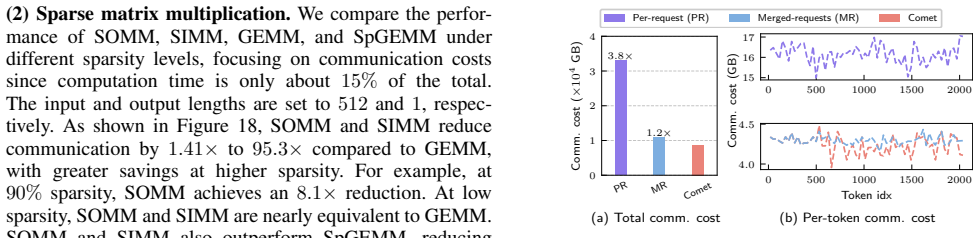
- KV caching remains usable despite sparse attention: merging miss requests gives a 3.8x communication reduction over per-request refilling, and prefetching adds a further 1.2x.
- The predictor's overhead stays below 15% of end-to-end inference time, with about 93% recall, which is why average accuracy loss stays around 1.5%.
Reading between the lines
- A natural extension is to apply the same shuffle-and-reveal indexing to other data-dependent zero structures in MPC, such as sparse embeddings, graph adjacency products, or mixture-of-experts routing, where revealing only an activity count is acceptable.
- The optional differential-privacy layer is a genuine tradeoff, not a free patch: the paper reports a 2.01x speedup at epsilon 0.01 versus 2.69x without DP, so a deployment that must hide sparsity levels will give up a meaningful share of the gain.
- Because a malicious model owner could design a predictor whose sparsity counts are distinctive per input, the predictor itself becomes an attack surface; verifying the predictor or certifying its output with DP noise is a plausible next step.
- A wrong prediction that a neuron is zero is irreversible and costs accuracy; an online fallback that recomputes a few masked neurons when the predictor is uncertain could widen the usable operating point, though the paper does not evaluate this.
Signed reviews
Editorial analysis
A structured set of objections, weighed in public.
Referee Report
Summary. The paper presents Comet, an MPC-based private inference system for LLMs that predicts activation sparsity to skip zero-valued computations in both linear and non-linear layers, thereby reducing communication and accelerating inference. It introduces a lightweight low-rank sparsity predictor protected by an oblivious-shuffle-based indexing scheme, sparse matrix multiplication protocols (SOMM and SIMM) with claimed communication/computation optimality, and a KV-cache manager that merges and prefetches cache refills. The evaluation covers OPT-1.3B/2.7B/6.7B and Llama2-7B against several private inference baselines, reporting 1.87x-2.63x speedup and 1.94x-2.64x communication reduction with about 1.5% average accuracy loss on Llama2-7B, plus additional results for other architectures and activation functions in appendices.
Significance. If the privacy model holds, Comet is a timely and useful contribution: to my knowledge it is the first system to exploit activation sparsity for MPC-based private LLM inference, and the protocol-level ideas (shuffle-based plaintext indexing, grouping connected components to minimize communication, column-by-row sparse multiplication) are well motivated and clearly presented. The optimality theorems for SOMM and SIMM are a valuable formal anchor, and the evaluation is broad, including different model sizes, bandwidths, and, in appendices, different architectures and activation functions. The predictor is trained on separate public datasets, so the speedup claims are not circular. However, the headline results are reported under a relaxed threat model that reveals per-layer sparsity counts, the paper's own appendix concedes that this can leak under repeated queries, and the DP-inclusive results fall outside the advertised speedup range. Several internal numerical inconsistencies further reduce confidence. With the privacy caveat addressed and the numbers reconciled, the contribution would be solid.
major comments (4)
- [Section 3.2, Appendix E, Table 7] The central privacy claim is not supported for the configurations whose performance is advertised. Section 3.2 relaxes the standard MPC threat model by assuming that sparsity levels (counts of zero values) may be revealed, and Appendix E concedes that repeated inference requests could map input-to-sparsity relationships and that a malicious model owner could engineer predictor outputs. The proposed MPC-based differential privacy is described as an optional mitigation, and the headline results (Abstract, Section 7.2, Table 2) are reported without it. Table 7 shows that applying DP with epsilon=0.01 reduces the Llama2-7B speedup to 2.01x, which is outside the advertised 1.87x-2.63x range. The authors must either present DP-enabled results as the main privacy-preserving configuration or provide a formal argument (e.g., a reduction or simulation proof that explicitly accounts for the revealed count) showing that sparsity-level leakage stays within the standard MPC leakage profile.
- [Abstract, Section 7.2, Table 2] The headline performance ranges are internally inconsistent with the reported best results. The Abstract and Section 7.2 state a 1.87x-2.63x speedup and a 1.94x-2.64x communication reduction, but Table 2 reports a Llama2-7B total speedup of 2.69x and a communication reduction of 3.14x, and Table 7 also lists the no-DP speedup as 2.69x. These numbers cannot all be correct. The ranges must be recomputed from the full result set, or the text and abstract must be corrected to match the reported tables.
- [Section 7.4, Table 3] Table 3 contains a likely data error that affects the stated accuracy claim: MBPP is listed with plaintext accuracy 22.4 and Comet accuracy 91.2, which is impossible given the text's claim of an average accuracy loss of about 1.5%. Using the other seven rows, the average loss is approximately 1.8%, not 1.5%. The table entry must be corrected and the average recomputed, since the accuracy-preservation claim is a key part of the paper's contribution.
- [Section 7.3] The interpretation of layer-wise speedups swaps the sparsity percentages. The sentence says "This is due to the higher sparsity rate of the FFN (approximately 50%) compared to that of the MHA (about 90%)", but Section 7.2 reports MHA/FFN sparsity as 49%/85% for Llama2-7B and Figure 3 shows FFN sparsity above 90% and MHA sparsity around 50%. The values are reversed relative to the paper's own measurements, which undermines the explanation of why FFN layers benefit more. This should be corrected.
minor comments (5)
- [Section 7.1] The text says "We select five mainstream Transformer private inference systems as baselines" but the Abstract and Figure 12 refer to six systems, and the legend includes Crypten in addition to Iron, Bolt, MPCFormer, SecFormer, and Puma. The baseline count should be made consistent.
- [Section 4.1] The notation for the threshold function is confusing: the formula y = sigma(W2(W1x + b1) + b2) uses sigma for both the threshold function and the activation output, and the text says "outputs 1 if sigma(x) > delta" where the inner sigma is the threshold function itself. This should be re-notated to avoid ambiguity.
- [Appendix A] The security proof for the oblivious shuffle claims that the revealed sparsity distribution S is uniformly random, but S is a shuffled version of a 0-1 vector and therefore has the same Hamming weight as the original; the proof should explicitly model the sparsity count as leaked and argue that the positions are uniform given that count, or incorporate the count into the leakage profile.
- [Section 6] There is a typo: "priavete inference" should read "private inference".
- [Appendix C, Table 6] The table reports speedups for several models with Swish/SwiGLU activations after ReLUfication, but the main paper's abstract only claims 1.87x-2.63x speedup over six systems on four models. The appendix numbers (e.g., 3.12x for Falcon-7B) go beyond that range; the relationship between the appendix results and the headline range should be clarified.
Circularity Check
No significant circularity: the speedup and communication claims are empirical measurements against external baselines, and the optimality theorems are self-contained given the sparsity distribution as input.
full rationale
Comet's central results are measured, not derived from the claimed prediction. The sparsity predictor is trained on WikiText2 and StarCoder (Section 7.4) and evaluated on held-out benchmarks (Alpaca-derived workloads and eight public LLM benchmarks), so there is no fitted parameter being renamed as a prediction. The SOMM and SIMM protocols take the sparsity distribution S as an explicit input and prove communication/computation optimality conditional on S (Theorems 1 and 2, Appendices B.1 and B.2); the graph-partitioning argument is self-contained and does not import the result being predicted. The speedups over Iron, Bolt, MPCFormer, SecFormer, and Puma are empirical wall-clock and byte-count comparisons (Section 7.2), and the predictor overhead is included in the totals. The only self-referential element is the appended S&P meta-review (Appendix F), which is a record of the review process and is not used as evidence in the technical derivation. The privacy caveat in Section 3.2 and Appendix E—that revealing sparsity levels may leak under repeated queries and requires MPC-based differential privacy as a mitigation—is a limitation of the threat model, not a circular derivation: the speedup numbers are reported for the system without DP, and Appendix E explicitly reports the reduced speedup under DP (2.01x at epsilon=0.01). That concern is substantive but belongs under correctness or threat-model risk, not circularity. No load-bearing step in the paper reduces by construction to its own inputs.
Assumptions & free parameters
free parameters (3)
- Predictor network weights W1,b1,W2,b2 =
not reported
- Predictor threshold delta =
0 for main results
- Predictor low-rank dimensions =
unspecified
assumptions (5)
- standard math Additive secret sharing and Beaver triples are secure for the basic MPC operations
- domain assumption The MPC servers are non-colluding and honest-but-curious
- domain assumption Revealing the sparsity level (number of zero values) does not leak meaningful input information
- domain assumption LLMs exhibit high and predictable activation sparsity after ReLU activation
- domain assumption Replacing non-ReLU activations with ReLU and fine-tuning preserves model accuracy
Cite this review
Pith. "Pith review of Comet: Accelerating Private Inference for Large Language Model by Predicting Activation Sparsity." pith.science (2026). https://pith.science/paper/XKEUHV2Y
@misc{pith2026250507239,
  author       = {Pith},
  title        = {Pith review of: Comet: Accelerating Private Inference for Large Language Model by Predicting Activation Sparsity},
  year         = {2026},
  howpublished = {\url{https://pith.science/paper/XKEUHV2Y}},
  note         = {Machine review of arXiv:2505.07239}
}
read the original abstract
With the growing use of large language models (LLMs) hosted on cloud platforms to offer inference services, privacy concerns about the potential leakage of sensitive information are escalating. Secure multi-party computation (MPC) is a promising solution to protect the privacy in LLM inference. However, MPC requires frequent inter-server communication, causing high performance overhead. Inspired by the prevalent activation sparsity of LLMs, where most neuron are not activated after non-linear activation functions, we propose an efficient private inference system, Comet. This system employs an accurate and fast predictor to predict the sparsity distribution of activation function output. Additionally, we introduce a new private inference protocol. It efficiently and securely avoids computations involving zero values by exploiting the spatial locality of the predicted sparse distribution. While this computation-avoidance approach impacts the spatiotemporal continuity of KV cache entries, we address this challenge with a low-communication overhead cache refilling strategy that merges miss requests and incorporates a prefetching mechanism. Finally, we evaluate Comet on four common LLMs and compare it with six state-of-the-art private inference systems. Comet achieves a 1.87x-2.63x speedup and a 1.94x-2.64x communication reduction.
Figures


Figures from the paper (15 more)



Reference graph
Works this paper leans on
-
[1]
Privformer: Privacy-preserving transformer with mpc,
Y . Akimoto, K. Fukuchi, Y . Akimoto, and J. Sakuma, “Privformer: Privacy-preserving transformer with mpc,” in 2023 IEEE 8th Euro- pean Symposium on Security and Privacy (EuroS&P) . IEEE, 2023, pp. 392–410
2023
-
[2]
The falcon series of open language models,
E. Almazrouei, H. Alobeidli, A. Alshamsi, A. Cappelli, R. Cojo- caru, M. Debbah, ´E. Goffinet, D. Hesslow, J. Launay, Q. Malartic et al. , “The falcon series of open language models,” arXiv preprint arXiv:2311.16867, 2023
arXiv 2023
-
[3]
Exposure notification privacy-preserving analyt- ics (enpa) white paper,
Apple and Google, “Exposure notification privacy-preserving analyt- ics (enpa) white paper,” 2021
2021
-
[4]
Oblivious linear group actions and applications,
N. Attrapadung, G. Hanaoaka, T. Matsuda, H. Morita, K. Ohara, J. C. Schuldt, T. Teruya, and K. Tozawa, “Oblivious linear group actions and applications,” in Proceedings of the 2021 ACM SIGSAC Conference on Computer and Communications Security , 2021, pp. 630–650
2021
-
[5]
Program synthesis with large language models,
J. Austin, A. Odena, M. Nye, M. Bosma, H. Michalewski, D. Dohan, E. Jiang, C. Cai, M. Terry, Q. Le et al., “Program synthesis with large language models,” arXiv preprint arXiv:2108.07732 , 2021
arXiv 2021
-
[6]
J. Bai, S. Bai, Y . Chu, Z. Cui, K. Dang, X. Deng, Y . Fan, W. Ge, Y . Han, F. Huang et al. , “Qwen technical report,” arXiv preprint arXiv:2309.16609, 2023
arXiv 2023
-
[7]
Efficient multiparty protocols using circuit randomiza- tion,
D. Beaver, “Efficient multiparty protocols using circuit randomiza- tion,” in Advances in Cryptology CRYPTO 91: Proceedings 11 . Springer, 1992, pp. 420–432
1992
-
[8]
Deepseek llm: Scaling open-source lan- guage models with longtermism,
X. Bi, D. Chen, G. Chen, S. Chen, D. Dai, C. Deng, H. Ding, K. Dong, Q. Du, Z. Fu et al., “Deepseek llm: Scaling open-source lan- guage models with longtermism,” arXiv preprint arXiv:2401.02954 , 2024
arXiv 2024
Show all 100 references
-
[9]
Piqa: Reasoning about physical commonsense in natural language,
Y . Bisk, R. Zellers, J. Gao, Y . Choi et al. , “Piqa: Reasoning about physical commonsense in natural language,” in Proceedings of the AAAI conference on artificial intelligence , vol. 34, no. 05, 2020, pp. 7432–7439
2020
-
[10]
Sparsity and privacy in secret sharing: A fundamental trade-off,
R. Bitar, M. Egger, A. Wachter-Zeh, and M. Xhemrishi, “Sparsity and privacy in secret sharing: A fundamental trade-off,” IEEE Trans- actions on Information Forensics and Security , 2024
2024
-
[11]
Safeguarding cryptographic keys,
G. R. Blakley, “Safeguarding cryptographic keys,” in Managing re- quirements knowledge, international workshop on . IEEE Computer Society, 1979, pp. 313–313
1979
-
[12]
On the opportunities and risks of foundation models,
R. Bommasani, D. A. Hudson, E. Adeli, R. Altman, S. Arora, S. von Arx, M. S. Bernstein, J. Bohg, A. Bosselut, E. Brunskill et al., “On the opportunities and risks of foundation models,” arXiv preprint arXiv:2108.07258, 2021
2021 arXiv
-
[13]
Language models are few-shot learners,
T. Brown, B. Mann, N. Ryder, M. Subbiah, J. D. Kaplan, P. Dhariwal, A. Neelakantan, P. Shyam, G. Sastry, A. Askell et al. , “Language models are few-shot learners,” Advances in neural information pro- cessing systems, vol. 33, pp. 1877–1901, 2020
1901
-
[14]
Flash: fast and ro- bust framework for privacy-preserving machine learning,
M. Byali, H. Chaudhari, A. Patra, and A. Suresh, “Flash: fast and ro- bust framework for privacy-preserving machine learning,” Cryptology ePrint Archive, 2019
2019
-
[15]
Universally composable security: A new paradigm for cryptographic protocols,
R. Canetti, “Universally composable security: A new paradigm for cryptographic protocols,” in Proceedings 42nd IEEE Symposium on Foundations of Computer Science . IEEE, 2001, pp. 136–145
2001
-
[16]
Membership inference attacks from first principles,
N. Carlini, S. Chien, M. Nasr, S. Song, A. Terzis, and F. Tramer, “Membership inference attacks from first principles,” in 2022 IEEE Symposium on Security and Privacy (SP) . IEEE, 2022, pp. 1897– 1914
2022
-
[17]
Data distributional properties drive emergent in-context learning in transformers,
S. Chan, A. Santoro, A. Lampinen, J. Wang, A. Singh, P. Richemond, J. McClelland, and F. Hill, “Data distributional properties drive emergent in-context learning in transformers,” Advances in Neural Information Processing Systems , vol. 35, pp. 18 878–18 891, 2022
2022
-
[18]
{SIMC}:{ML} inference secure against malicious clients at{Semi- Honest} cost,
N. Chandran, D. Gupta, S. L. B. Obbattu, and A. Shah, “{SIMC}:{ML} inference secure against malicious clients at{Semi- Honest} cost,” in 31st USENIX Security Symposium (USENIX Secu- rity 22), 2022, pp. 1361–1378
2022
-
[19]
Secret-shared shuffle,
M. Chase, E. Ghosh, and O. Poburinnaya, “Secret-shared shuffle,” in Advances in Cryptology–ASIACRYPT 2020: 26th International Con- ference on the Theory and Application of Cryptology and Information Security, Daejeon, South Korea, December 7–11, 2020, Proceedings, Part III 26....
2020
-
[20]
Trident: Efficient 4pc framework for privacy preserving machine learning,
H. Chaudhari, R. Rachuri, and A. Suresh, “Trident: Efficient 4pc framework for privacy preserving machine learning,” arXiv preprint arXiv:1912.02631, 2019
1912 arXiv
-
[21]
Evaluating large language models trained on code,
M. Chen, J. Tworek, H. Jun, Q. Yuan, H. P. D. O. Pinto, J. Ka- plan, H. Edwards, Y . Burda, N. Joseph, G. Brockman et al. , “Evaluating large language models trained on code,” arXiv preprint arXiv:2107.03374, 2021
2021 arXiv
-
[22]
The-x: Privacy-preserving transformer inference with homomorphic encryption,
T. Chen, H. Bao, S. Huang, L. Dong, B. Jiao, D. Jiang, H. Zhou, J. Li, and F. Wei, “The-x: Privacy-preserving transformer inference with homomorphic encryption,” arXiv preprint arXiv:2206.00216 , 2022
2022 arXiv
-
[23]
Securetlm: Private inference for transformer-based large model with mpc,
Y . Chen, X. Meng, Z. Shi, Z. Ning, and J. Lin, “Securetlm: Private inference for transformer-based large model with mpc,” Information Sciences, vol. 667, p. 120429, 2024
2024
-
[24]
An efficient secure three-party sorting protocol with an honest majority,
K. Chida, K. Hamada, D. Ikarashi, R. Kikuchi, N. Kiribuchi, and B. Pinkas, “An efficient secure three-party sorting protocol with an honest majority,” Cryptology ePrint Archive , 2019
2019
-
[25]
Boolq: Exploring the surprising difficulty of natural yes/no questions,
C. Clark, K. Lee, M.-W. Chang, T. Kwiatkowski, M. Collins, and K. Toutanova, “Boolq: Exploring the surprising difficulty of natural yes/no questions,” arXiv preprint arXiv:1905.10044 , 2019
1905 arXiv
-
[26]
Cramer, I
R. Cramer, I. B. Damg ˚ard et al. , Secure multiparty computation . Cambridge University Press, 2015
2015
-
[27]
Exploiting data sparsity in secure cross-platform social recommendation,
J. Cui, C. Chen, L. Lyu, C. Yang, and W. Li, “Exploiting data sparsity in secure cross-platform social recommendation,” Advances in Neural Information Processing Systems , vol. 34, pp. 10 524–10 534, 2021
2021
-
[28]
Bert: Pre- training of deep bidirectional transformers for language understand- ing,
J. Devlin, M.-W. Chang, K. Lee, and K. Toutanova, “Bert: Pre- training of deep bidirectional transformers for language understand- ing,” in Proceedings of the 2019 conference of the North Ameri- can chapter of the association for computational linguistics: human language techn...
2019
-
[29]
torch.sparse.mm,
P. Documentation, “torch.sparse.mm,” Online, 2024, accessed: March 12, 2025. [Online]. Available: https://pytorch.org/docs/stable/ generated/torch.sparse.mm
2024
-
[30]
Puma: Secure inference of llama- 7b in five minutes,
Y . Dong, W.-j. Lu, Y . Zheng, H. Wu, D. Zhao, J. Tan, Z. Huang, C. Hong, T. Wei, and W. Cheng, “Puma: Secure inference of llama- 7b in five minutes,” arXiv preprint arXiv:2307.12533 , 2023
2023
-
[31]
An image is worth 16x16 words: Transformers for image recognition at scale,
A. Dosovitskiy, L. Beyer, A. Kolesnikov, D. Weissenborn, X. Zhai, T. Unterthiner, M. Dehghani, M. Minderer, G. Heigold, S. Gellyet al., “An image is worth 16x16 words: Transformers for image recognition at scale,” arXiv preprint arXiv:2010.11929 , 2020
2010 arXiv
-
[32]
How to play any mental game, or a completeness theorem for protocols with honest majority,
O. Goldreich, S. Micali, and A. Wigderson, “How to play any mental game, or a completeness theorem for protocols with honest majority,” in Providing Sound Foundations for Cryptography: On the Work of Shafi Goldwasser and Silvio Micali , 2019, pp. 307–328
2019
-
[33]
The llama 3 herd of models,
A. Grattafiori, A. Dubey, A. Jauhri, A. Pandey, A. Kadian, A. Al- Dahle, A. Letman, A. Mathur, A. Schelten, A. Vaughan et al., “The llama 3 herd of models,” arXiv preprint arXiv:2407.21783 , 2024
2024 arXiv
-
[34]
Sigma: Secure gpt inference with function secret sharing,
K. Gupta, N. Jawalkar, A. Mukherjee, N. Chandran, D. Gupta, A. Pan- war, and R. Sharma, “Sigma: Secure gpt inference with function secret sharing,” Cryptology ePrint Archive , 2023
2023
-
[35]
Iron: Private inference on transformers,
M. Hao, H. Li, H. Chen, P. Xing, G. Xu, and T. Zhang, “Iron: Private inference on transformers,” Advances in neural information processing systems, vol. 35, pp. 15 718–15 731, 2022
2022
-
[36]
Measuring massive multitask language understanding,
D. Hendrycks, C. Burns, S. Basart, A. Zou, M. Mazeika, D. Song, and J. Steinhardt, “Measuring massive multitask language understanding,” arXiv preprint arXiv:2009.03300 , 2020
2009 arXiv
-
[37]
Gaussian error linear units (gelus),
D. Hendrycks and K. Gimpel, “Gaussian error linear units (gelus),” arXiv preprint arXiv:1606.08415 , 2016
2016 arXiv
-
[38]
Ci- phergpt: Secure two-party gpt inference,
X. Hou, J. Liu, J. Li, Y . Li, W.-j. Lu, C. Hong, and K. Ren, “Ci- phergpt: Secure two-party gpt inference,” Cryptology ePrint Archive, 2023
2023
-
[39]
Mixtral of experts,
A. Q. Jiang, A. Sablayrolles, A. Roux, A. Mensch, B. Savary, C. Bamford, D. S. Chaplot, D. d. l. Casas, E. B. Hanna, F. Bressand et al., “Mixtral of experts,” arXiv preprint arXiv:2401.04088 , 2024
2024 arXiv
-
[40]
Secure multi-party differential privacy,
P. Kairouz, S. Oh, and P. Viswanath, “Secure multi-party differential privacy,” in Advances in Neural Information Processing Systems , vol. 28, 2015
2015
-
[41]
Mascot: faster malicious arith- metic secure computation with oblivious transfer,
M. Keller, E. Orsini, and P. Scholl, “Mascot: faster malicious arith- metic secure computation with oblivious transfer,” in Proceedings of the 2016 ACM SIGSAC Conference on Computer and Communica- tions Security, 2016, pp. 830–842
2016
-
[42]
Crypten: Secure multi-party computation meets machine learning,
B. Knott, S. Venkataraman, A. Hannun, S. Sengupta, M. Ibrahim, and L. van der Maaten, “Crypten: Secure multi-party computation meets machine learning,” Advances in Neural Information Processing Systems, vol. 34, pp. 4961–4973, 2021
2021
-
[43]
Cryptflow: Secure tensorflow inference,
N. Kumar, M. Rathee, N. Chandran, D. Gupta, A. Rastogi, and R. Sharma, “Cryptflow: Secure tensorflow inference,” in 2020 IEEE Symposium on Security and Privacy (SP). IEEE, 2020, pp. 336–353
2020
-
[44]
Round-efficient oblivious database manipulation,
S. Laur, J. Willemson, and B. Zhang, “Round-efficient oblivious database manipulation,” in Information Security: 14th International Conference, ISC 2011, Xi’an, China, October 26-29, 2011. Proceed- ings 14. Springer, 2011, pp. 262–277
2011
-
[45]
Bloom: A 176b-parameter open-access multilingual language model,
T. Le Scao, A. Fan, C. Akiki, E. Pavlick, S. Ili ´c, D. Hesslow, R. Castagn ´e, A. S. Luccioni, F. Yvon, M. Gall ´e et al. , “Bloom: A 176b-parameter open-access multilingual language model,” 2023
2023
-
[46]
Muse: Secure inference resilient to malicious clients,
R. Lehmkuhl, P. Mishra, A. Srinivasan, and R. A. Popa, “Muse: Secure inference resilient to malicious clients,” in 30th USENIX Security Symposium (USENIX Security 21) , 2021, pp. 2201–2218
2021
-
[47]
Mpcformer: fast, performant and private transformer inference with mpc,
D. Li, R. Shao, H. Wang, H. Guo, E. P. Xing, and H. Zhang, “Mpcformer: fast, performant and private transformer inference with mpc,” arXiv preprint arXiv:2211.01452 , 2022
2022 arXiv
-
[48]
A survey on large language model acceleration based on kv cache management,
H. Li, Y . Li, A. Tian, T. Tang, Z. Xu, X. Chen, N. Hu, W. Dong, Q. Li, and L. Chen, “A survey on large language model acceleration based on kv cache management,” arXiv preprint arXiv:2412.19442 , 2024
2024 arXiv
-
[49]
Starcoder: may the source be with you!
R. Li, L. B. Allal, Y . Zi, N. Muennighoff, D. Kocetkov, C. Mou, M. Marone, C. Akiki, J. Li, J. Chim et al., “Starcoder: may the source be with you!” arXiv preprint arXiv:2305.06161 , 2023
2023 arXiv
-
[50]
Privacy-preserving feature selection with secure multiparty computation,
X. Li, R. Dowsley, and M. De Cock, “Privacy-preserving feature selection with secure multiparty computation,” in International Con- ference on Machine Learning . PMLR, 2021, pp. 6326–6336
2021
-
[51]
Backdoor learning: A survey,
Y . Li, Y . Jiang, Z. Li, and S.-T. Xia, “Backdoor learning: A survey,” IEEE transactions on neural networks and learning systems , vol. 35, no. 1, pp. 5–22, 2022
2022
-
[52]
The lazy neuron phenomenon: On emergence of activation sparsity in transformers,
Z. Li, C. You, S. Bhojanapalli, D. Li, A. S. Rawat, S. J. Reddi, K. Ye, F. Chern, F. Yu, R. Guo et al., “The lazy neuron phenomenon: On emergence of activation sparsity in transformers,” arXiv preprint arXiv:2210.06313, 2022
2022 arXiv
-
[53]
Holistic evaluation of language models,
P. Liang, R. Bommasani, T. Lee, D. Tsipras, D. Soylu, M. Yasunaga, Y . Zhang, D. Narayanan, Y . Wu, A. Kumaret al., “Holistic evaluation of language models,” arXiv preprint arXiv:2211.09110 , 2022
2022 arXiv
-
[54]
Merge: Fast private text generation,
Z. Liang, P. Wang, R. Zhang, N. Xu, S. Zhang, L. Xing, H. Bai, and Z. Zhou, “Merge: Fast private text generation,” in Proceedings of the AAAI Conference on Artificial Intelligence , vol. 38, no. 18, 2024, pp. 19 884–19 892
2024
-
[55]
How to simulate it–a tutorial on the simulation proof technique,
Y . Lindell, “How to simulate it–a tutorial on the simulation proof technique,” Tutorials on the Foundations of Cryptography: Dedicated to Oded Goldreich , pp. 277–346, 2017
2017
-
[56]
Llms can understand encrypted prompt: Towards privacy-computing friendly transformers,
X. Liu and Z. Liu, “Llms can understand encrypted prompt: Towards privacy-computing friendly transformers,” arXiv preprint arXiv:2305.18396, 2023
2023 arXiv
-
[57]
Deja vu: Contextual sparsity for efficient llms at inference time,
Z. Liu, J. Wang, T. Dao, T. Zhou, B. Yuan, Z. Song, A. Shrivastava, C. Zhang, Y . Tian, C. Re et al. , “Deja vu: Contextual sparsity for efficient llms at inference time,” in International Conference on Machine Learning. PMLR, 2023, pp. 22 137–22 176
2023
-
[58]
Bumblebee: Secure two-party inference framework for large transformers,
W.-j. Lu, Z. Huang, Z. Gu, J. Li, J. Liu, K. Ren, C. Hong, T. Wei, and W. Chen, “Bumblebee: Secure two-party inference framework for large transformers,” Cryptology ePrint Archive , 2023
2023
-
[59]
Secformer: Towards fast and accurate privacy-preserving inference for large language models,
J. Luo, Y . Zhang, J. Zhang, X. Mu, H. Wang, Y . Yu, and Z. Xu, “Secformer: Towards fast and accurate privacy-preserving inference for large language models,” arXiv preprint arXiv:2401.00793 , 2024
2024 arXiv
-
[60]
Accelerating relu for mpc-based private in- ference with a communication-efficient sign estimation,
K. Maeng and G. E. Suh, “Accelerating relu for mpc-based private in- ference with a communication-efficient sign estimation,” Proceedings of Machine Learning and Systems , vol. 6, pp. 128–147, 2024
2024
-
[61]
Pointer sentinel mixture models,
S. Merity, C. Xiong, J. Bradbury, and R. Socher, “Pointer sentinel mixture models,” arXiv preprint arXiv:1609.07843 , 2016
2016 arXiv
-
[62]
Relu strikes back: Ex- ploiting activation sparsity in large language models,
I. Mirzadeh, K. Alizadeh, S. Mehta, C. C. Del Mundo, O. Tuzel, G. Samei, M. Rastegari, and M. Farajtabar, “Relu strikes back: Ex- ploiting activation sparsity in large language models,” arXiv preprint arXiv:2310.04564, 2023
2023 arXiv
-
[63]
Aby3: A mixed protocol framework for machine learning,
P. Mohassel and P. Rindal, “Aby3: A mixed protocol framework for machine learning,” in Proceedings of the 2018 ACM SIGSAC conference on computer and communications security , 2018, pp. 35– 52
2018
-
[64]
Secure multi-party shuffling,
M. Movahedi, J. Saia, and M. Zamani, “Secure multi-party shuffling,” in Structural Information and Communication Complexity: 22nd In- ternational Colloquium, SIROCCO 2015, Montserrat, Spain, July 14- 16, 2015. Post-Proceedings 22 . Springer, 2015, pp. 459–473
2015
-
[65]
Powering secure computation, together,
MPC Alliance, “Powering secure computation, together,” https:// www.mpcalliance.org/, 2023, accessed: 2023
2023
-
[66]
Rectified linear units improve restricted boltzmann machines,
V . Nair and G. E. Hinton, “Rectified linear units improve restricted boltzmann machines,” in Proceedings of the 27th international con- ference on machine learning (ICML-10) , 2010, pp. 807–814
2010
-
[67]
Public-key cryptosystems based on composite degree residuosity classes,
P. Paillier, “Public-key cryptosystems based on composite degree residuosity classes,” in EUROCRYPT, 1999, pp. 223–238
1999
-
[68]
Bolt: Privacy-preserving, accurate and efficient inference for transformers,
Q. Pang, J. Zhu, H. M ¨ollering, W. Zheng, and T. Schneider, “Bolt: Privacy-preserving, accurate and efficient inference for transformers,” Cryptology ePrint Archive , 2023
2023
-
[69]
The lambada dataset: Word prediction requiring a broad discourse context,
D. Paperno, G. Kruszewski, A. Lazaridou, Q. N. Pham, R. Bernardi, S. Pezzelle, M. Baroni, G. Boleda, and R. Fern ´andez, “The lambada dataset: Word prediction requiring a broad discourse context,” arXiv preprint arXiv:1606.06031, 2016
2016 arXiv
-
[70]
Blaze: blazing fast privacy-preserving machine learning,
A. Patra and A. Suresh, “Blaze: blazing fast privacy-preserving machine learning,” arXiv preprint arXiv:2005.09042 , 2020
2005 arXiv
-
[71]
Language models are unsupervised multitask learners,
A. Radford, J. Wu, R. Child, D. Luan, D. Amodei, I. Sutskever et al., “Language models are unsupervised multitask learners,”OpenAI blog, vol. 1, no. 8, p. 9, 2019
2019
-
[72]
Exploring the limits of transfer learning with a unified text-to-text transformer,
C. Raffel, N. Shazeer, A. Roberts, K. Lee, S. Narang, M. Matena, Y . Zhou, W. Li, and P. J. Liu, “Exploring the limits of transfer learning with a unified text-to-text transformer,” Journal of machine learning research, vol. 21, no. 140, pp. 1–67, 2020
2020
-
[73]
Chameleon: A hybrid secure computation framework for machine learning applications,
M. S. Riazi, C. Weinert, O. Tkachenko, E. M. Songhori, T. Schnei- der, and F. Koushanfar, “Chameleon: A hybrid secure computation framework for machine learning applications,” in Proceedings of the 2018 on Asia conference on computer and communications security , 2018, pp. 707–721
2018
-
[74]
Choice of plausi- ble alternatives: An evaluation of commonsense causal reasoning
M. Roemmele, C. A. Bejan, and A. S. Gordon, “Choice of plausi- ble alternatives: An evaluation of commonsense causal reasoning.” in AAAI spring symposium: logical formalizations of commonsense reasoning, 2011, pp. 90–95
2011
-
[75]
Make some room for the zeros: Data sparsity in secure distributed machine learning,
P. Schoppmann, A. Gasc ´on, M. Raykova, and B. Pinkas, “Make some room for the zeros: Data sparsity in secure distributed machine learning,” in Proceedings of the 2019 ACM SIGSAC conference on computer and communications security , 2019, pp. 1335–1350
2019
-
[76]
How to share a secret,
A. Shamir, “How to share a secret,” Communications of the ACM , vol. 22, no. 11, pp. 612–613, 1979
1979
-
[77]
Glu variants improve transformer,
N. Shazeer, “Glu variants improve transformer,” arXiv preprint arXiv:2002.05202, 2020
2002 arXiv
-
[78]
Deep learning inference service at microsoft,
J. Soifer, J. Li, M. Li, J. Zhu, Y . Li, Y . He, E. Zheng, A. Oltean, M. Mosyak, C. Barnes et al. , “Deep learning inference service at microsoft,” in 2019 USENIX Conference on Operational Machine Learning (OpML 19) , 2019, pp. 15–17
2019
-
[79]
Prosparse: Introducing and enhancing intrinsic activation sparsity within large language models,
C. Song, X. Han, Z. Zhang, S. Hu, X. Shi, K. Li, C. Chen, Z. Liu, G. Li, T. Yang et al., “Prosparse: Introducing and enhancing intrinsic activation sparsity within large language models,” arXiv preprint arXiv:2402.13516, 2024
2024 arXiv
-
[80]
Powerinfer: Fast large language model serving with a consumer-grade gpu,
Y . Song, Z. Mi, H. Xie, and H. Chen, “Powerinfer: Fast large language model serving with a consumer-grade gpu,” arXiv preprint arXiv:2312.12456, 2023
2023 arXiv
-
[81]
Turbo sparse: Achieving llm sota performance with minimal acti- vated parameters,
Y . Song, H. Xie, Z. Zhang, B. Wen, L. Ma, Z. Mi, and H. Chen, “Turbo sparse: Achieving llm sota performance with minimal acti- vated parameters,” arXiv preprint arXiv:2406.05955 , 2024
2024 arXiv
-
[82]
Cryptgpu: Fast privacy- preserving machine learning on the gpu,
S. Tan, B. Knott, Y . Tian, and D. J. Wu, “Cryptgpu: Fast privacy- preserving machine learning on the gpu,” in 2021 IEEE Symposium on Security and Privacy (SP) . IEEE, 2021, pp. 1021–1038
2021
-
[83]
Stanford alpaca: An instruction- following llama model,
R. Taori, I. Gulrajani, T. Zhang, Y . Dubois, X. Li, C. Guestrin, P. Liang, and T. B. Hashimoto, “Stanford alpaca: An instruction- following llama model,” 2023
2023
-
[84]
Depth-first search and linear graph algorithms,
R. Tarjan, “Depth-first search and linear graph algorithms,” SIAM journal on computing , vol. 1, no. 2, pp. 146–160, 1972
1972
-
[85]
Gemma: Open models based on gemini research and technology,
G. Team, T. Mesnard, C. Hardin, R. Dadashi, S. Bhupatiraju, S. Pathak, L. Sifre, M. Rivi `ere, M. S. Kale, J. Love et al., “Gemma: Open models based on gemini research and technology,” arXiv preprint arXiv:2403.08295, 2024
2024 arXiv
-
[86]
Llama 2: Open foundation and fine-tuned chat models,
H. Touvron, L. Martin, K. Stone, P. Albert, A. Almahairi, Y . Babaei, N. Bashlykov, S. Batra, P. Bhargava, S. Bhosale et al. , “Llama 2: Open foundation and fine-tuned chat models,” arXiv preprint arXiv:2307.09288, 2023
2023 arXiv
-
[87]
Attention is all you need,
A. Vaswani, N. Shazeer, N. Parmar, J. Uszkoreit, L. Jones, A. N. Gomez, Ł. Kaiser, and I. Polosukhin, “Attention is all you need,” Advances in neural information processing systems , vol. 30, 2017
2017
-
[88]
Securenn: 3-party secure computation for neural network training,
S. Wagh, D. Gupta, and N. Chandran, “Securenn: 3-party secure computation for neural network training,” Proceedings on Privacy Enhancing Technologies, 2019
2019
-
[89]
Falcon: Honest-majority maliciously secure framework for private deep learning,
S. Wagh, S. Tople, F. Benhamouda, E. Kushilevitz, P. Mittal, and T. Rabin, “Falcon: Honest-majority maliciously secure framework for private deep learning,” arXiv preprint arXiv:2004.02229 , 2020
2004 arXiv
-
[90]
Glue: A multi-task benchmark and analysis platform for natural language understanding,
A. Wang, A. Singh, J. Michael, F. Hill, O. Levy, and S. R. Bowman, “Glue: A multi-task benchmark and analysis platform for natural language understanding,” arXiv preprint arXiv:1804.07461 , 2018
2018 arXiv
-
[91]
Q-sparse: All large language models can be fully sparsely-activated,
H. Wang, S. Ma, R. Wang, and F. Wei, “Q-sparse: All large language models can be fully sparsely-activated,” arXiv preprint arXiv:2407.10969, 2024
2024 arXiv
-
[92]
Huggingface’s transformers: State-of-the-art natural language processing,
T. Wolf, L. Debut, V . Sanh, J. Chaumond, C. Delangue, A. Moi, P. Cistac, T. Rault, R. Louf, M. Funtowicz et al. , “Huggingface’s transformers: State-of-the-art natural language processing,” arXiv preprint arXiv:1910.03771, 2019
1910 arXiv
-
[93]
Distilling script knowledge from large language models for constrained language planning,
S. Yuan, J. Chen, Z. Fu, X. Ge, S. Shah, C. R. Jankowski, Y . Xiao, and D. Yang, “Distilling script knowledge from large language models for constrained language planning,” arXiv preprint arXiv:2305.05252, 2023
2023 arXiv
-
[94]
Opt: Open pre-trained trans- former language models,
S. Zhang, S. Roller, N. Goyal, M. Artetxe, M. Chen, S. Chen, C. De- wan, M. Diab, X. Li, X. V . Lin et al., “Opt: Open pre-trained trans- former language models,” arXiv preprint arXiv:2205.01068 , 2022
2022 arXiv
-
[95]
Relu 2 wins: Discovering efficient activation functions for sparse llms,
Z. Zhang, Y . Song, G. Yu, X. Han, Y . Lin, C. Xiao, C. Song, Z. Liu, Z. Mi, and M. Sun, “Relu 2 wins: Discovering efficient activation functions for sparse llms,” arXiv preprint arXiv:2402.03804 , 2024
2024 arXiv
-
[96]
R-sparse: Rank-aware activation sparsity for efficient llm inference,
Z. Zhang, Z. Liu, Y . Tian, H. Khaitan, Z. Wang, and S. Li, “R-sparse: Rank-aware activation sparsity for efficient llm inference,” in The Thirteenth International Conference on Learning Representations , 2025. Appendix A. Security Proof The security of Comet adheres to the st...
2025
-
[97]
0” are flipped to “1
have shown that replacing them with ReLU-family functions (e.g., ReLU [66], ReLU 2 [95], shiftedReLU [62], dReLU [81]) followed by fine-tuning enables activation sparsity without significant accuracy loss. We applied this ReLUfication strategy to eight different LLMs, as shown...
2025
-
[98]
The paper addresses a timely challenge in secure inference for LLMs and notably improves over state- of-the-art in speed and communication
-
[99]
The proposed method is presented comprehensively, and the authors provide an extensive evaluation (in- cluding W AN settings, different activation functions, and various LLM architectures)
-
[100]
The paper contains many interesting and novel ideas on how to speed up inference
Reviewed August 15, 2026 · model on record in the stance chip above.
Discussion (0). Continue with ORCID to comment.