REVIEW 4 major objections 3 minor 51 references
LLM Enhancers for GNNs: An Analysis from the Perspective of Causal Mechanism Identification
T0 review · 4 major / 3 minor · reviewed 2026-08-15 · deepseek-v4-flash
Pith's one-line read By swapping internal activations between graph pairs, the paper locates where a frozen LLM's features enter a GNN — at the node and raw-data level, consumed in the shallow layers — and turns this insight into an attention module that…
desk verdict A genuinely useful synthetic dataset and an interesting empirical localization result wrapped in a theoretical section whose proofs do not currently hold up; worth refereeing with a strong request to repair or reframe the theory. read the letter →
The pith
A machine-rendered reading of the paper's core claim, the machinery that carries it, and where it could break.
The reading
What carries the argument
The central tool is the interchange intervention loss $L_{II}$: a value of an internal variable $Z_f$ of the trained network, computed on a second graph sample, is swapped into the network processing a first sample, and the resulting output is compared, via cross-entropy, to the same swap performed in a hand-built high-level causal model $h(\cdot)$. Searching over candidate hidden layers for the one that minimizes $L_{II}$ locates where the causal variables' information is encoded, and Theorems 3.2 to 3.5 convert that search into a statement about equal total effects. The CCSG dataset supplies the ground-truth causal variables ($\Psi$, $\Phi$, $\Gamma$, $\Omega$) that appear in those models, and the AT module — a small transformer that scores LLM output tokens across multiple prompts and reweights them into the node feature vector — operationalizes the finding.
What would settle it
Train the same GNN pipeline on CCSG with a frozen non-LLM feature extractor of similar size; if the same early-layer alignment pattern and $L_{II}$-accuracy correlation appear, the findings describe generic shallow-feature processing rather than LLM semantic knowledge. Alternatively, retrain the identical architecture with different seeds and rerun the interchange search: if the layer minimizing $L_{II}$ moves across seeds or sample pairs, the claim about where information lives in the model fails.
Extended reading notes
Core claim
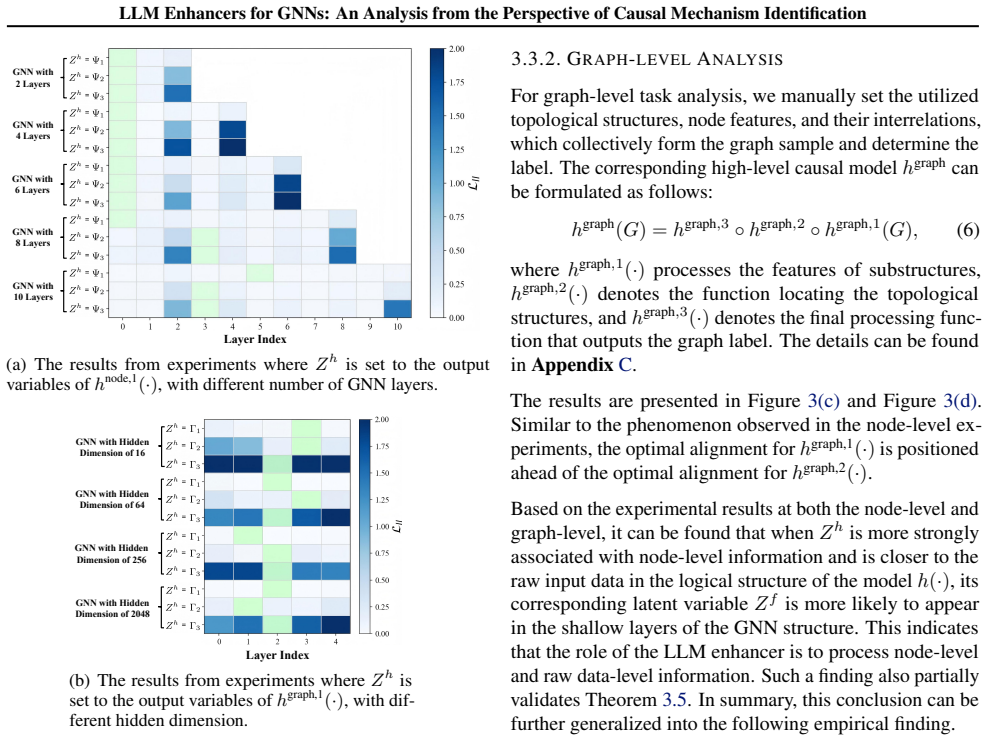
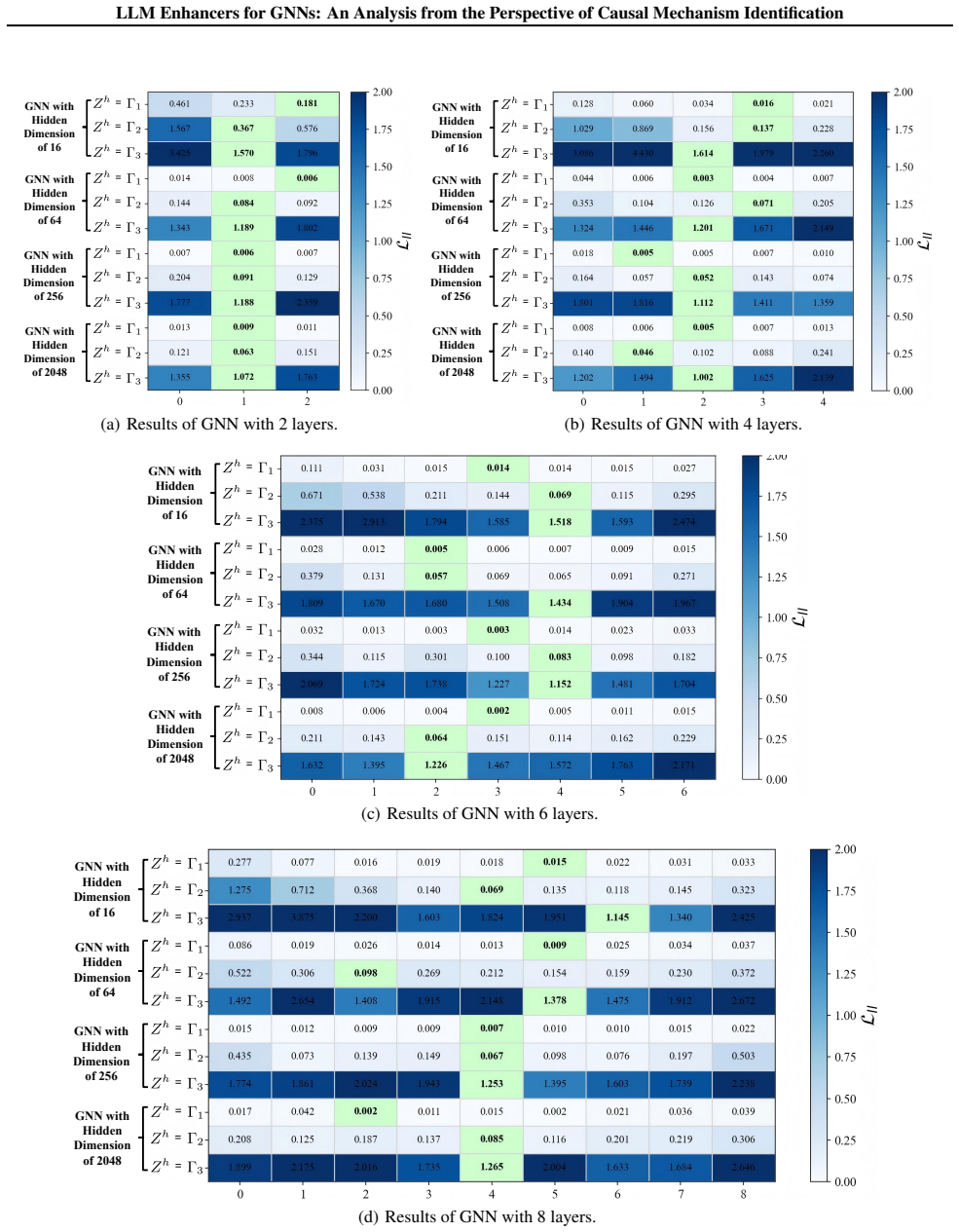
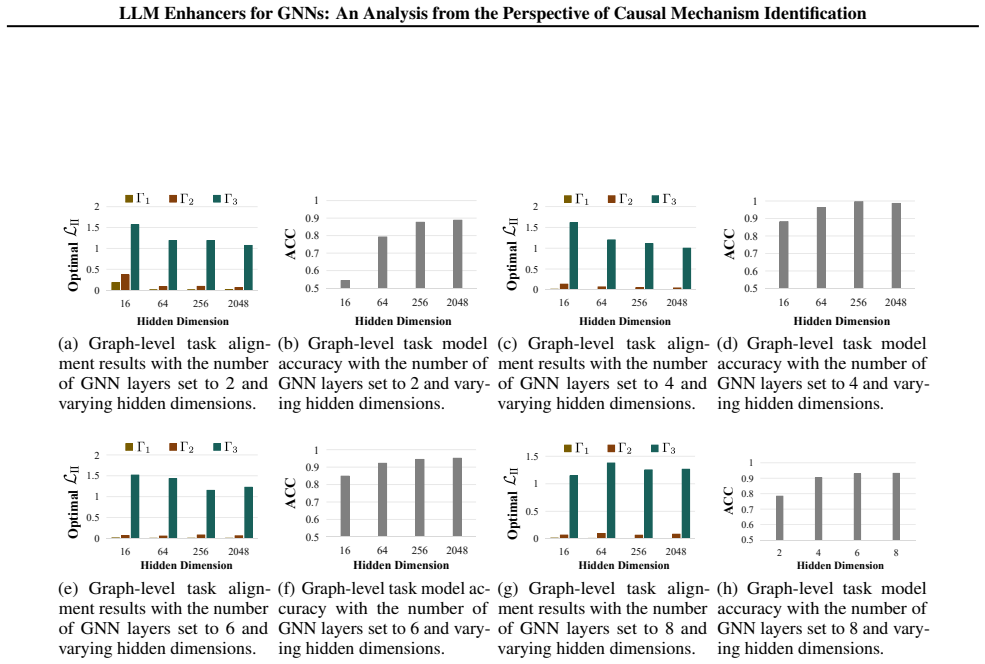
The central claim is that interchange interventions on the CCSG dataset reveal a precise division of labor in the LLM-enhancer-plus-GNN stack: with a fixed-parameter LLM, the features the LLM produces represent node-level and raw-data-level information, and the GNN internal variable that best matches the high-level causal model sits in layers 0 and 1, the early message-passing layers. The paper further claims that the GNN's internal structure after ingesting LLM input is largely invariant to model scale, that scaling up depth or width does not improve causal relation modeling, and that the minimum attainable interchange loss $L_{II}$ correlates with model accuracy. The design consequence is that the interface between the LLM output and the GNN input is a higher-leverage place to optimize than the backbone choice or model size, which motivates attention-weighted selection of token-level features as the AT module.
Load-bearing premise
The analysis assumes that a subset of the trained GNN's internal variables can be put into exact one-to-one correspondence with the variables of the hand-built causal models $h_{node}$ and $h_{graph}$; if no such correspondence really exists in a trained network, the layer that minimizes $L_{II}$ is only a proxy and the empirical findings partly describe the search procedure rather than the model's mechanism.
Editorial extensions
If this is right
- Fixed-parameter LLM enhancers should feed their knowledge into the earliest GNN layers; routing LLM features through many rounds of message passing adds little under the paper's analysis.
- Which token positions of the LLM output are selected as node features is a high-leverage design choice, reported as more consequential than the LLM family or GNN scale.
- The interchange loss $L_{II}$ can serve as an indicator of model capability, since lower minimum alignment loss generally coincides with higher accuracy in the reported experiments.
- Scaling up GNN depth or width mostly enlarges the structure without improving its ability to model the underlying causal relations, as the paper states as a hypothesis from Empirical Finding 2.
- Attention-based selection over multiple prompts yields consistent gains across three datasets and three GNN backbones while leaving the LLM frozen, making the module plug-and-play.
Reading between the lines
- If the early-layer locus generalizes beyond CCSG, the design rule for hybrid LLM/GNN systems would be to architect the feature interface rather than the GNN capacity; a testable extension is to fine-tune the LLM enhancer and check whether the semantic information moves deeper into the stack or stays at the LLM output.
- The even-layer-versus-odd-layer alignment asymmetry across depths could be probed by retraining the identical architecture with different seeds: if the asymmetry survives, it reflects a learned alternating internal structure rather than a property of the search procedure.
- The $L_{II}$-as-capability link, if confirmed on other architectures, offers a cheap training-free probe for benchmarking model families without full evaluation runs.
Signed reviews
Editorial analysis
A structured set of objections, weighed in public.
Referee Report
Summary. The paper analyzes the LLM-enhancer-plus-GNN paradigm by constructing a synthetic graph dataset (CCSG) with controllable causal relationships, then applying interchange interventions to identify which internal variables of the combined model correspond to variables of a hand-specified high-level causal model. It presents a theoretical validation of this alignment procedure (Theorem 3.2, Corollary 3.3, Proposition 3.4, Theorem 3.5), draws three empirical findings about where LLM-provided information enters the GNN, and proposes an Attention-based Transmission (AT) module that selects LLM token features and prompts. Table 2 reports consistent accuracy gains from the AT module across Cora, Pubmed, and Instagram with multiple LLM and GNN backbones.
Significance. If the causal-analysis claims were valid, the paper would provide a useful mechanistic account of LLM-enhanced GNNs and a practical plug-in module. The empirical infrastructure is a genuine strength: the authors build a controlled synthetic dataset, use standard backbones, report means and standard deviations, and release code. The AT module gains are consistent across three datasets and three LLM/GNN combinations, with improvements between roughly +0.7 and +3.1 points. However, the central theoretical validation is not established: the proofs of Theorems 3.2 and 3.5 contain circular or unsupported steps, and Empirical Finding 1 is drawn from a search restricted to GNN layers. Consequently, the analytical findings should be regarded as hypotheses about layer sensitivity rather than validated causal mechanisms.
major comments (4)
- [Section 3.2.3 / Appendix B.1, Eqs. (16)-(17)] The proof of Theorem 3.2 is circular and relies on an unstated value-preservation assumption. Equation (16) replaces f_{Z_f}(G_orig) with eta^{-1}(h_{Z_h}(G_orig)), although the theorem only assumes a bijection between variable sets and does not state that eta maps the value taken by Z_f on an input to the value taken by Z_h on the same input. More importantly, Eq. (17) concludes INTINV(f,Gorig,Gdiff,Z_f) = INTINV(h,Gorig,Gdiff,Z_h) by treating f_latter on a patched input as equal to h_latter on the corresponding patched input; that is exactly the interchange-invariance property the theorem is supposed to derive, not a consequence of the stated premises. Thus the claimed theoretical validation of the L_II minimization does not follow.
- [Appendix B.4, Eq. (31)] The claim that because Zhat^1_j blocks all causal routes from X_j to Y_f, one has INTINV(f,Gorig,Gdiff,S) = INTINV(f,Gorig,Gdiff,Zhat^1_j) for every S in {X_j} union {eZ^i_j} is false in general. Causal blocking gives conditional independence in the observational distribution, not equality of counterfactual interchange outcomes. Patching an intermediate LLM state eZ^i_j changes the subsequent LLM computation and therefore the value of Zhat^1_j in a way that need not coincide with the effect of patching Zhat^1_j directly, because Zhat^1_j is a non-injective, nonlinear function of the LLM layers. Since Eq. (31) is the only step that eliminates LLM variables from the intervention, Theorem 3.5 is unproven. The IC-algorithm argument in Lemma B.2 recovers only the architecture's dependency graph; it supplies no functional equations and no counterfactual equivalence.
- [Section 3.3.2 / Figure 3] Empirical Finding 1 is not supported by the reported experiments because the L_II search is restricted to GNN layers, as stated in Section 3.3. The observation that the smallest L_II among GNN layers occurs in layers 0-1 shows only that early GNN layers are more sensitive to patch-induced changes than later layers; it does not localize where the LLM's information is consumed, nor does it establish that the LLM output features 'serve the function of representing information at the node level and the raw data level.' The text also says this finding 'partially validates Theorem 3.5,' but since Theorem 3.5 is not established, that statement is unsupported. A control search over LLM intermediate variables, or an intervention that patches the entire LLM output, would be needed before this claim can be made.
- [Appendix B.3, Eq. (29) and Proposition 3.4] The justification of Proposition 3.4 contains an incoherent inequality: the left-hand side TE_{zf,zf'}(Y_f) - TE_{zf,zf'}(Y_f) is identically zero, and the surrounding sentence ('we have total effect of Z_{f,b} upon the output Y is strictly similar to Z_h than Z_{f,a}') is not a well-formed claim. More substantively, the proposition asserts that reaching the minimal possible value L*_II implies exact interchange equality and hence equal total effects; this assumes the existence of a variable that attains the lower bound, which is precisely what the earlier theorems were meant to establish. As a result, Proposition 3.4 does not provide an independent justification of the method.
minor comments (3)
- [Section 3.2.2, Step 4] Step 4 says 'utilize Equation 2 to calculate the loss L_II,' but the loss is defined in Equation 1; Equation 2 is the high-level model formula for the running example.
- [Table 5] The table lists 'Bipartite Graph' twice; the second row's description ('Outer nodes connected in a ring with a central node') appears to describe a different topology and should be re-labeled or corrected.
- [Appendix D.1 / Table 6] The experimental details state that q was set to 10 for the AT module, while Table 6 reports results only for q = 1, 2, 3, 4; please clarify whether q = 10 was used in Table 2 and why the ablation stops at q = 4.
Circularity Check
The method-validation theorems are circular: L*_II is defined as D(h,h), Theorem 3.2's proof assumes the interchange equality it must establish, and Theorem 3.5's Eq. (31) asserts the GNN-sufficiency conclusion; Empirical Finding 1 then validates Theorem 3.5 with a search the theorem itself restricted.
-
self definitional
[Section 3.2.3, Proposition 3.4 / Eq. (3)]
"Proposition 3.4. For a high-level causal modelh(·) and a low-level neural networkf(·), both mapping input graphsG∈G to outputs Y ∈Y such that Y = f(G) = h(G), if Z f within f(·) and Z h within h(·) minimizeLII to its optimal valueL∗ II, thenZ f aligns best withZ h and has an identical total effect on the output prediction as Zh. The minimalL∗ II is given by: L∗ II = 1/G2 Σ_{Gorig∈G} Σ_{Gdiff∈G} D(INTINV(h,Gorig,Gdiff,Zh), INTINV(h,Gorig,Gdiff,Zh)). (3)"
LII (Eq. 1) is defined as the distance between INTINV(h,...) and INTINV(f,...). 'Aligns best' has no independent content: the proposition defines best alignment as attaining the minimum of LII, and the minimum is by construction D(h,h), i.e., exact equality of the two intervention outputs. The asserted 'identical total effect' is thus the minimization objective restated, not a derived prediction. This proposition is the paper's theoretical warrant for using LII minima to locate Zf.
-
other
[Appendix B.1, proof of Theorem 3.2, Eqs. (16)-(17)]
"f latter [f pre(Gorig)\f Zf (Gorig)∪η−1(h Zh (Gorig))] = h latter [hpre(Gorig)\h Zh (Gorig)∪h Zh (Gorig)]. (16) Then, we have: INTINV(f,Gorig,Gdiff,Zf) = f latter [f pre(Gorig)\f Zf (Gorig)∪η−1(h Zh (Gdiff))] = h latter [hpre(Gorig)\h Zh (Gorig)∪h Zh (Gdiff)] = INTINV(h,Gorig,Gdiff,Zh). (17)"
Equation (16) asserts that replacing Zf by the bijective image of Zh's value inside f produces the same output as replacing Zh inside h. That interchange invariance is exactly the counterfactual correspondence Theorem 3.2 claims to establish. The stated assumptions—Y=f(G)=h(G) and a bijection η between variable sets—only equate outputs on complete inputs; they do not imply equality under partial internal substitution. The proof therefore reaches Eq. (17) by assuming the conclusion at Eq. (16). This is load-bearing because Theorem 3.2 is the theoretical validation of the whole LII search.
2 more flagged steps
-
other
[Appendix B.4, proof of Theorem 3.5, Eq. (31)]
"As the SCM demonstrates, we have ˆZ 1 j block all causal routes fromXj toY f. Therefore, we have: INTINV(f,Gorig,Gdiff,S) = INTINV(h,Gorig,Gdiff, ˆZ 1 j), S ∈ {Xj}∪{ eZ i j} eL i=1. (31)"
The theorem's conclusion is that GNN-internal variables are always sufficient to constitute Zf. Equation (31) asserts precisely that conclusion for every LLM hidden variable eZ^i_j: each is interventionally exchangeable with the first GNN layer variable Zhat^1_j. Causal blocking (d-separation) yields conditional independence, not interchange equivalence for non-injective nonlinear internal states, and Lemma B.2 only recovers the architecture's dependency graph, not functional equations. The proof then uses Eq. (31) to replace LLM variables by GNN variables in Eqs. (32)-(35), so the pivotal premise is the theorem's own claim. The RHS of Eq. (31) is also ill-typed: h has no variable Zhat^1_j.
-
other
[Section 3.3 / 3.3.2 (restriction to GNN layers and Empirical Finding 1)]
"According to the theorem, and taking into account the difficulty of fixed LLMs in modeling causal relationships, the subsequent analysis focuses on using the GNN model to examine causal relationship modeling within the framework. [...] This indicates that the role of the LLM enhancer is to process node-level and raw data-level information. Such a finding also partially validates Theorem 3.5."
Theorem 3.5 is used to justify restricting all LII searches to GNN-internal layers; no LLM hidden variable is ever a candidate. The resulting minima—which layer attains the lowest LII—are then offered as partial validation of Theorem 3.5 and as Empirical Finding 1 ('features output by the LLM serve the function of representing information at the node level'). This is a closed loop: the theorem licenses the restricted search, and the restricted search's outcome is evidence for the theorem and for where LLM information is consumed. The measured localization may only reflect which GNN layer is most sensitive to patching within the allowed candidate set.
full rationale
The central analytical claim—that interchange interventions localize where the fixed LLM's information enters the GNN—is not self-contained. The validation bundle (Theorem 3.2 and Proposition 3.4) makes 'best alignment' definitional by setting L*_II = D(h,h), and the proof of Theorem 3.2 assumes interchange invariance at Eq. (16). The sufficiency theorem that licenses searching only GNN layers (Theorem 3.5) is proved via Eq. (31), which simply asserts that every LLM hidden variable is exchangeable with a first-layer GNN variable. Empirical Finding 1 then completes the loop by using the GNN-only search results to 'partially validate' Theorem 3.5. The AT module and its accuracy gains on Cora, Pubmed, and Instagram are genuine external empirical contributions and are not circular; the self-citations to Gao et al. 2024 are not load-bearing. However, the paper's advertised mechanism-identification result depends on the circular theory chain, so the overall circularity score is 7 rather than lower.
Assumptions & free parameters
free parameters (4)
- q (number of prompts in AT module) =
10 in main experiments; ablation optimum 2
- m (number of selected LLM token features) =
2
- delta (prompt-selection warm-up epochs) =
10
- 90% accuracy floor for analytical experiments =
at least 90%
assumptions (6)
- domain assumption An exact bijective mapping eta from a subset of the GNN's intermediate variables to the variables of h_node and h_graph exists (Theorem 3.2 premise).
- ad hoc to paper The SCM in Figure 8 represents the general causal relationships among variables in the LLM-enhancer-plus-GNN model, with Pa(Z^l_i) = {Z^(l-1)_k : k in N(i) union {i}}.
- domain assumption The interchange search over single GNN layers identifies variables that behave like the abstract variables of h(·) when swap-based counterfactuals are applied.
- domain assumption The LLM enhancer is fixed-parameter and the findings are scoped to frozen LLMs.
- domain assumption The hand-defined h_node and h_graph equal the true label-generating process of the CCSG dataset.
- standard math Total effect decomposes into natural direct and indirect effects and can be computed by the replacement formulas in Eq. (18) to (21) (Pearl, 2009).
Cite this review
Pith. "Pith review of LLM Enhancers for GNNs: An Analysis from the Perspective of Causal Mechanism Identification." pith.science (2026). https://pith.science/paper/DMJRNC7S
@misc{pith2026250508265,
  author       = {Pith},
  title        = {Pith review of: LLM Enhancers for GNNs: An Analysis from the Perspective of Causal Mechanism Identification},
  year         = {2026},
  howpublished = {\url{https://pith.science/paper/DMJRNC7S}},
  note         = {Machine review of arXiv:2505.08265}
}
read the original abstract
The use of large language models (LLMs) as feature enhancers to optimize node representations, which are then used as inputs for graph neural networks (GNNs), has shown significant potential in graph representation learning. However, the fundamental properties of this approach remain underexplored. To address this issue, we propose conducting a more in-depth analysis of this issue based on the interchange intervention method. First, we construct a synthetic graph dataset with controllable causal relationships, enabling precise manipulation of semantic relationships and causal modeling to provide data for analysis. Using this dataset, we conduct interchange interventions to examine the deeper properties of LLM enhancers and GNNs, uncovering their underlying logic and internal mechanisms. Building on the analytical results, we design a plug-and-play optimization module to improve the information transfer between LLM enhancers and GNNs. Experiments across multiple datasets and models validate the proposed module.
Figures


Figures from the paper (9 more)



Reference graph
Works this paper leans on
-
[1]
D., D'Oosterlinck, K., Feder, A., Gat, Y
Abraham, E. D., D'Oosterlinck, K., Feder, A., Gat, Y. O., Geiger, A., Potts, C., Reichart, R., and Wu, Z. Cebab: Estimating the causal effects of real-world concepts on NLP model behavior. In Koyejo, S., Mohamed, S., Agarwal, A., Belgrave, D., Cho, K., and Oh, A. (eds.), Advances in Neural Information Processing Systems 35: Annual Conference on Neural Inf...
work page 2022
-
[2]
Beckers, S., Eberhardt, F., and Halpern, J. Y. Approximate causal abstractions. In Globerson, A. and Silva, R. (eds.), Proceedings of the Thirty-Fifth Conference on Uncertainty in Artificial Intelligence, UAI 2019, Tel Aviv, Israel, July 22-25, 2019 , volume 115 of Proceedings of Machine Learning Research, pp.\ 606--615. AUAI Press, 2019. URL http://proce...
work page 2019
-
[3]
Brown, T. B., Mann, B., Ryder, N., Subbiah, M., Kaplan, J., Dhariwal, P., Neelakantan, A., Shyam, P., Sastry, G., Askell, A., Agarwal, S., Herbert - Voss, A., Krueger, G., Henighan, T., Child, R., Ramesh, A., Ziegler, D. M., Wu, J., Winter, C., Hesse, C., Chen, M., Sigler, E., Litwin, M., Gray, S., Chess, B., Clark, J., Berner, C., McCandlish, S., Radford...
2020
-
[4]
Causal feature learning: an overview
Chalupka, K., Eberhardt, F., and Perona, P. Causal feature learning: an overview. Behaviormetrika, 44: 0 137--164, 2017
work page 2017
-
[5]
Exploring the potential of large language models (llms)in learning on graphs
Chen, Z., Mao, H., Li, H., Jin, W., Wen, H., Wei, X., Wang, S., Yin, D., Fan, W., Liu, H., and Tang, J. Exploring the potential of large language models (llms)in learning on graphs. SIGKDD Explor. , 25 0 (2): 0 42--61, 2023. doi:10.1145/3655103.3655110. URL https://doi.org/10.1145/3655103.3655110
arXiv 2023
-
[6]
BERT: pre-training of deep bidirectional transformers for language understanding
Devlin, J., Chang, M., Lee, K., and Toutanova, K. BERT: pre-training of deep bidirectional transformers for language understanding. In Burstein, J., Doran, C., and Solorio, T. (eds.), Proceedings of the 2019 Conference of the North American Chapter of the Association for Computational Linguistics: Human Language Technologies, NAACL-HLT 2019, Minneapolis, ...
doi:10.18653/v1/n 2019
-
[7]
Dubey, A., Jauhri, A., Pandey, A., Kadian, A., Al - Dahle, A., Letman, A., Mathur, A., Schelten, A., Yang, A., Fan, A., Goyal, A., Hartshorn, A., Yang, A., Mitra, A., Sravankumar, A., Korenev, A., Hinsvark, A., Rao, A., Zhang, A., Rodriguez, A., Gregerson, A., Spataru, A., Rozi \` e re, B., Biron, B., Tang, B., Chern, B., Caucheteux, C., Nayak, C., Bi, C....
-
[9]
Measuring causal effects of data statistics on language model's 'factual' predictions
Elazar, Y., Kassner, N., Ravfogel, S., Feder, A., Ravichander, A., Mosbach, M., Belinkov, Y., Sch \" u tze, H., and Goldberg, Y. Measuring causal effects of data statistics on language model's 'factual' predictions. CoRR, abs/2207.14251, 2022. doi:10.48550/ARXIV.2207.14251. URL https://doi.org/10.48550/arXiv.2207.14251
Show all 51 references
- [10]
-
[11]
Rethinking causal relationships learning in graph neural networks
Gao, H., Yao, C., Li, J., Si, L., Jin, Y., Wu, F., Zheng, C., and Liu, H. Rethinking causal relationships learning in graph neural networks. In Wooldridge, M. J., Dy, J. G., and Natarajan, S. (eds.), Thirty-Eighth AAAI Conference on Artificial Intelligence, AAAI 2024, Thirty-S...
2024
-
[12]
Neural natural language inference models partially embed theories of lexical entailment and negation
Geiger, A., Richardson, K., and Potts, C. Neural natural language inference models partially embed theories of lexical entailment and negation. In Alishahi, A., Belinkov, Y., Chrupala, G., Hupkes, D., Pinter, Y., and Sajjad, H. (eds.), Proceedings of the Third BlackboxNLP Work...
2020 doi
-
[13]
Causal abstractions of neural networks
Geiger, A., Lu, H., Icard, T., and Potts, C. Causal abstractions of neural networks. In Ranzato, M., Beygelzimer, A., Dauphin, Y. N., Liang, P., and Vaughan, J. W. (eds.), Advances in Neural Information Processing Systems 34: Annual Conference on Neural Information Processing ...
2021
-
[14]
Inducing causal structure for interpretable neural networks
Geiger, A., Wu, Z., Lu, H., Rozner, J., Kreiss, E., Icard, T., Goodman, N., and Potts, C. Inducing causal structure for interpretable neural networks. In International Conference on Machine Learning, pp.\ 7324--7338. PMLR, 2022 a
2022
-
[15]
D., and Potts, C
Geiger, A., Wu, Z., Lu, H., Rozner, J., Kreiss, E., Icard, T., Goodman, N. D., and Potts, C. Inducing causal structure for interpretable neural networks. In Chaudhuri, K., Jegelka, S., Song, L., Szepesv \' a ri, C., Niu, G., and Sabato, S. (eds.), International Conference on M...
2022
-
[16]
Geiger, A., Wu, Z., Potts, C., Icard, T., and Goodman, N. D. Finding alignments between interpretable causal variables and distributed neural representations. In Locatello, F. and Didelez, V. (eds.), Causal Learning and Reasoning, 1-3 April 2024, Los Angeles, California, USA ,...
2024
-
[17]
L., Ying, Z., and Leskovec, J
Hamilton, W. L., Ying, Z., and Leskovec, J. Inductive representation learning on large graphs. In Guyon, I., von Luxburg, U., Bengio, S., Wallach, H. M., Fergus, R., Vishwanathan, S. V. N., and Garnett, R. (eds.), Advances in Neural Information Processing Systems 30: Annual Co...
2017
-
[18]
Harnessing explanations: Llm-to-lm interpreter for enhanced text-attributed graph representation learning
He, X., Bresson, X., Laurent, T., Perold, A., LeCun, Y., and Hooi, B. Harnessing explanations: Llm-to-lm interpreter for enhanced text-attributed graph representation learning. In The Twelfth International Conference on Learning Representations, ICLR 2024, Vienna, Austria, May...
2024
-
[19]
Huang, C., Ren, X., Tang, J., Yin, D., and Chawla, N. V. Large language models for graphs: Progresses and directions. In Chua, T., Ngo, C., Lee, R. K., Kumar, R., and Lauw, H. W. (eds.), Companion Proceedings of the ACM on Web Conference 2024, WWW 2024, Singapore, Singapore, M...
2024
-
[20]
Inducing character-level structure in subword-based language models with type-level interchange intervention training
Huang, J., Wu, Z., Mahowald, K., and Potts, C. Inducing character-level structure in subword-based language models with type-level interchange intervention training. In Rogers, A., Boyd - Graber, J. L., and Okazaki, N. (eds.), Findings of the Association for Computational Ling...
2023 doi
-
[21]
PRODIGY: enabling in-context learning over graphs
Huang, Q., Ren, H., Chen, P., Krzmanc, G., Zeng, D., Liang, P., and Leskovec, J. PRODIGY: enabling in-context learning over graphs. In Oh, A., Naumann, T., Globerson, A., Saenko, K., Hardt, M., and Levine, S. (eds.), Advances in Neural Information Processing Systems 36: Annual...
2023
-
[22]
Can GNN be good adapter for llms? In Chua, T., Ngo, C., Kumar, R., Lauw, H
Huang, X., Han, K., Yang, Y., Bao, D., Tao, Q., Chai, Z., and Zhu, Q. Can GNN be good adapter for llms? In Chua, T., Ngo, C., Kumar, R., Lauw, H. W., and Lee, R. K. (eds.), Proceedings of the ACM on Web Conference 2024, WWW 2024, Singapore, May 13-17, 2024 , pp.\ 893--904. ACM...
2024
-
[23]
and Simon, H
Iwasaki, Y. and Simon, H. A. Causality and model abstraction. Artif. Intell., 67 0 (1): 0 143--194, 1994. doi:10.1016/0004-3702(94)90014-0. URL https://doi.org/10.1016/0004-3702(94)90014-0
1994 doi
-
[24]
Kipf, T. N. and Welling, M. Semi-supervised classification with graph convolutional networks. In Advances in Neural Information Processing Systems (NeurIPS), pp.\ 1--10, 2016. URL https://arxiv.org/abs/1609.02907
2016 arXiv
-
[25]
Semantic reshuffling with LLM and heterogeneous graph auto-encoder for enhanced rumor detection
Li, G., Hu, D., Liu, Z., Zhang, X., and Lyu, H. Semantic reshuffling with LLM and heterogeneous graph auto-encoder for enhanced rumor detection. In Rambow, O., Wanner, L., Apidianaki, M., Al - Khalifa, H., Eugenio, B. D., and Schockaert, S. (eds.), Proceedings of the 31st Inte...
2025
-
[26]
Liu, A., Pan, L., Lu, Y., Li, J., Hu, X., Zhang, X., Wen, L., King, I., Xiong, H., and Yu, P. S. A survey of text watermarking in the era of large language models. ACM Comput. Surv. , 57 0 (2): 0 47:1--47:36, 2025. doi:10.1145/3691626. URL https://doi.org/10.1145/3691626
2025 doi
-
[27]
One for all: Towards training one graph model for all classification tasks
Liu, H., Feng, J., Kong, L., Liang, N., Tao, D., Chen, Y., and Zhang, M. One for all: Towards training one graph model for all classification tasks. In The Twelfth International Conference on Learning Representations, 2024
2024
-
[28]
and Pavlick, E
Lovering, C. and Pavlick, E. Unit testing for concepts in neural networks. Trans. Assoc. Comput. Linguistics, 10: 0 1193--1208, 2022. doi:10.1162/TACL\_A\_00514. URL https://doi.org/10.1162/tacl\_a\_00514
2022 doi
-
[29]
G., He, J., Liu, B., and Niu, D
Lu, S., Mills, K. G., He, J., Liu, B., and Niu, D. Goat: Explaining graph neural networks via graph output attribution. In The Twelfth International Conference on Learning Representations, ICLR 2024, Vienna, Austria, May 7-11, 2024 . OpenReview.net, 2024. URL https://openrevie...
2024
-
[30]
Llm-rec: Personalized recommendation via prompting large language models
Lyu, H., Jiang, S., Zeng, H., Xia, Y., and Luo, J. Llm-rec: Personalized recommendation via prompting large language models. CoRR, abs/2307.15780, 2023. doi:10.48550/ARXIV.2307.15780. URL https://doi.org/10.48550/arXiv.2307.15780
-
[31]
Advancing graph representation learning with large language models: A comprehensive survey of techniques, 2024
Mao, Q., Liu, Z., Liu, C., Li, Z., and Sun, J. Advancing graph representation learning with large language models: A comprehensive survey of techniques, 2024. URL https://arxiv.org/abs/2402.05952
2024 arXiv
-
[32]
Causal abstraction with soft interventions
Massidda, R., Geiger, A., Icard, T., and Bacciu, D. Causal abstraction with soft interventions. In van der Schaar, M., Zhang, C., and Janzing, D. (eds.), Conference on Causal Learning and Reasoning, CLeaR 2023, 11-14 April 2023, Amazon Development Center, T \" u bingen, German...
2023
-
[33]
Locating and editing factual associations in GPT
Meng, K., Bau, D., Andonian, A., and Belinkov, Y. Locating and editing factual associations in GPT . In Koyejo, S., Mohamed, S., Agarwal, A., Belgrave, D., Cho, K., and Oh, A. (eds.), Advances in Neural Information Processing Systems 35: Annual Conference on Neural Information...
2022
-
[34]
Mustapha, K. B. A survey of emerging applications of large language models for problems in mechanics, product design, and manufacturing. Adv. Eng. Informatics, 64: 0 103066, 2025. doi:10.1016/J.AEI.2024.103066. URL https://doi.org/10.1016/j.aei.2024.103066
2025
-
[35]
Causality: Models, Reasoning, and Inference
Pearl, J. Causality: Models, Reasoning, and Inference. Cambridge University Press, second edition, 2009
2009
-
[36]
Causality 1988-2001 - introduction
Pearl, J. Causality 1988-2001 - introduction. In Geffner, H., Dechter, R., and Halpern, J. Y. (eds.), Probabilistic and Causal Inference: The Works of Judea Pearl, volume 36 of ACM Books , pp.\ 215--220. ACM , 2022. doi:10.1145/3501714.3501731. URL https://doi.org/10.1145/3501...
1988
-
[37]
Null it out: Guarding protected attributes by iterative nullspace projection
Ravfogel, S., Elazar, Y., Gonen, H., Twiton, M., and Goldberg, Y. Null it out: Guarding protected attributes by iterative nullspace projection. In Jurafsky, D., Chai, J., Schluter, N., and Tetreault, J. R. (eds.), Proceedings of the 58th Annual Meeting of the Association for C...
2020 doi
-
[38]
Representation learning with large language models for recommendation
Ren, X., Wei, W., Xia, L., Su, L., Cheng, S., Wang, J., Yin, D., and Huang, C. Representation learning with large language models for recommendation. In Chua, T., Ngo, C., Kumar, R., Lauw, H. W., and Lee, R. K. (eds.), Proceedings of the ACM on Web Conference 2024, WWW 2024, S...
2024
-
[39]
K., Weichwald, S., Bongers, S., Mooij, J
Rubenstein, P. K., Weichwald, S., Bongers, S., Mooij, J. M., Janzing, D., Grosse - Wentrup, M., and Sch \" o lkopf, B. Causal consistency of structural equation models. In Elidan, G., Kersting, K., and Ihler, A. (eds.), Proceedings of the Thirty-Third Conference on Uncertainty...
2017
-
[41]
C., Islamaj, R., Kapoor, A., Gao, X., and Lu, Z
Tian, S., Jin, Q., Yeganova, L., Lai, P.-T., Zhu, Q., Chen, X., Yang, Y., Chen, Q., Kim, W., Comeau, D. C., Islamaj, R., Kapoor, A., Gao, X., and Lu, Z. Opportunities and challenges for chatgpt and large language models in biomedicine and health. Briefings in Bioinformatics, 2...
2024 doi
- [42]
-
[43]
Graph attention networks
Velickovic, P., Cucurull, G., Casanova, A., Romero, A., Li \` o , P., and Bengio, Y. Graph attention networks. In 6th International Conference on Learning Representations, ICLR 2018, Vancouver, BC, Canada, April 30 - May 3, 2018, Conference Track Proceedings . OpenReview.net, ...
2018
-
[44]
Vig, J., Gehrmann, S., Belinkov, Y., Qian, S., Nevo, D., Singer, Y., and Shieber, S. M. Investigating gender bias in language models using causal mediation analysis. In Larochelle, H., Ranzato, M., Hadsell, R., Balcan, M., and Lin, H. (eds.), Advances in Neural Information Pro...
2020
-
[45]
Llm-enhanced cascaded multi-level learning on temporal heterogeneous graphs
Wang, F., Zhu, G., Yuan, C., and Huang, Y. Llm-enhanced cascaded multi-level learning on temporal heterogeneous graphs. In Yang, G. H., Wang, H., Han, S., Hauff, C., Zuccon, G., and Zhang, Y. (eds.), Proceedings of the 47th International ACM SIGIR Conference on Research and De...
2024
-
[46]
and Fey, M
Wittmann, J. and Fey, M. Wiki-cs: A wikipedia-based benchmark for graph neural networks. CoRR, abs/2007.02901, 2020. URL https://arxiv.org/abs/2007.02901
2007 arXiv
-
[47]
Discovering invariant rationales for graph neural networks
Wu, Y., Wang, X., Zhang, A., He, X., and Chua, T. Discovering invariant rationales for graph neural networks. In The Tenth International Conference on Learning Representations, ICLR 2022, Virtual Event, April 25-29, 2022 . OpenReview.net, 2022. URL https://openreview.net/forum...
2022
-
[48]
Causal proxy models for concept-based model explanations
Wu, Z., D'Oosterlinck, K., Geiger, A., Zur, A., and Potts, C. Causal proxy models for concept-based model explanations. In Krause, A., Brunskill, E., Cho, K., Engelhardt, B., Sabato, S., and Scarlett, J. (eds.), International Conference on Machine Learning, ICML 2023, 23-29 Ju...
2023
-
[49]
Wu, Z., Geiger, A., Icard, T., Potts, C., and Goodman, N. D. Interpretability at scale: Identifying causal mechanisms in alpaca. In Oh, A., Naumann, T., Globerson, A., Saenko, K., Hardt, M., and Levine, S. (eds.), Advances in Neural Information Processing Systems 36: Annual Co...
2023
-
[50]
Qwen2 technical report
Yang, A., Yang, B., Hui, B., Zheng, B., Yu, B., Zhou, C., Li, C., Li, C., Liu, D., Huang, F., Dong, G., Wei, H., Lin, H., Tang, J., Wang, J., Yang, J., Tu, J., Zhang, J., Ma, J., Yang, J., Xu, J., Zhou, J., Bai, J., He, J., Lin, J., Dang, K., Lu, K., Chen, K., Yang, K., Li, M....
-
[51]
Gnnexplainer: Generating explanations for graph neural networks
Ying, Z., Bourgeois, D., You, J., Zitnik, M., and Leskovec, J. Gnnexplainer: Generating explanations for graph neural networks. In Wallach, H. M., Larochelle, H., Beygelzimer, A., d'Alch \' e - Buc, F., Fox, E. B., and Garnett, R. (eds.), Advances in Neural Information Process...
2019
-
[52]
Empower text-attributed graphs learning with large language models (llms)
Yu, J., Ren, Y., Gong, C., Tan, J., Li, X., and Zhang, X. Empower text-attributed graphs learning with large language models (llms). CoRR, abs/2310.09872, 2023. doi:10.48550/ARXIV.2310.09872. URL https://doi.org/10.48550/arXiv.2310.09872
-
[53]
write newline
" write newline "" before.all 'output.state := FUNCTION n.dashify 't := "" t empty not t #1 #1 substring "-" = t #1 #2 substring "--" = not "--" * t #2 global.max substring 't := t #1 #1 substring "-" = "-" * t #2 global.max substring 't := while if t #1 #1 substring * t #2 gl...
Reviewed August 15, 2026 · model on record in the stance chip above.
Discussion (0). Continue with ORCID to comment.