SPP-SBL: Space-Power Prior Sparse Bayesian Learning for Block Sparse Recovery
Pith reviewed 2026-05-22 15:33 UTC · model grok-4.3
The pith
A space-power prior on undirected graphs lets sparse Bayesian learning recover block-sparse signals whose patterns are unknown in advance.
A machine-rendered reading of the paper's core claim, the machinery that carries it, and where it could break.
Core claim
By placing a space-power prior on an undirected graph model and learning the relative values of its space-coupling parameters, the SPP-SBL method adaptively captures unknown block-sparse structures that defeat earlier pattern-based sparse Bayesian learners.
What carries the argument
Space-power prior on undirected graphs, whose relative edge weights are estimated inside a variance-transformation framework by EM combined with high-order root solving.
If this is right
- Chain-structured and multi-pattern sparse signals become recoverable without supplying the pattern in advance.
- The same estimator works on real multi-modal data such as images and audio that exhibit structured sparsity.
- Parameter estimation no longer requires hand-tuned or fixed coupling strengths.
- Recovery accuracy improves across standard metrics once relative couplings are learned rather than assumed uniform.
Where Pith is reading between the lines
- The approach may extend to other graph-based priors where only relative edge strengths matter.
- If the graph topology itself is also unknown, a joint topology-and-parameter search could be a natural next step.
- The unification via variance transformation suggests that many earlier block-SBL variants are special cases that can now be compared on equal footing.
Load-bearing premise
The variance transformation successfully maps all existing pattern-based block sparse Bayesian methods into a common form that the space-power prior can then adapt to any unknown block structure.
What would settle it
A controlled test in which the relative space-coupling parameters are deliberately fixed to equal values while the true signal contains two or more distinct block patterns; recovery SNR or support error should then be markedly worse than when the parameters are learned.
Figures




read the original abstract
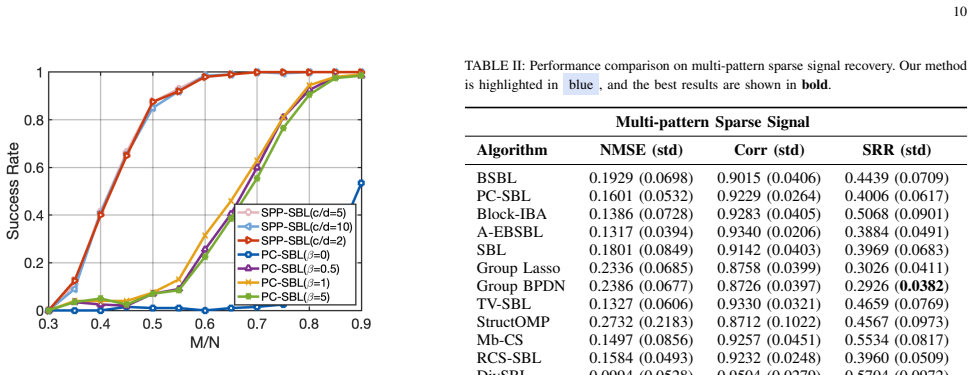
The recovery of block-sparse signals with unknown structural patterns remains a fundamental challenge in structured sparse signal reconstruction. By proposing a variance transformation framework, this paper unifies existing pattern-based block sparse Bayesian learning methods, and introduces a novel space power prior based on undirected graph models to adaptively capture the unknown patterns of block-sparse signals. By combining the EM algorithm with high-order equation root-solving, we develop a new structured sparse Bayesian learning method, SPP-SBL, which effectively addresses the open problem of space coupling parameter estimation in pattern-based methods. We further demonstrate that learning the relative values of space coupling parameters is key to capturing unknown block-sparse patterns and improving recovery accuracy. Experiments validate that SPP-SBL successfully recovers various challenging structured sparse signals (e.g., chain-structured signals and multi-pattern sparse signals) and real-world multi-modal structured sparse signals (images, audio), showing significant advantages in recovery accuracy across multiple metrics.
Editorial analysis
A structured set of objections, weighed in public.
Referee Report
Summary. The manuscript proposes a variance transformation framework to unify existing pattern-based block sparse Bayesian learning methods and introduces a novel space-power prior based on undirected graph models to adaptively capture unknown block-sparse patterns. It develops the SPP-SBL method by combining the EM algorithm with high-order equation root-solving to estimate space coupling parameters. The authors claim that learning the relative values of space coupling parameters is key to capturing unknown patterns and improving recovery accuracy, supported by experiments on synthetic chain-structured and multi-pattern signals as well as real-world multi-modal data such as images and audio.
Significance. If the unification holds and the adaptive estimation is rigorously shown to drive the gains, this could meaningfully advance structured sparse recovery by addressing the open problem of space coupling parameter estimation in pattern-based methods. The space-power prior offers a flexible graph-based modeling approach that may generalize to other applications in signal processing. The work's impact would be strengthened by clearer isolation of the learning step's contribution.
major comments (2)
- [§4] §4 (Experiments): The manuscript does not include an ablation study comparing SPP-SBL with learned relative space coupling parameters against a version using fixed or default values on the same graph model and datasets. This is load-bearing for the central claim that 'learning the relative values of space coupling parameters is key', as performance improvements could arise from the overall prior construction or the EM/root-solving procedure rather than the adaptive estimation.
- [§2] §2 (Variance transformation framework): The unification of existing pattern-based methods is asserted but lacks an explicit derivation or table mapping showing how specific prior methods emerge as special cases under the framework; this undercuts the novelty of the unification as a foundation for the space-power prior.
minor comments (2)
- [Abstract] Abstract: The phrase 'space-power prior' is used without a concise inline definition or reference to its graph-based construction, which would aid readability for a broad audience.
- [Method] Notation: The definition of the space coupling parameters and their relative values could be clarified with a small illustrative example or diagram in the method section to distinguish them from absolute values.
Simulated Author's Rebuttal
We thank the referee for the detailed and constructive feedback. The comments highlight important opportunities to strengthen the rigor of our claims regarding the variance transformation framework and the role of adaptive space coupling parameter estimation. We address each major comment below and outline the corresponding revisions.
read point-by-point responses
-
Referee: §4 (Experiments): The manuscript does not include an ablation study comparing SPP-SBL with learned relative space coupling parameters against a version using fixed or default values on the same graph model and datasets. This is load-bearing for the central claim that 'learning the relative values of space coupling parameters is key', as performance improvements could arise from the overall prior construction or the EM/root-solving procedure rather than the adaptive estimation.
Authors: We agree that directly isolating the contribution of learning the relative space coupling parameters is necessary to substantiate the central claim. In the revised manuscript, we will add an ablation study in Section 4 that compares the full SPP-SBL (with learned parameters via EM and root-solving) against controlled variants that use the same undirected graph model and space-power prior but with fixed or default relative coupling values. This will be performed on the same synthetic chain-structured, multi-pattern, and real-world image/audio datasets, with results reported using the existing recovery metrics to clarify that the performance gains stem from the adaptive estimation step. revision: yes
-
Referee: §2 (Variance transformation framework): The unification of existing pattern-based methods is asserted but lacks an explicit derivation or table mapping showing how specific prior methods emerge as special cases under the framework; this undercuts the novelty of the unification as a foundation for the space-power prior.
Authors: We acknowledge that an explicit mapping would make the unification more transparent and better position the space-power prior. In the revised Section 2, we will include a new table that systematically maps representative existing pattern-based block sparse Bayesian learning methods to special cases obtained by particular choices of the variance transformation parameters. Brief derivations for two or three canonical examples will be added to show how the framework recovers those priors, thereby clarifying the foundation upon which the space-power prior is constructed. revision: yes
Circularity Check
Minor self-citation risk but derivation remains independent
full rationale
The paper introduces a variance transformation framework to unify prior pattern-based BSBL methods and proposes a new space-power prior on undirected graphs, then derives SPP-SBL via EM combined with high-order root solving to estimate space-coupling parameters. The claim that learning relative values of those parameters is key is presented as an empirical demonstration from recovery experiments on synthetic and real data (images, audio), not as a mathematical identity or fitted quantity renamed as prediction. No load-bearing self-citation, uniqueness theorem, or ansatz smuggling is evident in the provided derivation chain; the central method addresses an acknowledged open estimation problem rather than presupposing its own solution. A score of 2 reflects only the normal presence of author citations to related work without reducing the core contribution to those citations.
Axiom & Free-Parameter Ledger
free parameters (1)
- space coupling parameters
axioms (1)
- domain assumption Undirected graph models can represent unknown block-sparse patterns
invented entities (1)
-
space-power prior
no independent evidence
Reference graph
Works this paper leans on
-
[1]
D. L. Donoho, “Compressed sensing,”IEEE Transactions on Information Theory, vol. 52, no. 4, pp. 1289–1306, 2006
work page 2006
-
[2]
Sparse signal reconstruction from limited data using FOCUSS: A re-weighted minimum norm algorithm,
I. F. Gorodnitsky and B. D. Rao, “Sparse signal reconstruction from limited data using FOCUSS: A re-weighted minimum norm algorithm,” IEEE Transactions on Signal Processing, vol. 45, no. 3, pp. 600–616, 1997
work page 1997
-
[3]
Decoding by linear programming,
E. J. Candes and T. Tao, “Decoding by linear programming,”IEEE Transactions on Information Theory, vol. 51, no. 12, pp. 4203–4215, 2005
work page 2005
-
[4]
Regression shrinkage and selection via the lasso,
R. Tibshirani, “Regression shrinkage and selection via the lasso,”Journal of the Royal Statistical Society Series B: Statistical Methodology, vol. 58, no. 1, pp. 267–288, 1996
work page 1996
-
[5]
Atomic decomposition by basis pursuit,
S. S. Chen, D. L. Donoho, and M. A. Saunders, “Atomic decomposition by basis pursuit,”SIAM Review, vol. 43, no. 1, pp. 129–159, 2001
work page 2001
-
[6]
Y . C. Pati, R. Rezaiifar, and P. S. Krisnaprasad, “Orthogonal matching pursuit: Recursive function approximation with applications to wavelet decomposition,” inProceedings of 27th Asilomar Conference on Signals, Systems and Computers. IEEE, pp. 40–44, 1993
work page 1993
-
[7]
Sparse Bayesian learning and the relevance vector machine,
M. E. Tipping, “Sparse Bayesian learning and the relevance vector machine,”Journal of Machine Learning Research, vol. 1, no. Jun, pp. 211–244, 2001
work page 2001
-
[8]
S. Ji, Y . Xue, and L. Carin, “Bayesian compressive sensing,”IEEE Transactions on Signal Processing, vol. 56, no. 6, pp. 2346–2356, 2008
work page 2008
-
[9]
Block-sparse signals: Uncertainty relations and efficient recovery,
Y . C. Eldar, P. Kuppinger, and H. Bolcskei, “Block-sparse signals: Uncertainty relations and efficient recovery,”IEEE Transactions on Signal Processing, vol. 58, no. 6, pp. 3042–3054, 2010
work page 2010
-
[10]
Model-based compressive sensing,
R. G. Baraniuk, V . Cevher, M. F. Duarte, and C. Hegde, “Model-based compressive sensing,”IEEE Transactions on Information Theory, vol. 56, no. 4, pp. 1982–2001, Apr. 2010
work page 1982
-
[11]
D. L. Donoho, I. Johnstone, and A. Montanari, “Accurate prediction of phase transitions in compressed sensing via a connection to minimax denoising,”IEEE Transactions on Information Theory, vol. 59, no. 6, pp. 3396–3433, 2013
work page 2013
-
[12]
Blind multiband signal reconstruction: Compressed sensing for analog signals,
M. Mishali and Y . C. Eldar, “Blind multiband signal reconstruction: Compressed sensing for analog signals,”IEEE Transactions on Signal Processing, vol. 57, no. 3, pp. 993–1009, 2009
work page 2009
-
[13]
Harmonic decomposition of audio signals with matching pursuit,
R. Gribonval and E. Bacry, “Harmonic decomposition of audio signals with matching pursuit,”IEEE Transactions on Signal Processing, vol. 51, no. 1, pp. 101–111, 2003
work page 2003
-
[14]
Block sparse Bayesian learning: A diversified scheme,
Y . Zhang, Z. Zhu, and Y . Xia, “Block sparse Bayesian learning: A diversified scheme,” inAdvances in Neural Information Processing Systems, vol. 37, pp. 129 988–130 017, 2024
work page 2024
-
[15]
Bayesian compressive sensing for cluster structured sparse signals,
L. Yu, H. Sun, J.-P. Barbot, and G. Zheng, “Bayesian compressive sensing for cluster structured sparse signals,”Signal Processing, vol. 92, no. 1, pp. 259–269, 2012
work page 2012
-
[16]
Exploiting structure in wavelet-based Bayesian compressive sensing,
L. He and L. Carin, “Exploiting structure in wavelet-based Bayesian compressive sensing,”IEEE Transactions on Signal Processing, vol. 57, no. 9, pp. 3488–3497, 2009
work page 2009
-
[17]
Sparsity and smoothness via the fused lasso,
R. Tibshirani, M. Saunders, S. Rosset, J. Zhu, and K. Knight, “Sparsity and smoothness via the fused lasso,”Journal of the Royal Statistical Society Series B: Statistical Methodology, vol. 67, no. 1, pp. 91–108, 2005
work page 2005
-
[18]
Non-uniform burst-sparsity learning for massive MIMO channel estimation,
J. Dai, A. Liu, and H. C. So, “Non-uniform burst-sparsity learning for massive MIMO channel estimation,”IEEE Transactions on Signal Processing, vol. 67, no. 4, pp. 1075–1087, 2018. 15
work page 2018
-
[19]
Inverse synthetic aperture radar imaging via modified smoothedl 0 norm,
J. Lv, L. Huang, Y . Shi, and X. Fu, “Inverse synthetic aperture radar imaging via modified smoothedl 0 norm,”IEEE Antennas and Wireless Propagation Letters, vol. 13, pp. 1235–1238, 2014
work page 2014
-
[20]
S. Srivastava, A. Mishra, A. Rajoriya, A. K. Jagannatham, and G. As- cheid, “Quasi-static and time-selective channel estimation for block- sparse millimeter wave hybrid MIMO systems: Sparse Bayesian learn- ing (SBL)-based approaches,”IEEE Transactions on Signal Processing, vol. 67, no. 5, pp. 1251–1266, Mar. 2019
work page 2019
-
[21]
Near/Far-field channel estimation for terahertz systems with ELAAs: A block-sparsity-aware approach,
H. Wang, J. Fang, H. Duan, H. Li, and L. Li, “Near/Far-field channel estimation for terahertz systems with ELAAs: A block-sparsity-aware approach,”IEEE Transactions on Communications, vol. 74, pp. 2685– 2700, 2025
work page 2025
-
[22]
Model selection and estimation in regression with grouped variables,
M. Yuan and Y . Lin, “Model selection and estimation in regression with grouped variables,”Journal of the Royal Statistical Society Series B: Statistical Methodology, vol. 68, no. 1, pp. 49–67, 2006
work page 2006
-
[23]
Sparse optimization with least- squares constraints,
E. Van den Berg and M. P. Friedlander, “Sparse optimization with least- squares constraints,”SIAM Journal on Optimization, vol. 21, no. 4, pp. 1201–1229, 2011
work page 2011
-
[24]
T. Park and G. Casella, “The Bayesian lasso,”Journal of the American Statistical Association, vol. 103, no. 482, pp. 681–686, 2008
work page 2008
-
[25]
The horseshoe estimator for sparse signals,
C. M. Carvalho, N. G. Polson, and J. G. Scott, “The horseshoe estimator for sparse signals,”Biometrika, vol. 97, no. 2, pp. 465–480, 2010
work page 2010
-
[26]
D. Hern ´andez-Lobato, J. M. Hern ´andez-Lobato, and P. Dupont, “Gen- eralized spike-and-slab priors for Bayesian group feature selection using expectation propagation,”The Journal of Machine Learning Research, vol. 14, no. 1, pp. 1891–1945, 2013
work page 1945
-
[27]
The Bayesian group-lasso for analyzing contingency tables,
S. Raman, T. J. Fuchs, P. J. Wild, E. Dahl, and V . Roth, “The Bayesian group-lasso for analyzing contingency tables,” inProceedings of the 26th Annual International Conference on Machine Learning, pp. 881–888, 2009
work page 2009
-
[28]
Sparse signal recovery with temporally correlated source vectors using sparse Bayesian learning,
Z. Zhang and B. D. Rao, “Sparse signal recovery with temporally correlated source vectors using sparse Bayesian learning,”IEEE Journal of Selected Topics in Signal Processing, vol. 5, no. 5, pp. 912–926, 2011
work page 2011
-
[29]
Extension of SBL algorithms for the recovery of block sparse signals with intra-block correlation,
Z. Zhang and B. D. Rao, “Extension of SBL algorithms for the recovery of block sparse signals with intra-block correlation,”IEEE Transactions on Signal Processing, vol. 61, no. 8, pp. 2009–2015, 2013
work page 2009
-
[30]
Pattern-coupled sparse Bayesian learning for recovery of block-sparse signals,
J. Fang, Y . Shen, H. Li, and P. Wang, “Pattern-coupled sparse Bayesian learning for recovery of block-sparse signals,”IEEE Transactions on Signal Processing, vol. 63, no. 2, pp. 360–372, 2015
work page 2015
-
[31]
L. Wang, L. Zhao, S. Rahardja, and G. Bi, “Alternative to extended block sparse Bayesian learning and its relation to pattern-coupled sparse Bayesian learning,”IEEE Transactions on Signal Processing, vol. 66, no. 10, pp. 2759–2771, 2018
work page 2018
-
[32]
Structured Bayesian learning for recovery of clustered sparse signal,
L. Wang, L. Zhao, L. Yu, J. Wang, and G. Bi, “Structured Bayesian learning for recovery of clustered sparse signal,”Signal Processing, vol. 166, 107255, 2020
work page 2020
-
[33]
Block-sparse signal recovery via general total variation regularized sparse Bayesian learning,
A. Sant, M. Leinonen, and B. D. Rao, “Block-sparse signal recovery via general total variation regularized sparse Bayesian learning,”IEEE Transactions on Signal Processing, vol. 70, pp. 1056–1071, 2022
work page 2022
-
[34]
Iterative Bayesian reconstruction of non-iid block-sparse signals,
M. Korki, J. Zhang, C. Zhang, and H. Zayyani, “Iterative Bayesian reconstruction of non-iid block-sparse signals,”IEEE Transactions on Signal Processing, vol. 64, no. 13, pp. 3297–3307, 2016
work page 2016
-
[35]
Maximum likelihood from incomplete data via the EM algorithm,
A. P. Dempster, N. M. Laird, and D. B. Rubin, “Maximum likelihood from incomplete data via the EM algorithm,”Journal of the Royal Statistical Society Series B: Statistical Methodology, vol. 39, no. 1, pp. 1–22, 1977
work page 1977
-
[36]
M. Abramowitz and I. A. Stegun,Handbook of mathematical functions: with formulas, graphs, and mathematical tables, vol. 55. New York, NY , USA: Dover Publications, 1965
work page 1965
-
[37]
Learning with structured sparsity,
J. Huang, T. Zhang, and D. Metaxas, “Learning with structured sparsity,” inProceedings of the 26th Annual International Conference on Machine Learning, pp. 417–424, 2009
work page 2009
-
[38]
A. Sant, M. Leinonen, and B. D. Rao, “General total variation regular- ized sparse Bayesian learning for robust block-sparse signal recovery,” in ICASSP 2021-2021 IEEE International Conference on Acoustics, Speech and Signal Processing (ICASSP). IEEE, pp. 5604–5608, 2021
work page 2021
-
[39]
Audio set: An ontology and human- labeled dataset for audio events,
J. F. Gemmeke, D. P. Ellis, D. Freedman, A. Jansen, W. Lawrence, R. C. Moore, M. Plakal, and M. Ritter, “Audio set: An ontology and human- labeled dataset for audio events,” in2017 IEEE International Conference on Acoustics, Speech and Signal Processing (ICASSP). IEEE, pp. 776– 780, 2017
work page 2017
discussion (0)
Sign in with ORCID, Apple, or X to comment. Anyone can read and Pith papers without signing in.