REVIEW 2 major objections 5 minor 41 references
MC-Swarm: Minimal-Communication Multi-Agent Trajectory Planning and Deadlock Resolution for Quadrotor Swarm
T0 review · 2 major / 5 minor · reviewed 2026-08-15 · deepseek-v4-flash
Pith's one-line read MC-Swarm guarantees collision avoidance and deadlock resolution for quadrotor swarms with zero in-flight communication.
desk verdict Solid engineering and experiments, but the central safety proof has a load-bearing gap: the modified BVC does not in general contain the agent's own position-to-subgoal segment. read the letter →
The pith
A machine-rendered reading of the paper's core claim, the machinery that carries it, and where it could break.
The reading
What carries the argument
The load-bearing construction is the modified Buffered Voronoi Cell (BVC): a half-space intersection $V_i$ built from the closest points $c_{i,j}$ between the two line segments $[\hat{p}_i, g_i^{(h-1)}]$ and $[\hat{p}_j, g_j^{(h-1)}]$ (Eq. 11). The cell is intended to contain the whole segment from the agent's position to its previous subgoal, so the subgoal is never unreachable because of a neighbor's safety region. Subgoal optimization (Eq. 14) then chooses, along the grid edge toward the waypoint, the point closest to the waypoint that still lies inside the intersection of the SFC and the modified BVC, and Lemma 4 ensures no two agents' subgoals occupy the interior of the same grid edge. Finally, the trajectory optimizer (Eq. 15) enforces every collision constraint produced in the window $[t - T_r - T_s, t]$ and requires $v_{i,M}=0$, which makes asynchronous replanning safe: any two agents share at least one common constraint, and a stopped agent remains inside a recently valid cell.
What would settle it
Record, at every coordination-state update in simulation, the closest-point distance between each pair of subgoal line segments; if any pair is ever below $2r$, the inclusion lemma behind Eq. (11) fails at that step, so the collision-avoidance theorems no longer apply. A stronger test is to construct start/goal assignments on the grid whose MAPF paths force two subgoal segments to cross in a corridor narrower than $2r$, and check whether the quadratic program (15) becomes infeasible or the agent's trajectory exits its own BVC.
Extended reading notes
Core claim
The paper's central claim is that asynchronous, communication-free operation does not cost safety or progress. It proves that if agents replan within a maximum period $T_r$ and the planning horizon is $T < T_r$, then no two agents ever violate the separation $\|p_i(t)-p_j(t)\| \ge 2r$ and no agent collides with static obstacles—even when the trajectory QP fails, because the final stop constraint keeps a failed agent inside a recent safety cell. It then proves a deadlock-resolution theorem: under a solvable grid-based multi-agent pathfinding instance and grid spacing $d > 2\sqrt{2}r$, every agent reaches its goal. These guarantees are obtained by constructing identical coordination states locally from sensed positions and by a subgoal rule that keeps agents on distinct grid edges, so that blocking cycles are impossible.
Load-bearing premise
The safety proof assumes that each agent can always draw a straight line from its own position to its subgoal without leaving its private safety region, and this only holds if the straight-line segments of different agents stay at least two robot radii apart—something the paper states but does not prove its update rule preserves.
Editorial extensions
If this is right
- A quadrotor swarm can operate in communication-denied or high-latency environments, such as underground or jammed areas, while retaining formal safety guarantees, provided agents can sense each other's positions and share goals once.
- The condition $d > 2\sqrt{2}r$ gives designers a direct rule relating grid resolution to robot radius; missions on coarser grids lose the deadlock-free guarantee.
- Asynchronous replanning itself is not an obstacle to provable collision avoidance: the time-window constraint trick used here can be applied to other decentralized planners that suffer from outdated information.
- The subgoal-optimization layer (unique grid-edge subgoals) is independent of the trajectory optimizer and could be reused with other local trajectory planners to prevent deadlock.
- The communication-based variant MC-Swarm-C shows that even exchanging a tiny consensus bitmask about which agents reached their waypoints cuts mission time noticeably, because agents no longer wait for the slowest peer.
Reading between the lines
- The guarantee effectively converts pairwise safety into a geometric separation requirement on subgoal segments; a natural extension is to enforce that separation explicitly in the subgoal optimization, which would close the proof gap identified around Eq. (11).
- If the grid assumption is relaxed, an analogous deadlock argument may hold for any graph of short, separated 'edges' that agents traverse in discrete steps, suggesting a general distributed coordination-graph design.
- One testable extension is to replace the assumed noiseless sensing with explicit measurement-error bounds and enlarge the BVC margin accordingly, which would let the formal guarantee survive realistic perception noise rather than the heuristic radius inflation used in experiments.
Signed reviews
Editorial analysis
A structured set of objections, weighed in public.
Referee Report
Summary. The paper presents MC-Swarm, a distributed asynchronous multi-agent trajectory planning framework for quadrotor swarms. It consists of a coordination state updater that computes waypoints, safe flight corridors, modified buffered Voronoi cells, and optimized subgoals, and a trajectory optimizer that solves a quadratic program with conservative collision constraints sampled over a window of past coordination states. Two variants are proposed: MC-Swarm-N, which requires no communication after initialization, and MC-Swarm-C, which uses lightweight communication to accelerate waypoint updates. The central claims are Theorem 1 (collision avoidance under asynchronous replanning when optimization succeeds), Theorem 2 (collision avoidance regardless of optimization failure under a horizon condition), and Theorem 3 (deadlock resolution). Experiments compare against MADER, EGO-v2, DREAM, and GCBF+ in obstacle-free, forest, and maze environments, plus hardware tests with eight Crazyflies.
Significance. The paper addresses an important problem: formal guarantees for communication-free asynchronous swarm trajectory planning. The proof structure is coherent and the empirical validation is extensive, including real-world experiments. If the theorems were valid, the contribution would be significant for multi-robot systems. However, the main safety and deadlock guarantees rest on a geometric segment-inclusion property that is not proved and is in fact false under the paper's own assumptions; in addition, the validation parameters violate the hypothesis of Theorem 2. As a result, the paper's central formal claims are not established.
major comments (2)
- [Section IV-C, after Eq. (11)] The sentence asserting that the modified BVC 'includes the line segment between \hat{p}_i and g_i^{(h-1)}' is made without proof, and the asserted inclusion is false when the two subgoal segments come closer than 2r. From Eq. (11), for any x on [\hat{p}_i, g_i^{(h-1)}], the left-hand side of (11a) is at most L = ||c_{i,j} - c_{j,i}||, while the required margin is d_{i,j} = r + L/2; hence the inclusion holds only if L >= 2r. The coordination-state update never establishes this separation. In particular, adjacent grid edges can meet at a vertex, so subgoal segments on different edges can be arbitrarily close; Lemma 4 excludes only two interior subgoals on the same grid edge. A concrete counterexample with the paper's simulation parameters d=0.5, r=0.15 is: p_i=(0.2,0), g_i=(0.5,0); p_j=(0.5,0.2), g_j=(0.5,0.5). Here ||p_i - p_j|| ≈ 0.36 > 2r = 0.3, but the distance between the two segments is L = 0.2, and (p_i - c_{j,i})·n_{i,j} = 0.2 < d_{i,j} = 0.25, so p_i ∉ V_i. Thus an agent's own position can lie outside its own safety cell, the constraint in (15) can be infeasible at k=0, and the 'no optimization failure' premise of Theorem 1 can fail. Theorem 2's recovery argument also assumes \hat{p}_i^{(h)} ∈ V_i^{(h)}, and Lemma 6's feasible-control construction assumes [p_{i,d}, g_{i,d}] ⊂ V_i. Without an additional invariant enforcing L >= 2r, the proofs of Theorems 1, 2, and 3 are not valid.
- [Section V-B, Theorem 2 and Section VI parameters] Theorem 2 states its conclusion under the hypothesis that 'the planning horizon T and trajectory replanning period are less than the maximum replanning period T_r.' The validation in Section VI, however, sets T = 1.0 s and T_r = 0.2 s, so T > T_r. The proof of Theorem 2 explicitly uses the inequality t_j - t_i < T < T_r in Case 1 and relies on the stopping argument in Case 2; with T = 1.0 > T_r = 0.2, the stated guarantee does not apply to any of the reported simulations or experiments. This is a load-bearing mismatch between the theoretical claim and the empirical validation.
minor comments (5)
- [Section VI, simulation parameters] The text reports 'Δth = 0.1 s' but later specifies 'time step Δt = 0.2 s' and T = M Δt = 5 × 0.2 = 1.0 s; the symbol Δth appears to be a typo and should be Δt = 0.2 s.
- [Section VI, cost weights] The sentence 'the weight parameters in the cost (16) are set as w_e = 0.01 and w_g = 0.1' should refer to w_e and w_a, matching the notation in Eq. (16).
- [Section VI, algorithm names] There is a typo in 'MC-Swarm-C: Commnucation-based' which should read 'Communication-based.'
- [Section V-A, notation] The symbol M is used both for the number of planning steps and for the index set {0, ..., M}; using a different symbol, such as \mathcal{M}, for the set would remove ambiguity in the statement of problem (15).
- [Section IV-C, Fig. 3] The figure illustrates the claimed segment-inclusion property only for well-separated subgoal segments; adding a case where subgoal segments meet at a grid vertex would make the limitation discussed in Major Comment 1 visible.
Circularity Check
No load-bearing circularity: the asynchronous collision-avoidance and deadlock guarantees are derived in this manuscript from explicitly stated equations, with prior self-citations used only as contextual background.
full rationale
The main derivation chain is self-contained in this manuscript rather than reducing to its inputs. Lemma 2 proves inter-agent collision avoidance directly from the modified BVC definition in Eq. (11), and Theorem 1 combines that lemma with the conservative time-window overlap argument; Theorem 3 derives deadlock resolution from Lemmas 4-6 and a KKT-based blocking-agent argument. The earlier same-author works (LSC, DLSC, DLSC-GC, and the ICRA 2023 modified BVC paper) are cited as background and as sources of components, but the components used here are re-stated in Eqs. (8), (9), and (11) and the key safety property is proved in Lemma 2 rather than imported as an unverified oracle. The MAPF basis (PIBT) is an external algorithm with its own reachability property, and no fitted parameter is renamed as a prediction; the inflated agent radius in Section V-D is disclosed as a safety margin motivated by tracking error. The weakest point, the asserted inclusion of the segment [p_i, g_i^(h-1)] in the modified BVC after Eq. (11), is a potential proof gap that could invalidate Theorems 1 and 2, but it is a correctness concern, not a circularity: it does not assume the theorem it is used to prove. The paper therefore receives a low score reflecting only the presence of minor, non-load-bearing self-citations.
Assumptions & free parameters
free parameters (6)
- safety-margin radius r =
0.15 m, with physical radius 7.5 cm
- grid resolution d =
0.5 m
- state update period T_s =
0.02 s
- maximum replanning period T_r =
0.2 s
- planning horizon T, steps M, time step delta_t =
T = 1.0 s, M = 5, delta_t = 0.2 s
- cost weights w_e and w_a =
w_e = 0.01, w_a/w_g = 0.1
assumptions (6)
- domain assumption Obstacle space O is known a priori and each agent observes all other agent positions and obstacles without sensing delay.
- domain assumption All agents share the same grid space G and synchronized clocks, and starts and goals are grid vertices.
- domain assumption Grid resolution satisfies d greater than 2*sqrt(2)*r and the MAPF mission is solvable.
- domain assumption Agents follow double-integrator dynamics with axis-wise velocity and acceleration limits.
- domain assumption PIBT guarantees finite-time goal reachability on the shared grid.
- ad hoc to paper The modified BVC contains the line segment from p_i to g_i^(h-1) whenever subgoal optimization is invoked.
Cite this review
Pith. "Pith review of MC-Swarm: Minimal-Communication Multi-Agent Trajectory Planning and Deadlock Resolution for Quadrotor Swarm." pith.science (2026). https://pith.science/paper/NNGZVPXF
@misc{pith2026250508593,
  author       = {Pith},
  title        = {Pith review of: MC-Swarm: Minimal-Communication Multi-Agent Trajectory Planning and Deadlock Resolution for Quadrotor Swarm},
  year         = {2026},
  howpublished = {\url{https://pith.science/paper/NNGZVPXF}},
  note         = {Machine review of arXiv:2505.08593}
}
read the original abstract
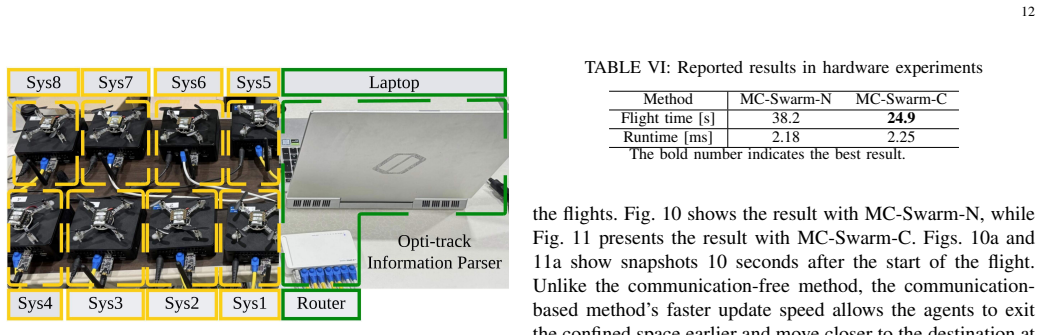
For effective multi-agent trajectory planning, it is important to consider lightweight communication and its potential asynchrony. This paper presents a distributed trajectory planning algorithm for a quadrotor swarm that operates asynchronously and requires no communication except during the initial planning phase. Moreover, our algorithm guarantees no deadlock under asynchronous updates and absence of communication during flight. To effectively ensure these points, we build two main modules: coordination state updater and trajectory optimizer. The coordination state updater computes waypoints for each agent toward its goal and performs subgoal optimization while considering deadlocks, as well as safety constraints with respect to neighbor agents and obstacles. Then, the trajectory optimizer generates a trajectory that ensures collision avoidance even with the asynchronous planning updates of neighboring agents. We provide a theoretical guarantee of collision avoidance with deadlock resolution and evaluate the effectiveness of our method in complex simulation environments, including random forests and narrow-gap mazes. Additionally, to reduce the total mission time, we design a faster coordination state update using lightweight communication. Lastly, our approach is validated through extensive simulations and real-world experiments with cluttered environment scenarios.
Figures


Figures from the paper (7 more)




Reference graph
Works this paper leans on
-
[1]
Drone swarm path planning for mobile edge computing in industrial internet of things,
Y . Miao, K. Hwang, D. Wu, Y . Hao, and M. Chen, “Drone swarm path planning for mobile edge computing in industrial internet of things,” IEEE Transactions on Industrial Informatics , vol. 19, no. 5, pp. 6836– 6848, 2022
work page 2022
-
[2]
Multi-uav trajectory planning for 3d visual inspection of complex structures,
S. Ivi ´c, B. Crnkovi´c, L. Grbˇci´c, and L. Matlekovi´c, “Multi-uav trajectory planning for 3d visual inspection of complex structures,” Automation in Construction, vol. 147, p. 104709, 2023
2023
-
[3]
Scalable cooperative transport of cable-suspended loads with uavs using distributed trajectory optimization,
B. E. Jackson, T. A. Howell, K. Shah, M. Schwager, and Z. Manchester, “Scalable cooperative transport of cable-suspended loads with uavs using distributed trajectory optimization,” IEEE Robotics and Automation Letters, vol. 5, no. 2, pp. 3368–3374, 2020
2020
-
[4]
Decentralized multi-agent planning using model predictive control and time-aware safe corridors,
C. Toumieh and A. Lambert, “Decentralized multi-agent planning using model predictive control and time-aware safe corridors,” IEEE Robotics and Automation Letters , vol. 7, no. 4, pp. 11 110–11 117, 2022
work page 2022
-
[5]
K. Kondo, R. Figueroa, J. Rached, J. Tordesillas, P. C. Lusk, and J. P. How, “Robust mader: Decentralized multiagent trajectory planner robust to communication delay in dynamic environments,” IEEE Robotics and Automation Letters, vol. 9, no. 2, pp. 1476–1483, 2023
work page 2023
-
[7]
Deadlock resolution and recursive feasibil- ity in mpc-based multi-robot trajectory generation,
Y . Chen, M. Guo, and Z. Li, “Deadlock resolution and recursive feasibil- ity in mpc-based multi-robot trajectory generation,” IEEE Transactions on Automatic Control , 2024
work page 2024
-
[8]
Primitive-Swarm: An Ultra-lightweight and Scalable Planner for Large-scale Aerial Swarms
J. Hou, X. Zhou, N. Pan, A. Li, Y . Guan, C. Xu, Z. Gan, and F. Gao, “Primitive-swarm: An ultra-lightweight and scalable planner for large- scale aerial swarms,” arXiv preprint arXiv:2502.16887 , 2025. 13
work page Pith review arXiv 2025
-
[9]
Multirobot exploration of communication-restricted environments: A survey,
F. Amigoni, J. Banfi, and N. Basilico, “Multirobot exploration of communication-restricted environments: A survey,” IEEE Intelligent Systems, vol. 32, no. 6, pp. 48–57, 2017
work page 2017
Show all 41 references
-
[10]
Generation of collision-free trajectories for a quadrocopter fleet: A sequential convex programming approach,
F. Augugliaro, A. P. Schoellig, and R. D’Andrea, “Generation of collision-free trajectories for a quadrocopter fleet: A sequential convex programming approach,” in 2012 IEEE/RSJ international conference on Intelligent Robots and Systems . IEEE, 2012, pp. 1917–1922
2012
-
[11]
Efficient multi-agent trajectory planning with feasibility guarantee using relative bernstein polynomial,
J. Park, J. Kim, I. Jang, and H. J. Kim, “Efficient multi-agent trajectory planning with feasibility guarantee using relative bernstein polynomial,” in 2020 IEEE International Conference on Robotics and Automation (ICRA). IEEE, 2020, pp. 434–440
2020
-
[12]
Safe and complete trajectory generation for robot teams with higher-order dynamics,
S. Tang and V . Kumar, “Safe and complete trajectory generation for robot teams with higher-order dynamics,” in 2016 IEEE/RSJ Interna- tional Conference on Intelligent Robots and Systems (IROS) . IEEE, 2016, pp. 1894–1901
2016
-
[13]
High-speed motion planning for aerial swarms in unknown and cluttered environments,
C. Toumieh and D. Floreano, “High-speed motion planning for aerial swarms in unknown and cluttered environments,” IEEE Transactions on Robotics, 2024
2024
-
[15]
T-star: Time-optimal swarm trajectory planning for quadrotor unmanned aerial vehicles,
H. Pan, M. Zahmatkesh, F. Rekabi-Bana, F. Arvin, and J. Hu, “T-star: Time-optimal swarm trajectory planning for quadrotor unmanned aerial vehicles,” IEEE Transactions on Intelligent Transportation Systems , 2025
2025
-
[16]
Mader: Trajectory planner in multiagent and dynamic environments,
J. Tordesillas and J. P. How, “Mader: Trajectory planner in multiagent and dynamic environments,” IEEE Transactions on Robotics , 2021
2021
-
[17]
Minvo basis: Finding simplexes with minimum volume enclosing polynomial curves,
——, “Minvo basis: Finding simplexes with minimum volume enclosing polynomial curves,” Computer-Aided Design, vol. 151, p. 103341, 2022
2022
-
[18]
Swarm of micro flying robots in the wild,
X. Zhou, X. Wen, Z. Wang, Y . Gao, H. Li, Q. Wang, T. Yang, H. Lu, Y . Cao, C. Xu,et al., “Swarm of micro flying robots in the wild,”Science Robotics, vol. 7, no. 66, p. eabm5954, 2022
2022
-
[19]
Geometrically constrained tra- jectory optimization for multicopters,
Z. Wang, X. Zhou, C. Xu, and F. Gao, “Geometrically constrained tra- jectory optimization for multicopters,” IEEE Transactions on Robotics , vol. 38, no. 5, pp. 3259–3278, 2022
2022
-
[20]
Dream: Decentralized real-time asynchronous probabilistic trajectory planning for collision-free multi- robot navigation in cluttered environments,
B. S ¸enbas ¸lar and G. S. Sukhatme, “Dream: Decentralized real-time asynchronous probabilistic trajectory planning for collision-free multi- robot navigation in cluttered environments,” IEEE Transactions on Robotics, 2024
2024
-
[21]
Gcbf+: A neural graph control barrier function framework for distributed safe multi-agent control,
S. Zhang, O. So, K. Garg, and C. Fan, “Gcbf+: A neural graph control barrier function framework for distributed safe multi-agent control,” IEEE Transactions on Robotics , 2025
2025
-
[22]
Rule-based lloyd algorithm for multi-robot motion planning and control with safety and convergence guarantees,
M. Boldrer, A. Serra-Gomez, L. Lyons, J. Alonso-Mora, and L. Fer- ranti, “Rule-based lloyd algorithm for multi-robot motion planning and control with safety and convergence guarantees,” arXiv preprint arXiv:2310.19511, 2023
2023 arXiv
-
[23]
Reactive mission and motion planning with deadlock resolution avoiding dynamic obstacles,
J. Alonso-Mora, J. A. DeCastro, V . Raman, D. Rus, and H. Kress- Gazit, “Reactive mission and motion planning with deadlock resolution avoiding dynamic obstacles,” Autonomous Robots , vol. 42, no. 4, pp. 801–824, 2018
2018
-
[24]
Decentralized trajectory planning for quadrotor swarm in cluttered environments with goal convergence guarantee,
J. Park, Y . Lee, I. Jang, and H. J. Kim, “Decentralized trajectory planning for quadrotor swarm in cluttered environments with goal convergence guarantee,” The International Journal of Robotics Research, vol. 0, no. 0, p. 02783649241312352, 0
-
[26]
Weighted buffered voronoi cells for distributed semi-cooperative behavior,
A. Pierson, W. Schwarting, S. Karaman, and D. Rus, “Weighted buffered voronoi cells for distributed semi-cooperative behavior,” in 2020 IEEE international conference on robotics and automation (ICRA) . IEEE, 2020, pp. 5611–5617
2020
-
[27]
Deadlock prediction and recovery for distributed collision avoidance with buffered voronoi cells,
M. Abdullhak and A. Vardy, “Deadlock prediction and recovery for distributed collision avoidance with buffered voronoi cells,” in 2021 IEEE/RSJ International Conference on Intelligent Robots and Systems (IROS). IEEE, 2021, pp. 429–436
2021
-
[28]
Grpavoid: Multigroup collision- avoidance control and optimization for uav swarm,
L. Luo, X. Wang, J. Ma, and Y .-S. Ong, “Grpavoid: Multigroup collision- avoidance control and optimization for uav swarm,” IEEE Transactions on Cybernetics, vol. 53, no. 3, pp. 1776–1789, 2021
2021
-
[29]
Multi-uav cooper- ative motion planning under global spatio-temporal path inspiration in constraint-rich dynamic environments,
Z. Mao, M. Hou, H. Li, Y . Yang, and W. Song, “Multi-uav cooper- ative motion planning under global spatio-temporal path inspiration in constraint-rich dynamic environments,” IEEE Transactions on Intelligent Vehicles, 2024
2024
-
[30]
Force-based algorithm for motion planning of large agent,
S. H. Semnani, A. H. de Ruiter, and H. H. Liu, “Force-based algorithm for motion planning of large agent,” IEEE Transactions on Cybernetics, vol. 52, no. 1, pp. 654–665, 2020
2020
-
[31]
Least squares quantization in pcm,
S. Lloyd, “Least squares quantization in pcm,” IEEE transactions on information theory, vol. 28, no. 2, pp. 129–137, 1982
1982
-
[32]
Online distributed trajectory planning for quadrotor swarm with feasibility guarantee using linear safe corridor,
J. Park, D. Kim, G. C. Kim, D. Oh, and H. J. Kim, “Online distributed trajectory planning for quadrotor swarm with feasibility guarantee using linear safe corridor,” IEEE Robotics and Automation Letters , vol. 7, no. 2, pp. 4869–4876, 2022
2022
-
[33]
Dlsc: Distributed multi-agent trajectory planning in maze-like dynamic environments using linear safe corridor,
J. Park, Y . Lee, I. Jang, and H. J. Kim, “Dlsc: Distributed multi-agent trajectory planning in maze-like dynamic environments using linear safe corridor,” IEEE Transactions on Robotics , 2023
2023
-
[34]
Network time protocol version 4: Protocol and algorithms specification,
D. Mills, J. Martin, J. Burbank, and W. Kasch, “Network time protocol version 4: Protocol and algorithms specification,” Tech. Rep., 2010
2010
-
[35]
Decentralized deadlock-free trajectory planning for quadrotor swarm in obstacle-rich environments,
J. Park, I. Jang, and H. J. Kim, “Decentralized deadlock-free trajectory planning for quadrotor swarm in obstacle-rich environments,” in 2023 IEEE International Conference on Robotics and Automation (ICRA) . IEEE, 2023, pp. 1428–1434
2023
-
[36]
Priority inheri- tance with backtracking for iterative multi-agent path finding,
K. Okumura, M. Machida, X. D ´efago, and Y . Tamura, “Priority inheri- tance with backtracking for iterative multi-agent path finding,” Artificial Intelligence, vol. 310, p. 103752, 2022
2022
-
[37]
Real-time trajectory generation for constrained nonlinear dynamical systems using non-uniform rational b-spline basis functions,
M. E. Flores, “Real-time trajectory generation for constrained nonlinear dynamical systems using non-uniform rational b-spline basis functions,” Ph.D. dissertation, California Institute of Technology, 2008
2008
-
[38]
Efficient multi-agent trajectory planning with feasibility guarantee using relative bernstein polynomial,
J. Park, J. Kim, I. Jang, and H. J. Kim, “Efficient multi-agent trajectory planning with feasibility guarantee using relative bernstein polynomial,” in 2020 IEEE International Conference on Robotics and Automation (ICRA), 2020, pp. 434–440
2020
-
[39]
Fast, on-line collision avoidance for dynamic vehicles using buffered voronoi cells,
D. Zhou, Z. Wang, S. Bandyopadhyay, and M. Schwager, “Fast, on-line collision avoidance for dynamic vehicles using buffered voronoi cells,” IEEE Robotics and Automation Letters , vol. 2, no. 2, pp. 1047–1054, 2017
2017
-
[40]
Asynchronous real-time decentral- ized multi-robot trajectory planning,
B. S ¸enbas ¸lar and G. S. Sukhatme, “Asynchronous real-time decentral- ized multi-robot trajectory planning,” in 2022 IEEE/RSJ International Conference on Intelligent Robots and Systems (IROS) . IEEE, 2022, pp. 9972–9979
2022
-
[41]
S. Boyd, S. P. Boyd, and L. Vandenberghe, Convex optimization . Cambridge university press, 2004
2004
-
[42]
Octomap: An efficient probabilistic 3d mapping framework based on octrees,
A. Hornung, K. M. Wurm, M. Bennewitz, C. Stachniss, and W. Burgard, “Octomap: An efficient probabilistic 3d mapping framework based on octrees,” Autonomous robots, vol. 34, no. 3, pp. 189–206, 2013
2013
-
[43]
12.7. 0 user’s manual,
I. CPLEX, “12.7. 0 user’s manual,” 2016
2016
-
[44]
Crazyflie 2.0 quadrotor as a platform for research and education in robotics and control engineering,
W. Giernacki, M. Skwierczy ´nski, W. Witwicki, P. Wro ´nski, and P. Kozierski, “Crazyflie 2.0 quadrotor as a platform for research and education in robotics and control engineering,” in 2017 22nd interna- tional conference on methods and models in automation and robotics (MMAR...
2017
Reviewed August 15, 2026 · model on record in the stance chip above.
Discussion (0). Continue with ORCID to comment.