REVIEW 3 major objections 5 minor 1 cited by
Quantum State Readout via Overlap-Based Feature Extraction
T0 review · 3 major / 5 minor · reviewed 2026-08-15 · deepseek-v4-flash
Pith's one-line read This paper claims that an unknown quantum state that is close to a sum of a few localized peaks can be reconstructed from overlap measurements whose number does not grow with the number of qubits.
desk verdict A real overlap-based readout technique for localized states, but the 'fewer measurements' claim compares overlap evaluations to shots and omits the proposed method's statistical error—needs a fair resource comparison. read the letter →
The pith
A machine-rendered reading of the paper's core claim, the machinery that carries it, and where it could break.
The reading
What carries the argument
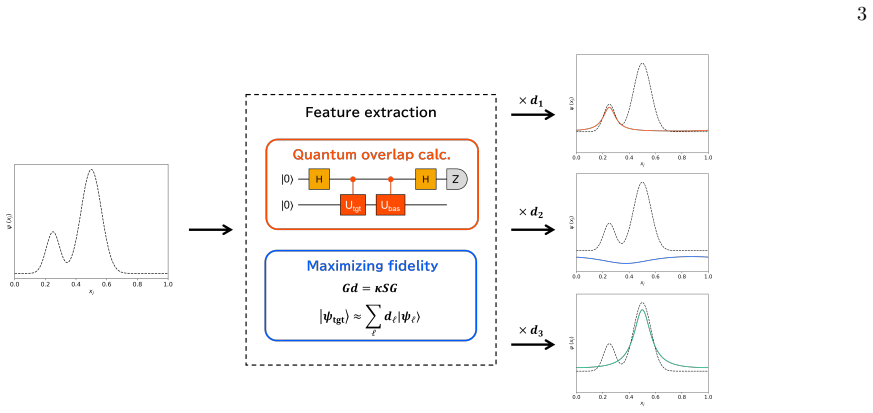
The load-bearing object is the shifted discrete Lorentzian function state $|L;a,k_c\rangle$: a normalized bell-shaped wavefunction with power-law tails, decay rate $a$, and center $k_c$, prepared from a discrete Slater state by a quantum Fourier transform and a translation operator. The method represents the unknown target as a linear combination of $n_{\rm loc}$ such states and turns state readout into overlap-based fitting: SWITCH tests supply complex overlaps when phases are needed, SWAP tests supply squared overlaps when only probabilities are needed, and a classical generalized-eigenvalue solve extracts the optimal coefficients from the measured overlap matrix. The analytical formula for the Lorentzian overlap matrix keeps classical cost low, and in the quantum-phase-estimation application two inverse quantum Fourier transforms cancel, shortening the circuit that feeds the fit.
What would settle it
Run the protocol on a target state deliberately far from the Lorentzian ansatz, such as random signs on all computational-basis amplitudes or a dense comb of closely spaced peaks, and count the SWAP/SWITCH overlap evaluations needed to reach an infidelity below 0.01. If that count grows with $N=2^n$, or if the optimizer fails in a constant fraction of trials as $n$ increases, the claimed qubit-independent readout cost does not hold.
Extended reading notes
Core claim
The central claim is that an unknown $n$-qubit target state $|\psi_{\rm tgt}\rangle$ that is well approximated by a linear combination of $n_{\rm loc}$ shifted discrete Lorentzian function states can be read out by maximizing the fidelity $F=|\langle\psi_{\rm tgt}|\psi_{\rm LCLF}\rangle|^2$. For fixed centers and widths, the optimal coefficients are the largest-eigenvalue eigenvector of the generalized eigenvalue problem $G\mathbf{d}=\kappa S\mathbf{d}$, where $G$ is built from measured overlaps between the target and each Lorentzian state and $S$ is the analytically known Lorentzian overlap matrix. The peak centers and decay rates are then optimized classically, with gradients evaluated by finite differences and additional overlap measurements. The paper demonstrates two variants: a phase-sensitive readout using the SWITCH test, and a probability-only readout using the SWAP test that suffices for spectral functions. The numerical evidence is that reconstruction infidelity is independent of the number of qubits, and that for quantum-phase-estimation spectra the number of overlap evaluations needed is smaller than the number of computational-basis amplitudes.
Load-bearing premise
The load-bearing premise is that the quantum state being read out is almost a sum of a few bell-shaped peaks whose positions and widths the classical optimizer can find; if the state has many peaks, broad nonlocal structure, or random sign fluctuations, the measurement savings and accuracy claims no longer hold.
Editorial extensions
If this is right
- For states that are sums of a few localized peaks, full state readout requires a number of overlap evaluations that does not grow with the number of qubits; the paper reports infidelity near $7\times10^{-3}$ for $n=5$ through $10$ with 1,000 measurements.
- For quantum-phase-estimation spectra, reading out squared amplitudes costs on average 28 overlap evaluations for $n=5$, fewer than the 32 computational-basis amplitudes direct readout would require.
- The fitting procedure gives two readout modes: phase-sensitive reconstruction through the SWITCH test, and probability-only reconstruction through the SWAP test, the latter being sufficient for spectral quantities such as X-ray absorption spectra.
- Because peak centers are optimized by Metropolis sampling, the number of quantum overlap evaluations grows roughly in proportion to the Hamming distance between the initial and true peak positions, so good initial guesses directly reduce measurement cost.
- Quantum amplitude estimation can be applied to the SWAP and SWITCH tests, replacing the Monte Carlo $O(1/\varepsilon^2)$ shot-count scaling with a Heisenberg-limited $O(1/\varepsilon)$ circuit-depth scaling.
Reading between the lines
- Editorial inference: The same overlap-fitting scheme should transfer to other localized basis families, such as Gaussians or wavelets, making it a general primitive for reading out smooth quantum states rather than a Lorentzian-specific trick.
- Editorial inference: The qubit-independence claim is conditional on the optimizer finding the right peaks; the paper's own 1-in-10 failure to converge for $n=9$ and $n=10$ suggests the practical scaling cliff may appear earlier than the asymptotic statement implies.
- Editorial inference: A natural stress test is to apply the method to two very close Lorentzian peaks; the overlap matrix becomes nearly singular, and the number of measurements or the classical conditioning may degrade even though the state is still a small linear combination.
- Editorial inference: Combining this readout with adaptive initial centers, for example from mean-field solutions, could turn the measurement-count advantage into an end-to-end protocol for iterative quantum simulations, since the solver's previous step supplies the next guess.
Signed reviews
Editorial analysis
A structured set of objections, weighed in public.
Referee Report
Summary. The paper proposes a hybrid quantum-classical protocol for reading out a quantum state that is well approximated by a linear combination of discrete Lorentzian functions (LCLF). The target state's overlaps with shifted Lorentzian basis states are estimated on a quantum processor via SWITCH or SWAP tests, then a classical optimizer adjusts the Lorentzian centers, decay rates, and expansion coefficients by solving a generalized eigenvalue problem (phase-sensitive readout) or a linear least-squares problem (amplitude-squared readout). The authors present quantum circuits, including an amplitude-estimation enhancement, and give an asymptotic cost model in Sec. II E. Numerical demonstrations reconstruct a grid-based wavefunction for n=5..10 qubits and a synthetic QPE-based X-ray absorption spectrum for n=5, and the paper claims the method requires fewer measurements than conventional direct state readout because the number of overlap evaluations is small and approximately independent of n.
Significance. If the resource claim were established, the protocol would be a useful tool for readout of structured quantum states, particularly in first-quantized simulation and spectral-function settings. The core algebraic formulation is sound: the rank-one GEVP for fixed centers and decay rates, the least-squares fit for squared amplitudes, and the analytical overlap formulas in Appendix C are concrete and checkable. The paper also provides explicit circuits for SWITCH/SWAP tests and QAE, and it carefully separates quantum and classical costs in Sec. II E. These are genuine strengths. However, the headline quantitative claim—that the method outperforms direct measurement in total measurement cost—is not supported by the numerics as presented, because the comparison mixes overlap evaluations with measurement shots and omits statistical error for the proposed method. The paper also inherits an approximation error floor from the LCLF ansatz and reports occasional optimization failures at n=9,10, which need to be quantified before the scalability claim is accepted.
major comments (3)
- [Sec. IV B and Fig. 7(b)] The central claim of requiring fewer measurements is not established because the comparison counts overlap evaluations, not measurement shots, and because the proposed method's infidelity is plotted without statistical error. In Fig. 7(b), the black broken line for the LCLF method explicitly ignores statistical error, while the direct-measurement baseline includes shot noise from 1,000 measurements. In Sec. IV B, the statement that a mean of 28 overlap calculations for n=5 is fewer than 2^5=32 computational-basis amplitudes equates one overlap evaluation with one measurement. But each SWITCH/SWAP overlap estimate is itself a random variable requiring O(1/epsilon^2) shots (or circuit depth O(1/epsilon) with QAE), as the paper's own cost model in Sec. II E states. The comparison should fix a target total infidelity, include statistical error for the proposed method, and compare total numbers of shots (or total circuit depth) for both approaches. As written, even if the LCLF approximation were exact, the total measurement budget for the proposed method could exceed direct readout once each overlap is sampled to the required precision.
- [Sec. IV A and Fig. 7(e)] The scalability claim that infidelity is independent of n is demonstrated only for the idealized case of known optimal centers and decay rates, not for the full optimization used to find those parameters. The text states that for n=9 and n=10 the final infidelity remained above 0.01 because the optimal peak positions were not found in 1 out of 10 trials. This means the readout protocol has a non-vanishing failure probability at the largest sizes tested, yet the paper's summary claim does not mention this caveat. The authors should either report the full distribution of infidelities including failed trials, show the success probability as a function of n, or clearly condition the scalability claim on convergence of the classical optimizer.
- [Sec. II E and Fig. 7(f)] The metric m_iter, the number of unique overlap evaluations, is not by itself a quantum resource metric. The paper argues that m_iter is approximately independent of n, but the actual quantum cost is c_tgt * m_iter / epsilon^2 (or /epsilon with QAE), with no specification of the precision epsilon per overlap used in the numerics. The apparent flatness of Fig. 7(f) therefore does not, by itself, imply that the method scales favorably relative to direct readout; the total cost includes both the number of overlap evaluations and the shot budget per evaluation, and the latter depends on the required accuracy of the LCLF fit, which in turn depends on the approximation error floor. The authors should present a total-resource comparison for a fixed target infidelity, including the per-overlap shot count and the contribution of the LCLF approximation error.
minor comments (5)
- [Eq. (8)] The displayed stationary condition contains an error: the final term 'edℓ′ = 0' is not part of the equation and should be removed; also the summation index ℓ' is used inconsistently in the same line.
- [Eq. (13)] The index structure of the derivative formula is unclear; it should specify which indices are summed and which are fixed, to avoid confusion between the derivative index ℓ and the summation indices.
- [Sec. IV A, Fig. 7 caption] The caption should explicitly state which curves include statistical error and which do not, and the proposed method should be shown with error bars or shaded confidence intervals in all panels, not only in the direct-measurement baseline.
- [Sec. IV A, paragraph on n=9 and n=10] The sentence 'In these cases, the optimal peak positions were not found in only 1 out of 10 trials' is ambiguous: it could mean one failed trial in each of the two sizes, or one failure total, or that the final infidelity stayed above 0.01 in only those failed trials. Please reword to state exactly how many of the ten trials converged for each n.
- [Sec. IV B and Fig. 8(c)] Please define precisely what counts as one 'quantum overlap calculation' in m_iter, including whether cached evaluations are reused, because this quantity is the basis for the claimed superiority over direct measurement.
Circularity Check
No significant circularity: the readout is an explicit least-squares/Rayleigh fit to a declared Lorentzian ansatz; no fitted parameter is renamed as an independent prediction.
full rationale
The paper's core step (Sec. II B, Eqs. (7)-(12)) is to maximize the overlap F(d,a,k_c)=|<psi_tgt|psi_LCLF>|^2 over coefficients, decay rates, and centers. This is a fit by explicit declaration ('assuming the target quantum state is well approximated by a linear combination of n_loc discrete LF states', Eq. (6)), so the overlap value is the objective, not an independently predicted quantity. The quantum overlap evaluations b(a_l,kc_l)=<psi_tgt|L;a_l,kc_l> are inputs to a generalized eigenvalue problem; the eigenvector giving the largest eigenvalue is by construction the best LCLF approximation in the declared span. This is a mathematical exactness, not a reduction of the output to the input. The self-citations [30,31] supply the LF basis construction and a Rayleigh-quotient gradient identity; both are standard linear algebra and are not used to forbid alternatives or to import a uniqueness theorem. The numerical demonstrations use a target deliberately chosen from Ref. [30], but the infidelity values are computed from the actual reconstruction, not from a fitted parameter claimed as a prediction. The Sec. IV B comparison counts m_iter overlap evaluations against 2^n amplitudes; whether this is the right cost metric (each overlap needs sampling or QAE depth) is a correctness or scope question, not a circularity. Therefore no step satisfies the evidentiary standard of 'Eq. X = Eq. Y by construction' or 'fitted parameter renamed as prediction'.
Assumptions & free parameters
free parameters (6)
- number of Lorentzian bases n_loc =
3
- decay rates a_l for each Lorentzian =
0.360, 1.672, 0.490
- peak centers kc_l =
0.25, 0.4375, 0.5 (times N)
- expansion coefficients d_l =
0.380, -0.517, 1.272
- Lorentzian broadening eta in QPE-LF example =
0.3
- optimization hyperparameters beta0, alpha0, alpha1 =
beta0=100 or 150, alpha0=2n-5, alpha1=15
assumptions (5)
- domain assumption The target quantum state is well approximated by a linear combination of n_loc discrete Lorentzian states (LCLF).
- standard math Quantum overlaps between the target and Lorentzian states can be measured with controllable precision using SWITCH and SWAP tests.
- domain assumption The QPE-sampling probability distribution with the Slater-function input is approximately a sum of Lorentzians (Eq. 33).
- ad hoc to paper Finite differences reliably approximate the quantum-overlap derivatives for optimizing decay rates.
- ad hoc to paper Metropolis search with the given cooling schedule finds the optimal peak centers.
Cite this review
Pith. "Pith review of Quantum State Readout via Overlap-Based Feature Extraction." pith.science (2026). https://pith.science/paper/6NAM3C6V
@misc{pith2026250508613,
  author       = {Pith},
  title        = {Pith review of: Quantum State Readout via Overlap-Based Feature Extraction},
  year         = {2026},
  howpublished = {\url{https://pith.science/paper/6NAM3C6V}},
  note         = {Machine review of arXiv:2505.08613}
}
read the original abstract
In this study, a method for quantum state readout and feature extraction is developed using quantum overlap-based fitting of function expansions. The approach involves the quantum calculation of quantum overlaps between a target quantum state and a linear combination of basis functions, such as Lorentzian functions, via measurements, and classical optimization of the parameters in the function expansion. This method is particularly effective in scenarios where the quantum state is approximately represented as a continuous function and expressed as a combination of localized functions. The proposed method involves a quantum state readout for both the raw and absolute values of the amplitudes in the quantum state. Preliminary numerical simulations were performed to reconstruct the grid-based wave function and X-ray absorption spectra from a quantum state, and the results show that our proposed method requires fewer measurements compared to conventional quantum state measurement techniques.
Figures


Figures from the paper (9 more)


Forward citations
Cited by 1 Pith paper
-
Fourier space readout method for efficiently recovering functions encoded in quantum states
Measuring a quantum state's Fourier coefficients, rather than its grid-point amplitudes, recovers smooth amplitude-encoded functions with shot count independent of grid size, preserving quantum speedups for CAE readout.
Reference graph
Works this paper leans on
-
[1]
K. Vogel and H. Risken, Determination of quasiproba- bility distributions in terms of probability distributions for the rotated quadrature phase, Phys. Rev. A40, 2847 (1989)
work page 1989
-
[2]
Hradil, Quantum-state estimation, Phys
Z. Hradil, Quantum-state estimation, Phys. Rev. A55, R1561 (1997)
1997
-
[3]
J.-P. Amiet and S. Weigert, Reconstructing a pure state of a spin s through three stern-gerlach measurements, Journal of Physics A: Mathematical and General32, 2777 (1999)
work page 1999
-
[4]
V. Dodonov and V. Man’ko, Positive distribution descrip- tion for spin states, Physics Letters A229, 335 (1997)
work page 1997
-
[5]
D. F. V. James, P. G. Kwiat, W. J. Munro, and A. G. White, Measurement of qubits, Phys. Rev. A64, 052312 (2001)
2001
-
[6]
Blume-Kohout, Optimal, reliable estimation of quan- tum states, New Journal of Physics12, 043034 (2010)
R. Blume-Kohout, Optimal, reliable estimation of quan- tum states, New Journal of Physics12, 043034 (2010)
2010
-
[7]
Gross, Y.-K
D. Gross, Y.-K. Liu, S. T. Flammia, S. Becker, and J. Eis- ert, Quantum state tomography via compressed sensing, Phys. Rev. Lett.105, 150401 (2010)
2010
-
[8]
Cramer, M
M. Cramer, M. B. Plenio, S. T. Flammia, R. Somma, D. Gross, S. D. Bartlett, O. Landon-Cardinal, D. Poulin, and Y.-K. Liu, Efficient quantum state tomography, Na- ture Communications1, 149 (2010)
2010
Show all 65 references
-
[9]
Bonet-Monroig, R
X. Bonet-Monroig, R. Babbush, and T. E. O’Brien, Nearly optimal measurement scheduling for partial to- mography of quantum states, Phys. Rev. X10, 031064 (2020)
2020
-
[10]
Hamamura and T
I. Hamamura and T. Imamichi, Efficient evaluation of quantum observables using entangled measurements, npj Quantum Information6, 56 (2020)
2020
-
[11]
W. J. Huggins, K. Wan, J. McClean, T. E. O’Brien, N. Wiebe, and R. Babbush, Nearly optimal quantum al- gorithm for estimating multiple expectation values, Phys. Rev. Lett.129, 240501 (2022)
2022
-
[12]
Inoue, K
W. Inoue, K. Aoyama, Y. Teranishi, K. Kanno, Y. O. Nakagawa, and K. Mitarai, Almost optimal measurement scheduling of molecular hamiltonian via finite projective plane, Phys. Rev. Res.6, 013096 (2024)
2024
-
[13]
S. Aaronson, Shadow tomography of quantum states, in Proceedings of the 50th Annual ACM SIGACT Sympo- sium on Theory of Computing, STOC 2018 (Association for Computing Machinery, New York, NY, USA, 2018) p. 325–338
2018
-
[14]
Huang, R
H.-Y. Huang, R. Kueng, and J. Preskill, Predicting many properties of a quantum system from very few measure- ments, Nature Physics16, 1050 (2020)
2020
-
[15]
Huang, R
H.-Y. Huang, R. Kueng, and J. Preskill, Efficient estima- tion of pauli observables by derandomization, Phys. Rev. Lett.127, 030503 (2021)
2021
-
[16]
Hadfield, S
C. Hadfield, S. Bravyi, R. Raymond, and A. Mezzacapo, Measurements of quantum hamiltonians with locally- biased classical shadows, Communications in Mathemat- ical Physics391, 951 (2022)
2022
-
[17]
A. A. Akhtar, H.-Y. Hu, and Y.-Z. You, Scalable and Flexible Classical Shadow Tomography with Tensor Net- works, Quantum7, 1026 (2023)
2023
-
[18]
I. Cong, S. Choi, and M. D. Lukin, Quantum convolu- tional neural networks, Nature Physics15, 1273 (2019)
2019
-
[19]
Pesah, M
A. Pesah, M. Cerezo, S. Wang, T. Volkoff, A. T. Sorn- borger, and P. J. Coles, Absence of barren plateaus in quantum convolutional neural networks, Phys. Rev. X 11, 041011 (2021)
2021
-
[20]
Budiutama, S
G. Budiutama, S. Daimon, H. Nishi, R. Kaneko, T. Oht- suki, and Y.-i. Matsushita, Channel attention for quan- tum convolutional neural networks, Phys. Rev. A110, 012447 (2024)
2024
-
[21]
C. A. Williams, S. Scali, A. A. Gentile, D. Berger, and O. Kyriienko, Addressing the Readout Problem in Quantum Differential Equation Algorithms with Quantum Scientific Machine Learning, arXiv e-prints , arXiv:2411.14259 (2024), arXiv:2411.14259 [quant-ph]
2024 arXiv
-
[22]
A. W. Harrow, A. Hassidim, and S. Lloyd, Quantum al- gorithm for linear systems of equations, Phys. Rev. Lett. 103, 150502 (2009)
2009
-
[23]
Y. Cao, A. Papageorgiou, I. Petras, J. Traub, and S. Kais, Quantum algorithm and circuit design solving the pois- son equation, New Journal of Physics15, 013021 (2013)
2013
-
[24]
D. W. Berry, High-order quantum algorithm for solving linear differential equations, Journal of Physics A: Math- ematical and Theoretical47, 105301 (2014)
2014
-
[25]
J.-P. Liu, H. Øie Kolden, H. K. Krovi, N. F. Loureiro, K. Trivisa, and A. M. Childs, Efficient quantum al- gorithm for dissipative nonlinear differential equations, Proceedings of the National Academy of Sciences118, e2026805118 (2021)
2021
-
[26]
Huang, H
X. Huang, H. Nishi, T. Kosugi, Y. Kawada, and Y.- i. Matsushita, A probabilistic imaginary-time evolu- tion quantum algorithm for advection-diffusion equa- tion: Explicit gate-level implementation and comparisons to quantum linear system algorithms, arXiv e-prints , arXiv:2409...
2024 arXiv
-
[27]
Kassal, S
I. Kassal, S. P. Jordan, P. J. Love, M. Mohseni, and A. Aspuru-Guzik, Polynomial-time quantum algorithm for the simulation of chemical dynamics, Proceedings of the National Academy of Sciences105, 18681 (2008)
2008
-
[28]
Kosugi, Y
T. Kosugi, Y. Nishiya, H. Nishi, and Y.-i. Matsushita, Imaginary-time evolution using forward and backward real-time evolution with a single ancilla: First-quantized eigensolver algorithm for quantum chemistry, Phys. Rev. Research4, 033121 (2022)
2022
-
[29]
Nishiya, H
Y. Nishiya, H. Nishi, T. Kosugi, and Y.-i. Mat- sushita, Orbital-free density functional theory with first-quantized quantum subroutines, arXiv e-prints , arXiv:2407.16191 (2024), arXiv:2407.16191 [quant-ph]
2024 arXiv
-
[30]
Kosugi, S
T. Kosugi, S. Daimon, H. Nishi, S. Tsuneyuki, and Y.- i. Matsushita, Qubit encoding for a mixture of localized functions, Phys. Rev. A110, 062407 (2024)
2024
-
[31]
Kosugi, X
T. Kosugi, X. Huang, H. Nishi, and Y.-i. Matsushita, Tensor decomposition technique for qubit encoding of maximal-fidelity Lorentzian orbitals in real-space quan- tum chemistry, arXiv e-prints , arXiv:2501.07211 (2025), arXiv:2501.07211 [quant-ph]
2025 arXiv
-
[32]
D. W. Berry, A. M. Childs, R. Cleve, R. Kothari, and R. D. Somma, Simulating hamiltonian dynamics with a truncated taylor series, Phys. Rev. Lett.114, 090502 (2015)
2015
-
[33]
Kosugi and Y.-i
T. Kosugi and Y.-i. Matsushita, Linear-response func- tions of molecules on a quantum computer: Charge and spin responses and optical absorption, Phys. Rev. Re- search2, 033043 (2020)
2020
-
[34]
Iaconis, S
J. Iaconis, S. Johri, and E. Y. Zhu, Quantum state 14 preparation of normal distributions using matrix prod- uct states, npj Quantum Information10, 15 (2024)
2024
-
[35]
Manabe and Y
H. Manabe and Y. Sano, The State Preparation of Multivariate Normal Distributions using Tree Ten- sor Network, arXiv e-prints , arXiv:2412.12067 (2024), arXiv:2412.12067 [quant-ph]
2024 arXiv
-
[36]
Klco and M
N. Klco and M. J. Savage, Minimally entangled state preparation of localized wave functions on quantum com- puters, Phys. Rev. A102, 012612 (2020)
2020
-
[37]
Buhrman, R
H. Buhrman, R. Cleve, J. Watrous, and R. de Wolf, Quantum fingerprinting, Phys. Rev. Lett.87, 167902 (2001)
2001
-
[38]
Chamorro-Posada and J
P. Chamorro-Posada and J. C. Garcia-Escartin, The switch test for discriminating quantum evolutions, Jour- nal of Physics A: Mathematical and Theoretical56, 355301 (2023)
2023
-
[39]
Motta, C
M. Motta, C. Sun, A. T. Tan, M. J. O’Rourke, E. Ye, A. J. Minnich, F. G. Brandao, and G. K. Chan, Deter- mining eigenstates and thermal states on a quantum com- puter using quantum imaginary time evolution, Nature Physics16, 205 (2020)
2020
-
[40]
Seki and S
K. Seki and S. Yunoki, Quantum power method by a superposition of time-evolved states, PRX Quantum2, 010333 (2021)
2021
-
[41]
N. H. Stair, R. Huang, and F. A. Evangelista, A multiref- erence quantum krylov algorithm for strongly correlated electrons, Journal of Chemical Theory and Computation 16, 2236 (2020), pMID: 32091895
2020
-
[42]
Brassard and P
G. Brassard and P. Hoyer, An exact quantum polynomial-time algorithm for simon’s problem, inPro- ceedings of the Fifth Israeli Symposium on Theory of Computing and Systems(1997) pp. 12–23
1997
-
[43]
Barenco, C
A. Barenco, C. H. Bennett, R. Cleve, D. P. DiVincenzo, N. Margolus, P. Shor, T. Sleator, J. A. Smolin, and H. Weinfurter, Elementary gates for quantum computa- tion, Phys. Rev. A52, 3457 (1995)
1995
-
[44]
Maslov, Advantages of using relative-phase toffoli gates with an application to multiple control toffoli opti- mization, Phys
D. Maslov, Advantages of using relative-phase toffoli gates with an application to multiple control toffoli opti- mization, Phys. Rev. A93, 022311 (2016)
2016
-
[45]
Suzuki, S
Y. Suzuki, S. Uno, R. Raymond, T. Tanaka, T. On- odera, and N. Yamamoto, Amplitude estimation without phase estimation, Quantum Information Processing19, 75 (2020)
2020
-
[46]
Tanaka, Y
T. Tanaka, Y. Suzuki, S. Uno, R. Raymond, T. Onodera, and N. Yamamoto, Amplitude estimation via maximum likelihood on noisy quantum computer, Quantum Infor- mation Processing20, 293 (2021)
2021
-
[47]
Grinko, J
D. Grinko, J. Gacon, C. Zoufal, and S. Woerner, Itera- tive quantum amplitude estimation, npj Quantum Infor- mation7, 52 (2021)
2021
-
[48]
Giurgica-Tiron, I
T. Giurgica-Tiron, I. Kerenidis, F. Labib, A. Prakash, and W. Zeng, Low depth algorithms for quantum ampli- tude estimation, Quantum6, 745 (2022)
2022
-
[49]
Manzano, D
A. Manzano, D. Musso, and ´A. Leitao, Real quantum amplitude estimation, EPJ Quantum Technology10, 2 (2023)
2023
-
[50]
Rall and B
P. Rall and B. Fuller, Amplitude Estimation from Quan- tum Signal Processing, Quantum7, 937 (2023)
2023
-
[51]
Ghosh, K
K. Ghosh, K. Yogaraj, G. Agliardi, P. Sabino, M. Fern´ andez-Campoamor, J. Bernab´ e-Moreno, G. Cor- tiana, O. Shehab, and C. O’Meara, Energy risk anal- ysis with dynamic amplitude estimation and piecewise approximate quantum compiling, IEEE Transactions on Quantum Engineering...
2024
-
[52]
Hohenberg and W
P. Hohenberg and W. Kohn, Inhomogeneous electron gas, Phys. Rev.136, B864 (1964)
1964
-
[53]
Kohn and L
W. Kohn and L. J. Sham, Self-consistent equations in- cluding exchange and correlation effects, Phys. Rev.140, A1133 (1965)
1965
-
[54]
and X-ray absorption spectroscopy (XAS) spectra [33, 55, 56]. B. Lorentzian fitting of XAS spectra Next, we describe a method for estimating the proba- bility distribution obtained by QPE in Eq. (33) using the LF state. Eq. (29) is rewritten as |ψQPE⟩= N−1X k=0 eck|eϕk⟩⊗|k⟩ n ...
-
[55]
Kosugi and Y.-i
T. Kosugi and Y.-i. Matsushita, Construction of green’s functions on a quantum computer: Quasiparticle spectra of molecules, Phys. Rev. A101, 012330 (2020)
2020
-
[56]
Fomichev, K
S. Fomichev, K. Hejazi, I. Loaiza, M. S. Zini, A. Delgado, A.-C. Voigt, J. E. Mueller, and J. M. Arrazola, Simulat- ing x-ray absorption spectroscopy of battery materials on a quantum computer, arXiv e-prints , arXiv:2405.11015 (2024), arXiv:2405.11015 [quant-ph]
2024 arXiv
-
[57]
Sakuma, S
R. Sakuma, S. Kanno, K. Sugisaki, T. Abe, and N. Ya- mamoto, Entanglement-assisted phase-estimation algo- rithm for calculating dynamical response functions, Phys. Rev. A110, 022618 (2024)
2024
-
[58]
Nishiya, H
Y. Nishiya, H. Nishi, Y. Couzini´ e, T. Kosugi, and Y.- i. Matsushita, First-quantized adiabatic time evolution for the ground state of a many-electron system and the optimal nuclear configuration, Phys. Rev. A109, 022423 (2024)
2024
-
[59]
Okuyama, T
T. Okuyama, T. Sonobe, K.-i. Kawarabayashi, and M. Yamaoka, Binary optimization by momentum anneal- ing, Phys. Rev. E100, 012111 (2019)
2019
-
[60]
Taillefumier, D
M. Taillefumier, D. Cabaret, A.-M. Flank, and F. Mauri, X-ray absorption near-edge structure calculations with the pseudopotentials: Application to the k edge in dia- mond andα-quartz, Phys. Rev. B66, 195107 (2002)
2002
-
[61]
S.-P. Gao, C. J. Pickard, M. C. Payne, J. Zhu, and J. Yuan, Theory of core-hole effects in 1score-level spec- troscopy of the first-row elements, Phys. Rev. B77, 115122 (2008)
2008
-
[62]
Gougoussis, M
C. Gougoussis, M. Calandra, A. Seitsonen, C. Brouder, A. Shukla, and F. Mauri, Intrinsic charge transfer gap in nio from Nik-edge x-ray absorption spectroscopy, Phys. Rev. B79, 045118 (2009)
2009
-
[63]
M. Fang, S. Fenner, F. Green, S. Homer, and Y. Zhang, Quantum Lower Bounds for Fanout, arXiv e-prints , quant-ph/0312208 (2003), arXiv:quant-ph/0312208 [quant-ph]
2003 arXiv
-
[64]
Takahashi and S
Y. Takahashi and S. Tani, Power of uninitialized qubits in shallow quantum circuits, Theoretical Computer Science 851, 129 (2021)
2021
-
[65]
Nishi, T
H. Nishi, T. Kosugi, S. Hirose, T. Okayama, and Y.-i. Matsushita, Demonstration of quantum phase estimation for x-ray absorption spectra, to be published. (2025)
2025
Reviewed August 15, 2026 · model on record in the stance chip above.
Discussion (0). Continue with ORCID to comment.