REVIEW 3 major objections 3 minor 1 cited by
Quantum dynamics in frustrated Ising fullerenes
T0 review · 3 major / 3 minor · reviewed 2026-08-15 · deepseek-v4-flash
Pith's one-line read This paper reports the experimental observation that quantum fluctuations lift the classical ground-state degeneracy of Ising models on fullerene graphs, producing a superposition state that two generations of superconducting quantum…
desk verdict Worth engaging: genuinely useful frustrated-fullerene benchmarks and a clear newer-vs-older annealer comparison, with the effective-time calibration as the main soft spot. read the letter →
The pith
A machine-rendered reading of the paper's core claim, the machinery that carries it, and where it could break.
The reading
What carries the argument
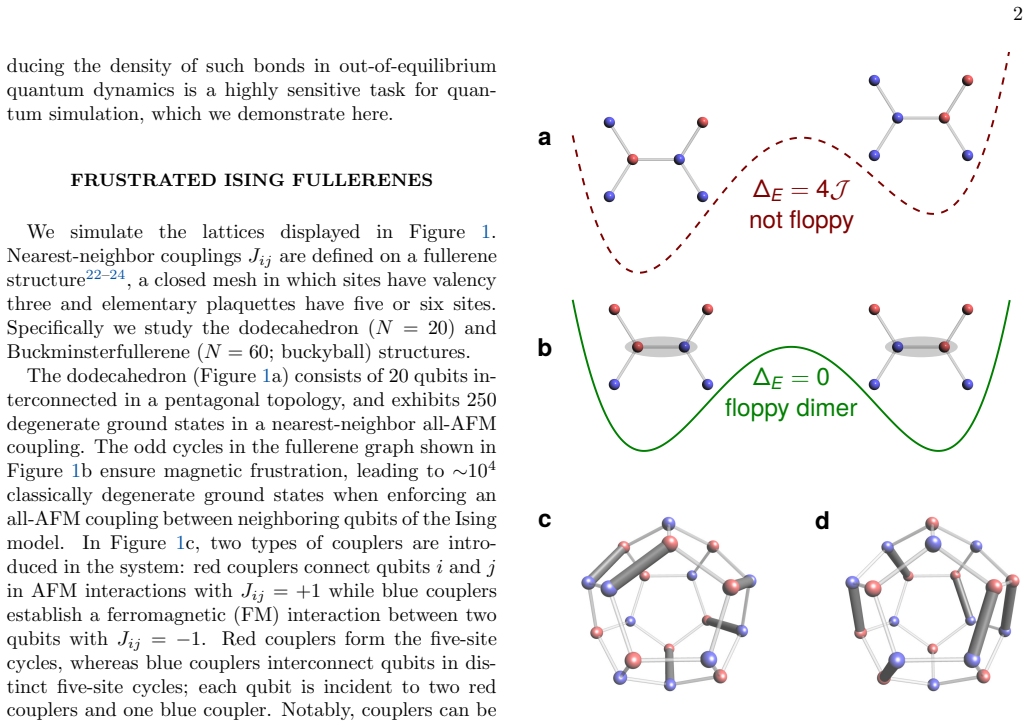
The load-bearing mechanism is the floppy dimer: a pair of spins joined by a bond whose simultaneous flip connects two classical ground states at Hamming distance 2. Under a small transverse field each floppy dimer acts as a second-order tunneling resonance, contributing an off-diagonal −1 to the effective tunneling matrix on the ground-state manifold; the perturbative ground state |ψε⟩ is the principal eigenvector of that matrix, which plays the role of a dimer-flip adjacency graph on the degenerate space. The key experimental observable is the binned fidelity F′, the Bhattacharyya coefficient between sampled output probabilities and the |ψε⟩ probabilities averaged over automorphism orbits of the fullerene; binning by symmetry suppresses the large sampling error that would otherwise drown out the signal, and together with the floppy-dimer density operator D it turns a highly degenerate manifold into a sensitive and shot-efficient benchmark of a simulator's adherence to the coherent quantum target state.
What would settle it
Check the calibration anchor: simulate the ideal closed-system dynamics (exact diagonalization for N=20) at t_a = 5 ns with |J|=1 and compare directly, without any rescaling, to the QPU output at 5 ns under the actual annealing schedule. If the binned fidelity or dimer density differ by more than the statistical sampling error, the assumption of negligible decoherence at 5 ns fails. A second check: recalibrate by matching the fidelity at a different anchor time (e.g., 10 ns) and test whether the qualitative ADV1-versus-ADV2 separation in the residual energy and dimer density curves survives.
Extended reading notes
Core claim
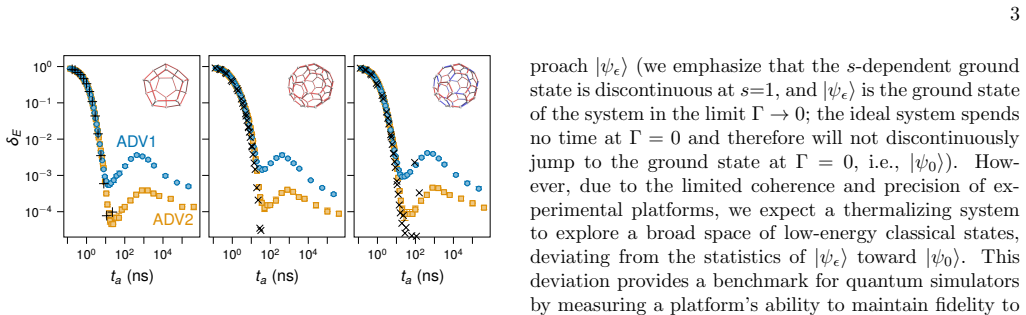
On a three-regular fullerene graph with ±1 couplings, the classical Ising model has 250, 16,000, or 1,125,000 degenerate ground states depending on the coupling pattern. In the perturbative limit Γ=ε→0, the paper claims that the ground state of εH_D + H_I is determined entirely by the tunneling matrix whose rows and columns index the classical ground states: the entry is −1 for pairs of states that differ by a floppy-dimer flip (the simultaneous flip of two coupled spins) and 0 otherwise, and |ψε⟩ is the principal eigenvector of this matrix. The paper simulates the nonequilibrium approach toward |ψε⟩ with exact diagonalization and MPS time evolution and on two generations of superconducting quantum annealers, tracking residual energy density, the average floppy-dimer density D, and a binned fidelity F′. In the coherent short-time regime the QPU measurements reproduce the nonmonotonic D curve and the infidelity minimum of the ideal closed-system dynamics; at long anneal times they thermalize toward the uniform-superposition statistics |ψ0⟩ rather than |ψε⟩, and the lower-noise second-generation processor (ADV2) reaches lower residual energy, later thermalization onset, and higher peak fidelity than its predecessor (ADV1). The authors take this as experimental demonstration that quantum fluctuations lift the classical ground-state degeneracy in these fullerenes, with the dynamics precisely enough resolved to distinguish simulator quality.
Load-bearing premise
The whole comparison of QPU data against classical simulations stands on the claim that at the shortest anneal time t_a = 5 ns the QPU output is a faithful closed-system evolution with negligible decoherence; if already decohered at 5 ns, the time rescaling that produces the apparent agreement would be anchoring the data to the wrong curve.
Editorial extensions
If this is right
- Frustrated fullerenes provide a systematic benchmark family: the degeneracy N_GS can be tuned from 250 to over 10^6 by choosing the dodecahedron, the all-antiferromagnetic buckyball, or the mixed ferromagnet/antiferromagnet buckyball, and the same graphs embed directly in current annealer topologies.
- A simulator's quality is read off from the plateau value of the floppy-dimer density D and the minimum of the binned infidelity 1−F′: coherent platforms settle near |ψε⟩ (D≈5.45 for the dodecahedron) while thermalizing platforms drift toward |ψ0⟩ (D≈4.8), so D itself is a single-number coherence proxy.
- The benchmark distinguishes hardware generations without needing full state tomography: ADV2's later thermalization onset and higher peak fidelity relative to ADV1 demonstrate that the observables are sensitive to noise levels.
- Because the target state |ψε⟩ differs from the uniform classical superposition |ψ0⟩, the same experiment separates coherent quantum evolution from classical sampling: a thermal sampler would produce |ψ0⟩ statistics, not |ψε⟩, at long times.
Reading between the lines
- The tunneling matrix on the ground-state manifold is the adjacency matrix of a graph whose vertices are classical ground states; for fullerenes with larger degeneracy this graph likely fragments, and the principal-eigenvector selection would then single out one connected component, making the benchmark's dynamics sensitive to the fullerenes' dimer-cover topology — a sharper discriminator than tota
- A cross-platform test could use the same calibration trick on neutral-atom or trapped-ion simulators: any platform whose output at short times matches exact diagonalization should collapse onto the same universal curves of D versus effective time, giving a direct apples-to-apples comparison of simulation quality across hardware types.
- The calibration is anchored at a single point (t_a=5 ns) using only the N=20 dodecahedron; extending the same fidelity-matching to N=60 or to the mixed-coupler fullerene would test whether the effective-time mapping is a genuine dynamical equivalence, and any failure would point to schedule-dependent decoherence models rather than a single timescale.
- Because binned fidelity uses automorphism orbits, the same symmetry reduction could be applied to other observables or to noisy intermediate-scale processors with fewer shots, potentially making such benchmarks accessible to hardware with low repetition rates.
Signed reviews
Editorial analysis
A structured set of objections, weighed in public.
Referee Report
Summary. The paper proposes frustrated Ising fullerenes (the 20-spin dodecahedron and two 60-spin buckyball variants) as boundary-free benchmark systems for quantum simulators. For these systems, the authors derive a perturbative target state |ψ_ε> from degenerate perturbation theory: it is the principal eigenvector of the tunneling matrix among classical ground states, with 'floppy dimers' as the tunneling objects. They report quantum annealing experiments on two D-Wave processors (ADV1 and ADV2), comparing residual energy density δE, average floppy-dimer density D, and a binned fidelity F' against exact diagonalization for N=20 and matrix-product-state simulations for N=60. The central claim is that the QPU dynamics reproduce the quantum-fluctuation-selected state |ψ_ε> in the coherent regime, and that the newer ADV2 processor achieves higher fidelity to this state than the older ADV1 processor.
Significance. If the result holds, this is a valuable benchmark proposal: the target state |ψ_ε> is derived from first principles with no fitted physics parameters, and the N=20 exact-diagonalization comparison is rigorous. The paper also includes careful MPS convergence checks, reports reproducible simulator settings, and connects the observed order-by-disorder phenomenon to an experimentally testable observable. The qualitative ordering ADV2 > ADV1 in fidelity is a useful, hardware-relevant finding. However, the quantitative agreement between QPU and classical curves is weakened by the effective-time calibration, as detailed in the major comments.
major comments (3)
- [Supplementary, 'Calibrating effective time'] The effective-time calibration is the load-bearing element of the quantitative comparison. The assumption that t_a=5 ns QPU dynamics are those of a closed quantum system with negligible decoherence, followed by matching F' at the anchor, means that the agreement between QPU and classical curves in Figs. 3 and 4 is enforced at one point and only tests the shape of the curves through the global time rescaling. If decoherence is already significant at 5 ns, all calibrated times are biased and the quantitative values of D and F' reported for the 'coherent regime' are not meaningful. Please provide a robustness analysis: for example, vary the anchor time if the hardware allows, or validate the mapping using an observable not involved in the calibration (e.g., δE or D), and state explicitly what deviations would falsify the closed-system assumption.
- [Supplementary, Fig. S2 and 'Classical simulation methods' (MPS)] For N=60, the MPS benchmark is not converged in the region t_a≈1 ns on the calibrated axis, where bond-dimension deviations are largest and where the QPU data are mapped. The main-text claim that QPU data 'track' the classical curves in the coherent regime for N=60 is therefore supported by unconverged reference data. The quantitative N=60 comparison should be either converged further (e.g., higher χ in the short-t_a region) or downgraded to a qualitative statement, with the rigorous quantitative comparison restricted to N=20 where ED is exact.
- [Results, Fig. 4] The binned fidelity F' is used both as the calibration observable and as the central quality metric. This creates a partial circularity: the time rescaling is chosen to make F' match at the anchor, and the subsequent agreement of the 1-F' minimum is not fully independent. Please show the raw, uncalibrated QPU data (physical t_a and |J_ij| values) alongside the rescaled curves, or calibrate on one observable (e.g., δE) and test F' out-of-sample, so that the reader can assess which features of the data are robust.
minor comments (3)
- [Fig. 4b caption] The spelled name 'Battachyyara' is a typo; it should be 'Bhattacharyya'.
- [Eq. (6)] The operator D is presented without derivation; a short explanation of how the projectors enforce the floppy-dimer condition would improve readability.
- [Introduction and 'Frustrated Ising fullerenes'] The relation between the 'resonating dimers' of the abstract and the perturbative tunneling matrix is stated only informally; a few sentences connecting the dimer flip to the −1 off-diagonal matrix element would help.
Circularity Check
QPU effective time is calibrated to match classical F' at t_a=5 ns for N=20, making that anchor agree by construction; the remaining comparison is largely independent.
-
fitted input called prediction
[Supplementary Material, 'Calibrating effective time']
"We assume that for t_a = 5 ns the QPU dynamics closely reflect the ideal dynamics of a closed quantum system with negligible decoherence. ... We mapped both ADV1 and ADV2 QPU experiments to ADV1 ED and MPS experiments by doing the same at ta = 5 ns, for every energy scale |Jij| studied, for N=20. Thus QPU ta are fitted based on F′ at ta = 5 ns for N=20."
The QPU time axis is not independently measured; it is defined by matching the QPU binned fidelity F′ at physical t_a=5 ns to the ED/MPS value of F′ at an effective time, separately for each |J_ij| and for N=20. Consequently, the QPU and classical curves coincide at that anchor by construction, so the apparent agreement at the anchor is not independent evidence for the closed-system hypothesis. The calibration also rests on the explicit assumption that 5 ns is within the coherent regime. However, the circularity is localized: the nonmonotonic dimer density, the F′ minimum at later times, the ADV1/ADV2 ordering, and the N=60 data are not forced by this single-point fit, so the central qualitative claims retain independent content.
full rationale
The central theoretical object, |ψ_ε⟩, is defined as the principal eigenvector of the tunneling matrix among classical ground states of εH_D + H_I, with no fitting to QPU data. The perturbative argument and the floppy-dimer analysis are self-contained and do not reduce to experimental inputs. The only fitted content is the effective-time calibration, which uses one binned-fidelity anchor (t_a=5 ns, N=20) to map QPU times onto the ED/MPS axis. This makes the anchor point agree by construction and slightly weakens the evidential value of F′ at that point, but it does not determine the shape of D(t_a), the location of the infidelity minimum, or the ADV2-better-than-ADV1 result. Self-citations (Refs. 30, 36, 37) are used for simulation methods, calibration refinement, and code availability; they do not supply the central uniqueness or derivation claim. The paper also openly states the coherent-at-5-ns assumption, which is a testable premise rather than a hidden circular definition. No renaming of known results or author-imported uniqueness theorems are present. Overall the paper is substantially self-contained, with only a minor, openly disclosed calibration-induced anchor overlap; score 2 reflects that localized circularity without implying that the benchmark conclusions are forced.
Assumptions & free parameters
free parameters (2)
- ADV1-ADV2 time mapping prefactor =
≈1.75
- QPU effective-time mapping onto ED/MPS axis =
not reported as a scalar; matched per |J_ij| at t_a=5 ns for N=20
assumptions (4)
- domain assumption For Γ=ε→0, the ground state of εH_D+H_I is the principal eigenvector of the -1/0 tunneling matrix over the classical ground-state manifold, with -1 entries for floppy-dimer moves.
- standard math Any two isoenergetic classical states on a 3-regular fullerene have Hamming distance ≥2, so floppy-dimer pair flips are the only ground-state connections.
- domain assumption The QPU realizes H(s)=Γ(s)H_D+J(s)H_I with the published schedules and calibrated couplings.
- domain assumption The ideal slow-anneal target is |ψ_ε>, not the classical uniform superposition |ψ_0>, because the s-dependent ground state is discontinuous at s=1 and the ideal closed system spends no time at Γ=0.
Cite this review
Pith. "Pith review of Quantum dynamics in frustrated Ising fullerenes." pith.science (2026). https://pith.science/paper/GCTIKIHH
@misc{pith2026250508994,
  author       = {Pith},
  title        = {Pith review of: Quantum dynamics in frustrated Ising fullerenes},
  year         = {2026},
  howpublished = {\url{https://pith.science/paper/GCTIKIHH}},
  note         = {Machine review of arXiv:2505.08994}
}
read the original abstract
The complex energy landscapes exhibited by frustrated magnetic systems undergoing quantum fluctuations are a challenge to accurately simulate, and thus of great interest for testing diverse qubit platforms in the field of quantum simulation. This study experimentally demonstrates quantum fluctuations lifting the degenerate ground-state manifold of classical magnetic configurations in fullerene Ising models with resonating dimers. The interplay between degeneracy and quantum fluctuations makes these boundary-free models a suitable benchmark for quantum simulators. Indeed, we observe significant performance improvement across generations of superconducting quantum annealers, showing the potential of highly symmetric, frustrated systems for assessing the precision of quantum-simulation technologies.
Figures

Figures from the paper (1 more)

Forward citations
Cited by 1 Pith paper
-
Evaluating classical simulations with a quantum processor
Using QA hardware as a proxy ground truth, the authors find BP-TNS correlation error does not decrease from L=3 to L=4 cubic dimer lattices, contrary to the prediction in Ref [10].
Reference graph
Works this paper leans on
-
[1]
J. Vannimenus and G. Toulouse, Theory of the frustra- tion effect. II. Ising spins on a square lattice, Journal of Physics C: Solid State Physics10, L537 (1977)
work page 1977
-
[2]
R. F. Wang, C. Nisoli, R. S. Freitas, J. Li, W. McConville, et al., Artificial ’spin ice’ in a geometrically frustrated lattice of nanoscale ferromagnetic islands, Nature439, 303 (2006)
work page 2006
-
[3]
N. Shannon, O. Sikora, F. Pollmann, K. Penc, and P. Fulde, Quantum Ice: A Quantum Monte Carlo Study, Physical Review Letters108, 067204 (2012)
work page 2012
-
[4]
J. S. Gardner, M. J. P. Gingras, and J. E. Greedan, Mag- netic pyrochlore oxides, Reviews of Modern Physics82, 53 (2010)
2010
-
[5]
Villain, R
J. Villain, R. Bidaux, J.-P. Carton, and R. Conte, Order as an effect of disorder, Journal de Physique41, 1263 (1980)
1980
-
[6]
R. Hanai, Nonreciprocal Frustration: Time Crystalline Order-by-Disorder Phenomenon and a Spin-Glass-like State, Physical Review X14, 011029 (2024)
work page 2024
- [7]
-
[8]
J. D. M. Champion, M. J. Harris, P. C. W. Holdsworth, A. S. Wills, G. Balakrishnan,et al., Er 2Ti2O7: Evidence of quantum order by disorder in a frustrated antiferro- magnet, Physical Review B68, 020401 (2003)
work page 2003
Show all 37 references
-
[9]
M. E. Zhitomirsky, M. V. Gvozdikova, P. C. W. Holdsworth, and R. Moessner, Quantum Order by Dis- order and Accidental Soft Mode in Er 2Ti2O7, Physical Review Letters109, 077204 (2012)
2012
-
[10]
Moessner and S
R. Moessner and S. L. Sondhi, Ising models of quantum frustration, Physical Review B63, 1 (2001)
2001
-
[11]
Savary and L
L. Savary and L. Balents, Quantum spin liquids: A re- view, Reports on Progress in Physics80, 016502 (2017)
2017
-
[12]
Barends, A
R. Barends, A. Shabani, L. Lamata, J. Kelly, A. Mezza- capo,et al., Digitized adiabatic quantum computing with a superconducting circuit, Nature534, 222 (2016)
2016
-
[13]
A. D. King, J. Carrasquilla, J. Raymond, I. Ozfidan, E. Andriyash,et al., Observation of topological phenom- ena in a programmable lattice of 1,800 qubits, Nature 560, 456 (2018)
2018
-
[14]
A. Ali, H. Xu, W. Bernoudy, A. Nocera, A. D. King, and A. Banerjee, Quantum quench dynamics of geomet- rically frustrated Ising models, Nature Communications 15, 10756 (2024)
2024
-
[15]
Miessen, D
A. Miessen, D. J. Egger, I. Tavernelli, and G. Mazzola, Benchmarking Digital Quantum Simulations Above Hun- dreds of Qubits Using Quantum Critical Dynamics, PRX Quantum5, 040320 (2024)
2024
-
[16]
T. I. Andersen, N. Astrakhantsev, A. H. Karamlou, J. Berndtsson, J. Motruk,et al., Thermalization and crit- icality on an analogue–digital quantum simulator, Nature 638, 79 (2025)
2025
-
[17]
Keesling, A
A. Keesling, A. Omran, H. Levine, H. Bernien, H. Pich- ler,et al., Quantum Kibble-Zurek mechanism and critical dynamics on a programmable Rydberg simulator, Nature 568, 207 (2019)
2019
-
[18]
Ebadi, T
S. Ebadi, T. T. Wang, H. Levine, A. Keesling, G. Se- meghini,et al., Quantum phases of matter on a 256- atom programmable quantum simulator, Nature595, 227 (2021)
2021
-
[19]
Scholl, M
P. Scholl, M. Schuler, H. J. Williams, A. A. Eberharter, D. Barredo,et al., Quantum simulation of 2D antiferro- magnets with hundreds of Rydberg atoms, Nature595, 233 (2021)
2021
-
[20]
Kim, M.-S
K. Kim, M.-S. Chang, S. Korenblit, R. Islam, E. E. Edwards, J. K. Freericks, G.-D. Lin, L.-M. Duan, and C. Monroe, Quantum simulation of frustrated Ising spins with trapped ions, Nature465, 590 (2010)
2010
-
[21]
Barredo, V
D. Barredo, V. Lienhard, S. De L´ es´ eleuc, T. Lahaye, and A. Browaeys, Synthetic three-dimensional atomic struc- tures assembled atom by atom, Nature561, 79 (2018)
2018
-
[22]
A. T. Balaban, X. Liu, D. J. Klein, D. Babic, T. G. Schmalz, W. A. Seitz, and M. Randic, Graph Invari- ants for Fullerenes, Journal of Chemical Information and Computer Sciences35, 396 (1995)
1995
-
[23]
Tom´ anek,Guide Through the Nanocarbon Jungle: 6 Buckyballs, Nanotubes, Graphene and Beyond(Morgan & Claypool Publishers, 2014)
D. Tom´ anek,Guide Through the Nanocarbon Jungle: 6 Buckyballs, Nanotubes, Graphene and Beyond(Morgan & Claypool Publishers, 2014)
2014
-
[24]
R. K. Prahlaadh and R. Ganesh, Quantum dimer model on fullerenes: Resonance, scarring, and confinement, Physical Review B106, 054438 (2022)
2022
-
[25]
N. G. Dickson, M. W. Johnson, M. H. Amin, R. Harris, F. Altomare,et al., Thermally assisted quantum anneal- ing of a 16-qubit problem., Nature Communications4, 1903 (2013)
2013
-
[26]
Lanting, A
T. Lanting, A. D. King, B. Evert, and E. Hoskinson, Experimental demonstration of perturbative anticrossing mitigation using nonuniform driver Hamiltonians, Phys- ical Review A96, 1 (2017)
2017
-
[27]
Mandr` a, Z
S. Mandr` a, Z. Zhu, and H. G. Katzgraber, Exponentially Biased Ground-State Sampling of Quantum Annealing Machines with Transverse-Field Driving Hamiltonians, Physical Review Letters118, 070502 (2017)
2017
-
[28]
B. H. Zhang, G. Wagenbreth, V. Martin-Mayor, and I. Hen, Advantages of Unfair Quantum Ground-State Sampling, Scientific Reports7, 1044 (2017)
2017
-
[29]
Matsuda, H
Y. Matsuda, H. Nishimori, and H. G. Katzgraber, Ground-state statistics from annealing algorithms: Quantum versus classical approaches, New Journal of Physics11, 73021 (2009)
2009
-
[30]
A. D. King, A. Nocera, M. M. Rams, J. Dziarmaga, R. Wiersema,et al., Beyond-classical computation in quantum simulation, Science388, 199 (2025)
2025
-
[31]
A. D. King, S. Suzuki, J. Raymond, A. Zucca, T. Lanting, et al., Coherent quantum annealing in a programmable 2,000 qubit Ising chain, Nature Physics18, 1324 (2022)
2022
-
[32]
Beguˇ si´ c, J
T. Beguˇ si´ c, J. Gray, and G. K.-L. Chan, Fast and con- verged classical simulations of evidence for the utility of quantum computing before fault tolerance, Science Ad- vances10, eadk4321 (2024)
2024
-
[33]
G. Park, J. Gray, and G. K.-L. Chan, Simulating quan- tum dynamics in two-dimensional lattices with tensor network influence functional belief propagation (2025), arXiv:2504.07344 [quant-ph]
2025
-
[34]
Tindall, A
J. Tindall, A. Mello, M. Fishman, M. Stoudenmire, and D. Sels, Dynamics of disordered quantum systems with two- and three-dimensional tensor networks (2025)
2025
-
[35]
McCreesh, P
C. McCreesh, P. Prosser, and J. Trimble, The Glas- gow Subgraph Solver: Using Constraint Programming to Tackle Hard Subgraph Isomorphism Problem Vari- ants, inGraph Transformation, edited by F. Gadducci and T. Kehrer (Springer International Publishing, Cham,
-
[36]
Chern, K
K. Chern, K. Boothby, J. Raymond, P. Farr´ e, and A. D. King, Tutorial: Calibration refinement in quan- tum annealing, Frontiers in Computer Science5, 10.3389/fcomp.2023.1238988 (2023)
2023
-
[37]
Tindall and M
J. Tindall and M. S. Rudolph, TensorNetworkQuan- tumSimulator,https://github.com/JoeyT1994/ TensorNetworkQuantumSimulator/tree/Research/ Research/DWave(2025). ACKNOWLEDGEMENTS The authors thank Joel Pasvolsky for editing the manuscript. Work was carried out under the auspices ...
2025
Reviewed August 15, 2026 · model on record in the stance chip above.
Discussion (0). Continue with ORCID to comment.