REVIEW 5 major objections 4 minor 60 references
Dictionary revision for mapping boundary data to bound states
T0 review · 5 major / 4 minor · reviewed 2026-08-15 · deepseek-v4-flash
Pith's one-line read The standard dictionary connecting scattering and bound orbits breaks at 4PM; one analytic continuation repairs it.
desk verdict Real defect, plausible fix, but branch choice underjustified and validation partly self-referenced; send to review with major revision. read the letter →
The pith
A machine-rendered reading of the paper's core claim, the machinery that carries it, and where it could break.
The reading
What carries the argument
The load-bearing object is the radial momentum squared $p_r^2$ of the binary, expressed at 4PM as $p_r^2 = P_0 r^2 - J^2/r^2 + P_1 G/r + P_2 (G/r)^2 + P_3 (G/r)^3 + P_4 (G/r)^4$, where the coefficients $P_n$ come from the Fourier transform of the scattering amplitude and carry factors $(p_\infty^2)^{-n/2}$. The singularity at $p_\infty^2=0$ is why any dictionary based on $\beta\to i\beta$ fails at this order. The proposed replacement is to analytically continue $p_\infty^2$ around the singularity as $p_\infty^2\to p_\infty^2 e^{-i\pi}$, the same style of continuation used in black-hole radiation; this choice places branch cuts in the lower half-plane, keeps $p_r^2$ analytic in the upper half-plane, and supplies a corrected dictionary entry $b=J/p_\infty \to \pm i|b|$.
What would settle it
The central claim would be settled by computing the 4PM periastron advance and binding energy with the opposite continuation $p_\infty^2 e^{+i\pi}$, and with an explicit branch-cut contribution, then comparing both sets against high-precision numerical-relativity data for small-eccentricity binaries; if the alternative branch fits the data where $e^{-i\pi}$ does not, the proposed dictionary is wrong, and if neither branch fits, the analytic-continuation picture itself needs revision.
Extended reading notes
Core claim
The central discovery is a diagnosis and a cure. The radial momentum squared $p_r^2$ for the two-body system, built from Fourier-transformed scattering amplitudes, contains coefficients $P_n$ that scale as $(p_\infty^2)^{-n/2}$; at $n=4$ this introduces a genuine singularity at $p_\infty^2=0$. The original dictionary assumes that the hyperbolic parameter $\gamma=\cosh\beta$ for scattering can be connected to the bound-state parameter $\gamma=\cos\beta$ through $\beta\to i\beta$ at $\beta=0$, i.e. at the singular point, and this invalid connection produces complex periastron advances and even a 2PM precession angle that decreases as the separation shrinks. The paper argues that the correct connection is instead to continue $p_\infty^2$ from positive to negative values around the lower half-plane, $p_\infty^2 \to p_\infty^2 e^{-i\pi}$, which respects analyticity in the upper half-plane. This revised dictionary yields real bound-state quantities, consistent trends for the scattering and precession angles, and binding-energy curves that track numerical-relativity data.
Load-bearing premise
The argument depends on assuming that going around the singularity in the direction $p_\infty^2 \to p_\infty^2 e^{-i\pi}$, rather than the opposite direction, gives the physical bound-state quantities; this sheet choice is asserted rather than proved.
Editorial extensions
If this is right
- At 4PM order, the periastron advance computed with the corrected dictionary is real for all $\beta$, removing the complex unphysical values produced by the old dictionary.
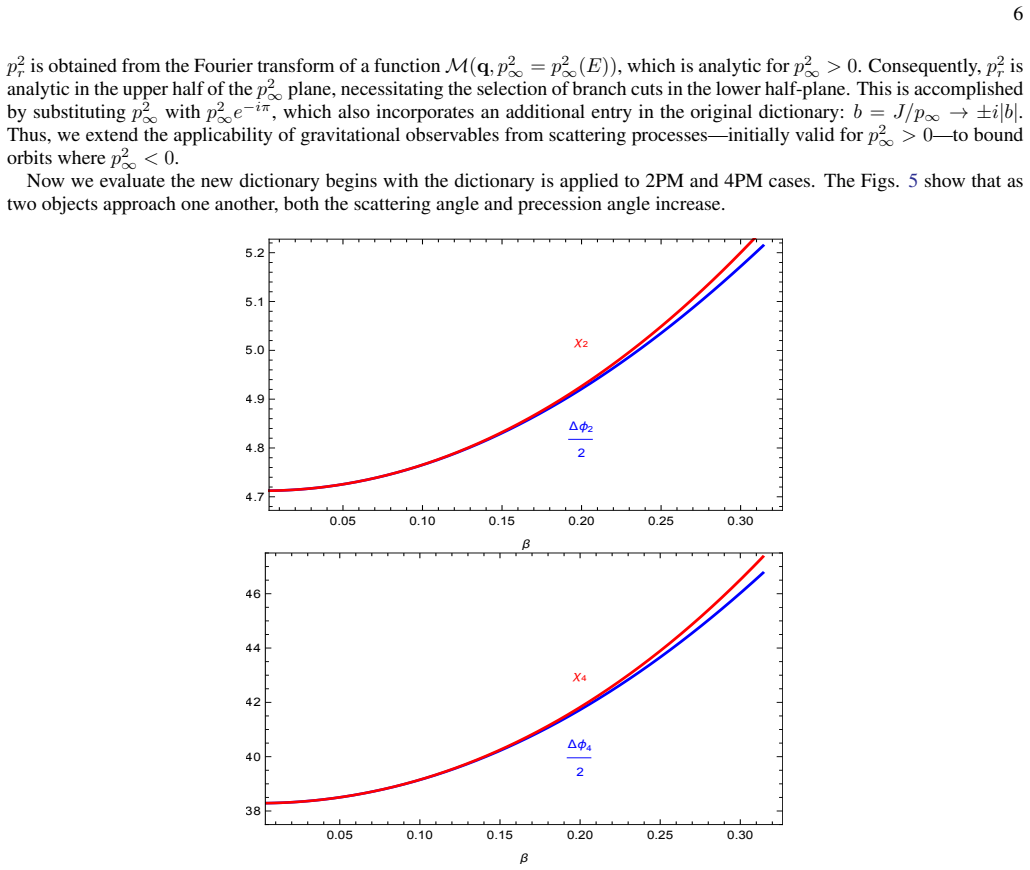
- With the corrected dictionary, the 2PM and 4PM precession angles increase as the binary separation decreases, matching the behavior of the scattering angle required by classical expectations.
- Effective-one-body binding-energy curves built from 4PM scattering data and the new continuation reproduce numerical-relativity data at the innermost stable circular orbit for mass ratios $q=1$ and $q=10$.
- Post-Minkowskian waveform models no longer need to manually discard, modify, or substitute problematic terms such as $\mathrm{Li}_2$ or $\log(\gamma^2-1)$ to avoid complex results.
Reading between the lines
- If the $e^{-i\pi}$ sheet choice is right, the same continuation should also cure complex-valued spin and tidal dictionary entries whenever their Fourier coefficients first acquire a $(p_\infty^2)^{-n/2}$ singularity; the paper does not test that extension.
- The prescription could be tested independently by computing the same bound observables with the alternative continuation $p_\infty^2 e^{+i\pi}$ and checking whether realness and agreement with numerical relativity uniquely select $e^{-i\pi}$; the paper argues analyticity in the upper half-plane but does not rule out extra branch-cut contributions.
- A natural next check is to compare the corrected 4PM binding energy against high-precision numerical relativity for additional mass ratios and for small nonzero eccentricities, making the comparison more than a sparse spot check.
Signed reviews
Editorial analysis
A structured set of objections, weighed in public.
Referee Report
Summary. The paper addresses the failure of the Kalin-Porto dictionary when mapping scattering data to bound-state observables at 4PM order. The authors identify a singular factor (p_inf^2)^{-n/2} in the Fourier transform of the scattering amplitude, argue that the original dictionary, which connects scattering and bound states at p_inf^2=0, becomes invalid at 4PM, and propose an analytic continuation p_inf^2 -> p_inf^2 e^{-i pi}, motivated by an analogy with Hawking's treatment of black hole radiation. They then show that the new dictionary restores the expected monotonic behavior of the 2PM and 4PM precession angles and compare EOB binding energies with SXS numerical-relativity data for mass ratios q=1 and q=10, reporting good agreement.
Significance. If the proposed continuation is correct, the paper would resolve a concrete obstruction to using 4PM scattering information for bound orbits, which is important for PM-based waveform models and for the boundary-to-bound program generally. The paper's diagnosis of a singular factor at p_inf^2=0 is concrete and reasonable, and the figures showing that the original dictionary gives complex precession angles illustrate a genuine problem. However, the central prescription is justified more by assertion than by proof: the branch choice for multivalued functions is not specified or tested, the 3PM consistency limit is not checked, and the numerical validation relies on the author's own EOB framework without an independent calibration. These gaps are load-bearing for the central claim and need to be addressed before the result can be accepted.
major comments (5)
- [Sec. III, Eqs. (5)-(6)] The continuation p_inf^2 -> p_inf^2 e^{-i pi} does not by itself fix the branches of the multivalued functions appearing in P4, namely log(p_inf^2), Li2, arccosh, and non-integer powers. Since e^{-i pi} = e^{+i pi} = -1, the substitution alone does not distinguish the two sides of the negative real axis; the result depends on whether log(-|x|) is assigned +i pi or -i pi, and similarly for the other functions. The paper asserts that p_r^2 is analytic in the upper half p_inf^2 plane and that branch cuts lie in the lower half-plane, which would suggest approaching the negative real axis from above (arg = +pi), yet the text's notation e^{-i pi} suggests the opposite. The paper never computes both branch choices and shows that only the chosen one yields a real, physical 4PM precession angle. This ambiguity must be resolved with an explicit principal-branch definition and a demonstration that the chosen continuation is unique or physically selected.
- [Sec. III, after Eq. (8)] No consistency check at 3PM is provided. At 3PM the singular factor (p_inf^2)^{-n/2} is absent, and the original Kalin-Porto dictionary is known to work; the new dictionary must reduce to the established 3PM bound-state results in the limit P4 -> 0. The paper does not show this reduction, which is a mandatory check because the branch rule only affects terms involving multivalued functions that appear at 4PM. The absence of this check leaves open the possibility that the new continuation is only one of several branches and that its success at 4PM is accidental.
- [Sec. III, Fig. 6 and Refs. [50-53]] The EOB/NR validation is not independent and the comparison is not apples-to-apples. The EOB model in Refs. [50-53] is constructed within the same PM framework and, according to the text, uses the same continuation, so agreement with SXS data cannot be used as evidence for the branch choice unless the EOB Hamiltonian is independently calibrated from other input. Moreover, the figure compares the EOB innermost stable circular orbit (ISCO) binding energy to the NR 'final state of the black hole,' which is not the same quantity; no error bars, no definition of the NR binding energy, and no description of how the ISCO point is extracted are given. A robust validation would compare well-defined ISCO binding energies (or the full Eb(j) curve) against NR data with stated uncertainties and with an independently constructed EOB model.
- [Eq. (6) and Ref. [56]] The coefficients h_i appearing in T4p are referred to Ref. [56], which is listed as 'To appear 111, 111 (2024)' with no title, journal, or accessible preprint. Since Eq. (6) is the core 4PM input and the h_i are necessary to reproduce the claimed results, this reference must be replaced by a publicly available version or the expressions must be given explicitly. As it stands, the central 4PM calculation cannot be independently checked.
- [Sec. III, paragraph on analytic continuation] The claim that p_r^2 is analytic in the upper half p_inf^2 plane is asserted rather than proved. The Fourier transform in Eq. (3) is defined for p_inf^2 > 0, and no argument is given that the resulting coefficients P_n, which involve logarithms, dilogarithms, and arccosh functions, extend analytically to the upper half-plane without acquiring additional branch cuts. Since the entire continuation prescription rests on this analyticity statement, a proof or a precise reference establishing it is required.
minor comments (4)
- [Throughout] The manuscript contains numerous grammatical errors and typos, e.g., 'These work lie', 'are should exhibit', 'one shows', and 'detial'; these should be corrected in a thorough language edit.
- [Figs. 5 and 6] Several figures are hard to read: Fig. 5 appears to lack axis labels or definitions of the plotted quantities, and Fig. 6's caption does not specify what quantity is plotted on each axis or how the NR 'final state' point is defined. The figures should be redrawn with clear labels, units, and error bars.
- [Eq. (3)] The text states that the Fourier transform includes a factor of (p_inf^2)^{-n/2}, but this factor is not displayed explicitly in Eq. (3); the authors should indicate where in the derivation of P_n this factor arises, since it is the central object of the paper.
- [Sec. III] The analogy with Hawking's black-hole radiation method is presented only briefly; the paper should explain more concretely how the Bogoliubov-coefficient continuation maps onto the continuation of P_n, rather than relying on a general analogy.
Circularity Check
No constructional circularity in the new dictionary; however the 4PM coefficient and the EOB validation both rest on same-author citations, making the central claim only partially independent.
-
self citation load bearing
[Section III, final paragraph (EOB/NR comparison); Refs. [50–53]]
"Furthermore, by comparing the binding energy Eb(j) (where j denotes the orbital angular momentum) calculated using EOB theory up to 4PM order [50–53] with results obtained from NR simulations ... As illustrated in Figures 6, the relationship between binding energy and angular momentum concerning the innermost stable circular orbit, as derived from EOB theory, demonstrates a remarkable agreement with NR data."
The validation of the revised dictionary uses binding energies from Refs. [50–53], all authored by J. Jing and built in the same post-Minkowskian/EOB framework with the same 4PM inputs. Because those EOB Hamiltonians are not independently derived or machine-checked here, the agreement with SXS data tests the combined dictionary-plus-EOB construction rather than the new analytic continuation alone. The SXS data are external, so the circularity is partial, not total.
-
self citation load bearing
[Eq. (6) and Ref. [56]]
"where the quantities hi can be, for clarity, found in Ref. [56]. ... [56] J. Jing, Effective one-body theory of spinless binary evolution dynamics, To appear 111, 111 (2024)."
The 4PM coefficient P4, whose singular 1/p_inf^2 terms are the stated reason the original dictionary fails, depends in its transcendental part T4p on coefficients h_i supplied only by an unpublished 'To appear' article by the same author. No external derivation, code, or independent check of those coefficients is given, so the 4PM prediction that motivates and tests the new dictionary cannot be verified outside the author's own citation chain.
full rationale
The core dictionary step, p_inf^2 -> p_inf^2 e^{-i pi}, is not fitted to the SXS data: it is prescribed before the comparison, and the numerical relativity points are external. Thus the central construction is not circular by definition. However, the paper's demonstration that the original dictionary yields complex 4PM precession angles and that the revised dictionary yields real ones relies on P4 in Eqs. (5)-(6), whose h_i coefficients are taken from an unpublished same-author reference, and the only quantitative validation is an EOB/NR comparison with the author's own EOB framework. These are load-bearing self-citations, although they do not reduce the dictionary itself to an input. Separately, the paper's branch prescription is underdetermined: p_inf^2 e^{-i pi} = -p_inf^2 is the same real substitution as the original beta -> i beta dictionary, and the text does not specify how log, Li2, arccosh, and fractional powers are evaluated on the chosen sheet; the claim of analyticity in the upper half-plane would suggest arg = +pi, while e^{-i pi} corresponds to the lower side. That is a mathematical gap in the derivation, but it is a correctness risk rather than a constructional circularity, so it is not scored as a circular step itself.
Assumptions & free parameters
free parameters (1)
- analytic continuation phase =
-i pi (multiplication by e^(-i pi))
assumptions (4)
- standard math The 4PM conservative Hamiltonian and radial momentum p_r^2 are correctly given by Eqs. (1)-(5), inherited from Bern et al. [54,55].
- domain assumption The relation between scattering angle and periastron precession, Delta_Phi_j^(2n) = 2 chi_j^(2n), remains valid after analytic continuation.
- ad hoc to paper p_r^2 is analytic in the upper half of the p_inf^2 plane, so the physical bound-state branch is reached by p_inf^2 -> p_inf^2 e^(-i pi).
- domain assumption The EOB binding energy computed from Refs. [50-53] is accurate enough to validate the dictionary.
Cite this review
Pith. "Pith review of Dictionary revision for mapping boundary data to bound states." pith.science (2026). https://pith.science/paper/NBJHQ7FV
@misc{pith2026250509052,
  author       = {Pith},
  title        = {Pith review of: Dictionary revision for mapping boundary data to bound states},
  year         = {2026},
  howpublished = {\url{https://pith.science/paper/NBJHQ7FV}},
  note         = {Machine review of arXiv:2505.09052}
}
abstract
The correspondence between gravitational observables derived from scattering processes and adiabatic invariants in bound orbits, within the framework of the Post-Minkowskian (PM) expansion, has garnered significant attention in the study of bound orbital systems. However, the existing dictionary for this correspondence, \textcolor{black}{characterized by the transformation $\beta\rightarrow i \beta$ and $b\rightarrow \pm i |b|$ with $\beta=arccosh \gamma$}, produces complex-valued quantities of bound orbits in 4PM calculations. These results contradict fundamental physical principles, thereby highlighting deficiencies in the existing dictionary. Our research identifies a critical issue: the Fourier transform of the scattering amplitude incorporates a factor of $(p_\infty^2)^{-n/2}$. This factor introduces singularities at $p_\infty^2 = 0$, thereby rendering the original dictionary become ineffective, as it assumes the possibility of connecting both scattering states and bound states at the singular point. We propose a rigorous modification by employing Hawking's method for black hole radiation, specifically analytical continuing $p_\infty^2 \rightarrow p_\infty^2 e^{-i \pi}$. We also evaluate the new dictionary by comparing the binding energy calculated using effective one-body theory with numerical relativity simulation data from the SXS collaboration. Our findings indicate a remarkable agreement between the two sets of results. This revised dictionary enhances the applicability of gravitational observables derived from scattering processes to bound orbits and effectively fulfills the objectives envisioned by the pioneers who proposed this correspondence.
Figures


Figures from the paper (3 more)


Reference graph
Works this paper leans on
-
[56]
Z. Bern, C. Cheung, R. Roiban, C.-H. Shen, M. P. Solon, and M. Zeng, Black hole binary dynamics from the double copy and effective theory, Journal of High Energy Physics 2019, 206 (2019)
work page 2019
-
[1]
Z. Bern, C. Cheung, R. Roiban, C.-H. Shen, M. P. Solon, and M. Zeng, Scattering Amplitudes and the Conservative Hamiltonian for Binary Systems at Third Post-Minkowskian Order, Phys. Rev. Lett. 122, 201603 (2019), arXiv:1901.04424 [hep-th]
arXiv 2019
-
[2]
G. K ¨alin, Z. Liu, and R. A. Porto, Conservative Dynamics of Binary Systems to Third Post-Minkowskian Order from the Effective Field Theory Approach, Phys. Rev. Lett. 125, 261103 (2020), arXiv:2007.04977 [hep-th]
arXiv 2020
-
[3]
N. E. J. Bjerrum-Bohr, P. H. Damgaard, L. Plant ´e, and P. Vanhove, The amplitude for classical gravitational scattering at third Post- Minkowskian order, JHEP 08, 172, arXiv:2105.05218 [hep-th]
-
[4]
Z. Bern, J. Parra-Martinez, R. Roiban, M. S. Ruf, C.-H. Shen, M. P. Solon, and M. Zeng, Scattering Amplitudes, the Tail Effect, and Conservative Binary Dynamics at O(G4), Phys. Rev. Lett.128, 161103 (2022), arXiv:2112.10750 [hep-th]
arXiv 2022
- [5]
-
[6]
Damour, Radiative contribution to classical gravitational scattering at the third order in G, Phys
T. Damour, Radiative contribution to classical gravitational scattering at the third order in G, Phys. Rev. D 102, 124008 (2020), arXiv:2010.01641 [gr-qc]
arXiv 2020
-
[7]
P. Di Vecchia, C. Heissenberg, R. Russo, and G. Veneziano, Radiation Reaction from Soft Theorems, Phys. Lett. B 818, 136379 (2021), arXiv:2101.05772 [hep-th]
arXiv 2021
Show all 60 references
-
[8]
G. Cho, G. K ¨alin, and R. A. Porto, From boundary data to bound states. Part III. Radiative effects, JHEP 04, 154, [Erratum: JHEP 07, 002 (2022)], arXiv:2112.03976 [hep-th]
2022 arXiv
-
[9]
Di Vecchia, C
P. Di Vecchia, C. Heissenberg, R. Russo, and G. Veneziano, The eikonal approach to gravitational scattering and radiation at O(G3), JHEP 07, 169, arXiv:2104.03256 [hep-th]
-
[10]
Herrmann, J
E. Herrmann, J. Parra-Martinez, M. S. Ruf, and M. Zeng, Radiative classical gravitational observables at O(G3) from scattering ampli- tudes, JHEP 10, 148, arXiv:2104.03957 [hep-th]
-
[11]
D. Bini, T. Damour, and A. Geralico, Radiative contributions to gravitational scattering, Phys. Rev. D 104, 084031 (2021), arXiv:2107.08896 [gr-qc]
2021 arXiv
-
[12]
Bini and A
D. Bini and A. Geralico, Higher-order tail contributions to the energy and angular momentum fluxes in a two-body scattering process, Phys. Rev. D 104, 104020 (2021), arXiv:2108.05445 [gr-qc]
2021 arXiv
-
[13]
A. V . Manohar, A. K. Ridgway, and C.-H. Shen, Radiated Angular Momentum and Dissipative Effects in Classical Scattering, Phys. Rev. Lett. 129, 121601 (2022), arXiv:2203.04283 [hep-th]
2022 arXiv
-
[14]
Dlapa, G
C. Dlapa, G. K ¨alin, Z. Liu, J. Neef, and R. A. Porto, Radiation Reaction and Gravitational Waves at Fourth Post-Minkowskian Order, (2022), arXiv:2210.05541 [hep-th]
2022 arXiv
-
[15]
Bini and T
D. Bini and T. Damour, Gravitational spin-orbit coupling in binary systems, post-Minkowskian approximation and effective one-body theory, Phys. Rev. D96, 104038 (2017), arXiv:1709.00590 [gr-qc]
2017 arXiv
-
[16]
Vines, Scattering of two spinning black holes in post-Minkowskian gravity, to all orders in spin, and effective-one-body mappings, Class
J. Vines, Scattering of two spinning black holes in post-Minkowskian gravity, to all orders in spin, and effective-one-body mappings, Class. Quant. Grav. 35, 084002 (2018), arXiv:1709.06016 [gr-qc]
2018 arXiv
-
[17]
Bini and T
D. Bini and T. Damour, Gravitational spin-orbit coupling in binary systems at the second post-Minkowskian approximation, Phys. Rev. D98, 044036 (2018), arXiv:1805.10809 [gr-qc]
2018 arXiv
-
[18]
Vines, J
J. Vines, J. Steinhoff, and A. Buonanno, Spinning-black-hole scattering and the test-black-hole limit at second post-Minkowskian order, Phys. Rev. D 99, 064054 (2019), arXiv:1812.00956 [gr-qc]
2019 arXiv
-
[19]
Guevara, A
A. Guevara, A. Ochirov, and J. Vines, Black-hole scattering with general spin directions from minimal-coupling amplitudes, Phys. Rev. D 100, 104024 (2019), arXiv:1906.10071 [hep-th]
2019 arXiv
-
[20]
K ¨alin and R
G. K ¨alin and R. A. Porto, From boundary data to bound states. Part II. Scattering angle to dynamical invariants (with twist), JHEP 02, 120, arXiv:1911.09130 [hep-th]
1911 arXiv
-
[21]
Kosmopoulos and A
D. Kosmopoulos and A. Luna, Quadratic-in-spin Hamiltonian at O(G2) from scattering amplitudes, JHEP 07, 037, arXiv:2102.10137 [hep-th]
-
[22]
Aoude, K
R. Aoude, K. Haddad, and A. Helset, Classical Gravitational Spinning-Spinless Scattering at O(G2S ∞), Phys. Rev. Lett. 129, 141102 (2022), arXiv:2205.02809 [hep-th]
2022 arXiv
-
[23]
G. U. Jakobsen and G. Mogull, Conservative and Radiative Dynamics of Spinning Bodies at Third Post-Minkowskian Order Using Worldline Quantum Field Theory, Phys. Rev. Lett.128, 141102 (2022), arXiv:2201.07778 [hep-th]
2022 arXiv
-
[24]
Z. Bern, A. Luna, R. Roiban, C.-H. Shen, and M. Zeng, Spinning black hole binary dynamics, scattering amplitudes, and effective field theory, Phys. Rev. D 104, 065014 (2021), arXiv:2005.03071 [hep-th]
2021 arXiv
-
[25]
Z. Bern, D. Kosmopoulos, A. Luna, R. Roiban, and F. Teng, Binary Dynamics Through the Fifth Power of Spin at O(G2), (2022), arXiv:2203.06202 [hep-th]
2022 arXiv
-
[26]
Febres Cordero, M
F. Febres Cordero, M. Kraus, G. Lin, M. S. Ruf, and M. Zeng, Conservative Binary Dynamics with a Spinning Black Hole at O(G3) from Scattering Amplitudes, Phys. Rev. Lett. 130, 021601 (2023), arXiv:2205.07357 [hep-th]
2023 arXiv
-
[27]
D. Bini, T. Damour, and A. Geralico, Scattering of tidally interacting bodies in post-Minkowskian gravity, Phys. Rev. D 101, 044039 (2020), arXiv:2001.00352 [gr-qc]
2020 arXiv
-
[28]
Z. Bern, J. Parra-Martinez, R. Roiban, E. Sawyer, and C.-H. Shen, Leading Nonlinear Tidal Effects and Scattering Amplitudes, JHEP05, 188, arXiv:2010.08559 [hep-th]
2010 arXiv
-
[29]
Cheung and M
C. Cheung and M. P. Solon, Tidal Effects in the Post-Minkowskian Expansion, Phys. Rev. Lett. 125, 191601 (2020), arXiv:2006.06665 [hep-th]
2020 arXiv
-
[30]
K ¨alin, Z
G. K ¨alin, Z. Liu, and R. A. Porto, Conservative Tidal Effects in Compact Binary Systems to Next-to-Leading Post-Minkowskian Order, Phys. Rev. D 102, 124025 (2020), arXiv:2008.06047 [hep-th]
2020 arXiv
-
[31]
found that a reformulation of PM information in terms of effective-one-body (EOB) radial potentials leads to remarkable agreement with numerical relativity data, especially when using the radiation-reacted 4PM information. Recent significant ad- vancements in PM theory have ge...
2025 arXiv
-
[32]
Damour and P
T. Damour and P. Rettegno, Strong-field scattering of two black holes: Numerical relativity meets post-Minkowskian gravity, Phys. Rev. D 107, 064051 (2023), arXiv:2211.01399 [gr-qc]
2023 arXiv
-
[33]
K ¨alin and R
G. K ¨alin and R. A. Porto, From Boundary Data to Bound States, JHEP 01, 072, arXiv:1910.03008 [hep-th]
1910 arXiv
-
[34]
R. A. Porto, The effective field theorist’s approach to gravitational dynamics, Phys. Rept. 633, 1 (2016), arXiv:1601.04914 [hep-th]
2016 arXiv
-
[35]
K ¨alin and R
G. K ¨alin and R. A. Porto, Post-Minkowskian Effective Field Theory for Conservative Binary Dynamics, JHEP11, 106, arXiv:2006.01184 [hep-th]
2006 arXiv
-
[36]
Z. Liu, R. A. Porto, and Z. Yang, Spin Effects in the Effective Field Theory Approach to Post-Minkowskian Conservative Dynamics, JHEP 06, 012, arXiv:2102.10059 [hep-th]
-
[37]
Dlapa, G
C. Dlapa, G. K ¨alin, Z. Liu, and R. A. Porto, Dynamics of binary systems to fourth Post-Minkowskian order from the effective field theory approach, Phys. Lett. B 831, 137203 (2022), arXiv:2106.08276 [hep-th]
2022 arXiv
-
[38]
Adamo, R
T. Adamo, R. Gonzo, and A. Ilderton, Gravitational bound waveforms from amplitudes, JHEP 05, 034, arXiv:2402.00124 [hep-th]
-
[39]
Wilson-Gerow, Conservative Dynamics of Relativistic Binaries Beyond Einstein Gravity, (2025), arXiv:2503.02867 [hep-th]
J. Wilson-Gerow, Conservative Dynamics of Relativistic Binaries Beyond Einstein Gravity, (2025), arXiv:2503.02867 [hep-th]
2025 arXiv
-
[40]
Dlapa, G
C. Dlapa, G. K ¨alin, Z. Liu, and R. A. Porto, Local in Time Conservative Binary Dynamics at Fourth Post-Minkowskian Order, Phys. Rev. Lett. 132, 221401 (2024), arXiv:2403.04853 [hep-th]. 9
2024 arXiv
-
[41]
Buonanno, G
A. Buonanno, G. U. Jakobsen, and G. Mogull, Post-Minkowskian theory meets the spinning effective-one-body approach for two-body scattering, Phys. Rev. D 110, 044038 (2024), arXiv:2402.12342 [gr-qc]
2024 arXiv
-
[42]
Chiaramello and A
D. Chiaramello and A. Nagar, Faithful analytical effective-one-body waveform model for spin-aligned, moderately eccentric, coalescing black hole binaries, Phys. Rev. D 101, 101501 (2020), arXiv:2001.11736 [gr-qc]
2020 arXiv
-
[43]
Nagar, A
A. Nagar, A. Bonino, and P. Rettegno, Effective one-body multipolar waveform model for spin-aligned, quasicircular, eccentric, hyper- bolic black hole binaries, Phys. Rev. D 103, 104021 (2021), arXiv:2101.08624 [gr-qc]
2021 arXiv
-
[44]
Placidi, S
A. Placidi, S. Albanesi, A. Nagar, M. Orselli, S. Bernuzzi, and G. Grignani, Exploiting Newton-factorized, 2PN-accurate waveform multipoles in effective-one-body models for spin-aligned noncircularized binaries, Phys. Rev. D 105, 104030 (2022), arXiv:2112.05448 [gr-qc]
2022 arXiv
-
[45]
Khalil, A
M. Khalil, A. Buonanno, J. Steinhoff, and J. Vines, Radiation-reaction force and multipolar waveforms for eccentric, spin-aligned binaries in the effective-one-body formalism, Phys. Rev. D104, 024046 (2021), arXiv:2104.11705 [gr-qc]
2021 arXiv
-
[46]
Ramos-Buades, A
A. Ramos-Buades, A. Buonanno, M. Khalil, and S. Ossokine, Effective-one-body multipolar waveforms for eccentric binary black holes with nonprecessing spins, Phys. Rev. D 105, 044035 (2022), arXiv:2112.06952 [gr-qc]
2022 arXiv
-
[47]
Nagar and P
A. Nagar and P. Rettegno, Next generation: Impact of high-order analytical information on effective one body waveform models for noncircularized, spin-aligned black hole binaries, Phys. Rev. D 104, 104004 (2021), arXiv:2108.02043 [gr-qc]
2021 arXiv
-
[48]
Khalil, A
M. Khalil, A. Buonanno, J. Steinhoff, and J. Vines, Energetics and scattering of gravitational two-body systems at fourth post- Minkowskian order, Phys. Rev. D106, 024042 (2022), arXiv:2204.05047 [gr-qc]
2022 arXiv
-
[49]
Buonanno, G
A. Buonanno, G. Mogull, R. Patil, and L. Pompili, Post-Minkowskian Theory Meets the Spinning Effective-One-Body Approach for Bound-Orbit Waveforms, Phys. Rev. Lett.133, 211402 (2024), arXiv:2405.19181 [gr-qc]
2024 arXiv
-
[50]
X. He, J. Jing, and Z. Cao, Generalized gravitomagnetic field and gravitational waves, Sci. China Phys. Mech. Astron.62, 110422 (2019)
2019
-
[51]
J. Jing, S. Long, W. Deng, M. Wang, and J. Wang, New self-consistent effective one-body theory for spinless binaries based on the post-Minkowskian approximation, Science China Physics, Mechanics, and Astronomy 65, 100411 (2022)
2022
-
[52]
J. Jing, S. Chen, M. Sun, X. He, M. Wang, and J. Wang, Self-consistent effective-one-body theory for spinless binaries based on post- minkowskian approximation i: Hamiltonian and decoupled equation for ψ4, Science China Physics, Mechanics, and Astronomy 65, 260411 (2022)
2022
-
[53]
J. Jing, W. Deng, S. Long, and J. Wang, Self-consistent effective-one-body theory for spinning binaries based on post-minkowskian approximation, Science China Physics, Mechanics, and Astronomy 66, 270411 (2023)
2023
-
[54]
J. Jing, W. Deng, S. Long, and J. Wang, Effective metric of spinless binaries with radiation-reaction effect up to fourth post-minkowskian order in effective-one-body theory, The European Physical Journal C 83, 608 (2023)
2023
-
[55]
Z. Bern, C. Cheung, R. Roiban, C.-H. Shen, M. P. Solon, and M. Zeng, Scattering amplitudes and the conservative hamiltonian for binary systems at third post-minkowskian order, Phys. Rev. Lett.122, 201603 (2019)
2019
-
[57]
Jing, Effective one-body theory of spinless binary evolution dynamics, To appear 111, 111 (2024)
J. Jing, Effective one-body theory of spinless binary evolution dynamics, To appear 111, 111 (2024)
2024
-
[58]
S. W. Hawking, Particle creation by black holes, Commun. math. Phys. 43, 199 (1975)
1975
-
[59]
Damour, A
T. Damour, A. Nagar, D. Pollney, and C. Reisswig, Energy versus angular momentum in black hole binaries, Phys. Rev. Lett.108, 131101 (2012)
2012
-
[60]
Nagar, T
A. Nagar, T. Damour, C. Reisswig, and D. Pollney, Energetics and phasing of nonprecessing spinning coalescing black hole binaries, Phys. Rev. D 93, 044046 (2016)
2016
Reviewed August 15, 2026 · model on record in the stance chip above.
Discussion (0). Continue with ORCID to comment.