REVIEW 3 major objections 4 minor 92 references
Discrete time quasi-crystal in Rydberg atomic chain
T0 review · 3 major / 4 minor · reviewed 2026-08-15 · deepseek-v4-flash
Pith's one-line read Two golden-ratio-driven time crystals can form a discrete time quasi-crystal in a Rydberg chain.
desk verdict A concrete Rydberg proposal for DTQC with clean numerics, but the central claim that the observed intermodulation peaks require Rydberg coupling is not yet supported: the nonlinear order parameter can fake them. read the letter →
The pith
A machine-rendered reading of the paper's core claim, the machinery that carries it, and where it could break.
The reading
What carries the argument
The machinery is the bipartite Floquet-driven PXP model: the Rydberg blockade is encoded by projectors $\hat P_{i-1}\hat X_i\hat P_{i+1}$, so no two neighbouring atoms can be simultaneously excited, and the drive is a sequence of two $\delta$-function kicks with periods $T_L$ and $T_R$ satisfying $T_L/T_R=(\sqrt5+1)/2$. The paper couples this with the observable $m(t)=|\sum_i(-1)^i\hat n_i|/N$, whose Fourier peaks are indexed by half-integer combinations $f=(k_1/2)f_L+(k_2/2)f_R$. The golden-ratio choice makes the two drive frequencies maximally incommensurate, so the sum-frequency peaks are genuine quasiperiodic responses rather than harmonics of a common period; the PXP constraint at the boundary is what lets the two halves talk to each other. The antiferromagnetic initial state and the $\theta=\pi$ Floquet strength, where the drive anti-commutes with the subsystem Hamiltonian, stabilize the scarred revivals on each half.
What would settle it
Remove the Rydberg blockade constraint on the single bond connecting the two halves (equivalently, set the boundary PXP projector to zero) and repeat the golden-ratio double-Floquet protocol. If the Fourier peaks at $(1/2,1/2)$ and $(-1/2,1/2)$ persist with comparable amplitude while the bipartite entanglement entropy drops to zero, the aperiodic response would be shown to come from two independent time crystals rather than from their interaction.
Extended reading notes
Core claim
The central claim is that coupling two discrete time crystals with maximally incommensurate driving frequencies produces a discrete time quasi-crystal phase. Concretely, the paper studies a one-dimensional Rydberg chain described by the PXP model, divided into left and right subsystems with Rabi frequencies and Floquet pulse periods whose ratio is the golden ratio $(\sqrt5+1)/2$. Starting from the experimentally natural $Z_2$ antiferromagnetic state, the antiferromagnetic order parameter $m=|\sum_i(-1)^i\hat n_i|/N$ keeps oscillating without an identifiable period; its Fourier spectrum shows stable subharmonic peaks at $(1/2,1/2)$ and $(-1/2,1/2)$ in units of the two driving frequencies, exactly the sums and differences of the two half-frequencies. The paper interprets these peaks as the signature of the quasi-crystal phase and argues that the aperiodic response is caused by the Rydberg blockade coupling between the two subsystems, not merely by adding two independent time crystals. Fidelity and bipartite entanglement entropy simulations are used to support the phase's existence, robustness, and boundary-localized entanglement.
Load-bearing premise
The causal claim that the aperiodic response arises from the Rydberg-blockade interaction between the two halves rests on the assumption that the absolute-value order parameter $m(t)$ reports genuine coupled dynamics; if two decoupled subharmonic oscillators already produce the same Fourier peaks, the claimed mechanism is not established.
Editorial extensions
If this is right
- At intermediate driving frequencies, the Fourier spectrum of the antiferromagnetic order parameter is dominated by the peaks $(1/2,1/2)$ and $(-1/2,1/2)$, the sum and difference of half the two drive frequencies.
- Low driving frequency pushes the response into a chaotic regime, while high driving frequency decouples the two halves and leaves only the simple addition of two independent discrete time crystals.
- The quasi-crystal order parameter is robust to system size, with the typical Fourier amplitudes saturating as the chain grows, whereas fidelity amplitudes decay exponentially with system size.
- The bipartite entanglement entropy stays low and appears concentrated at the boundary, indicating that the coupling between the two time crystals comes from the Rydberg blockade of the nearest boundary sites.
- The phase region widens near modulation strength $\theta=\pi$ and a driving frequency about twice the inherent scar oscillation frequency, giving concrete parameter targets for an experiment.
Reading between the lines
- A decoupled-control simulation, with the boundary blockade term switched off, would settle whether the $(1/2,1/2)$ peaks require interaction; the absolute value in $m$ means intermodulation of two independent half-frequency oscillators could in principle mimic them.
- The golden-ratio construction suggests a general recipe: any pair of irrational drive frequencies with strong incommensurability might produce analogous quasiperiodic time order, so scanning the frequency ratio would test how special the golden ratio is.
- Because the entanglement entropy is boundary-localized and small, the quasi-crystal phase may be fragile to strengthening the boundary coupling or adding bulk interactions; varying the boundary spacing or Rabi frequency would probe this fragility.
- The observed exponential decay of fidelity peaks with system size implies that direct revival diagnostics become impractical in large chains, so the phase is best certified through the order-parameter spectrum or boundary entanglement rather than wavefunction overlap.
Signed reviews
Editorial analysis
A structured set of objections, weighed in public.
Referee Report
Summary. The paper proposes a scheme to generate a discrete time quasi-crystal (DTQC) in a one-dimensional Rydberg atom array by dividing the chain into two halves and driving them with two Floquet frequencies whose ratio is the golden ratio. The authors argue that the Rydberg blockade interaction at the boundary couples the two halves, each of which individually supports a discrete time crystal (DTC), and that this coupling produces a stable aperiodic response. They study the antiferromagnetic order parameter m defined in Eq. (3), the fidelity F defined in Eq. (6), compute Fourier spectra that show peaks at half-integer combinations of the two drive frequencies, map phase diagrams using a lifetime criterion tau > 30 T_L, and compute the bipartite entanglement entropy between the two halves. The central claim, stated in the abstract and in Section VII, is that the aperiodic response is 'indeed caused by interaction between systems via Rydberg blockade effect.'
Significance. If the interaction-causality claim were established, the work would be a notable proposal that extends DTC physics to quasi-periodic time order on a Rydberg array, which is a leading quantum simulation platform. The numerics are carefully specified (exact diagonalization for N<14, MPS time evolution with truncation error below 5e-9 and bond dimension up to 500), the drive ratio is fixed a priori to the golden ratio rather than fitted, and the DTC benchmark is grounded in Refs. 31 and 32. The paper also makes concrete falsifiable predictions about the location of Fourier peaks. However, as written, the central claim is not yet supported because the chosen order parameter and fidelity are nonlinear or factorizing functions of the two subsystem observables in a way that produces the claimed sum- and difference-frequency peaks even when the two subsystems are completely decoupled. The missing decoupled control is a load-bearing gap, but it is addressable within the scope of the manuscript.
major comments (3)
- [Section III, Eq. (3); Abstract and Section VII] The central claim that the aperiodic response is 'indeed caused by interaction between systems via Rydberg blockade effect' is not supported by the evidence, because the order parameter m = |Σ_i (-1)^i n_i|/N is a nonlinear function of the separate staggered magnetizations M_L and M_R. In the decoupled limit, each subsystem is expected to oscillate subharmonically at ω_L/2 and ω_R/2. For A=B, |M_L+M_R| = 2|A cos((ω_L+ω_R)t/4) cos((ω_L-ω_R)t/4)|; each |cos| factor has a DC component and harmonics, so the product contains spectral lines at (ω_L+ω_R)/2 and |ω_L-ω_R|/2, exactly the (1/2,1/2) and (-1/2,1/2) peaks shown in Fig. 1(c). The manuscript does not report a control simulation in which the boundary PXP projectors between sites N_L and N_L+1 are switched off, so the observed peaks could arise from two independent DTCs even with zero coupling. Please add such a decoupled control (e.g., remove the terms at i=N_L and i=N_L+1 in Eq. (1)) and compare the resulting Fourier spectra with the coupled case; if the peaks persist, the causal attribution in the abstract and Section VII must be revised.
- [Section V, Eq. (6), Fig. 3] The fidelity F = |⟨Z2|ψ(t)⟩| has the same weakness as m. In a decoupled evolution with |ψ(t)⟩ = |ψ_L(t)⟩ ⊗ |ψ_R(t)⟩, F factorizes as F_L(t) F_R(t) (up to a constant), and the product of two subharmonic signals at angular frequencies ω_L/2 and ω_R/2 contains components at (ω_L+ω_R)/2 and |ω_L-ω_R|/2. The fidelity peaks labeled (1/2,1/2) and (-1/2,1/2) in Fig. 3(b) are therefore fully consistent with a zero-coupling product state. The paper should either provide a decoupled-control fidelity spectrum or state explicitly that the fidelity data do not distinguish coupled from uncoupled dynamics.
- [Section VI, first two paragraphs] The argument that a non-zero entanglement entropy between the left and right halves 'demonstrates that there exists the coupling between two DTCs' only shows that some boundary coupling exists; it does not establish that the dominant Fourier peaks of m and F are caused by that coupling. To support the causal claim, the paper should connect coupling strength to the spectral response, for example by tuning the boundary PXP coupling (or comparing with the decoupled control suggested above) and showing that the (1/2,1/2) and (-1/2,1/2) peak amplitudes vanish or change qualitatively as the coupling is removed. The manuscript's own description of the large-frequency limit in Fig. 2(d) as 'simple additivity of two independent DTCs' further illustrates that the global observables can produce the same spectral structure without interaction.
minor comments (4)
- [Abstract] The sentence beginning 'While we analysis its robustness' contains a grammatical error and should read 'While we analyze its robustness'; the phrase 'We significantly calculate the entanglement entropy' is awkward and should be rephrased.
- [Appendices B and C] The text refers to Fig. 7 for the initial-state dependence and to Fig. 6 for the fidelity phase diagrams, but the figure captions describe Fig. 6 as initial-state dependence and Fig. 7 as fidelity phase diagrams; the references or the captions should be swapped so that they agree.
- [Appendix A, Fig. 5 caption] The caption parameters do not match the panel assignment in the text: the text assigns (a) uniform quench, (b) non-uniform quench, (c) DTC, and (d) DTQC, while the caption lists parameter sets that place the DTC in (b) and the non-uniform quench in (c). Please reconcile the caption with the text.
- [Section IV, around Eq. (5)] Equation (5) uses f both as a summation index and as the argument of cos(ft), which is confusing; using a dummy index such as j would avoid the conflict.
Circularity Check
Mild self-referentiality in the DTQC detection criterion; otherwise the simulation is not parameter-fitted and the DTC input is independently sourced.
-
self definitional
[Section III, Eq. (4) and the paragraph following Fig. 1(c)]
"Therefore, the expected frequency response f is formalized as, f(fL,fR)=k1/2×fL+k2/2×fR, k1,k2∈Z. ... For our simulation, we numerically observe several sharp peaks in Fig.1(c) ... Moreover, we find the frequency responses are mainly concentrated at the position (1/2, 1/2), and (-1/2, 1/2), which are the summation and subtraction of the halve of two incommensurable driving frequencies. Such behavior accords with the definition of the DTQC in phenomenon."
Equation (4) is introduced as the expected Fourier comb that defines 2-order DTQC ('the peaks in the Fourier spectrum of 2-order DTQC phase should be subharmonic and incommensurate'). The same comb is then used as the detection criterion: sharp peaks at (1/2,1/2) and (-1/2,1/2) are taken as validation of the phase. Those two coordinates are not independently derived predictions; they are the sums and differences of fL/2 and fR/2, i.e., exactly the comb Eq. (4) built from the two input drive frequencies. Thus the match between observation and criterion is partly by construction.
full rationale
The central simulation is self-contained: the Hamiltonian is specified by Eqs. (1) and (2), the golden-ratio drive is chosen from known incommensurability rather than fitted to the target peaks, and the observed Fourier peaks, lifetimes, and phase diagrams are obtained by diagonalization and MPS time evolution. There is no load-bearing self-citation chain: Refs. [31,32] are external experimental and theoretical DTC benchmarks, and no uniqueness theorem from the present authors is invoked. The only mild circularity is the DTQC detection criterion itself: Eq. (4) defines the expected frequency comb, and the same comb is used to certify the phase, so locating the 'typical peaks' against it is partially self-referential. The skeptic's stronger concern, that m and F are non-additive functions whose absolute-value or product forms can generate sum- and difference-frequency peaks from two independent subharmonic DTCs even without coupling, and that no decoupled control is reported, is a correctness and evidence gap about causal attribution (abstract and Sec. VI) rather than a circular reduction by the paper's own equations; per the hard rules, it is therefore not scored as circularity. Overall circularity burden is low, consistent with score 2.
Assumptions & free parameters
free parameters (3)
- modulation strength theta =
pi
- drive period T_L =
4.74 (f_L = 1.326)
- ratio r =
(sqrt(5)+1)/2
assumptions (5)
- domain assumption The PXP model (Eq. 1) with open boundary conditions captures the Rydberg blockade dynamics of the chain.
- domain assumption Delta-function pulses (Eq. 2) are a valid idealization of experimental Floquet modulation.
- ad hoc to paper The frequency comb f = k1/2 f_L + k2/2 f_R (Eq. 4) constitutes the diagnostic definition of DTQC.
- ad hoc to paper The phase boundary is defined by lifetime tau > 30 T_L (Section IV).
- domain assumption Coupling between the two halves is mediated only by the Rydberg blockade at the boundary (Section VI).
Cite this review
Pith. "Pith review of Discrete time quasi-crystal in Rydberg atomic chain." pith.science (2026). https://pith.science/paper/GBKUB6Q6
@misc{pith2026250509117,
  author       = {Pith},
  title        = {Pith review of: Discrete time quasi-crystal in Rydberg atomic chain},
  year         = {2026},
  howpublished = {\url{https://pith.science/paper/GBKUB6Q6}},
  note         = {Machine review of arXiv:2505.09117}
}
read the original abstract
Discrete time quasi-crystals are non-equilibrium quantum phenomena with quasi-periodic order in the time dimension, and are an extension of the discrete time-crystal phase. As a natural platform to explore the non-equilibrium phase of matter, the Rydberg atomic array has implemented the quantum simulation of the discrete-time crystal phase, associated with quantum many-body scar state. However, the existence of discrete time quasi-crystal on the Rydberg cold atom experiment platform has yet to be conceived. Here, we propose a method to generate the discrete time quasi-crystal behavior by coupling two discrete time-crystals, where associated two external driving frequencies have the maximum incommensurability. While we analysis its robustness and compute the phase diagram of corresponding observables. We significantly calculate the entanglement entropy between two parts of the system. Remarkably, we find the emergence of the aperiodic response is indeed caused by interaction between systems via Rydberg blockade effect. Our method thus offers the possibilities to explore the novel phases in quantum simulator.
Figures


Figures from the paper (3 more)


Reference graph
Works this paper leans on
-
[1]
Wilczek, Quantum Time Crystals, Physical Review Letters 109, 160401 (2012)
F. Wilczek, Quantum Time Crystals, Physical Review Letters 109, 160401 (2012)
2012
-
[2]
M. P. Zaletel, M. Lukin, C. Monroe, C. Nayak, F. Wilczek, and N. Y. Yao, Colloquium : Quantum and classical discrete time crystals, Reviews of Modern Physics 95, 031001 (2023)
2023
-
[3]
4(b2), combined with its sum frequency and difference frequency
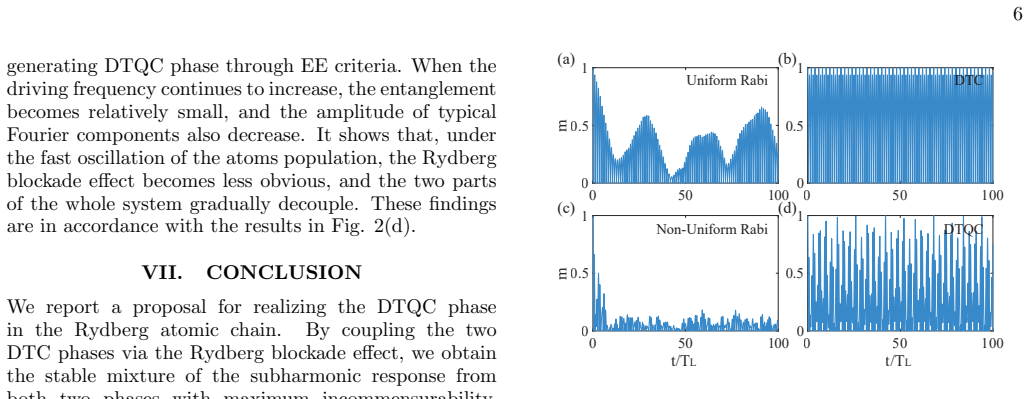
We observe several clear peaks from the subharmonic response of each drive in Fig. 4(b2), combined with its sum frequency and difference frequency. Such conditions could be identified as the proper parameter range for 6 generating DTQC phase through EE criteria. When the driving frequency continues to increase, the entanglement becomes relatively small, a...
-
[4]
Carraro-Haddad, D
I. Carraro-Haddad, D. L. Chafatinos, A. S. Kuznetsov, I. A. Papuccio-Fern´ andez, A. A. Reynoso, A. Bruchhausen, K. Biermann, P. V. Santos, G. Usaj, and A. Fainstein, Solid-state continuous time crystal in a polariton condensate with a built-in mechanical clock, Science 384, 995 (2024)
2024
-
[5]
M. P. Estarellas, T. Osada, V. M. Bastidas, B. Renoust, K. Sanaka, W. J. Munro, and K. Nemoto, Simulating complex quantum networks with time crystals, SCIENCE ADVANCES (2020)
2020
-
[6]
Frey and S
P. Frey and S. Rachel, Realization of a discrete time crystal on 57 qubits of a quantum computer, Science Advances 8, eabm7652 (2022)
2022
-
[7]
Liu, J.-Y
T. Liu, J.-Y. Ou, K. F. MacDonald, and N. I. Zheludev, Photonic metamaterial analogue of a continuous time crystal, Nature Physics 19, 986 (2023)
2023
-
[8]
Lyubarov, Y
M. Lyubarov, Y. Lumer, A. Dikopoltsev, E. Lustig, Y. Sharabi, and M. Segev, Amplified emission and lasing in photonic time crystals, Science 377, 425 (2022)
2022
Show all 92 references
-
[9]
Raskatla, T
V. Raskatla, T. Liu, J. Li, K. F. MacDonald, and N. I. Zheludev, Continuous Space-Time Crystal State Driven by Nonreciprocal Optical Forces, Physical Review Letters 133, 136202 (2024)
2024
-
[10]
Tr¨ ager, P
N. Tr¨ ager, P. Gruszecki, F. Lisiecki, F. Groß, J. F¨ orster, M. Weigand, H. G lowi´ nski, P. Ku´ swik, J. Dubowik, G. Sch¨ utz, M. Krawczyk, and J. Gr¨ afe, Real-Space Observation of Magnon Interaction with Driven Space-Time Crystals, Physical Review Letters 126, 057201 (2021)
2021
-
[11]
X. Wang, M. S. Mirmoosa, V. S. Asadchy, C. Rockstuhl, S. Fan, and S. A. Tretyakov, Metasurface-based realization of photonic time crystals, Science Advances 9, eadg7541 (2023)
2023
-
[12]
Iemini, A
F. Iemini, A. Russomanno, J. Keeling, M. Schir` o, M. Dalmonte, and R. Fazio, Boundary Time Crystals, Physical Review Letters 121, 035301 (2018)
2018
-
[13]
T. E. Lee, H. H¨ affner, and M. C. Cross, Antiferromagnetic phase transition in a nonequilibrium lattice of Rydberg atoms, Physical Review A 84, 031402 (2011)
2011
-
[14]
Pizzi, J
A. Pizzi, J. Knolle, and A. Nunnenkamp, Higher-order and fractional discrete time crystals in clean long-range interacting systems, Nature Communications 12, 2341 (2021)
2021
-
[15]
Russo and T
F. Russo and T. Pohl, Quantum Dissipative Continuous Time Crystals (2025), arXiv:2503.16141 [quant-ph]
2025 arXiv
-
[16]
Solanki and F
P. Solanki and F. Minganti, Chaos in Time: A Dissipative Continuous Quasi Time Crystals (2024), arXiv:2411.07297 [quant-ph]
2024
-
[17]
Z. Wang, R. Gao, X. Wu, B. Buˇ ca, K. Mølmer, L. You, and F. Yang, Boundary Time Crystals Induced by Local Dissipation and Long-Range Interactions (2025), arXiv:2503.20761 [quant-ph]
2025
-
[18]
A. C. Louren¸ co, L. F. D. Prazeres, T. O. Maciel, F. Iemini, and E. I. Duzzioni, Genuine multipartite correlations in a boundary time crystal, Physical Review B 105, 134422 (2022)
2022
-
[19]
C.-h. Fan, D. Rossini, H.-X. Zhang, J.-H. Wu, M. Artoni, and G. C. La Rocca, Discrete time crystal in a finite chain of Rydberg atoms without disorder, Physical Review A 101, 013417 (2020)
2020
-
[20]
Zhang, P
J. Zhang, P. W. Hess, A. Kyprianidis, P. Becker, A. Lee, J. Smith, G. Pagano, I.-D. Potirniche, A. C. Potter, A. Vishwanath, N. Y. Yao, and C. Monroe, Observation of a discrete time crystal, Nature 543, 217 (2017)
2017
-
[21]
Kyprianidis, F
A. Kyprianidis, F. Machado, W. Morong, P. Becker, K. S. Collins, D. V. Else, L. Feng, P. W. Hess, C. Nayak, G. Pagano, N. Y. Yao, and C. Monroe, Observation of 8 a prethermal discrete time crystal, Science 372, 1192 (2021)
2021
-
[22]
Keßler, P
H. Keßler, P. Kongkhambut, C. Georges, L. Mathey, J. G. Cosme, and A. Hemmerich, Observation of a Dissipative Time Crystal, Physical Review Letters 127, 043602 (2021)
2021
-
[23]
Kongkhambut, J
P. Kongkhambut, J. Skulte, L. Mathey, J. G. Cosme, A. Hemmerich, and H. Keßler, Observation of a continuous time crystal, Science 377, 670 (2022)
2022
-
[24]
S. Choi, J. Choi, R. Landig, G. Kucsko, H. Zhou, J. Isoya, F. Jelezko, S. Onoda, H. Sumiya, V. Khemani, C. Von Keyserlingk, N. Y. Yao, E. Demler, and M. D. Lukin, Observation of discrete time-crystalline order in a disordered dipolar many-body system, Nature 543, 221 (2017)
2017
-
[25]
Randall, C
J. Randall, C. E. Bradley, F. V. Van Der Gronden, A. Galicia, M. H. Abobeih, M. Markham, D. J. Twitchen, F. Machado, N. Y. Yao, and T. H. Taminiau, Many-body–localized discrete time crystal with a programmable spin-based quantum simulator, Science 374, 1474 (2021)
2021
-
[26]
G. He, B. Ye, R. Gong, C. Yao, Z. Liu, K. W. Murch, N. Y. Yao, and C. Zu, Experimental Realization of Discrete Time Quasicrystals, Physical Review X 15, 011055 (2025)
2025
-
[27]
X. Wu, Z. Wang, F. Yang, R. Gao, C. Liang, M. K. Tey, X. Li, T. Pohl, and L. You, Dissipative time crystal in a strongly interacting Rydberg gas, Nature Physics 20, 1389 (2024)
2024
-
[28]
Liu, L.-H
B. Liu, L.-H. Zhang, Q.-F. Wang, Y. Ma, T.-Y. Han, J. Zhang, Z.-Y. Zhang, S.-Y. Shao, Q. Li, H.-C. Chen, B.-S. Shi, and D.-S. Ding, Higher-order and fractional discrete time crystals in Floquet-driven Rydberg atoms, Nature Communications 15, 9730 (2024)
2024
-
[29]
Y. Jiao, Y. Zhang, J. Bai, S. Jia, C. S. Adams, Z. Bai, H. Shen, and J. Zhao, Many-body nonequilibrium dynamics in a self-induced Floquet system (2024), arXiv:2411.04650 [quant-ph]
2024
-
[30]
Y. Jiao, W. Jiang, Y. Zhang, J. Bai, Y. He, H. Shen, J. Zhao, and S. Jia, Observation of a time crystal comb in a driven-dissipative system with Rydberg gas (2024), arXiv:2402.13112 [physics]
2024
-
[31]
Y. Jiao, Y. Zhang, J. Bai, W. Jiang, Y. He, H. Shen, S. Jia, J. Zhao, and C. S. Adams, Quantum Lotka-Volterra dynamics (2024), arXiv:2408.01726 [quant-ph]
2024 arXiv
-
[32]
Bluvstein, A
D. Bluvstein, A. Omran, H. Levine, A. Keesling, G. Semeghini, S. Ebadi, T. T. Wang, A. A. Michailidis, N. Maskara, W. W. Ho, S. Choi, M. Serbyn, M. Greiner, V. Vuleti´ c, and M. D. Lukin, Controlling quantum many-body dynamics in driven Rydberg atom arrays, Science 371, 1355 (2021)
2021
-
[33]
Maskara, A
N. Maskara, A. A. Michailidis, W. W. Ho, D. Bluvstein, S. Choi, M. D. Lukin, and M. Serbyn, Discrete Time-Crystalline Order Enabled by Quantum Many-Body Scars: Entanglement Steering via Periodic Driving, Physical Review Letters 127, 090602 (2021)
2021
-
[34]
Giudici, S
G. Giudici, S. Veroni, G. Giudice, H. Pichler, and J. Zeiher, Fast entangling gates for Rydberg atoms via resonant dipole-dipole interaction (2024), arXiv:2411.05073 [quant-ph]
2024 arXiv
-
[35]
Jaksch, J
D. Jaksch, J. I. Cirac, P. Zoller, S. L. Rolston, R. Cˆ ot´ e, and M. D. Lukin, Fast Quantum Gates for Neutral Atoms, Physical Review Letters 85, 2208 (2000)
2000
-
[36]
M. D. Lukin, M. Fleischhauer, R. Cote, L. M. Duan, D. Jaksch, J. I. Cirac, and P. Zoller, Dipole Blockade and Quantum Information Processing in Mesoscopic Atomic Ensembles, Physical Review Letters 87, 037901 (2001)
2001
-
[37]
Zhang, F
C. Zhang, F. Pokorny, W. Li, G. Higgins, A. P¨ oschl, I. Lesanovsky, and M. Hennrich, Submicrosecond entangling gate between trapped ions via Rydberg interaction, Nature 580, 345 (2020)
2020
-
[38]
Block, B
M. Block, B. Ye, B. Roberts, S. Chern, W. Wu, Z. Wang, L. Pollet, E. J. Davis, B. I. Halperin, and N. Y. Yao, Scalable spin squeezing from finite-temperature easy-plane magnetism, Nature Physics 20, 1575 (2024)
2024
-
[39]
Bornet, G
G. Bornet, G. Emperauger, C. Chen, B. Ye, M. Block, M. Bintz, J. A. Boyd, D. Barredo, T. Comparin, F. Mezzacapo, T. Roscilde, T. Lahaye, N. Y. Yao, and A. Browaeys, Scalable spin squeezing in a dipolar Rydberg atom array, Nature 621, 728 (2023)
2023
-
[40]
C. Chen, G. Bornet, M. Bintz, G. Emperauger, L. Leclerc, V. S. Liu, P. Scholl, D. Barredo, J. Hauschild, S. Chatterjee, M. Schuler, A. M. L¨ auchli, M. P. Zaletel, T. Lahaye, N. Y. Yao, and A. Browaeys, Continuous symmetry breaking in a two-dimensional Rydberg array, Nature 61...
2023
-
[41]
Ebadi, T
S. Ebadi, T. T. Wang, H. Levine, A. Keesling, G. Semeghini, A. Omran, D. Bluvstein, R. Samajdar, H. Pichler, W. W. Ho, S. Choi, S. Sachdev, M. Greiner, V. Vuleti´ c, and M. D. Lukin, Quantum phases of matter on a 256-atom programmable quantum simulator, Nature 595, 227 (2021)
2021
-
[42]
Emperauger, M
G. Emperauger, M. Qiao, G. Bornet, C. Chen, R. Martin, Y. T. Chew, B. G´ ely, L. Klein, D. Barredo, A. Browaeys, and T. Lahaye, Benchmarking direct and indirect dipolar spin-exchange interactions between two Rydberg atoms (2025), arXiv:2503.15034 [physics]
2025 arXiv
-
[43]
Emperauger, M
G. Emperauger, M. Qiao, C. Chen, F. Caleca, S. Bocini, M. Bintz, G. Bornet, R. Martin, B. G´ ely, L. Klein, D. Barredo, S. Chatterjee, N. Yao, F. Mezzacapo, T. Lahaye, T. Roscilde, and A. Browaeys, Tomonaga-Luttinger Liquid Behavior in a Rydberg-encoded Spin Chain (2025), arXi...
2025 arXiv
-
[44]
Geier, N
S. Geier, N. Thaicharoen, C. Hainaut, T. Franz, A. Salzinger, A. Tebben, D. Grimshandl, G. Z¨ urn, and M. Weidem¨ uller, Floquet Hamiltonian engineering of an isolated many-body spin system, Science 374, 1149 (2021)
2021
-
[45]
Labuhn, D
H. Labuhn, D. Barredo, S. Ravets, S. De L´ es´ eleuc, T. Macr` ı, T. Lahaye, and A. Browaeys, Tunable two-dimensional arrays of single Rydberg atoms for realizing quantum Ising models, Nature 534, 667 (2016)
2016
-
[46]
Maskara, S
N. Maskara, S. Ostermann, J. Shee, M. Kalinowski, A. McClain Gomez, R. Araiza Bravo, D. S. Wang, A. I. Krylov, N. Y. Yao, M. Head-Gordon, M. D. Lukin, and S. F. Yelin, Programmable simulations of molecules and materials with reconfigurable quantum processors, Nature Physics 10...
2025 doi
-
[47]
M. Qiao, G. Emperauger, C. Chen, L. Homeier, S. Hollerith, G. Bornet, R. Martin, B. G´ ely, L. Klein, D. Barredo, S. Geier, N.-C. Chiu, F. Grusdt, A. Bohrdt, T. Lahaye, and A. Browaeys, Realization of a doped quantum antiferromagnet with dipolar tunnelings in a Rydberg tweezer...
2025 arXiv
-
[48]
Scholl, M
P. Scholl, M. Schuler, H. J. Williams, A. A. Eberharter, D. Barredo, K.-N. Schymik, V. Lienhard, L.-P. Henry, T. C. Lang, T. Lahaye, A. M. L¨ auchli, and A. Browaeys, Quantum simulation of 2D antiferromagnets with hundreds of Rydberg atoms, Nature 595, 233 (2021)
2021
-
[49]
Slagle, Y
K. Slagle, Y. Liu, D. Aasen, H. Pichler, R. S. K. Mong, X. Chen, M. Endres, and J. Alicea, Quantum spin liquids bootstrapped from Ising criticality in Rydberg arrays, Physical Review B 106, 115122 (2022)
2022
-
[50]
Warman, F
A. Warman, F. Yang, A. Tiwari, H. Pichler, and S. Schafer-Nameki, Categorical Symmetries in Spin Models with Atom Arrays (2025), arXiv:2412.15024 [cond-mat]
2025
-
[51]
De L´ es´ eleuc, V
S. De L´ es´ eleuc, V. Lienhard, P. Scholl, D. Barredo, S. Weber, N. Lang, H. P. B¨ uchler, T. Lahaye, and A. Browaeys, Observation of a symmetry-protected topological phase of interacting bosons with Rydberg atoms, Science 365, 775 (2019)
2019
-
[52]
Giudice, F
G. Giudice, F. M. Surace, H. Pichler, and G. Giudici, Trimer states with Z 3 topological order in Rydberg atom arrays, Physical Review B 106, 195155 (2022)
2022
-
[53]
Giudici, M
G. Giudici, M. D. Lukin, and H. Pichler, Dynamical Preparation of Quantum Spin Liquids in Rydberg Atom Arrays, Physical Review Letters 129, 090401 (2022)
2022
-
[54]
Semeghini, H
G. Semeghini, H. Levine, A. Keesling, S. Ebadi, T. T. Wang, D. Bluvstein, R. Verresen, H. Pichler, M. Kalinowski, R. Samajdar, A. Omran, S. Sachdev, A. Vishwanath, M. Greiner, V. Vuletic, and M. D. Lukin, Probing topological spin liquids on a programmable quantum simulator,
-
[55]
Weber, R
S. Weber, R. Bai, N. Makki, J. M¨ ogerle, T. Lahaye, A. Browaeys, M. Daghofer, N. Lang, and H. P. B¨ uchler, Experimentally Accessible Scheme for a Fractional Chern Insulator in Rydberg Atoms, PRX Quantum 3, 030302 (2022)
2022
-
[56]
C. Xie, K. Sun, K.-D. Wu, C.-F. Li, G.-C. Guo, W. Yi, and G.-Y. Xiang, Chiral switching of many-body steady states in a dissipative Rydberg gas (2024), arXiv:2402.02779 [cond-mat]
2024 arXiv
-
[57]
Bernien, S
H. Bernien, S. Schwartz, A. Keesling, H. Levine, A. Omran, H. Pichler, S. Choi, A. S. Zibrov, M. Endres, M. Greiner, V. Vuleti´ c, and M. D. Lukin, Probing many-body dynamics on a 51-atom quantum simulator, Nature 551, 579 (2017)
2017
-
[58]
A. Celi, B. Vermersch, O. Viyuela, H. Pichler, M. D. Lukin, and P. Zoller, Emerging Two-Dimensional Gauge Theories in Rydberg Configurable Arrays, Physical Review X 10, 021057 (2020)
2020
-
[59]
Bluvstein, H
D. Bluvstein, H. Levine, G. Semeghini, T. T. Wang, S. Ebadi, M. Kalinowski, A. Keesling, N. Maskara, H. Pichler, M. Greiner, V. Vuleti´ c, and M. D. Lukin, A quantum processor based on coherent transport of entangled atom arrays, Nature 604, 451 (2022)
2022
-
[60]
Cesa and H
F. Cesa and H. Pichler, Universal Quantum Computation in Globally Driven Rydberg Atom Arrays, Physical Review Letters 131, 170601 (2023)
2023
-
[61]
J. Choi, A. L. Shaw, I. S. Madjarov, X. Xie, R. Finkelstein, J. P. Covey, J. S. Cotler, D. K. Mark, H.-Y. Huang, A. Kale, H. Pichler, F. G. S. L. Brand˜ ao, S. Choi, and M. Endres, Preparing random states and benchmarking with many-body quantum chaos, Nature 613, 468 (2023)
2023
-
[62]
Ebadi, A
S. Ebadi, A. Keesling, M. Cain, T. T. Wang, H. Levine, D. Bluvstein, G. Semeghini, A. Omran, S. Sachdev, N. Gemelke, L. Zhou, S. Choi, H. Pichler, V. Vuleti´ c, and M. D. Lukin, Quantum optimization of maximum independent set using Rydberg atom arrays,
-
[63]
Huang, R
Q. Huang, R. Yao, L. Liang, S. Wang, Q. Zheng, D. Li, W. Xiong, X. Zhou, W. Chen, X. Chen, and J. Hu, Observation of Many-Body Quantum Phase Transitions beyond the Kibble-Zurek Mechanism, Physical Review Letters 127, 200601 (2021)
2021
-
[64]
Keesling, Quantum Kibble–Zurek mechanism and critical dynamics on a programmable Rydberg simulator,
A. Keesling, Quantum Kibble–Zurek mechanism and critical dynamics on a programmable Rydberg simulator,
-
[65]
Manovitz, S
T. Manovitz, S. H. Li, S. Ebadi, R. Samajdar, A. A. Geim, S. J. Evered, D. Bluvstein, H. Zhou, N. U. Koyluoglu, J. Feldmeier, P. E. Dolgirev, N. Maskara, M. Kalinowski, S. Sachdev, D. A. Huse, M. Greiner, V. Vuleti´ c, and M. D. Lukin, Quantum coarsening and collective dynamic...
2025
-
[66]
Zhang and Z
T. Zhang and Z. Cai, Quantum Slush State in Rydberg Atom Arrays, Physical Review Letters 132, 206503 (2024)
2024
-
[67]
W. W. Ho, S. Choi, H. Pichler, and M. D. Lukin, Periodic orbits, entanglement and quantum many-body scars in constrained models: Matrix product state approach, Physical Review Letters 122, 040603 (2019), arXiv:1807.01815 [quant-ph]
2019 arXiv
-
[68]
C. J. Turner, A. A. Michailidis, D. A. Abanin, M. Serbyn, and Z. Papi´ c, Quantum scarred eigenstates in a Rydberg atom chain: Entanglement, breakdown of thermalization, and stability to perturbations, Physical Review B 98, 155134 (2018)
2018
-
[69]
C. J. Turner, A. A. Michailidis, D. A. Abanin, M. Serbyn, and Z. Papi´ c, Weak ergodicity breaking from quantum many-body scars, Nature Physics 14, 745 (2018)
2018
-
[70]
Serbyn, D
M. Serbyn, D. A. Abanin, and Z. Papi´ c, Quantum many-body scars and weak breaking of ergodicity, Nature Physics 17, 675 (2021)
2021
-
[71]
G.-X. Su, H. Sun, A. Hudomal, J.-Y. Desaules, Z.-Y. Zhou, B. Yang, J. C. Halimeh, Z.-S. Yuan, Z. Papi´ c, and J.-W. Pan, Observation of many-body scarring in a Bose-Hubbard quantum simulator, Physical Review Research 5, 023010 (2023)
2023
-
[72]
J. C. Halimeh, L. Barbiero, P. Hauke, F. Grusdt, and A. Bohrdt, Robust quantum many-body scars in lattice gauge theories, Quantum 7, 1004 (2023), arXiv:2203.08828 [cond-mat]
2023 arXiv
-
[73]
Windt and H
B. Windt and H. Pichler, Squeezing Quantum Many-Body Scars, Physical Review Letters 128, 090606 (2022)
2022
-
[74]
Giudici, F
G. Giudici, F. M. Surace, and H. Pichler, Unraveling PXP Many-Body Scars through Floquet Dynamics, Physical Review Letters 133, 190404 (2024)
2024
-
[75]
A. A. Michailidis, C. J. Turner, Z. Papi´ c, D. A. Abanin, and M. Serbyn, Slow Quantum Thermalization and Many-Body Revivals from Mixed Phase Space, Physical Review X 10, 011055 (2020)
2020
-
[76]
Restrepo, J
S. Restrepo, J. Cerrillo, V. M. Bastidas, D. G. Angelakis, and T. Brandes, Driven Open Quantum Systems and Floquet Stroboscopic Dynamics, Physical Review Letters 117, 250401 (2016)
2016
-
[77]
Rovny, R
J. Rovny, R. L. Blum, and S. E. Barrett, Observation of Discrete-Time-Crystal Signatures in an Ordered Dipolar Many-Body System, Physical Review Letters 120, 180603 (2018). 10
2018
-
[78]
Zhang, W
X. Zhang, W. Jiang, J. Deng, K. Wang, J. Chen, P. Zhang, W. Ren, H. Dong, S. Xu, Y. Gao, F. Jin, X. Zhu, Q. Guo, H. Li, C. Song, A. V. Gorshkov, T. Iadecola, F. Liu, Z.-X. Gong, Z. Wang, D.-L. Deng, and H. Wang, Digital quantum simulation of Floquet symmetry-protected topologi...
2022
-
[79]
L. Zhao, M. D. K. Lee, M. M. Aliyu, and H. Loh, Floquet-tailored Rydberg interactions, Nature Communications 14, 7128 (2023)
2023
-
[80]
Bukov, L
M. Bukov, L. D’Alessio, and A. Polkovnikov, Universal High-Frequency Behavior of Periodically Driven Systems: From Dynamical Stabilization to Floquet Engineering, Advances in Physics 64, 139 (2015), arXiv:1407.4803 [cond-mat]
2015 arXiv
-
[81]
Hudomal, J.-Y
A. Hudomal, J.-Y. Desaules, B. Mukherjee, G.-X. Su, J. C. Halimeh, and Z. Papi´ c, Driving quantum many-body scars in the PXP model, Physical Review B 106, 104302 (2022)
2022
-
[82]
Mizuta, K
K. Mizuta, K. Takasan, and N. Kawakami, Exact Floquet quantum many-body scars under Rydberg blockade, Physical Review Research 2, 033284 (2020)
2020
-
[83]
Mukherjee, S
B. Mukherjee, S. Nandy, A. Sen, D. Sen, and K. Sengupta, Collapse and revival of quantum many-body scars via Floquet engineering, Physical Review B 101, 245107 (2020)
2020
-
[84]
Autti, V
S. Autti, V. B. Eltsov, and G. E. Volovik, Observation of a Time Quasicrystal and Its Transition to a Superfluid Time Crystal, Physical Review Letters 120, 215301 (2018)
2018
-
[85]
D. V. Else, W. W. Ho, and P. T. Dumitrescu, Long-Lived Interacting Phases of Matter Protected by Multiple Time-Translation Symmetries in Quasiperiodically Driven Systems, Physical Review X 10, 021032 (2020)
2020
-
[86]
Pizzi, J
A. Pizzi, J. Knolle, and A. Nunnenkamp, Period- n Discrete Time Crystals and Quasicrystals with Ultracold Bosons, Physical Review Letters 123, 150601 (2019)
2019
-
[87]
H. Zhao, F. Mintert, and J. Knolle, Floquet time spirals and stable discrete-time quasicrystals in quasiperiodically driven quantum many-body systems, Physical Review B 100, 134302 (2019)
2019
-
[88]
Lesanovsky and H
I. Lesanovsky and H. Katsura, Interacting Fibonacci anyons in a Rydberg gas, Physical Review A 86, 041601 (2012)
2012
-
[89]
Hauschild and F
J. Hauschild and F. Pollmann, Efficient numerical simulations with Tensor Networks: Tensor Network Python (TeNPy), SciPost Physics Lecture Notes , 5 (2018), arXiv:1805.00055 [cond-mat]
2018 arXiv
-
[90]
Haegeman, C
J. Haegeman, C. Lubich, I. Oseledets, B. Vandereycken, and F. Verstraete, Unifying time evolution and optimization with matrix product states, Physical Review B 94, 165116 (2016)
2016
-
[91]
Haegeman, J
J. Haegeman, J. I. Cirac, T. J. Osborne, I. Piˇ zorn, H. Verschelde, and F. Verstraete, Time-Dependent Variational Principle for Quantum Lattices, Physical Review Letters 107, 070601 (2011)
2011
-
[92]
The operation for doubling acting the time evolution operator is exactly equal to the unit operator ˆCe−iTL ˆHPXP ,LˆCe−iTL ˆHPXP ,L = eiTL ˆHPXP ,Le−iTL ˆHPXP ,L = 1
Considering only the left part, the Hamiltonian defined on the left part ˆHPXP ,L anticommutes with the Floquent operator on the left part ˆCL =e−iπ ˆnL. The operation for doubling acting the time evolution operator is exactly equal to the unit operator ˆCe−iTL ˆHPXP ,LˆCe−iTL...
Reviewed August 15, 2026 · model on record in the stance chip above.
Discussion (0). Continue with ORCID to comment.