REVIEW 4 major objections 5 minor 77 references
The Dual Primordial Black Hole Formation Scenario
T0 review · 4 major / 5 minor · reviewed 2026-08-15 · deepseek-v4-flash
Pith's one-line read A single inflationary scale can forge two black-hole families: ultra-light holes that reheat the universe and heavy ones that survive as dark matter.
desk verdict A novel dual-PBH scenario with a clean analytic skeleton, but the load-bearing suppression of the heavy PBH abundance rests on an undocumented numerical transfer function and a parameter example that is not internally consistent; it deserves peer review with a demand for reproducible numerics. read the letter →
The pith
A machine-rendered reading of the paper's core claim, the machinery that carries it, and where it could break.
The reading
What carries the argument
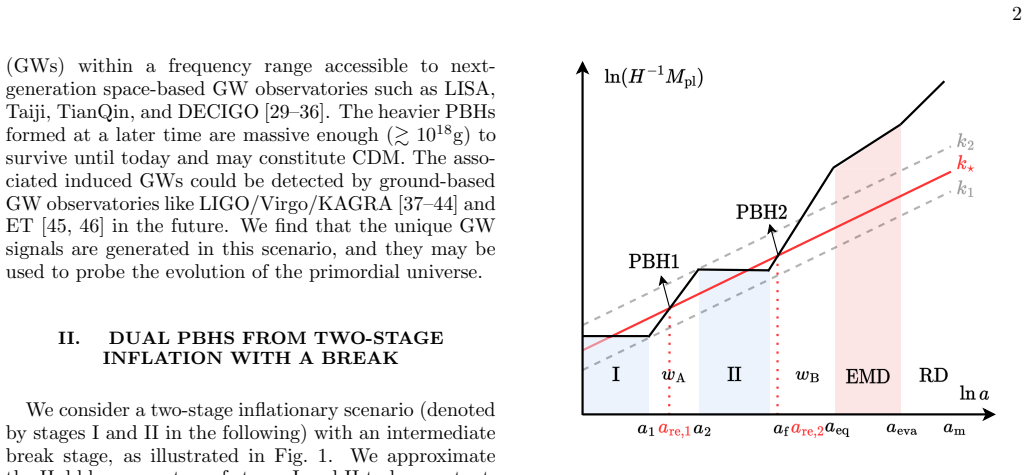
The load-bearing object is the double horizon crossing of one comoving mode $k_\star$ in a two-stage inflationary model with a break. The mass scale at each crossing is set by $M_{\mathrm{PBH}} = 4\pi\gamma M_{\mathrm{pl}}^2/H(t_{\mathrm{re}})$, so two different Hubble rates yield two different black-hole masses. The abundance of each family is set through the standard collapse-abundance formula $\beta \propto \mathrm{erfc}[\delta_{\mathrm{th}}/(\sqrt{2}\sigma)]$, where $\sigma^2$ is the smoothed density-contrast variance; the mechanism that makes the ratio small enough is the curvature transfer function $T(k) \equiv P_{\mathcal R}(k,t_f)/P_{\mathcal R}(k,t_{\mathrm{re},1})$, obtained by solving the linear curvature perturbation equation $\mathcal R''_k + 2(z'/z)\mathcal R_k' + c_s^2 k^2 \mathcal R_k = 0$, which the authors find behaves as $k^{-4}$ in the suppression band. That $k^{-4}$ suppression, combined with the exponential sensitivity of $\beta$ to $\delta_{\mathrm{th}}/\sigma$, is what lets the heavy black-hole abundance fall below the required ceiling while remaining large enough to be all of the cold dark matter.
What would settle it
To settle the central claim, compute the collapse threshold and smoothing window for the break and post-inflation equations of state rather than assuming $\delta_{\mathrm{th}}=0.4$ and a sharp lognormal peak, and check whether $\beta_2/\beta_1$ can stay below $6\times10^{-17}$ while $\beta_1$ satisfies Condition 1; observationally, a null detection of either predicted gravitational-wave peak by LISA or DECIGO in the $10^{-1}$ to $1$ Hz window would rule out the advertised parameter space.
Extended reading notes
Core claim
The central discovery claim is the 'dual' formation: at a fixed comoving wavenumber $k_\star$, the Hubble horizon is crossed twice, so the same primordial curvature perturbation seeds black holes at two epochs. During the non-inflationary break between the two inflationary stages, the mode re-enters at a high Hubble rate $H_{\mathrm{re},1}$, forming PBH1 with mass $M_1 = 4\pi\gamma M_{\mathrm{pl}}^2/H_{\mathrm{re},1} \lesssim 5\times 10^8$ g; after inflation it re-enters at a lower $H_{\mathrm{re},2}$, forming PBH2 with $M_2 \gtrsim 10^{17}$ g. The paper derives two necessary conditions: PBH1 must dominate the energy density and then evaporate before Big Bang nucleosynthesis (Condition 1), and PBH2 must remain subdominant at matter-radiation equality unless it is the dark matter (Condition 2, $\beta_2/\beta_1 \lesssim 6\times 10^{-17}$). It then shows numerically that the curvature power spectrum at the end of inflation can be suppressed relative to the first re-entry, scaling as $P_{\mathcal R} \propto k^{-4}$ in the relevant band, which can supply the needed suppression of $\beta_2$ while keeping PBH2 abundant enough to be all of the dark matter. The observable signature is a two-peak stochastic gravitational-wave background, one peak from the isocurvature perturbations that source gravitational waves during PBH1 evaporation and one from second-order curvature-induced gravitational waves at PBH2 formation.
Load-bearing premise
Everything rests on the claim that the same fluctuation that made the ultra-light black holes is strongly damped by the time it re-enters the horizon a second time, by an amount large enough to keep the heavy black-hole abundance below its ceiling; small changes in the break equation of state, the smoothness of the transitions, the smoothing window, or the collapse threshold can move the abundance ratio by many orders of magnitude.
Editorial extensions
If this is right
- The same $k_\star$ predicts two gravitational-wave peaks, one near $10^{-1}$ Hz from the evaporation of PBH1 and one near $10^{-1}$ to $1$ Hz from curvature-induced gravitational waves at PBH2 formation, placing both in the LISA, Taiji, TianQin, and DECIGO band.
- If PBH1 mass is near $5\times10^8$ g and PBH2 near $10^{17}$ g, the scenario yields both a Big Bang nucleosynthesis-safe reheating and $f_{\mathrm{PBH}}=1$ cold dark matter, with an abundance ratio $\beta_2/\beta_1$ as small as $10^{-17}$.
- With a radiation-like post-inflation epoch ($w_B=1/3$), the mass of the dark-matter black holes is bounded by $M_2 \lesssim 10^{19}$ g when $M_1<5\times10^8$ g; with a kination epoch ($w_B=1$), the bound relaxes to $M_2\lesssim10^{23}$ g.
- Because the abundance ratio is exponentially sensitive to the collapse threshold and the amplitude ratio, the scenario makes sharp, testable predictions about the relative heights of the two gravitational-wave peaks rather than a loose order-of-magnitude range.
Reading between the lines
- If the $k^{-4}$ suppression is a general feature of a break stage, then measuring the two peak heights in the gravitational-wave background would directly constrain the break's duration $\Delta N$, its equation-of-state parameter $w_A$, and the smoothness of the transitions, quantities that are otherwise hard to access.
- The same double-re-entry logic could produce more than two black-hole populations if inflation contains several pauses; each additional re-entry would add a peak, so the bi-peak spectrum is the minimal case of a broader family.
- The paper's illustrative example ($A_R=1$, $\Delta=0.5$, $\delta_{\mathrm{th}}=0.4$) leads to the condition $k_\star > 8.24 k_0$, a threshold that depends on the assumed collapse threshold; a dedicated numerical-relativity threshold calculation for the break equation of state would either support or close this window.
- Because the numerical transfer function is computed with $w_A=1/3$ and smooth transitions while the threshold argument allows $w_B>w_A$, the most direct theoretical test is to evolve the transfer function across the actual equation-of-state history and recompute both abundances self-consistently.
Signed reviews
Editorial analysis
A structured set of objections, weighed in public.
Referee Report
Summary. The paper proposes that in a two-stage inflationary scenario with an intermediate non-inflationary break, a single comoving scale can cross the Hubble horizon twice: first during the break stage and again after the end of inflation. The first crossing produces ultralight PBHs (PBH1) whose Hawking evaporation can reheat the universe, while the second produces heavier PBHs (PBH2) that can constitute cold dark matter. The authors derive mass and abundance relations (Conditions 1 and 2), compute a transfer function for the curvature perturbation through the break, and show that the associated induced gravitational wave background has two peaks detectable by LISA, DECIGO, ET, and LIGO A+. The central quantitative claim is that a suppression of the curvature amplitude between the two re-entries, approximated as P_R ∝ k^{-4}, can realize the required ratio β2/β1 ≈ 6×10^{-17}.
Significance. If the central claim were quantitatively established, the paper would present an appealing unified scenario connecting inflation, reheating, and dark matter through a single mechanism, with a falsifiable double-peak gravitational wave signature. The kinematic relations in Sec. II A, the mass bounds from Conditions 1 and 2, and the qualitative idea of dual horizon re-entries are clear and internally consistent. The paper also correctly emphasizes that the abundance ratio is exponentially sensitive to the curvature amplitude and collapse threshold. However, the quantitative demonstration of the suppression factor is not yet convincing: the transfer-function calculation is not reproducible as presented, the analytic finite-width formula has internal inconsistencies, and the parameter example used for the gravitational wave plots is not calibrated to the Press-Schechter abundance. These issues directly affect the load-bearing claim that PBH2 can be all of the cold dark matter while PBH1 reheats the universe.
major comments (4)
- [Sec. II.B, Eq. (20)] The finite-width ratio β2/β1 in Eq. (20) does not follow from the preceding equations. Using the paper's own lognormal approximation and the transfer-function scaling P_R(k;t_f) = P_R^peak(k)(k/k0)^{-4}, the peak of the transferred spectrum is at k⋆2 = e^{-4Δ²}k⋆, but the value at the peak is A_R e^{-8Δ²}(k0/k⋆2)^4/(√(2π)Δ), not A_R(k0/k⋆2)^4/(√(2π)Δ) as stated after Eq. (19). Direct integration with the density-contrast factor (k/k⋆2)^4 gives σ2² = (16/81) A_R e^{16Δ²}(k0/k⋆)^4, whereas Eq. (19) contains an extra factor e^{8Δ²}. Neither this corrected expression nor the expression in the paper reduces to the prefactor (k0/k⋆)^2 and the exponent 4Δ² + (81/32)e^{-16Δ²}δ_th² A_R^{-1}[e^{8Δ²} - (k⋆/k0)^4] displayed in Eq. (20). Therefore the numerical threshold k⋆ > 8.24 k0, which is used to claim that Condition 2 is satisfied, is not supported by the displayed derivation.
- [Sec. II.B, Fig. 4 and following text] The transfer function T(k) shown in Fig. 4 is the only quantitative input that suppresses β2, but the numerical setup is not documented. The caption specifies only 'smooth transitions' of w from −0.999 to 1/3 and back, with c_s² evolving from 1 to 1/3 and to 1, and durations of O(1) e-folds; no profile functions, initial conditions, discretization, or convergence checks are given. Moreover, the analytic replacement P_R(k;t_f) ≈ P_R^peak(k)(k/k0)^{-4} is applied for all k in the lognormal spectrum, including k < k0 where Fig. 4 shows the transfer function returning to unity. Because the Press-Schechter abundance is exponentially sensitive to the amplitude, even a small unsuppressed low-k tail can dominate β2; the paper does not quantify this contribution. The robustness of the suppression window to the transition profile and to the choice of k0 must be demonstrated, ideally with a reproducible numerical calculation or an analytic model with controlled errors.
- [Sec. II.B, Eqs. (18)-(20) and Fig. 6] The parameter choices used for the gravitational wave predictions are not consistent with the Press-Schechter abundance formula used elsewhere. For A_R = 0.05, Δ = 0.5, and δ_th = 0.4, Eq. (18) gives σ1² = (16/81) × 0.05 × e² ≈ 0.073, so β1 ≈ γ erfc[δ_th/(√2 σ1)] ≈ 0.2 × erfc(1.05) ≈ 0.03, not the β1 = 10^{-2} adopted in Fig. 6. Conversely, the example in the text that satisfies Condition 2, A_R = 1 and k⋆ > 8.24 k0, has A1 ≈ A_R e^{8Δ²} ≈ 7.4, which is not a rare Gaussian fluctuation and lies outside the regime where the Press-Schechter formula is reliable. The paper therefore does not present a single parameter point where the required β2/β1 ≈ 6×10^{-17}, the consistency of β1 with the density-variance calculation, and the plotted gravitational wave amplitudes are all mutually consistent.
- [Sec. II.B, text after Eq. (15)] The statement that A(t_re,2) ≲ 10^{-2} 'provided that A(t_re,1) ≃ 10^{-1}' is necessary but not sufficient for Condition 2. For A(t_re,1) = 0.1 and δ_th = 0.4, the ratio in Eq. (15) is β2/β1 ≈ (A2/0.1) exp[-20.3(A2^{-1} - 10)], and the required value 6×10^{-17} is reached only in a narrow interval of A2. The paper does not translate the numerical transfer function into a predicted value of A(t_re,2) with the accuracy needed for an exponentially sensitive quantity. This gap, together with the issues in Eqs. (19)-(20), means the central assertion that the mechanism can realize the dark-matter abundance is not quantitatively established.
minor comments (5)
- [Sec. II.B] The sentence containing 'we assume radiation domination during both formation stages we assume wA = wB = 1/3' has a duplicated 'we assume' and should be edited.
- [Sec. II.B, Fig. 4] The caption should specify the transition profile functions, the duration of each transition, and how k0 is determined from T(k0) = 1; currently the description is too vague to reproduce the curve.
- [Sec. II.B, Eq. (13)] The text says the approximate equality sign in Eq. (13) corresponds to f_PBH = 1, but the equation is written as an inequality; please clarify whether the equality is meant as the maximum allowed value or as a separate benchmark.
- [Abstract and Sec. II.B] The abstract says PBHs form at 'nearly the same comoving scales', but the finite-width calculation places the second peak at k⋆2 = e^{-4Δ²}k⋆, which for Δ = 0.5 is about 0.37 k⋆; please reconcile the wording with the shifted peak.
- [Sec. III, Eq. (27)] The peak frequency f⋆ uses k⋆, but if PBH2 forms predominantly from modes near k⋆2, the peak of the induced GW spectrum should be evaluated at the corresponding frequency; this point should at least be discussed.
Circularity Check
No significant circularity: the scenario's derivations are self-contained and its benchmark parameters are chosen, not fitted or predicted from their own outputs.
full rationale
The derivation chain is self-contained. PBH masses follow from horizon-reentry epochs via Eq. (1); abundances follow from the standard Press-Schechter formula with an assumed lognormal curvature spectrum (17); the suppression of the second-reentry amplitude is computed from a numerical transfer function T(k), and the condition k* > 8.24 k0 is derived by imposing Condition 2 (13), a consistency bound, rather than by fitting the bound to the prediction. No fitted parameter is renamed as a prediction, and no load-bearing self-citation is used: the cited two-stage-inflation literature motivates the model, but the paper's analytic relations and numerical transfer-function check carry the argument. The dark-matter and reheating requirements are applied as constraints on the parameter space, not as outputs that had secretly been inserted. Apparent issues such as the reproducibility of the Fig. 4 transfer function and the internal consistency of the Fig. 6 parameter choice (AR = 0.05 versus beta1 = 1e-2) are correctness and robustness concerns, not circularity, since none of the plotted quantities is equivalent to an input by construction.
Assumptions & free parameters
free parameters (9)
- beta1, PBH1 abundance at formation =
10^-2 (Fig. 6); 4.43x10^-2 and 10^-1 (Fig. 3)
- M1, PBH1 mass =
5x10^8 g (fiducial)
- M2, PBH2 mass =
10^17 g (fiducial)
- AR, lognormal peak curvature amplitude =
1 in Eq. (20) example; 0.05 in Fig. 6
- Delta, lognormal width =
0.5
- delta_th, collapse threshold =
0.4
- k_star/k0, ratio fixing the suppression =
>8.24 (claimed); formula suggests ~1.65
- wA and wB, equation-of-state parameters =
1/3 in abundance estimates; wB=1/3 or 1 in Fig. 3
- Delta N, break duration =
9 e-folds in numerical examples
assumptions (5)
- domain assumption Press-Schechter formalism with Gaussian curvature perturbations and a fixed threshold delta_th relates beta to the density variance sigma^2.
- ad hoc to paper The comoving curvature perturbation obeys Eq. (16) and is conserved on superhorizon scales during the inflationary stages, with the break stage transfer function suppressing P_R as k^-4.
- domain assumption The break stage and the second inflationary stage are long enough for the same mode k_star to re-enter, re-exit, and re-enter again.
- domain assumption The universe is dominated by a fluid with constant equation of state wA during the break and wB after inflation, and by a nearly constant Hubble rate during each inflationary stage.
- standard math Induced gravitational wave formulas from Refs. [17,53,64] apply as quoted.
Cite this review
Pith. "Pith review of The Dual Primordial Black Hole Formation Scenario." pith.science (2026). https://pith.science/paper/WKSASM7A
@misc{pith2026250509337,
  author       = {Pith},
  title        = {Pith review of: The Dual Primordial Black Hole Formation Scenario},
  year         = {2026},
  howpublished = {\url{https://pith.science/paper/WKSASM7A}},
  note         = {Machine review of arXiv:2505.09337}
}
read the original abstract
We report a novel mechanism where two families of primordial black holes (PBHs) may form at nearly the same comoving scales but at two different epochs. It is realized in two-stage inflation where a non-inflationary stage is sandwiched by the two inflationary stages. In this case, smaller PBHs form when the comoving scale of interest re-enters the horizon during the break period, and larger PBHs form when the scale re-enters the horizon after inflation. This mechanism may realize both reheating of the universe through the evaporation of ultralight PBHs formed during the break stage and the dark matter by those formed after inflation. We show that this scenario may give rise to a distinctive signature in the stochastic gravitational wave background that can be tested by the near-future gravitational wave observatories such as LISA and DECIGO. Our work thus provides a unified observational window into the physics of inflation, reheating, and dark matter.
Figures


Figures from the paper (3 more)


Reference graph
Works this paper leans on
-
[1]
2, we assume that PBH2 are al- ways subdominant to PBH1 before they evaporate, i.e, ρPBH2≪ ρPBH1
GWs induced by PBH isocurvature As shown in Fig. 2, we assume that PBH2 are al- ways subdominant to PBH1 before they evaporate, i.e, ρPBH2≪ ρPBH1. Assuming the Poisson distribution of PBHs, the ultra-violet (UV) cut-off of the PBH1 density spectrum is given by kUV≡ are,1 d =k⋆ β1 γ 1/3 (≪k⋆), (21) whered is the mean physical separation of PBH1. Before the...
-
[2]
It is evident from (13) that the abundance of PBH2 must be much lower than that of PBH1 at the formation time. Since the abundance is sensitive to both the thresh- old [49] and the amplitude of the curvature perturbation at horizon re-entry, there are three ways to realize the suppression of the PBH2 formation relative to the PBH1 formation: (i) The curva...
-
[3]
GWs induced by enhanced curvature perturbations In addition to GWs produced at PBH1 evaporation, the enhanced curvature perturbation at k⋆ can induce GWs at second order [55–63]. Here we note that PBH2s are produced during the wB stage, not during radiation dominance after evaporation of PBH1. The frequency of the spectral peak today is given by f⋆ = k⋆ 2...
-
[4]
Y. B. Zel’dovich and I. Novikov, Astronomicheskii Zhur- nal 43, 758 (1966)
work page 1966
-
[5]
Hawking, Mon
S. Hawking, Mon. Not. Roy. Astron. Soc. 152, 75 (1971)
1971
-
[6]
B. J. Carr and S. W. Hawking, Mon. Not. Roy. Astron. Soc. 168, 399 (1974)
1974
-
[7]
Meszaros, Astron
P. Meszaros, Astron. Astrophys. 37, 225 (1974)
1974
-
[8]
M. Khlopov, B. A. Malomed, and I. B. Zeldovich, Mon. Not. Roy. Astron. Soc. 215, 575 (1985)
work page 1985
Show all 77 references
-
[9]
G. F. Chapline, Nature 253, 251 (1975)
1975
-
[10]
Niikura, M
H. Niikura, M. Takada, S. Yokoyama, T. Sumi, and S. Masaki, Phys. Rev. D 99, 083503 (2019), arXiv:1901.07120 [astro-ph.CO]
2019 arXiv
-
[11]
A. Katz, J. Kopp, S. Sibiryakov, and W. Xue, JCAP 12, 005 (2018), arXiv:1807.11495 [astro-ph.CO]
2018 arXiv
-
[12]
Smyth, S
N. Smyth, S. Profumo, S. English, T. Jeltema, K. McK- innon, and P. Guhathakurta, Phys. Rev. D 101, 063005 (2020), arXiv:1910.01285 [astro-ph.CO]
2020 arXiv
-
[13]
Montero-Camacho, X
P. Montero-Camacho, X. Fang, G. Vasquez, M. Silva, and C. M. Hirata, JCAP 08, 031 (2019), arXiv:1906.05950 [astro-ph.CO]
2019 arXiv
-
[14]
J. C. Hidalgo, L. A. Urena-Lopez, and A. R. Liddle, Phys. Rev. D 85, 044055 (2012), arXiv:1107.5669 [astro- ph.CO]
2012 arXiv
-
[15]
B. J. Carr, Astrophys. J. 206, 8 (1976)
1976
-
[16]
Papanikolaou, V
T. Papanikolaou, V. Vennin, and D. Langlois, JCAP 03, 053 (2021), arXiv:2010.11573 [astro-ph.CO]
2021 arXiv
-
[17]
Dom` enech, C
G. Dom` enech, C. Lin, and M. Sasaki, JCAP 04, 062 (2021), [Erratum: JCAP 11, E01 (2021)], arXiv:2012.08151 [gr-qc]
2021 arXiv
- [18]
-
[19]
Martin, T
J. Martin, T. Papanikolaou, and V. Vennin, JCAP 01, 024 (2020), arXiv:1907.04236 [astro-ph.CO]
2020 arXiv
- [20]
-
[21]
del Corral, K
D. del Corral, K. S. Kumar, and J. a. Marto, (2025), arXiv:2504.05875 [astro-ph.CO]
2025 arXiv
-
[22]
Polarski and A
D. Polarski and A. A. Starobinsky, Phys. Lett. B 356, 196 (1995), arXiv:astro-ph/9505125
1995 arXiv
-
[23]
M. I. Zelnikov and V. F. Mukhanov, JETP Lett. 54, 197 (1991)
1991
-
[24]
Allahverdi, A
R. Allahverdi, A. Mazumdar, and T. Multamaki, (2007), arXiv:0712.2031 [astro-ph]
2007 arXiv
-
[25]
M. H. Namjoo, H. Firouzjahi, and M. Sasaki, JCAP 12, 018 (2012), arXiv:1207.3638 [hep-th]
2012 arXiv
-
[26]
Kohri, C.-M
K. Kohri, C.-M. Lin, and T. Matsuda, Phys. Rev. D 87, 103527 (2013), arXiv:1211.2371 [hep-ph]
2013 arXiv
-
[27]
S. Pi, M. Sasaki, and Y.-l. Zhang, JCAP 06, 049 (2019), arXiv:1904.06304 [gr-qc]
2019 arXiv
-
[28]
Wang, Y.-l
X. Wang, Y.-l. Zhang, and M. Sasaki, JCAP 07, 076 (2024), arXiv:2404.02492 [astro-ph.CO]
2024 arXiv
-
[29]
J. Kim, X. Wang, Y.-l. Zhang, and Z. Ren, (2025), arXiv:2504.12035 [astro-ph.CO]
2025 arXiv
-
[30]
S. W. Hawking, Commun. Math. Phys. 43, 199 (1975), [Erratum: Commun.Math.Phys. 46, 206 (1976)]
1975
-
[31]
Riajul Haque, E
M. Riajul Haque, E. Kpatcha, D. Maity, and Y. Mambrini, Phys. Rev. D 108, 063523 (2023), arXiv:2305.10518 [hep-ph]
2023 arXiv
-
[32]
P. A. Seoane et al. (LISA), Living Rev. Rel. 26, 2 (2023), arXiv:2203.06016 [gr-qc]
2023 arXiv
-
[33]
Luo et al
J. Luo et al. (TianQin), Class. Quant. Grav. 33, 035010 (2016), arXiv:1512.02076 [astro-ph.IM]
2016 arXiv
-
[34]
Ruan, Z.-K
W.-H. Ruan, Z.-K. Guo, R.-G. Cai, and Y.-Z. Zhang, Int. J. Mod. Phys. A 35, 2050075 (2020), arXiv:1807.09495 [gr-qc]
2020 arXiv
-
[35]
Hu and Y.-L
W.-R. Hu and Y.-L. Wu, Natl. Sci. Rev. 4, 685 (2017)
2017
-
[36]
Kawamura et al
S. Kawamura et al. , Class. Quant. Grav. 28, 094011 (2011)
2011
-
[37]
Kawamura et al., Class
S. Kawamura et al., Class. Quant. Grav. 23, S125 (2006)
2006
-
[38]
Kawamura et al
S. Kawamura et al. , PTEP 2021, 05A105 (2021), arXiv:2006.13545 [gr-qc]. 9
2021 arXiv
-
[39]
Mei et al
J. Mei et al. (TianQin), PTEP 2021, 05A107 (2021), arXiv:2008.10332 [gr-qc]
2021
-
[40]
B. P. Abbott et al. (LIGO Scientific, Virgo), Phys. Rev. X 9, 031040 (2019), arXiv:1811.12907 [astro-ph.HE]
2019 arXiv
-
[41]
Abbott et al
R. Abbott et al. (LIGO Scientific, Virgo), Phys. Rev. X 11, 021053 (2021), arXiv:2010.14527 [gr-qc]
2021 arXiv
-
[42]
Abbott et al
R. Abbott et al. (LIGO Scientific, VIRGO, KAGRA), (2021), arXiv:2111.03606 [gr-qc]
2021 arXiv
-
[43]
B. P. Abbott et al. (KAGRA, LIGO Scientific, Virgo, VIRGO), Living Rev. Rel. 21, 3 (2018), arXiv:1304.0670 [gr-qc]
2018 arXiv
-
[44]
Acernese et al
F. Acernese et al. (VIRGO), Class. Quant. Grav. 32, 024001 (2015), arXiv:1408.3978 [gr-qc]
2015 arXiv
-
[45]
R. E. Smith, J. A. Peacock, A. Jenkins, S. D. M. White, C. S. Frenk, F. R. Pearce, P. A. Thomas, G. Efstathiou, and H. M. P. Couchmann (VIRGO Consortium), Mon. Not. Roy. Astron. Soc. 341, 1311 (2003), arXiv:astro- ph/0207664
2003
-
[46]
Somiya (KAGRA), Class
K. Somiya (KAGRA), Class. Quant. Grav. 29, 124007 (2012), arXiv:1111.7185 [gr-qc]
2012 arXiv
-
[47]
Y. Aso, Y. Michimura, K. Somiya, M. Ando, O. Miyakawa, T. Sekiguchi, D. Tatsumi, and H. Ya- mamoto (KAGRA), Phys. Rev. D 88, 043007 (2013), arXiv:1306.6747 [gr-qc]
2013 arXiv
-
[48]
Punturo et al., Class
M. Punturo et al., Class. Quant. Grav.27, 194002 (2010)
2010
-
[49]
Hild et al
S. Hild et al. , Class. Quant. Grav. 28, 094013 (2011), arXiv:1012.0908 [gr-qc]
2011 arXiv
-
[50]
See a proof in Appendix A
It can be proved that it is impossible for those modes to re-enter the horizon during or after the early PBH dominated era. See a proof in Appendix A
-
[51]
Here TPBH ≡ M2 pl/M1, then α≈ 3.8πgH(TPBH)/480
Since we are considering PBH1 whose mass M1≪ 1011g, the spin-weighted degree of freedom gH(TPBH)≈ 108[73, 74] is used in the following calculation. Here TPBH ≡ M2 pl/M1, then α≈ 3.8πgH(TPBH)/480
-
[52]
Using Press-Schechter formalism, the PBH abundance at the formation for the Gaussian case is β(M) = γ erfc δth/ √ 2σδ(H) , whereσ2 δ(H)∝σ2 R(H) is the vari- ance of the density contrast on scale H, smoothed by a window function W (k;R)
-
[53]
Harada, C.-M
T. Harada, C.-M. Yoo, and K. Kohri, Phys. Rev. D 88, 084051 (2013), [Erratum: Phys.Rev.D 89, 029903 (2014)], arXiv:1309.4201 [astro-ph.CO]
2013 arXiv
-
[54]
Inomata, K
K. Inomata, K. Kohri, T. Nakama, and T. Terada, Phys. Rev. D 100, 043532 (2019), [Erratum: Phys.Rev.D 108, 049901 (2023)], arXiv:1904.12879 [astro-ph.CO]
2019 arXiv
-
[55]
Inomata, M
K. Inomata, M. Kawasaki, K. Mukaida, T. Terada, and T. T. Yanagida, Phys. Rev. D 101, 123533 (2020), arXiv:2003.10455 [astro-ph.CO]
2020 arXiv
-
[56]
Dom` enech, Universe7, 398 (2021), arXiv:2109.01398 [gr-qc]
G. Dom` enech, Universe7, 398 (2021), arXiv:2109.01398 [gr-qc]
2021 arXiv
-
[57]
While at the time of matter-radiation dominationg⋆s(Teq)≈ g⋆s(T0)≈ 3.94, g⋆(Teq)≈ g⋆(T0)≈ 3.38
For radiation at temperature T , the entropy can be calculated by s = 2π2 45 g⋆s(T )T 3, for T > 100GeV we have g⋆s ≈ g⋆ ≈ 106.75. While at the time of matter-radiation dominationg⋆s(Teq)≈ g⋆s(T0)≈ 3.94, g⋆(Teq)≈ g⋆(T0)≈ 3.38. Considering that the total en- tropy is conserved,...
-
[58]
Matarrese, O
S. Matarrese, O. Pantano, and D. Saez, Phys. Rev. D 47, 1311 (1993)
1993
-
[59]
Matarrese, O
S. Matarrese, O. Pantano, and D. Saez, Phys. Rev. Lett. 72, 320 (1994), arXiv:astro-ph/9310036
1994 arXiv
-
[60]
T. T. Nakamura and E. D. Stewart, Phys. Lett. B 381, 413 (1996), arXiv:astro-ph/9604103
1996 arXiv
-
[61]
Matarrese, S
S. Matarrese, S. Mollerach, and M. Bruni, Phys. Rev. D 58, 043504 (1998), arXiv:astro-ph/9707278
1998 arXiv
-
[62]
Noh and J.-c
H. Noh and J.-c. Hwang, Phys. Rev. D69, 104011 (2004)
2004
-
[63]
Carbone and S
C. Carbone and S. Matarrese, Phys. Rev. D 71, 043508 (2005), arXiv:astro-ph/0407611
2005 arXiv
- [64]
-
[65]
K. N. Ananda, C. Clarkson, and D. Wands, Phys. Rev. D 75, 123518 (2007), arXiv:gr-qc/0612013
2007 arXiv
-
[66]
Osano, C
B. Osano, C. Pitrou, P. Dunsby, J.-P. Uzan, and C. Clarkson, JCAP 04, 003 (2007), arXiv:gr-qc/0612108
2007 arXiv
- [67]
-
[68]
Thrane and J
E. Thrane and J. D. Romano, Phys. Rev. D 88, 124032 (2013), arXiv:1310.5300 [astro-ph.IM]
2013 arXiv
-
[69]
Schmitz, JHEP 01, 097 (2021), arXiv:2002.04615 [hep-ph]
K. Schmitz, JHEP 01, 097 (2021), arXiv:2002.04615 [hep-ph]
2021 arXiv
-
[70]
N. Seto, S. Kawamura, and T. Nakamura, Phys. Rev. Lett. 87, 221103 (2001), arXiv:astro-ph/0108011
2001 arXiv
-
[71]
The A+ design curve,
L. S. Collaboration, “The A+ design curve,” https:// dcc.ligo.org/LIGO-T1800042/public
-
[72]
Maggiore et al
M. Maggiore et al. (ET), JCAP 03, 050 (2020), arXiv:1912.02622 [astro-ph.CO]
2020 arXiv
-
[73]
Suyama and S
T. Suyama and S. Yokoyama, PTEP 2019, 103E02 (2019), arXiv:1906.04958 [astro-ph.CO]
2019 arXiv
-
[74]
Papanikolaou, X.-C
T. Papanikolaou, X.-C. He, X.-H. Ma, Y.-F. Cai, E. N. Saridakis, and M. Sasaki, (2024), arXiv:2403.00660 [astro-ph.CO]
2024 arXiv
-
[75]
He, Y.-F
X.-C. He, Y.-F. Cai, X.-H. Ma, T. Papanikolaou, E. N. Saridakis, and M. Sasaki, JCAP 12, 039 (2024), arXiv:2409.11333 [astro-ph.CO]
2024 arXiv
-
[76]
Husdal, Galaxies 4, 78 (2016), arXiv:1609.04979 [astro-ph.CO]
L. Husdal, Galaxies 4, 78 (2016), arXiv:1609.04979 [astro-ph.CO]
2016 arXiv
- [77]
Reviewed August 15, 2026 · model on record in the stance chip above.
Discussion (0). Continue with ORCID to comment.