REVIEW 3 major objections 5 minor 2 cited by
Probabilistic construction of non compactified imaginary Liouville field theory
T0 review · 3 major / 5 minor · reviewed 2026-08-15 · deepseek-v4-flash
Pith's one-line read Imaginary Liouville field theory, defined by a U-shaped zero-mode contour, reproduces the imaginary DOZZ structure constants without a neutrality constraint.
desk verdict A genuinely new probabilistic proposal for imaginary Liouville theory with an exact circle result and a striking numerical match on the sphere; the sphere three-point claim rests on an unproved tail conjecture, so the paper is conditional rather than established. read the letter →
The pith
A machine-rendered reading of the paper's core claim, the machinery that carries it, and where it could break.
The reading
What carries the argument
The central object is the moment generating function $G_{\beta,\alpha}(\mu)=E[e^{-\mu M_{\beta,\alpha}}]$ of the imaginary Gaussian multiplicative chaos $M_{\beta,\alpha}$, the limit of $\int e^{i\beta X_\epsilon}\,\epsilon^{-\beta^2/2} dv$ with charge insertions, together with the U-shaped Hankel contour for the zero mode $c$. On the circle the Laplace transform is evaluated through Selberg integrals as $G^S_\beta(\mu)=\int_0^\infty e^{-\mu t^{\beta^2/4}-t}dt$, whose algebraic tail $\mu^{-4/\beta^2}$ selects $U$ as the contour on which the one-point integral converges, in direct analogy with the inverse Gamma function. On the sphere the same mechanism is conjectured to hold: sufficient decay of the integrand in $C_\alpha=\int_U e^{i(\bar\alpha-2Q)c}G^{\hat C}_{\beta,\alpha}(\mu e^{i\beta c})dc$ makes the three-point function finite, and the shift equations together with duality $\beta\to -4/\beta$ identify the result with $C^{\mathrm{ImDOZZ}}_\alpha$. The U contour is the load-bearing choice: it replaces the neutrality constraint of the compactified theory by a prescription valid for real $s=(2Q-\sum_i\alpha_i)/\beta$.
What would settle it
For fixed $\beta\in(0,\sqrt{2})$ and charges $\alpha_i>Q$, estimate the sphere tail $E[e^{-\mu M^{\hat C}_{\beta,\alpha}}]$ for large $\mu$; if $\mu^{4/\beta^2}E[e^{-\mu M^{\hat C}_{\beta,\alpha}}]$ does not approach a nonzero constant, the contour integral (15) will diverge or acquire extra terms and $C_\alpha=C^{\mathrm{ImDOZZ}}_\alpha$ will fail. The same test near a pole of $C^{\mathrm{ImDOZZ}}$, where the numerical method already loses accuracy, is a direct place to look.
Extended reading notes
Core claim
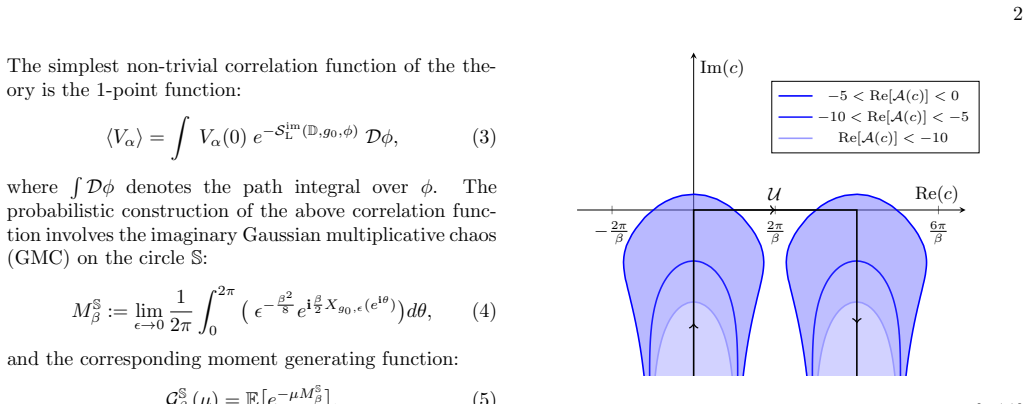
The discovery is a contour prescription that makes the imaginary Liouville path integral well defined. Writing $\phi = X + c$ with $X$ a real Gaussian free field and $c$ a complex constant, the paper integrates $c$ along $U$, made of the lines $[0,-i\infty)$, $[0,2\pi/\beta]$ and $[2\pi/\beta,2\pi/\beta-i\infty)$ on the sphere, with $4\pi/\beta$ replacing $2\pi/\beta$ on the circle. On the circle this yields the exact one-point formula $\langle V_\alpha\rangle = \frac{4\pi}{\beta} e^{-i\pi s} \mu_B^s \frac{\Gamma(1+s\beta^2/4)}{(\Gamma(1+\beta^2/4))^s \Gamma(1+s)}$, built on the rigorous tail $G^S_\beta(\mu)\sim C \mu^{-4/\beta^2}$ of the Laplace transform of imaginary Gaussian multiplicative chaos. On the sphere the same contour gives $C_\alpha = \int_U e^{i(\bar\alpha-2Q)c} G^{\hat C}_{\beta,\alpha}(\mu e^{i\beta c}) dc$, and the paper claims this equals the imaginary DOZZ structure constant $C^{\mathrm{ImDOZZ}}_\alpha$, with numerical simulations in close agreement. The construction is presented as the first explicit Lagrangian theory reproducing those constants without a neutrality condition, and as a real-$s$ extension of the Coulomb-gas Dotsenko-Fateev integrals.
Load-bearing premise
The sphere claim stands on the unproven assumption that the average $E[e^{-\mu M}]$ decays as a pure power of $\mu$ for large $\mu$, just as it does on the circle; the paper's own numerical agreement also degrades near the poles of the imaginary DOZZ constant.
Editorial extensions
If this is right
- The three-point functions of a Lagrangian field theory at central charge $c_{\mathrm{charge}}\le 1$ become one-dimensional contour integrals over imaginary Gaussian multiplicative chaos, with no neutrality condition.
- For integer $s$, the U-contour definition reduces to the Dotsenko-Fateev Coulomb-gas integrals, so the theory is the real-$s$ interpolation of the compactified imaginary Liouville theory.
- The circle one-point function obeys the expected shift relations and the duality $\beta\to -4/\beta$, and the same zero-mode integral with the contour $i\mathbb{R}$ gives the analytic continuation of real Liouville theory.
- On general closed surfaces, the same prescription defines correlation functions under the Seiberg-type bounds $\alpha_j>Q$ and $s<\beta\lambda$, with a pole at $s=\beta\lambda$ fixed by the Laplace-transform tail.
- If the equality holds, the paper supplies a Lagrangian counterpart to the bootstrap solutions used in Potts and $O(n)$ loop models.
Reading between the lines
- A proof of the conjectured power-law tail on the sphere, perhaps by extending the Selberg-type moment computations used on the circle, would turn the numerical match into a theorem; the same exact moment method that produces the circle tail is a plausible route.
- The numerical breakdown near poles suggests rare-event tails dominate the Laplace transform there, so importance sampling or a direct tail-exponent computation at the pole would sharpen the test without a full proof.
- Because the paper leaves four-point factorization open, a natural next test is to compute a four-point ratio from the U-contour and compare with the known non-compact bootstrap solution, which would reveal whether the U-contour theory is the same conformal field theory or a new one.
- Rational $\beta^2$ or the $\beta\to\sqrt{2}$ boundary could anchor the construction to exact minimal-model or $c=1$ answers, providing cross-checks outside the parameter range currently simulated.
Signed reviews
Editorial analysis
A structured set of objections, weighed in public.
Referee Report
Summary. The manuscript proposes a probabilistic construction of imaginary Liouville field theory based on a real (non-compactified) Gaussian free field, with the zero mode integrated over a U-shaped Hankel-type contour in the complex plane. For the circle, the authors rigorously compute the one-point function by combining known Selberg-integral moments of imaginary Gaussian multiplicative chaos with the exact power-law tail of its Laplace transform, obtaining the closed expression in Eq. (8). For the sphere, they define the three-point function as the U-contour integral in Eq. (15) involving the Laplace transform of the sphere imaginary GMC, rewrite it as Eq. (16), and conjecture that this equals the imaginary DOZZ structure constant (Eq. (17)). The equality is supported by numerical Monte Carlo simulations shown in Fig. 9 and by the observation that at integer values of the parameter s the expressions reduce to Dotsenko-Fateev/Coulomb gas integrals. The manuscript also sketches a definition for general surfaces under a postulated power-law decay of the Laplace transform.
Significance. If the central claim (17) were established rigorously, this would be an important step: it would provide the first explicit Lagrangian path-integral construction reproducing the imaginary DOZZ structure constants without a neutrality constraint, with direct relevance to c ≤ 1 conformal field theories, Potts models, and O(n) loop models. The circle one-point function is a rigorous and valuable exact result, obtained from Selberg integrals and a clean asymptotic analysis. The general idea of using a complex zero-mode contour to continue the Coulomb gas integrals to real s is attractive and well motivated by prior work on analytic continuation of Liouville theory. However, the sphere three-point claim rests on a conjectured tail behavior and on numerical evidence of limited scope, so the paper is best viewed as a compelling proposal with a rigorous core on the circle and an open analytical gap on the sphere.
major comments (3)
- [Eqs. (15)–(17) and the paragraph after Eq. (15)] The numerical support in Fig. 9 is not sufficient for the full parameter range of Eq. (17). The figure uses a single parameter set beta = 0.44, alpha1 = -3.94, alpha2 = -3.58, a fixed cutoff N_modes = 211, and no reported error bars or convergence tests in N_modes and sample number. The authors state in the supplementary material that the simulations lose accuracy near a pole of the imaginary DOZZ function, precisely where the tail of the GMC distribution determines the result. Since the claimed equality is supposed to hold for all allowed alpha_i > Q, the numerical evidence covers only a small slice of the domain. At a minimum, the paper should show error estimates, convergence with cutoff, and tests at several non-integer values of s away from integer points and from poles.
- [Eq. (16) and the paragraph beginning 'When s in N'] Part of the agreement with the imaginary DOZZ constant is by construction: for integer s, Eq. (16) reduces exactly to the Dotsenko-Fateev/Coulomb gas integrals, and the imaginary DOZZ constant is defined as the unique analytic continuation of those integrals (the authors cite Schomerus, Kostov-Petkova, Zamolodchikov, Dotsenko for this). Therefore equality at integer s is not an independent confirmation of Eq. (17). The genuinely independent content of the claim is the extension to non-integer s, and the numerical evidence for that extension is the limited set shown in Fig. 9. The paper should state this distinction explicitly and focus the numerical and analytical effort on the non-integer regime.
- [General-surface section and Seiberg bounds] The proposed definition for a general surface (Sigma,g) is based entirely on the postulated power-law decay E[e^{-mu M} ] ~ mu^{-lambda}, with no proof or numerical test except on the circle and sphere. The manuscript presents this as a definition for LFT_i_beta, but the convergence of the U-contour integral and the validity of the Seiberg-type bounds depend critically on the value of lambda and on the absence of oscillatory or logarithmic corrections. Since the sphere case, which is the paper's main result, already depends on an unproved conjecture, the general-surface proposal should be clearly labeled as conditional on this postulate and not as a construction of the theory.
minor comments (5)
- [Main text after Eq. (23)] The text refers to 'the asymptotic behavior (24)' and says it is checked in the supplementary material, but Eq. (24) appears only in the supplementary material and is not labeled in the main text; the cross-reference should be corrected.
- [Fig. 5 caption] Some axis labels in Fig. 5 are garbled, e.g. 'G S_{beta,epsilon}(e^{i beta/2 c})]' appears to be missing a 'Re' or 'Im' prefix; please fix the LaTeX and ensure both panels have clear axis labels.
- [Supplementary material, sentence after Eq. (45)] The statement 'the accuracy of the numerical results diminishes in the vicinity of the pole s = -4/beta^2' is important and should appear in the main text as a limitation of the numerical method, not only in the supplementary material.
- [Main text, paragraph before Eq. (11)] The notation 's in -N*' is nonstandard; write 's in -N' or 's = -n with n in N' for clarity.
- [Reference list] The reference '[Not]' is informal; if the Girsanov/Cameron-Martin formula is used, cite a standard textbook or the original source instead of a parenthetical remark.
Circularity Check
Three-point equality is partly definitional: both sides reduce to the same Dotsenko–Fateev integrals at integer s, so the non-integer comparison validates a unique analytic continuation rather than an independent prediction.
-
self definitional
[Main text after Eq. (16) and Eq. (17); supplementary material around Eq. (27)]
"one can show that when s∈ N, Eq. (25) yields the value of the Coulomb gas integral with three electric charges ; The LFT iβ, as defined above, represents an extension of the Coulomb gas correlation functions – and hence of the CILT – to real values of the parameter s. ... Moreover, it can be derived as the unique analytic continuation of the Dotsenko-Fateev integrals with 3 electric charges ... This is precisely why our theory must coincide with this bootstrap solution: Cα =CImDOZZ α ."
At integer s, the authors' own Eq. (16) collapses to the horizontal branch and gives the Dotsenko-Fateev/Coulomb-gas integral, exactly the object that Eq. (25) reduces to for integer s. The paper then defines LFT iβ as an extension of those same Coulomb-gas integrals to real s, and introduces the comparison target CImDOZZ as the unique analytic continuation of the very same integrals. Thus, once the U-contour integral is assumed to be analytic (which requires the conjectured power-law tail of the sphere GMC Laplace transform), the identity Cα=CImDOZZ is forced by uniqueness; the equality at integer s is by construction, and the numerical agreement for non-integer s is a consistency check on the tail conjecture rather than a test against an independently defined structure constant.
full rationale
The paper contains substantial non-circular content: the circle one-point function (Eq. 8) is derived rigorously from Selberg-type moments and the exact Laplace-transform tail (Eq. 7); the sphere three-point function is defined through the probabilistic imaginary GMC, not through the DOZZ formula; and the comparison to CImDOZZ is a numerical benchmark. The main circularity concern is narrower and located in the reasoning leading to Eq. (17). The text explicitly says the theory is an extension of the Coulomb-gas integrals to real s, while CImDOZZ is invoked as the unique analytic continuation of those same integrals. Since Eq. (16) reduces to the Coulomb-gas integrals at every positive integer s, the equality at those points is automatic, and for non-integer s the equality follows from uniqueness if the conjectured power-law decay of the sphere moment generating function holds. This makes the central three-point identity partially definitional: it verifies that the probabilistic U-contour integral realizes the unique analytic continuation of its own integer-s special cases. However, this is not a case of fitted parameters or a self-citation chain; the probabilistic construction and the rigorous circle results add independent mathematical content, and the unproved tail behavior is a correctness/convergence gap rather than circularity. Self-citations such as [CSU23] for the U-contour choice and [GKRa] for exponential moments are used as ordinary inputs, not as the sole justification of the central identity. Overall the paper is not fundamentally circular, but the headline three-point claim is moderately weakened by being anchored, by design, to the same Dotsenko-Fateev integrals that define the comparison target.
Assumptions & free parameters
free parameters (1)
- Vertex operator normalization =
Not numerically specified; chosen to satisfy shift equations and to match [GKRa] convention (Eq. 25)
assumptions (5)
- domain assumption Imaginary GMC on the circle (M_S^beta) and on the sphere (M^C_hat_{beta,alpha}) exist as random variables with finite L2 and exponential moments for beta in (0,sqrt(2)) and alpha_i > Q.
- standard math Selberg integral: E[(M_S^beta)^n] = Gamma(1+n beta^2/4) / Gamma(1+beta^2/4)^n.
- ad hoc to paper The path integral factorizes as integral Dphi... = integral_C dc E[...] with a complex constant c, and the zero-mode contour can be deformed to the U-shaped Hankel contour.
- ad hoc to paper The Laplace transform of the sphere imaginary GMC, G^C_hat_{beta,alpha}(mu), decays as a power law as mu -> +infinity (conjectured).
- domain assumption The imaginary DOZZ constant is the unique solution of the shift equations at c<=1, so any theory extending the Coulomb gas integrals must equal it.
Cite this review
Pith. "Pith review of Probabilistic construction of non compactified imaginary Liouville field theory." pith.science (2026). https://pith.science/paper/SFFZRHUW
@misc{pith2026250509390,
  author       = {Pith},
  title        = {Pith review of: Probabilistic construction of non compactified imaginary Liouville field theory},
  year         = {2026},
  howpublished = {\url{https://pith.science/paper/SFFZRHUW}},
  note         = {Machine review of arXiv:2505.09390}
}
read the original abstract
We propose a probabilistic construction of imaginary Liouville Field Theory based on a real (non-compactified) Gaussian Free Field. We argue that our theory is the first explicit Lagrangian field theory that reproduces the imaginary DOZZ structure constants without requiring a neutrality constraint. Our proposal is supported by exact results for the imaginary Gaussian Multiplicative Chaos on the circle, and by numerical simulations on the sphere. In particular, we show that the three-point functions of the theory agree remarkably well with the imaginary DOZZ structure constants.
Figures


Figures from the paper (5 more)


Forward citations
Cited by 2 Pith papers
-
On the Virasoro Crossing Kernels at Rational Central Charge
At rational central charge, the Virasoro crossing kernels decompose into two admissible square-root-branched kernels; the physical c≤1 kernels are derived for the first time.
-
Quantum Liouville Cosmology
Timelike Liouville disk path integrals in fixed K-representation produce Hartle-Hawking-like states, a conjecture for all-loop wavefunctions, and a K-independent inner product for 2D quantum cosmology.
Reference graph
Works this paper leans on
-
[1]
T. Bautista and A. Bawane. Boundary timelike Liouville theory: Bulk one-point and boundary two-point functions . Phys. Rev. D , 106:126011, 2022
work page 2022
-
[2]
S. Collier, L. Eberhardt, B. M \"u hlmann, and V. Rodriguez. The Virasoro minimal string . SciPost Physics , 16(2), 2024
work page 2024
-
[3]
S. Chatterjee. Rigorous results for timelike L iouville field theory . ArXiv:2504.02348
-
[4]
X. Cao, R. Santachiara, and R. Usciati. On the analytical continuation of lattice Liouville theory . Journal of High Energy Physics , 2023(3), 2023
work page 2023
-
[5]
V; Dotsenko and V. Fateev. Conformal algebra and multipoint correlation functions in 2D statistical models . Nuclear Physics B , 312:691, 1984
work page 1984
- [6]
-
[7]
Y. Fyodorov and J-P. Bouchaud. Freezing and extreme-value statistics in a random energy model with logarithmically correlated potential. J. Phys. A: Math. Theor. , 41(37):372001, 2008
work page 2008
-
[8]
P. Forrester and S.O. Warnaar. The importance of the Selberg integral . Bulletin of the A.M.S. , 45(4):489--534, 2008
work page 2008
Show all 31 references
-
[9]
Guillarmou, A
C. Guillarmou, A. Kupiainen, and R. Rhodes. Compactified Imaginary Liouville Theory . ArXiv:2310.18226
-
[10]
Guillarmou, A
C. Guillarmou, A. Kupiainen, and R. Rhodes. Review on the probabilistic construction and conformal bootstrap in Liouville theory . arXiv:2403.12780
-
[11]
Guillarmou, A
C. Guillarmou, A. Kupiainen, R. Rhodes, and V. Vargas. Segal's axioms and bootstrap for Liouville Theory . ArXiv: 2112.14859
-
[12]
Guillarmou, R
C. Guillarmou, R. Rhodes, and V. Vargas. Polyakov's formulation of 2d bosonic string theory. Publ. math. IHES , 130(1):111--185, 2019
2019
-
[13]
Gutperle and A
M. Gutperle and A. Strominger. Timelike boundary Liouville theory . Phys. Rev. D , 67:126002, 2003
2003
-
[14]
Harlow, J
D. Harlow, J. Maltz, and E. Witten. Analytic continuation of Liouville theory . Journal of High Energy Physics , 71, 2011
2011
-
[15]
Huang, R
Y. Huang, R. Rhodes, and V. Vargas. Liouville quantum gravity on the unit disk . Ann. Inst. H. Poincar \'e Probab. Statist. , 54(3):1694--1730, 2018
2018
-
[16]
Ikhlef, J
Y. Ikhlef, J. Jacobsen, and H. Saleur. Three-Point Functions in c 1 Liouville Theory and Conformal Loop Ensembles . Phys. Rev. Lett. , 116(13):130601, 2016
2016
-
[17]
Kostov and V.B
I.K. Kostov and V.B. Petkova. Bulk correlation functions in 2-D quantum gravity . Theor.Math.Phys. , 146:108--118, 2006
2006
-
[18]
Lacoin, R
H. Lacoin, R. Rhodes, and V. Vargas. Complex Gaussian multiplicative chaos . Commun. Math. Phys. , 337:569--632, 2015
2015
-
[19]
Coulomb gas formulation of 2-d phase transitions
B Nienhuis. Coulomb gas formulation of 2-d phase transitions. Phase transitions and critical phenomena , 11:1, 1987
1987
-
[20]
Also known by the name of complete-the-square trick in the physics literature
-
[21]
Picco, S
M. Picco, S. Ribault, and R. Santachiara. A conformal bootstrap approach to critical percolation in two dimensions . SciPost Phys. , 1:009, 2016
2016
-
[22]
Picco, R
M. Picco, R. Santachiara, J. Viti, and G. Delfino. Connectivities of Potts Fortuin-Kasteleyn clusters and time-like Liouville correlator . Nucl.Phys. , B875:719--737, 2013
2013
-
[23]
G. Remy. The Fyodorov-Bouchaud formula and Liouville conformal field theory . Duke Math. J. , 169(1), 2020
2020
-
[24]
S. Ribault. Exactly solvable conformal field theories. arXiv:2411.17262
-
[25]
Ribault and R
S. Ribault and R. Santachiara . Liouville theory with a central charge less than one . Journal of High Energy Physics , 8:109, August 2015
2015
-
[26]
Remy and T
G. Remy and T. Zhu. Integrability of boundary Liouville conformal field theory . Commun. Math. Phys. , 395(1):179--268, 2022
2022
-
[27]
Schomerus
V. Schomerus. Rolling tachyons from Liouville theory . Journal of High Energy Physics , 2003(11):043, 2003
2003
-
[28]
A. Selberg. Bemerkninger om et multipelt integral. Norsk. Mat. Tidsskr. , 24:71--78, 1944
1944
-
[29]
Sheffield
S. Sheffield. Gaussian free fields for mathematicians . Probab. Theory Relat. Fields , 139:521--541, 2007
2007
-
[30]
E. Witten. Analytic continuation of Chern-Simons theory . AMS/IP Stud.Adv.Math. , 50:347--446, 2011
2011
-
[31]
Zamolodchikov
Al. Zamolodchikov. Three-point function in the minimal Liouville gravity . Theoretical and Mathematical Physics , 142(2):183--196, 2005
2005
Reviewed August 15, 2026 · model on record in the stance chip above.
Discussion (0). Continue with ORCID to comment.