REVIEW 3 major objections 5 minor 60 references
Analytical and Scale-Free Phase-Field Studies of $\alpha$ to $\omega$ Phase Transformation in Single Crystal Zirconium under Nonhydrostatic Loadings
T0 review · 3 major / 5 minor · reviewed 2026-08-15 · deepseek-v4-flash
Pith's one-line read The paper derives explicit transformation-pressure criteria for the \(\alpha \to \omega\) transition in zirconium and shows that deviatoric stresses reduce the transition pressure by at most about 0.65 GPa in a single crystal and 1.52 GPa…
desk verdict Solid analytical criteria and honest FEM work, but the paper's headline 1.52 GPa bound on deviatoric stress effects rests on a shaky Taylor-factor estimate. read the letter →
The pith
A machine-rendered reading of the paper's core claim, the machinery that carries it, and where it could break.
The reading
What carries the argument
The load-bearing object is the scale-free phase-field approach adapted from earlier multivariant martensitic models: it omits gradient energy, uses the martensite volume fraction \(c\) as the order parameter, and treats the transformation work \(W_{i0} = \$\sigma$ : \varepsilon_{ti}\) as the driving force for each variant, with an interaction term \(A c(1-c)\) and an athermal threshold \(k\) controlling hysteresis. The paper splits each transformation strain into volumetric and deviatoric parts, which turns the phase-transformation criterion into an explicit linear relation between pressure and the projection \(S : e_{ti}\) of the deviatoric stress onto the deviatoric transformation strain. This relation, together with estimates of achievable deviatoric stresses in single crystals and deformed polycrystals, is what bounds the pressure shift. Analytical homogeneous solutions are obtained by imposing \(X_{i0}=0\) at each volume fraction \(c\) and using mixture-rule elastic constants, and they are checked against finite-element solutions of the same phase-field equations.
What would settle it
A decisive test would be to measure the \(\$\alpha$ \to \omega\) transformation pressure in a single crystal of zirconium under hydrostatic pressure alone and then under a known, controlled uniaxial compression that stays in the elastic regime, holding temperature and purity fixed; if the deviatoric stress lowers the transformation pressure by more than the predicted 0.65 GPa (or more than 1.52 GPa for a hardened polycrystal), the paper's bound is wrong.
Extended reading notes
Core claim
The central claim is that, once the stress tensor is split into pressure \(p\) and deviatoric part \(S\), the transformation work for austenite-to-variant \(i\) becomes \(-p\varepsilon_t^v + S : e_{ti}\), and the transformation criterion turns into an explicit inequality linking pressure to the projection of \(S\) onto the deviatoric transformation strain \(e_{ti}\). Because the three \(\omega\) variants have sizable deviatoric transformation strains (up to 0.0371 normal and 0.0604 shear components), deviatoric stress does shift the transformation pressure. Using the critical resolved shear stresses of \(\$\alpha$\)-Zr limits the shift to 0.38–0.65 GPa in a single crystal, and using the yield strengths of a severely deformed polycrystal divided by a Taylor factor of 3 gives 0.88–1.52 GPa per grain. The paper argues these numbers are too small to explain reductions from about 6 GPa to 0.67 GPa measured during plastic compression, and concludes that strain-induced mechanisms such as nucleation at dislocation pileups and twins are the dominant cause. The same framework yields complete analytical stress-strain curves, transformation hysteresis, and variant fractions under homogeneous fields, with finite-element simulations giving statistically equivalent microstructures and plate-like morphology consistent with experiments.
Load-bearing premise
The quantitative bound rests on the assumed deviatoric stress levels in the experiments: the paper takes critical shear stresses from single-crystal data and, for a severely deformed polycrystal, yield strengths from the literature divided by a Taylor factor of 3, so if local stresses at dislocation pileups, twins, or grain contacts are substantially larger than these estimates, the predicted pressure shift could be larger.
Editorial extensions
If this is right
- If the bound holds, reported transformation pressures below the hydrostatic range during plastic deformation cannot be rationalized by elastic deviatoric stress alone; strain-induced nucleation at pileups and twins must carry the effect.
- The derived criteria give explicit transformation start and finish pressures for any stress state, so they can be used to interpret diamond-anvil-cell and rotational-anvil experiments where the stress state is only partially known.
- Variant-variant reorientations in the \(\omega\) phase are driven only by deviatoric stress and are independent of pressure, meaning shear can reorient \(\omega\) variants without changing the applied pressure.
- Analytical stress-strain and variant-fraction curves reproduce the averaged finite-element behavior closely, so homogeneous-field formulas provide a fast predictive tool for single-crystal and polycrystal grain response.
- Finite-strain effects matter even at transformation strains below 0.1: small-strain analytical solutions deviate noticeably under constrained boundary conditions, so finite-strain formulations should be retained.
Reading between the lines
- The authors do not claim this, but the same pressure/deviatoric decomposition could be applied directly to titanium and hafnium, which share the \(\alpha \to \omega\) pathway; if the bound holds there too, it would strengthen the general conclusion that plastic strain, not stress, drives low-pressure transformation in group IV metals.
- A natural experimental follow-up the paper does not perform is a controlled elastic uniaxial loading of an oriented single crystal to measure the 0.65 GPa shift directly; confirming it would also constrain the athermal threshold \(k\) and the interaction parameter \(A\).
- The finding that shear-stress reversal can eliminate hysteresis (at \(\sigma_{12} = \pm 0.465\) GPa the hysteresis window closes) suggests some reported 'equilibrium' pressures in shear experiments may be kinematic artifacts of stress sign rather than true phase equilibrium.
Signed reviews
Editorial analysis
A structured set of objections, weighed in public.
Referee Report
Summary. The paper develops a finite-strain, scale-free phase-field approach for the multivariant α-to-ω martensitic transformation in single-crystal zirconium under general nonhydrostatic loadings, together with explicit analytical criteria for direct, reverse, and variant-variant transformations in stress space. It derives analytical stress-strain solutions under five loading sets, verifies them against finite-element simulations, and studies microstructure evolution in single crystals and in two grains of a 30-grain polycrystal. The central conclusion is that deviatoric stresses reduce the transformation pressure by at most about 0.65 GPa for a single crystal and about 1.52 GPa for a severely deformed polycrystal, values that the authors argue are insufficient to explain experimentally observed reductions from 6.0 GPa to 0.67 GPa under plastic flow, so that plastic strain-induced mechanisms must dominate.
Significance. If the quantitative bound on the deviatoric-stress effect is correct, the paper would substantially clarify an important controversy in Zr high-pressure studies: the relative roles of nonhydrostatic stresses versus plastic strain-induced transformation mechanisms. The analytical transformation criteria in Eqs. (37)-(58) are a useful closed-form resource, and the model is calibrated with experimentally measured lattice parameters and elastic constants rather than fitted to the target transformation-pressure data. The FEM implementation is reproducible through the open-source deal.II library, and the paper includes a detailed and honest mesh-convergence analysis. The main caveat is that the headline numerical bound rests on a stress estimate whose derivation is questionable, as detailed below.
major comments (3)
- [Section 4, after Eq. (58)] The estimate for a severely deformed polycrystal divides the macroscopic yield strengths by a Taylor factor of 3 to obtain S12 = 0.23 GPa and S22 = 0.40 GPa. This is not appropriate for the Cartesian deviatoric stress components entering the transformation work. The Taylor factor converts a polycrystalline uniaxial flow stress into an average resolved shear stress on slip systems; it does not reduce the local Cartesian shear stress component S12 in a grain. If S12 = 0.69 GPa is used instead, Eqs. (55)-(58) with S11 = 0 and S22 = 0.40 GPa yield a maximum pressure reduction of about 2.8 GPa for variant 2, almost double the stated 1.52 GPa. Since transformation is detected at the weakest site, local stress concentrations at dislocation pileups, twins, and grain-boundary contacts can raise the relevant deviatoric stresses further. The paper should either justify the Taylor-factor scaling for these specific stress components or present the deviatoric-stress bound as an order-of-magnitude estimate with an explicit uncertainty range.
- [Section 4 and Section 7] The quantitative conclusion that deviatoric stresses cannot explain the reduction to 0.67 GPa relies on the assumption that the stress state at the transformation site is characterized by the macroscopic yield strengths of reference [38]. However, the experiments that report the 0.67 GPa transformation pressure do not include a direct measurement of the local deviatoric stress at the nucleation site. The authors themselves invoke dislocation pileups and twins as the cause of strain-induced transformation, and these defects generate local stresses that can greatly exceed the macroscopic yield strength. The manuscript should state that the 1.52 GPa bound applies to a homogeneous macroscopic deviatoric stress and does not bound the effect of stress concentrations, and it should discuss whether the distinction between 'deviatoric stress' and 'strain-induced mechanism' remains sharp once such concentrations are admitted.
- [Section 6.2 and Eqs. (78)-(82)] The linear analytical solution for Set 2 predicts transformation end stresses of {-7.748, -7.151, -2.358} GPa, whereas the nonlinear model gives {-11.349, -9.360, -0.970} GPa and the FEM simulation gives {-10.676, -9.107, -0.768} GPa. The linear solution also fails to capture the instability in σ33 because Eq. (82) is not satisfied for the linear model. This is a large quantitative discrepancy for a central component of the paper, even though the authors acknowledge it. The abstract and Section 7 present the analytical solutions as being 'well described' by the FEM results; this claim should be qualified to refer to the nonlinear analytical solution, and the limits of the linear solution should be stated clearly in the abstract or conclusions.
minor comments (5)
- [Section 4, after Eq. (58)] The sentence 'we obtain from Eqs. (54) and (58) the reduction in PT pressure by 0.38 and 0.65 GPa, respectively' is confusing because with positive S12 and S22, Eq. (54) gives a reduction from the S22 term while Eq. (58) gives an increase from the S12 term; the sign conventions and the equation numbers should be checked.
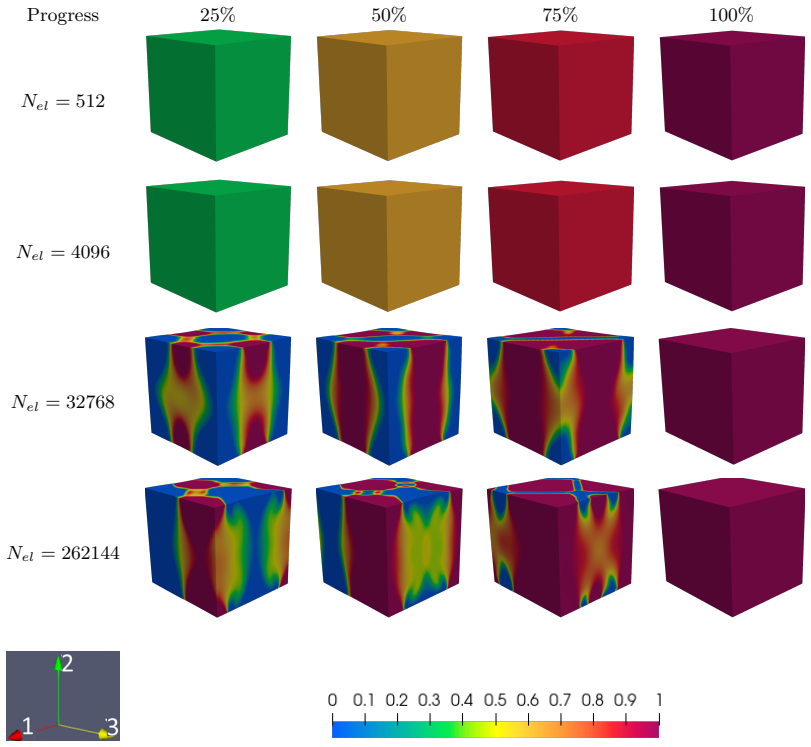
- [Section 6.3] The text contains a typo: '3,2768 elements' should be '32,768 elements'.
- [Eq. (31)] The matrix for εt2 contains a formatting error ('0 .0302 0') that should be corrected to a proper three-column matrix.
- [Section 5.1] The notation εi in Eq. (72) is used without specifying the index range; it should be stated that i runs over the strain components and that ε1t1 is the transformation strain component in the loading direction.
- [Section 7] The claim that the PFA in Refs. [56,9] uses an interfacial energy γαω = 0.01 J/m2, while the estimate here gives 0.138-0.276 J/m2, would benefit from a direct statement that this comparison is approximate because Eq. (95) is derived from a different Landau potential and interface-width definition.
Circularity Check
No significant circularity: the PT-pressure reduction estimates are algebraic consequences of the stated thermodynamic model with literature-based inputs, not fitted to the target data.
full rationale
The paper's central derivation chain—thermodynamic driving forces (Eqs. 13–17), PT start/finish criteria (Eqs. 35–58), and analytical stress–strain solutions (Eqs. 71–93)—proceeds from explicitly stated material parameters (lattice parameters, elastic constants, Δψθ, A) and the model's own equilibrium condition Xi0 = 0. The key quantitative claim, that deviatoric stresses reduce the PT pressure by at most about 0.65 GPa in a single crystal and 1.52 GPa in a severely deformed polycrystal, is obtained by substituting literature yield-strength values into the derived formulas; it is not fitted to the experimental reduction from 6.0 to 0.67 GPa that the paper seeks to explain. The self-citations to prior work of the same group (e.g., [4], [25], [27–30], [38], [42]) supply the modeling framework, mechanistic hypotheses, and some experimental inputs, but the load-bearing algebraic steps are presented in this paper and the cited experimental numbers are external measurements. The Taylor-factor division used to estimate local deviatoric stresses could be challenged as an approximation or as a correctness risk, but it is not a circular reduction: the predicted bound does not contain the target experimental reduction as an input. No step satisfies the evidentiary standard for circularity, so the appropriate finding is no significant circularity.
Assumptions & free parameters
free parameters (4)
- Interaction parameter A =
0.028 GPa
- Athermal threshold k_M-A =
0 GPa (set to zero)
- Kinetic coefficient λ =
5 x 10^-3 (Pa s)^-1
- Initial nucleus size and shape (Sets 4 and 5) =
radius 1/8 cube (Set 5); nucleus passing through cube corners (Set 4)
assumptions (6)
- domain assumption Multiplicative decomposition of the deformation gradient and linear mixture of transformation strains (Eqs. 1-2)
- domain assumption Scale-free phase-field approximation with no gradient-energy term (Section 2, item 1)
- domain assumption Small-strain formulation for all analytical solutions (Section 5)
- ad hoc to paper Athermal thresholds k_M-A and k_M-M set to zero (Section 2.4)
- ad hoc to paper Deviatoric stress estimates based on yield strength and Taylor factor (Section 4)
- domain assumption Elastic constants and lattice parameters taken from literature (Tables 1 and 2)
Cite this review
Pith. "Pith review of Analytical and Scale-Free Phase-Field Studies of $\alpha$ to $\omega$ Phase Transformation in Single Crystal Zirconium under Nonhydrostatic Loadings." pith.science (2026). https://pith.science/paper/TVQOWCOJ
@misc{pith2026250509570,
  author       = {Pith},
  title        = {Pith review of: Analytical and Scale-Free Phase-Field Studies of $\alpha$ to $\omega$ Phase Transformation in Single Crystal Zirconium under Nonhydrostatic Loadings},
  year         = {2026},
  howpublished = {\url{https://pith.science/paper/TVQOWCOJ}},
  note         = {Machine review of arXiv:2505.09570}
}
abstract
Zirconium (Zr) is an important engineering material with numerous practical applications. It undergoes martensitic $\alpha$ to $\omega$ phase transformation (PT) at pressures that vary from 0.67 GPa to 17 GPa under different loading conditions. Despite numerous experimental and theoretical studies, the effect of the nonhydrostatic stresses is not well understood. To separate the effect of nonhydrostatic stresses from the plastic deformation, a scale-free phase field approach (PFA) for multivariant $\alpha$ to $\omega$ PT in a single crystal Zr under general nonhydrostatic loadings is presented. Explicit conditions for the direct and reverse PTs between austenite and martensitic variants and between martensitic variants under general stress tensor are derived and analyzed. In particular, the effect of the deviatoric stresses on the PT pressures is elucidated. It is shown that their effect cannot explain much larger reduction in the transformation pressure observed during plastic flow, i.e., specific mechanisms of strain-induced phase transformations should be involved. Under assumption of the homogeneous fields in the sample, complete analytical solutions that include stress-strain curves during the PT, PT start and finish stresses (i.e., stress hysteresis), and volume fraction of the variants, are determined for different loadings. Finite element method (FEM) solutions are found for the phase field simulations of the microstructure evolution for the same loadings, as well as for two grains of the polycrystalline sample. Macroscopic averaged characteristics of the PFA solutions are well described by an analytical solution, which also simplifies their interpretations. Obtained results are in good qualitative agreement with existing experiments. In addition, some controversies of the previous approaches are analysed.
Figures


Figures from the paper (12 more)


Reference graph
Works this paper leans on
-
[4]
Hamed Babaei and Valery I Levitas. Finite-strain scale-free phase-field approach to multivariant marten- sitic phase transformations with stress-dependent effective thresholds. Journal of the Mechanics and Physics of Solids , 144:104114, 2020
work page 2020
-
[38]
Valery I Levitas, Achyut Dhar, and KK Pandey. Tensorial stress-plastic strain fields in α-ω Zr mixture, transformation kinetics, and friction in diamond-anvil cell. Nature Communications, 14(1):5955, 2023
work page 2023
-
[1]
Phase transitions and equation of state of Zirconium under high pressure
Simone Anzellini, Fran¸ cois Bottin, Johann Bouchet, and Agn` es Dewaele. Phase transitions and equation of state of Zirconium under high pressure. Physical Review B, 102(18):184105, 2020
work page 2020
-
[2]
Hamed Babaei and Valery I Levitas. Phase-field approach for stress-and temperature-induced phase transformations that satisfies lattice instability conditions. Part 2. simulations of phase transformations Si I↔Si II. International Journal of Plasticity , 107:223–245, 2018
work page 2018
-
[5]
Hamed Babaei, Raghunandan Pratoori, and Valery I Levitas. Simulations of multivariant Si I to Si II phase transformation in polycrystalline silicon with finite-strain scale-free phase-field approach. Acta Materialia, 254:118996, 2023
work page 2023
-
[6]
Omega phase transformation–morphologies and mechanisms
Surjo Banerjee, R Tewari, and GK Dey. Omega phase transformation–morphologies and mechanisms. International Journal of Materials Research , 97(7):963–977, 2022
work page 2022
-
[7]
W. Bangerth, R. Hartmann, and G. Kanschat. deal.II - A general-purpose object-oriented finite element library. ACM Transactions on Mathematical Software (TOMS) , 33(4), 8 2007. ISSN 00983500
work page 2007
-
[8]
Phase transitions in solids under high pressure
Vladimir Davydovich Blank and Emmanuel Isakovich Estrin. Phase transitions in solids under high pressure. Crc Press, 2013
work page 2013
Show all 60 references
-
[9]
Effect of hydrostatic pressure on the kinetics of α–ω phase transformation in Zirconium
Jacob Brown and Hemantha Kumar Yeddu. Effect of hydrostatic pressure on the kinetics of α–ω phase transformation in Zirconium. Modelling and Simulation in Materials Science and Engineering , 30(4): 045008, 2022
2022
-
[10]
C´ aceres and P
C.H. C´ aceres and P. Luk´ aˇ c. Strain hardening behaviour and the Taylor factor of pure magnesium. Philosophical Magazine, 88(7):977–989, 2008. 36
2008
-
[11]
Quantitative kinetic rules for plastic strain-induced α-ω phase transformation in Zr under high pressure
Achyut Dhar, Valery I Levitas, KK Pandey, Changyong Park, Maddury Somayazulu, and Nenad Velisavl- jevic. Quantitative kinetic rules for plastic strain-induced α-ω phase transformation in Zr under high pressure. npj Computational Materials , 10(1):290, 2024
2024
-
[12]
Allotropic phase transformation of pure Zirconium by high-pressure torsion
Kaveh Edalati, Zenji Horita, Shunsuke Yagi, and Eiichiro Matsubara. Allotropic phase transformation of pure Zirconium by high-pressure torsion. Materials Science and Engineering: A , 523(1-2):277–281, 2009
2009
-
[13]
Pressure-induced α→ ω transition in Titanium metal: a systematic study of the effects of uniaxial stress
Daniel Errandonea, Y Meng, M Somayazulu, and D H¨ ausermann. Pressure-induced α→ ω transition in Titanium metal: a systematic study of the effects of uniaxial stress. Physica B: Condensed Matter , 355(1-4):116–125, 2005
2005
-
[14]
Microscale phase field modeling of the martensitic transformation during cyclic loading of NiTi single crystal
S Ehsan Esfahani, Iman Ghamarian, Valery I Levitas, and Peter C Collins. Microscale phase field modeling of the martensitic transformation during cyclic loading of NiTi single crystal. International Journal of Solids and Structures , 146:80–96, 2018
2018
-
[15]
Strain-induced multivariant martensitic transformations: A scale-independent simulation of interaction between localized shear bands and mi- crostructure
S Ehsan Esfahani, Iman Ghamarian, and Valery I Levitas. Strain-induced multivariant martensitic transformations: A scale-independent simulation of interaction between localized shear bands and mi- crostructure. Acta Materialia, 196:430–443, 2020
2020
-
[16]
Pandey Sorb Yesudhas Feng Lin, Valery I
Krishan K. Pandey Sorb Yesudhas Feng Lin, Valery I. Levitas and Changyong Park. In-situ study of rules of nanostructure evolution, severe plastic deformations, and friction under high pressure. Materials Research Letters, 11(9):757–763, 2023
2023
-
[17]
Lei Gao, Xiangdong Ding, Turab Lookman, Jun Sun, and E. K.H. Salje. Metastable phase transformation and hcp- ω transformation pathways in Ti and Zr under high hydrostatic pressures. Applied Physics Letters, 109(3):031912, jul 2016
2016
-
[18]
Phase transitions in high-purity Zirconium under dynamic compression
Carl William Greeff, J Brown, Nenad Velisavljevic, and Paulo A Rigg. Phase transitions in high-purity Zirconium under dynamic compression. Physical Review B, 105(18):184102, 2022
2022
-
[19]
Phase transitions in Zr at sub-nanosecond time scales
Paulius Grivickas, Ryan A Austin, Michael R Armstrong, Harry B Radousky, and Jonathan L Belof. Phase transitions in Zr at sub-nanosecond time scales. Journal of Applied Physics , 131(8):085902, 2022
2022
-
[20]
R. Hill. On Macroscopic Effects Of Heterogeneity In Elastoplastic Media At Finite Strain. Mathematical Proceedings of the Cambridge Philosophical Society , 95(3):481–494, 1984. ISSN 14698064
1984
-
[21]
Finite element simulations of martensitic phase transitions and microstructures based on a strain softening model
A V Idesman, V I Levitas, D L Preston, and J-Y Cho. Finite element simulations of martensitic phase transitions and microstructures based on a strain softening model. Journal of the Mechanics and Physics of Solids, 53(3):495–523, 2005
2005
-
[22]
Role of twinning on the omega-phase transformation and stability in Zirconium
M Arul Kumar, Nadege Hilairet, RJ McCabe, T Yu, Y Wang, IJ Beyerlein, and CN Tom´ e. Role of twinning on the omega-phase transformation and stability in Zirconium. Acta Materialia, 185:211–217, 2020. 37
2020
-
[23]
Effect of dislo- cation slip and deformation twinning on the high-pressure phase transformation in Zirconium
M Arul Kumar, T Yu, Y Wang, Z Jianzhong, RJ McCabe, CN Tom´ e, and L Capolungo. Effect of dislo- cation slip and deformation twinning on the high-pressure phase transformation in Zirconium. Scripta Materialia, 242:115941, 2024
2024
-
[24]
Some relations for finite inelastic deformation of microheterogeneous materials with moving discontinuity surfaces
Valery I Levitas. Some relations for finite inelastic deformation of microheterogeneous materials with moving discontinuity surfaces. In IUTAM Symposium on Micromechanics of Plasticity and Damage of Multiphase Materials: Proceedings of the IUTAM Symposium held in S` evres, Par...
1995
-
[25]
High-pressure mechanochemistry: conceptual multiscale theory and interpretation of experiments
Valery I Levitas. High-pressure mechanochemistry: conceptual multiscale theory and interpretation of experiments. Physical Review B, 70(18):184118, 2004
2004
-
[26]
Phase field approach for stress-and temperature-induced phase transformations that satisfies lattice instability conditions
Valery I Levitas. Phase field approach for stress-and temperature-induced phase transformations that satisfies lattice instability conditions. Part I. General theory. International Journal of Plasticity , 106: 164–185, 2018
2018
-
[27]
High pressure phase transformations revisited
Valery I Levitas. High pressure phase transformations revisited. Journal of Physics: Condensed Matter , 30(16):163001, 2018
2018
-
[28]
High-Pressure Phase Transformations under Severe Plastic Deformation by Torsion in Rotational Anvils
Valery I Levitas. High-Pressure Phase Transformations under Severe Plastic Deformation by Torsion in Rotational Anvils. Materials Transactions, 60(7):1294–1301, 7 2019
2019
-
[29]
Phase transformations, fracture, and other structural changes in inelastic materials
Valery I Levitas. Phase transformations, fracture, and other structural changes in inelastic materials. International Journal of Plasticity , 140:102914, 2021
2021
-
[30]
Recent in situ experimental and theoretical advances in severe plastic deformations, strain-induced phase transformations, and microstructure evolution under high pressure
Valery I Levitas. Recent in situ experimental and theoretical advances in severe plastic deformations, strain-induced phase transformations, and microstructure evolution under high pressure. Materials transactions, 64(8):1866–1878, 2023
2023
-
[31]
Athermal resistance to interface motion in the phase-field theory of microstructure evolution
Valery I Levitas and Dong-Wook Lee. Athermal resistance to interface motion in the phase-field theory of microstructure evolution. Physical review letters, 99(24):245701, 2007
2007
-
[32]
Three-dimensional Landau theory for multi- variant stress-induced martensitic phase transformations
Valery I Levitas, Dean L Preston, and Dong-Wook Lee. Three-dimensional Landau theory for multi- variant stress-induced martensitic phase transformations. III. Alternative potentials, critical nuclei, kink solutions, and dislocation theory. Physical review B, 68(13):134201, 2003
2003
-
[33]
Microscale simulation of martensitic microstructure evolution
Valery I Levitas, Alexander V Idesman, and Dean L Preston. Microscale simulation of martensitic microstructure evolution. Physical Review Letters, 93(10):105701, 2004
2004
-
[34]
Valery I Levitas, Dong-Wook Lee, and Dean L Preston. Interface propagation and microstructure evolution in phase field models of stress-induced martensitic phase transformations.International Journal of Plasticity, 26(3):395–422, 2010. 38
2010
-
[35]
Levitas, Hao Chen, and Liming Xiong
Valery I. Levitas, Hao Chen, and Liming Xiong. Lattice instability during phase transformations under multiaxial stress: Modified transformation work criterion. Physical Review B , 96(5):054118, 8 2017. ISSN 24699969
2017
-
[36]
Levitas, Hao Chen, and Liming Xiong
Valery I. Levitas, Hao Chen, and Liming Xiong. Triaxial-Stress-Induced Homogeneous Hysteresis-Free First-Order Phase Transformations with Stable Intermediate Phases. Physical Review Letters , 118(2): 025701, 1 2017. ISSN 10797114
2017
-
[37]
Levitas, S
Valery I. Levitas, S. Ehsan Esfahani, and Iman Ghamarian. Scale-Free Modeling of Coupled Evolution of Discrete Dislocation Bands and Multivariant Martensitic Microstructure. Physical Review Letters , 121(20):205701, 11 2018. ISSN 10797114
2018
-
[39]
Grain growth phenomenon during pressure-induced phase transformations at room temperature
Valery I Levitas, Raghunandan Pratoori, Dmitry Popov, Changyong Park, and Nenad Velisavljevic. Grain growth phenomenon during pressure-induced phase transformations at room temperature. arXiv preprint arXiv:2406.09461, 2024
2024 arXiv
-
[40]
Rules for the crystallite size and dislocation density evolution in phases during α-ω transformation in zr under high- pressure and severe plastic flow
Feng Lin, Valery I Levitas, Krishan K Pandey, Sorb Yesudhas, and Changyong Park. Rules for the crystallite size and dislocation density evolution in phases during α-ω transformation in zr under high- pressure and severe plastic flow. SSRN, 2025. URL http://dx.doi.org/10.2139/s...
2025 doi
-
[41]
Revisiting the High-Pressure Behaviors of Zirconium: Nonhydrostaticity Promoting the Phase Transitions and Absence of the Isostructural Phase Transition in β-Zirconium
Lei Liu, Qiumin Jing, Hua Y Geng, Yinghua Li, Yi Zhang, Jun Li, Shourui Li, Xiaohui Chen, Junjie Gao, and Qiang Wu. Revisiting the High-Pressure Behaviors of Zirconium: Nonhydrostaticity Promoting the Phase Transitions and Absence of the Isostructural Phase Transition in β-Zir...
2023
-
[42]
In situ quantitative study of plastic strain-induced phase transfor- mations under high pressure: Example for ultra-pure Zr
K K Pandey and Valery I Levitas. In situ quantitative study of plastic strain-induced phase transfor- mations under high pressure: Example for ultra-pure Zr. Acta Materialia, 196:338–346, 2020
2020
-
[43]
In situ study of microstructure evolution andα→ω phase transition in annealed and pre-deformed Zr under hydrostatic loading.Journal of Applied Physics , 136(11):115901, 2024
KK Pandey, Valery I Levitas, Changyong Park, and Guoyin Shen. In situ study of microstructure evolution andα→ω phase transition in annealed and pre-deformed Zr under hydrostatic loading.Journal of Applied Physics , 136(11):115901, 2024
2024
-
[44]
H. Petryk. Macroscopic rate-variables in solids undergoing phase transformation. Journal of the Me- chanics and Physics of Solids , 46(5):873–894, 1998. ISSN 00225096
1998
-
[45]
Real time study of grain enlargement in zirconium under room-temperature compression across the α to ω phase transition
Dmitry Popov, Nenad Velisavljevic, Wenjun Liu, Rostislav Hrubiak, Changyong Park, and Guoyin Shen. Real time study of grain enlargement in zirconium under room-temperature compression across the α to ω phase transition. Scientific Reports, 9(1):15712, 2019. 39
2019
-
[46]
Classification of the critical resolved shear stress in the hexagonal-close-packed materials by atomic simulation: Application to α-Zirconium and α-Titanium
A Poty, J-M Raulot, H Xu, J Bai, Christophe Schuman, J-S Lecomte, M-J Philippe, and C Esling. Classification of the critical resolved shear stress in the hexagonal-close-packed materials by atomic simulation: Application to α-Zirconium and α-Titanium. Journal of applied physic...
2011
-
[47]
Omega phase in materials
SK Sikka, YK Vohra, and R Chidambaram. Omega phase in materials. Progress in Materials Science , 27(3-4):245–310, 1982
1982
-
[48]
Microscopic and crystallographic aspects of retained omega phase in shock- loaded Zirconium and its formation mechanism
SG Song and GT Gray III. Microscopic and crystallographic aspects of retained omega phase in shock- loaded Zirconium and its formation mechanism. Philosophical Magazine A , 71(2):275–290, 1995
1995
-
[49]
Orientation dependency of the α to ω plus beta transformation in commercially pure Zirconium by high-pressure torsion
B Srinivasarao, AP Zhilyaev, and MT Perez-Prado. Orientation dependency of the α to ω plus beta transformation in commercially pure Zirconium by high-pressure torsion. Scripta Materialia , 65(3): 241–244, 2011
2011
-
[50]
Picosecond dynamics of a shock-driven displacive phase transformation in Zr
TD Swinburne, MG Glavicic, KM Rahman, NG Jones, J Coakley, DE Eakins, TG White, V Tong, D Mi- lathianaki, GJ Williams, et al. Picosecond dynamics of a shock-driven displacive phase transformation in Zr. Physical Review B, 93(14):144119, 2016
2016
-
[51]
Microstructural evolution in Zirco- nium based alloys
R Tewari, D Srivastava, GK Dey, JK Chakravarty, and S Banerjee. Microstructural evolution in Zirco- nium based alloys. Journal of Nuclear Materials , 383(1-2):153–171, 2008
2008
-
[52]
Effects of intersti- tial impurities on the high pressure martensitic α to ω structural transformation and grain growth in Zirconium
Nenad Velisavljevic, Gary N Chesnut, Lewis L Stevens, and Dana M Dattelbaum. Effects of intersti- tial impurities on the high pressure martensitic α to ω structural transformation and grain growth in Zirconium. Journal of Physics: Condensed Matter , 23(12):125402, 2011
2011
-
[53]
First-principles calculations of phase transition, elas- ticity, and thermodynamic properties for TiZr alloy
Bao-Tian Wang, Wei-Dong Li, and Ping Zhang. First-principles calculations of phase transition, elas- ticity, and thermodynamic properties for TiZr alloy. Journal of nuclear materials , 420(1-3):501–507, 2012
2012
-
[54]
Orientation rela- tions during the α-ω phase transition of zirconium: In situ texture observations at high pressure and temperature
H-R Wenk, P Kaercher, W Kanitpanyacharoen, E Zepeda-Alarcon, and Y Wang. Orientation rela- tions during the α-ω phase transition of zirconium: In situ texture observations at high pressure and temperature. Physical review letters, 111(19):195701, 2013
2013
-
[55]
Three- dimensional phase-field modeling of martensitic microstructure evolution in steels
Hemantha Kumar Yeddu, Amer Malik, John Gren, Gustav Amberg, and Annika Borgenstam. Three- dimensional phase-field modeling of martensitic microstructure evolution in steels. Acta Materialia, 60 (4):1538–1547, feb 2012
2012
-
[56]
α–ω and ω–α phase transformations in Zirconium under hydrostatic pressure: A 3D mesoscale study
Hemantha Kumar Yeddu, Hongxiang Zong, and Turab Lookman. α–ω and ω–α phase transformations in Zirconium under hydrostatic pressure: A 3D mesoscale study. Acta Materialia, 102:97–107, 2016
2016
-
[57]
Lattice instability during solid-solid structural transformations under a general applied stress tensor: Example of Si I → Si II with metallization
Nikolai A Zarkevich, Hao Chen, Valery I Levitas, and Duane D Johnson. Lattice instability during solid-solid structural transformations under a general applied stress tensor: Example of Si I → Si II with metallization. Physical review letters, 121(16):165701, 2018. 40
2018
-
[58]
Understanding controversies in the α-ω and ω-β phase transformations of Zirconium from nonhydrostatic thermodynamics
Lin Zhang, Ying-Hua Li, Yan-Qin Gu, and Ling-Cang Cai. Understanding controversies in the α-ω and ω-β phase transformations of Zirconium from nonhydrostatic thermodynamics. Scientific Reports, 9(1): 16889, 2019
2019
-
[59]
α–ω conversion in Titanium and Zirconium during shear deformation under pressure
VA Zil’bershtein, NP Chistotina, AA Zharov, NS Grishina, and EI Estrin. α–ω conversion in Titanium and Zirconium during shear deformation under pressure. Technical report, Inst. of Metal Science and Physics of Metals, Moscow, 1975
1975
-
[60]
Devel- oping an interatomic potential for martensitic phase transformations in Zirconium by machine learning
Hongxiang Zong, Ghanshyam Pilania, Xiangdong Ding, Graeme J Ackland, and Turab Lookman. Devel- oping an interatomic potential for martensitic phase transformations in Zirconium by machine learning. npj Computational Materials , 4(1):48, 2018
2018
-
[61]
hcp →ω phase transition mechanisms in shocked Zirconium: A machine learning based atomic simulation study
Hongxiang Zong, Yufei Luo, Xiangdong Ding, Turab Lookman, and Graeme J Ackland. hcp →ω phase transition mechanisms in shocked Zirconium: A machine learning based atomic simulation study. Acta Materialia, 162:126–135, 2019. 41
2019
Reviewed August 15, 2026 · model on record in the stance chip above.
Discussion (0). Continue with ORCID to comment.