REVIEW 3 major objections 5 minor 2 cited by
Retrieving interior properties of hot Jupiters with Love numbers and atmospheric measurements
T0 review · 3 major / 5 minor · reviewed 2026-08-15 · deepseek-v4-flash
Pith's one-line read WASP-19Ab's measured tidal response, combined with its atmospheric metallicity, points to a core of about 79 Earth masses.
desk verdict Solid retrieval framework and useful precision thresholds, but the WASP-19Ab core detection leans on a linear-tidal calculation that the authors themselves flag as potentially biased by more than the measurement error. read the letter →
The pith
A machine-rendered reading of the paper's core claim, the machinery that carries it, and where it could break.
The reading
What carries the argument
The load-bearing observable is the second-order Love number $k_2$, the surface value of the Love function $K_n(r)$ that measures how strongly a planet's gravitational potential responds to an external tide. It is computed from the interior density profile by integrating a first-order differential equation for $\eta_2(r)$ under the assumption of hydrostatic equilibrium and a linear tidal response. The retrieval uses the planetary structure code CEPAM to generate density profiles for a homogeneous two-layer model (compact heavy-element core plus uniform H/He envelope) and an inhomogeneous model with a dilute core whose heavy-element fraction falls off through an error-function gradient; a nested-sampling Bayesian engine then fits predicted radius and $k_2$ to observations, with atmospheric metallicity entering as a Gaussian prior on the envelope metal fraction. The $k_2$ measurement carries the core-mass information because a more centrally concentrated mass distribution (larger core) lowers the Love number.
What would settle it
A non-linear tidal calculation for WASP-19Ab (for example with the concentric MacLaurin spheroid method used for WASP-12b) that changes the predicted $k_2$ by the ~19% bias would move the observed value relative to the model grid; if the resulting posterior no longer excludes a coreless interior, the detection claim collapses. A direct JWST phase-curve measurement of $k_2$ for this planet that differs from the Bernabò et al. (2024) value by more than the combined uncertainties would likewise settle the question.
Extended reading notes
Core claim
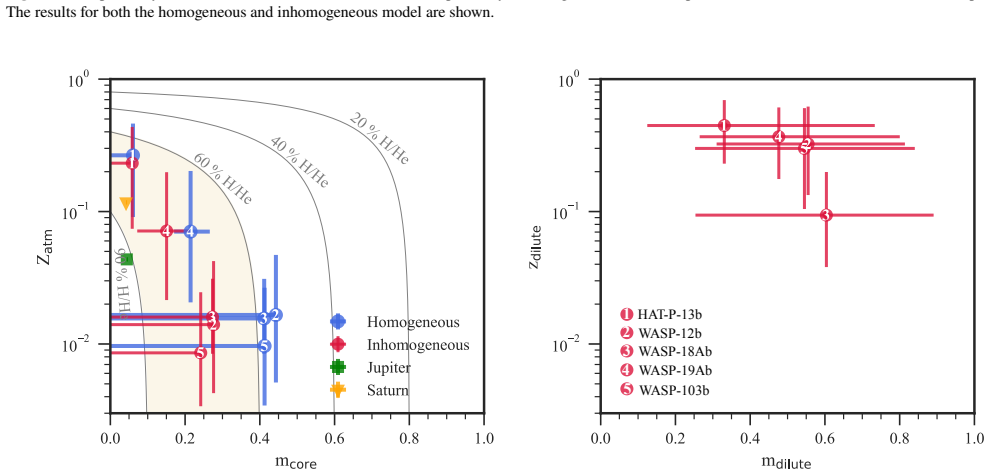
The central claim is that accurate interior constraints for hot Jupiters require a Love number measurement with precision better than about 40% for a homogeneous model and 15% for a dilute-core model, and that this must be paired with an atmospheric metallicity measurement to break the remaining degeneracy. For the only planet in the current sample that meets both criteria, WASP-19Ab, the retrieved posteriors rule out a coreless interior: the probability that both the core mass fraction and the dilute-core extent are below 0.1 is only 0.02%. The homogeneous model gives a core mass fraction of $0.21^{+0.05}_{-0.04}$ ($79^{+21}_{-18}$ $M_\oplus$), while the inhomogeneous model gives a compact core of $55^{+25}_{-29}$ $M_\oplus$ that extends to zero but is almost never zero. The paper does not claim to distinguish a compact from a diluted core, only that some form of dense core is present.
Load-bearing premise
The core detection for WASP-19Ab rests on interpreting its measured Love number with a linear, hydrostatic first-order tidal model, even though the planet's rotation parameter ($q_0 \approx 0.06$) is large enough that non-linear effects could shift the Love number by about 19%, larger than the 12% observational uncertainty.
Editorial extensions
If this is right
- Love number measurements with uncertainties above roughly 40% provide little interior information, so future observation campaigns should target phase-curve precisions below that threshold.
- Only two current planets, HAT-P-13b and WASP-19Ab, meet the precision threshold; for the other three the retrievals return upper limits rather than detections.
- WASP-19Ab becomes a benchmark for formation models: any successful giant-planet formation theory must reproduce a core of roughly 80 Earth masses inside a 1.15 Jupiter-mass planet.
- Applying the same retrieval to predicted JWST phase-curve detections (~17% precision for WASP-12b-like planets) would move several planets into the regime where a core is detected rather than merely bounded.
- The Love number also sharpens the constraint on the heating efficiency parameter $\gamma$, linking tidal response to the inflation mechanism.
Reading between the lines
- If the non-linear tidal bias for WASP-19Ab is as large as the paper's cited estimate for the similar planet WASP-12b (~19% in $k_2$), the retrieved core mass fraction could shift noticeably; the authors themselves recommend modelling non-linear effects before trusting the exact value.
- A natural extension is to apply the retrieval to the upcoming JWST Love-number and atmospheric-metallicity measurements for a larger planet sample, which would test whether the mass–metallicity trend seen in the current five planets persists.
- The large spread between atmospheric and bulk metallicity found in Figure 10 suggests atmospheric metallicity alone is a weak proxy for a planet's total heavy-element content, so future atmospheric surveys should not be read as direct interior constraints.
Signed reviews
Editorial analysis
A structured set of objections, weighed in public.
Referee Report
Summary. The paper presents a Bayesian retrieval framework that combines mass, radius, equilibrium temperature, atmospheric metallicity, and Love number measurements to infer the interior structure of hot Jupiters, using CEPAM-based interior models in two configurations: a homogeneous two-layer model and an inhomogeneous dilute-core model. The framework is validated on a synthetic test planet with known interior properties, and the authors quantify the Love-number precision required to recover bulk metallicity and core mass, finding thresholds of approximately 40% for the homogeneous model and 15% for the dilute-core model. The framework is then applied to five hot Jupiters with measured Love numbers, of which WASP-19Ab is the only planet with both a precise Love number and an atmospheric metallicity constraint; for this planet the paper reports a homogeneous-model core mass fraction of 0.21+0.05/-0.04, corresponding to about 79 Earth masses, and a claimed 0.02% probability of a coreless interior in the inhomogeneous model.
Significance. If the WASP-19Ab result holds, the paper would provide the first exoplanet core detection based on a Love number measurement combined with an atmospheric metallicity constraint, which is a notable advance. The test-planet validation with injected values, the explicit comparison of two interior models, and the quantitative precision-threshold analysis are strengths that make the retrieval methodology useful for planning JWST-era observations. However, the flagship core-detection claim relies on a linear hydrostatic Love number calculation that the authors themselves identify as potentially biased for WASP-19Ab; because the potential systematic is larger than the observational uncertainty, the core detection should be tested against this systematic before the claim is treated as settled.
major comments (3)
- [Section 5.1, Table 3, Section 4.2.2, Abstract] The WASP-19Ab core-detection claim is not robust to the non-linear tidal systematic that the authors themselves quantify. Section 5.1 states that WASP-19Ab has rotational parameter q0 approximately 0.06, which exceeds the q0 << 0.01 regime where the linear approximation holds, and that Wahl et al. (2021) estimate that neglecting non-linear effects underestimates k2 by about 19% for WASP-12b, a planet with similar q0. This is larger than the 12% observational uncertainty adopted in the retrieval, and k2 is the main constraint on core mass. The abstract and Section 4.2.2 present the core mass of 0.21+0.05/-0.04 and the coreless-probability statement without this caveat. I request that the authors add a retrieval with k2 shifted upward by approximately 19% (or with a non-linearly corrected k2) and report whether the core detection and the 0.02% probability survive; if they do not, the abstract and conclusions should be revised to present the core detection as conditional on the linear-tidal interpretation.
- [Section 4.2.2] The claim that a coreless interior is "effectively ruled out" relies on a probability threshold that is not physically defined. The 0.02% figure is computed as the probability that both m_core and m_dilute are below 0.1, but a diluted-core model with these parameters can still contain substantial heavy elements in the envelope (the retrieved Z_atm for WASP-19Ab is about 0.07), so this is not a direct posterior probability for the absence of a compact core. The authors should either justify the threshold as a physically meaningful definition of coreless or replace the statement with a model-comparison metric that directly contrasts interiors with and without a compact core.
- [Section 4.1] The systematic tendency for the retrieved Love numbers to fall at the lower end of, or below, the observed values for most planets in the sample is discussed by the authors as a possible observational bias or missing physics. Since WASP-19Ab is the only planet with a precise enough measurement to drive a core detection, the absence of a quantitative test of how this systematic discrepancy would affect the WASP-19Ab inference is a gap. The authors should state explicitly whether the WASP-19Ab agreement is expected to be immune to the same bias, or add a sensitivity test in which the observed k2 is shifted within the plausible systematic range.
minor comments (5)
- [Equation (1)] The notation Z_atm appears in Equation (1) while the text and Table 1 use Z_env for the envelope metal mass fraction; please unify the notation.
- [Figure 5] The middle panel label reads "Love number k22" but should read "Love number k2".
- [Table 1] The prior notation "LU(0, l_age_min)/U(1, L_age_min)" for L_grav is confusing, particularly because the text in Section 2.3 says the lower limit is set to 1 L_J; please clarify the intended ranges in the table.
- [Appendix B] The sentence "In Figures B2, B3, B4, B5 and B6 we the results obtained" is missing the verb "show"; please correct it.
- [Abstract] The phrase "interiors structures" should be "interior structures" for grammatical correctness.
Circularity Check
No significant circularity: the interior retrieval is a forward-model fit to independent Love number and atmospheric metallicity constraints, not a self-referential prediction.
full rationale
The derivation chain is self-contained. The forward interior model (CEPAM) computes radius and k2 from structure parameters via the hydrostatic equations and the first-order Love number relation (Eqs. 4-5), and the likelihood (Eq. 6) compares those model outputs to observed Rp and k2. The core mass fraction mcore and envelope metallicity Zenv are free parameters with physically chosen priors (Table 1); neither is defined in terms of the quantities the paper claims to infer. The atmospheric metallicity enters as an independent Gaussian prior and the Love number as an independent likelihood term, and the WASP-19Ab core detection is a posterior inference driven by the measured k2 = 0.20(+0.02/-0.03), not a restatement of the prior (mcore is uniform on [0,1]). The test-planet validation in Section 3 uses injected true values to check the retrieval, providing an internal consistency check rather than a tuned input for the science claim. The self-citation to Bloot et al. (2023) for the dilute-core gradient and Lgrav prior is methodological and not load-bearing; no conclusion depends on accepting that citation as proof. The non-linear tidal caveat in Section 5.1 is a physical model-dependence concern that the authors flag, not a circularity.
Assumptions & free parameters
free parameters (2)
- gamma (heating efficiency) =
WASP-19Ab: 0.02+0.02/-0.01 (homogeneous, log-uniform prior, Table C4)
- Lgrav (intrinsic luminosity)
assumptions (6)
- domain assumption Planets are in hydrostatic equilibrium; the first-order Love number k2 is computed from the density profile with the Sterne ODE (Eqs. 4-5).
- domain assumption Envelope composition uses a proto-solar H/He ratio (Lodders 2021) with heavy elements represented by water; EOS: MH13-H, SCH95-He, Mazevet et al. 2019 water, Hubbard and Marley 1989 core.
- ad hoc to paper Hot Jupiter inflation is modeled as L_int = L_grav + gamma times L_irr, with gamma free between 1e-5 and 0.1 and heat deposited uniformly.
- domain assumption Observed atmospheric metallicity [M/H] equals the envelope metal mass fraction Zenv and is converted to mass fraction assuming solar abundances and proto-solar H/He (Appendix A).
- domain assumption Dilute core heavy-element gradient is parameterized by an error function with fixed width dm = 0.075 (Eq. 1).
- standard math Nested sampling (PyMultinest) with 1000 live points and sampling efficiency 0.1 gives converged posterior estimates.
Cite this review
Pith. "Pith review of Retrieving interior properties of hot Jupiters with Love numbers and atmospheric measurements." pith.science (2026). https://pith.science/paper/7YKPLW3T
@misc{pith2026250510304,
  author       = {Pith},
  title        = {Pith review of: Retrieving interior properties of hot Jupiters with Love numbers and atmospheric measurements},
  year         = {2026},
  howpublished = {\url{https://pith.science/paper/7YKPLW3T}},
  note         = {Machine review of arXiv:2505.10304}
}
abstract
Understanding exoplanet interiors is crucial for interpreting atmospheric observations and constraining their evolution and formation. However, due to limited observational constraints, interiors structures remain poorly understood. In this work, we investigate how new observational constraints, such as the Love number and atmospheric metallicity, improve our ability to characterize the interiors of hot Jupiters, planets for which Love number measurements are most feasible. We assess the precision required in Love number measurements to derive interior properties using both a simple two-layer homogeneous model and a more complex dilute core model. To account for observational uncertainties, we implement a retrieval framework. Our results show that accurately constraining core mass and bulk metallicity requires a high-precision Love number measurement, better than 40% for a homogeneous model and 15% for a dilute core model, along with an atmospheric metallicity measurement. We apply our retrieval framework to five planets with observed Love numbers, of which only WASP-19Ab has both an atmospheric metallicity constraint and a highly precise Love number measurement, with a precision of 12%. For this flagship planet, both models confirm the presence of a core, although we cannot yet distinguish between a compact core or diluted core. With the homogeneous model, we find a core mass fraction of $0.21^{+0.05}_{-0.04}$, corresponding to $79^{+21}_{-18}$ $M_\mathrm{earth}$. Upcoming JWST observations are expected to provide high-precision Love number measurements and precise atmospheric data, offering new insights into the structure and composition of gas giant interiors.
Figures


Figures from the paper (6 more)




Forward citations
Cited by 2 Pith papers
-
The influence of composition gradients on giant planet radii
Composition gradients change giant-planet radii only by altering total entropy over time; after a ~Gyr decoupling age the radius depends only on mass and bulk metallicity.
-
Discovering and Characterising Exoplanets and Ultracool Dwarfs with the Square Kilometre Array
The Square Kilometre Array is projected to enable first radio detections of giant exoplanets, thousands of ultracool dwarfs, and few-Earth-mass planets around nearby UCDs via VLBI astrometry.
Reference graph
Works this paper leans on
-
[1]
Akinsanmi B., Lendl M., Bou \'e G., Barros S. C. C., 2024a, @doi [ ] 10.1051/0004-6361/202347739 , https://ui.adsabs.harvard.edu/abs/2024A&A...682A..15A 682, A15
-
[2]
Akinsanmi B., et al., 2024b, @doi [ ] 10.1051/0004-6361/202348502 , https://ui.adsabs.harvard.edu/abs/2024A&A...685A..63A 685, A63
-
[3]
Arras P., Socrates A., 2010, @doi [ ] 10.1088/0004-637X/714/1/1 , https://ui.adsabs.harvard.edu/abs/2010ApJ...714....1A 714, 1
-
[4]
Barros S. C. C., et al., 2022, @doi [ ] 10.1051/0004-6361/202142196 , https://ui.adsabs.harvard.edu/abs/2022A&A...657A..52B 657, A52
-
[5]
Batygin K., Stevenson D. J., 2010, @doi [ ] 10.1088/2041-8205/714/2/L238 , https://ui.adsabs.harvard.edu/abs/2010ApJ...714L.238B 714, L238
-
[6]
Batygin K., Bodenheimer P., Laughlin G., 2009, @doi [ ] 10.1088/0004-637X/704/1/L49 , https://ui.adsabs.harvard.edu/abs/2009ApJ...704L..49B 704, L49
-
[7]
Batygin K., Stevenson D. J., Bodenheimer P. H., 2011, @doi [ ] 10.1088/0004-637X/738/1/1 , https://ui.adsabs.harvard.edu/abs/2011ApJ...738....1B 738, 1
-
[8]
Baumeister P., Tosi N., 2023, @doi [ ] 10.1051/0004-6361/202346216 , https://ui.adsabs.harvard.edu/abs/2023A&A...676A.106B 676, A106
Show all 75 references
-
[9]
M., Csizmadia S., Smith A
Bernab \`o L. M., Csizmadia S., Smith A. M. S., Rauer H., Hatzes A., Esposito M., Gandolfi D., Cabrera J., 2024, @doi [ ] 10.1051/0004-6361/202346852 , https://ui.adsabs.harvard.edu/abs/2024A&A...684A..78B 684, A78
2024 doi
-
[10]
L., Wong M
Bjoraker G. L., Wong M. H., de Pater I., Hewagama T., \'A d \'a mkovics M., Orton G. S., 2018, @doi [ ] 10.3847/1538-3881/aad186 , https://ui.adsabs.harvard.edu/abs/2018AJ....156..101B 156, 101
2018 doi
-
[11]
Bloot S., Miguel Y., Bazot M., Howard S., 2023, @doi [ ] 10.1093/mnras/stad1873 , https://ui.adsabs.harvard.edu/abs/2023MNRAS.523.6282B 523, 6282
2023 doi
-
[12]
Bodenheimer P., Lin D. N. C., Mardling R. A., 2001, @doi [ ] 10.1086/318667 , https://ui.adsabs.harvard.edu/abs/2001ApJ...548..466B 548, 466
2001 doi
-
[13]
S., et al., 2017, @doi [ ] 10.1051/0004-6361/201629882 , https://ui.adsabs.harvard.edu/abs/2017A&A...602A.107B 602, A107
Bonomo A. S., et al., 2017, @doi [ ] 10.1051/0004-6361/201629882 , https://ui.adsabs.harvard.edu/abs/2017A&A...602A.107B 602, A107
2017 doi
-
[14]
Buchner J., et al., 2014, @doi [ ] 10.1051/0004-6361/201322971 , https://ui.adsabs.harvard.edu/abs/2014A&A...564A.125B 564, A125
2014 doi
-
[15]
B., Knutson H
Buhler P. B., Knutson H. A., Batygin K., Fulton B. J., Fortney J. J., Burrows A., Wong I., 2016, @doi [ ] 10.3847/0004-637X/821/1/26 , https://ui.adsabs.harvard.edu/abs/2016ApJ...821...26B 821, 26
2016 doi
-
[16]
Chakrabarty A., Sengupta S., 2019, @doi [ ] 10.3847/1538-3881/ab24dd , https://ui.adsabs.harvard.edu/abs/2019AJ....158...39C 158, 39
2019 doi
-
[17]
C., Hoyer S., Sanhueza B., Correa-Amaro P., Albornoz J., 2020, @doi [ ] 10.1051/0004-6361/201936279 , https://ui.adsabs.harvard.edu/abs/2020A&A...636A..98C 636, A98
Cort \'e s-Zuleta P., Rojo P., Wang S., Hinse T. C., Hoyer S., Sanhueza B., Correa-Amaro P., Albornoz J., 2020, @doi [ ] 10.1051/0004-6361/201936279 , https://ui.adsabs.harvard.edu/abs/2020A&A...636A..98C 636, A98
2020 doi
-
[18]
Coulombe L.-P., et al., 2023, @doi [ ] 10.1038/s41586-023-06230-1 , https://ui.adsabs.harvard.edu/abs/2023Natur.620..292C 620, 292
2023 doi
-
[19]
Csizmadia S., Hellard H., Smith A. M. S., 2019, @doi [ ] 10.1051/0004-6361/201834376 , https://ui.adsabs.harvard.edu/abs/2019A&A...623A..45C 623, A45
2019 doi
-
[20]
Demory B.-O., Seager S., 2011, @doi [ ] 10.1088/0067-0049/197/1/12 , https://ui.adsabs.harvard.edu/abs/2011ApJS..197...12D 197, 12
2011 doi
-
[21]
Edwards B., et al., 2023, @doi [ ] 10.3847/1538-4365/ac9f1a , https://ui.adsabs.harvard.edu/abs/2023ApJS..269...31E 269, 31
2023 doi
-
[22]
P., 2008, @doi [ ] 10.1111/j.1365-2966.2007.12353.x , https://ui.adsabs.harvard.edu/abs/2008MNRAS.384..449F 384, 449
Feroz F., Hobson M. P., 2008, @doi [ ] 10.1111/j.1365-2966.2007.12353.x , https://ui.adsabs.harvard.edu/abs/2008MNRAS.384..449F 384, 449
2008
-
[23]
N., Orton G
Fletcher L. N., Orton G. S., Teanby N. A., Irwin P. G. J., Bjoraker G. L., 2009, @doi [ ] 10.1016/j.icarus.2008.09.019 , https://ui.adsabs.harvard.edu/abs/2009Icar..199..351F 199, 351
2009 doi
-
[24]
Gillon M., et al., 2014, @doi [ ] 10.1051/0004-6361/201323014 , https://ui.adsabs.harvard.edu/abs/2014A&A...562L...3G 562, L3
2014 doi
-
[25]
Ginzburg S., Sari R., 2016, @doi [ ] 10.3847/0004-637X/819/2/116 , https://ui.adsabs.harvard.edu/abs/2016ApJ...819..116G 819, 116
2016 doi
-
[26]
M., Lewis N
Goyal J. M., Lewis N. K., Wakeford H. R., MacDonald R. J., Mayne N. J., 2021, @doi [ ] 10.3847/1538-4357/ac27b2 , https://ui.adsabs.harvard.edu/abs/2021ApJ...923..242G 923, 242
2021 doi
-
[27]
Guillot T., Morel P., 1995, , https://ui.adsabs.harvard.edu/abs/1995A&AS..109..109G 109, 109
1995
-
[28]
P., 2002, @doi [ ] 10.1051/0004-6361:20011624 , https://ui.adsabs.harvard.edu/abs/2002A&A...385..156G 385, 156
Guillot T., Showman A. P., 2002, @doi [ ] 10.1051/0004-6361:20011624 , https://ui.adsabs.harvard.edu/abs/2002A&A...385..156G 385, 156
2002 doi
-
[29]
A., et al., 2017, @doi [ ] 10.3847/1538-4357/836/1/143 , https://ui.adsabs.harvard.edu/abs/2017ApJ...836..143H 836, 143
Hardy R. A., et al., 2017, @doi [ ] 10.3847/1538-4357/836/1/143 , https://ui.adsabs.harvard.edu/abs/2017ApJ...836..143H 836, 143
2017 doi
-
[30]
R., et al., 2020, @doi [Nature] 10.1038/s41586-020-2649-2 , 585, 357
Harris C. R., et al., 2020, @doi [Nature] 10.1038/s41586-020-2649-2 , 585, 357
2020 doi
-
[31]
R., 2024, @doi [ ] 10.3847/2041-8213/ad7957 , https://ui.adsabs.harvard.edu/abs/2024ApJ...973L..46H 973, L46
Hasegawa Y., Swain M. R., 2024, @doi [ ] 10.3847/2041-8213/ad7957 , https://ui.adsabs.harvard.edu/abs/2024ApJ...973L..46H 973, L46
2024 doi
-
[32]
Hasegawa Y., Bryden G., Ikoma M., Vasisht G., Swain M., 2018, @doi [ ] 10.3847/1538-4357/aad912 , https://ui.adsabs.harvard.edu/abs/2018ApJ...865...32H 865, 32
2018 doi
-
[33]
Hellard H., Csizmadia S., Padovan S., Rauer H., Cabrera J., Sohl F., Spohn T., Breuer D., 2019, @doi [ ] 10.3847/1538-4357/ab2048 , https://ui.adsabs.harvard.edu/abs/2019ApJ...878..119H 878, 119
2019 doi
-
[34]
Hellard H., Csizmadia S., Padovan S., Sohl F., Rauer H., 2020, @doi [ ] 10.3847/1538-4357/ab616e , https://ui.adsabs.harvard.edu/abs/2020ApJ...889...66H 889, 66
2020 doi
-
[35]
Howard S., Helled R., M \"u ller S., 2025, @doi [ ] 10.1051/0004-6361/202452783 , https://ui.adsabs.harvard.edu/abs/2025A&A...693L...7H 693, L7
2025 doi
-
[36]
Huang X., Cumming A., 2012, @doi [ ] 10.1088/0004-637X/757/1/47 , https://ui.adsabs.harvard.edu/abs/2012ApJ...757...47H 757, 47
2012 doi
-
[37]
B., Marley M
Hubbard W. B., Marley M. S., 1989, @doi [ ] 10.1016/0019-1035(89)90072-9 , https://ui.adsabs.harvard.edu/abs/1989Icar...78..102H 78, 102
1989 doi
-
[38]
D., 2007, @doi [Computing in Science & Engineering] 10.1109/MCSE.2007.55 , 9, 90
Hunter J. D., 2007, @doi [Computing in Science & Engineering] 10.1109/MCSE.2007.55 , 9, 90
2007 doi
-
[39]
J., 2021, @doi [The Planetary Science Journal] 10.3847/PSJ/abe715 , https://ui.adsabs.harvard.edu/abs/2021PSJ.....2...69I 2, 69
Idini B., Stevenson D. J., 2021, @doi [The Planetary Science Journal] 10.3847/PSJ/abe715 , https://ui.adsabs.harvard.edu/abs/2021PSJ.....2...69I 2, 69
2021 doi
-
[40]
Kellermann C., Becker A., Redmer R., 2018, @doi [ ] 10.1051/0004-6361/201731775 , https://ui.adsabs.harvard.edu/abs/2018A&A...615A..39K 615, A39
2018 doi
-
[41]
D., Youdin A
Komacek T. D., Youdin A. N., 2017, @doi [ ] 10.3847/1538-4357/aa7b75 , https://ui.adsabs.harvard.edu/abs/2017ApJ...844...94K 844, 94
2017 doi
-
[42]
J., 2011, @doi [ ] 10.1051/0004-6361/201015803 , https://ui.adsabs.harvard.edu/abs/2011A&A...528A..18K 528, A18
Kramm U., Nettelmann N., Redmer R., Stevenson D. J., 2011, @doi [ ] 10.1051/0004-6361/201015803 , https://ui.adsabs.harvard.edu/abs/2011A&A...528A..18K 528, A18
2011 doi
-
[43]
J., Neuh \"a user R., Redmer R., 2012, @doi [ ] 10.1051/0004-6361/201118141 , https://ui.adsabs.harvard.edu/abs/2012A&A...538A.146K 538, A146
Kramm U., Nettelmann N., Fortney J. J., Neuh \"a user R., Redmer R., 2012, @doi [ ] 10.1051/0004-6361/201118141 , https://ui.adsabs.harvard.edu/abs/2012A&A...538A.146K 538, A146
2012 doi
-
[44]
Lodders K., 2021, @doi [ ] 10.1007/s11214-021-00825-8 , https://ui.adsabs.harvard.edu/abs/2021SSRv..217...44L 217, 44
2021 doi
-
[45]
Cambridge University Press
Love A., 1911, Some Problems of Geodynamics. Cambridge University Press
1911
-
[46]
R., Fuller J., 2021, @doi [Nature Astronomy] 10.1038/s41550-021-01448-3 , https://ui.adsabs.harvard.edu/abs/2021NatAs...5.1103M 5, 1103
Mankovich C. R., Fuller J., 2021, @doi [Nature Astronomy] 10.1038/s41550-021-01448-3 , https://ui.adsabs.harvard.edu/abs/2021NatAs...5.1103M 5, 1103
2021 doi
-
[47]
Y., 2019, @doi [ ] 10.1051/0004-6361/201833963 , https://ui.adsabs.harvard.edu/abs/2019A&A...621A.128M 621, A128
Mazevet S., Licari A., Chabrier G., Potekhin A. Y., 2019, @doi [ ] 10.1051/0004-6361/201833963 , https://ui.adsabs.harvard.edu/abs/2019A&A...621A.128M 621, A128
2019 doi
-
[48]
Miguel Y., Guillot T., Fayon L., 2016, @doi [ ] 10.1051/0004-6361/201629732 , https://ui.adsabs.harvard.edu/abs/2016A&A...596A.114M 596, A114
2016 doi
-
[49]
Miguel Y., et al., 2022, @doi [ ] 10.1051/0004-6361/202243207 , https://ui.adsabs.harvard.edu/abs/2022A&A...662A..18M 662, A18
2022 doi
-
[50]
B., 2013, @doi [ ] 10.1088/0004-637X/774/2/148 , https://ui.adsabs.harvard.edu/abs/2013ApJ...774..148M 774, 148
Militzer B., Hubbard W. B., 2013, @doi [ ] 10.1088/0004-637X/774/2/148 , https://ui.adsabs.harvard.edu/abs/2013ApJ...774..148M 774, 148
2013 doi
-
[51]
J., 2011, @doi [ ] 10.1088/2041-8205/736/2/L29 , https://ui.adsabs.harvard.edu/abs/2011ApJ...736L..29M 736, L29
Miller N., Fortney J. J., 2011, @doi [ ] 10.1088/2041-8205/736/2/L29 , https://ui.adsabs.harvard.edu/abs/2011ApJ...736L..29M 736, L29
2011 doi
-
[52]
M \"u ller S., Helled R., 2025, @doi [ ] 10.1051/0004-6361/202452442 , https://ui.adsabs.harvard.edu/abs/2025A&A...693L...4M 693, L4
2025 doi
-
[53]
Nettelmann N., et al., 2021, @doi [The Planetary Science Journal] 10.3847/PSJ/ac390a , https://ui.adsabs.harvard.edu/abs/2021PSJ.....2..241N 2, 241
2021 doi
-
[54]
Padovan S., Spohn T., Baumeister P., Tosi N., Breuer D., Csizmadia S., Hellard H., Sohl F., 2018, @doi [ ] 10.1051/0004-6361/201834181 , https://ui.adsabs.harvard.edu/abs/2018A&A...620A.178P 620, A178
2018 doi
-
[55]
Parmentier V., Guillot T., 2014, @doi [ ] 10.1051/0004-6361/201322342 , https://ui.adsabs.harvard.edu/abs/2014A&A...562A.133P 562, A133
2014 doi
-
[56]
J., Marley M
Parmentier V., Guillot T., Fortney J. J., Marley M. S., 2015, @doi [ ] 10.1051/0004-6361/201323127 , https://ui.adsabs.harvard.edu/abs/2015A&A...574A..35P 574, A35
2015 doi
-
[57]
Perna R., Menou K., Rauscher E., 2010, @doi [ ] 10.1088/0004-637X/719/2/1421 , https://ui.adsabs.harvard.edu/abs/2010ApJ...719.1421P 719, 1421
2010 doi
-
[58]
S., 2009, @doi [ ] 10.1088/0004-637X/698/2/1778 , https://ui.adsabs.harvard.edu/abs/2009ApJ...698.1778R 698, 1778
Ragozzine D., Wolf A. S., 2009, @doi [ ] 10.1088/0004-637X/698/2/1778 , https://ui.adsabs.harvard.edu/abs/2009ApJ...698.1778R 698, 1778
2009 doi
-
[59]
Sainsbury-Martinez F., et al., 2019, @doi [ ] 10.1051/0004-6361/201936445 , https://ui.adsabs.harvard.edu/abs/2019A&A...632A.114S 632, A114
2019 doi
-
[60]
D., Molli \`e re P., 2021, @doi [ ] 10.1051/0004-6361/202038361 , https://ui.adsabs.harvard.edu/abs/2021A&A...645A..79S 645, A79
Sarkis P., Mordasini C., Henning T., Marleau G. D., Molli \`e re P., 2021, @doi [ ] 10.1051/0004-6361/202038361 , https://ui.adsabs.harvard.edu/abs/2021A&A...645A..79S 645, A79
2021 doi
-
[61]
M., 1995, @doi [ ] 10.1086/192204 , https://ui.adsabs.harvard.edu/abs/1995ApJS...99..713S 99, 713
Saumon D., Chabrier G., van Horn H. M., 1995, @doi [ ] 10.1086/192204 , https://ui.adsabs.harvard.edu/abs/1995ApJS...99..713S 99, 713
1995 doi
-
[62]
P., Guillot T., 2002, @doi [ ] 10.1051/0004-6361:20020101 , https://ui.adsabs.harvard.edu/abs/2002A&A...385..166S 385, 166
Showman A. P., Guillot T., 2002, @doi [ ] 10.1051/0004-6361:20020101 , https://ui.adsabs.harvard.edu/abs/2002A&A...385..166S 385, 166
2002 doi
-
[63]
E., 1939, @doi [ ] 10.1093/mnras/99.5.451 , https://ui.adsabs.harvard.edu/abs/1939MNRAS..99..451S 99, 451
Sterne T. E., 1939, @doi [ ] 10.1093/mnras/99.5.451 , https://ui.adsabs.harvard.edu/abs/1939MNRAS..99..451S 99, 451
1939 doi
-
[64]
Sur A., Tejada Arevalo R., Su Y., Burrows A., 2025, @doi [ ] 10.3847/2041-8213/adad62 , https://ui.adsabs.harvard.edu/abs/2025ApJ...980L...5S 980, L5
2025 doi
-
[65]
P., Fortney J
Thorngren D. P., Fortney J. J., 2018, @doi [ ] 10.3847/1538-3881/aaba13 , https://ui.adsabs.harvard.edu/abs/2018AJ....155..214T 155, 214
2018 doi
-
[66]
P., Fortney J
Thorngren D. P., Fortney J. J., Murray-Clay R. A., Lopez E. D., 2016, @doi [ ] 10.3847/0004-637X/831/1/64 , https://ui.adsabs.harvard.edu/abs/2016ApJ...831...64T 831, 64
2016 doi
-
[67]
Tremblin P., et al., 2017, @doi [ ] 10.3847/1538-4357/aa6e57 , https://ui.adsabs.harvard.edu/abs/2017ApJ...841...30T 841, 30
2017 doi
-
[68]
D., et al., 2016, @doi [ ] 10.1093/mnras/stw574 , https://ui.adsabs.harvard.edu/abs/2016MNRAS.459..789T 459, 789
Turner J. D., et al., 2016, @doi [ ] 10.1093/mnras/stw574 , https://ui.adsabs.harvard.edu/abs/2016MNRAS.459..789T 459, 789
2016 doi
-
[69]
S., 2013, @doi [ ] 10.1088/0004-637X/775/1/10 , https://ui.adsabs.harvard.edu/abs/2013ApJ...775...10V 775, 10
Valencia D., Guillot T., Parmentier V., Freedman R. S., 2013, @doi [ ] 10.1088/0004-637X/775/1/10 , https://ui.adsabs.harvard.edu/abs/2013ApJ...775...10V 775, 10
2013 doi
-
[70]
Virtanen P., et al., 2020, @doi [Nature Methods] 10.1038/s41592-019-0686-2 , https://rdcu.be/b08Wh 17, 261
2020 doi
-
[71]
M., et al., 2017, @doi [ ] 10.1002/2017GL073160 , https://ui.adsabs.harvard.edu/abs/2017GeoRL..44.4649W 44, 4649
Wahl S. M., et al., 2017, @doi [ ] 10.1002/2017GL073160 , https://ui.adsabs.harvard.edu/abs/2017GeoRL..44.4649W 44, 4649
2017 doi
-
[72]
M., Thorngren D., Lu T., Militzer B., 2021, @doi [ ] 10.3847/1538-4357/ac1a72 , https://ui.adsabs.harvard.edu/abs/2021ApJ...921..105W 921, 105
Wahl S. M., Thorngren D., Lu T., Militzer B., 2021, @doi [ ] 10.3847/1538-4357/ac1a72 , https://ui.adsabs.harvard.edu/abs/2021ApJ...921..105W 921, 105
2021 doi
-
[73]
Wu Y., Lithwick Y., 2013, @doi [ ] 10.1088/0004-637X/763/1/13 , https://ui.adsabs.harvard.edu/abs/2013ApJ...763...13W 763, 13
2013 doi
-
[74]
N., Mitchell J
Youdin A. N., Mitchell J. L., 2010, @doi [ ] 10.1088/0004-637X/721/2/1113 , https://ui.adsabs.harvard.edu/abs/2010ApJ...721.1113Y 721, 1113
2010 doi
-
[75]
write newline
" write newline "" before.all 'output.state := FUNCTION fin.entry write newline FUNCTION new.block output.state before.all = 'skip after.block 'output.state := if FUNCTION new.sentence output.state after.block = 'skip output.state before.all = 'skip after.sentence 'output.stat...
Reviewed August 15, 2026 · model on record in the stance chip above.
Discussion (0). Continue with ORCID to comment.