REVIEW 2 major objections 5 minor 64 references
For fixed mass and bulk metals, a giant planet's radius is set by total entropy; after a few gigayears the internal metal distribution no longer matters.
Reviewed by Pith at T0; open to challenge. T0 means a machine referee read the full paper against a public rubric. the ladder, T0–T4 →
T0 review · grok-4.5
2026-07-12 02:16 UTC pith:U4I7ZKW3
load-bearing objection Clean first-order proof that radius is fixed by M, bulk Z and total S once entropies converge; gradients only matter while they keep total S divergent. the 2 major comments →
The influence of composition gradients on giant planet radii
The pith
A machine-rendered reading of the paper's core claim, the machinery that carries it, and where it could break.
Core claim
The spatial redistribution of a fixed inventory of heavy elements does not inherently alter a gas giant's radius. Observable radius differences arise only from the total-entropy offset that composition gradients create during cooling. Once total entropies of stratified and homogeneous models of equal mass and bulk metallicity converge (typically after a few gigayears), the radius decouples from the internal heavy-element profile Z(m) and is set solely by mass and bulk composition.
What carries the argument
First-order radius perturbation decomposed into thermal, pressure, and composition terms. Because the specific-volume response to composition is nearly uniform, the composition integral vanishes for equal bulk metallicity; when total thermal entropy also matches and its difference keeps constant sign, the remaining terms force the macroscopic radius difference to zero.
Load-bearing premise
The material response of specific volume to composition changes is nearly the same at every depth, so the composition contribution factors cleanly out of the radius integral and cancels for equal total metals.
What would settle it
Measure two gas giants of nearly identical mass, bulk metallicity and age well past a few gigayears but with demonstrably different internal metal distributions (e.g., via gravity or Love numbers); if their radii still differ by more than a few percent after total-entropy convergence, the claim fails.
Editorial analysis
A structured set of objections, weighed in public.
Referee Report
Summary. The paper argues that for fixed mass and bulk metallicity, a gas giant’s macroscopic radius is set by its total entropy rather than by the internal heavy-element distribution Z(m). Using a first-order perturbation analysis (Sect. 2), the authors show that the direct composition contribution to δR vanishes by construction of equal bulk Z once the specific-volume response ζ is approximately uniform, that a constant-sign thermal-entropy difference plus equal integrated thermal entropy kills the thermal term, and that hydrostatic equilibrium plus Γ1 > 4/3 forces the pressure-driven residual to zero. Numerical MESA/MESPA evolutionary tracks (Fig. 3) confirm that radii diverge at early ages but collapse onto a single R(S) locus once total entropies converge. The authors introduce an “entropy-divergent” versus “entropy-convergent” dichotomy, derive an analytic and empirical decoupling timescale τ_dec of order a few Gyr, and discuss implications for mass–metallicity relations, directly imaged planets, irradiation, and helium rain.
Significance. If the central thermodynamic claim holds, it supplies a clean physical origin for the mass–radius–composition relation and a concrete criterion for when simplified layered models remain legitimate for giant exoplanets. The analytic derivation is transparent and largely parameter-free once equal bulk Z and total S are imposed; the numerical corroboration (radii collapsing when plotted against total entropy) is a strong, falsifiable check. The work also places a thermodynamic bound on permanent radius inflation by metals. These results are of direct interest to both Solar-System and exoplanet communities and justify the continued use of simple interior models for the oldest observed giants while flagging the need for composition-gradient treatments near the ~1–few Gyr transition.
major comments (2)
- Sect. 2, Eq. (6) and Appendix A: the cancellation of the composition term rests on ζ being sufficiently uniform that it factors out of the mass integral. Appendix A shows a residual (δR/R)_Z of order 1 % for the adopted EoS and half-rock/half-water mixture, with a comparable and often opposite homology residual in the pressure term. This is adequate for the present claim, but the manuscript should state more explicitly that the result is EoS-dependent and that strongly non-uniform deep H–He–metal chemistry could leave a non-vanishing first-order composition contribution. A short additional test with an alternate metal mixture or tabulated ζ(m) would strengthen the load-bearing idealization without altering the paper’s scope.
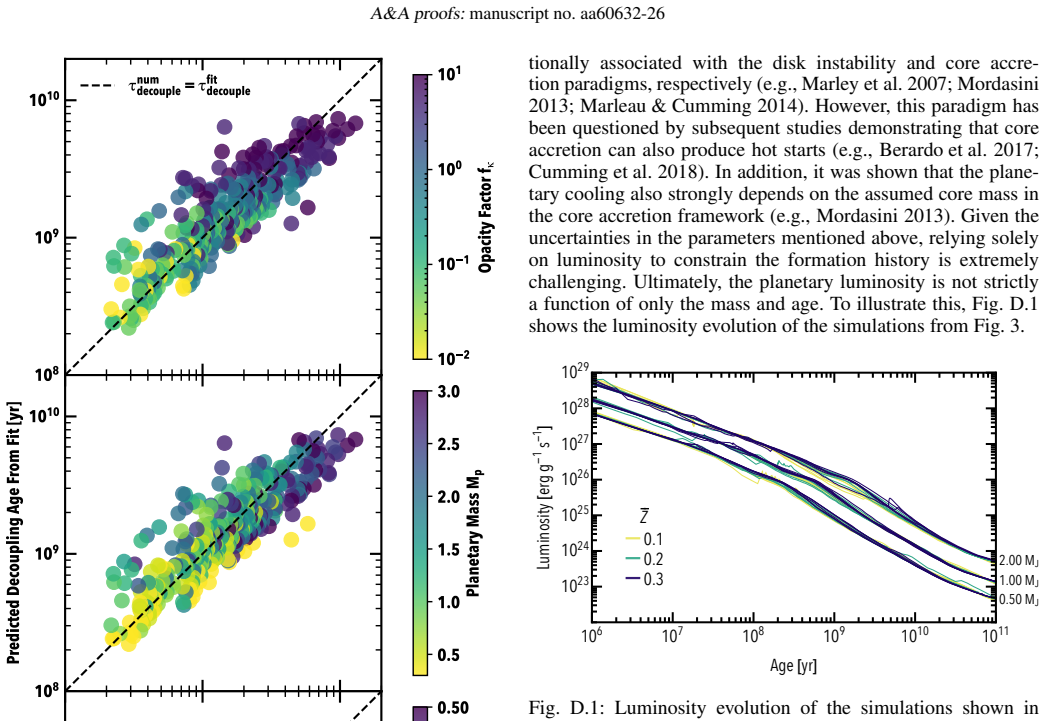
- Sect. 3.1 and Eq. (13): the empirical decoupling timescale is obtained from a power-law fit to a finite grid (Mp = 0.3–3 MJ, Z = 0.1–0.5, opacity factors 0.01–10). The formal uncertainties in Table C.1 are tiny, yet the text correctly notes that theoretical uncertainties (opacities, convection treatment, initial entropy profiles) are larger. The paper should either (i) quote a more realistic uncertainty band on τ_dec or (ii) present Eq. (13) strictly as an order-of-magnitude estimator and avoid using it as a sharp observational classifier in Fig. 4 without that caveat.
minor comments (5)
- Fig. 3 caption and surrounding text: the right-hand panel (R vs total entropy) is the key numerical validation; it would help the reader if the caption explicitly stated that the tracks are for identical bulk Z and that the collapse demonstrates the analytic claim of Sect. 2.
- Appendix B: the logistic form for Z(m) is a practical compromise, but the text should note that it cannot produce multi-step or inverted gradients that some formation models predict; a one-sentence caveat is sufficient.
- Sect. 4 / Fig. 4: the PlanetS sample comparison is useful, but the two limiting (Z, κ) cases produce quite different “coupled/potentially coupled/decoupled” fractions. A brief statement of how sensitive the population statistics are to the opacity scale would improve clarity.
- Typographical: “10 9 yr” and similar constructions appear with missing superscripts in several places (e.g., abstract, Sect. 3.1); these should be standardized to 10^9 yr throughout.
- References: the self-citation density is high but methodologically justified; no action required beyond ensuring that the key prior results (Knierim & Helled 2024, 2025) are cited at the first technical use rather than only in the introduction.
Circularity Check
Central radius–entropy identity is a self-contained first-order thermodynamic argument; only minor secondary empiricism and method self-citations, not load-bearing circularity.
specific steps
-
fitted input called prediction
[Sect. 3.1, Eq. (13); Appendix C]
"By fitting a power law to the epoch where the radius discrepancy between the stratified and homogeneous models drops to 1% for planetary masses between 0.3 and 3 MJ, we derive the decoupling relation τ_dec ≈ 1.93×10^9 yr (Z/0.1)^−0.46 (κ/30.6 cm^2 g^−1)^0.22 (Mp/1 MJ)^0.71"
τ_dec is extracted by fitting the authors’ own simulation grid (when |δR|/R falls to 1%), then used in Sect. 4 to classify observed exoplanets as coupled/decoupled. This is a secondary empirical scaling, not the central thermodynamic claim; the analytic order-of-magnitude τ_dec ~ 10^9 yr is independent. Mild fitted-input pattern only for the population application, not for the radius–entropy identity.
full rationale
The load-bearing claim—that at fixed mass M and bulk metallicity Z the macroscopic radius is fixed by total entropy S, so that after entropy convergence the radius decouples from Z(m)—is derived in Sect. 2 from the volume integral, the total differential of specific volume, hydrostatic equilibrium under a homology approximation, and the fact that ∫δZ dm = 0 by equal bulk Z. The composition term vanishes only under the additional idealization that ζ is nearly mass-uniform (tested to ~1% residual in Appendix A); that is an assumption, not a circular definition of the target radius. The thermal and pressure branches then force δR → 0 when total thermal entropies match and Γ1 > 4/3. Numerical MESA tracks (Fig. 3) independently corroborate that R(t) tracks diverge then converge while R(S) collapses. Self-citations (Knierim & Helled 2024/2025; Knierim et al. 2026) supply the evolution code, potential-entropy language, and helium-rain algorithm; they do not supply the identity being proved. The only mild circularity-adjacent element is the empirical τ_dec power law (Eq. 13), which is fitted to the authors’ own grid and then applied to PlanetS ages—secondary and clearly labeled empirical, not a first-principles prediction of the central claim. Score 1 reflects that minor secondary fit plus ordinary method self-citation, not reduction of the main result to its inputs.
Axiom & Free-Parameter Ledger
free parameters (4)
- τ_dec power-law coefficients (normalization, Z, κ, Mp exponents) =
1.93e9 yr; exponents −0.46, 0.22, 0.71
- H–He demixing temperature offset =
+325 K
- Initial entropy profile parameters (s_core, s_env, α_s) =
s_core⊙≈8, s_env⊙≈10 kB mu⁻¹, α_s=0.6 (1 MJ)
- Metal mixture (half rock, half water) and reference opacity scale =
50/50 rock–water; κ_ref=30.6 cm² g⁻¹
axioms (6)
- standard math Hydrostatic equilibrium and the first-order specific-volume differential in s, P, Z (Sect. 2, Eqs. 2–5).
- domain assumption Homology approximation δr/r = δR/R used to close the pressure perturbation (Eq. 7).
- domain assumption ζ (compositional specific-volume response) is sufficiently uniform in mass that it factors out of the radius integral.
- domain assumption Thermal entropy difference δs_Z maintains constant sign once outer envelopes lose primordial memory on a Kelvin–Helmholtz time.
- domain assumption Chabrier & Debras (2021) H–He EoS, Guillot (2010) semi-gray atmosphere, and MESA mixing/convection treatment adequately represent cooling.
- standard math Stable gas giants have Γ1 > 4/3, so the only physical solution of the pressure-term identity is δR=0.
invented entities (1)
-
Entropy-divergent and entropy-convergent evolutionary regimes / decoupling age τ_dec
independent evidence
read the original abstract
The radius of a giant planet is a key physical property. It encapsulates the outcome of its mass, composition, and thermal state, serving as a critical link between observations and the theory of planetary interiors. While traditional interior models assume distinct core-envelope structures, recent gravity measurements of Jupiter and Saturn reveal complex interiors with deep composition gradients. Here, we combine an analytic framework with numerical evolution simulations to elucidate how internal structures with composition gradients affect the planetary radius. We demonstrate that the spatial redistribution of heavy elements does not inherently alter the planetary size; rather, it is the resulting difference in total entropy over time that drives observable radius variations. We show that this mechanism naturally establishes two distinct evolutionary regimes. During the first few gigayears of evolution, composition gradients trap thermal energy deep within the interior, significantly affecting the planetary evolution and internal structure. However, as the planet cools and contracts, this ``thermal memory'' fades and the total entropy no longer depends on the primordial conditions. Consequently, the planetary radius decouples from the internal distribution of heavy elements, becoming solely a function of the total mass and bulk composition. Our results present the physical origin of the mass-radius-composition relation and suggest that the use of simplified interior models for giant exoplanets is legitimate only after the planet has surpassed this evolutionary threshold. Our analysis establishes a thermodynamic constraint on the planetary structure: while composition gradients can temporarily modulate cooling, they cannot permanently sustain radius inflation, as the addition of heavy elements, regardless of their distribution, inevitably leads to planetary contraction.
Figures


Reference graph
Works this paper leans on
-
[1]
Jupiter's formation and its primordial internal structure
Jupiter s Formation and Its Primordial Internal Structure. , keywords =. doi:10.3847/1538-4357/836/2/227 , archivePrefix =. 1701.01719 , primaryClass =
work page internal anchor Pith review Pith/arXiv arXiv doi:10.3847/1538-4357/836/2/227
-
[2]
The fuzziness of giant planets' cores
The Fuzziness of Giant Planets Cores. , keywords =. doi:10.3847/2041-8213/aa6d08 , archivePrefix =. 1704.01299 , primaryClass =
work page internal anchor Pith review Pith/arXiv arXiv doi:10.3847/2041-8213/aa6d08 2041
-
[3]
2025 , bdsk-url-1 =
David Stevenson , date-added =. 2025 , bdsk-url-1 =
2025
-
[4]
Revising the Giant Planet Mass─Metallicity Relation: Deciphering the Formation Sequence of Giant Planets. , keywords =. doi:10.3847/1538-4357/ae0cbf , archivePrefix =. 2509.20428 , primaryClass =
-
[5]
Retrieving interior properties of hot Jupiters with Love numbers and atmospheric measurements. , keywords =. doi:10.1093/mnras/staf814 , archivePrefix =. 2505.10304 , primaryClass =
-
[6]
Giant exoplanet composition: The impact of the hydrogen helium equation of state and interior structure. , keywords =. doi:10.1051/0004-6361/202452783 , archivePrefix =. 2410.21382 , primaryClass =
-
[7]
Howard, S. and M. Evolution of Jupiter and Saturn with helium rain , journal =. 2024 , volume =. doi:10.1051/0004-6361/202450629 , url =
-
[8]
Jupiter Evolutionary Models Incorporating Stably Stratified Regions
Jupiter Evolutionary Models Incorporating Stably Stratified Regions. , keywords =. doi:10.3847/1538-4357/ada030 , archivePrefix =. 2410.12899 , primaryClass =
work page internal anchor Pith review Pith/arXiv arXiv doi:10.3847/1538-4357/ada030
-
[9]
How internal structure shapes the metallicity of giant exoplanets. , keywords =. doi:10.1051/0004-6361/202557645 , archivePrefix =. 2510.08280 , primaryClass =
-
[10]
doi:10.1007/978-3-642-30304-3 , adsurl =
Stellar Structure and Evolution. doi:10.1007/978-3-642-30304-3 , adsurl =
-
[11]
The Primordial Entropy of Jupiter
The primordial entropy of Jupiter. , keywords =. doi:10.1093/mnras/sty1000 , archivePrefix =. 1804.06019 , primaryClass =
work page internal anchor Pith review Pith/arXiv arXiv doi:10.1093/mnras/sty1000
-
[12]
On the radiative equilibrium of irradiated planetary atmospheres. , keywords =. doi:10.1051/0004-6361/200913396 , archivePrefix =. 1006.4702 , primaryClass =
-
[13]
Giant planet evolution with MESA. , keywords =. doi:10.1051/0004-6361/202556537 , archivePrefix =. 2510.23678 , primaryClass =
-
[14]
APPLE: An Evolution Code for Modeling Giant Planets
APPLE: An Evolution Code for Modeling Giant Planets. , keywords =. doi:10.3847/1538-4357/ad57c3 , archivePrefix =. 2404.14483 , primaryClass =
work page internal anchor Pith review Pith/arXiv arXiv doi:10.3847/1538-4357/ad57c3
-
[15]
Jupiter's evolution with primordial composition gradients
Jupiter's evolution with primordial composition gradients. , keywords =. doi:10.1051/0004-6361/201732522 , archivePrefix =. 1801.08149 , primaryClass =
work page internal anchor Pith review Pith/arXiv arXiv doi:10.1051/0004-6361/201732522
-
[16]
The Challenge of Forming a Fuzzy Core in Jupiter
The challenge of forming a fuzzy core in Jupiter. , keywords =. doi:10.1051/0004-6361/201937376 , archivePrefix =. 2004.13534 , primaryClass =
work page internal anchor Pith review Pith/arXiv arXiv doi:10.1051/0004-6361/201937376 2004
-
[17]
Jupiter's Interior with an Inverted Helium Gradient
Jupiter's Interior with an Inverted Helium Gradient. , keywords =. doi:10.3847/PSJ/adbdb7 , archivePrefix =. 2504.00228 , primaryClass =
work page internal anchor Pith review Pith/arXiv arXiv doi:10.3847/psj/adbdb7
-
[18]
and Wahl, Sean and Lunine, Jonathan I
Militzer, Burkhard and Hubbard, William B. and Wahl, Sean and Lunine, Jonathan I. and Galanti, Eli and Kaspi, Yohai and Miguel, Yamila and Guillot, Tristan and Moore, Kimberly M. and Parisi, Marzia and Connerney, John E. P. and Helled, Ravid and Cao, Hao and Mankovich, Christopher and Stevenson, David J. and Park, Ryan S. and Wong, Mike and Atreya, Sushil...
-
[19]
The composition of transiting giant extrasolar planets
The composition of transiting giant extrasolar planets. Physica Scripta Volume T , keywords =. doi:10.1088/0031-8949/2008/T130/014023 , archivePrefix =. 0712.2500 , primaryClass =
work page internal anchor Pith review Pith/arXiv arXiv doi:10.1088/0031-8949/2008/t130/014023 2008
-
[20]
The Heavy-element Masses of Extrasolar Giant Planets, Revealed. , keywords =. doi:10.1088/2041-8205/736/2/L29 , archivePrefix =. 1105.0024 , primaryClass =
-
[21]
The origin of the high metallicity of close-in giant exoplanets. Combined effects of resonant and aerodynamic shepherding. , keywords =. doi:10.1051/0004-6361/201936700 , archivePrefix =. 1911.02292 , primaryClass =
work page internal anchor Pith review Pith/arXiv arXiv doi:10.1051/0004-6361/201936700 1911
-
[22]
How drifting and evaporating pebbles shape giant planets. I. Heavy element content and atmospheric C/O. , keywords =. doi:10.1051/0004-6361/202039640 , archivePrefix =. 2105.13267 , primaryClass =
work page internal anchor Pith review Pith/arXiv arXiv doi:10.1051/0004-6361/202039640
-
[23]
Measurement and implications of Saturn's gravity field and ring mass. Science , keywords =. doi:10.1126/science.aat2965 , adsurl =
-
[24]
Comparing Jupiter interior structure models to Juno gravity measurements and the role of a dilute core. , keywords =. doi:10.1002/2017GL073160 , archivePrefix =. 1707.01997 , primaryClass =
work page internal anchor Pith review Pith/arXiv arXiv doi:10.1002/2017gl073160
-
[25]
The bulk metallicity of giant planets around M stars. , keywords =. doi:10.1051/0004-6361/202452442 , archivePrefix =. 2411.16197 , primaryClass =
-
[26]
Annual Review of Earth and Planetary Sciences , keywords =
Interiors of the Giant Planets. Annual Review of Earth and Planetary Sciences , keywords =. doi:10.1146/annurev.ea.10.050182.001353 , adsurl =
-
[27]
Nonadiabatic Models of Jupiter and Saturn. , keywords =. doi:10.1006/icar.1994.1189 , adsurl =
-
[28]
The mass-radius relation of exoplanets, revisited
The mass-radius relation of exoplanets revisited. , keywords =. doi:10.1051/0004-6361/202348690 , archivePrefix =. 2311.12593 , primaryClass =
work page internal anchor Pith review Pith/arXiv arXiv doi:10.1051/0004-6361/202348690
-
[29]
Batygin, Konstantin and Stevenson, David J. , title =. 2013 , month =. doi:10.1088/2041-8205/769/1/L9 , url =
-
[30]
Swift, D. C. and Eggert, J. H. and Hicks, D. G. and Hamel, S. and Caspersen, K. and Schwegler, E. and Collins, G. W. and Nettelmann, N. and Ackland, G. J. , title =. 2011 , month =. doi:10.1088/0004-637X/744/1/59 , url =
-
[31]
The Mass-Metallicity Relation for Giant Planets. , keywords =. doi:10.3847/0004-637X/831/1/64 , archivePrefix =. 1511.07854 , primaryClass =
-
[32]
The Mass-Radius Relation for 65 Exoplanets Smaller than 4 Earth Radii. , keywords =. doi:10.1088/2041-8205/783/1/L6 , archivePrefix =. 1312.0936 , primaryClass =
-
[33]
, year = 1969, month = nov, volume =
The Mass-Radius Relation for Cold Spheres of Low Mass. , year = 1969, month = nov, volume =. doi:10.1086/150240 , adsurl =
doi:10.1086/150240 1969
-
[34]
An introduction to the study of stellar structure
-
[35]
Further constraints on Jupiter's primordial structure. , keywords =. doi:10.1051/0004-6361/202556984 , archivePrefix =. 2512.03961 , primaryClass =
-
[36]
Unraveling the origin of giant exoplanets: Observational implications of convective mixing
Unraveling the origin of giant exoplanets: Observational implications of convective mixing. , keywords =. doi:10.1051/0004-6361/202554506 , archivePrefix =. 2504.12118 , primaryClass =
work page internal anchor Pith review Pith/arXiv arXiv doi:10.1051/0004-6361/202554506
-
[37]
Convective Mixing in Gas Giant Planets with Primordial Composition Gradients. , keywords =. doi:10.3847/1538-4357/ad8dd0 , archivePrefix =. 2407.09341 , primaryClass =
-
[38]
A correlation between the heavy element content of transiting extrasolar planets and the metallicity of their parent stars. , keywords =. doi:10.1051/0004-6361:20065476 , archivePrefix =. astro-ph/0605751 , primaryClass =
work page internal anchor Pith review Pith/arXiv arXiv doi:10.1051/0004-6361:20065476
-
[39]
The evolution and internal structure of Neptunes and sub-Neptunes: The importance of thermal conductivity in non-convective regions. , keywords =. doi:10.1051/0004-6361/202556526 , archivePrefix =. 2509.04564 , primaryClass =
-
[40]
Constraining the origin of giant exoplanets via elemental abundance measurements
Constraining the origin of giant exoplanets via elemental abundance measurements. , keywords =. doi:10.1051/0004-6361/202244516 , archivePrefix =. 2209.01240 , primaryClass =
work page internal anchor Pith review Pith/arXiv arXiv doi:10.1051/0004-6361/202244516
-
[41]
The Astrophysical Journal Supplement Series , author =
Modules for. The Astrophysical Journal Supplement Series , author =. 2011 , note =. doi:10.1088/0067-0049/192/1/3 , abstract =
-
[42]
The Astrophysical Journal Supplement Series , author =
Modules for. The Astrophysical Journal Supplement Series , author =. 2013 , note =. doi:10.1088/0067-0049/208/1/4 , abstract =
-
[43]
The Astrophysical Journal Supplement Series , author =
Modules for. The Astrophysical Journal Supplement Series , author =. 2015 , note =. doi:10.1088/0067-0049/220/1/15 , abstract =
-
[44]
The Astrophysical Journal Supplement Series , author =
Modules for. The Astrophysical Journal Supplement Series , author =. 2018 , note =. doi:10.3847/1538-4365/aaa5a8 , abstract =
-
[45]
The Astrophysical Journal Supplement Series , author =
Modules for. The Astrophysical Journal Supplement Series , author =. 2019 , note =. doi:10.3847/1538-4365/ab2241 , abstract =
-
[46]
The Astrophysical Journal Supplement Series , author =
Modules for. The Astrophysical Journal Supplement Series , author =. 2023 , note =. doi:10.3847/1538-4365/acae8d , abstract =
-
[47]
Monthly Notices of the Royal Astronomical Society, Volume 434, Issue 4, p.3283-3292 , author =
The effect of composition on the evolution of giant and intermediate-mass planets , issn =. Monthly Notices of the Royal Astronomical Society, Volume 434, Issue 4, p.3283-3292 , author =. doi:10.1093/mnras/stt1248 , abstract =
-
[48]
Parc, Léna and Bouchy, François and Venturini, Julia and Dorn, Caroline and Helled, Ravit , month = aug, year =. From super-. Astronomy & Astrophysics , publisher =. doi:10.1051/0004-6361/202449911 , abstract =
-
[49]
Stevenson, D. J. and Salpeter, E. E. , month = oct, year =. The dynamics and helium distribution in hydrogen-helium fluid planets. , volume =. The Astrophysical Journal Supplement Series , publisher =. doi:10.1086/190479 , abstract =
-
[50]
Icarus, Volume 164, Issue 1, p
Phase separation in giant planets: inhomogeneous evolution of. Icarus, Volume 164, Issue 1, p. 228-243. , author =. doi:10.1016/S0019-1035(03)00130-1 , abstract =
-
[51]
Sur, Ankan and Tejada Arevalo, Roberto and Su, Yubo and Burrows, Adam , month = feb, year =. Simultaneous. The Astrophysical Journal Letters , publisher =. doi:10.3847/2041-8213/adad62 , abstract =
-
[52]
The. AGU Advances , author =. 2024 , keywords =. doi:10.1029/2024AV001171 , abstract =
-
[53]
Chabrier, Gilles and Debras, Florian , month = aug, year =. A. The Astrophysical Journal , publisher =. doi:10.3847/1538-4357/abfc48 , abstract =
-
[54]
and Burrows, Adam , month = jan, year =
Spiegel, David S. and Burrows, Adam , month = jan, year =. The Astrophysical Journal , publisher =. doi:10.1088/0004-637X/745/2/174 , abstract =
-
[55]
Mordasini, C. , month = oct, year =. Luminosity of young. Astronomy & Astrophysics , publisher =. doi:10.1051/0004-6361/201321617 , abstract =
-
[56]
Monthly Notices of the Royal Astronomical Society, Volume 507, Issue 2, pp.2094-2102 , author =
Synthetic evolution tracks of giant planets , issn =. Monthly Notices of the Royal Astronomical Society, Volume 507, Issue 2, pp.2094-2102 , author =. doi:10.1093/mnras/stab2250 , abstract =
-
[57]
Marley, Mark S. and Fortney, Jonathan J. and Hubickyj, Olenka and Bodenheimer, Peter and Lissauer, Jack J. , month = jan, year =. On the. The Astrophysical Journal , publisher =. doi:10.1086/509759 , abstract =
-
[58]
Monthly Notices of the Royal Astronomical Society , author =
Constraining the initial entropy of directly detected exoplanets , volume =. Monthly Notices of the Royal Astronomical Society , author =. 2014 , pages =. doi:10.1093/mnras/stt1967 , abstract =
-
[59]
Fortney, J. J. and Marley, M. S. and Saumon, D. and Lodders, K. , month = aug, year =. Synthetic. The Astrophysical Journal , publisher =. doi:10.1086/589942 , abstract =
-
[60]
Baraffe, I. and Chabrier, G. and Allard, F. and Hauschildt, P. H. , month = feb, year =. Evolutionary models for low-mass stars and brown dwarfs:. Astronomy & Astrophysics , publisher =. doi:10.1051/0004-6361:20011638 , abstract =
-
[61]
Burrows, A. and Marley, M. and Hubbard, W. B. and Lunine, J. I. and Guillot, T. and Saumon, D. and Freedman, R. and Sudarsky, D. and Sharp, C. , month = dec, year =. A. The Astrophysical Journal , publisher =. doi:10.1086/305002 , abstract =
-
[62]
Sur, Ankan and Arevalo, Roberto Tejada and Burrows, Adam and Chen, Yi-Xian , month = feb, year =. Next-generation. The Astrophysical Journal , publisher =. doi:10.3847/1538-4357/ae3a85 , abstract =
-
[63]
The Astrophysical Journal , publisher =
Berardo, David and Cumming, Andrew and Marleau, Gabriel-Dominique , month = jan, year =. The Astrophysical Journal , publisher =. doi:10.3847/1538-4357/834/2/149 , abstract =
-
[64]
Schöttler, Manuel and Redmer, Ronald , month = mar, year =. Ab. Physical Review Letters , publisher =. doi:10.1103/PhysRevLett.120.115703 , abstract =
discussion (0)
Sign in with ORCID, Apple, or X to comment. Anyone can read and Pith papers without signing in.