Comparative Study of Indicators of Chaos in the Closed and Open Dicke Model
Pith reviewed 2026-05-22 14:50 UTC · model grok-4.3
The pith
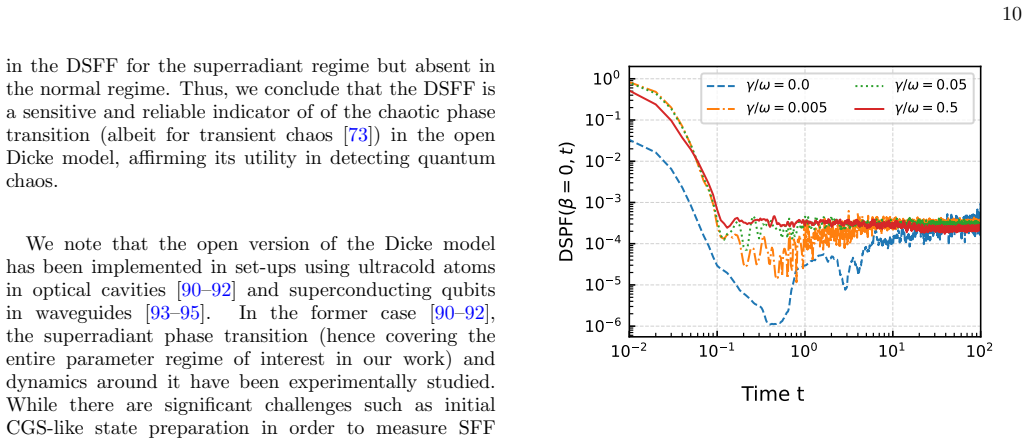
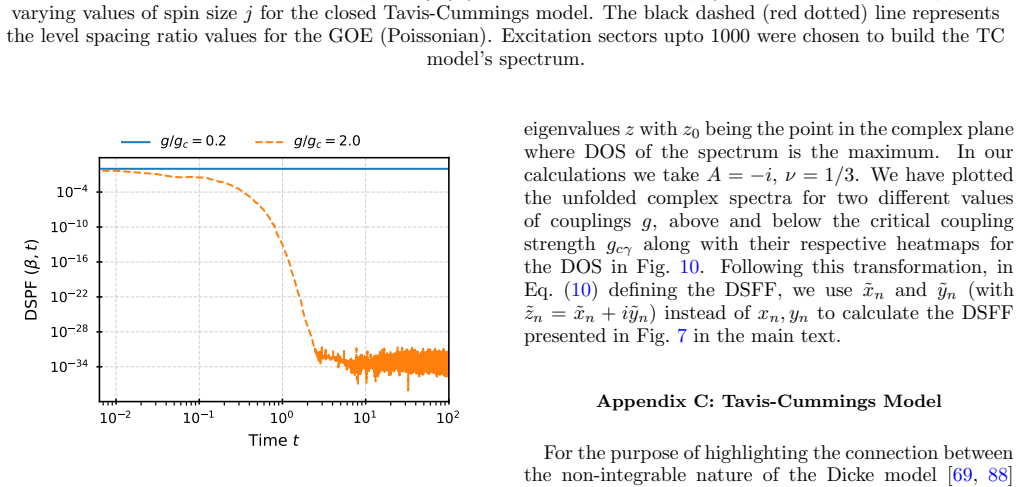
In the open Dicke model, the dissipative spectral form factor displays quadratic dip-ramp-plateau behavior matching the Ginibre Unitary Ensemble only in the superradiant regime.
A machine-rendered reading of the paper's core claim, the machinery that carries it, and where it could break.
Core claim
The authors establish that indicators sensitive to long-range correlations like the spectral form factor require very large spin sizes in the closed Dicke model to avoid false signals of chaos in the regular phase. For the open Dicke model, the dissipative spectral form factor emerges as a robust diagnostic that exhibits the quadratic dip-ramp-plateau characteristic of the Ginibre Unitary Ensemble in the superradiant regime. Additionally, the spectral properties of the Liouvillian provide indirect evidence that the dissipative superradiant quantum phase transition occurs together with the change from 2-D Poissonian to GinUE eigenvalue statistics.
What carries the argument
The dissipative spectral form factor, computed from the complex eigenvalues of the Liouvillian in the open quantum system, which captures long-range correlations in the spectrum and signals the transition to chaotic behavior.
If this is right
- In the open Dicke model, chaos diagnostics based on the Liouvillian spectrum can reliably identify the superradiant regime.
- The concurrence of the phase transition with the change in eigenvalue statistics suggests that the superradiant phase supports random-matrix-like dynamics.
- Finite-size effects must be carefully considered when applying spectral form factors to detect regularity in closed many-body systems.
- Open system versions of the Dicke model may provide cleaner tests of quantum chaos predictions than closed ones.
Where Pith is reading between the lines
- Similar dissipative diagnostics could be applied to other open quantum phase transitions to check for accompanying chaos.
- Experiments in cavity quantum electrodynamics might observe this quadratic behavior in the superradiant phase to confirm the GinUE statistics.
- Extending to the thermodynamic limit could strengthen the evidence for the concurrence of the transition and the statistical change.
- This approach might help in designing open systems where controlled chaos is desired for specific applications.
Load-bearing premise
Numerical simulations at finite spin sizes and specific damping rates capture the representative behavior expected in the thermodynamic limit across a wide range of parameters.
What would settle it
A simulation or analysis at significantly larger spin sizes where the dissipative spectral form factor in the superradiant regime fails to show the quadratic dip-ramp-plateau matching GinUE would disprove the robustness claim.
Figures





read the original abstract
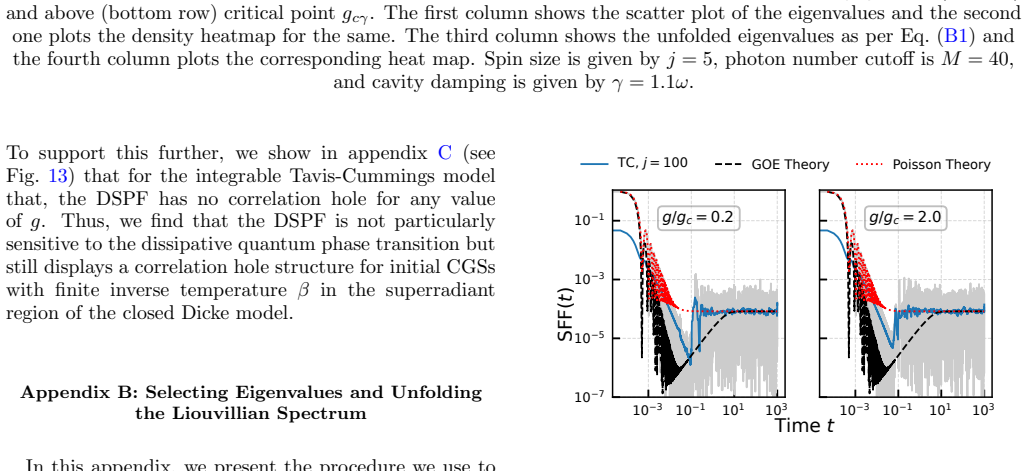
The Dicke model, renowned for its superradiant quantum phase transition, also exhibits a transition from regular to chaotic dynamics. In this work, we provide a systematic, comparative study of static and dynamical indicators of chaos for the closed and open Dicke model. In the closed Dicke model, we find that indicators of chaos sensitive to long-range correlations in the energy spectrum, such as the spectral form factor (SFF), can deviate from the Poissonian predictions and show a dip-ramp-plateau feature even in the regular region of the Dicke model unless very large values of the spin size are chosen. Thus, care is needed in using such indicators of chaos in general. In the open Dicke model with cavity damping, we find that the dissipative spectral form factor emerges as a robust diagnostic displaying a quadratic dip-ramp-plateau behavior in agreement with the Ginibre Unitary Ensemble (GinUE) in the superradiant regime. Moreover, by examining the spectral properties of the Liouvillian, we provide indirect evidence for the concurrence of the dissipative superradiant quantum phase transition and the change in Liouvillian eigenvalue statistics from 2-D Poissonian to GinUE behavior.
Editorial analysis
A structured set of objections, weighed in public.
Referee Report
Summary. The paper performs a comparative study of static and dynamical indicators of chaos in the closed and open Dicke models. In the closed case, it demonstrates that long-range spectral indicators like the spectral form factor (SFF) can exhibit spurious dip-ramp-plateau features in the regular regime at moderate spin sizes N, necessitating very large N to recover expected Poissonian statistics. In the open Dicke model with cavity damping, the dissipative SFF is shown to display a quadratic dip-ramp-plateau consistent with the Ginibre Unitary Ensemble (GinUE) specifically in the superradiant regime. Additionally, analysis of Liouvillian eigenvalue statistics provides indirect evidence that the dissipative superradiant quantum phase transition coincides with a transition from 2D Poissonian to GinUE statistics.
Significance. This work offers valuable insights into quantum chaos diagnostics for both closed and open quantum systems, particularly highlighting the robustness of the dissipative SFF in the open Dicke model and its potential connection to the superradiant transition. The caution regarding finite-size effects in SFF for the closed model is a useful contribution to the field, preventing misinterpretation of chaos indicators.
major comments (1)
- [§5] §5 (Open Dicke model and dissipative SFF): The claim that the dissipative SFF is a robust diagnostic displaying quadratic dip-ramp-plateau behavior in agreement with GinUE in the superradiant regime is based on finite-N numerics. The closed-model section already notes that SFF can produce spurious dip-ramp features at moderate N even in regular regimes; without demonstrated scaling collapse, results at substantially larger N, or explicit checks that the GinUE features and their alignment with the critical coupling survive the N→∞ limit, the concurrence with the dissipative superradiant QPT remains unestablished.
minor comments (3)
- [Methods] The manuscript would benefit from a short paragraph in the methods or appendix detailing the exact system sizes N, damping rates, and convergence criteria used for the Liouvillian diagonalization and SFF computations.
- [Figures] Figure captions for the dissipative SFF plots should explicitly state the ensemble size or number of realizations averaged, if any.
- [Introduction] A brief comparison to existing literature on dissipative spectral statistics (e.g., prior works on open quantum maps or Lindblad operators) would help contextualize the GinUE observation.
Simulated Author's Rebuttal
We thank the referee for the positive overall assessment and for the constructive comment on finite-size effects. We address the major point below and will revise the manuscript accordingly.
read point-by-point responses
-
Referee: §5 (Open Dicke model and dissipative SFF): The claim that the dissipative SFF is a robust diagnostic displaying quadratic dip-ramp-plateau behavior in agreement with GinUE in the superradiant regime is based on finite-N numerics. The closed-model section already notes that SFF can produce spurious dip-ramp features at moderate N even in regular regimes; without demonstrated scaling collapse, results at substantially larger N, or explicit checks that the GinUE features and their alignment with the critical coupling survive the N→∞ limit, the concurrence with the dissipative superradiant QPT remains unestablished.
Authors: We agree that the analogy to the closed-model finite-size caveats is important and that a full N→∞ demonstration would strengthen the claim. Our current numerics show the quadratic dip-ramp-plateau emerging consistently only in the superradiant phase for the accessible N, with the onset aligning with the critical coupling; this is absent in the normal phase. In the revised manuscript we will add explicit checks at larger N where feasible, include a brief discussion of the observed N-dependence, and qualify the concurrence with the QPT as supported by both dissipative SFF and Liouvillian statistics but still requiring further scaling studies in the thermodynamic limit. revision: yes
Circularity Check
No circularity: direct numerical spectral computations compared to standard RMT ensembles
full rationale
The paper reports direct numerical extraction of eigenvalues from the closed Dicke Hamiltonian and the open Dicke Liouvillian at finite N, followed by explicit computation of the spectral form factor (SFF) from those eigenvalues. The observed dip-ramp-plateau shapes are compared against the known analytic forms for Poisson, GOE, and GinUE ensembles; no parameters are fitted to the target statistics and then re-labeled as predictions. The finite-N caveat stated for the closed model is applied consistently and does not rely on any self-referential definition or self-citation chain. All load-bearing steps remain independent of the final claims about GinUE agreement or concurrence with the dissipative superradiant transition.
Axiom & Free-Parameter Ledger
free parameters (1)
- spin size
axioms (1)
- domain assumption The Dicke model and its dissipative extension via cavity damping are correctly described by the standard Hamiltonian and Lindblad master equation.
Forward citations
Cited by 1 Pith paper
-
Robust continuous symmetry breaking and multiversality in the chiral Dicke model
The chiral Dicke model exhibits robust U(1) symmetry breaking in a superradiant phase and multiversality, with the dynamical critical exponent zν changing from 1 to 1/2 along a special parameter line.
Reference graph
Works this paper leans on
-
[1]
E. P. Wigner, Random matrices in physics, SIAM Review9, 1 (1967)
work page 1967
-
[2]
T. Guhr, A. M¨ uller–Groeling, and H. A. Weidenm¨ uller, Random-matrix theories in quantum physics: common concepts, Physics Reports299, 189 (1998)
work page 1998
-
[3]
O. Bohigas, M. J. Giannoni, and C. Schmit, Characterization of chaotic quantum spectra and universality of level fluctuation laws, Phys. Rev. Lett. 52, 1 (1984)
work page 1984
-
[4]
C. Emary and T. Brandes, Chaos and the quantum phase transition in the dicke model, Phys. Rev. E67, 066203 (2003)
work page 2003
-
[5]
J. M. G. G´ omez, R. A. Molina, A. Rela˜ no, and J. Retamosa, Misleading signatures of quantum chaos, Phys. Rev. E66, 036209 (2002)
work page 2002
-
[6]
A. A. Abul-Magd and A. Y. Abul-Magd, Unfolding of the spectrum for chaotic and mixed systems, Physica A: Statistical Mechanics and its Applications396, 185–194 (2014)
work page 2014
-
[7]
R. Hamazaki, K. Kawabata, and M. Ueda, Non- hermitian many-body localization, Phys. Rev. Lett. 123, 090603 (2019)
work page 2019
-
[8]
R. Hamazaki, K. Kawabata, N. Kura, and M. Ueda, Universality classes of non-hermitian random matrices, Phys. Rev. Res.2, 023286 (2020)
work page 2020
-
[9]
L. S´ a, P. Ribeiro, and T. Prosen, Complex Spacing Ratios: A Signature of Dissipative Quantum Chaos, Physical Review X10, 021019 (2020), publisher: American Physical Society
work page 2020
-
[10]
Lindbladian many-body localization
R. Hamazaki, M. Nakagawa, T. Haga, and M. Ueda, Lindbladian many-body localization (2022), arXiv:2206.02984 [cond-mat.dis-nn]
- [11]
- [12]
-
[13]
V. Oganesyan and D. A. Huse, Localization of interacting fermions at high temperature, Phys. Rev. B75, 155111 (2007)
work page 2007
-
[14]
Y. Y. Atas, E. Bogomolny, O. Giraud, and G. Roux, Distribution of the ratio of consecutive level spacings in random matrix ensembles, Phys. Rev. Lett.110, 084101 (2013)
work page 2013
-
[15]
V. Kota,Embedded Random Matrix Ensembles in Quantum Physics, Lecture Notes in Physics (Springer International Publishing, 2014)
work page 2014
-
[16]
S. H. Tekur, U. T. Bhosale, and M. S. Santhanam, Higher-order spacing ratios in random matrix theory and complex quantum systems, Physical Review B98, 10.1103/physrevb.98.104305 (2018)
-
[17]
Rao, Higher-order level spacings in random matrix theory based on Wigner’s conjecture, Phys
W.-J. Rao, Higher-order level spacings in random matrix theory based on Wigner’s conjecture, Phys. Rev. B102, 054202 (2020)
work page 2020
-
[18]
A. I. Larkin and Y. N. Ovchinnikov, Quasiclassical Method in the Theory of Superconductivity, Soviet Journal of Experimental and Theoretical Physics28, 1200 (1969)
work page 1969
-
[19]
L. Leviandier, M. Lombardi, R. Jost, and J. P. Pique, Fourier transform: A tool to measure statistical level properties in very complex spectra, Phys. Rev. Lett.56, 2449 (1986)
work page 1986
-
[20]
S. H. Shenker and D. Stanford, Black holes and the butterfly effect, JHEP03, 067
- [21]
-
[22]
Swingle, Unscrambling the physics of out-of-time- order correlators, Nature Physics14, 988 (2018)
B. Swingle, Unscrambling the physics of out-of-time- order correlators, Nature Physics14, 988 (2018)
work page 2018
-
[23]
D. Chowdhury and B. Swingle, Onset of many-body chaos in theO(N) model, Phys. Rev. D96, 065005 (2017)
work page 2017
-
[24]
J. Wilkie and P. Brumer, Time-dependent manifestations of quantum chaos, Phys. Rev. Lett.67, 1185 (1991)
work page 1991
-
[25]
Y. Alhassid and R. D. Levine, Spectral autocorrelation function in the statistical theory of energy levels, Phys. Rev. A46, 4650 (1992)
work page 1992
-
[26]
Y. Alhassid and N. Whelan, Onset of chaos and its signature in the spectral autocorrelation function, Phys. Rev. Lett.70, 572 (1993)
work page 1993
-
[27]
E. Br´ ezin and S. Hikami, Spectral form factor in a random matrix theory, Physical Review E55, 4067–4083 (1997)
work page 1997
-
[28]
L. Bao, F. Pan, J. Lu, and J. P. Draayer, The critical point entanglement and chaos in the dicke model, Entropy17, 5022 (2015). 15
work page 2015
-
[29]
J. S. Cotler, G. Gur-Ari, M. Hanada, J. Polchinski, P. Saad, S. H. Shenker, D. Stanford, A. Streicher, and M. Tezuka, Black holes and random matrices, Journal of High Energy Physics2017, 118 (2017)
work page 2017
-
[30]
F. Fritzsch and M. F. I. Kieler, Universal spectral correlations in interacting chaotic few-body quantum systems, Phys. Rev. E109, 014202 (2024)
work page 2024
-
[31]
H. A. Camargo, V. Jahnke, H.-S. Jeong, K.-Y. Kim, and M. Nishida, Spectral and krylov complexity in billiard systems, Phys. Rev. D109, 046017 (2024)
work page 2024
-
[32]
K. Papadodimas and S. Raju, Local Operators in the Eternal Black Hole, Phys. Rev. Lett.115, 211601 (2015)
work page 2015
-
[33]
A. M. Garc´ ıa-Garc´ ıa and J. J. M. Verbaarschot, Spectral and thermodynamic properties of the Sachdev-Ye- Kitaev model, Phys. Rev. D94, 126010 (2016)
work page 2016
-
[34]
C. Krishnan, S. Sanyal, and P. N. Bala Subramanian, Quantum Chaos and Holographic Tensor Models, JHEP 03, 056
- [35]
-
[36]
A. del Campo, J. Molina-Vilaplana, and J. Sonner, Scrambling the spectral form factor: unitarity constraints and exact results, Phys. Rev. D95, 126008 (2017)
work page 2017
-
[37]
A. Gaikwad and R. Sinha, Spectral form factor in non- gaussian random matrix theories, Phys. Rev. D100, 026017 (2019)
work page 2019
- [38]
-
[39]
M. Winer and B. Swingle, Reappearance of thermalization dynamics in the late-time spectral form factor (2023), arXiv:2307.14415 [nlin.CD]
-
[40]
K. Okuyama and K. Sakai, Spectral form factor in the τ-scaling limit, JHEP04, 123
-
[41]
G. Cipolloni, L. Erd˝ os, and D. Schr¨ oder, On the spectral form factor for random matrices, Communications in Mathematical Physics401, 1665 (2023)
work page 2023
-
[42]
A. S. Matsoukas-Roubeas, M. Beau, L. F. Santos, and A. del Campo, Unitarity breaking in self- averaging spectral form factors, Physical Review A108, 10.1103/physreva.108.062201 (2023)
-
[43]
A. Bhattacharyya, S. S. Haque, G. Jafari, J. Murugan, and D. Rapotu, Krylov complexity and spectral form factor for noisy random matrix models, Journal of High Energy Physics2023(2023)
work page 2023
-
[44]
A. Bhattacharyya, S. Ghosh, and S. Pal, Aspects of TT¯+JT¯deformed Schwarzian: From gravity partition function to late-time spectral form factor, Phys. Rev. D110, 126015 (2024)
work page 2024
-
[45]
S. Das, S. K. Garg, C. Krishnan, and A. Kundu, What is the simplest linear ramp?, Journal of High Energy Physics2024(2024)
work page 2024
-
[46]
E. J. Torres-Herrera, A. M. Garc´ ıa-Garc´ ıa, and L. F. Santos, Generic dynamical features of quenched interacting quantum systems: Survival probability, density imbalance, and out-of-time-ordered correlator, Phys. Rev. B97, 060303 (2018)
work page 2018
-
[47]
D. Villase˜ nor, S. Pilatowsky-Cameo, M. A. Bastarrachea-Magnani, S. Lerma-Hern´ andez, L. F. Santos, and J. G. Hirsch, Quantum vs classical dynamics in a spin-boson system: manifestations of spectral correlations and scarring, New Journal of Physics22, 063036 (2020)
work page 2020
-
[48]
S. Lerma-Hern´ andez, D. Villase˜ nor, M. A. Bastarrachea-Magnani, E. J. Torres-Herrera, L. F. Santos, and J. G. Hirsch, Dynamical signatures of quantum chaos and relaxation time scales in a spin-boson system, Phys. Rev. E100, 012218 (2019)
work page 2019
-
[49]
A. Tameshtit and J. E. Sipe, Survival probability and chaos in an open quantum system, Phys. Rev. A45, 8280 (1992)
work page 1992
-
[50]
A. del Campo, J. Molina-Vilaplana, and J. Sonner, Scrambling the spectral form factor: Unitarity constraints and exact results, Phys. Rev. D95, 126008 (2017)
work page 2017
-
[51]
Z. Xu, A. Chenu, T. Prosen, and A. del Campo, Thermofield dynamics: Quantum chaos versus decoherence, Phys. Rev. B103, 064309 (2021)
work page 2021
-
[52]
A. S. Matsoukas-Roubeas, T. Prosen, and A. d. Campo, Quantum Chaos and Coherence: Random Parametric Quantum Channels, Quantum8, 1446 (2024)
work page 2024
-
[53]
J. Cornelius, Z. Xu, A. Saxena, A. Chenu, and A. del Campo, Spectral filtering induced by non-hermitian evolution with balanced gain and loss: Enhancing quantum chaos, Phys. Rev. Lett.128, 190402 (2022)
work page 2022
-
[54]
J. Li, T. Prosen, and A. Chan, Spectral statistics of non-hermitian matrices and dissipative quantum chaos, Phys. Rev. Lett.127, 170602 (2021)
work page 2021
- [55]
-
[56]
Berry, Quantum chaology, not quantum chaos, Physica Scripta40, 335 (1989)
M. Berry, Quantum chaology, not quantum chaos, Physica Scripta40, 335 (1989)
work page 1989
-
[57]
N. R. Hunter-Jones,Chaos and Randomness in Strongly-Interacting Quantum Systems, Ph.D. thesis, California Institute of Technology, Pasadena, California (2018), thesis defended on May 22, 2018
work page 2018
- [58]
-
[59]
M. A. Bastarrachea-Magnani, B. L´ opez-del Carpio, J. Ch´ avez-Carlos, S. Lerma-Hern´ andez, and J. G. Hirsch, Delocalization and quantum chaos in atom-field systems, Physical Review E93(2016)
work page 2016
-
[60]
C. Emary and T. Brandes, Quantum chaos triggered by precursors of a quantum phase transition: The dicke model, Physical Review Letters90(2003)
work page 2003
-
[61]
D. Villase˜ nor, S. Pilatowsky-Cameo, M. A. Bastarrachea-Magnani, S. Lerma-Hern´ andez, L. F. Santos, and J. G. Hirsch, Chaos and thermalization in the spin-boson dicke model, Entropy25(2023)
work page 2023
-
[62]
U. Bhattacharya, S. Dasgupta, and A. Dutta, Exploring chaos in the dicke model using ground-state fidelity and loschmidt echo, Phys. Rev. E90, 022920 (2014)
work page 2014
-
[63]
D. Tiwari and S. Banerjee, Quantum chaos in the dicke model and its variants, Proceedings of the Royal Society A: Mathematical, Physical and Engineering Sciences 479(2023)
work page 2023
-
[64]
Wang, Quantum chaos in the extended dicke model, Entropy24, 1415 (2022)
Q. Wang, Quantum chaos in the extended dicke model, Entropy24, 1415 (2022)
work page 2022
-
[65]
Q. Wang and M. Robnik, Statistical properties of the localization measure of chaotic eigenstates in the dicke model, Phys. Rev. E102, 032212 (2020)
work page 2020
-
[66]
S. Pilatowsky-Cameo, D. Villase˜ nor, M. A. Bastarrachea-Magnani, S. Lerma-Hern´ andez, L. F. Santos, and J. G. Hirsch, Ubiquitous quantum scarring 16 does not prevent ergodicity, Nature Communications 12, 852 (2021)
work page 2021
-
[67]
D. Villase˜ nor and P. Barberis-Blostein, Analysis of chaos and regularity in the open dicke model, Physical Review E109(2024)
work page 2024
-
[68]
D. Villase˜ nor, L. F. Santos, and P. Barberis-Blostein, Breakdown of the quantum distinction of regular and chaotic classical dynamics in dissipative systems, Phys. Rev. Lett.133, 240404 (2024)
work page 2024
-
[69]
J. Larson and E. K. Irish, Some remarks on ‘superradiant’ phase transitions in light-matter systems, Journal of Physics A: Mathematical and Theoretical50, 174002 (2017)
work page 2017
- [70]
- [71]
- [72]
- [73]
-
[74]
R. H. Dicke, Coherence in spontaneous radiation processes, Phys. Rev.93, 99 (1954)
work page 1954
-
[75]
A. Edelman and N. Rao, Random matrix theory, Acta Numerica14, 233 (2005)
work page 2005
-
[76]
G. Akemann, N. Ayg¨ un, M. Kieburg, and P. P¨ aßler, Complex symmetric, self-dual, and ginibre random matrices: Analytical results for three classes of bulk and edge statistics (2024), arXiv:2410.21032 [math-ph]
- [77]
-
[78]
G. Akemann, M. Kieburg, A. Mielke, and T. Prosen, Universal Signature from Integrability to Chaos in Dissipative Open Quantum Systems, Physical Review Letters123(2019)
work page 2019
-
[79]
S. C. L. Srivastava, A. Lakshminarayan, S. Tomsovic, and A. B¨ acker, Ordered level spacing probability densities, Journal of Physics A: Mathematical and Theoretical52, 025101 (2018)
work page 2018
- [80]
discussion (0)
Sign in with ORCID, Apple, or X to comment. Anyone can read and Pith papers without signing in.