REVIEW 4 major objections 4 minor 22 references
FactsR: A Safer Method for Producing High Quality Healthcare Documentation
T0 review · 4 major / 4 minor · reviewed 2026-08-15 · deepseek-v4-flash
Pith's one-line read FactsR produces clinical notes that are more complete and concise than one-shot ambient scribes by extracting and refining clinical facts in real time during the consultation.
desk verdict A promising clinician-in-the-loop scribe design undermined by an evaluation that leaks the gold note and relies on an uncalibrated private judge. read the letter →
The pith
A machine-rendered reading of the paper's core claim, the machinery that carries it, and where it could break.
The reading
What carries the argument
The load-bearing mechanism is the Fact: a short, patient-specific clinical statement such as "diarrhea five times daily for 10 days," extracted from a sliding window of transcript tokens. A draft model proposes candidate facts from the current window together with facts already accumulated; an evaluator checks each candidate against the window; a refinement model rewrites any candidate that fails; and the loop repeats up to a maximum number of refinement steps. Because the transcript is processed in overlapping windows, facts accumulate as the consultation unfolds rather than in one expensive pass, and the clinician sees an editable fact list. The final note is generated by an instruction-tuned model from the verified fact set, not from the raw transcript, so formatting and phrasing are separated from clinical content.
What would settle it
Have a panel of clinicians independently rate the same Primock57 outputs from the baseline ambient scribe and from FactsR on completeness, conciseness, and groundedness. If the panel's ordering of the two systems does not reproduce the alignment model's ordering, or if the panel finds the baseline notes no less complete or concise than FactsR's, the central claim's evaluation foundation is not supported.
Extended reading notes
Core claim
The paper's central claim, stated in Section 5, is that FactsR produces notes that are significantly more complete and concise than traditional few-shot ambient scribe approaches while maintaining a high level of groundedness. The reported numbers behind that claim are: the baseline ambient scribe ($T \rightarrow D_T$) scores $0.802$ completeness and $0.851$ conciseness with $0.971$ groundedness; the FactsR pipeline ($F \rightarrow D_F$) scores $0.814$ and $0.878$ with $0.922$ groundedness; filtering the facts as a clinician would ($F_p \rightarrow D_p$) gives $0.821$ and $0.946$; and adding clinically meaningful facts missing from the transcript ($\hat{F}_p \rightarrow \hat{D}_p$) gives $0.931$ completeness, $0.948$ conciseness, and $0.914$ groundedness. The interpretation is that one-pass, post-hoc summarization stays close to the transcript but abstracts and filters poorly, whereas decomposing the consultation into a live, editable fact list moves the note toward what a clinician would actually write.
Load-bearing premise
The evaluation assumes that the private alignment model's semantic-equivalence scores are a faithful proxy for what a clinician would call complete, concise, and grounded, and the paper does not calibrate that model against human clinician ratings.
Editorial extensions
If this is right
- Clinicians can validate documentation during the consultation, so a factual mistake is catchable before the final note is created.
- Note generation becomes modular: templates, fact granularity, and evaluation criteria can be adapted per clinic or specialty without rewriting a monolithic prompt.
- The live fact stream can feed real-time decision support during the consultation, not just documentation afterward.
- Long or complex consultations are handled incrementally, avoiding the degradation that comes from summarizing a long transcript in one pass.
Reading between the lines
- As an editorial extension, the fact list is format-independent, so the same verified facts could be reused for billing codes, handoff notes, or patient summaries without regenerating them.
- A direct testable extension would deploy FactsR with a visible fact panel in real outpatient visits and measure whether clinicians' live corrections reduce post-visit note editing time, a quantity the paper does not report.
- The draft-evaluate-refine loop is a generic self-refinement pattern, so the same architecture could transfer to other high-stakes summarization settings where a wrong omission is expensive, such as legal or safety-critical incident reports.
Signed reviews
Editorial analysis
A structured set of objections, weighed in public.
Referee Report
Summary. The paper introduces FactsR, a modular clinician-in-the-loop pipeline for ambient clinical documentation. Instead of generating a SOAP note from the entire transcript in a single pass, FactsR extracts a set of "Facts" incrementally from a stream of consultation windows, refines them via an LLM-based evaluator and refinement model, and then generates the final note from the refined facts. The evaluation uses the publicly available Primock57 benchmark and a private alignment model to compute completeness, conciseness, and groundedness for a few-shot baseline (T→DT), FactsR (F→DF), and two simulated clinician-intervention variants (Fp→Dp and Fhatp→Dhatp). The paper claims that FactsR significantly improves completeness and conciseness while maintaining groundedness, and that clinician-guided refinement further improves fidelity. The authors explicitly acknowledge in Section 4.1 that using the gold notes to simulate clinician interaction introduces circularity and limits conclusions.
Significance. If the evaluation could be trusted, FactsR would be a meaningful step toward safer ambient scribe systems: it decomposes clinical summarization into interpretable fact-extraction and refinement steps, puts clinicians in the loop during the consultation, and targets a real patient-safety concern. The paper makes a good-faith attempt to move beyond lexical metrics, uses a public benchmark rather than a proprietary one, and openly discloses the circularity of the clinician-simulation. These strengths are real. However, the quantitative evidence is currently undermined by an uncalibrated private evaluation model and by a clinician-in-the-loop simulation that leaks the gold note; the central comparative claim is therefore not yet established.
major comments (4)
- [Section 4.2.2] The evaluation depends entirely on a private alignment model that has not been calibrated against clinician judgment; the only reported sanity check is that DG aligns with itself, which demonstrates self-consistency rather than clinical validity. Because all three metrics in Table 1 are produced by this judge, the central comparison is only as credible as the judge, and no evidence (e.g., per-note human ratings, precision/recall of the judge against human annotation, or a public model variant) is provided.
- [Table 1, Section 5] The primary comparison T→DT versus F→DF yields small differences (completeness 0.802 versus 0.814, conciseness 0.851 versus 0.878, groundedness 0.971 versus 0.922), but no per-note distributions, confidence intervals, or paired significance tests are reported, so the conclusion in Section 5 that FactsR produces notes that are "significantly more complete and concise" is not statistically supported.
- [Sections 4.1 and 4.2.2] The clinician-in-the-loop rows Fp→Dp and Fhatp→Dhatp are constructed directly from the gold note DG: Fhatp adds segments taken from DG, so the large completeness gain to 0.931 is partly guaranteed by construction. The manuscript itself concedes this in Section 4.1, yet the conclusion still cites these rows as evidence that clinician-guided refinement improves safety and fidelity; this evidence needs to be recharacterized or replaced with a non-leaking protocol.
- [Section 4.2.2, Fp definition] The displayed definition Fp = {f ∈ F | f ⊄ DG} selects facts from F that are not contained in DG, which appears to be the opposite of the intended filtering described in the text ("filtering out irrelevant facts") and is inconsistent with the improvement reported for Fp→Dp; this definitional inconsistency must be resolved because the clinician-intervention results depend on it.
minor comments (4)
- [Section 3, Eq. (1)] The windows W(j) are defined for every token j, but Algorithm 1 and the text state that updates occur every X tokens; please clarify how the incremental update frequency X relates to the formal window set W.
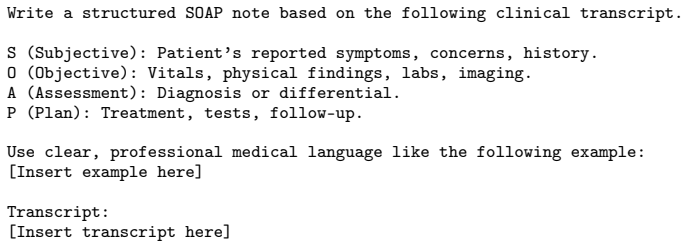
- [Figure 1] Figure 1 is only a placeholder prompt with bracketed text such as "[Insert example here]" and "[Insert transcript here]"; since few-shot prompting is the baseline, the actual prompt construction and the number of examples used should be described.
- [Table 1 caption] The table caption says model-based rows are Adjusted Completeness, but the text in Section 4.3 refers to those rows simply as completeness; please clarify which quantity is reported in each row to avoid confusion.
- [Section 2] The statement that minimal few-shot prompts "typically yield suboptimal performance" is anecdotal; please provide references or report the prompt lengths and examples used in the baseline.
Circularity Check
Gold-note-derived clinician edits and a self-confirming judge inflate the headline completeness and conciseness gains.
-
self definitional
[Section 4.1 (Dataset) and Section 4.2.2 (Alignment based evaluation metrics)]
"We will use the physician-written notes as the gold standard for meaning, and use the meaning contained in the note for simulating a clinician-in-the-loop. This introduces circularity and limits conclusions, but also provides us with a useful benchmark. ... To simulate human involvement, we define Fp and F ˆp as Fp ={f∈F|f̸⊆DG} (facts fromF not aligning withDG) F ˆp =Fp∪{s∈DG|s̸⊆F} (Fp plus parts ofDG not covered byF )"
Fp is defined by deleting every extracted fact not contained in the gold note DG, and F-hat-p is defined by adding segments taken from DG. The table then scores Dp and D-hat-p for completeness and conciseness against that same DG. Removing non-DG content and inserting DG content before generation makes the completeness and conciseness gains in the rows Fp→Dp and F-hat-p→D-hat-p partly guaranteed by construction. The paper admits the circularity, yet the conclusion still uses these rows to claim that clinician-guided refinement improves note quality and safety, so the headline improvement inherits this construction.
-
other
[Section 4.2.2 (Alignment based evaluation metrics) and Section 4.3 (Results)]
"We tune our alignment model to be as strict (/unbiased) as possible by requiring thatDG must align with itself (/DG) with a 100% Completeness and Conciseness score. ... The perfect performance of completeness and conciseness is also an indication that the Model-as-a-Judge approach works well."
The judge's threshold is set by requiring DG to self-align at 100%; the model was tuned until this condition held. Citing DG's perfect self-score as evidence that the judge is well-calibrated is therefore self-confirmation rather than external validation. All three headline metrics are produced by this privately tuned judge, and the paper reports no calibration against clinician ratings, so the central numbers are only as independent as the judge's own self-consistency.
full rationale
The paper contains two genuinely circular evaluation mechanisms. First, the simulated clinician-in-the-loop is constructed from the gold note DG: Fp deletes facts not in DG and F-hat-p inserts DG segments, and the resulting notes are then scored for completeness and conciseness against DG. The 0.931 completeness and 0.948 conciseness of D-hat-p are therefore partly guaranteed by construction; the paper explicitly concedes this in Section 4.1. Second, the alignment judge is tuned until DG self-aligns at 100%, and DG's perfect self-score is then cited as evidence that the judge works; that is self-confirmation, not calibration. The comparison T→DT versus F→DF is not circular in itself, but it is small (0.802 vs 0.814 completeness, 0.851 vs 0.878 conciseness), reported without confidence intervals or significance tests, and it is produced by the same privately tuned judge with no external human calibration. Hence the central claim, as stated in Section 5, leans on the construction-derived clinician-loop rows and on a self-confirming judge, making the headline improvement partially circular.
Assumptions & free parameters
free parameters (3)
- window size w
- update frequency X
- max refinement steps Nmax
assumptions (3)
- domain assumption Gold clinician notes (DG) are a complete and accurate representation of the consultation's clinical meaning.
- domain assumption Sliding-window segmentation with fixed width w preserves all clinically relevant information.
- domain assumption The alignment model's semantic equivalence judgments are a reliable proxy for clinician judgment.
Cite this review
Pith. "Pith review of FactsR: A Safer Method for Producing High Quality Healthcare Documentation." pith.science (2026). https://pith.science/paper/XDHGHA5P
@misc{pith2026250510360,
  author       = {Pith},
  title        = {Pith review of: FactsR: A Safer Method for Producing High Quality Healthcare Documentation},
  year         = {2026},
  howpublished = {\url{https://pith.science/paper/XDHGHA5P}},
  note         = {Machine review of arXiv:2505.10360}
}
read the original abstract
There are now a multitude of AI-scribing solutions for healthcare promising the utilization of large language models for ambient documentation. However, these AI scribes still rely on one-shot, or few-shot prompts for generating notes after the consultation has ended, employing little to no reasoning. This risks long notes with an increase in hallucinations, misrepresentation of the intent of the clinician, and reliance on the proofreading of the clinician to catch errors. A dangerous combination for patient safety if vigilance is compromised by workload and fatigue. In this paper, we introduce a method for extracting salient clinical information in real-time alongside the healthcare consultation, denoted Facts, and use that information recursively to generate the final note. The FactsR method results in more accurate and concise notes by placing the clinician-in-the-loop of note generation, while opening up new use cases within real-time decision support.
Figures
Reference graph
Works this paper leans on
-
[1]
Gordon Caldwell. The process of clinical consultation is crucial to patient outcomes and safety: 10 quality indicators. Clinical Medicine, 19: 0 503--506, 11 2019
work page 2019
-
[2]
The impact of electronic health record systems on clinical documentation times: A systematic review
Lisa Baumann, Jannah Baker, and Adam Elshaug. The impact of electronic health record systems on clinical documentation times: A systematic review. Health Policy, 122, 2018
work page 2018
-
[3]
Hart, Lorelle Martin, Julia Todd, and Nicole Hosking
Graeme K. Hart, Lorelle Martin, Julia Todd, and Nicole Hosking. Technology-based challenges of informal clinical communication in an australian tertiary referral hospital: a survey-based assessment of user perspectives. BMJ Open Quality, 14, 2025
work page 2025
-
[4]
Ambient artificial intelligence scribes: utilization and impact on documentation time
Stephen P Ma, April S Liang, Shreya J Shah, Margaret Smith, Yejin Jeong, Anna Devon-Sand, Trevor Crowell, Clarissa Delahaie, Caroline Hsia, Steven Lin, Tait Shanafelt, Michael A Pfeffer, Christopher Sharp, and Patricia Garcia. Ambient artificial intelligence scribes: utilization and impact on documentation time. Journal of the American Medical Informatics...
work page 2024
-
[5]
Ambient artificial intelligence scribes to alleviate the burden of clinical documentation
Aaron Tierney, Gregg Gayre, Brian Hoberman, Britt Mattern, Mamuel Ballesca, Patricia Kipnis, Vincent Liu, and Kristine Lee. Ambient artificial intelligence scribes to alleviate the burden of clinical documentation. NEJM Catalyst, 5, 02 2024
work page 2024
-
[6]
Michael Albrecht, Denton Shanks, Tina Shah, Taina Hudson, Jeffrey Thompson, Tanya Filardi, Kelli Wright, Gregory A Ator, and Timothy Ryan Smith. Enhancing clinical documentation with ambient artificial intelligence: a quality improvement survey assessing clinician perspectives on work burden, burnout, and job satisfaction. JAMIA Open, 8 0 (1), 02 2025
work page 2025
-
[7]
D. Van Veen, C. Van Uden, L. Blankemeier, J. B. Delbrouck, A. Aali, C. Bluethgen, A. Pareek, M. Polacin, E. P. Reis, A. Seehofnerová, N. Rohatgi, P. Hosamani, W. Collins, N. Ahuja, C. P. Langlotz, J. Hom, S. Gatidis, J. Pauly, and A. S. Chaudhari. Adapted large language models can outperform medical experts in clinical text summarization. Nature Medicine,...
work page 2024
-
[8]
Zero-shot large language models for long clinical text summarization with temporal reasoning, 2025
Maya Kruse, Shiyue Hu, Nicholas Derby, Yifu Wu, Samantha Stonbraker, Bingsheng Yao, Dakuo Wang, Elizabeth Goldberg, and Yanjun Gao. Zero-shot large language models for long clinical text summarization with temporal reasoning, 2025. URL https://arxiv.org/abs/2501.18724
arXiv 2025
Show all 22 references
-
[9]
Anirudh Joshi, Namit Katariya, Xavier Amatriain, and Anitha Kannan. Dr. summarize: Global summarization of medical dialogue by exploiting local structures. In Findings of the Association for Computational Linguistics: EMNLP 2020, pages 3755--3763. Association for Computational...
2020
-
[10]
Inter-rater reliability and generalizability of patient note scores using a scoring rubric based on the usmle step-2 cs format
Yoon Soo Park, Abbas Hyderi, Georges Bordage, Kuan Xing, and Rachel Yudkowsky. Inter-rater reliability and generalizability of patient note scores using a scoring rubric based on the usmle step-2 cs format. Advances in Health Sciences Education, 21: 0 1--13, 10 2016
2016
-
[11]
What disease does this patient have? a large-scale open domain question answering dataset from medical exams
Di Jin, Eileen Pan, Nassim Oufattole, Wei-Hung Weng, Hanyi Fang, and Peter Szolovits. What disease does this patient have? a large-scale open domain question answering dataset from medical exams. Applied Sciences, 11: 0 6421, 07 2021
2021
-
[12]
Large language models are zero-shot reasoners
Takeshi Kojima, Shixiang Shane Gu, Machel Reid, Yutaka Matsuo, and Yusuke Iwasawa. Large language models are zero-shot reasoners. In Proceedings of the 36th International Conference on Neural Information Processing Systems, NIPS 22, 2022
2022
-
[13]
Chi, Quoc V
Jason Wei, Xuezhi Wang, Dale Schuurmans, Maarten Bosma, Brian Ichter, Fei Xia, Ed H. Chi, Quoc V. Le, and Denny Zhou. Chain-of-thought prompting elicits reasoning in large language models. In Proceedings of the 36th International Conference on Neural Information Processing Sys...
2022
-
[14]
S umm QA at MEDIQA -chat 2023: In-context learning with GPT -4 for medical summarization
Yash Mathur, Sanketh Rangreji, Raghav Kapoor, Medha Palavalli, Amanda Bertsch, and Matthew Gormley. S umm QA at MEDIQA -chat 2023: In-context learning with GPT -4 for medical summarization. In Proceedings of the 5th Clinical Natural Language Processing Workshop, pages 490--502...
2023
-
[15]
What`s wrong? refining meeting summaries with LLM feedback
Frederic Thomas Kirstein, Terry Lima Ruas, and Bela Gipp. What`s wrong? refining meeting summaries with LLM feedback. In Owen Rambow, Leo Wanner, Marianna Apidianaki, Hend Al-Khalifa, Barbara Di Eugenio, and Steven Schockaert, editors, Proceedings of the 31st International Con...
2025
-
[16]
Fine-tuning large language models for specialized use cases
DM Anisuzzaman, JG Malins, PA Friedman, and ZI Attia. Fine-tuning large language models for specialized use cases. Mayo Clinic Proceedings: Digital Health, 3 0 (1): 0 100184, Nov 29 2024
2024
-
[17]
(in press): Primock57: A dataset of primary care mock consultations
Alex Papadopoulos Korfiatis, Francesco Moramarco, Radmila Sarac, and Aleksandar Savkov. (in press): Primock57: A dataset of primary care mock consultations. In Proceedings of the 60th Annual Meeting of the Association for Computational Linguistics, 2022
2022
-
[18]
Expert evaluation of large language models for clinical dialogue summarization
David Fraile Navarro, Enrico Coiera, Thomas Hambly, Zoe Triplett, Nahyan Asif, Anindya Susanto, Anamika Chowdhury, Amaya Lorenzo, Mark Dras, and Shlomo Berkovsky. Expert evaluation of large language models for clinical dialogue summarization. Scientific Reports, 15, 01 2025
2025
-
[19]
Llm-based nlg evaluation: Current status and challenges, 2024
Mingqi Gao, Xinyu Hu, Jie Ruan, Xiao Pu, and Xiaojun Wan. Llm-based nlg evaluation: Current status and challenges, 2024. URL https://arxiv.org/abs/2402.01383
2024 arXiv
-
[20]
Llms-as-judges: A comprehensive survey on llm-based evaluation methods, 2024
Haitao Li, Qian Dong, Junjie Chen, Huixue Su, Yujia Zhou, Qingyao Ai, Ziyi Ye, and Yiqun Liu. Llms-as-judges: A comprehensive survey on llm-based evaluation methods, 2024. URL https://arxiv.org/abs/2412.05579
2024 arXiv
-
[21]
Survey on evaluation of llm-based agents, 2025
Asaf Yehudai, Lilach Eden, Alan Li, Guy Uziel, Yilun Zhao, Roy Bar-Haim, Arman Cohan, and Michal Shmueli-Scheuer. Survey on evaluation of llm-based agents, 2025. URL https://arxiv.org/abs/2503.16416
2025 arXiv
-
[22]
Rahul K. Arora, Jason Wei, Rebecca Soskin Hicks, Preston Bowman, Joaquin Quiñonero-Candela, Foivos Tsimpourlas, Michael Sharman, Meghan Shah, Andrea Vallone, Alex Beutel, Johannes Heidecke, and Karan Singhal. Healthbench: Evaluating large language models towards improved human...
2025 arXiv
Reviewed August 15, 2026 · model on record in the stance chip above.
Discussion (0). Continue with ORCID to comment.