REVIEW 3 major objections 4 minor 78 references
Does Feasibility Matter? Understanding the Impact of Feasibility on Synthetic Training Data
T0 review · 3 major / 4 minor · reviewed 2026-08-15 · deepseek-v4-flash
Pith's one-line read Feasibility of synthetic training images barely changes CLIP accuracy
desk verdict A useful controlled-generation pipeline and a plausible but not yet proven null result — feasibility barely matters for CLIP classification, but single runs and contaminated infeasible sets keep the claim conditional. read the letter →
The pith
A machine-rendered reading of the paper's core claim, the machinery that carries it, and where it could break.
The reading
What carries the argument
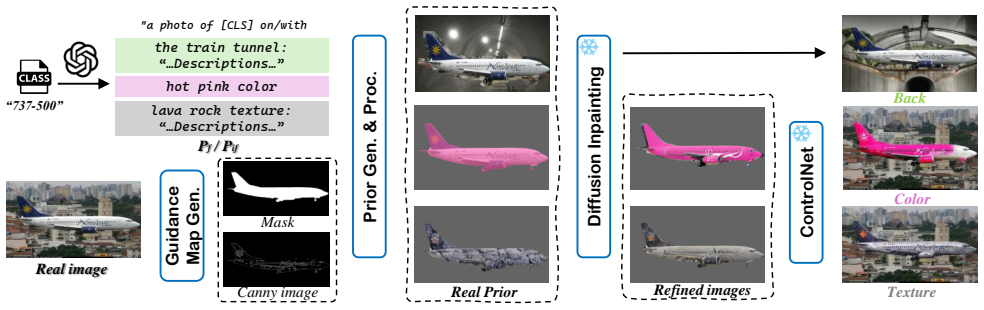
The VariReal pipeline generates minimal-change feasible/infeasible image pairs from real images. It uses GPT-4 with in-context examples to produce class-specific feasible and infeasible attribute prompts (background, color, texture), then performs prior-guided diffusion editing: inpainting with a real prior and mask dilation for backgrounds, and a two-stage inpainting-plus-ControlNet with Canny-edge conditioning for foreground color and texture edits. An MLLM (Llava-Next) filters outputs by attribute and feasibility. Performance is measured by LoRA fine-tuning of CLIP, computing $\Delta_1 = F - IF$ (feasible minus infeasible top-1 accuracy) and $\Delta_2 = \text{Mix} - \frac{F+IF}{2}$ (mixing gain over the average of pure sets). The mechanism that carries the argument is this pairing: because each real image is edited in only one attribute and every image is reused across all prompts, feasible and infeasible training sets differ only in the target attribute, isolating feasibility from other image content.
What would settle it
Train LoRA-fine-tuned CLIP on feasible and infeasible synthetic sets that have been censored by a human panel so every image is verified as correctly labeled, across many random seeds. If the top-1 accuracy gap between the two sets consistently exceeds 1% on any of the three attributes—or if the paper's below-0.3% differences fail to replicate under this stricter label control—then the claim that feasibility has no clear impact is falsified.
Extended reading notes
Core claim
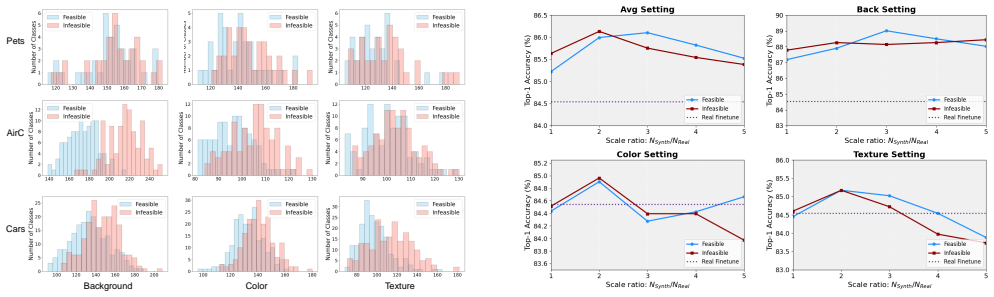
The central claim, stated on the paper's own terms, is that feasibility has no clear impact on classification performance for LoRA-fine-tuned CLIP models. Across Oxford Pets, FGVC-Aircraft, and Stanford Cars, most differences $\Delta_1 = F - IF$ are below 0.3%, with the largest being a 1.8% gain for feasible backgrounds on Aircraft and a 3.2% gain for feasible textures on Cars; the direction is not consistent. The main corollary is that infeasible synthetic images can be used interchangeably with feasible ones: generation need not enforce feasibility, and mixing the two types does not hurt. The paper's second claim is that the attribute type matters: background edits consistently beat real-only training even when infeasible, whereas color and texture edits are less effective and may degrade performance at scale.
Load-bearing premise
The comparison assumes that 'feasible' and 'infeasible' are cleanly separated: the whole result rests on prompt generation, manual filtering, and per-attribute editing parameters producing truly infeasible images, yet human evaluation labeled up to 19.1% of infeasible texture images as feasible, so if infeasible data is actually in-distribution or the edits also change naturalness or class-relevant cues, the null finding becomes an artifact of the generator rather than a property of feasibility.
Editorial extensions
If this is right
- Synthetic-data pipelines for object-centric classification can stop treating infeasible outputs as waste; both feasible and infeasible images are usable training material.
- Background diversity is the more useful axis of augmentation: both feasible and infeasible background edits outperform real-only training, so constraints like ALIA's feasible-background restriction are unnecessary.
- Color and texture edits should be used sparingly as augmentation; their benefit peaks at low synthetic-to-real ratios and turns negative at larger scale.
- Mixing feasible and infeasible data is safe and can even add complementary signal in synthetic-only training, since the two types push models toward different correct-prediction sets while reaching similar accuracy.
Reading between the lines
- Editorial inference: the paper's null result is probably a lower bound on feasibility effects: up to 19.1% of 'infeasible' texture images passed human inspection as feasible, so a cleaner operationalization of infeasibility could either shrink the gap further or reveal a genuine effect.
- Editorial inference: the pattern that foreground edits underperform despite being distributionally closer to real data suggests classifiers rely on class-relevant foreground cues; feasibility research should separate 'distributional closeness' from 'task-relevance'.
- Editorial inference: because the evidence comes from CLIP with LoRA and object-centric datasets, the conclusion may not transfer to other architectures, tasks like detection or segmentation, or safety-critical domains; testing with a convolutional baseline or a medical or autonomous-driving dataset would decide.
- Editorial inference: the strongest testable extension is to vary one attribute at a time with a hard feasibility guarantee, such as physically impossible but photorealistic combinations verified by a panel, and measure per-seed accuracy gaps to see whether the below-0.3% null holds outside the paper's generator.
Signed reviews
Editorial analysis
A structured set of objections, weighed in public.
Referee Report
Summary. The paper proposes VariReal, a diffusion-based minimal-edit pipeline that creates feasible and infeasible variants of real images along background, color, and texture attributes, and evaluates them on three fine-grained datasets (Oxford Pets, FGVC Aircraft, Stanford Cars) plus WaterBirds for background. CLIP models are LoRA-fine-tuned under synthetic-only and real+synthetic training, comparing feasible, infeasible, and mixed conditions. The main empirical claim is that feasibility has no clear impact on top-1 accuracy (Observation 1), that background edits help while color/texture edits are less effective (Observation 2), and that strictly feasible synthetic data is not necessary (Observation 3). The paper includes human evaluation, MLLM-based filtering, distributional metrics, scaling experiments, and ablations supporting the dataset-generation pipeline.
Significance. If the null result survives proper statistical treatment, the paper makes a useful and somewhat counterintuitive contribution: it challenges the common assumption that infeasible synthetic images are harmful and suggests that synthetic-data pipelines need not strictly enforce feasibility. The VariReal pipeline is a concrete, reusable tool for controlled attribute editing, with code released, and the study design includes human evaluation, automatic filtering, distributional analyses, and scaling/ablation experiments, which are strengths. However, the central evidence consists of small accuracy differences without variance estimates or significance testing, so the contribution is currently conditional on additional statistical validation.
major comments (3)
- [§4.2.1, Table 1, Observation 1] The central claim that feasibility 'shows no clear impact' rests on point estimates from a single LoRA fine-tuning run per condition; no seed variation, confidence intervals, or significance tests are reported. Most Δ1 values are below 0.3%, but per-cell gaps reach 3.2% (Cars, texture, synthetic-only), and the paper provides no estimate of run-to-run variability for this training protocol. Without repeated seeds or an equivalence test with a pre-specified margin, the absence of a visible gap cannot be distinguished from a real effect obscured by noise. Please add multi-seed results with variance reporting and a formal or semi-formal test of the no-effect claim.
- [§4.2.1] The paragraph reporting the distribution of Δ1 values contains an internal arithmetic error: after incorporating real data, the text states that '78% of Δ1 values (5/9) remain within 0.3%,' but 5/9 is 56%, not 78%. The sentence reports both 78% and the fraction 5/9, so the quantitative summary is internally inconsistent. This needs correction and a re-audit of all percentages and counts in the section.
- [§3.2.3, Table 2, Supp. G, Supp. Table 5] The operationalization of feasibility is not clean enough to support a strong null conclusion. Table 2 reports 80.9% feasibility correctness for infeasible texture images, so 19.1% of that training set is judged feasible by human evaluators; Supp. G attributes this to textures that only convey color and to implausible object-background combinations. If a substantial share of 'infeasible' data is actually in-distribution, any true feasibility effect is attenuated toward zero. Additionally, Supp. Table 5 shows that feasible and infeasible conditions use different generation hyperparameters (guidance scales, strengths, mask dilation/alpha factors), so the comparison varies in more than the target attribute. I request a contamination-filtered analysis on the human-verified subsets and either matched generation hyperparameters or a sensitivity analysis showing robustness to these choices.
minor comments (4)
- [Figure 4 caption] The caption contains a typo: 'Standford-Cars' should be 'Stanford Cars'.
- [Supp. Figure 13 caption] The caption begins with 'TQualitative results', which appears to be missing a leading word or contains a typo; please correct it.
- [§3.1] The notation ISyn is introduced in the task formulation but not defined at first use; please define it explicitly.
- [Table 1 caption] The formula for Δ2 is written as 'Mix− F+IF/2', which is ambiguous; it should be written as Mix − (F + IF)/2.
Circularity Check
No significant circularity: the feasibility comparison is an external empirical measurement, with only a minor non-load-bearing self-citation to DataDream for hyperparameter tuning.
full rationale
The paper contains no derivation chain whose conclusion is equivalent to its inputs. The central claim (Observation 1: 'feasibility shows no clear impact on classification performance') is an empirical measurement: top-1 accuracy is computed on the original held-out test sets of Oxford Pets, FGVC Aircraft, and Stanford Cars after LoRA fine-tuning, and the feasible/infeasible comparison is evaluated externally to the label-generation process. The feasible and infeasible prompt lists are curated (GPT-4 plus manual verification, Sec. 3.2.1) and further validated by human annotators (Table 2); this is construct validation, not a fitted parameter renamed as a prediction, because the reported accuracy numbers are not derived from the feasibility labels. The only self-citation with overlapping authors that carries any procedural weight is 'Following DataDream [28], we tune learning rates and weight decay' (Supp. B); this is a hyperparameter-tuning convention and is not load-bearing for the feasibility conclusion. The paper's own stated limitations—per-condition generation hyperparameters (Supp. A) and the 19.1% of infeasible texture images judged feasible by human evaluators (Table 2)—weaken the strength of the null result as a measurement claim, but they do not make the result circular. The reported arithmetic inconsistency in Sec. 4.2.1 (5/9 is 56%, not 78%) is an error in presentation, not a circularity. No equation in the paper reduces the target claim to its inputs, and no invoked theorem or prior result by the same authors is used to force the conclusion. Hence a score of 1 reflects only the minor, non-load-bearing self-citation.
Assumptions & free parameters
free parameters (2)
- Per-condition generation hyperparameters (guidance scales, strengths, mask dilation/alpha factors) =
Varies per dataset and feasibility (Supplementary Table 5)
- CLIP fine-tuning hyperparameters (learning rate, weight decay) =
lr from {1e-3, 5e-4, 1e-4, 5e-5, 1e-5}; weight decay from {1e-3, 1e-4, 5e-5}
assumptions (2)
- domain assumption Feasibility is a well-defined binary property for each attribute-class pair, and infeasible images are truly out-of-distribution for the real test set.
- domain assumption Synthetic edits preserve all class-identifying and task-relevant information except the manipulated attribute.
Cite this review
Pith. "Pith review of Does Feasibility Matter? Understanding the Impact of Feasibility on Synthetic Training Data." pith.science (2026). https://pith.science/paper/5LH52RYN
@misc{pith2026250510551,
  author       = {Pith},
  title        = {Pith review of: Does Feasibility Matter? Understanding the Impact of Feasibility on Synthetic Training Data},
  year         = {2026},
  howpublished = {\url{https://pith.science/paper/5LH52RYN}},
  note         = {Machine review of arXiv:2505.10551}
}
read the original abstract
With the development of photorealistic diffusion models, models trained in part or fully on synthetic data achieve progressively better results. However, diffusion models still routinely generate images that would not exist in reality, such as a dog floating above the ground or with unrealistic texture artifacts. We define the concept of feasibility as whether attributes in a synthetic image could realistically exist in the real-world domain; synthetic images containing attributes that violate this criterion are considered infeasible. Intuitively, infeasible images are typically considered out-of-distribution; thus, training on such images is expected to hinder a model's ability to generalize to real-world data, and they should therefore be excluded from the training set whenever possible. However, does feasibility really matter? In this paper, we investigate whether enforcing feasibility is necessary when generating synthetic training data for CLIP-based classifiers, focusing on three target attributes: background, color, and texture. We introduce VariReal, a pipeline that minimally edits a given source image to include feasible or infeasible attributes given by the textual prompt generated by a large language model. Our experiments show that feasibility minimally affects LoRA-fine-tuned CLIP performance, with mostly less than 0.3% difference in top-1 accuracy across three fine-grained datasets. Also, the attribute matters on whether the feasible/infeasible images adversarially influence the classification performance. Finally, mixing feasible and infeasible images in training datasets does not significantly impact performance compared to using purely feasible or infeasible datasets.
Figures


Figures from the paper (14 more)



Reference graph
Works this paper leans on
-
[1]
Josh Achiam, Steven Adler, Sandhini Agarwal, Lama Ah- mad, Ilge Akkaya, Florencia Leoni Aleman, Diogo Almeida, Janko Altenschmidt, Sam Altman, Shyamal Anadkat, et al. Gpt-4 technical report. arXiv preprint arXiv:2303.08774 ,
-
[2]
VisMin: Visual minimal-change understanding
Rabiul Awal, Saba Ahmadi, Le Zhang, and Aishwarya Agrawal. VisMin: Visual minimal-change understanding. arXiv preprint arXiv:2407.16772, 2024. 3
arXiv 2024
-
[3]
ClearDepth: en- hanced stereo perception of transparent objects for robotic manipulation
Kaixin Bai, Huajian Zeng, Lei Zhang, Yiwen Liu, Hongli Xu, Zhaopeng Chen, and Jianwei Zhang. ClearDepth: en- hanced stereo perception of transparent objects for robotic manipulation. arXiv preprint arXiv:2409.08926, 2024. 3
arXiv 2024
-
[4]
Deep learners benefit more from out-of-distribution examples
Yoshua Bengio, Fr ´ed´eric Bastien, Arnaud Bergeron, Nicolas Boulanger-Lewandowski, Thomas Breuel, Youssouf Chher- awala, Moustapha Cisse, Myriam C ˆot´e, Dumitru Erhan, Jeremy Eustache, et al. Deep learners benefit more from out-of-distribution examples. In Proceedings of the Four- teenth International Conference on Artificial Intelligence and Statistics...
work page 2011
-
[5]
Briaai background removal v1.4 model, 2024
Briaai. Briaai background removal v1.4 model, 2024. https://huggingface.co/briaai/RMBG-1.4. 5
work page 2024
-
[6]
In- structpix2pix: Learning to follow image editing instructions
Tim Brooks, Aleksander Holynski, and Alexei A Efros. In- structpix2pix: Learning to follow image editing instructions. In CVPR, pages 18392–18402, 2023. 1, 3
work page 2023
-
[7]
Internvl: Scaling up vision foundation mod- els and aligning for generic visual-linguistic tasks
Zhe Chen, Jiannan Wu, Wenhai Wang, Weijie Su, Guo Chen, Sen Xing, Muyan Zhong, Qinglong Zhang, Xizhou Zhu, Lewei Lu, et al. Internvl: Scaling up vision foundation mod- els and aligning for generic visual-linguistic tasks. In CVPR, pages 24185–24198, 2024. 1
2024
-
[8]
Diversified in-domain synthesis with efficient fine-tuning for few-shot classification
Victor G Turrisi da Costa, Nicola Dall’Asen, Yiming Wang, Nicu Sebe, and Elisa Ricci. Diversified in-domain synthesis with efficient fine-tuning for few-shot classification. arXiv preprint arXiv:2312.03046, 2023. 2, 3
arXiv 2023
Show all 78 references
-
[9]
The value of out-of- distribution data
Ashwin De Silva, Rahul Ramesh, Carey Priebe, Pratik Chaudhari, and Joshua T V ogelstein. The value of out-of- distribution data. In International Conference on Machine Learning, pages 7366–7389. PMLR, 2023. 2
2023
-
[10]
ImageNet: A large-scale hierarchical im- age database
Jia Deng, Wei Dong, Richard Socher, Li-Jia Li, Kai Li, and Li Fei-Fei. ImageNet: A large-scale hierarchical im- age database. In 2009 IEEE conference on computer vision and pattern recognition, pages 248–255. Ieee, 2009. 5
2009
-
[11]
The MNIST database of handwritten digit images for machine learning research
Li Deng. The MNIST database of handwritten digit images for machine learning research. IEEE signal processing mag- azine, 29(6):141–142, 2012. 2
2012
-
[12]
A survey on in-context learning
Qingxiu Dong, Lei Li, Damai Dai, Ce Zheng, Jingyuan Ma, Rui Li, Heming Xia, Jingjing Xu, Zhiyong Wu, Tianyu Liu, et al. A survey on in-context learning. arXiv preprint arXiv:2301.00234, 2022. 4
2022 arXiv
-
[13]
An image is worth 16x16 words: Trans- formers for image recognition at scale
Alexey Dosovitskiy, Lucas Beyer, Alexander Kolesnikov, Dirk Weissenborn, Xiaohua Zhai, Thomas Unterthiner, Mostafa Dehghani, Matthias Minderer, Georg Heigold, Syl- vain Gelly, et al. An image is worth 16x16 words: Trans- formers for image recognition at scale. arXiv preprint a...
2010 arXiv
-
[14]
Gonzalez, and Trevor Darrell
Lisa Dunlap, Alyssa Umino, Han Zhang, Jiezhi Yang, Joseph E. Gonzalez, and Trevor Darrell. Diversify your vi- sion datasets with automatic diffusion-based augmentation. NeurIPS, 36:79024–79034, 2023. 2, 3, 5, 6, 7, 1, 4
2023
-
[15]
Deep genera- tive models for synthetic data: A survey
Peter Eigenschink, Thomas Reutterer, Stefan Vamosi, Ralf Vamosi, Chang Sun, and Klaudius Kalcher. Deep genera- tive models for synthetic data: A survey. IEEE Access, 11: 47304–47320, 2023. 2
2023
-
[16]
Scaling laws of synthetic images for model training
Lijie Fan, Kaifeng Chen, Dilip Krishnan, Dina Katabi, Phillip Isola, and Yonglong Tian. Scaling laws of synthetic images for model training... for now. In Proceedings of the IEEE/CVF Conference on Computer Vision and Pattern Recognition, pages 7382–7392, 2024. 3, 5
2024
-
[17]
Instagen: Enhancing object detection by training on synthetic dataset
Chengjian Feng, Yujie Zhong, Zequn Jie, Weidi Xie, and Lin Ma. Instagen: Enhancing object detection by training on synthetic dataset. In CVPR, pages 14121–14130, 2024. 3
2024
-
[18]
Guiding instruction-based im- age editing via multimodal large language models
Tsu-Jui Fu, Wenze Hu, Xianzhi Du, William Yang Wang, Yinfei Yang, and Zhe Gan. Guiding instruction-based im- age editing via multimodal large language models. arXiv preprint arXiv:2309.17102, 2023. 3
2023 arXiv
-
[19]
How much data are augmentations worth? an in- vestigation into scaling laws, invariance, and implicit regu- larization
Jonas Geiping, Micah Goldblum, Gowthami Somepalli, Ravid Shwartz-Ziv, Tom Goldstein, and Andrew Gordon Wilson. How much data are augmentations worth? an in- vestigation into scaling laws, invariance, and implicit regu- larization. arXiv preprint arXiv:2210.06441, 2022. 2
-
[20]
Synthetic data in health care: A narrative review
Aldren Gonzales, Guruprabha Guruswamy, and Scott R Smith. Synthetic data in health care: A narrative review. PLOS Digital Health, 2(1):e0000082, 2023. 2
2023
-
[21]
Generative adversarial networks
Ian Goodfellow, Jean Pouget-Abadie, Mehdi Mirza, Bing Xu, David Warde-Farley, Sherjil Ozair, Aaron Courville, and Yoshua Bengio. Generative adversarial networks. Commu- nications of the ACM, 63(11):139–144, 2020. 1
2020
-
[22]
SynthCLIP: Are we Ready for a fully synthetic CLIP training? arXiv preprint arXiv:2402.01832, 2024
Hasan Abed Al Kader Hammoud, Hani Itani, Fabio Pizzati, Philip Torr, Adel Bibi, and Bernard Ghanem. SynthCLIP: Are we Ready for a fully synthetic CLIP training? arXiv preprint arXiv:2402.01832, 2024. 2
2024 arXiv
-
[23]
Deep residual learning for image recognition
Kaiming He, Xiangyu Zhang, Shaoqing Ren, and Jian Sun. Deep residual learning for image recognition. In CVPR, pages 770–778, 2016. 2
2016
-
[24]
Is synthetic data from generative models ready for image recognition? arXiv preprint arXiv:2210.07574, 2022
Ruifei He, Shuyang Sun, Xin Yu, Chuhui Xue, Wenqing Zhang, Philip Torr, Song Bai, and Xiaojuan Qi. Is synthetic data from generative models ready for image recognition? arXiv preprint arXiv:2210.07574, 2022. 2, 3
2022 arXiv
-
[25]
Prompt-to-prompt im- age editing with cross attention control
Amir Hertz, Ron Mokady, Jay Tenenbaum, Kfir Aberman, Yael Pritch, and Daniel Cohen-Or. Prompt-to-prompt im- age editing with cross attention control. arXiv preprint arXiv:2208.01626, 2022. 3
2022 arXiv
-
[26]
Denoising diffu- sion probabilistic models
Jonathan Ho, Ajay Jain, and Pieter Abbeel. Denoising diffu- sion probabilistic models. NeurIPS, 33:6840–6851, 2020. 1, 2
2020
-
[27]
Lora: Low-rank adaptation of large language models
Edward J Hu, Yelong Shen, Phillip Wallis, Zeyuan Allen- Zhu, Yuanzhi Li, Shean Wang, Lu Wang, and Weizhu Chen. Lora: Low-rank adaptation of large language models. arXiv preprint arXiv:2106.09685, 2021. 2, 3, 5 9
2021 arXiv
-
[28]
DataDream: Few-shot guided dataset generation
Jae Myung Kim, Jessica Bader, Stephan Alaniz, Cordelia Schmid, and Zeynep Akata. DataDream: Few-shot guided dataset generation. arXiv preprint arXiv:2407.10910, 2024. 2, 3, 5, 1
2024 arXiv
-
[29]
Diffblender: Scalable and composable multimodal text-to-image diffusion models
Sungnyun Kim, Junsoo Lee, Kibeom Hong, Daesik Kim, and Namhyuk Ahn. Diffblender: Scalable and composable multimodal text-to-image diffusion models. arXiv preprint arXiv:2305.15194, 2023. 3
2023 arXiv
-
[30]
Auto-encoding variational bayes
Diederik P Kingma. Auto-encoding variational bayes. arXiv preprint arXiv:1312.6114, 2013. 1, 4
2013 arXiv
-
[31]
Segment any- thing
Alexander Kirillov, Eric Mintun, Nikhila Ravi, Hanzi Mao, Chloe Rolland, Laura Gustafson, Tete Xiao, Spencer White- head, Alexander C Berg, Wan-Yen Lo, et al. Segment any- thing. In ICCV, pages 4015–4026, 2023. 1
2023
-
[32]
3d object representations for fine-grained categorization
Jonathan Krause, Michael Stark, Jia Deng, and Li Fei-Fei. 3d object representations for fine-grained categorization. In ICCV, pages 554–561, 2013. 5, 6, 4, 8
2013
-
[33]
Llava-next-interleave: Tackling multi-image, video, and 3d in large multimodal models
Feng Li, Renrui Zhang, Hao Zhang, Yuanhan Zhang, Bo Li, Wei Li, Zejun Ma, and Chunyuan Li. Llava-next-interleave: Tackling multi-image, video, and 3d in large multimodal models. arXiv preprint arXiv:2407.07895, 2024. 5
2024 arXiv
-
[34]
Towards understanding cross and self-attention in stable diffusion for text-guided image editing
Bingyan Liu, Chengyu Wang, Tingfeng Cao, Kui Jia, and Jun Huang. Towards understanding cross and self-attention in stable diffusion for text-guided image editing. In CVPR, pages 7817–7826, 2024. 1, 3
2024
-
[35]
Visual instruction tuning
Haotian Liu, Chunyuan Li, Qingyang Wu, and Yong Jae Lee. Visual instruction tuning. NeurIPS, 36, 2024. 5
2024
-
[36]
GroundingDino: Marrying dino with grounded pre-training for open-set object detection
Shilong Liu, Zhaoyang Zeng, Tianhe Ren, Feng Li, Hao Zhang, Jie Yang, Chunyuan Li, Jianwei Yang, Hang Su, Jun Zhu, et al. GroundingDino: Marrying dino with grounded pre-training for open-set object detection. arXiv preprint arXiv:2303.05499, 2023. 5
2023 arXiv
-
[37]
Summary of chatgpt-related research and perspective towards the future of large language models
Yiheng Liu, Tianle Han, Siyuan Ma, Jiayue Zhang, Yuanyuan Yang, Jiaming Tian, Hao He, Antong Li, Meng- shen He, Zhengliang Liu, et al. Summary of chatgpt-related research and perspective towards the future of large language models. Meta-Radiology, page 100017, 2023. 1
2023
-
[38]
Decoupled weight decay regularization
Ilya Loshchilov and Frank Hutter. Decoupled weight decay regularization. arXiv preprint arXiv:1711.05101, 2017. 6, 1
2017 arXiv
-
[39]
Repaint: Inpainting using denoising diffusion probabilistic models
Andreas Lugmayr, Martin Danelljan, Andres Romero, Fisher Yu, Radu Timofte, and Luc Van Gool. Repaint: Inpainting using denoising diffusion probabilistic models. In CVPR, pages 11461–11471, 2022. 3, 1, 2
2022
-
[40]
Inpainting using denoising diffusion probabilistic models
Andreas Lugmayr, Martin Danelljan, Andres Romero, Fisher Yu, Radu Timofte, and L Repaint Van Gool. Inpainting using denoising diffusion probabilistic models. In CVPR, pages 11461–11471, 2022. 3, 4
2022
-
[41]
Fine-grained visual classi- fication of aircraft
Subhransu Maji, Esa Rahtu, Juho Kannala, Matthew Blaschko, and Andrea Vedaldi. Fine-grained visual classi- fication of aircraft. arXiv preprint arXiv:1306.5151 , 2013. 5, 6, 7, 8, 4
2013 arXiv
-
[42]
Backpropa- gating through fr\’echet inception distance
Alexander Mathiasen and Frederik Hvilshøj. Backpropa- gating through fr\’echet inception distance. arXiv preprint arXiv:2009.14075, 2020. 6, 7
2009 arXiv
-
[43]
Context diffusion: In-context aware image generation
Ivona Najdenkoska, Animesh Sinha, Abhimanyu Dubey, Dhruv Mahajan, Vignesh Ramanathan, and Filip Radenovic. Context diffusion: In-context aware image generation. arXiv preprint arXiv:2312.03584, 5, 2023. 3
2023 arXiv
-
[44]
Glide: Towards photorealistic image generation and editing with text-guided diffusion models.arXiv preprint arXiv:2112.10741, 2021
Alex Nichol, Prafulla Dhariwal, Aditya Ramesh, Pranav Shyam, Pamela Mishkin, Bob McGrew, Ilya Sutskever, and Mark Chen. Glide: Towards photorealistic image generation and editing with text-guided diffusion models.arXiv preprint arXiv:2112.10741, 2021. 3
2021 arXiv
-
[45]
Dinov2: Learning robust visual features without supervision
Maxime Oquab, Timoth ´ee Darcet, Th ´eo Moutakanni, Huy V o, Marc Szafraniec, Vasil Khalidov, Pierre Fernandez, Daniel Haziza, Francisco Massa, Alaaeldin El-Nouby, et al. Dinov2: Learning robust visual features without supervision. arXiv preprint arXiv:2304.07193, 2023. 6, 7
2023 arXiv
-
[46]
Cats and dogs
Omkar M Parkhi, Andrea Vedaldi, Andrew Zisserman, and CV Jawahar. Cats and dogs. In 2012 IEEE conference on computer vision and pattern recognition, pages 3498–3505. IEEE, 2012. 5, 6, 3, 4, 7
2012
-
[47]
Learning transferable visual models from natural language supervi- sion
Alec Radford, Jong Wook Kim, Chris Hallacy, Aditya Ramesh, Gabriel Goh, Sandhini Agarwal, Girish Sastry, Amanda Askell, Pamela Mishkin, Jack Clark, et al. Learning transferable visual models from natural language supervi- sion. In International conference on machine learning, ...
2021
-
[48]
In- finigen indoors: Photorealistic indoor scenes using procedu- ral generation
Alexander Raistrick, Lingjie Mei, Karhan Kayan, David Yan, Yiming Zuo, Beining Han, Hongyu Wen, Meenal Parakh, Stamatis Alexandropoulos, Lahav Lipson, et al. In- finigen indoors: Photorealistic indoor scenes using procedu- ral generation. In CVPR, pages 21783–21794, 2024. 3
2024
-
[49]
Zero-shot text-to-image generation
Aditya Ramesh, Mikhail Pavlov, Gabriel Goh, Scott Gray, Chelsea V oss, Alec Radford, Mark Chen, and Ilya Sutskever. Zero-shot text-to-image generation. In International confer- ence on machine learning, pages 8821–8831. Pmlr, 2021. 3
2021
-
[50]
Sam 2: Segment anything in images and videos
Nikhila Ravi, Valentin Gabeur, Yuan-Ting Hu, Ronghang Hu, Chaitanya Ryali, Tengyu Ma, Haitham Khedr, Roman R¨adle, Chloe Rolland, Laura Gustafson, et al. Sam 2: Segment anything in images and videos. arXiv preprint arXiv:2408.00714, 2024. 5
2024 arXiv
-
[51]
High-resolution image syn- thesis with latent diffusion models
Robin Rombach, Andreas Blattmann, Dominik Lorenz, Patrick Esser, and Bj¨orn Ommer. High-resolution image syn- thesis with latent diffusion models. In CVPR, pages 10684– 10695, 2022. 1, 2, 3, 4, 5
2022
-
[52]
U- Net: Convolutional networks for biomedical image segmen- tation
Olaf Ronneberger, Philipp Fischer, and Thomas Brox. U- Net: Convolutional networks for biomedical image segmen- tation. In Medical image computing and computer-assisted intervention–MICCAI 2015: 18th international conference, Munich, Germany, October 5-9, 2015, proceedings, pa...
2015
-
[53]
Photorealistic text-to-image diffusion models with deep language understanding
Chitwan Saharia, William Chan, Saurabh Saxena, Lala Li, Jay Whang, Emily L Denton, Kamyar Ghasemipour, Raphael Gontijo Lopes, Burcu Karagol Ayan, Tim Salimans, et al. Photorealistic text-to-image diffusion models with deep language understanding. NeurIPS, 35:36479–36494, 2022. 3
2022
-
[54]
Fake it till you make it: Learning trans- ferable representations from synthetic imagenet clones
Mert B ¨ulent Sarıyıldız, Karteek Alahari, Diane Larlus, and Yannis Kalantidis. Fake it till you make it: Learning trans- ferable representations from synthetic imagenet clones. In CVPR, pages 8011–8021, 2023. 2, 3
2023
-
[55]
Diffumask: Synthesizing images with pixel-level annotations for semantic segmentation using dif- fusion models
Weijia Wu, Yuzhong Zhao, Mike Zheng Shou, Hong Zhou, and Chunhua Shen. Diffumask: Synthesizing images with pixel-level annotations for semantic segmentation using dif- fusion models. In ICCV, pages 1206–1217, 2023. 2, 3 10
2023
-
[56]
Paint by example: Exemplar-based image editing with diffusion mod- els
Binxin Yang, Shuyang Gu, Bo Zhang, Ting Zhang, Xuejin Chen, Xiaoyan Sun, Dong Chen, and Fang Wen. Paint by example: Exemplar-based image editing with diffusion mod- els. In CVPR, pages 18381–18391, 2023. 3
2023
-
[57]
Generalized out-of-distribution detection: A survey
Jingkang Yang, Kaiyang Zhou, Yixuan Li, and Ziwei Liu. Generalized out-of-distribution detection: A survey. Inter- national Journal of Computer Vision, pages 1–28, 2024. 2
2024
-
[58]
IP- Adapter: Text compatible image prompt adapter for text-to- Image diffusion models
Hu Ye, Jun Zhang, Sibo Liu, Xiao Han, and Wei Yang. IP- Adapter: Text compatible image prompt adapter for text-to- Image diffusion models. arXiv preprint arXiv:2308.06721,
-
[59]
Diversify, don’t fine-tune: Scaling up visual recognition training with synthetic images
Zhuoran Yu, Chenchen Zhu, Sean Culatana, Raghuraman Krishnamoorthi, Fanyi Xiao, and Yong Jae Lee. Diversify, don’t fine-tune: Scaling up visual recognition training with synthetic images. arXiv preprint arXiv:2312.02253, 2023. 2
2023 arXiv
-
[60]
Dino: Detr with improved denoising anchor boxes for end-to-end object detection
Hao Zhang, Feng Li, Shilong Liu, Lei Zhang, Hang Su, Jun Zhu, Lionel M Ni, and Heung-Yeung Shum. Dino: Detr with improved denoising anchor boxes for end-to-end object detection. arXiv preprint arXiv:2203.03605, 2022. 1
2022 arXiv
-
[61]
Adding conditional control to text-to-image diffusion models
Lvmin Zhang, Anyi Rao, and Maneesh Agrawala. Adding conditional control to text-to-image diffusion models. In ICCV, pages 3836–3847, 2023. 3, 4, 5, 1, 2
2023
-
[62]
The unreasonable effectiveness of deep features as a perceptual metric
Richard Zhang, Phillip Isola, Alexei A Efros, Eli Shechtman, and Oliver Wang. The unreasonable effectiveness of deep features as a perceptual metric. In CVPR, pages 586–595,
-
[63]
Hive: Harnessing human feedback for instructional visual editing
Shu Zhang, Xinyi Yang, Yihao Feng, Can Qin, Chia-Chih Chen, Ning Yu, Zeyuan Chen, Huan Wang, Silvio Savarese, Stefano Ermon, et al. Hive: Harnessing human feedback for instructional visual editing. In CVPR, pages 9026–9036,
-
[64]
a [CLS] in the [ATTRIBUTE] background
Fan Zhou, Zengzhi Wang, Qian Liu, Junlong Li, and Pengfei Liu. Programming every example: Lifting pre- training data quality like experts at scale. arXiv preprint arXiv:2409.17115, 2024. 1 11 Does Feasibility Matter? Understanding the Impact of Feasibility on Synthetic Trainin...
2024 arXiv
-
[65]
Unique [Attribute]: Ensure each listed [Attribute] is distinct and not synonymous with others pro- vided
-
[66]
Empty List Handling: If no unfeasible back- grounds can be identified, use ’EMPTY’ to denote this
-
[67]
Positive Example: • Object Class: [CLASS] • Question: Provide five different [Attribute] for the object class, each accompanied by a concise visual description
Format Requirement: Answers must be formatted as a Python list, following the structure shown in the ’Answer’ section of the ’Example’. Positive Example: • Object Class: [CLASS] • Question: Provide five different [Attribute] for the object class, each accompanied by a concise ...
2012
-
[68]
Feasible Backgrounds: Identify environments where the object class naturally occurs in the real world
-
[69]
inside a sun
Unfeasible Backgrounds: Identify environments where the object class cannot naturally or logically be present. Avoid fantastical or scientifically impossible scenarios (e.g., "inside a sun")
-
[70]
Unique Backgrounds: Ensure each background is distinct and does not overlap in meaning with others
-
[71]
Empty List Handling: If no unfeasible backgrounds can be identified, use ’EMPTY’ to denote this
-
[72]
In Context Learning Example
Format Requirement: Responses must be formatted as a Python list, following the structure provided in the ’Example’ section. In Context Learning Example
-
[73]
Question: Provide five different unfeasible backgrounds for a dog, each accompanied by a concise visual description
-
[74]
Answer: (a) ’underwater coral reef: A vibrant underwater scene filled with colorful corals, schools of fish, and shimmering light filtering through the water surface.’ (b) ’volcano crater: A rugged, rocky landscape with molten lava, steam vents, and an eerie red glow from the ...
-
[75]
The following answers are not acceptable: (a) ’industrial furnace room: A high-temperature environment with large furnaces used for metal smelting, filled with intense heat and noise.’ (b) ’operating theater: A sterile room in a hospital where surgeries are performed, requirin...
-
[76]
unsuitable for pets
Reasons: (a) Responses are not in a proper Python list format (e.g., [’’, ’’, ..., ’’]). (b) Descriptions should focus on specific visual elements (e.g., objects, colors, lighting) instead of abstract concepts like "unsuitable for pets." (c) Example descriptions should include...
-
[77]
Please generate 20 different feasible and unfeasible backgrounds, respectively, for the class ’pets.’
-
[78]
edit instruction
Additionally, provide detailed visual descriptions for each background. Figure 8. A specific prompt example used for background prompt words generation of Oxford Pets [46] dataset. 5 Feasible Prompt Word Examples from Pets Background: • suburban backyard: A grassy area with a ...
Reviewed August 15, 2026 · model on record in the stance chip above.
Discussion (0). Continue with ORCID to comment.