REVIEW 4 major objections 6 minor 31 references
CRPE: Expanding The Reasoning Capability of Large Language Model for Code Generation
T0 review · 4 major / 6 minor · reviewed 2026-08-15 · deepseek-v4-flash
Pith's one-line read A three-stage data-and-training pipeline claims to turn base code models into benchmark-leading code reasoners, with one 7B model beating instruction-tuned models of comparable size and one 32B model beating GPT-4O on LiveCodeBench.
desk verdict A plausible three-stage recipe for code reasoning that would be worth believing once the label-quality and artifact issues are addressed. read the letter →
The pith
A machine-rendered reading of the paper's core claim, the machinery that carries it, and where it could break.
The reading
What carries the argument
The load-bearing machinery is the three-stage loop. Stage one is a code problem pipeline that extracts code snippets from a large open corpus, prompts an LLM to write new problems inspired by them, applies Evol-Instruct-style rewriting to make them harder, filters for clarity, difficulty, and self-containedness, and decontaminates against the test benchmark. Stage two is the Code-COT Maker, a multi-agent workflow in which a strong direct-answer model plays a Thinking Agent that emits step-by-step reasoning, a Reflection Agent that judges whether the reasoning is on track and analyzes execution errors, and an Execution Agent that compiles and runs the code; when no tests exist, an LLM Test Generator writes test cases and an LLM Result Checker decides yes/no on the output. Stage three is the self-improvement loop: the SFT model samples complete reasoning paths from each node of a tree, nodes whose sampled paths all fail are marked rejected and nodes that lead to a correct answer are accepted, and accepted/rejected child-node pairs become preference data for Step-DPO, a preference objective that increases the probability of the next correct reasoning step and decreases the next wrong one. The chain-of-thought traces are delimited with <thinking>, <reflection>, and <ChainOfThought> tags, which give the model a concrete output structure to imitate.
What would settle it
Take a random sample of the code problems used in training, replace the LLM-written test cases and the LLM result checker with independent, human-written unit tests, and re-score every 'accepted' reasoning path and every Step-DPO preference pair; if a substantial fraction of accepted paths fail the independent tests, or if retraining on only independently verified pairs wipes out the reported LiveCodeBench gains, the central claim is false.
Extended reading notes
Core claim
On its own terms, CRPE establishes that a code model can be upgraded by treating reasoning as a trainable intermediate product. Starting from Qwen2.5-Coder-7B/32B-Base, the pipeline produces COT-Coder-StepDPO models whose LiveCodeBench pass@1 scores (21.88 for 7B, 35.08 in the abstract and 35.09 in Table I for 32B) exceed the instruction-tuned Qwen2.5-Coder baselines (15.94 and 29.71) and, for 32B, the GPT-4O score of 33.6. The reasoning data is the carrier: supervised fine-tuning on 2,810 high-quality reasoning traces beats fine-tuning on direct answers in the paper's controlled comparison (19.15 vs 16.60 on partial data), and step-DPO on tree-search preference pairs adds further gains. The conclusion the paper draws is that synthesizing the process, not just the final code, is what improves code generation ability.
Load-bearing premise
The entire result depends on the AI-written tests and the AI yes/no checker being reliable judges of whether a solution is correct, because those labels decide which reasoning traces are kept in the SFT data and which reasoning steps are preferred during Step-DPO.
Editorial extensions
If this is right
- If CRPE works as reported, a base code model can gain several points of LiveCodeBench pass@1 without hand-labeling reasoning traces or training a separate reward model.
- The controlled comparison of reasoning-annotated answers versus direct answers implies that the marginal value in code SFT data is the reasoning trace, so dataset builders should spend budget on process annotation rather than only on more solutions.
- Tree-search sampling makes preference pairs a byproduct of exploration, which means the improvement loop can be run iteratively: the better the model becomes, the more reliable accepted nodes become for the next Step-DPO round.
- Because the reported numbers are on a decontaminated benchmark window, the framework's real test is whether the same models hold their advantage on later coding benchmark windows without further training.
Reading between the lines
- Editorial inference: the correctness signal in both the expert-data stage and the self-improvement stage is produced by LLMs that also write the tests; an important extension is to audit how often LLM-written tests accept wrong code and whether removing such cases changes the ranking.
- Editorial inference: the paper does not isolate whether the gains come from genuinely better reasoning or from learning a well-structured chain-of-thought format; a control that trains on the same reasoning traces with randomly shuffled steps would separate format learning from reasoning learning.
- Editorial inference: the Step-DPO preference pairs are sampled from the model being trained, so the loop may reinforce the model's own error patterns; a test using preference pairs generated by a different model would show how much of the gain is self-contained.
- Editorial inference: since decontamination is done against the specific LiveCodeBench window, a natural next experiment is to run the identical pipeline on a later benchmark window and compare the score gap to the original result.
Signed reviews
Editorial analysis
A structured set of objections, weighed in public.
Referee Report
Summary. The paper proposes CRPE, a three-stage pipeline for synthesizing code reasoning data and training code LLMs: (i) generation and filtering of large-scale code problem instructions, (ii) multi-agent synthesis of chain-of-thought reasoning data for supervised fine-tuning (SFT), and (iii) tree-search self-exploration with Step-DPO for iterative self-improvement. The authors report pass@1 results on LiveCodeBench (20240701-20240901), claiming that COT-Coder-7B-StepDPO reaches 21.88 and COT-Coder-32B-StepDPO reaches 35.08, outperforming GPT-4O. The central claim is that explicitly training on reasoning processes, rather than only on final answers, improves code generation capability.
Significance. If the reported gains are real, CRPE offers a practical, open recipe for improving code reasoning in LLMs without training a separate reward model. The controlled CoT-versus-direct comparison in Section IV.C.1 is a reasonable way to isolate the value of reasoning-process data, and the decontamination step against LiveCodeBench is a genuine safeguard. The manuscript also provides full prompt templates and training hyperparameters, which supports reproducibility. However, the absence of validation of the correctness labels used to construct SFT and Step-DPO data, combined with small unquantified performance gaps and overreaching summary claims, means the headline contributions are not yet fully established.
major comments (4)
- [Abstract and Section IV.B, Table I] The abstract claims that COT-Coder-7B-StepDPO 'exceeds all models with similar or even larger sizes,' but Table I reports Llama3.3-70B-Instruct at 26.88 and Qwen2.5-Coder-32B-Instruct at 29.71, both higher than the 7B model's 21.88. Additionally, Section IV.B states that 'CRPE-32B model achieved a score of 34.22,' while Table I lists COT-Coder-32B-StepDPO at 35.09 and the abstract gives 35.08. These numerical contradictions must be resolved because the headline comparison is a central claim.
- [Section III.C.3 and Section IV.A] The correctness labels that select SFT data and Step-DPO preference pairs are produced by the pipeline's own LLM-based Test Generator and Result Checker, with no reported audit against human-written or hidden tests. Because Step-DPO's chosen/rejected child nodes are defined directly by these accept/reject labels, systematic noise in the labels could produce the observed benchmark gains without genuine improvement in reasoning ability. The authors should report a manual audit (e.g., false-positive and false-negative rates on a sample with known correct answers) or compare LLM-generated tests against independent held-out tests, and quantify how label noise affects the Step-DPO training signal.
- [Section IV.A and Table I] The main evaluation reports a single pass@1 estimate per model with no error bars, confidence intervals, or multiple seeds. The SFT-to-StepDPO deltas (20.18 vs 21.88 for the 7B model; 33.49 vs 35.09 for the 32B model) are small enough that sampling noise could change the conclusions. Please provide variance estimates, for example via multiple evaluation seeds or bootstrap confidence intervals on pass@1.
- [Section II and Table I] The comparison set lacks reasoning-oriented baselines that are most relevant to the paper's claim of expanding reasoning capability, such as OpenAI o1, QwQ, or other Step-DPO/process-supervised code reasoning models. Without these baselines, the improvement over generic instruction-tuned models does not establish the specific contribution of the proposed reasoning-enhancement method.
minor comments (6)
- [Section IV.B] The phrases 'Our CRPE-7B model scored 21' and 'CRPE-32B model achieved a score of 34.22' should be updated to match the exact numbers in Table I (21.88 and 35.09).
- [Section IV.C.2] The post-hoc correction of function names (HumanEval improvement to 74.4/68.9 and MBPP to 78.6/66.1) is not an official benchmark result and should be clearly labeled as an analysis of failure modes rather than as a score.
- [Throughout] The paper uses 'COT' and 'CoT' interchangeably, and 'step-DPO' appears alongside 'Step-DPO' in several places; please standardize the terminology.
- [References] Reference [13] appears twice with inconsistent capitalization, and the bibliography contains many missing line breaks; the authors should run a standard citation formatting pass.
- [Section III.B.1 vs Section IV.A] The paper says 'we ultimately gather several thousand code instructions' in Section III.B.1, but Section IV.A reports 4,749 open-source code problems; please harmonize these numbers.
- [Appendix] The prompt templates in Figures 7-12 are not explicitly referenced in the experimental setup; adding pointers to the relevant sections would improve reproducibility.
Circularity Check
No circularity: CRPE's claimed benchmark gains are measured on external LiveCodeBench, and the training labels are not fitted to that benchmark.
full rationale
CRPE is an empirical data-synthesis and training pipeline rather than a formal derivation whose output reduces to its inputs. The headline claims are pass@1 scores on LiveCodeBench, an external held-out benchmark, and Section III.B.3 explicitly decontaminates the training problems against LiveCodeBench by removing any data with a 10-gram overlap. The SFT data are produced by a multi-agent Code-COT Maker, and the Step-DPO preference pairs are derived from tree-search accept/reject labels; for problems without provided unit tests, those labels come from LLM-generated tests and an LLM-based result checker (Sections III.C.3, III.D, IV.A). This is a self-training loop with a potentially noisy correctness signal, but it is not circular: the final evaluation is separate from the training labels, and no fitted parameter is renamed as a prediction. The CoT-versus-direct ablation compares answer formats drawn from the same problem set, so it tests the effect of reasoning format rather than reducing the central claim to its inputs. The Limitations section (Section VI) acknowledges reliance on high-quality code problems and the lack of a method for evaluating data effectiveness for the target model; this is a data-quality concern, not a circularity. There are no load-bearing self-citations, no imported uniqueness theorems, and no ansatz smuggled in via citation. Therefore the paper is self-contained against an external benchmark and receives a circularity score of 0.
Assumptions & free parameters
free parameters (5)
- max path num =
5
- max depth num =
64
- max token limit per path =
25,000
- Step-DPO beta =
0.1
- NLL loss coefficient =
0.2
assumptions (5)
- domain assumption LLM-generated test cases and LLM-as-Critic result checking determine code correctness when official tests are absent.
- domain assumption Step-DPO on accepted and rejected node pairs produced by the tree search improves the model's code reasoning ability.
- domain assumption LiveCodeBench pass@1 estimated from 10 sampled solutions with temperature 0.2 is a reliable comparison signal.
- domain assumption The 10-gram overlap decontamination procedure removes training problems that would leak LiveCodeBench answers.
- domain assumption Claude-3.5-sonnet's step-by-step reasoning traces represent expert reasoning suitable for SFT.
Cite this review
Pith. "Pith review of CRPE: Expanding The Reasoning Capability of Large Language Model for Code Generation." pith.science (2026). https://pith.science/paper/6J6TA7CY
@misc{pith2026250510594,
  author       = {Pith},
  title        = {Pith review of: CRPE: Expanding The Reasoning Capability of Large Language Model for Code Generation},
  year         = {2026},
  howpublished = {\url{https://pith.science/paper/6J6TA7CY}},
  note         = {Machine review of arXiv:2505.10594}
}
read the original abstract
We introduce CRPE (Code Reasoning Process Enhancer), an innovative three-stage framework for data synthesis and model training that advances the development of sophisticated code reasoning capabilities in large language models (LLMs). Building upon existing system-1 models, CRPE addresses the fundamental challenge of enhancing LLMs' analytical and logical processing in code generation tasks. Our framework presents a methodologically rigorous yet implementable approach to cultivating advanced code reasoning abilities in language models. Through the implementation of CRPE, we successfully develop an enhanced COT-Coder that demonstrates marked improvements in code generation tasks. Evaluation results on LiveCodeBench (20240701-20240901) demonstrate that our COT-Coder-7B-StepDPO, derived from Qwen2.5-Coder-7B-Base, with a pass@1 accuracy of 21.88, exceeds all models with similar or even larger sizes. Furthermore, our COT-Coder-32B-StepDPO, based on Qwen2.5-Coder-32B-Base, exhibits superior performance with a pass@1 accuracy of 35.08, outperforming GPT4O on the benchmark. Overall, CRPE represents a comprehensive, open-source method that encompasses the complete pipeline from instruction data acquisition through expert code reasoning data synthesis, culminating in an autonomous reasoning enhancement mechanism.
Figures


Figures from the paper (9 more)




Reference graph
Works this paper leans on
-
[2]
DeepSeek-Coder-V2: Breaking the Barrier of Closed- Source Models in Code Intelligence,
DeepSeek-AI, Q. Zhu, D. Guo, Z. Shao, D. Yang, P. Wang, R. Xu, Y . Wu, Y . Li, H. Gao, S. Ma, W. Zeng, X. Bi, Z. Gu, H. Xu, D. Dai, K. Dong, L. Zhang, Y . Piao, Z. Gou, Z. Xie, Z. Hao, B. Wang, J. Song, D. Chen, X. Xie, K. Guan, Y . You, A. Liu, Q. Du, W. Gao, X. Lu, Q. Chen, Y . Wang, C. Deng, J. Li, C. Zhao, C. Ruan, F. Luo, and W. Liang, “DeepSeek-Code...
arXiv 2024
-
[3]
Chain of thought prompting elicits reasoning in large language models,
J. Wei, X. Wang, D. Schuurmans, M. Bosma, E. H. Chi, Q. Le, and D. Zhou, “Chain of thought prompting elicits reasoning in large language models,” CoRR, vol. abs/2201.11903, 2022. [Online]. Available: https://arxiv.org/abs/2201.11903
arXiv 2022
-
[4]
Tree of thoughts: Deliberate problem solving with large language models,
S. Yao, D. Yu, J. Zhao, I. Shafran, T. L. Griffiths, Y . Cao, and K. Narasimhan, “Tree of thoughts: Deliberate problem solving with large language models,” 2023. [Online]. Available: https: //arxiv.org/abs/2305.10601
arXiv 2023
-
[5]
Alphamath almost zero: Process supervision without process,
G. Chen, M. Liao, C. Li, and K. Fan, “Alphamath almost zero: Process supervision without process,” 2024. [Online]. Available: https://arxiv.org/abs/2405.03553
arXiv 2024
-
[6]
Llama-berry: Pairwise optimization for o1-like olympiad-level mathematical reasoning,
D. Zhang, J. Wu, J. Lei, T. Che, J. Li, T. Xie, X. Huang, S. Zhang, M. Pavone, Y . Li, W. Ouyang, and D. Zhou, “Llama-berry: Pairwise optimization for o1-like olympiad-level mathematical reasoning,” 2024. [Online]. Available: https://arxiv.org/abs/2410.02884
arXiv 2024
-
[7]
Wizardcoder: Empowering code large language models with evol-instruct,
Z. Luo, C. Xu, P. Zhao, Q. Sun, X. Geng, W. Hu, C. Tao, J. Ma, Q. Lin, and D. Jiang, “Wizardcoder: Empowering code large language models with evol-instruct,” 2023. [Online]. Available: https://arxiv.org/abs/2306.08568
arXiv 2023
-
[8]
Z. Yu, X. Zhang, N. Shang, Y . Huang, C. Xu, Y . Zhao, W. Hu, and Q. Yin, “Wavecoder: Widespread and versatile enhancement for code large language models by instruction tuning,” 2024. [Online]. Available: https://arxiv.org/abs/2312.14187
arXiv 2024
-
[9]
Magicoder: Empowering code generation with oss-instruct,
Y . Wei, Z. Wang, J. Liu, Y . Ding, and L. Zhang, “Magicoder: Empowering code generation with oss-instruct,” 2024. [Online]. Available: https://arxiv.org/abs/2312.02120
arXiv 2024
Show all 31 references
-
[10]
Stepcoder: Improve code generation with reinforcement learning from compiler feedback,
S. Dou, Y . Liu, H. Jia, L. Xiong, E. Zhou, W. Shen, J. Shan, C. Huang, X. Wang, X. Fan, Z. Xi, Y . Zhou, T. Ji, R. Zheng, Q. Zhang, X. Huang, and T. Gui, “Stepcoder: Improve code generation with reinforcement learning from compiler feedback,” 2024. [Online]. Available: https:...
2024 arXiv
-
[11]
Execution-based code generation using deep reinforcement learning,
P. Shojaee, A. Jain, S. Tipirneni, and C. K. Reddy, “Execution-based code generation using deep reinforcement learning,” 2023. [Online]. Available: https://arxiv.org/abs/2301.13816
2023 arXiv
-
[12]
Rltf: Reinforcement learning from unit test feedback,
J. Liu, Y . Zhu, K. Xiao, Q. Fu, X. Han, W. Yang, and D. Ye, “Rltf: Reinforcement learning from unit test feedback,” 2023. [Online]. Available: https://arxiv.org/abs/2307.04349
2023 arXiv
-
[13]
Qwen2.5-coder technical report,
B. Hui, J. Yang, Z. Cui, J. Yang, D. Liu, L. Zhang, T. Liu, J. Zhang, B. Yu, K. Lu, K. Dang, Y . Fan, Y . Zhang, A. Yang, R. Men, F. Huang, B. Zheng, Y . Miao, S. Quan, Y . Feng, X. Ren, X. Ren, J. Zhou, and J. Lin, “Qwen2.5-coder technical report,” 2024. [Online]. Available: ...
2024 arXiv
-
[14]
Deepseek-coder: When the large language model meets programming – the rise of code intelligence,
D. Guo, Q. Zhu, D. Yang, Z. Xie, K. Dong, W. Zhang, G. Chen, X. Bi, Y . Wu, Y . K. Li, F. Luo, Y . Xiong, and W. Liang, “Deepseek-coder: When the large language model meets programming – the rise of code intelligence,” 2024. [Online]. Available: https://arxiv.org/abs/2401.14196
2024 arXiv
-
[15]
Code llama: Open foundation models for code,
B. Rozi `ere, J. Gehring, F. Gloeckle, S. Sootla, I. Gat, X. E. Tan, Y . Adi, J. Liu, R. Sauvestre, T. Remez, J. Rapin, A. Kozhevnikov, I. Evtimov, J. Bitton, M. Bhatt, C. C. Ferrer, A. Grattafiori, W. Xiong, A. D ´efossez, J. Copet, F. Azhar, H. Touvron, L. Martin, N. Usunier...
2024 arXiv
-
[16]
The llama 3 herd of models,
A. Grattafiori, A. Dubey, A. Jauhri, A. Pandey, A. Kadian, A. Al- Dahle, A. Letman, A. Mathur, A. Schelten, A. Vaughan, A. Yang, A. Fan, A. Goyal, A. Hartshorn, A. Yang, A. Mitra, A. Sravankumar, A. Korenev, A. Hinsvark, A. Rao, A. Zhang, A. Rodriguez, A. Gregerson, A. Spataru...
-
[17]
Starcoder 2 and the stack v2: The next generation,
A. Lozhkov, R. Li, L. B. Allal, F. Cassano, J. Lamy-Poirier, N. Tazi, A. Tang, D. Pykhtar, J. Liu, Y . Wei, T. Liu, M. Tian, D. Kocetkov, A. Zucker, Y . Belkada, Z. Wang, Q. Liu, D. Abulkhanov, I. Paul, Z. Li, W.-D. Li, M. Risdal, J. Li, J. Zhu, T. Y . Zhuo, E. Zheltonozhskii,...
2024 arXiv
-
[18]
Compilable neural code generation with compiler feedback,
X. Wang, Y . Wang, Y . Wan, F. Mi, Y . Li, P. Zhou, J. Liu, H. Wu, X. Jiang, and Q. Liu, “Compilable neural code generation with compiler feedback,” 2022. [Online]. Available: https://arxiv.org/abs/2203.05132
2022 arXiv
-
[19]
Coderl: Mastering code generation through pretrained models and deep reinforcement learning,
H. Le, Y . Wang, A. D. Gotmare, S. Savarese, and S. C. H. Hoi, “Coderl: Mastering code generation through pretrained models and deep reinforcement learning,” 2022. [Online]. Available: https: //arxiv.org/abs/2207.01780
2022 arXiv
-
[20]
Codedpo: Aligning code models with self generated and verified source code,
K. Zhang, G. Li, Y . Dong, J. Xu, J. Zhang, J. Su, Y . Liu, and Z. Jin, “Codedpo: Aligning code models with self generated and verified source code,” 2024. [Online]. Available: https://arxiv.org/abs/2410.05605
2024 arXiv
-
[21]
Learning to reason with large language models
OpenAI, “Learning to reason with large language models.” 2024. [On- line]. Available: https://openai.com/index/learning-to-reason-with-llms/
2024
-
[22]
Qwq-32b-preview
Q. Team, “Qwq-32b-preview.” 2024. [Online]. Available: https: //qwenlm.github.io/zh/blog/qwq-32b-preview/
2024
-
[23]
Process supervision-guided policy optimization for code generation,
N. Dai, Z. Wu, R. Zheng, Z. Wei, W. Shi, X. Jin, G. Liu, C. Dun, L. Huang, and L. Yan, “Process supervision-guided policy optimization for code generation,” 2024. [Online]. Available: https://arxiv.org/abs/2410.17621
2024 arXiv
-
[24]
o1-coder: an o1 replication for coding,
Y . Zhang, S. Wu, Y . Yang, J. Shu, J. Xiao, C. Kong, and J. Sang, “o1-coder: an o1 replication for coding,” 2024. [Online]. Available: https://arxiv.org/abs/2412.00154
2024 arXiv
-
[25]
Direct preference optimization: Your language model is secretly a reward model,
R. Rafailov, A. Sharma, E. Mitchell, S. Ermon, C. D. Manning, and C. Finn, “Direct preference optimization: Your language model is secretly a reward model,” 2024. [Online]. Available: https: //arxiv.org/abs/2305.18290
2024 arXiv
-
[26]
Step-dpo: Step-wise preference optimization for long-chain reasoning of llms,
X. Lai, Z. Tian, Y . Chen, S. Yang, X. Peng, and J. Jia, “Step-dpo: Step-wise preference optimization for long-chain reasoning of llms,”
-
[27]
Deepseek-prover-v1.5: Harnessing proof assistant feedback for reinforcement learning and monte-carlo tree search,
H. Xin, Z. Z. Ren, J. Song, Z. Shao, W. Zhao, H. Wang, B. Liu, L. Zhang, X. Lu, Q. Du, W. Gao, Q. Zhu, D. Yang, Z. Gou, Z. F. Wu, F. Luo, and C. Ruan, “Deepseek-prover-v1.5: Harnessing proof assistant feedback for reinforcement learning and monte-carlo tree search,” 2024. [Onl...
2024 arXiv
-
[28]
Available: https://arxiv.org/abs/2406.18629
[Online]. Available: https://arxiv.org/abs/2406.18629
-
[30]
Is your code generated by chatgpt really correct? rigorous evaluation of large language models for code generation,
J. Liu, C. S. Xia, Y . Wang, and L. Zhang, “Is your code generated by chatgpt really correct? rigorous evaluation of large language models for code generation,” 2023. [Online]. Available: https://arxiv.org/abs/2305.01210 APPENDIX Please gain inspiration from the following rand...
2023 arXiv
-
[31]
[Problem Description]: This should be **completely self-contained**, providingall the contextual information one needs to understand and solve the problem.Assume common programming knowledge, but ensure that any specific context,variables, or code snippets pertinent to this pr...
-
[32]
intent":
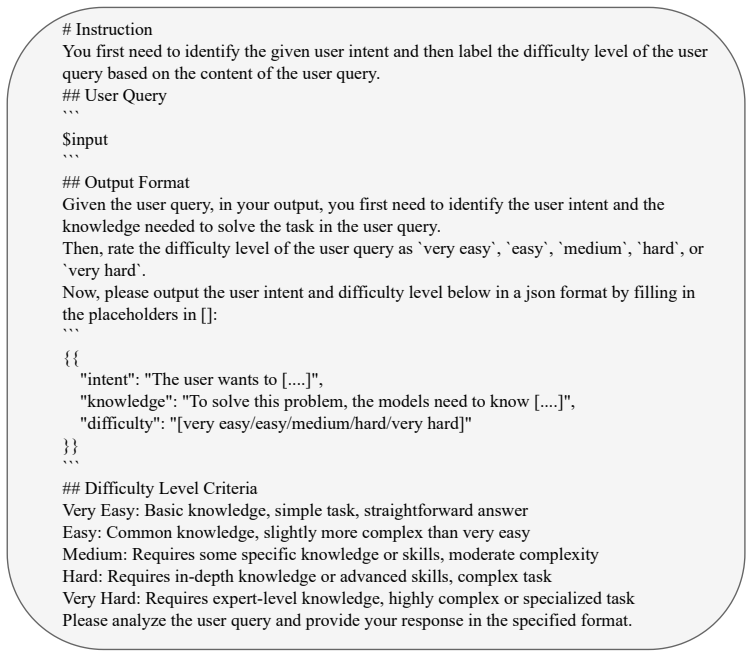
[Solution]: Offer a comprehensive, **correct** solution that accurately addressesthe [Problem Description] you provided. Fig. 7. Prompt for generating code problem # InstructionYou first need to identify the given user intent and then label the difficulty level of the userquer...
-
[2024]
Available: https://arxiv.org/abs/2407.21783
[Online]. Available: https://arxiv.org/abs/2407.21783
Reviewed August 15, 2026 · model on record in the stance chip above.
Discussion (0). Continue with ORCID to comment.