REVIEW 3 major objections 6 minor 41 references
Universal scaling of segment fluctuations in polymer and chromatin dynamics
T0 review · 3 major / 6 minor · reviewed 2026-08-15 · deepseek-v4-flash
Pith's one-line read Segment motion in polymers and chromatin follows a universal center-of-mass law of inverse length.
desk verdict A clean universal 1/s COM correction with real simulations and a suggestive but not decisive chromatin reanalysis; the Eq. (9) decomposition is the main theoretical soft spot. read the letter →
The pith
A machine-rendered reading of the paper's core claim, the machinery that carries it, and where it could break.
The reading
What carries the argument
The load-bearing object is the center of mass of a subchain of $s$ beads: summing the overdamped Langevin equations over the segment cancels reciprocal internal forces, leaving only the segment-averaged uncorrelated noise and producing $D_{\mathrm{COM}}(s)=\Theta_1/s$. The blob argument then converts this into $\langle x_{\mathrm{COM}}^2\rangle = B t^\xi/s$, and the same COM term supplies the $s^{-1}$ correction in the two-point MSD and, via the second derivative of the squared separation, the post-quench $s^{-3}$ tangent correlations.
What would settle it
Take a polymer or a chromosome with beads labeled at several spacings $s$ and directly track the center of mass of the intervening segment. If the short-time segment COM MSD does not scale as $t^\xi / s$ with $\xi = z(2+d_f)/2$, or if the exponent of $s$ deviates from $-1$, the universal law fails. Equivalently, compute $s^2 \partial_s M_2(s,t)$ from two-locus trajectories; the universal law requires a time-only power law $t^\xi$ with no residual $s$-dependence at short times.
Extended reading notes
Core claim
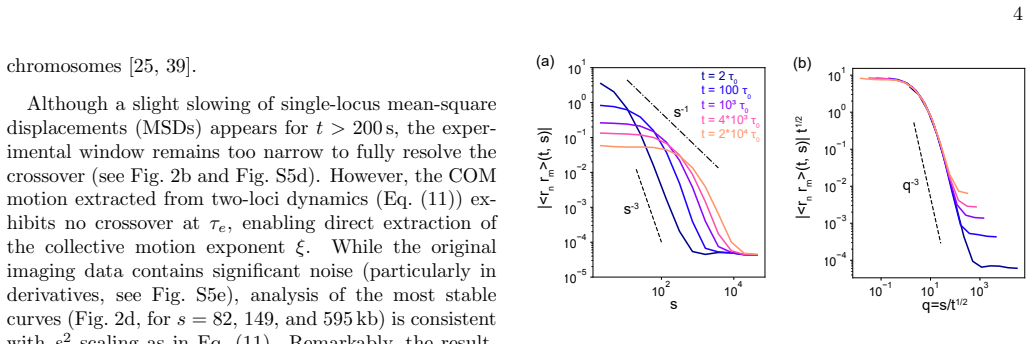
The central discovery is that for a polymer segment of contour length $s$, the center-of-mass diffusion coefficient is $D_{\mathrm{COM}}(s)=\Theta_1/s$ whenever internal forces are reciprocal and external noise is spatially uncorrelated, regardless of fractal dimension, viscoelastic memory, or activity. At short times a segment behaves as $s/s_*$ independently relaxing blobs, so its COM mean-squared displacement is $\langle x_{\mathrm{COM}}^2(s,t)\rangle = B t^\xi / s$ with $\xi = z(2+d_f)/2$. This enters the two-point separation MSD as $M_2(s,t)=2\Theta_1 t^z - 2B t^\xi /s$, producing an apparent short-time speed-up of fluctuations with segment length. Reanalysis of two-locus chromatin tracks gives $\xi = 0.77\pm 0.14$, consistent with crumpled-globule predictions ($5/7\approx 0.71$) and with $\xi\approx0.65$ for annealed lattice animals, and inconsistent with simple $\xi=1$ bead-spring dynamics. A separate consequence is that after a quench in temperature or activity, transient tangent-tangent correlations decay as $s^{-3}$ for $s>(t/\tau_0)^{\xi/2}$, even in ideal chains.
Load-bearing premise
The derivation assumes the chain's ends do not pull on the measured segment during the measurement window, so the segment acts like independent small pieces; if that pulling matters, the measured exponent is biased.
Editorial extensions
If this is right
- The dynamic exponent $\xi$ can be read off from two-locus data at short times without waiting for the long-time crossover, so the extraction is independent of whether single-locus MSDs look ideal.
- In any system with reciprocal forces and spatially uncorrelated noise, the apparent $s$-dependence of two-point diffusivity is a COM artifact, not a scale-dependent diffusion coefficient.
- The collapse $s^2 \partial_s M_2 \sim t^\xi$ is a model-free diagnostic; simulations of ideal and crumpled chains reproduce it with $\xi=1$ and $\xi\approx 5/7$.
- A quench in temperature or activity creates transient tangent-tangent correlations $\sim s^{-3}$ whose sign follows the quench direction, observable even in ideal chains.
- For chromatin, the model predicts a crossover time of roughly 200-500 s, below which motion appears ideal and above which crumpled dynamics with $z\approx0.3$ dominate.
Reading between the lines
- Because the $1/s$ law relies only on spatial uncorrelatedness of the noise, the same $t^\xi/s$ correction should appear in actively driven polymer models; a deviation would signal coherent, spatially correlated motor activity.
- The quench $s^{-3}$ memory effect suggests a practical perturbation experiment: change nuclear temperature or activity and follow the crossover length $s_*=(t/\tau_0)^{\xi/2}$ in tangent correlations of labeled pairs.
- Reported scale-dependent two-locus diffusivities should be re-expressible as the COM correction; subtracting the segment COM explicitly from existing trajectories would provide a direct, dataset-level falsification.
Signed reviews
Editorial analysis
A structured set of objections, weighed in public.
Referee Report
Summary. The paper argues that, for any polymer model with reciprocal internal forces and spatially uncorrelated noise, the center-of-mass diffusivity of a segment of contour length s scales universally as 1/s, independent of fractal dimension, viscoelasticity, or activity. It then uses this result to predict a short-time correction to the two-point mean-squared displacement, M2(s,t) = 2Θ1 t^z − 2B t^ξ/s, and a post-quench tangential correlation scaling as s^−3. The predictions are tested with molecular dynamics simulations of phantom chains and ring melts, and the two-point correction is reanalyzed in two-locus chromatin tracking data, yielding ξ = 0.77 ± 0.14, which the authors compare with crumpled-globule predictions (ξ = 5/7). The paper concludes that the apparent discrepancy between chromatin's crumpled structure and its Rouse-like dynamics can be explained by a short-time crossover and by the collective COM correction.
Significance. If the central claim holds, the paper offers a simple and broadly applicable scaling law for collective polymer motion, with direct relevance to chromatin imaging: the two-point observable provides a route to extract collective dynamics without requiring single-locus long-time data. The exact whole-chain COM derivation (Eqs. 3–4) is clean, and the two-point correction is a concrete, falsifiable prediction. The simulation support for phantom chains and ring melts, and the reanalysis of the data of Brückner et al., are appropriate in spirit. The quench prediction of transient s^−3 tangent correlations is a novel and testable non-equilibrium signature. The main limitation is that the universal sub-segment COM scaling rests on a heuristic blob picture and on an approximate short-time decomposition that is not rigorously justified for arbitrary s; these points are load-bearing for the central claim and for the experimental extraction of ξ.
major comments (3)
- [Model, Eq. (5)] The 1/s scaling of the sub-segment COM diffusivity is obtained from the blob argument that a segment of length s behaves as s/s* independently diffusing blobs. Unlike the whole-chain result in Eqs. (3)–(4), this does not follow from an exact cancellation of internal forces: the forces exerted by the rest of the chain at the segment boundaries are not reciprocal within the segment, and the paper does not show that they are negligible in the time window t << τ(s) used subsequently. Please provide a mode-based derivation or an explicit error bound for Eq. (5), or state precisely the conditions under which the boundary forces can be neglected for a finite segment in a chain with arbitrary fractal dimension and viscoelasticity.
- [Two-point dynamics, Eq. (9)] The decomposition C2(s,t) = C2(s,0) − ⟨x_n^2(t)⟩ + ⟨x_COM^2(s,t)⟩ assumes that endpoint fluctuations about the segment COM are independent and that the cross-term ⟨ΔR_cn ΔR_cm⟩ vanishes. This is not exact even in the Rouse model: for a two-bead segment (s = 1) the two deviations are perfectly anti-correlated, and a mode expansion shows that the omitted cross-term is comparable to the retained COM term whenever s is not large compared with the dynamical length scale (Dt)^{1/2}. The paper should state the precise asymptotic regime, for example s >> (Dt)^{1/2}, in which Eq. (10) is valid, and should verify numerically, in the simulations of Figs. S2–S3, that the cross-term is indeed negligible in the s-range used to test Eq. (11).
- [Analysis of imaging data, Fig. 2] The experimental exponent ξ = 0.77 ± 0.14 is extracted from s^2 ∂_s M2 at only three genomic separations (s = 82, 149, and 595 kb) and from derivatives of noisy imaging data. The systematic error arising from the approximations in Eqs. (5) and (9) is not quantified. Given these uncertainties, the reported agreement with the crumpled-globule prediction 5/7 should be supported by an error budget and by a leave-one-out robustness check of the fitted exponent.
minor comments (6)
- [Eq. (14)] The equilibrium tangential correlation for d_f = 2 is written as 'δ_{s,0} = δ_{nm}'; this notation mixes the contour distance s with the bead indices n and m and should be clarified.
- [Two-point dynamics] The sentence containing 'yields gives' should be corrected to 'yields'.
- [Quench simulations] The text refers to 'Fig. 2a' and 'Fig. 2b' when describing the simulation shown in Fig. 3; the figure references should be updated.
- [Abstract] The abstract contains the typo '1/swith' and should read '1/s with'.
- [Eq. (5)] The quantity s*(t) is used without a definition; please define it as the dynamical blob size at time t.
- [Eq. (15)] The summation notation 'N/sX' is unclear; please introduce the cutoff on the mode index p explicitly.
Circularity Check
No significant circularity: the 1/s COM scaling is derived from the noise-averaging identity, and the data comparison tests the predicted exponent independently.
full rationale
The derivation chain is self-contained. Equation (4) follows algebraically from summing the overdamped Langevin equations (1) over all N beads: reciprocal internal forces cancel, and the covariance of the averaged noise is Θ1/N by independence (Eq. 3), so D_COM(N)=Θ1/N is an identity under the stated assumptions, not a fitted result. The extension to subsegments (Eq. 5) is an explicitly stated blob scaling hypothesis, not an input derived from the two-locus data; its predictions (s^-1 correction, ξ=z(2+d_f)/2) are then compared with, not fitted to, the imaging data. The value ξ=0.77±0.14 is extracted from the time dependence of s^2∂_s M_2 (Eq. 11) and compared with 5/7 from externally cited models [33,34] and with independent simulations; the authors' own prior works [14,18,39,40] supply the generalized Rouse model and crumpled-globule modeling framework but do not determine the central prediction by construction. The main approximations (independence of endpoint fluctuations about the COM, neglect of boundary forces on a subchain) are physical simplifications that could bias the extracted ξ, but they do not make the derivation circular: M_2 is defined independently via Eq. (6) and the s^-1 correction is a falsifiable prediction rather than a renamed input. No fitted parameter is relabeled as a prediction, and no load-bearing claim rests solely on a self-citation.
Assumptions & free parameters
free parameters (3)
- dynamic exponent xi from two-locus data =
0.77 +/- 0.14
- single-locus MSD exponent z =
1/2 at short times; ~0.3 at long times
- noise amplitude Theta_1 (or B) =
not quoted numerically
assumptions (5)
- domain assumption Internal inter-bead forces are reciprocal (f^vol_nk = -f^vol_kn).
- domain assumption External noise is spatially uncorrelated across beads (Eq. 2).
- ad hoc to paper At short times a segment behaves as s/s* independently diffusing blobs with blob size s*.
- ad hoc to paper The two endpoints of a segment fluctuate independently relative to the segment COM at t << tau(s) (Eq. 9 decomposition).
- domain assumption Equilibrium noise correlation C(Delta t) = (2-alpha)(1-alpha) Delta t^{-alpha} and the GRLE with quadratic interactions.
Cite this review
Pith. "Pith review of Universal scaling of segment fluctuations in polymer and chromatin dynamics." pith.science (2026). https://pith.science/paper/GVUT2EUR
@misc{pith2026250510943,
  author       = {Pith},
  title        = {Pith review of: Universal scaling of segment fluctuations in polymer and chromatin dynamics},
  year         = {2026},
  howpublished = {\url{https://pith.science/paper/GVUT2EUR}},
  note         = {Machine review of arXiv:2505.10943}
}
abstract
We demonstrate how center-of-mass (COM) motion influences polymer segment fluctuations. Cancellation of internal forces, together with spatially uncorrelated external noise, generally yields COM diffusivity scaling as $1/s$ with segment length $s$, regardless of fractal dimension, viscoelasticity, or activity. This introduces distinct dynamic scaling corrections to two-point fluctuations and quenched-induced tangential correlations, validated by theory, simulations, and chromatin imaging data. In the latter, the extracted dynamic exponent reveals topological constraints, thereby resolving the discrepancy between chromatin's crumpled structure and its Rouse-like dynamics.
Figures


Reference graph
Works this paper leans on
-
[1]
P. G. De Gennes,Scaling Concepts in Polymer Physics (Cornell university press, 1979)
work page 1979
- [2]
-
[3]
M. V. Tamm and K. Polovnikov,Dynamics of Polymers: Classic Results and Recent Developments. Order, Disor- der and Criticality: Advanced Problems of Phase Transi- tion Theory(World Scientific, 2018)
work page 2018
-
[4]
A. Y. Grosberg and A. R. Khokhlov,Statistical Mechan- ics of Macromolecules(AIP: Woodbury, NY., 1994) p. 350
work page 1994
-
[5]
A. R. Khokhlov and S. K. Nechaev, Polymer chain in an array of obstacles, Physics Letters A112, 156 (1985)
work page 1985
-
[6]
M. Rubinstein, Dynamics of ring polymers in the pres- ence of fixed obstacles, Physical Review Letters57, 3023 (1986)
work page 1986
-
[7]
R. Everaerset al., Rheology and microscopic topology of entangled polymeric liquids, Science303, 823 (2004)
work page 2004
-
[8]
A. Rosa and R. Everaers, Ring polymers in the melt state: the physics of crumpling, Physical Review Letters 112, 118302 (2014)
work page 2014
Show all 41 references
-
[9]
J. D. Halversonet al., Rheology of ring polymer melts: From linear contaminants to ring-linear blends, Physical Review Letters108, 038301 (2011)
2011
-
[10]
V. I. Keizeret al., Live-cell micromanipulation of a ge- nomic locus reveals interphase chromatin mechanics, Sci- ence377, 489 (2023)
2023
-
[11]
Gabrieleet al., Dynamics of CTCF-and cohesin- mediated chromatin looping revealed by live-cell imaging, Science376, 496 (2022)
M. Gabrieleet al., Dynamics of CTCF-and cohesin- mediated chromatin looping revealed by live-cell imaging, Science376, 496 (2022)
2022
-
[12]
D. B. Br¨ uckner, H. Chen, L. Barinov, B. Zoller, and T. Gregor, Stochastic motion and transcriptional dynam- ics of pairs of distal DNA loci on a compacted chromo- some, Science380, 1357 (2023)
2023
-
[13]
M. M. Tortora, H. Salari, and D. Jost, Chromosome dynamics during interphase: a biophysical perspective, Current Opinion in Genetics and Development61, 37 (2020)
2020
-
[14]
Polovnikov, M
K. Polovnikov, M. Gherardi, M. Cosentino-Lagomarsino, and M. Tamm, Fractal folding and medium viscoelastic- ity contribute jointly to chromosome dynamics, Physical Review Letters120, 088101 (2018)
2018
-
[15]
S. C. Weber, A. J. Spakowitz, and J. A. Theriot, Bacte- rial chromosomal loci move subdiffusively through a vis- coelastic cytoplasm, Physical Review Letters104, 238102 (2010)
2010
-
[16]
T. J. Lampo, A. S. Kennard, and A. J. Spakowitz, Phys- ical modeling of dynamic coupling between chromosomal 6 loci, Biophysical Journal110, 338 (2016)
2016
-
[17]
M. V. Tamm, L. I. Nazarov, A. A. Gavrilov, and A. V. Chertovich, Anomalous diffusion in fractal glob- ules, Physical Review Letters14, 178102 (2015)
2015
-
[18]
Polovnikov, S
K. Polovnikov, S. Nechaev, and M. V. Tamm, Effective Hamiltonian of topologically stabilized polymer states, Soft Matter14, 6561 (2018)
2018
-
[19]
Amitai and D
A. Amitai and D. Holcman, Polymer model with long- range interactions: Analysis and applications to the chro- matin structure, Physical Review E88, 052604 (2013)
2013
-
[20]
S. C. Weber, A. J. Spakowitz, and J. A. Theriot, Non- thermal ATP-dependent fluctuations contribute to the in vivo motion of chromosomal loci, Proceedings of the National Academy of Sciences109, 7338 (2012)
2012
-
[21]
Goychuk, D
A. Goychuk, D. Kannan, A. K. Chakraborty, and M. Kar- dar, Polymer folding through active processes recreates features of genome organization, Proceedings of the Na- tional Academy of Sciences120, e2221726120 (2023)
2023
-
[22]
Zidovska, D
A. Zidovska, D. A. Weitz, and T. J. Mitchison, Micron- scale coherence in interphase chromatin dynamics, Pro- ceedings of the National Academy of Sciences110, 15555 (2013)
2013
-
[23]
Eshghi, A
I. Eshghi, A. Zidovska, and A. Y. Grosberg, Symmetry- based classification of forces driving chromatin dynamics, Soft Matter18, 8134 (2022)
2022
-
[24]
S. Shin, H. W. Cho, G. Shi, and D. Thirumalai, Transcription-induced active forces suppress chromatin motion by inducing a transient disorder-to-order transi- tion, Biophysical Journal122, 19a (2013)
2013
-
[25]
Chan and M
B. Chan and M. Rubinstein, Activity-driven chromatin organization during interphase: Compaction, segrega- tion, and entanglement suppression, Proceedings of the National Academy of Sciences121, e2401494121 (2024)
2024
-
[26]
D. Goh, D. Kannan, P. Natarajan, A. Goychuk, and A. K. Chakraborty, RNA gradients can guide con- densates toward promoters: implications for enhancer- promoter contacts and condensate-promoter kissing, bioRxiv (2024)
2024
-
[27]
Wittmeret al., Long range bond-bond correlations in dense polymer solutions, Physical Review Letters93, 147801 (2004)
J. Wittmeret al., Long range bond-bond correlations in dense polymer solutions, Physical Review Letters93, 147801 (2004)
2004
-
[28]
Wittmeret al., Why polymer chains in a melt are not random walks, Europhysics Letters77, 56003 (2007)
J. Wittmeret al., Why polymer chains in a melt are not random walks, Europhysics Letters77, 56003 (2007)
2007
-
[29]
Lieberman-Aidenet al., Comprehensive mapping of long-range interactions reveals folding principles of the human genome, Science326, 289 (2009)
E. Lieberman-Aidenet al., Comprehensive mapping of long-range interactions reveals folding principles of the human genome, Science326, 289 (2009)
2009
-
[30]
Mirny, The fractal globule as a model of chromatin architecture in the cell, Chromosome Res.19, 37 (2011)
L. Mirny, The fractal globule as a model of chromatin architecture in the cell, Chromosome Res.19, 37 (2011)
2011
-
[31]
Grosberg, Y
A. Grosberg, Y. Rabin, S. Havlin, and A. Neer, Crumpled globule model of the three-dimensional structure of DNA, Europhysics Letters23, 373 (1993)
1993
-
[32]
Grosberg, S
A. Grosberg, S. Nechaev, and E. Shakhnovich, The role of topological constraints in the kinetics of collapse of macromolecules, Journal de Physique49, 2095 (1988)
1988
-
[33]
Smrek and A
J. Smrek and A. Grosberg, Understanding the dynamics of rings in the melt in terms of the annealed tree model, Journal of Physics: Condensed Matter27, 064117 (2015)
2015
-
[34]
T. Ge, S. Panyukov, and M. Rubinstein, Self-similar con- formations and dynamics in entangled melts and solu- tions of nonconcatenated ring polymers, Macromolecules 49, 708 (2016)
2016
-
[35]
J. D. Halverson, J. Smrek, K. Kremer, and A. Y. Gros- berg, From a melt of rings to chromosome territories: the role of topological constraints in genome folding, Reports on Progress in Physics77, 022601 (2014)
2014
-
[36]
Grimm and M
J. Grimm and M. Dolgushev, Dynamics of networks in a viscoelastic and active environment, Soft Matter14, 1171 (2018)
2018
-
[37]
See Supplemental Material at [URL-will-be-inserted-by- publisher] for further details
-
[38]
Slavov and K
B. Slavov and K. Polovnikov, Intrachain distances in a crumpled polymer with random loops, JETP Letters 118, 208 (2023)
2023
-
[39]
K. E. Polovnikovet al., Crumpled polymer with loops recapitulates key features of chromosome organization, Physical Review X13, 041029 (2023)
2023
-
[40]
K. E. Polovnikov and B. Slavov, Topological and non- topological mechanisms of loop formation in chromo- somes: Effects on the contact probability, Physical Re- view E107, 054135 (2023)
2023
-
[41]
J. M. Arbona, S. Herbert, E. Fabre, and C. Zimmer, In- ferring the physical properties of yeast chromatin through bayesian analysis of whole nucleus simulations, Genome Biology18, 1 (2017)
2017
Reviewed August 15, 2026 · model on record in the stance chip above.
Discussion (0). Continue with ORCID to comment.