REVIEW 4 major objections 6 minor 65 references
One Image is Worth a Thousand Words: A Usability Preservable Text-Image Collaborative Erasing Framework
T0 review · 4 major / 6 minor · reviewed 2026-08-15 · deepseek-v4-flash
Pith's one-line read Concept erasure fails because erasure is text-only; this paper adds the model's own images of the target concept as visual templates and cuts nudity attack success from 76% to 17% with image quality intact.
desk verdict A genuinely new text-image collaborative erasing method with extensive experiments, but the flagship gain is partly confounded because the same NudeNet detector filters the training templates and scores the efficacy metrics. read the letter →
The pith
A machine-rendered reading of the paper's core claim, the machinery that carries it, and where it could break.
The reading
What carries the argument
The load-bearing object is the dual-branch text-image condition injected through decoupled cross-attention, together with a text-guided refinement that turns a raw generated image into a concept-specific template. In the refinement, the image encoder supplies the query $Q_r = E_{\text{image}}(X)$ and the text label supplies key and value $K_r = V_r = E_{\text{text}}(Y)$, so the output embedding keeps only the visual features the text names: $c_{\text{image}} = \operatorname{Softmax}(Q_r K_r^\top/\sqrt{d_r}) V_r$. At each cross-attention layer the U-Net latent attends separately to the text embedding and the refined image embedding, and the two attention outputs are summed; the resulting condition $c = [c_{\text{text}}, c_{\text{image}}]$ enters the ESD-style update $\varepsilon_{\theta^*}(z_t, c, t) \leftarrow \varepsilon_\theta(z_t, t) - \eta[\varepsilon_\theta(z_t, c, t) - \varepsilon_\theta(z_t, t)]$, which suppresses the model's probability of generating the concept. Because the image branch exists only during training, the erased model at inference is architecturally identical to the original, which is what allows the branch to be grafted onto other erasure frameworks.
What would settle it
A direct test compares erasure coverage against template coverage: generate the image set from the single literal prompt "a photo of c", pick test prompts that evoke facets of c absent from those images (for example, scenes a template never produces, such as a ruined church or a wedding interior), and check whether the erased model still generates those facets; the paper's own failure-case figure predicts it will. The sharper version is distributional: self-generated templates and real images of the concept differ in t-SNE space (the paper's Figure 8), so if the modality-gap story is right, erasure should be measurably worse on prompts that target the regions where the real-image distribution has no synthetic counterpart, and improving template diversity should shrink the residual attack success.
Extended reading notes
Core claim
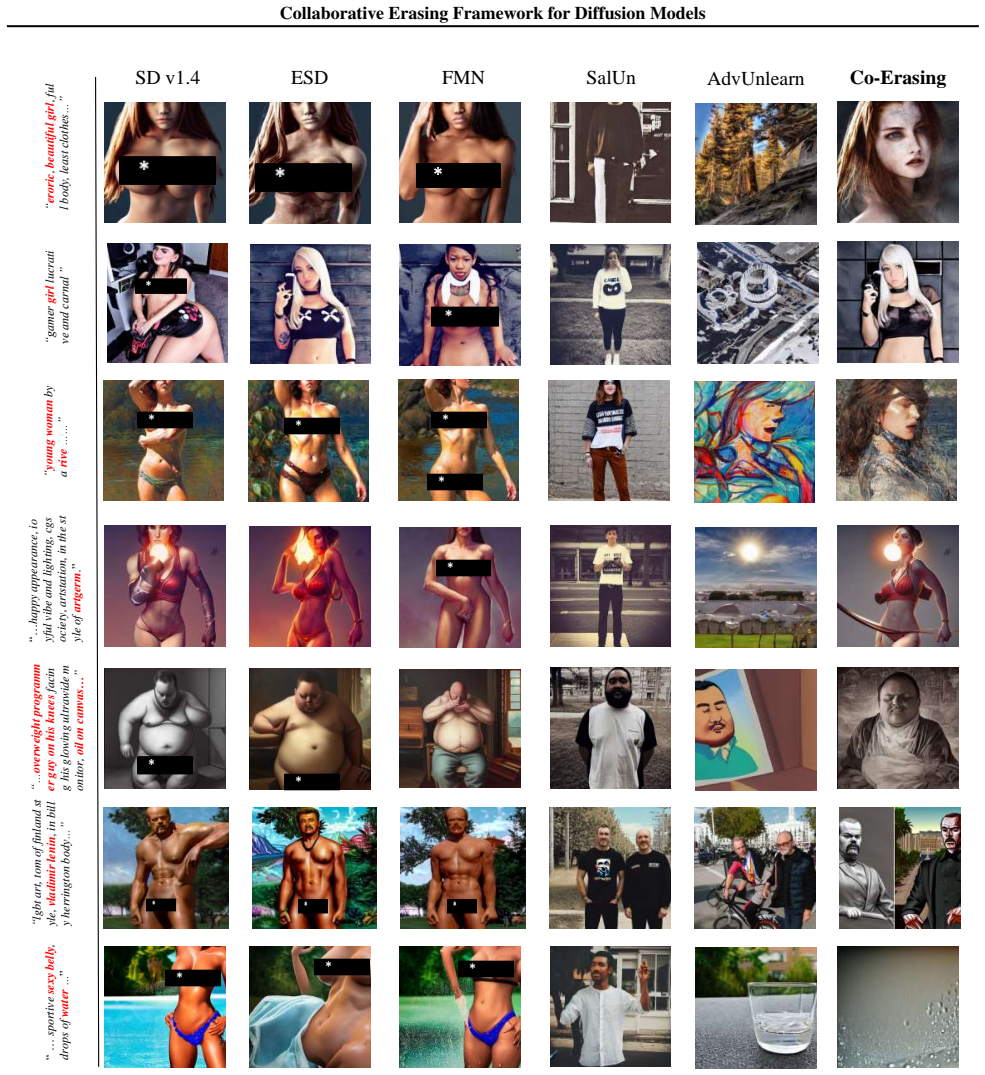
Co-Erasing starts from the ESD-style negative-guidance objective $P_{\theta^*}(x) \propto P_\theta(x)/P_\theta(c|x)^\eta$ and replaces the purely textual condition with the pair $c = [c_{\text{text}}, c_{\text{image}}]$. The image condition comes from the clean model itself, which generates images of the concept under a template such as "a photo of nudity"; a text-guided refinement, $c_{\text{image}} = \operatorname{Softmax}(Q_r K_r^\top/\sqrt{d_r}) V_r$ with the image encoder as query and the text label as key and value, distills each image down to the features the words name. Text and refined-image embeddings enter the U-Net through separate cross-attention branches whose outputs are summed, and the image branch is dropped at inference. Against the text-only ESD baseline, the reported effect is that adversarial attack success on nudity falls from 76.05% to 16.96% with FID at 18.77 versus 18.18 and CLIP unchanged at 0.302; ablations show unrefined images alone cut attack success to the 27-33% range but push FID above 22, with the refinement module recovering the lost quality. The same visual branch transfers to the SLD and MACE frameworks and to multi-concept erasure, and self-generated templates outperform real NSFW images (ASR 16.96 versus 33.90, FID 18.77 versus 23.89), which the paper takes as evidence that the model's own output best represents its concept knowledge.
Load-bearing premise
Erasure is bounded by what the small self-generated image set shows: any facet of the target concept that the clean model never produces under the chosen prompt template will be absent from the visual templates and will not be erased, a failure mode the paper itself reports in its appendix (features tightly tied to text descriptions never appear in the reference images and survive erasure).
Editorial extensions
If this is right
- Under the paper's evaluations, the erased model blocks adversarial and learnable-prompt attacks at a rate no text-only erasure reached: for nudity, ASR 16.96% versus 76.05% for ESD and 11.27% for SalUn, while FID and CLIP stay near the ESD baseline instead of degrading toward SalUn's FID of 53.21.
- The image branch needs no external data and no architecture change at inference, and the paper shows it can be appended to other erasure frameworks: SLD's nudity detections on the I2P set drop from 125 to 22, and MACE's multi-concept scores improve or hold.
- Erasure stops scaling with word lists: a single template generating 200 images outperforms any tested multi-word descriptor set on both efficacy and usability, which is the direct consequence of replacing text-only concept descriptions with visual ones.
- Self-generated templates are load-bearing rather than incidental: swapping them for real NSFW images raises ASR from 16.96% to 33.90% and FID from 18.77 to 23.89, supporting the paper's claim that the model's own generations encode exactly the knowledge that needs suppressing.
- The framework extends beyond nudity to styles, objects, portraits, and multi-concept sets, and the refined erasure consistently lands on the better-efficacy side of the trade-off frontier with usability near the unmodified model.
Reading between the lines
- A testable extension the paper does not run: template diversity should set the erasure ceiling, so generating the 200 images from several paraphrased templates per concept rather than one should shrink the residual failure cases in its Appendix C.7, where facets tied to text descriptions never appear in the reference images.
- The refinement module is effectively a text-conditioned visual filter, and the same construction could serve other targeted-removal problems, such as suppressing memorized training images, removing a person's likeness, or erasing a subcategory while keeping the supercategory, whenever a short text label can name the visual content to drop.
- Because the templates are drawn from the model's own prior, the method carries a lifecycle implication the paper leaves implicit: if the base model is later fine-tuned, its concept knowledge shifts and the stored templates become stale, so erasure quality may degrade until the templates are regenerated from the updated model.
- One could reverse the paper's comparison and use the synthetic-versus-real distribution gap as a diagnostic: prompts whose outputs fall in the real-image regions with no synthetic counterpart are exactly where a Co-Erasing model should still fail, giving a cheap way to build red-team prompts.
Signed reviews
Editorial analysis
A structured set of objections, weighed in public.
Referee Report
Summary. The paper proposes Co-Erasing, a concept-erasing framework for text-to-image diffusion models that augments text prompts with self-generated images of the target concept. The method uses a decoupled cross-attention image branch (IP-Adapter style), a text-guided refinement module (Eq. 6) to isolate concept-relevant visual features, and an ESD-style negative-guidance update (Eq. 7) to fine-tune the U-Net. The authors evaluate on nudity, style, and object erasure, reporting markedly lower attack success rates (e.g., nudity ASR 16.96% vs ESD's 76.05%) with comparable FID/CLIP, plus transfer to SLD and MACE. The claimed contribution is that visual templates close the text-image gap and jointly improve efficacy and usability.
Significance. If the claims hold, this is a valuable contribution to the concept-erasing literature. It introduces a straightforward way to inject visual supervision into erasure, supported by extensive experiments (three task families, six metrics, nine baselines, ablations on image count and source, and transfer to SLD/MACE). The paper ships code and openly discloses the self-generated-image pattern (Figure 8, Table 4). The main caveats are reproducibility (the fine-tuning objective is not stated) and a potential detector-alignment confound in the nudity experiments; both are fixable with additional experiments and disclosure, so the core idea is not invalidated by these issues.
major comments (4)
- [§4.2.2, Eq. (7), and Appendix A.4] The fine-tuning objective is never specified. Eq. (7) gives the modified noise target for negative guidance, but the paper does not state the loss function minimized over the U-Net parameters, how the image branch is trained or frozen, or what role the refinement module's parameters play in the optimization. The phrase 'conduct fine-tuning on full parameters' is ambiguous. Without the objective, the method is not reproducible and the ablations in Table 3 cannot be interpreted as attributing improvements to specific components. Please provide the full training loss and update rule.
- [Appendix A.4, Appendix A.5, Table 9] There is a potential circularity in the nudity experiments: the self-generated training templates are filtered 'according to the classification scores provided by a classifier' (Appendix A.4), while the efficacy metrics (pre-ASR, ASR, P4D, CCE) all score outputs with the same NudeNet detector at threshold 0.75 (Appendix A.5). If the filtering uses NudeNet, the model is trained to suppress the detector's positive class, which may inflate the measured ASR improvement (e.g., 16.96 vs 76.05). The paper must disclose the filtering classifier and threshold, and should evaluate with an independent detector (e.g., a different NSFW classifier or CLIP-based scoring) to rule out detector-aligned overfitting.
- [Table 4 and Figure 8] The comparison between real and self-generated images is confounded by the quality filter. The generated templates are filtered by the classifier, while the real NSFW images appear to be used unfiltered. The conclusion that self-generated images 'better represent the model's knowledge' could instead be an artifact of detector-aligned selection. Please repeat the 'Real' condition with the same filtering procedure applied to the real images, or demonstrate that the result is robust to the filter.
- [Appendix C.7 and §4.2.3] The paper's own stated failure mode—'some features are not unique and strongly associated with corresponding text descriptions, and therefore such visual features are not generated in the reference images and, consequently not fully erased'—is a principled limitation of the approach. Since the visual templates are generated from a fixed prompt template, the erasure is bounded by the coverage of that template and the model's ability to generate the target concept. This limitation should be stated in the main text and the claims about 'complete erasure' or 'concept erasure' should be scoped accordingly. The current presentation is honest but the limitation is consequential for the central claim.
minor comments (6)
- [Throughout] There are several presentation artifacts: the word 'dasdsa' appears immediately before 'Contents' in the appendix, Figure 1 contains garbled generated text and an 'Added for publication' annotation, and the caption of Figure 1 describes the example without clearly explaining the artifact. Please clean these up.
- [Appendix A.3] The definition 'ASR = pre-ASR + post-ASR' is unclear. Since both are success rates in percent, the sum can exceed 100, and the computation of post-ASR is not described. Please clarify whether these are joint or marginal rates and how the sum is intended to be interpreted.
- [Table 3] The checkmark rows in the ablation table are ambiguous; the first row (text only) appears to be the ESD baseline, but the reader must infer this. Please label the baseline explicitly and add a note that 'text' means the ESD text-only update.
- [§5.1] The paper states that 9 competitors are included, but the quantitative tables list fewer per task. Please clarify which methods are evaluated on each task and why some are omitted.
- [Eq. (6)] The dimensions of the refined image embedding are unclear. The paper states cimage is b×4×768, but Eq. (6) with Qr=E_image(X) (a single image vector) and Kr=Vr=E_text(Y) (a sequence of text embeddings) would produce a sequence of length equal to the text length. Please specify the exact shapes and how the output maps to the 4-token image embedding used in the cross-attention.
- [Appendix B.5] The transfer to SLD is described as replacing the text embedding c_s with [c_s, c_i] during inference. Please clarify whether this changes the diffusion process only at inference time and whether any training is involved for the SLD variant, since the main method is presented as fine-tuning-based.
Circularity Check
Partial circularity: the nudity visual templates are filtered by the same NudeNet detector that scores efficacy, confounding the real-vs-synthetic ablation; the core derivation is otherwise self-contained.
-
other
[Appendix A.4; Appendix A.5; Table 4 and Section 5.3 (Real Images vs. Synthetic Images)]
"We discard low-quality images according to the classification scores provided by a classifier, which is just required by the attacking methods. ... When evaluating nudity, we load a pretrained NudeNet with the threshold 0.75."
For the flagship nudity experiment, the self-generated visual templates are retained or discarded using classifier scores (Appendix A.4), while every efficacy metric is scored by the same kind of detector, NudeNet at threshold 0.75 (Appendix A.5). The visual concept being erased is therefore, at least in part, the evaluation detector's positive class: suppressing the detector-labeled content in the training templates is aligned with the evaluation criterion by construction. The ablation in Table 4 is also uncontrolled: the 'Generated' template set is classifier-filtered, whereas the 'Real' NSFW images are not, so the conclusion that self-generated images better represent the model's knowledge is confounded by detector-aligned filtering.
full rationale
The paper's central derivation is not circular: Co-Erasing augments the ESD negative-guidance objective (Eq. 7) with an image-conditioned cross-attention branch, and the main comparisons are against external benchmarks (I2P, UDA, RAB, COCO-10K) rather than against the training templates. The use of self-generated images is disclosed and motivated by distribution analysis (Figure 8), and the acknowledged coverage limitation in Appendix C.7 is a genuine, non-circular failure mode. There are no load-bearing self-citations, no imported uniqueness theorems, and no ansatz smuggled in via citation; the image encoder is a pretrained external IP-Adapter component. The one concrete circularity-adjacent issue is the NudeNet coupling: the same detector family filters the training templates and defines the efficacy metric, and the real-vs-generated ablation is not controlled for this filtering. That confound affects the strength of a specific supporting claim (Table 4) and partially the interpretation of the nudity gains, but it does not reduce the entire derivation to its inputs. A score of 3 reflects one genuine evaluation-alignment issue with substantial independent content remaining.
Assumptions & free parameters
free parameters (4)
- number of self-generated training images n =
200 for nudity, parachute, church, tench, French horn, garbage truck; 50 for Van Gogh and Picasso
- prompt template for image generation =
'a photo of c', extended for parachute with randomly appended phrases
- quality-filter threshold for self-generated images =
unspecified
- guidance scale eta in Eq. 7 =
not reported
assumptions (4)
- domain assumption Reducing P(c|x) via ESD-style negative guidance (Eq. 2) is an effective way to erase a concept from a diffusion model.
- standard math The epsilon-prediction can be expressed as a noise estimate related to the score (Tweedie's formula, Eq. 7).
- ad hoc to paper Self-generated images from the clean model faithfully represent the visual knowledge of the target concept inside the model.
- domain assumption CLIP text embeddings of a single-word description (e.g., 'nudity') can isolate the target concept in a generated image through the cross-attention refinement of Eq. 6.
Cite this review
Pith. "Pith review of One Image is Worth a Thousand Words: A Usability Preservable Text-Image Collaborative Erasing Framework." pith.science (2026). https://pith.science/paper/BHAEBR3Z
@misc{pith2026250511131,
  author       = {Pith},
  title        = {Pith review of: One Image is Worth a Thousand Words: A Usability Preservable Text-Image Collaborative Erasing Framework},
  year         = {2026},
  howpublished = {\url{https://pith.science/paper/BHAEBR3Z}},
  note         = {Machine review of arXiv:2505.11131}
}
read the original abstract
Concept erasing has recently emerged as an effective paradigm to prevent text-to-image diffusion models from generating visually undesirable or even harmful content. However, current removal methods heavily rely on manually crafted text prompts, making it challenging to achieve a high erasure (efficacy) while minimizing the impact on other benign concepts (usability). In this paper, we attribute the limitations to the inherent gap between the text and image modalities, which makes it hard to transfer the intricately entangled concept knowledge from text prompts to the image generation process. To address this, we propose a novel solution by directly integrating visual supervision into the erasure process, introducing the first text-image Collaborative Concept Erasing (Co-Erasing) framework. Specifically, Co-Erasing describes the concept jointly by text prompts and the corresponding undesirable images induced by the prompts, and then reduces the generating probability of the target concept through negative guidance. This approach effectively bypasses the knowledge gap between text and image, significantly enhancing erasure efficacy. Additionally, we design a text-guided image concept refinement strategy that directs the model to focus on visual features most relevant to the specified text concept, minimizing disruption to other benign concepts. Finally, comprehensive experiments suggest that Co-Erasing outperforms state-of-the-art erasure approaches significantly with a better trade-off between efficacy and usability. Codes are available at https://github.com/Ferry-Li/Co-Erasing.
Figures


Figures from the paper (34 more)




Reference graph
Works this paper leans on
-
[1]
write newline
" write newline "" before.all 'output.state := FUNCTION n.dashify 't := "" t empty not t #1 #1 substring "-" = t #1 #2 substring "--" = not "--" * t #2 global.max substring 't := t #1 #1 substring "-" = "-" * t #2 global.max substring 't := while if t #1 #1 substring * t #2 global.max substring 't := if while FUNCTION format.date year duplicate empty "emp...
-
[2]
Alvin, H. and Harold, S. Selective amnesia: A continual learning approach to forgetting in deep generative models. In NeurIPS, pp.\ 17170--17194, 2023
work page 2023
-
[3]
Collaborative preference embedding against sparse labels
Bao, S., Xu, Q., Ma, K., Yang, Z., Cao, X., and Huang, Q. Collaborative preference embedding against sparse labels. In ACM Multimedia, pp.\ 2079--2087, 2019
work page 2019
-
[4]
The minority matters: A diversity-promoting collaborative metric learning algorithm
Bao, S., Xu, Q., Yang, Z., He, Y., Cao, X., and Huang, Q. The minority matters: A diversity-promoting collaborative metric learning algorithm. NeurIPS, pp.\ 2451--2464, 2022
work page 2022
-
[5]
Aucpro: Auc-oriented provable robustness learning
Bao, S., Xu, Q., Yang, Z., He, Y., Cao, X., and Huang, Q. Aucpro: Auc-oriented provable robustness learning. TPAMI, 2025
work page 2025
-
[6]
Tweedie’s formula and selection bias
Bradley, R. Tweedie’s formula and selection bias. Journal of the American Statistical Association,, pp.\ 1602--1614, 2021
work page 2021
-
[7]
Erasing undesirable concepts in diffusion models with adversarial preservation
Bui, A., Vuong, L., Doan, K., Le, T., Montague, P., Abraham, T., and Phung, D. Erasing undesirable concepts in diffusion models with adversarial preservation. NeurIPS, 2024
work page 2024
-
[8]
Casanova, A., Marlène, C., Verbeek, J., Drozdzal, M., and Adriana, R.-S. Instance-conditioned gan. arXiv, 2021
work page 2021
Show all 65 references
-
[9]
Changhoon, K., Kyle, M., and Yang, Y. R.a.c.e. : Robust adversarial concept erasure for secure text-to-image diffusion model. In ECCV, pp.\ 461--478, 2024
2024
-
[10]
Reliable and efficient concept erasure of text-to-image diffusion models
Chao, G., Kai, C., Zhipeng, W., Jingjing, C., and Yu-Gang, J. Reliable and efficient concept erasure of text-to-image diffusion models. In ECCV, pp.\ 73--88, 2024
2024
-
[11]
Salun: Empowering machine unlearning via gradient-based weight saliency in both image classification and generation
Fan, C., Liu, J., Zhang, Y., Wong, E., Wei, D., and Liu, S. Salun: Empowering machine unlearning via gradient-based weight saliency in both image classification and generation. In ICLR, 2024
2024
-
[12]
Erasing concepts from diffusion models
Gandikota, R., Materzynska, J., Fiotto-Kaufman, J., and Bau, D. Erasing concepts from diffusion models. In ICCV, pp.\ 2426--2436, 2023
2023
-
[13]
Unified concept editing in diffusion models
Gandikota, R., Orgad, H., Belinkov, Y., Materzy \'n ska, J., and Bau, D. Unified concept editing in diffusion models. In WACV, pp.\ 5111--5120, 2024
2024
-
[14]
Eraseanything: Enabling concept erasure in rectified flow transformers
Gao, D., Lu, S., Walters, S., Zhou, W., Chu, J., Zhang, J., Zhang, B., Jia, M., Zhao, J., Fan, Z., et al. Eraseanything: Enabling concept erasure in rectified flow transformers. arXiv preprint arXiv:2412.20413, 2024
2024 arXiv
-
[15]
Generative adversarial nets
Goodfellow, I., Pouget-Abadie, J., Mirza, M., Xu, B., Warde-Farley, D., Ozair, S., Courville, A., and Bengio, Y. Generative adversarial nets. In NeurIPS, pp.\ 2672--2680, 2014
2014
-
[16]
Aucseg: Auc-oriented pixel-level long-tail semantic segmentation
Han, B., Xu, Q., Yang, Z., Bao, S., Wen, P., Jiang, Y., and Huang, Q. Aucseg: Auc-oriented pixel-level long-tail semantic segmentation. In NeurIPS, 2024
2024
-
[17]
L., and Choi, Y
Hessel, J., Holtzman, A., Forbes, M., Bras, R. L., and Choi, Y. Clipscore: A reference-free evaluation metric for image captioning. arXiv, 2021
2021
-
[18]
Gans trained by a two time-scale update rule converge to a local nash equilibrium
Heusel, M., Ramsauer, H., Unterthiner, T., Nessler, B., and Hochreiter, S. Gans trained by a two time-scale update rule converge to a local nash equilibrium. In NeurIPS, pp.\ 6626--6637, 2017
2017
-
[19]
Classifier-free diffusion guidance
Ho, J. Classifier-free diffusion guidance. ArXiv, 2022
2022
-
[20]
Denoising diffusion probabilistic models
Ho, J., Jain, A., and Abbeel, P. Denoising diffusion probabilistic models. In NeurIPS, 2020
2020
-
[21]
J., Norouzi, M., and Salimans, T
Ho, J., Saharia, C., Chan, W., Fleet, D. J., Norouzi, M., and Salimans, T. Cascaded diffusion models for high fidelity image generation. JMLR, pp.\ 1--33, 2022
2022
-
[22]
Reconboost: Boosting can achieve modality reconcilement
Hua, C., Xu, Q., Bao, S., Yang, Z., and Huang, Q. Reconboost: Boosting can achieve modality reconcilement. In ICML, pp.\ 19573--19597, 2024
2024
-
[23]
Huang, C.-P., Chang, K.-P., Tsai, C.-T., Lai, Y.-H., Yang, F.-E., and Wang, Y.-C. F. Receler: Reliable concept erasing of text-to-image diffusion models via lightweight erasers. arXiv, 2023
2023
-
[24]
Hierarchical set-to-set representation for 3-d cross-modal retrieval
Jiang, Y., Hua, C., Feng, Y., and Gao, Y. Hierarchical set-to-set representation for 3-d cross-modal retrieval. TNNLS, 2023
2023
-
[25]
Erasediff: Erasing data influence in diffusion models
Jing, W., Trung, L., Munawar, H., and Mehrtash, H. Erasediff: Erasing data influence in diffusion models. arXiv, 2024
2024
-
[26]
Imagic: Text-based real image editing with diffusion models
Kawar, B., Zada, S., Lang, O., Tov, O., Chang, H., Dekel, T., Mosseri, I., and Irani, M. Imagic: Text-based real image editing with diffusion models. In CVPR, pp.\ 6007--6017, 2023
2023
-
[27]
Kingma, D. P. and Welling, M. Auto-encoding variational bayes. arXiv, 2013
2013
-
[28]
Ablating concepts in text-to-image diffusion models
Kumari, N., Zhang, B., Wang, S.-Y., Shechtman, E., Zhang, R., and Zhu, J.-Y. Ablating concepts in text-to-image diffusion models. In ICCV, pp.\ 22691--22702, 2023
2023
-
[29]
Size-invariance matters: Rethinking metrics and losses for imbalanced multi-object salient object detection
Li, F., Xu, Q., Bao, S., Yang, Z., Cong, R., Cao, X., and Huang, Q. Size-invariance matters: Rethinking metrics and losses for imbalanced multi-object salient object detection. In ICML, pp.\ 28989--29021, 2024
2024
-
[30]
Diffusion models for image restoration and enhancement--a comprehensive survey
Li, X., Ren, Y., Jin, X., Lan, C., Wang, X., Zeng, W., Wang, X., and Chen, Z. Diffusion models for image restoration and enhancement--a comprehensive survey. arXiv, 2023
2023
-
[31]
W., Zhang, Y., Kwon, Y., Yeung, S., and Zou, J
Liang, V. W., Zhang, Y., Kwon, Y., Yeung, S., and Zou, J. Y. Mind the gap: Understanding the modality gap in multi-modal contrastive representation learning. NeurIPS, pp.\ 17612--17625, 2022
2022
-
[32]
Lu, S., Wang, Z., Li, L., Liu, Y., and Kong, A. W.-K. Mace: Mass concept erasure in diffusion models. In CVPR, pp.\ 6430--6440, 2024
2024
-
[33]
One-dimensional adapter to rule them all: Concepts, diffusion models and erasing applications
Lyu, M., Yang, Y., Hong, H., Chen, H., Jin, X., He, Y., Xue, H., Han, J., and Ding, G. One-dimensional adapter to rule them all: Concepts, diffusion models and erasing applications. In CVPR, pp.\ 7559--7568, 2024
2024
-
[34]
SDE dit: Guided image synthesis and editing with stochastic differential equations
Meng, C., He, Y., Song, Y., Song, J., Wu, J., Zhu, J.-Y., and Ermon, S. SDE dit: Guided image synthesis and editing with stochastic differential equations. In ICLR, 2022
2022
-
[35]
M., Niv, C., Govind, M., and Hegde, C
Minh, P., Kelly, O. M., Niv, C., Govind, M., and Hegde, C. Circumventing concept erasure methods for text-to-image generative models. In ICLR, 2023
2023
-
[36]
and Osindero, S
Mirza, M. and Osindero, S. Conditional generative adversarial nets. arXiv, 2014
2014
-
[37]
W., Hallacy, C., Ramesh, A., Goh, G., Agarwal, S., Sastry, G., Askell, A., Mishkin, P., Clark, J., Krueger, G., and Sutskever, I
Radford, A., Kim, J. W., Hallacy, C., Ramesh, A., Goh, G., Agarwal, S., Sastry, G., Askell, A., Mishkin, P., Clark, J., Krueger, G., and Sutskever, I. Learning transferable visual models from natural language supervision. In ICML, pp.\ 8748--8763, 2021
2021
-
[38]
Zero-shot text-to-image generation
Ramesh, A., Pavlov, M., Goh, G., Gray, S., Voss, C., Radford, A., Chen, M., and Sutskever, I. Zero-shot text-to-image generation. In ICML, pp.\ 8821--8831, 2021
2021
-
[39]
High-resolution image synthesis with latent diffusion models
Rombach, R., Blattmann, A., Lorenz, D., Esser, P., and Ommer, B. High-resolution image synthesis with latent diffusion models. In CVPR, pp.\ 10684--10695, 2022
2022
-
[40]
U-net: Convolutional networks for biomedical image segmentation
Ronneberger, O., Fischer, P., and Brox, T. U-net: Convolutional networks for biomedical image segmentation. In MICCAI, pp.\ 234--241, 2015
2015
-
[41]
Safe latent diffusion: Mitigating inappropriate degeneration in diffusion models
Schramowski, P., Brack, M., Deiseroth, B., and Kersting, K. Safe latent diffusion: Mitigating inappropriate degeneration in diffusion models. In CVPR, pp.\ 22522--22531, 2023
2023
-
[42]
Laion-5b: An open large-scale dataset for training next generation image-text models
Schuhmann, C., Beaumont, R., Vencu, R., Gordon, C., Wightman, R., Cherti, M., Coombes, T., Katta, A., Mullis, C., Wortsman, M., Kornblith, S., and Alayrac, J.-B. Laion-5b: An open large-scale dataset for training next generation image-text models. arXiv, 2022
2022
-
[43]
Learning structured output representation using deep conditional generative models
Sohn, K., Lee, H., and Yan, X. Learning structured output representation using deep conditional generative models. In NeurIPS, volume 28, pp.\ 3483--3491, 2015
2015
-
[44]
Denoising diffusion implicit models
Song, J., Meng, C., and Ermon, S. Denoising diffusion implicit models. arXiv, 2021
2021
-
[45]
and Nishimoto, S
Takagi, Y. and Nishimoto, S. High-resolution image reconstruction with latent diffusion models from human brain activity. In CVPR, pp.\ 14453--14463, 2023
2023
-
[46]
Ring-a-bell! how reliable are concept removal methods for diffusion models? arXiv preprint arXiv:2310.10012, 2023
Tsai, Y.-L., Hsu, C.-Y., Xie, C., Lin, C.-H., Chen, J.-Y., Li, B., Chen, P.-Y., Yu, C.-M., and Huang, C.-Y. Ring-a-bell! how reliable are concept removal methods for diffusion models? arXiv preprint arXiv:2310.10012, 2023
2023 arXiv
-
[47]
Stylenat: Giving each head a new perspective
Walton, S., Hassani, A., Xu, X., Wang, Z., and Shi, H. Stylenat: Giving each head a new perspective. arXiv, 2022
2022
-
[48]
Sample then identify: A general framework for risk control and assessment in multimodal large language models
Wang, Q., Geng, T., Wang, Z., Wang, T., Fu, B., and Zheng, F. Sample then identify: A general framework for risk control and assessment in multimodal large language models. ICLR, 2025
2025
-
[49]
and Harandi, M
Wu, J. and Harandi, M. Scissorhands: Scrub data influence via connection sensitivity in networks. In ECCV, 2024
2024
-
[50]
P., Verbin, D., Barron, J
Wu, R., Mildenhall, B., Henzler, P., Park, K., Gao, R., Watson, D., Srinivasan, P. P., Verbin, D., Barron, J. T., Poole, B., et al. Reconfusion: 3d reconstruction with diffusion priors. In CVPR, pp.\ 21551--21561, 2024
2024
-
[51]
Paint by example: Exemplar-based image editing with diffusion models
Yang, B., Gu, S., Zhang, B., Zhang, T., Chen, X., Sun, X., Chen, D., and Wen, F. Paint by example: Exemplar-based image editing with diffusion models. In CVPR, pp.\ 18381--18391, 2023 a
2023
-
[52]
When all we need is a piece of the pie: A generic framework for optimizing two-way partial auc
Yang, Z., Xu, Q., Bao, S., He, Y., Cao, X., and Huang, Q. When all we need is a piece of the pie: A generic framework for optimizing two-way partial auc. In ICML, pp.\ 11820--11829, 2021
2021
-
[53]
Revisiting auc-oriented adversarial training with loss-agnostic perturbations
Yang, Z., Xu, Q., Hou, W., Bao, S., He, Y., Cao, X., and Huang, Q. Revisiting auc-oriented adversarial training with loss-agnostic perturbations. TPAMI, pp.\ 15494--15511, 2023 b
2023
-
[54]
Ip-adapter: Text compatible image prompt adapter for text-to-image diffusion models
Ye, H., Zhang, J., Liu, S., Han, X., and Yang, W. Ip-adapter: Text compatible image prompt adapter for text-to-image diffusion models. arXiv, 2023
2023
-
[55]
and Lu, J
Ye, S. and Lu, J. Sequence unlearning for sequential recommender systems. In Australasian Joint Conference on Artificial Intelligence, pp.\ 403--415, 2023
2023
-
[56]
and Lu, J
Ye, S. and Lu, J. Robust recommender systems with rating flip noise. ACM Transactions on Intelligent Systems and Technology, pp.\ 1--19, 2024
2024
-
[57]
Towards safe machine unlearning: A paradigm that mitigates performance degradation
Ye, S., Lu, J., and Zhang, G. Towards safe machine unlearning: A paradigm that mitigates performance degradation. In Proceedings of the ACM on Web Conference 2025, pp.\ 4635--4652, 2025
2025
-
[58]
Scaling autoregressive models for content-rich text-to-image generation
Yu, J., Xu, Y., Koh, J., Luong, T., Baid, G., Wang, Z., Vasudevan, V., Ku, A., Yang, Y., Ayan, B., Hutchinson, B., Han, W., Parekh, Z., Li, X., Zhang, H., Baldridge, J., and Wu, Y. Scaling autoregressive models for content-rich text-to-image generation. arXiv, 2022
2022
-
[59]
Forget-me-not: Learning to forget in text-to-image diffusion models
Zhang, G., Wang, K., Xu, X., Wang, Z., and Shi, H. Forget-me-not: Learning to forget in text-to-image diffusion models. In CVPR Workshops, pp.\ 1755--1764, 2024 a
2024
-
[60]
Adding conditional control to text-to-image diffusion models
Zhang, L., Rao, A., and Agrawala, M. Adding conditional control to text-to-image diffusion models. In ICCV, pp.\ 3836--3847, 2023
2023
-
[61]
Long-tailed diffusion models with oriented calibration
Zhang, T., Zheng, H., Yao, J., Wang, X., Zhou, M., Zhang, Y., and Wang, Y. Long-tailed diffusion models with oriented calibration. In ICLR, 2024 b
2024
-
[62]
Defensive unlearning with adversarial training for robust concept erasure in diffusion models
Zhang, Y., Chen, X., Jia, J., Zhang, Y., Fan, C., Liu, J., Hong, M., Ding, K., and Liu, S. Defensive unlearning with adversarial training for robust concept erasure in diffusion models. In NeurIPS, 2024 c
2024
-
[63]
To generate or not? safety-driven unlearned diffusion models are still easy to generate unsafe images
Zhang, Y., Jia, J., Chen, X., Chen, A., Zhang, Y., Liu, J., Ding, K., and Liu, S. To generate or not? safety-driven unlearned diffusion models are still easy to generate unsafe images... for now. In ECCV, pp.\ 385--403, 2024 d
2024
-
[64]
Prompting4debugging: Red-teaming text-to-image diffusion models by finding problematic prompts
Zhi-Yi, C., Chieh-Ming, J., Ching-Chun, H., Pin-Yu, C., and Wei-Chen, C. Prompting4debugging: Red-teaming text-to-image diffusion models by finding problematic prompts. In ICML, pp.\ 8468--8486, 2024
2024
-
[65]
Shifted diffusion for text-to-image generation
Zhou, Y., Liu, B., Zhu, Y., Yang, X., Chen, C., and Xu, J. Shifted diffusion for text-to-image generation. In CVPR, pp.\ 10157--10166, 2023
2023
Reviewed August 15, 2026 · model on record in the stance chip above.
Discussion (0). Continue with ORCID to comment.